Home › Past questions › JAMB › Mathematics › 2009 40 questions. Try each one, then open the answer to check yourself and read the explanation.
Sign up free to answer these questions on a CBT screen with a timer, then see your score and every answer explained.
Start practising free
Question 1 Number Bases Subtract 164189 from 186309 .
A. 11219 B. 21129 C. 21139 D. 22119 Show the answer and explanation Answer: D (22119 )
Explanation In base ten, 186309 = 12906 and 164189 = 11276, so the difference is 1630. 1630 = 2 × 729 + 2 × 81 + 1 × 9 + 1, which is 22119 .
Open this question
Question 2 Number Bases If 55x + 52x = 7710 , find x.
A. 5 B. 6 C. 7 D. 10 Show the answer and explanation Answer: C (7 )
Explanation (5x + 5) + (5x + 2) = 77 gives 10x = 70, so x = 7.
Open this question
Question 3 Fractions, Decimals and Approximation Simplify 7 1/12 − 4 3/4 + 2 1/2.
A. 4 B. 4 1/6 C. 4 5/6 D. 5 1/6 Show the answer and explanation Answer: C (4 5/6 )
Explanation In twelfths: 85/12 − 57/12 + 30/12 = 58/12 = 4 5/6.
Open this question
Question 4 Fractions, Decimals and Approximation Evaluate (81.81 + 99.44)/(20.09 + 36.16) correct to 3 significant figures.
A. 6.21 B. 3.22 C. 2.78 D. 2.13 Show the answer and explanation Answer: B (3.22 )
Explanation The top is 181.25 and the bottom is 56.25, and 181.25 ÷ 56.25 = 3.222..., which is 3.22 to 3 s.f.
Open this question
Question 5 Commercial Arithmetic A man bought a second-hand photocopying machine for N34 000. He serviced it at a cost of N2, 000 and then sold it at a profit of 15%. What was the selling price?
A. N37, 550 B. N40, 400 C. N41, 400 D. N42, 400 Show the answer and explanation Answer: C (N41, 400 )
Explanation His total cost was N36,000. A 15% profit adds N5,400, so the selling price is N41,400.
Open this question
Question 6 Fractions, Decimals and Approximation A student spent 1/5 of his allowances on books, 1/3 of the remainder on food and kept the rest for contingencies. What fraction was kept?
A. 7/15 B. 8/15 C. 2/3 D. 4/5 Show the answer and explanation Answer: B (8/15 )
Explanation After books, 4/5 is left. Food takes 1/3 × 4/5 = 4/15. He keeps 1 − 1/5 − 4/15 = 8/15.
Open this question
Question 7 Indices Solve 52(x−1) × 5x+1 = 0.04.
A. 1/3 B. 1/4 C. −1/5 D. −1/3 Show the answer and explanation Answer: D (−1/3 )
Explanation 0.04 = 1/25 = 5−2 . Adding the powers: 2x − 2 + x + 1 = −2, so 3x = −1 and x = −1/3.
Open this question
Question 8 Logarithms If log10 2 = 0.3010 and log10 7 = 0.8451, evaluate log10 280.
A. 3.4471 B. 2.4471 C. 1.4471 D. 1.4071 Show the answer and explanation Answer: B (2.4471 )
Explanation 280 = 22 × 7 × 10, so log 280 = 2(0.3010) + 0.8451 + 1 = 2.4471.
Open this question
Question 9 Surds Simplify (5 + √7)/(3 + √7)
A. 17 − √7 B. 4 − √7 C. 15 + √7 D. 7 − √7 Show the answer and explanation Answer: B (4 − √7 )
Explanation Multiply top and bottom by 3 − √7: (15 − 5√7 + 3√7 − 7)/(9 − 7) = (8 − 2√7)/2 = 4 − √7.
Open this question
Question 10 Sets If x = {n2 + 1 : n is a positive integer and 1 ≤ n ≤ 5}, y = {5n : n is a positive integer and 1 ≤ n ≤ 5}, find x ∩ y.
A. {5, 10} B. {5, 10, 15} C. {2, 5, 10} D. {5, 10, 15, 20} Show the answer and explanation Answer: A ({5, 10} )
Explanation x = {2, 5, 10, 17, 26} and y = {5, 10, 15, 20, 25}. The common elements are 5 and 10.
Open this question
Question 11 Sets I. S ∩ T ∩ W = S
A. I and II B. I and III C. II and III D. I, II and III Show the answer and explanation Answer: A (I and II )
Explanation Since S is inside T and T is inside W, the intersection of all three is S (I true) and the union is W (II true). But T ∩ W = T, not S, so III is false.
Open this question
Question 12 Algebraic Expressions If P = √(rs3 /t), express r in terms of p, s and t.
A. p2 t/s3 B. p3 t/s3 C. p3 t/s2 D. pt/s3 Show the answer and explanation Answer: A (p2 t/s3 )
Explanation Square both sides: P2 = rs3 /t, so r = P2 t/s3 .
Open this question
Question 13 Polynomials A polynomial in x whose roots are 4/3 and −3/5 is
A. 15x2 − 11x − 12 B. 15x2 + 11x − 12 C. 12x2 − x − 12 D. 12x2 + 11x − 15 Show the answer and explanation Answer: A (15x2 − 11x − 12 )
Explanation The factors are (3x − 4) and (5x + 3). Multiplying: 15x2 + 9x − 20x − 12 = 15x2 − 11x − 12.
Open this question
Question 15 Variation W is directly proportional to U. If W = 5 when U = 3, find U when W = 2/7.
A. 6/35 B. 10/21 C. 21/10 D. 35/6 Show the answer and explanation Answer: A (6/35 )
Explanation W = kU gives k = 5/3. Then U = W/k = 2/7 × 3/5 = 6/35.
Open this question
Question 16 Inequalities Determine the value of x for which (x2 − 1) > 0.
A. x < −1 or x > 1 B. −1 < x < 1 C. x > 0 D. x < −1 Show the answer and explanation Answer: A (x < −1 or x > 1 )
Explanation x2 − 1 = (x − 1)(x + 1) is positive when both factors have the same sign, i.e. x < −1 or x > 1.
Open this question
Question 17 Inequalities Find the range of values of x for which 3x − 7 ≤ 0 and x + 5 > 0
A. −5 < x < 7/3 B. −5 ≤ x ≤ 7/3 C. −5 < x ≤ 7/3 D. −5 ≤ x < 7/3 Show the answer and explanation Answer: C (−5 < x ≤ 7/3 )
Explanation 3x − 7 ≤ 0 gives x ≤ 7/3, and x + 5 > 0 gives x > −5. Together −5 < x ≤ 7/3.
Open this question
Question 18 Progressions The sum of the first n terms of the arithmetic progression 5, 11, 17, 23, 29, 35, ... is
A. n(3n − 0.5) B. n(3n + 2) C. n(3n + 2.5) D. n(3n + 5) Show the answer and explanation Answer: B (n(3n + 2) )
Explanation a = 5 and d = 6, so Sn = n/2 [10 + 6(n − 1)] = n/2 (6n + 4) = n(3n + 2).
Open this question
Question 20 Binary Operations If m * n = n − (m + 2) for any real numbers m and n, find the value of 3 * (−5).
A. −6 B. −8 C. −10 D. −12 Show the answer and explanation Answer: C (−10 )
Explanation 3 * (−5) = −5 − (3 + 2) = −10.
Open this question
Question 21 Binary Operations A binary operation ⊗ defined on the set of integers is such that m ⊗ n = m + n + mn for all integers m and n. Find the inverse of −5 under this operation, if the identity element is 0.
A. −5/4 B. −5/6 C. 0 D. 5 Show the answer and explanation Answer: A (−5/4 )
Explanation −5 ⊗ a = 0 gives −5 + a − 5a = 0, so −4a = 5 and a = −5/4.
Open this question
Question 22 Matrices and Determinants If Q = (9 −2; −7 4), then |Q| is (matrix written row by row)
A. −50 B. −22 C. 22 D. 50 Show the answer and explanation Answer: C (22 )
Explanation |Q| = 9 × 4 − (−2)(−7) = 36 − 14 = 22.
Open this question
Question 23 Matrices and Determinants If P = (x + 3 x + 2; x + 1 x − 1), evaluate x if |P| = −10. (Matrix written row by row.)
A. −5 B. −2 C. 2 D. 5 Show the answer and explanation Answer: D (5 )
Explanation |P| = (x + 3)(x − 1) − (x + 2)(x + 1) = (x2 + 2x − 3) − (x2 + 3x + 2) = −x − 5. So −x − 5 = −10 and x = 5.
Open this question
Question 24 Coordinate Geometry Find the acute angle between the straight lines y = x and y = √3x
A. 15° B. 30° C. 45° D. 60° Show the answer and explanation Answer: A (15° )
Explanation y = x makes 45° with the x-axis (tan 45° = 1) and y = √3x makes 60° (tan 60° = √3). The angle between them is 60° − 45° = 15°.
Open this question
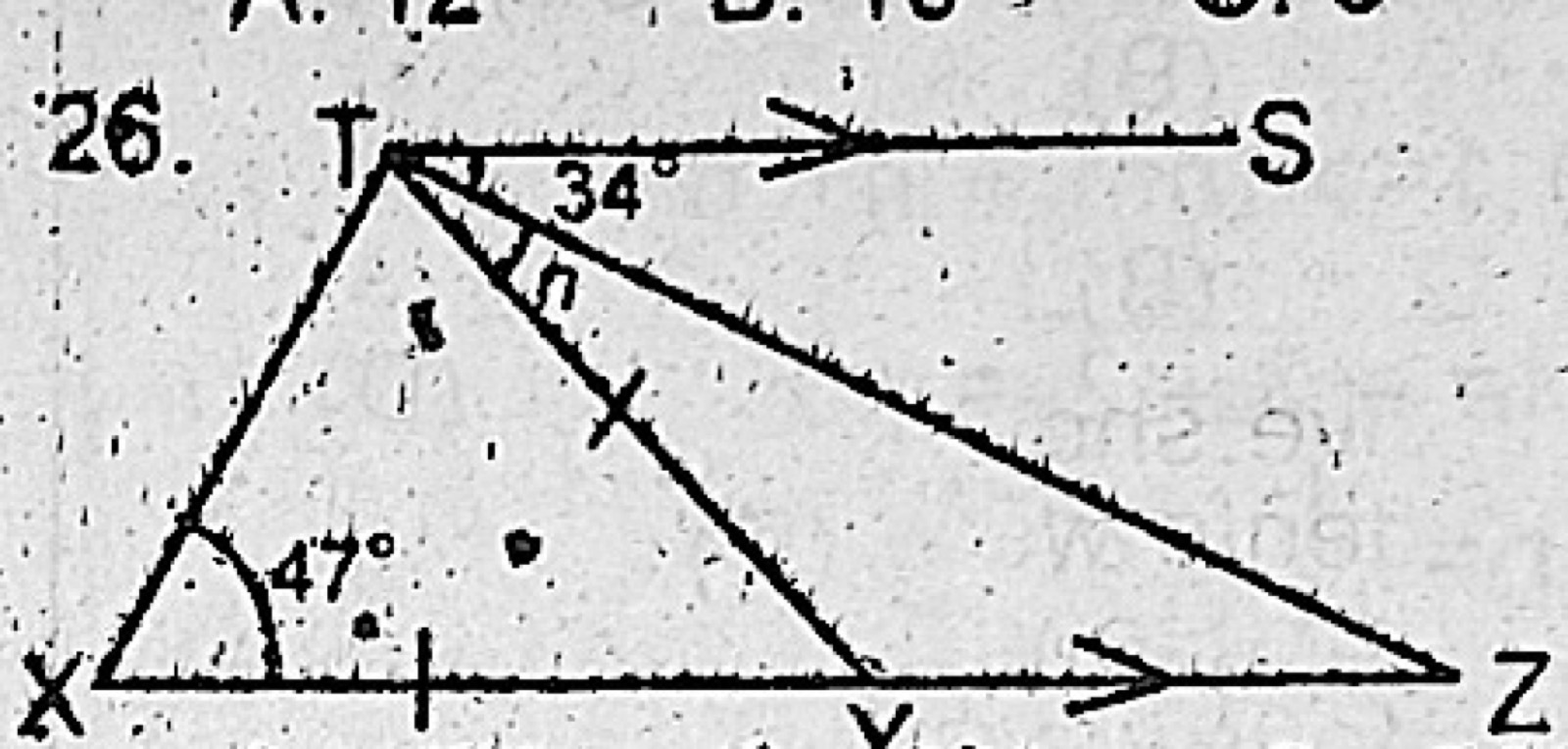
Question 26 Angles and Polygons In the figure above, TS // XY and XY = TY, ∠STZ = 34°, ∠TXY = 47°, find the angle marked n.
A. 47° B. 52° C. 56° D. 99° Show the answer and explanation Answer: B (52° )
Explanation XY = TY, so ∠XTY = 47° and the exterior angle ∠TYZ = 94°. ∠TZY = ∠STZ = 34° (alternate angles). In triangle TYZ, n = 180° − 94° − 34° = 52°.
Open this question
Question 27 Mensuration of Plane Shapes If the hypotenuse of a right-angled isosceles triangle is 2 cm, what is the area of the triangle?
A. 1/√2 cm2 B. 1 cm2 C. √2 cm2 D. 2√2 cm2 Show the answer and explanation Answer: B (1 cm2 )
Explanation Each equal side x satisfies 2x2 = 4, so x = √2. Area = ½ × √2 × √2 = 1 cm2 .
Open this question
Question 28 Circle Theorems A chord is drawn 5 cm away from the centre of a circle of radius 13 cm. Calculate the length of a chord.
A. 7cm B. 9cm C. 12cm D. 24cm Show the answer and explanation Answer: D (24cm )
Explanation Half the chord = √(132 − 52 ) = √144 = 12cm, so the chord is 24cm.
Open this question
Question 30 Loci Find the locus of a particle which moves in the first quadrant so that it is equidistant from the lines x = 0 and y = 0 (where k is a constant)
A. x + y = 0 B. x − y = 0 C. x + y + k = 0 D. x − y − k = 0 Show the answer and explanation Answer: B (x − y = 0 )
Explanation Being equidistant from both axes means x = y, i.e. the line x − y = 0 (in the first quadrant).
Open this question
Question 32 Coordinate Geometry What is the value of p if the gradient of the line joining (−1, p) and (p, 4) is 2/3?
A. −2 B. −1 C. 1 D. 2 Show the answer and explanation Answer: D (2 )
Explanation (4 − p)/(p + 1) = 2/3 gives 12 − 3p = 2p + 2, so 5p = 10 and p = 2.
Open this question
Question 33 Coordinate Geometry What is the value of r if the distance between the points (4, 2) and (1, r) is 3 units?
A. 1 B. 2 C. 3 D. 4 Show the answer and explanation Answer: B (2 )
Explanation (1 − 4)2 + (r − 2)2 = 9 gives (r − 2)2 = 0, so r = 2.
Open this question
Question 34 Trigonometry Find the value of sin 45° − cos 30°.
A. (2 + √6)/4 B. (√2 + √3)/4 C. (√2 + √3)/2 D. (√2 − √3)/2 Show the answer and explanation Answer: D ((√2 − √3)/2 )
Explanation sin 45° = √2/2 and cos 30° = √3/2, so the difference is (√2 − √3)/2.
Open this question
Question 35 Trigonometry A cliff on the bank of a river is 300 metres high. If the angle of depression of a point on the opposite side of the river is 60°, find the width of the river.
A. 100m B. 75√3 m C. 100√3 m D. 200√3 m Show the answer and explanation Answer: C (100√3 m )
Explanation The angle of elevation from the point is 60°, so width = 300/tan 60° = 300/√3 = 100√3 m.
Open this question
Question 36 Differentiation If y = 3 cos 4x, dy/dx equals
A. 6 sin 8x B. −24 sin 4x C. 12 sin 4x D. −12 sin 4x Show the answer and explanation Answer: D (−12 sin 4x )
Explanation dy/dx = 3 × (−sin 4x) × 4 = −12 sin 4x.
Open this question
Question 37 Differentiation If s = (2 + 3t)(5t − 4), find ds/dt when t = 4/5 secs.
A. 0 units per sec. B. 15 units per sec. C. 22 units per sec. D. 26 units per sec. Show the answer and explanation Answer: C (22 units per sec. )
Explanation s = 15t2 − 2t − 8, so ds/dt = 30t − 2 = 24 − 2 = 22 at t = 4/5.
Open this question
Question 38 Differentiation What value of x will make the function x(4 − x) a maximum?
A. 4 B. 3 C. 2 D. 1 Show the answer and explanation Answer: C (2 )
Explanation y = 4x − x2 gives dy/dx = 4 − 2x = 0 at x = 2, and the second derivative −2 is negative, so this is a maximum.
Open this question
Question 39 Differentiation The distance travelled by a particle from a fixed point is given as s = (t3 − t2 − t + 5) cm. Find the minimum distance that the particle can cover from the fixed point.
A. 2.3 cm B. 4.0 cm C. 5.2 cm D. 6.0 cm Show the answer and explanation Answer: B (4.0 cm )
Explanation ds/dt = 3t2 − 2t − 1 = (3t + 1)(t − 1) = 0 at t = 1 (for t > 0), and the second derivative is positive there. s = 1 − 1 − 1 + 5 = 4.0 cm.
Open this question
Question 40 Integration Evaluate ∫sec2 θ dθ
A. sec θ tan θ + k B. tan θ + k C. 2sec θ + k D. sec θ + k Show the answer and explanation Answer: B (tan θ + k )
Explanation The derivative of tan θ is sec2 θ, so the integral is tan θ + k.
Open this question
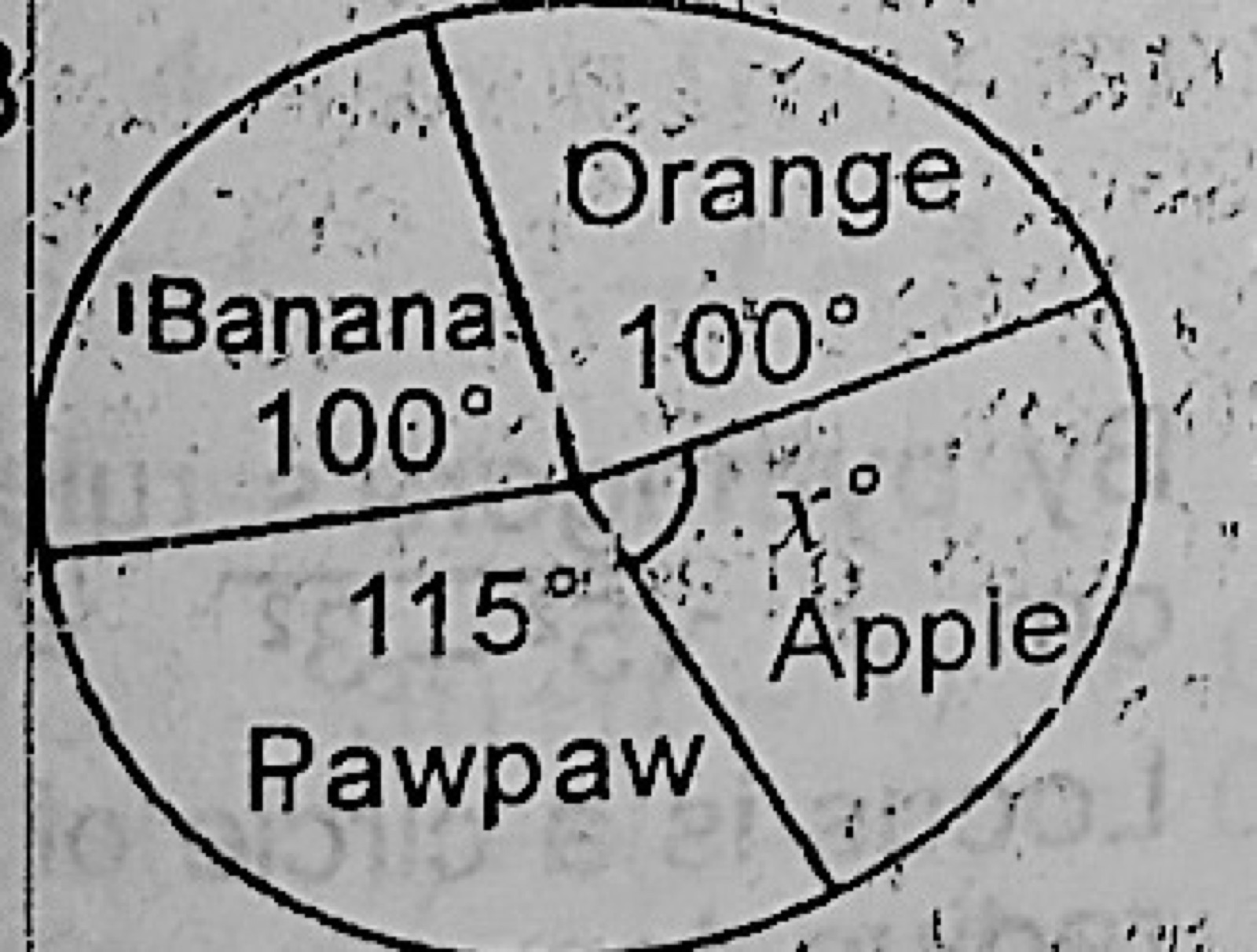
Question 43 Data Presentation The pie chart above represents 400 fruits on display in a grocery store. How many apples are in the store?
A. 45 B. 50 C. 60 D. 75 Show the answer and explanation Answer: B (50 )
Explanation The apple angle is x = 360° − (100° + 100° + 115°) = 45°. 45/360 × 400 = 50 apples.
Open this question
Question 45 Measures of Central Tendency 5, 8, 6 and k occur with frequencies 3, 2, 4 and 1 respectively and have a mean of 5.7. Find the value of k.
A. 4 B. 3 C. 2 D. 1 Show the answer and explanation Answer: C (2 )
Explanation (15 + 16 + 24 + k)/10 = 5.7 gives 55 + k = 57, so k = 2.
Open this question
Question 46 Measures of Dispersion What is the mean deviation of x, 2x, x + 1 and 3x, if their mean is 2?
A. 0.5 B. 1.0 C. 1.5 D. 2.0 Show the answer and explanation Answer: A (0.5 )
Explanation (7x + 1)/4 = 2 gives x = 1, so the numbers are 1, 2, 2, 3. The absolute deviations from 2 are 1, 0, 0, 1, so the mean deviation = 2/4 = 0.5.
Open this question
Question 48 Permutation and Combination In how many ways can 9 people be seated if 3 chairs are available?
A. 720 B. 504 C. 336 D. 210 Show the answer and explanation Answer: B (504 )
Explanation Order matters on the chairs: 9 P3 = 9 × 8 × 7 = 504.
Open this question
Question 50 Probability Marks: 2, 3, 4, 5, 6, 7, 8, 9
A. 3/5 B. 4/9 C. 7/20 D. 1/5 Show the answer and explanation Answer: A (3/5 )
Explanation There are 20 students and 0 + 4 + 5 + 2 + 1 = 12 scored 5 or more, so the probability is 12/20 = 3/5.
Open this question Sign up free for every JAMB Mathematics year, practice by topic and timed mocks.
Start practising free