JAMB Mathematics 2004 past questions and answers

45 questions. Try each one, then open the answer to check yourself and read the explanation.

Question 1

Number Bases

Find x and y respectively in the subtraction below carried out in base 5.
4 2 4 3
− 1 3 x 4
= y 3 4 4

  1. A.2, 4
  2. B.3, 2
  3. C.4, 2
  4. D.4, 3
Show the answer and explanation

Answer: C (4, 2)

Explanation

Units: borrow, 8 − 4 = 4. Fives: 3 − x needs a borrow, 8 − x = 4, so x = 4. Twenty-fives: 6 − 3 = 3. Hundred-and-twenty-fives: 4 − 1 − 1 = 2, so y = 2.

Open this question

Question 2

Number Bases

Find p, if 4516 − p7 = 3056.

  1. A.6117
  2. B.1427
  3. C.1167
  4. D.627
Show the answer and explanation

Answer: C (1167)

Explanation

4516 = 175 and 3056 = 113 in base ten, so p = 62. In base seven, 62 = 1 × 49 + 1 × 7 + 6 = 1167.

Open this question

Question 4

Ratio, Percentages and Rates

A farmer planted 5,000 grains of maize and harvested 5,000 cobs, each bearing 5000 grains. What is the ratio of the number of grains sowed to the number harvested?

  1. A.1 : 500
  2. B.1 : 5,000
  3. C.1 : 25,000
  4. D.1 : 250,000
Show the answer and explanation

Answer: B (1 : 5,000)

Explanation

Grains harvested = 5,000 × 5,000 = 25,000,000. The ratio 5,000 : 25,000,000 simplifies to 1 : 5,000.

Open this question

Question 5

Ratio, Percentages and Rates

Three teachers shared a packet of chalk. The first teacher got 2/5 of the chalk and the second teacher received 2/15 of the remainder. What fraction did the third teacher receive?

  1. A.11/25
  2. B.12/25
  3. C.13/25
  4. D.8/15
Show the answer and explanation

Answer: C (13/25)

Explanation

The remainder after the first teacher is 3/5; the second gets 2/15 × 3/5 = 2/25. The third gets 1 − 2/5 − 2/25 = 13/25.

Open this question

Question 6

Indices

Given that ∛(42x) = 16, find the value of x.

  1. A.2
  2. B.3
  3. C.4
  4. D.6
Show the answer and explanation

Answer: B (3)

Explanation

∛(42x) = 42x/3 and 16 = 42, so 2x/3 = 2 and x = 3.

Open this question

Question 7

Surds

Simplify 1/(√3 + 2) in the form a + b√3

  1. A.−2 − √3
  2. B.−2 + √3
  3. C.2 − √3
  4. D.2 + √3
Show the answer and explanation

Answer: C (2 − √3)

Explanation

Multiply top and bottom by 2 − √3: (2 − √3)/(4 − 3) = 2 − √3.

Open this question

Question 8

Logarithms

If 6logx2 − 3logx3 = 3log50.2, find x.

  1. A.3/8
  2. B.3/4
  3. C.4/3
  4. D.8/3
Show the answer and explanation

Answer: B (3/4)

Explanation

The left side is logx(64/27) and the right side is 3 × (−1) = −3. So x−3 = 64/27, x3 = 27/64 and x = 3/4.

Open this question

Question 10

Sets

In a class of 40 students, each student offers at least one of Physics and Chemistry. If the number of students that offer Physics is three times the number that offer both subjects and the number that offer Chemistry is twice the number that offer Physics, find the number of students that offer Physics only.

  1. A.25
  2. B.15
  3. C.10
  4. D.5
Show the answer and explanation

Answer: C (10)

Explanation

Let x offer both. Physics = 3x, Chemistry = 6x, so 3x + 6x − x = 40 and x = 5. Physics only = 3x − x = 10.

Open this question

Question 11

Graphs of Functions

Find the values of x where the curve y = x3 + 2x2 − 5x − 6 crosses the x-axis

  1. A.−2, −1 and 3
  2. B.−2, 1 and −3
  3. C.2, −1 and −3
  4. D.2, 1 and 3
Show the answer and explanation

Answer: C (2, −1 and −3)

Explanation

x = 2 makes the cubic zero, and dividing by (x − 2) leaves x2 + 4x + 3 = (x + 1)(x + 3). So x = 2, −1, −3.

Open this question

Question 12

Polynomials

Find the remainder when 3x3 + 5x2 − 11x + 4 is divided by x + 3.

  1. A.4
  2. B.1
  3. C.−1
  4. D.−4
Show the answer and explanation

Answer: B (1)

Explanation

By the remainder theorem, put x = −3: −81 + 45 + 33 + 4 = 1.

Open this question

Question 13

Algebraic Expressions

Factorize completely ac − 2bc − a2 + 4b2.

  1. A.(a − 2b)(c + a − 2b)
  2. B.(a − 2b)(c − a − 2b)
  3. C.(a − 2b)(c + a + 2b)
  4. D.(a − 2b)(c − a + 2b)
Show the answer and explanation

Answer: B ((a − 2b)(c − a − 2b))

Explanation

ac − 2bc = c(a − 2b) and 4b2 − a2 = −(a − 2b)(a + 2b). Taking out (a − 2b) leaves c − a − 2b.

Open this question

Question 14

Variation

y is inversely proportional to x and y = 4 when x = ½. Find x when y = 10.

  1. A.1/10
  2. B.1/5
  3. C.2
  4. D.10
Show the answer and explanation

Answer: B (1/5)

Explanation

y = k/x, so k = 4 × ½ = 2. When y = 10, x = 2/10 = 1/5.

Open this question

Question 15

Variation

The length L of a simple pendulum varies directly as the square of its period T. If a pendulum with period 4 sec. is 64cm long, find the length of a pendulum whose period is 9 sec.

  1. A.36cm
  2. B.96cm
  3. C.144cm
  4. D.324cm
Show the answer and explanation

Answer: D (324cm)

Explanation

L = kT2: 64 = 16k, so k = 4. Then L = 4 × 81 = 324cm.

Open this question

Question 16

Inequalities

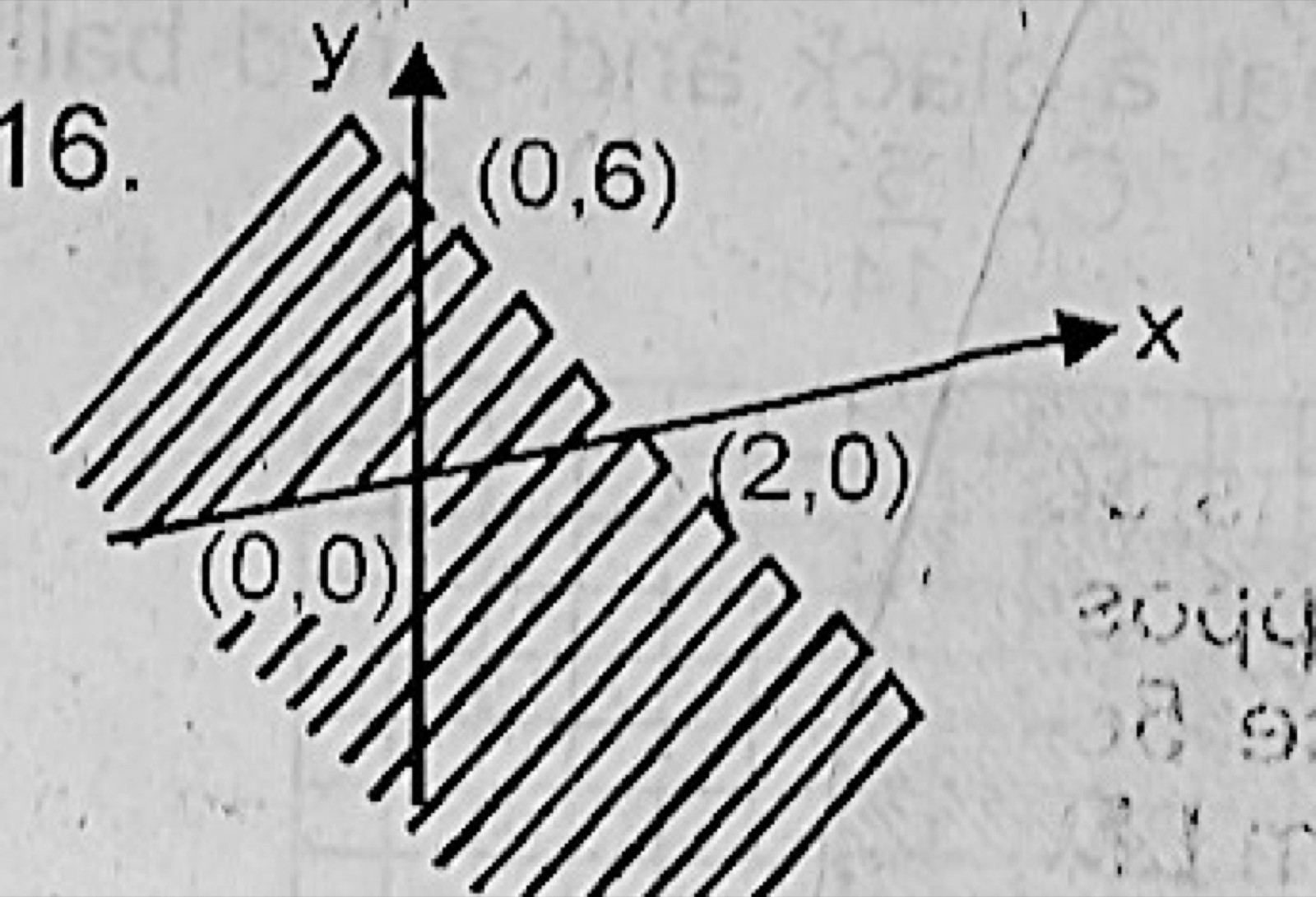
The shaded area in the diagram above is represented by

Diagram for this question
  1. A.{(x,y) : y + 3x < 6}
  2. B.{(x,y) : y + 3x < −6}
  3. C.{(x,y) : y − 3x < 6}
  4. D.{(x,y) : y − 3x < −6}
Show the answer and explanation

Answer: A ({(x,y) : y + 3x < 6})

Explanation

The line through (0, 6) and (2, 0) is y = −3x + 6, i.e. y + 3x = 6. The shaded side contains the origin, where y + 3x = 0 < 6.

Open this question

Question 18

Progressions

The nth terms of two sequences are Qn = 3.2n−2 and Um = 3.22m−3. Find the product of Q2 and U2.

  1. A.3
  2. B.6
  3. C.12
  4. D.18
Show the answer and explanation

Answer: D (18)

Explanation

Q2 = 3 × 20 = 3 and U2 = 3 × 21 = 6, so the product is 18.

Open this question

Question 19

Progressions

Given that the first and fourth terms of a G.P. are 6 and 162 respectively, find the sum of the first three terms of the progression.

  1. A.8
  2. B.27
  3. C.48
  4. D.78
Show the answer and explanation

Answer: D (78)

Explanation

ar3 = 162 and a = 6, so r3 = 27 and r = 3. The first three terms are 6, 18, 54, which add to 78.

Open this question

Question 20

Progressions

Find the sum to infinity of the series ½, 1/6, 1/18, ...

  1. A.1
  2. B.¾
  3. C.2/3
  4. D.1/3
Show the answer and explanation

Answer: B (¾)

Explanation

a = ½ and r = 1/3, so S = a/(1 − r) = ½ ÷ 2/3 = ¾.

Open this question

Question 21

Binary Operations

If the operation * on the set of integers is defined by p * q = √(pq), find the value of 4 * (8 * 32)

  1. A.16
  2. B.8
  3. C.4
  4. D.3
Show the answer and explanation

Answer: B (8)

Explanation

8 * 32 = √256 = 16, then 4 * 16 = √64 = 8.

Open this question

Question 22

Matrices and Determinants

The inverse of the matrix (2 1; 1 1) is (matrices written row by row)

  1. A.(1 1; −1 2)
  2. B.(1 −1; 1 2)
  3. C.(1 1; 1 2)
  4. D.(1 −1; −1 2)
Show the answer and explanation

Answer: D ((1 −1; −1 2))

Explanation

The determinant is 2 − 1 = 1. Swap the diagonal entries and change the signs of the others: (1 −1; −1 2).

Open this question

Question 24

Angles and Polygons

The sum of the interior angles of a pentagon is 6x + 6y. Find y in terms of x.

  1. A.y = 60 − x
  2. B.y = 90 − x
  3. C.y = 120 − x
  4. D.y = 150 − x
Show the answer and explanation

Answer: B (y = 90 − x)

Explanation

A pentagon's angles add to 540°, so 6x + 6y = 540, x + y = 90 and y = 90 − x.

Open this question

Question 25

Mensuration of Plane Shapes

PQRSTV is a regular polygon of side 7 cm inscribed in a circle. Find the circumference of the circle PQRSTV. [π = 22/7]

  1. A.22cm
  2. B.42cm
  3. C.44cm
  4. D.56cm
Show the answer and explanation

Answer: C (44cm)

Explanation

A regular hexagon's side equals the radius of its circle, so r = 7cm and the circumference = 2 × 22/7 × 7 = 44cm.

Open this question

Question 26

Circle Theorems

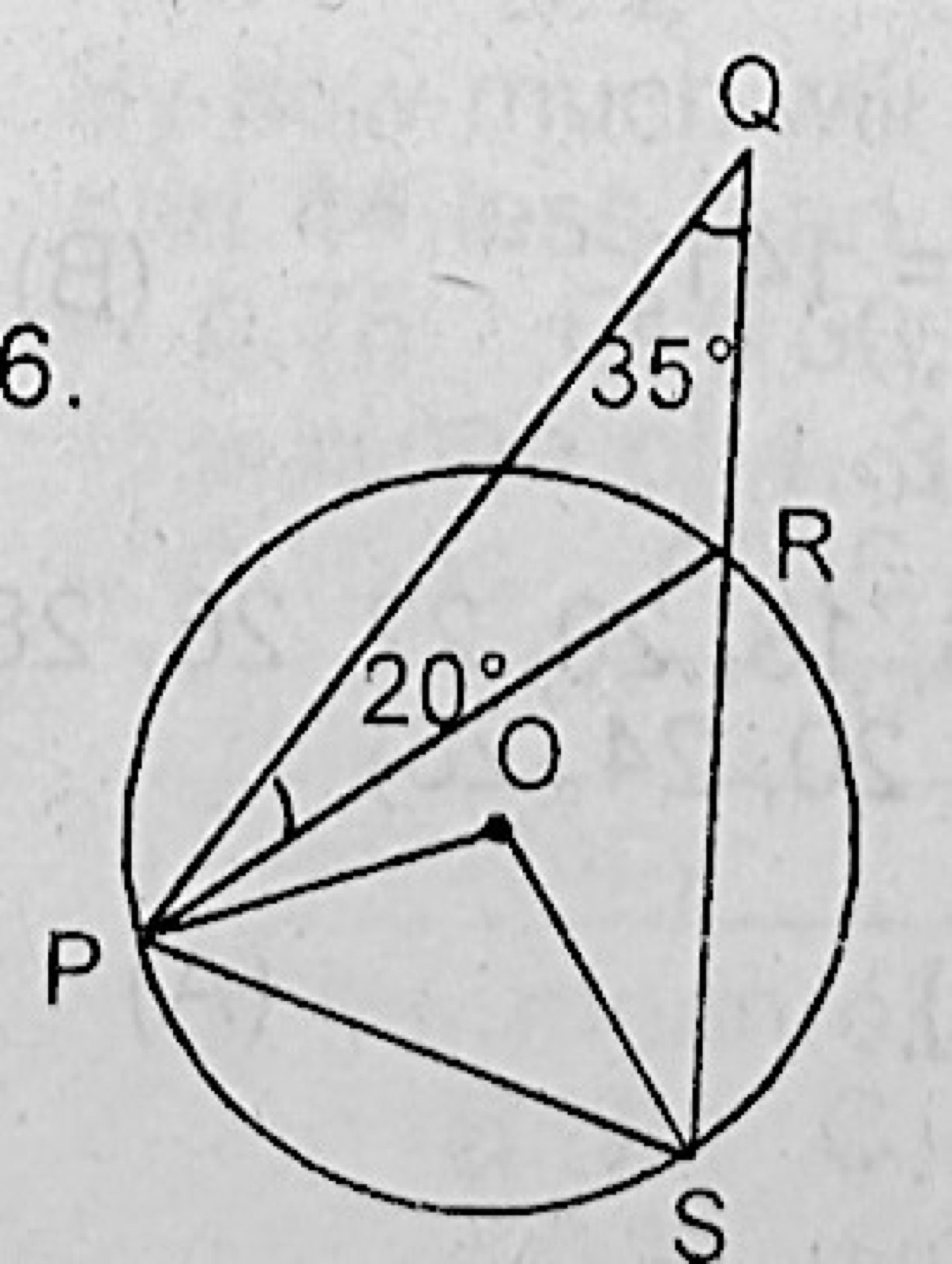
P, R and S lie on a circle centre O as shown above, while Q lies outside the circle. Find ∠PSO.

Diagram for this question
  1. A.35°
  2. B.40°
  3. C.45°
  4. D.55°
Show the answer and explanation

Answer: A (35°)

Explanation

In triangle PQR, ∠QRP = 180° − 20° − 35° = 125°, so ∠PRS = 55°. Then ∠POS = 2 × 55° = 110°, and triangle POS is isosceles, so ∠PSO = (180° − 110°)/2 = 35°.

Open this question

Question 27

Mensuration of Plane Shapes

In the diagram above, PQ = 4cm and TS = 6cm. If the area of parallelogram PQTU is 32 cm2, find the area of the trapezium PQRU.

Diagram for this question
  1. A.24cm2
  2. B.48cm2
  3. C.60cm2
  4. D.72cm2
Show the answer and explanation

Answer: D (72cm2)

Explanation

The height is 32 ÷ 4 = 8cm. UR = UT + TS + SR = 4 + 6 + 4 = 14cm, so the area = ½ × (4 + 14) × 8 = 72cm2.

Open this question

Question 28

Mensuration of Plane Shapes

An arc of a circle of length 22cm subtends an angle of 3x° at the centre of the circle. Find the value of x if the diameter of the circle is 14cm. [π = 22/7]

  1. A.30°
  2. B.60°
  3. C.120°
  4. D.180°
Show the answer and explanation

Answer: B (60°)

Explanation

The circumference is 44cm, so the arc is half the circle: 3x = 180 and x = 60.

Open this question

Question 29

Loci

Determine the locus of a point inside a square PQRS which is equidistant from PQ and QR.

  1. A.The diagonal PR
  2. B.The diagonal QS
  3. C.Side SR
  4. D.The perpendicular bisector of PQ
Show the answer and explanation

Answer: B (The diagonal QS)

Explanation

Points equidistant from two lines meeting at Q lie on the bisector of angle Q, which in a square is the diagonal QS.

Open this question

Question 30

Loci

The locus of a point which is 5cm from the line LM is a

  1. A.pair of lines on opposite sides of LM and parallel to it, each distance 5cm from LM
  2. B.line parallel to LM and 5cm from LM
  3. C.pair of parallel lines on one side of LM and parallel to LM
  4. D.line distance 10cm from LM and parallel to LM
Show the answer and explanation

Answer: A (pair of lines on opposite sides of LM and parallel to it, each distance 5cm from LM)

Explanation

Points 5cm from a line can be on either side of it, giving two parallel lines, one on each side.

Open this question

Question 31

Coordinate Geometry

Find the value of α2 + β2 if α + β = 2 and the distance between the points (1, α) and (β, 1) is 3 units

  1. A.3
  2. B.5
  3. C.11
  4. D.14
Show the answer and explanation

Answer: C (11)

Explanation

(β − 1)2 + (1 − α)2 = 9 gives α2 + β2 − 2(α + β) + 2 = 9, so α2 + β2 = 9 + 4 − 2 = 11.

Open this question

Question 32

Coordinate Geometry

Find the midpoint of the line joining P(−3, 5) and Q(5, −3).

  1. A.(4, −4)
  2. B.(4, 4)
  3. C.(2, 2)
  4. D.(1, 1)
Show the answer and explanation

Answer: D ((1, 1))

Explanation

Midpoint = ((−3 + 5)/2, (5 − 3)/2) = (1, 1).

Open this question

Question 33

Triangles and Quadrilaterals

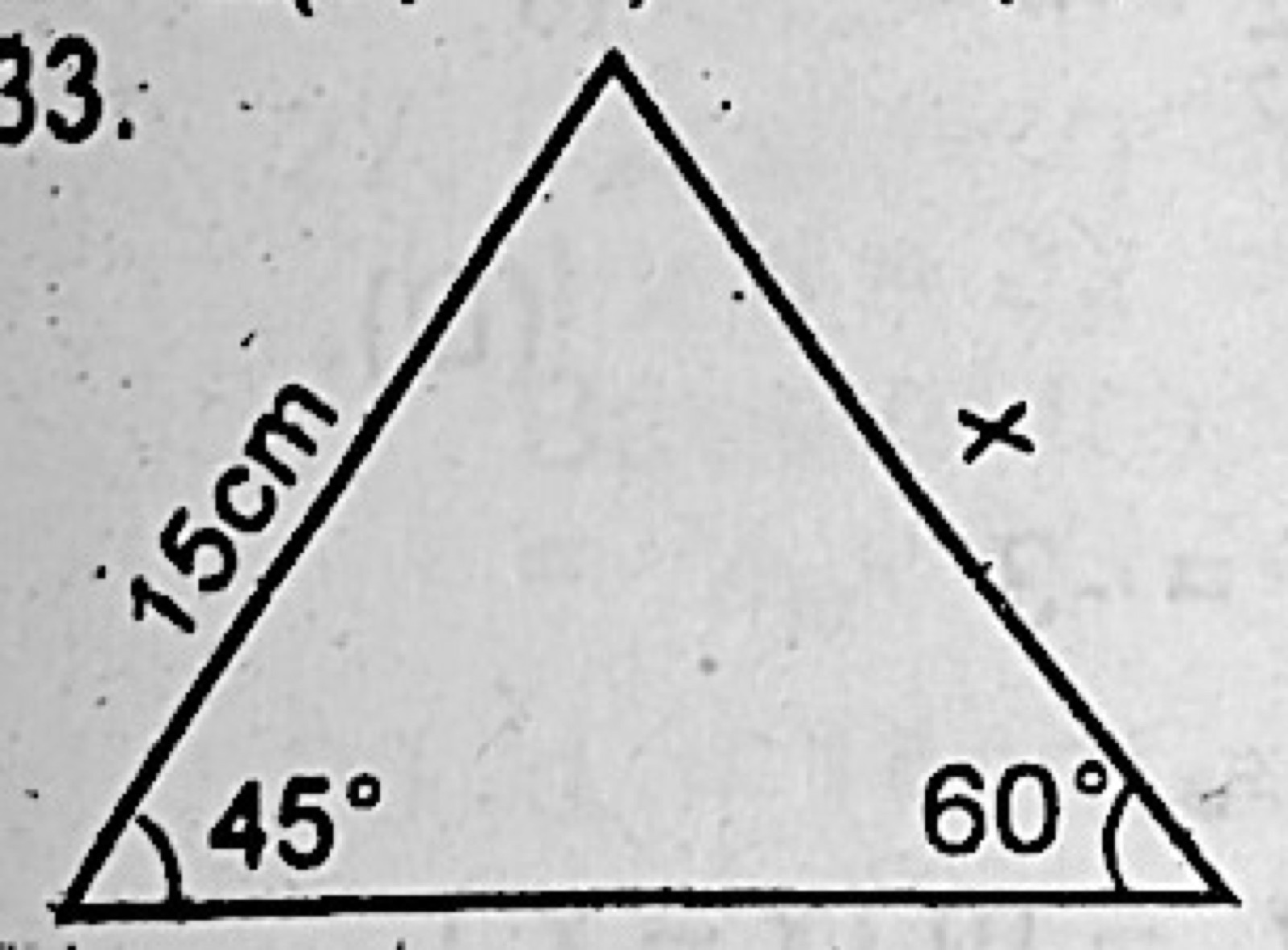
Find the value of x in the figure above.

Diagram for this question
  1. A.20√6
  2. B.15√6
  3. C.5√6
  4. D.3√6
Show the answer and explanation

Answer: C (5√6)

Explanation

By the sine rule, x/sin 45° = 15/sin 60°, so x = 15 × (√2/2)/(√3/2) = 15√2/√3 = 5√6.

Open this question

Question 34

Trigonometry

The shadow of a pole 5√3m high is 5m. Find the angle of elevation of the sun.

  1. A.30°
  2. B.45°
  3. C.60°
  4. D.75°
Show the answer and explanation

Answer: C (60°)

Explanation

tan θ = height/shadow = 5√3/5 = √3, so θ = 60°.

Open this question

Question 35

Differentiation

Find the derivative of (2 + 3x)(1 − x) with respect to x.

  1. A.6x − 1
  2. B.1 − 6x
  3. C.6
  4. D.−3
Show the answer and explanation

Answer: B (1 − 6x)

Explanation

Expanding gives 2 + x − 3x2, whose derivative is 1 − 6x.

Open this question

Question 36

Differentiation

Find the derivative of the function y = 2x2(2x − 1) at the point x = −1.

  1. A.−6
  2. B.−4
  3. C.16
  4. D.18
Show the answer and explanation

Answer: C (16)

Explanation

y = 4x3 − 2x2, so dy/dx = 12x2 − 4x = 12 + 4 = 16 at x = −1.

Open this question

Question 37

Differentiation

If y = 3 cos(x/3), find dy/dx when x = 3π/2

  1. A.2
  2. B.1
  3. C.−1
  4. D.−3
Show the answer and explanation

Answer: C (−1)

Explanation

dy/dx = −sin(x/3). At x = 3π/2, x/3 = π/2, so dy/dx = −1.

Open this question

Question 38

Differentiation

What is the rate of change of the volume v of a hemisphere with respect to its radius r when r = 2?

  1. A.2π
  2. B.4π
  3. C.8π
  4. D.16π
Show the answer and explanation

Answer: C (8π)

Explanation

v = (2/3)πr3, so dv/dr = 2πr2 = 8π when r = 2.

Open this question

Question 39

Integration

Evaluate ∫13 (x2 − 1)dx

  1. A.6⅔
  2. B.2/3
  3. C.−2/3
  4. D.−6⅔
Show the answer and explanation

Answer: A (6⅔)

Explanation

[x3/3 − x] from 1 to 3 = (9 − 3) − (1/3 − 1) = 6 + 2/3 = 6⅔.

Open this question

Question 40

Data Presentation

The pie chart above shows the distribution of the crops harvested from a farmland in a year. If 3000 tonnes of millet is harvested, what amount of beans is harvested?

Diagram for this question
  1. A.9000 tonnes
  2. B.6000 tonnes
  3. C.1500 tonnes
  4. D.1200 tonnes
Show the answer and explanation

Answer: D (1200 tonnes)

Explanation

Maize is a right angle, so beans = 360° − (60° + 90° + 150°) = 60°. Beans = 60/150 × 3000 = 1200 tonnes.

Open this question

Question 41

Data Presentation

I. Rectangular bars of equal width
II. The height of each rectangular bar is proportional to the frequency of the corresponding class interval.
III. Rectangular bars have common sides with no gaps in-between.
A histogram is described completely by

  1. A.I and II
  2. B.I and III
  3. C.I, II and III
  4. D.II and III
Show the answer and explanation

Answer: C (I, II and III)

Explanation

In the usual school histogram the bars have equal widths, their heights show the frequencies and they touch with no gaps, so all three statements are needed.

Open this question

Question 43

Measures of Central Tendency

The mean age of a group of students is 15 years. When the age of a teacher, 45 years old, is added to the ages of the students, the mean of their ages becomes 18 years. Find the number of students in the group

  1. A.7
  2. B.9
  3. C.15
  4. D.42
Show the answer and explanation

Answer: B (9)

Explanation

With n students, (15n + 45)/(n + 1) = 18, so 15n + 45 = 18n + 18 and n = 9.

Open this question

Question 44

Measures of Dispersion

The weights of 10 pupils in class are 15kg, 16kg, 17kg, 18kg, 16kg, 17kg, 17kg, 17kg, 18kg and 16kg. What is the range of this distribution?

  1. A.1
  2. B.2
  3. C.3
  4. D.4
Show the answer and explanation

Answer: C (3)

Explanation

Range = 18 − 15 = 3.

Open this question

Question 45

Measures of Dispersion

Find the mean deviation of 1, 2, 3 and 4.

  1. A.1.0
  2. B.1.5
  3. C.2.0
  4. D.2.5
Show the answer and explanation

Answer: A (1.0)

Explanation

The mean is 2.5; the absolute deviations are 1.5, 0.5, 0.5, 1.5, which total 4. Mean deviation = 4/4 = 1.0.

Open this question

Question 46

Permutation and Combination

In how many ways can 2 students be selected from a group of 5 students in a debating competition?

  1. A.10 ways
  2. B.15 ways
  3. C.20 ways
  4. D.25 ways
Show the answer and explanation

Answer: A (10 ways)

Explanation

5C2 = (5 × 4)/2 = 10.

Open this question

Question 47

Permutation and Combination

A committee of six is to be formed by a state governor from nine state commissioners and three members of the state House of Assembly. In how many ways can the members of the committee be chosen so as to include one member of the House of Assembly?

  1. A.924 ways
  2. B.840 ways
  3. C.462 ways
  4. D.378 ways
Show the answer and explanation

Answer: D (378 ways)

Explanation

Choose 1 of the 3 Assembly members and 5 of the 9 commissioners: 3 × 9C5 = 3 × 126 = 378.

Open this question

Question 48

Probability

Some white balls were put in a basket containing twelve red balls and sixteen black balls. If the probability of picking a white ball from the basket is 3/7, how many white balls were introduced?

  1. A.32
  2. B.28
  3. C.21
  4. D.12
Show the answer and explanation

Answer: C (21)

Explanation

x/(28 + x) = 3/7 gives 7x = 84 + 3x, so x = 21.

Open this question

Question 49

Probability

An unbiased die is rolled 100 times and the outcome is tabulated as follows:
Number: 1, 2, 3, 4, 5, 6
Frequency: 13, 15, 22, 14, 20, 16
What is the probability of obtaining 5?

  1. A.1/6
  2. B.1/5
  3. C.1/4
  4. D.1/2
Show the answer and explanation

Answer: B (1/5)

Explanation

5 came up 20 times out of 100, so the probability is 20/100 = 1/5.

Open this question

Question 50

Probability

A container has 30 gold medals, 22 silver medals and 18 bronze medals. If one medal is selected at random from the container, what is the probability that it is not a gold medal?

  1. A.4/7
  2. B.3/7
  3. C.11/35
  4. D.9/35
Show the answer and explanation

Answer: A (4/7)

Explanation

There are 70 medals and 40 are not gold, so the probability is 40/70 = 4/7.
Open this question