Question 1
LogarithmsEvaluate log√24 + log½16 − log432
- A.−5.5
- B.−2.5
- C.2.5
- D.5.5
Show the answer and explanation
Answer: B (−2.5)
Explanation
log√24 = 4 because (√2)4 = 4; log½16 = −4; log432 = 5/2. So 4 − 4 − 2.5 = −2.5.
49 questions. Try each one, then open the answer to check yourself and read the explanation.
Evaluate log√24 + log½16 − log432
Answer: B (−2.5)
log√24 = 4 because (√2)4 = 4; log½16 = −4; log432 = 5/2. So 4 − 4 − 2.5 = −2.5.
Simplify 2134 × 234
Answer: C (122314)
2134 = 39 and 234 = 11 in base ten, so the product is 429. Converting 429 to base four gives 122314.
In a class of 40 students, 32 offer Mathematics, 24 offer Physics. How many offer both Mathemaics and Physics?
Answer: B (16)
Everyone offers at least one subject, so both = 32 + 24 − 40 = 16.
A woman buys 270 oranges for N1,800.00 and sells at 5 for N40.00. What is her profit?
Answer: D (N360.00)
She sells 270 ÷ 5 = 54 lots at N40, getting N2,160. Profit = 2,160 − 1,800 = N360.
Simplify 1 − (2⅓ × 1¼) + 3/5
Answer: B (−1 19/60)
2⅓ × 1¼ = 7/3 × 5/4 = 35/12. Then 1 − 35/12 + 3/5 = (60 − 175 + 36)/60 = −79/60 = −1 19/60.
Simplify (√98 − √50)/√32
Answer: C (½)
√98 = 7√2, √50 = 5√2 and √32 = 4√2, so the value is 2√2/(4√2) = ½.
A cinema hall contains a certain number of people. If 22½% are children, 47½% are men and 84 are women, find the number of men in the hall.
Answer: D (133)
Women are 100 − 22½ − 47½ = 30% of the hall, so the hall holds 84 ÷ 0.3 = 280 people. Men = 47½% of 280 = 133.
If 92x − 1/27x+1 = 1, find the value of x.
Answer: B (5)
92x − 1 = 27x + 1 means 34x − 2 = 33x + 3, so 4x − 2 = 3x + 3 and x = 5.
The sum of four numbers is 12145. What is the average expressed in base five?
Answer: B (141)
12145 = 125 + 50 + 5 + 4 = 184. The average is 184 ÷ 4 = 46, and 46 = 1415.
Given:
U = {Even numbers between 0 and 30}
P = {Multiples of 6 between 0 and 30}
Q = {Multiples of 4 between 0 and 30}
Find (P∪Q)c
Answer: A ({2,10,14,22,26})
P ∪ Q = {4, 6, 8, 12, 16, 18, 20, 24, 28}. The even numbers left over in U are {2, 10, 14, 22, 26}.
x varies directly as the product of u and v and inversely as their sum. If x = 3 when u = 3 and v = 1, what is the value of x if u = 3 and v = 3?
Answer: C (6)
x = kuv/(u + v). From 3 = k(3)/4, k = 4. Then x = 4 × 9/6 = 6.
Find the range of the values of x satisfying the inequalities 5 + x ≤ 8 and 13 + x ≥ 7.
Answer: C (−6 ≤ x ≤ 3)
5 + x ≤ 8 gives x ≤ 3 and 13 + x ≥ 7 gives x ≥ −6, so −6 ≤ x ≤ 3.
If |−x 2; 4x 1| = |3 3x; 4 −5|, find the value of x. (Each is a 2 × 2 determinant written row by row.)
Answer: D (−5)
Left side: −x − 8x = −9x. Right side: −15 − 12x. So −9x = −15 − 12x, 3x = −15 and x = −5.
The graph of the function y = x2 + 4 and a straight line PQ are drawn to solve the equation x2 − 3x + 2 = 0. What is the equation PQ?
Answer: B (y = 3x + 2)
x2 − 3x + 2 = 0 can be written x2 + 4 = 3x + 2, so the line is y = 3x + 2.
The length a person can jump is inversely proportional to his weight. If a 20kg person can jump 1.5m, find the constant proportionality.
Answer: B (30)
L = k/W, so k = LW = 1.5 × 20 = 30.
Find the values of x and y respectively if 3x − 5y + 5 = 0 and 4x − 7y + 8 = 0
Answer: D (5, 4)
Multiply to get 12x − 20y = −20 and 12x − 21y = −24; subtracting gives y = 4. Then 3x = 20 − 5 = 15, so x = 5.
Three consecutive terms of a geometric progression are given as n − 2, n and n + 3. Find the common ratio.
Answer: D (3/2)
n2 = (n − 2)(n + 3) = n2 + n − 6, so n = 6. The terms are 4, 6, 9 and the ratio is 6/4 = 3/2.
Triangle OPQ above is the solution to the inequalities
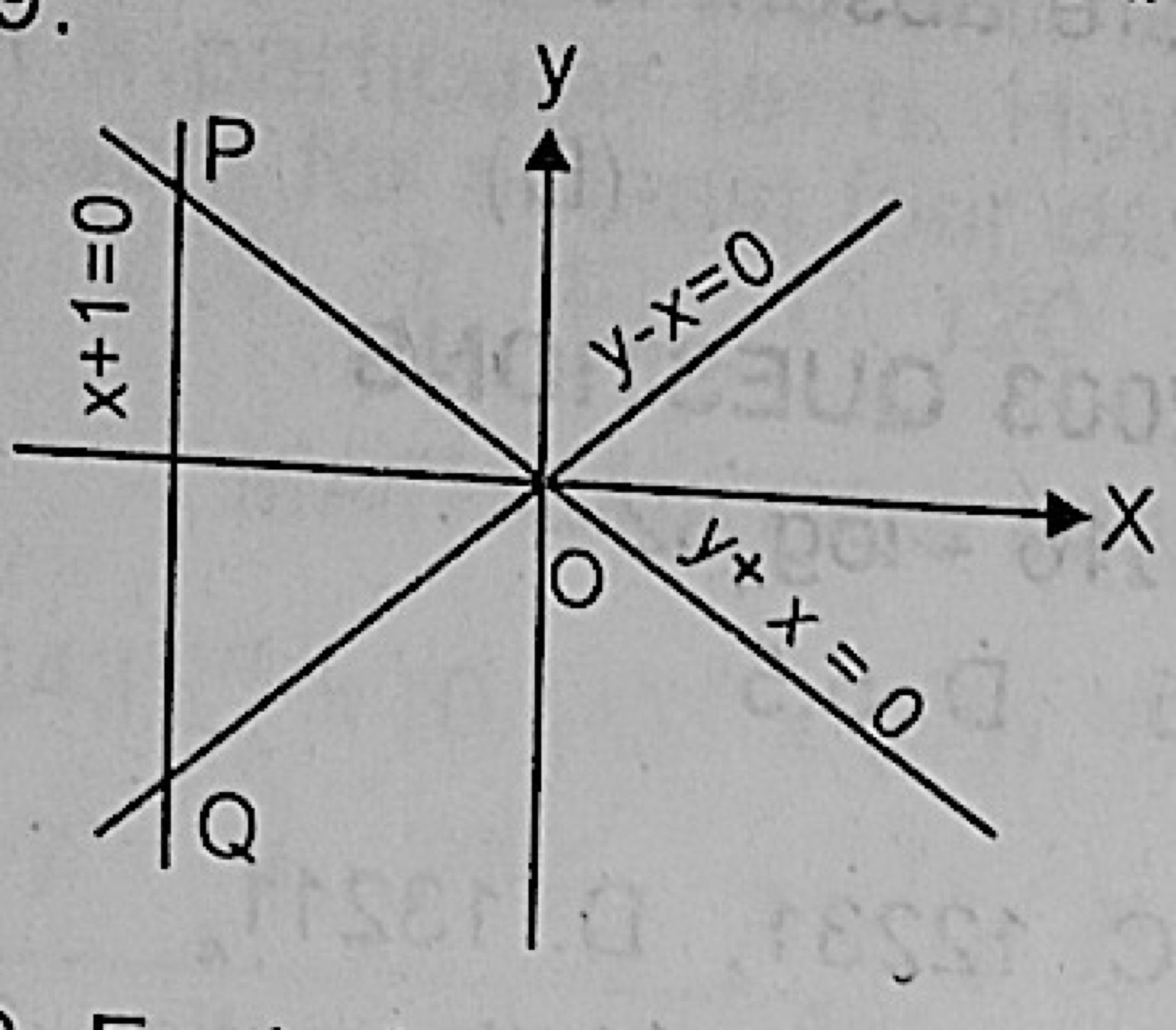
Answer: A (x + 1 ≥ 0, y + x ≤ 0, y − x ≥ 0)
The triangle lies to the right of x = −1 (x + 1 ≥ 0), below the line y + x = 0 and above the line y − x = 0. The point (−0.5, 0) inside it satisfies all three inequalities in A.
Factorize completely 4abx − 2axy − 12b2x + 6bxy.
Answer: A (2x(a − 3b)(2b − y))
Group: 2ax(2b − y) − 6bx(2b − y) = (2ax − 6bx)(2b − y) = 2x(a − 3b)(2b − y).
A matrix P has an inverse P−1 = (1 −3; 0 1). Find P. (Matrices are written row by row.)
Answer: D ((1 3; 0 1))
P is the inverse of P−1. The determinant of (1 −3; 0 1) is 1, so its inverse is (1 3; 0 1).
The sum of the first n terms of an arithmetic progression is 252. If the first term is −16 and the last term is 72, find the number of terms in the series.
Answer: D (9)
S = n/2 (a + l): 252 = n/2 (−16 + 72) = 28n, so n = 9.
An arc of a circle subtends an angle of 30° on the circumference of a circle of radius 21cm. Find the length of the arc. [π = 22/7]
Answer: B (22cm)
The angle at the centre is twice the angle at the circumference, so it is 60°. Arc length = 60/360 × 2 × 22/7 × 21 = 22cm.
Find the equation of the locus of a point P(x,y) which is euidistant from Q(0,0) and R(2,1).
Answer: A (4x + 2y = 5)
x2 + y2 = (x − 2)2 + (y − 1)2 gives 0 = −4x + 4 − 2y + 1, so 4x + 2y = 5.
In the diagram above, PQ is parallel to RS. What is the value of α + β + γ?
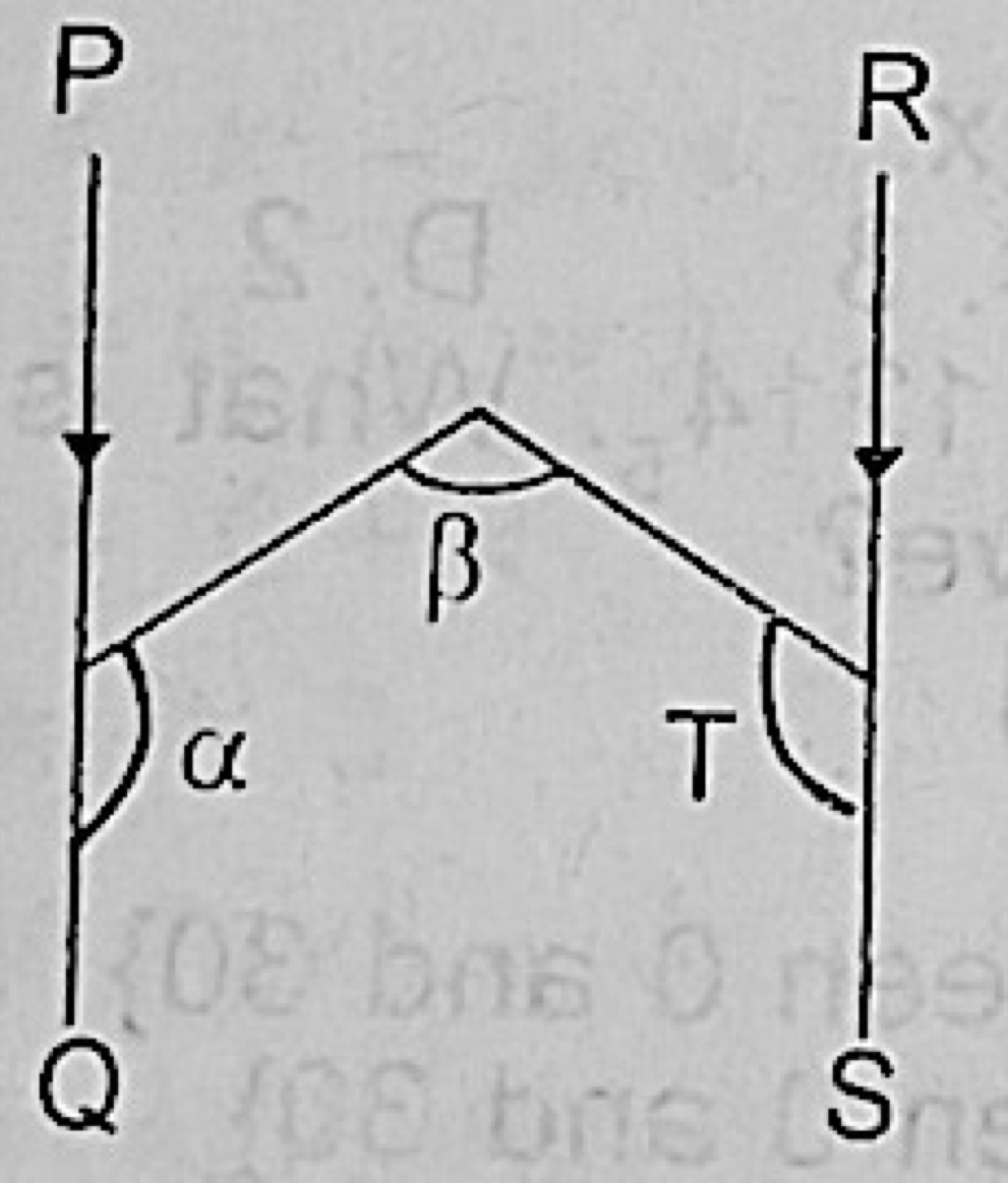
Answer: A (360°)
If each slanting line makes angles θ and φ with the horizontal, then α = 90° + θ, γ = 90° + φ and β = 180° − θ − φ. Adding them gives 360°.
A trapezium has two parallel sides of length 5cm and 9cm. If the area is 21cm2, find the distance between the parallel sides.
Answer: A (3cm)
Area = ½(5 + 9) × h = 7h = 21, so h = 3cm.
Which of the following is the graph of sinθ for −π/2 ≤ θ ≤ 3π/2?
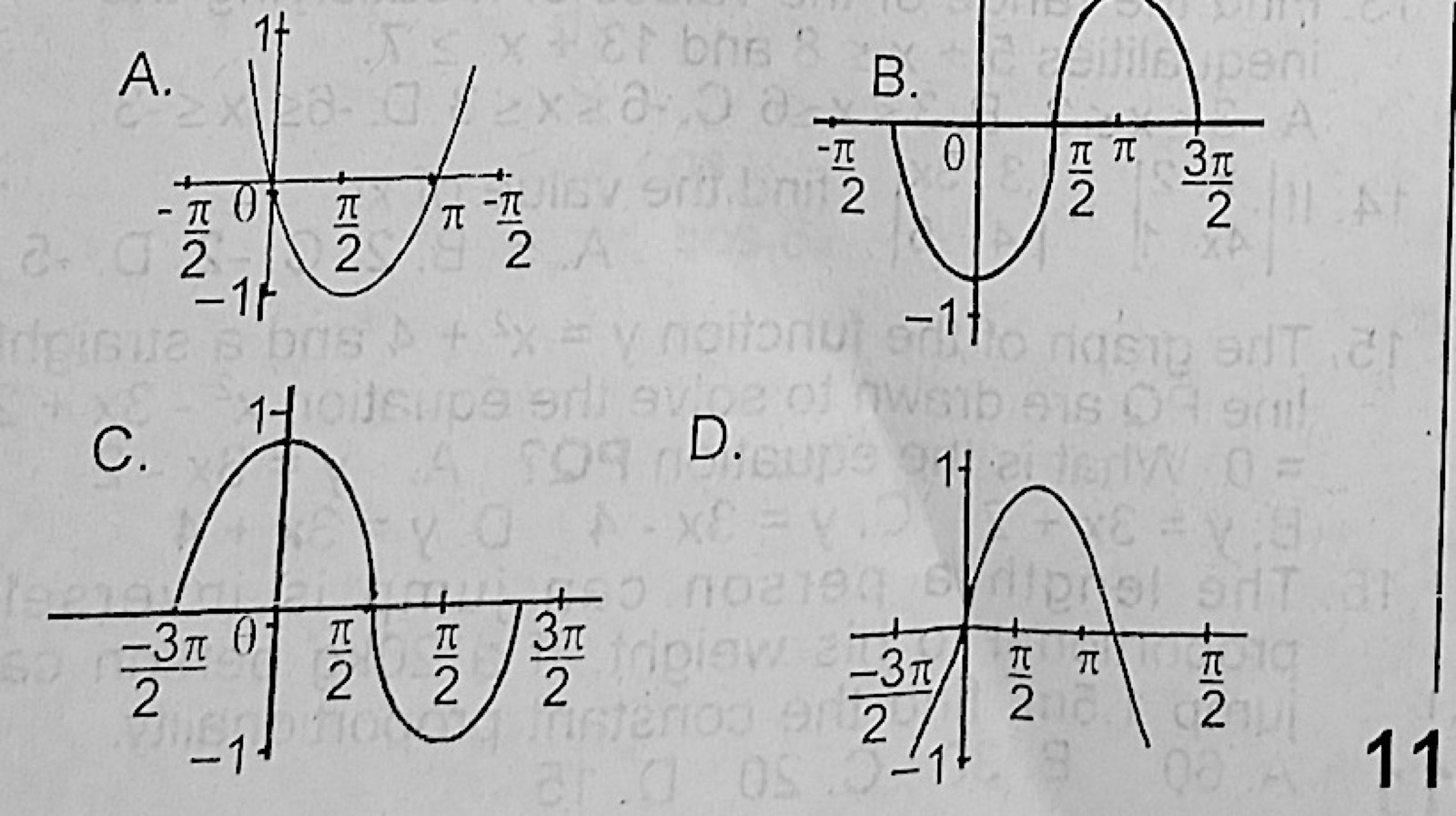
Answer: D (Graph D)
sin θ is −1 at −π/2, 0 at 0, 1 at π/2, 0 at π and −1 at 3π/2: it rises through the origin to a peak and then falls. Only graph D has this shape.
In the diagram above, O is the centre of the circle, POM is a diameter and ∠MNQ = 42°. Calculate ∠QMP.
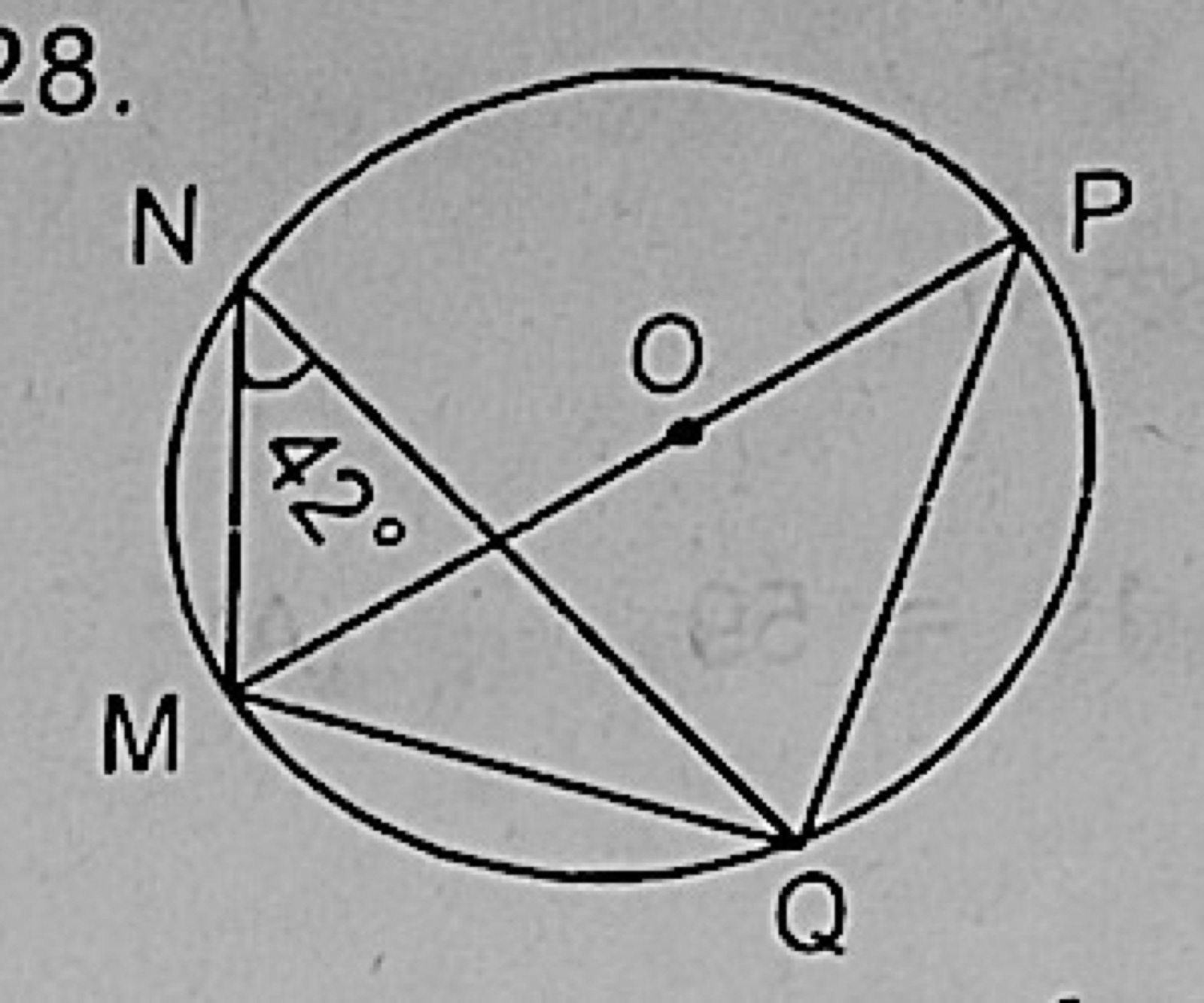
Answer: B (48°)
∠MPQ = ∠MNQ = 42° (angles in the same segment), and ∠MQP = 90° (angle in a semicircle). So ∠QMP = 180° − 90° − 42° = 48°.
Find the value of p, if the line which passes through (−1, −p) and (−2p, 2) is parallel to the line 2y + 8x − 17 = 0
Answer: B (6/7)
The given line has gradient −4. So (2 + p)/(−2p + 1) = −4, giving 2 + p = −4 + 8p, 7p = 6 and p = 6/7.
An aeroplane flies due north from airports P to Q and then flies due east to R. If Q is euidistant from P and R, find the bearing of P from R.
Answer: C (225°)
PQR is a right-angled isosceles triangle, so from R the line to P points 45° south of due west, a bearing of 180° + 45° = 225°.
The locus of a point P which moves on one side only of a straight line XY so that ∠XPY = 90° is
Answer: B (a semicircle)
The angle in a semicircle is 90°, so P lies on the semicircle with XY as diameter (one side only).
If π/2 ≤ θ ≤ 2π, find the maximum value of f(θ) = 4/(6 + 2cosθ)
Answer: B (1)
The fraction is largest when the denominator is smallest, at cos θ = −1 (θ = π): f = 4/(6 − 2) = 1.
XYZ is a circle with center O and radius 7cm. Find the area of the shaded region. [π = 22/7]
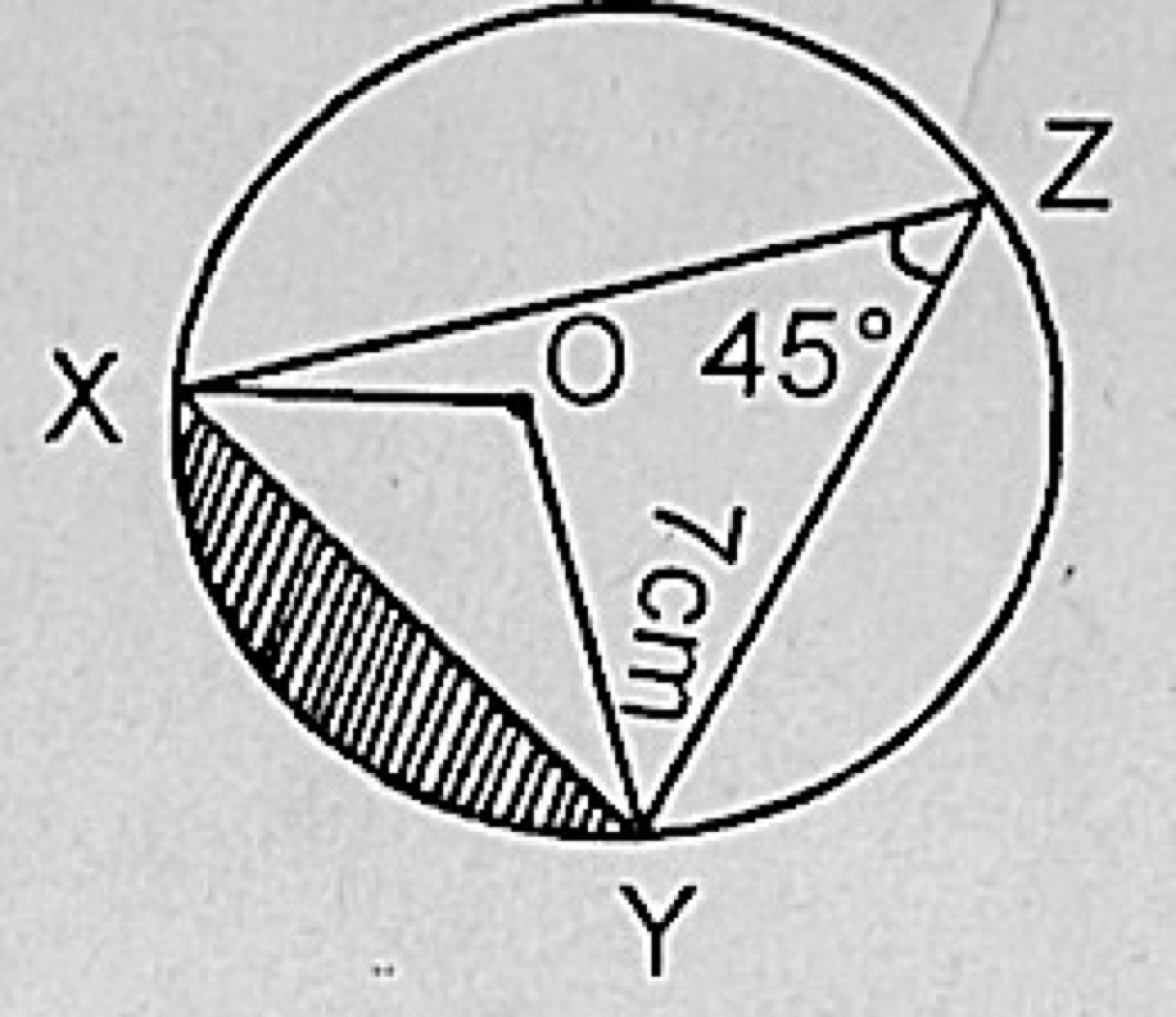
Answer: D (14cm2)
∠XZY = 45°, so ∠XOY = 90°. Shaded segment = sector − triangle = ¼ × 22/7 × 49 − ½ × 7 × 7 = 38.5 − 24.5 = 14cm2.
A triangle has vertices P(−1,6), Q(−3,−4) and R(1,−4). Find the midpoints of PQ and QR respectively.
Answer: D ((−2,1) and (−1,−4))
Midpoint of PQ = ((−1 − 3)/2, (6 − 4)/2) = (−2, 1). Midpoint of QR = ((−3 + 1)/2, (−4 − 4)/2) = (−1, −4).
In the diagram above, PQR is a straight line and PS is a tangent to the circle QRS with |PS| = |SR| and ∠SPR = 40°. Find ∠PSQ.
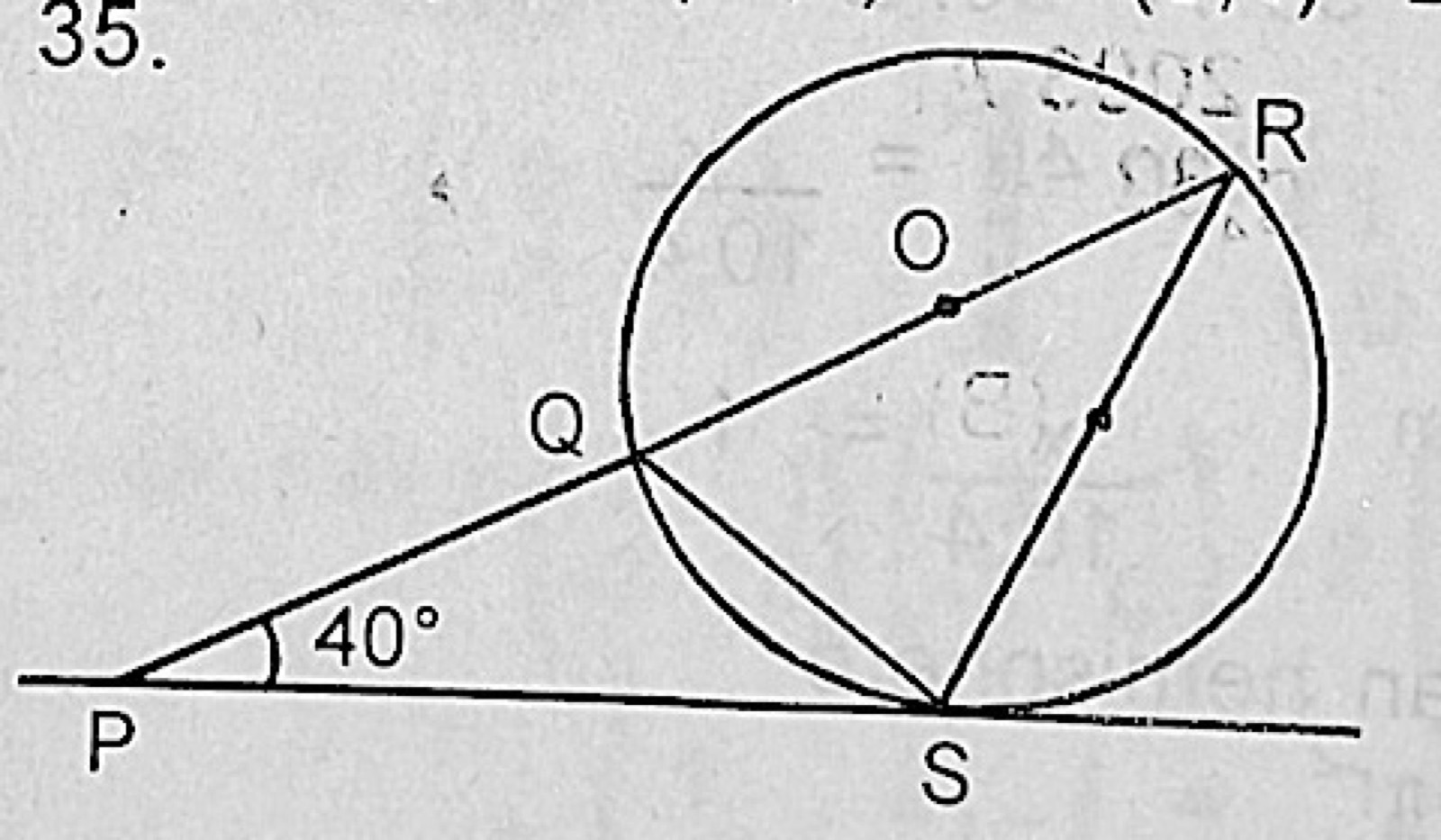
Answer: A (40°)
Triangle PSR is isosceles, so ∠SRP = 40°. By the alternate segment theorem ∠PSQ = ∠SRQ = 40°.
Find the slope of the curve y = 2x2 + 5x − 3 at (1,4).
Answer: D (9)
dy/dx = 4x + 5, which is 9 at x = 1.
Evaluate ∫23 (x2 − 2x)dx
Answer: C (4/3)
[x3/3 − x2] from 2 to 3 = (9 − 9) − (8/3 − 4) = 4/3.
If y = 3 sin(−4x), dy/dx is
Answer: C (−12 cos(−4x))
By the chain rule, dy/dx = 3 cos(−4x) × (−4) = −12 cos(−4x).
Determine the maximum value of y = 3x2 − x3.
Answer: C (4)
dy/dx = 6x − 3x2 = 0 at x = 0 or 2; the second derivative is negative at x = 2, so the maximum is 12 − 8 = 4.
By how much will the mean of 30, 56, 31, 55, 43 and 44 less than the median?
Answer: C (0.33)
Mean = 259/6 ≈ 43.17. In order 30, 31, 43, 44, 55, 56, so the median is 43.5. Difference ≈ 0.33.
The range of 4, 3, 11, 9, 6, 15, 19, 23, 27, 24, 21 and 16 is
Answer: D (24)
Range = largest − smallest = 27 − 3 = 24.
Value: 0, 1, 2, 3, 4
Frequency: 1, 2, 2, 1, 9
Find the mean of the distribution above.
Answer: C (3)
Σfx = 0 + 2 + 4 + 3 + 36 = 45 and Σf = 15, so the mean = 45/15 = 3.
On a pie chart, there are four sectors of which three angles are 45°, 90° and 135°. If the smallest sector represents N28.00, how much is the largest sector?
Answer: B (N84.00)
The fourth angle is 90°, so the largest sector is 135°, three times the smallest (45°): 3 × N28 = N84.
Two dice are thrown. What is the probability that the sum of the numbers is divisible by 3?
Answer: C (1/3)
Sums of 3, 6, 9 and 12 occur in 2 + 5 + 4 + 1 = 12 of the 36 outcomes, so the probability is 12/36 = 1/3.
If nP3 − 6(nC4) = 0, find the value of n.
Answer: C (7)
n(n − 1)(n − 2) = 6 × n(n − 1)(n − 2)(n − 3)/24, so 1 = (n − 3)/4 and n = 7.
Find the number of committees of three that can be formed consisting of two men and one woman from four men and three women.
Answer: C (18)
Choose 2 of 4 men (6 ways) and 1 of 3 women (3 ways): 6 × 3 = 18.
The mean of the numbers 3, 6, 4, x and 7 is 5. Find the standard deviation.
Answer: A (√2)
3 + 6 + 4 + x + 7 = 25, so x = 5. Squared deviations are 4, 1, 1, 0, 4, total 10; variance = 10/5 = 2, so SD = √2.
A bag contains 5 black balls and 3 red balls. Two balls are picked randomly without replacement. What is the probability that a black and a red ball are picked?
Answer: A (15/28)
P = (5/8 × 3/7) + (3/8 × 5/7) = 15/56 + 15/56 = 15/28.
The histogram above shows the ages of the victims of a pollution. How many people were involved in the pollution?
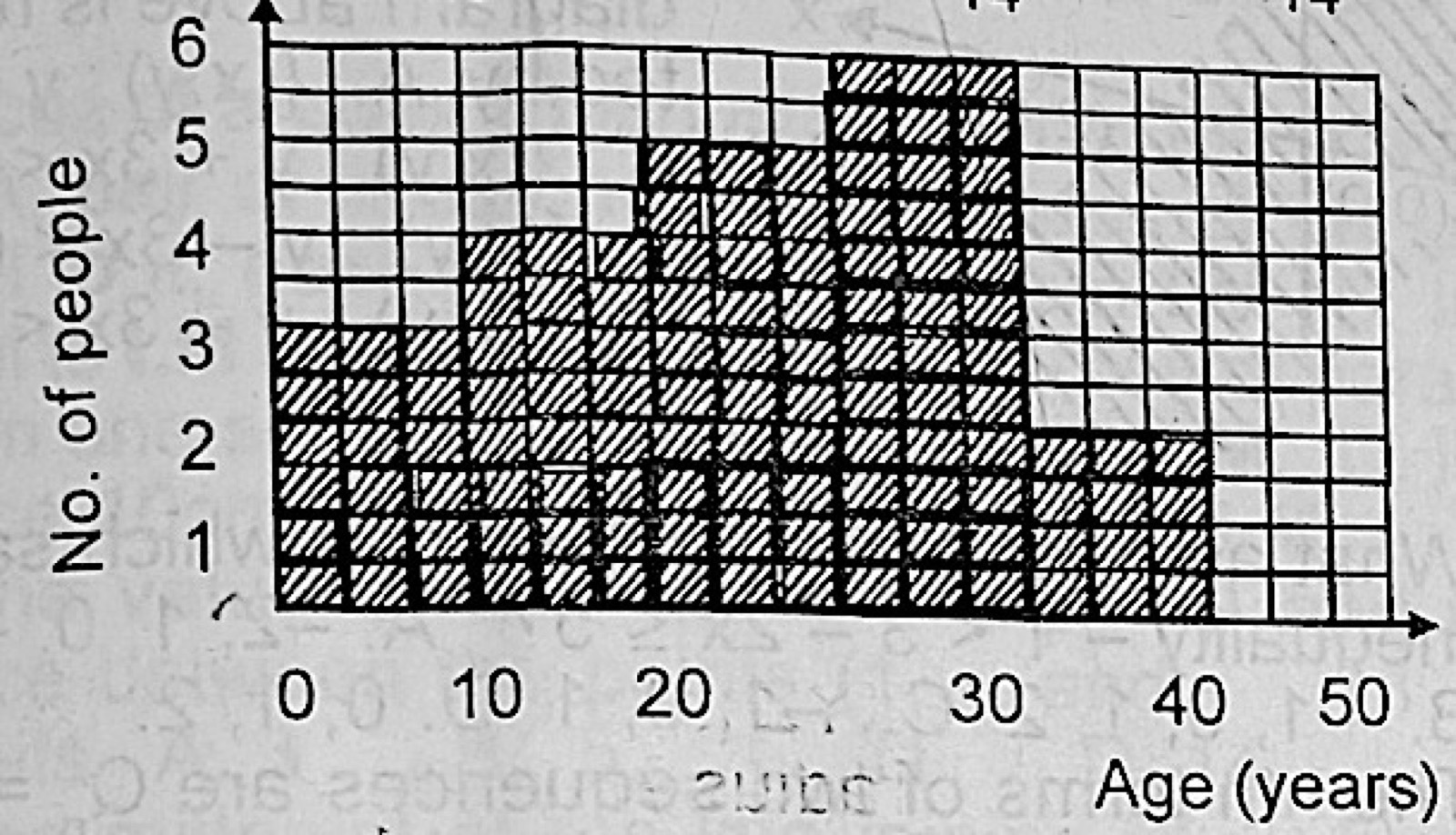
Answer: C (20)
Add the heights of the bars: 3 + 4 + 5 + 6 + 2 = 20 people.
Number: 1, 2, 3, 4, 5, 6
Frequency: 12, 20, x, 21, x − 1, 28
The result of tossing a fair dice 120 times is summarized above. Find the value of x.
Answer: B (20)
12 + 20 + x + 21 + (x − 1) + 28 = 120, so 80 + 2x = 120 and x = 20.