Question 1
Number BasesIf 10112 + X7 = 2510, solve for X
- A.14
- B.20
- C.24
- D.25
Show the answer and explanation
Answer: B (20)
Explanation
1011₂ = 8 + 2 + 1 = 11, so X₇ must equal 25 − 11 = 14 in base ten. 14 = 2 × 7 + 0, which is 20 in base 7.
48 questions. Try each one, then open the answer to check yourself and read the explanation.
If 10112 + X7 = 2510, solve for X
Answer: B (20)
1011₂ = 8 + 2 + 1 = 11, so X₇ must equal 25 − 11 = 14 in base ten. 14 = 2 × 7 + 0, which is 20 in base 7.
Evaluate (1/0.03 ÷ 1/0.024)−1 correct to 2 decimal places.
Answer: B (1.25)
1/0.03 ÷ 1/0.024 = 0.024/0.03 = 0.8. Its reciprocal is 1/0.8 = 1.25.
If b3 = a−2 and c1/3 = a1/2b, express c in terms of a.
Answer: A (a−1/2)
b = a^(−2/3), so c^(1/3) = a^(1/2) × a^(−2/3) = a^(−1/6). Cubing gives c = a^(−1/2).
Given that log4(y − 1) + log4(½x) = 1 and log2(y + 1) + log2x = 2, solve for x and y respectively.
Answer: C (−2, −3)
The first equation gives (y − 1)(x/2) = 4, so xy − x = 8. The second gives x(y + 1) = 4, so xy + x = 4. Subtracting gives 2x = −4, so x = −2 and then y = −3.
Find the value of K if K/(√3 + √2) = K√3 − 2
Answer: D (√2)
K = (K√3 − 2)(√3 + √2) = 3K + K√6 − 2√3 − 2√2, so K(2 + √6) = 2(√3 + √2). Since 2 + √6 = √2(√2 + √3), K = 2/√2 = √2.
A market woman sells oil in cylindrical tins 10cm deep and 6cm in diameter at N15.00 each. If she bought a full cylindrical jug 18cm deep and 10cm in diameter for N50.00, how much did she make by selling all the oil?
Answer: D (N25.00)
Tin volume = π × 3² × 10 = 90π; jug volume = π × 5² × 18 = 450π. The jug fills 5 tins, which sell for 5 × N15 = N75, so she makes N75 − N50 = N25.
A man is paid r naira per hour for normal work and double rate for overtime. If he does a 35-hour week which includes q hours of overtime, what is the weekly earning in naira.
Answer: A (r(35 + q))
He works 35 − q normal hours at r and q overtime hours at 2r: (35 − q)r + 2qr = 35r + qr = r(35 + q).
Given the universal set U = {1, 2, 3, 4, 5, 6} and the sets P = {1, 2, 3, 4}, Q = {3, 4, 5} and R = {2, 4, 6}. Find P ∪ (Q ∪ R)′.
Answer: B ({1, 2, 3, 4})
Q ∪ R = {2, 3, 4, 5, 6}, so its complement is {1}. Then P ∪ {1} = {1, 2, 3, 4}.
In the diagram above, the shaded region is
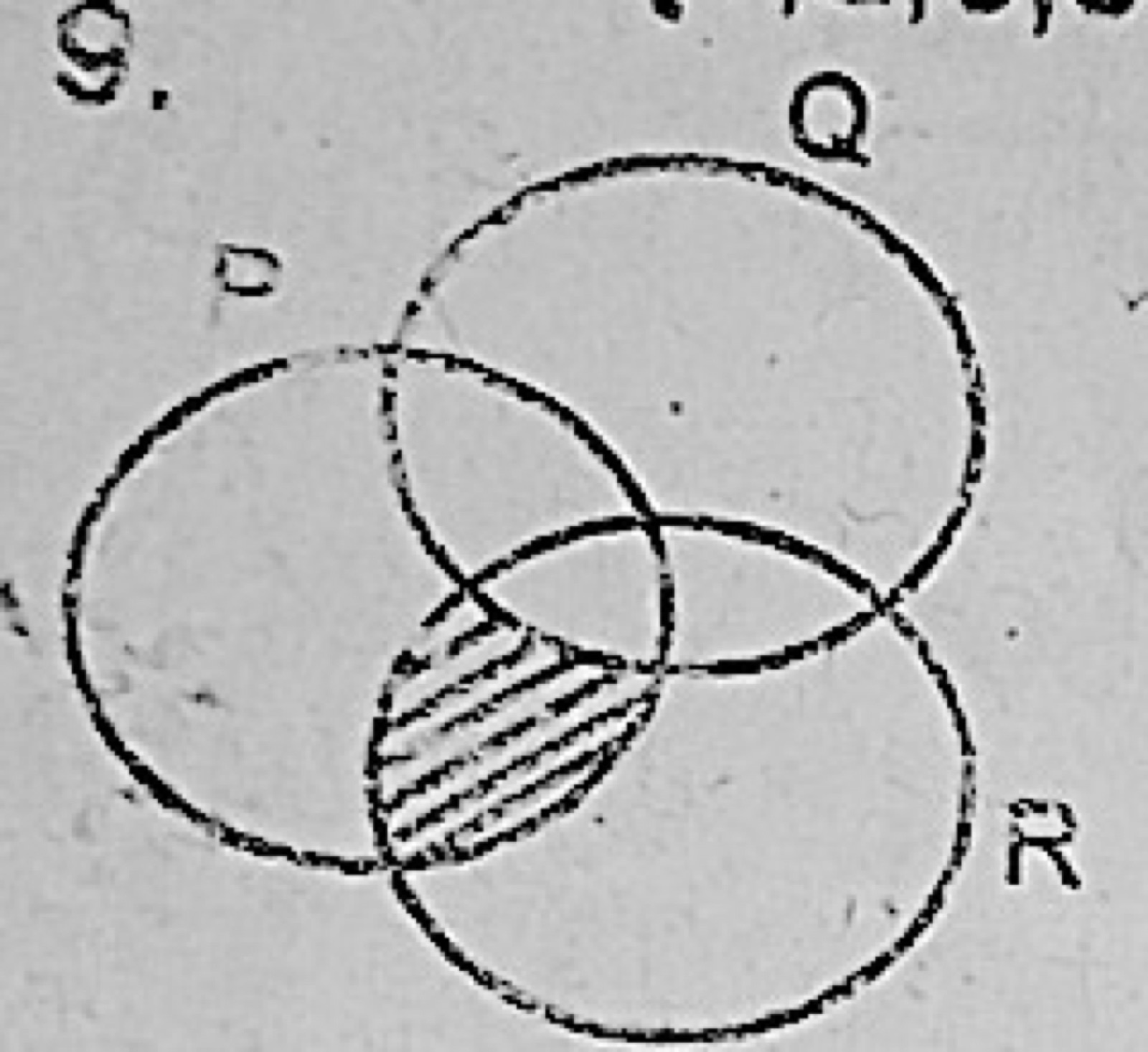
Answer: C ((P ∩ Q′) ∩ R)
The shaded part lies inside both P and R but outside Q, which is (P ∩ Q′) ∩ R.
When the expression pm2 + qm + 1 is divided by (m − 1), it has a remainder 2 and when divided by (m + 1) the remainder is 4. Find p and q respectively.
Answer: A (2, −1)
By the remainder theorem, p + q + 1 = 2 and p − q + 1 = 4. So p + q = 1 and p − q = 3, giving p = 2 and q = −1.
Factorize r2 − r(2p + q) + 2pq.
Answer: C ((r − q)(r − 2p))
r² − 2pr − qr + 2pq = r(r − 2p) − q(r − 2p) = (r − q)(r − 2p).
Solve the equation √x − √(x − 2) − 1 = 0
Answer: D (9/4)
√x = 1 + √(x − 2). Squaring: x = 1 + 2√(x − 2) + x − 2, so √(x − 2) = 1/2, x − 2 = 1/4 and x = 9/4.
Find the range of values of m for which the roots of the equation 3x2 − 3mx + (m2 − m − 3) = 0 are real.
Answer: B (−2 ≤ m ≤ 6)
Real roots need b² − 4ac ≥ 0: 9m² − 12(m² − m − 3) ≥ 0, i.e. m² − 4m − 12 ≤ 0, so (m − 6)(m + 2) ≤ 0 and −2 ≤ m ≤ 6.
make a/x the subject of formula (x + a)/(x − a) = m
Answer: A ((m − 1)/(m + 1))
x + a = mx − ma, so a(1 + m) = x(m − 1) and a/x = (m − 1)/(m + 1).
Divide 2x3 + 11x2 + 17x + 6 by 2x + 1
Answer: A (x2 + 5x + 6)
Long division gives x² + 5x + 6 with no remainder; check: (2x + 1)(x² + 5x + 6) = 2x³ + 11x² + 17x + 6.
Express in partial fractions (11x + 2)/(6x2 − x − 1)
Answer: D (1/(3x + 1) + 3/(2x − 1))
6x² − x − 1 = (3x + 1)(2x − 1). Write 11x + 2 = A(2x − 1) + B(3x + 1); x = ½ gives B = 3 and x = −⅓ gives A = 1.
If x is a positive real number, find the range of values for which 1/3x + ½ > 1/4x
Answer: B (x > 0)
Since x > 0, multiply through by 12x: 4 + 6x > 3, so x > −1/6. Every positive number satisfies this, so the solution is all x > 0.
The shaded area above represents
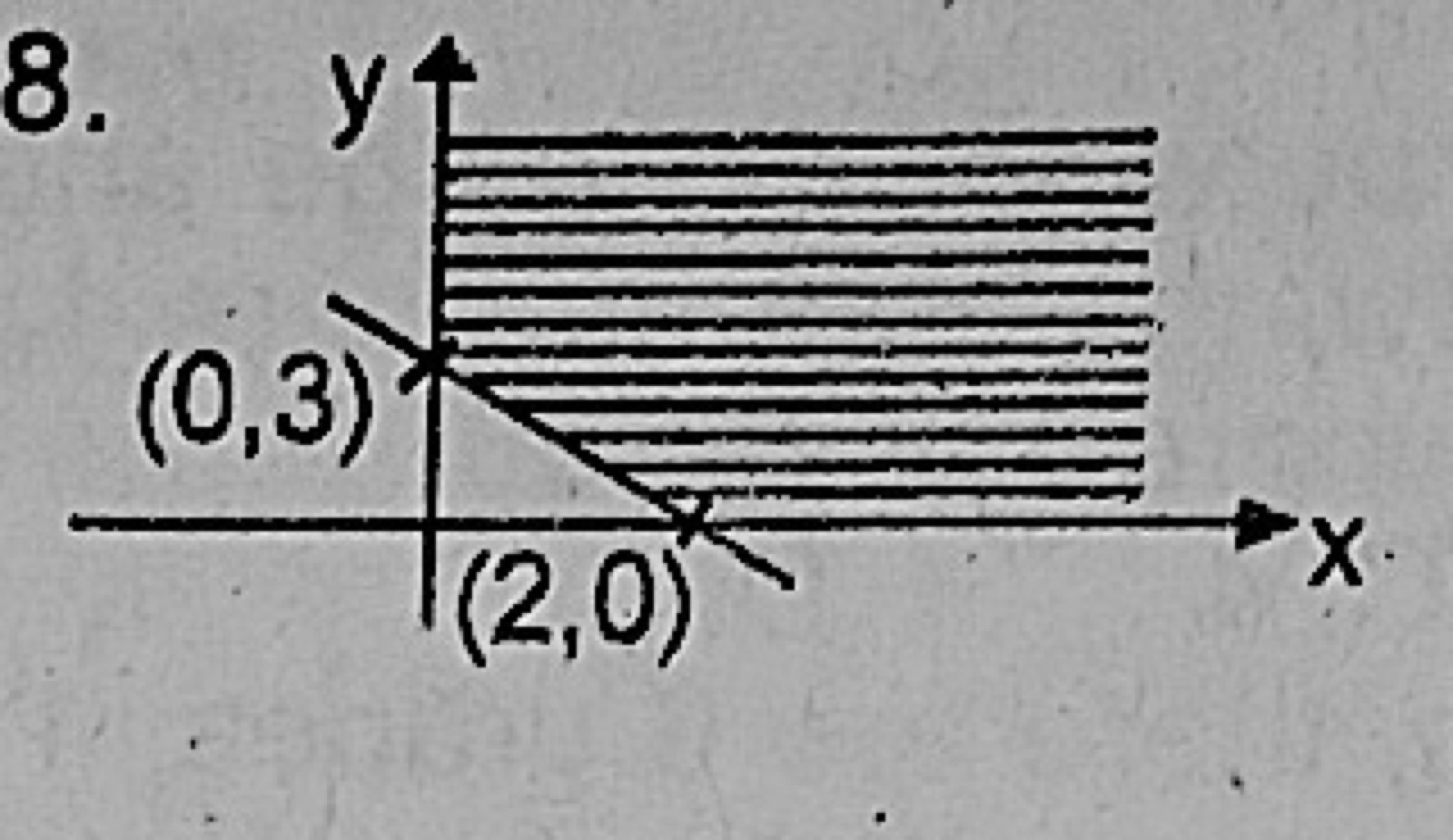
Answer: D (x ≥ 0, y ≥ 0, 3x + 2y ≥ 6)
The line through (0, 3) and (2, 0) is 3x + 2y = 6. The shading is above this line and in the first quadrant, so x ≥ 0, y ≥ 0 and 3x + 2y ≥ 6.
If p + 1, 2p − 10, 1 − 4p2 are three consecutive terms of an arithmetic progression, find the possible values of p.
Answer: C (−11/4, 2)
For an AP, 2(2p − 10) = (p + 1) + (1 − 4p²). This gives 4p² + 3p − 22 = 0, i.e. (4p + 11)(p − 2) = 0, so p = 2 or −11/4.
The sum of the first three terms of a geometric progression is half its sum to infinity. Find the positive common ratio of the progression.
Answer: D (1/∛2)
a(1 − r³)/(1 − r) = ½ × a/(1 − r), so 1 − r³ = ½, r³ = ½ and r = 1/∛2.
The identity element with respect to the element shown in the table above is

Answer: B (q)
The identity e satisfies e ⊗ x = x for every x. The row for q reads p, q, r, s, the same as the heading row, so q is the identity.
The binary operation ∗ is defined by x∗y = xy − y − x for all real values x and y. If x∗3 = 2∗x, find x.
Answer: C (1)
x∗3 = 3x − 3 − x = 2x − 3 and 2∗x = 2x − x − 2 = x − 2. So 2x − 3 = x − 2, giving x = 1.
The determinant of matrix
( x 1 0 )
( 1−x 2 3 )
( 1 1+x 4 )
in terms of x is.
Answer: B (−3x2 + 9x − 1)
Expand along the first row: x[2(4) − 3(1 + x)] − 1[4(1 − x) − 3] = x(5 − 3x) − (1 − 4x) = −3x² + 9x − 1.
Let I = (1 0 / 0 1), P = (2 3 / 4 5), Q = (u 4+u / −2v v) be 2 × 2 matrices such that PQ = I. Find (u, v)
(Rows are separated by /.)
Answer: A ((−5/2, −1))
From PQ = I: 2u − 6v = 1 and 4u − 10v = 0. The second gives u = 5v/2; substituting, −v = 1, so v = −1 and u = −5/2.
In the diagram above, PR is a diameter of the circle PQRS. PST and QRT are straight lines. Find ∠QSR
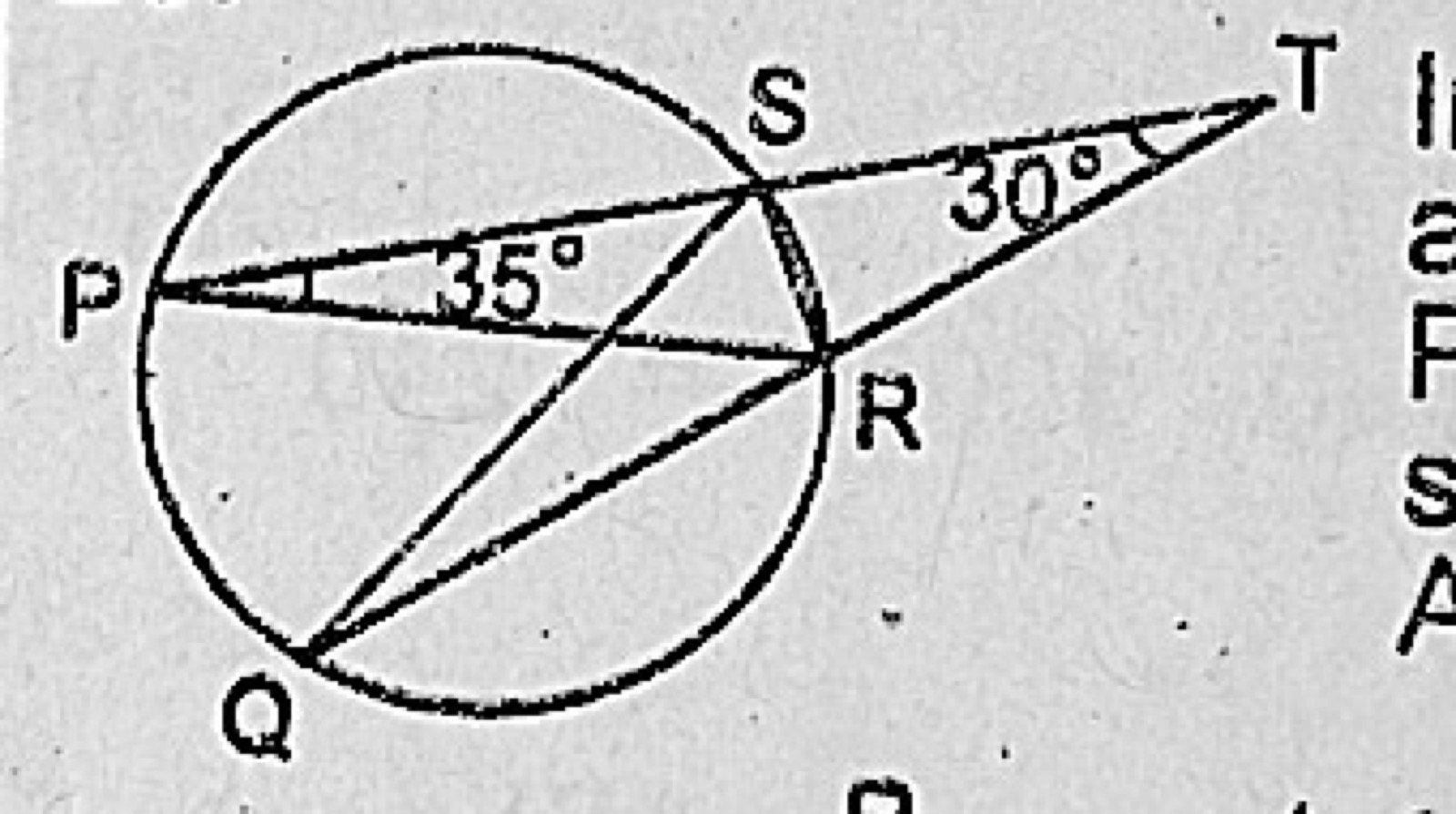
Answer: B (25°)
∠PSR = 90° (angle in a semicircle), so ∠RST = 90° and ∠SRT = 60°. Then ∠QRS = 120°, so ∠QPS = 60° (cyclic quadrilateral) and ∠QPR = 60° − 35° = 25°. ∠QSR = ∠QPR = 25° (same segment).
In the diagram above, PQ||ST and ∠PQR = 120°. ∠RST = 130°. Find the angle marked x
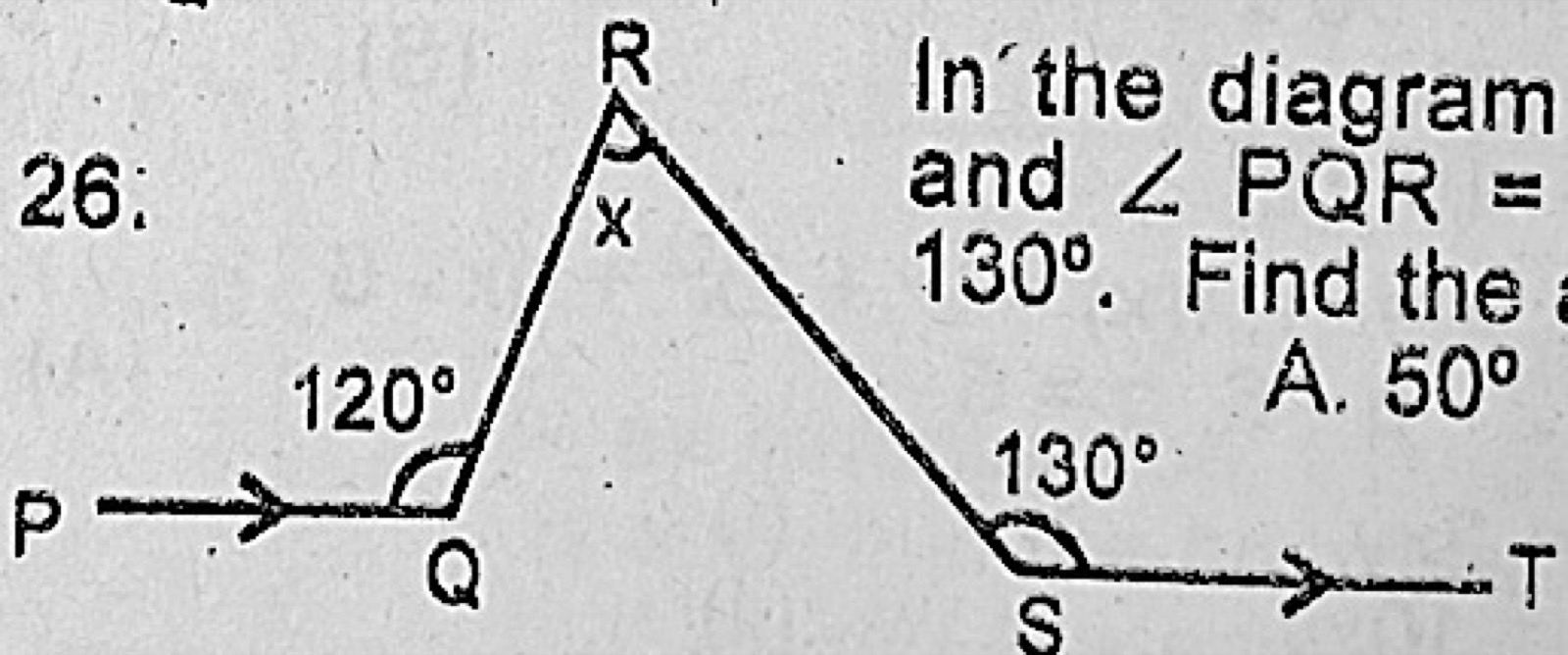
Answer: C (70°)
Draw a line through R parallel to PQ. The angles it makes with RQ and RS are 180° − 120° = 60° and 180° − 130° = 50°. So x = 180° − 60° − 50° = 70°.
In the figure above, PQST is a parallelogram and TSR is a straight line. If the area of ΔQRS is 20cm2, find the area of the trapezium PQRT
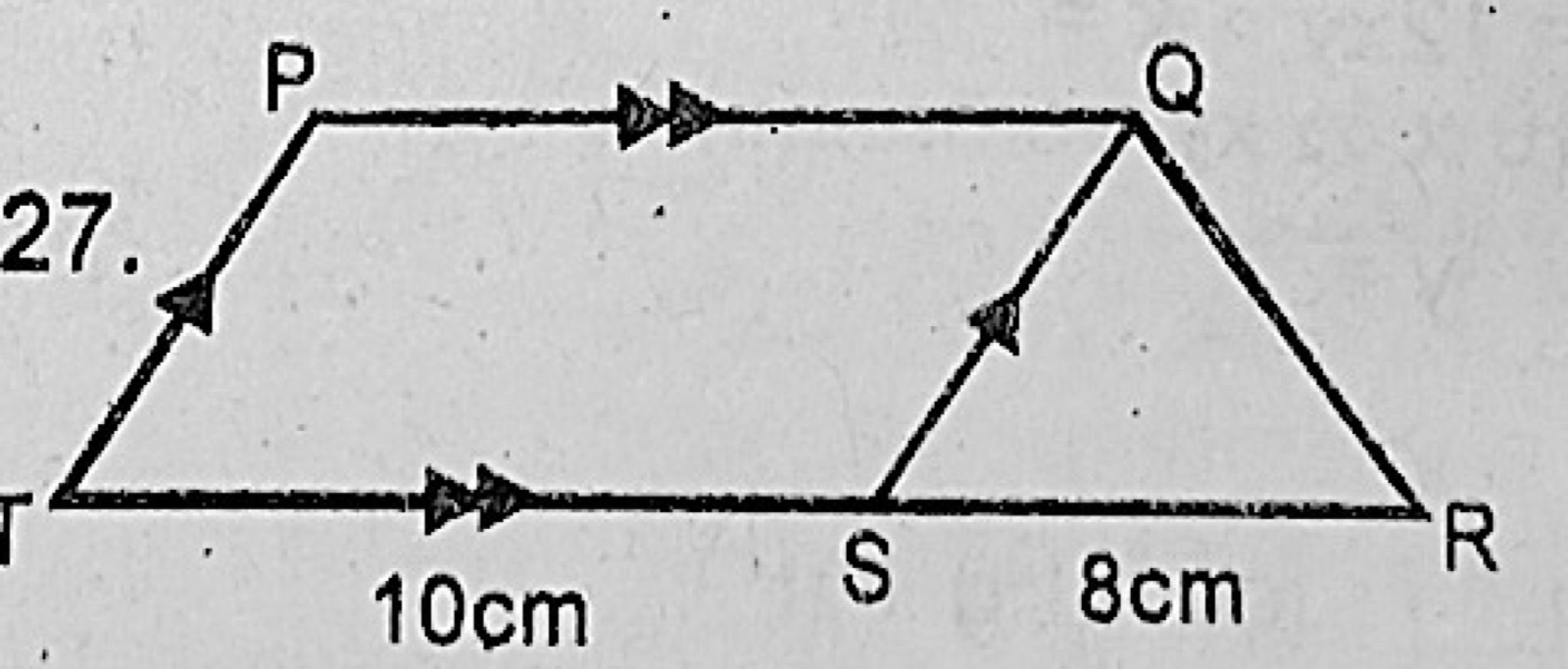
Answer: C (70cm2)
½ × 8 × h = 20 gives the height h = 5 cm. PQ = TS = 10 cm and TR = 18 cm, so the trapezium's area = ½(10 + 18) × 5 = 70 cm².
TQ is tangent to a circle XYTR, ∠YXT = 32°, ∠RTQ = 40°. Find ∠YTR
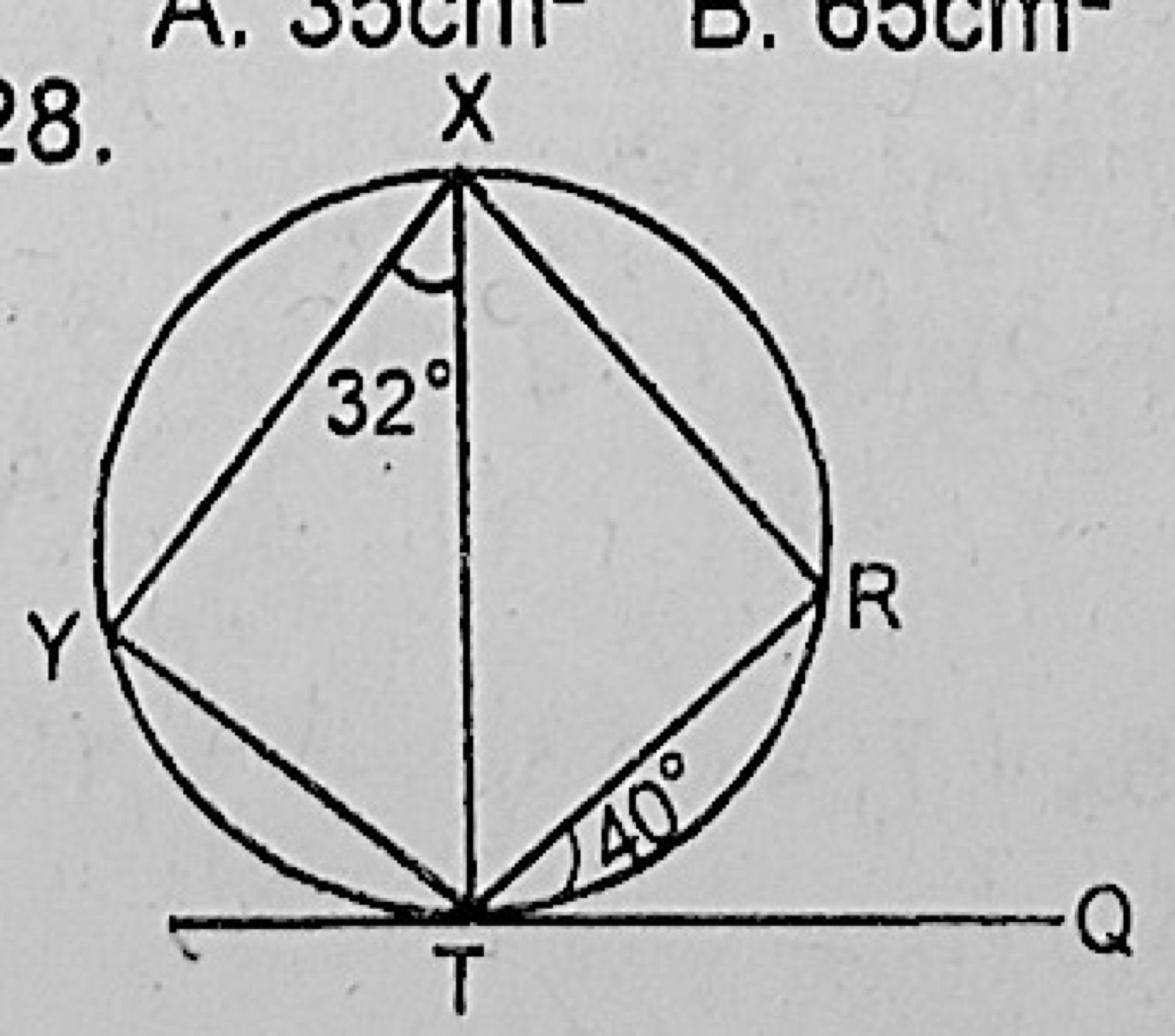
Answer: A (108°)
By the alternate segment theorem ∠RXT = ∠RTQ = 40°, so ∠YXR = 32° + 40° = 72°. Opposite angles of cyclic quadrilateral XYTR add to 180°, so ∠YTR = 108°.
A chord of a circle radius √3cm subtends an angle of 60° on the circumference of the circle. Find the length of the chord.
Answer: D (3cm)
The angle at the centre is 120°. Half the chord = √3 × sin 60° = 3/2, so the chord is 3 cm.
A cylindrical drum of diameter 56cm contains 123.2 litres of oil when full. Find the height of the drum in centimetres. (π = 22/7)
Answer: D (50.0)
123.2 litres = 123 200 cm³. Base area = (22/7) × 28² = 2464 cm², so height = 123 200 ÷ 2464 = 50 cm.
The locus of all points at a distance 8cm from a point N passes through points T and S. If S equi-distant from T and N, find the area of triangle STN.
Answer: B (16√3cm2)
NT = NS = 8 cm (radius) and ST = SN = 8 cm, so the triangle is equilateral with side 8 cm. Area = (√3/4) × 64 = 16√3 cm².
If the distance between the points (x, 3) and (−x, 2) is 5. Find x.
Answer: C (√6)
(2x)² + 1² = 25, so 4x² = 24, x² = 6 and x = √6.
The midpoint of the segment of the line y = 4x + 3 which lies between the x-axis and the y-axis is
Answer: D ((−3/8, 3/2))
The line meets the x-axis at (−3/4, 0) and the y-axis at (0, 3). The midpoint is (−3/8, 3/2).
In the diagram above QTR is a straight line and ∠PQT = 30°. Find the sine of ∠PTR
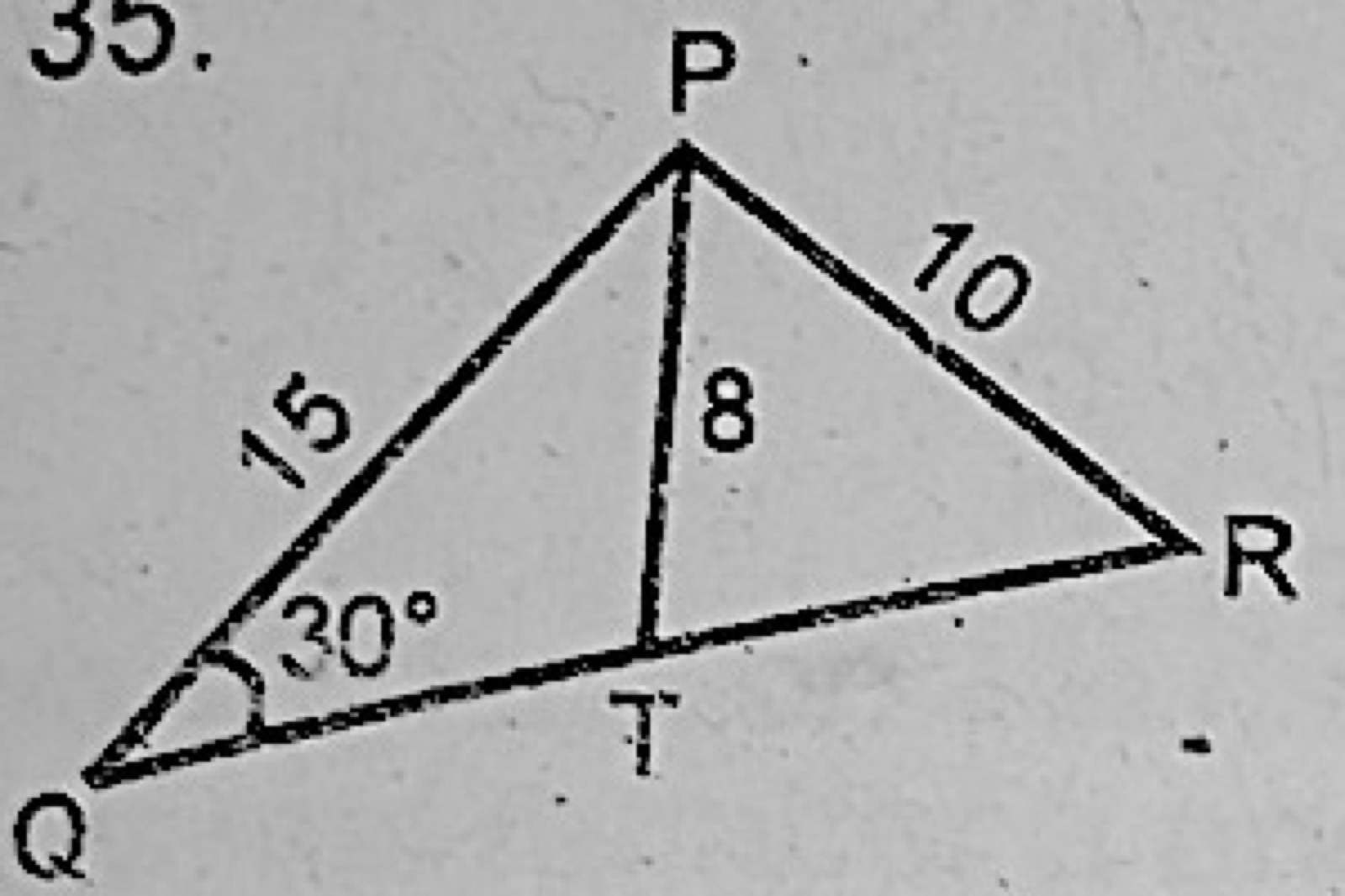
Answer: D (15/16)
In triangle PQT, sin∠PTQ/PQ = sin 30°/PT, so sin∠PTQ = (15 × ½)/8 = 15/16. ∠PTR = 180° − ∠PTQ has the same sine.
For what value of x does 6 sin(2x − 25)° attain its maximum value in the range 0° ≤ x ≤ 180°?
Answer: C (57½)
Sine is greatest when the angle is 90°: 2x − 25 = 90, so x = 57½.
From the top of a vertical mast 150m high, two huts on the same ground level are observed. One due East and the other due West of the mast. Their angles of depression are 60° and 45° respectively. Find the distance between the huts.
Answer: B (50(3 + √3)m)
The huts are 150/tan 60° = 50√3 m and 150/tan 45° = 150 m from the mast, on opposite sides. Total = 150 + 50√3 = 50(3 + √3) m.
If y = 243(4x + 5)−2, find dy/dx when x = 1
Answer: A (−8/3)
dy/dx = 243 × (−2)(4x + 5)⁻³ × 4. At x = 1: −1944/9³ = −1944/729 = −8/3.
Differentiate x/cos x with respect to x.
Answer: D (sec x + x sec x tan x)
x/cos x = x sec x. By the product rule its derivative is sec x + x sec x tan x.
Evaluate ∫2π (sec2x − tan2x)dx.
Answer: B (π − 2)
sec²x − tan²x = 1, so the integral is [x] from 2 to π = π − 2.
Find the equation of the curve which passes through the point (2, 5) and whose gradient at any point is given by 6x − 5.
Answer: D (3x2 − 5x + 3)
Integrating, y = 3x² − 5x + c. At (2, 5): 5 = 12 − 10 + c, so c = 3.
If m and n are the mean and median respectively of the set of numbers 2, 3, 9, 7, 6, 7, 8, 5, find m + 2n to the nearest whole number.
Answer: A (19)
Sum = 47 for 8 numbers, so m = 5.875. In order: 2, 3, 5, 6, 7, 7, 8, 9, so n = (6 + 7)/2 = 6.5. m + 2n = 18.875 ≈ 19.
Average hourly earnings (N): 5–9, 10–14, 15–19, 20–24
No. of workers: 17, 32, 25, 24
Estimate the mode of the above frequency distribution.
Answer: C (12.9)
The modal class is 10–14 (32 workers). Mode = L + d₁/(d₁ + d₂) × c = 9.5 + 15/(15 + 7) × 5 ≈ 9.5 + 3.4 = 12.9.
Find the variance of the number k, k + 1, k + 2
Answer: A (2/3)
The mean is k + 1 and the deviations are −1, 0, 1. Variance = (1 + 0 + 1)/3 = 2/3.
Find the positive value of x if the standard deviation of the numbers 1, x + 1, 2x + 1 is √6
Answer: C (3)
The mean is x + 1 and the deviations are −x, 0, x. Variance = 2x²/3 = 6, so x² = 9 and x = 3.
A bag contains 16 red and 20 blue balls only. How many white balls must be added to the bag so that the probability of randomly picking a red ball is equal to 2/5?
Answer: A (4)
We need 16/(36 + w) = 2/5, so 36 + w = 40 and w = 4.
The pie chart above shows the monthly expenditure of a public servant. The monthly expenditure on housing is twice that of school fees. How much does the worker spend on housing if his monthly income is N7200?
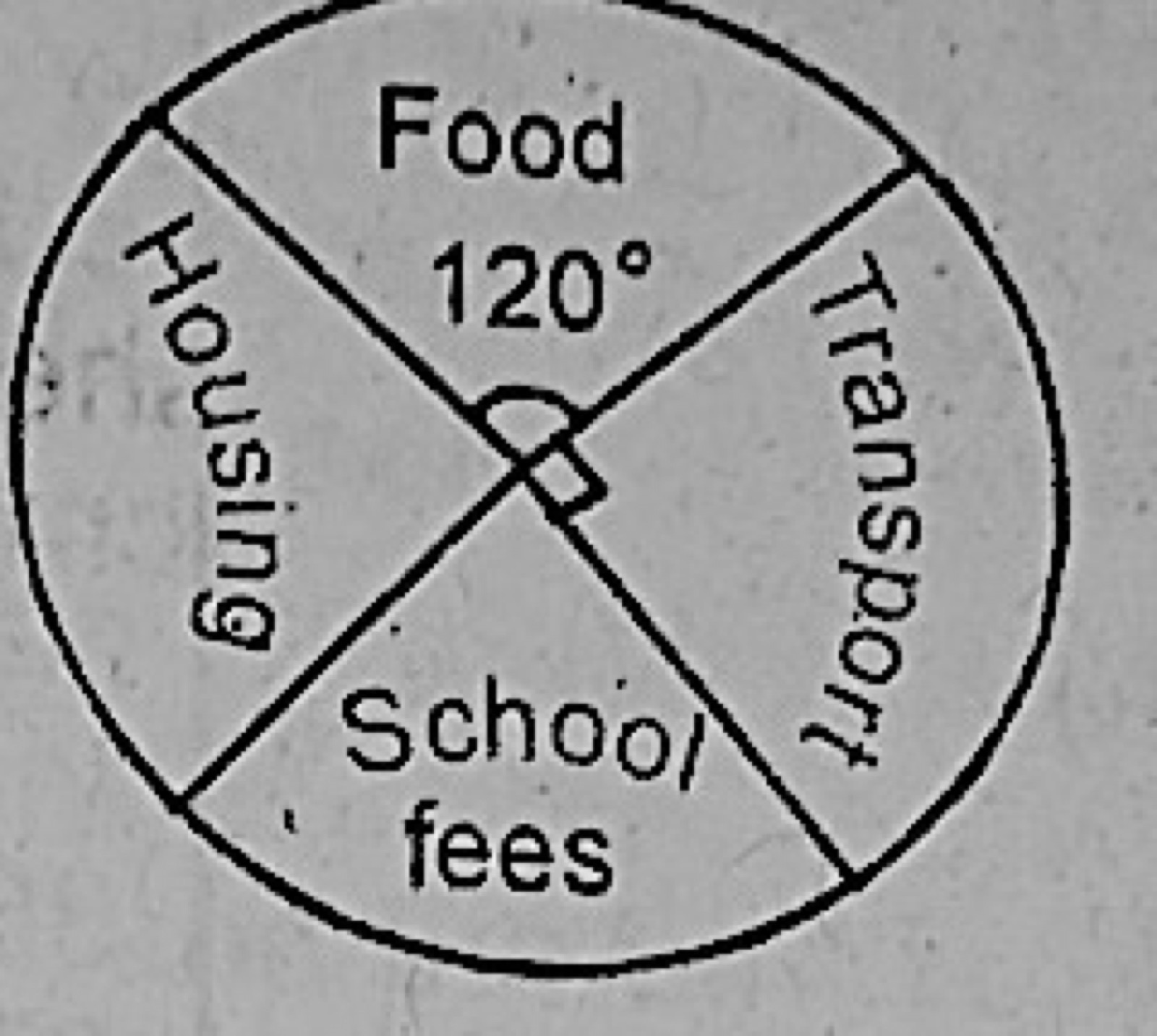
Answer: B (2000)
Food is 120° and transport 90°, leaving 150° for housing and school fees. Housing is twice school fees, so housing = 100°. 100/360 × 7200 = N2000.
In a recent zonal championship games involving 10 teams, teams X and Y were given probabilities 2/5 and 1/3 respectively of winning the gold in the football event. What is the probability that either team will win the gold?
Answer: C (11/15)
Only one team can win, so add the probabilities: 2/5 + 1/3 = 6/15 + 5/15 = 11/15.
If x, y can take values from the set {1, 2, 3, 4}, find the probability that the product of x and y is not greater than 6.
Answer: A (5/8)
There are 4 × 4 = 16 pairs. Products ≤ 6: with x = 1 four pairs, x = 2 three, x = 3 two, x = 4 one, 10 in all. So 10/16 = 5/8.