JAMB Mathematics 1995 past questions and answers

47 questions. Try each one, then open the answer to check yourself and read the explanation.

Question 1

Number Bases

Calculate 33105 − 14425.

  1. A.13135
  2. B.21315
  3. C.43025
  4. D.11035
Show the answer and explanation

Answer: A (13135)

Explanation

In base ten, 33105 = 455 and 14425 = 247, so the difference is 208. 208 = 1×125 + 3×25 + 1×5 + 3, which is 13135.

Open this question

Question 2

Fractions, Decimals and Approximation

Convert 3.1415926 to 5 decimal places.

  1. A.3.14160
  2. B.3.14159
  3. C.0.31415
  4. D.3.14200
Show the answer and explanation

Answer: B (3.14159)

Explanation

Keep five digits after the point: 3.14159|26. The next digit is 2 (less than 5), so it stays 3.14159.

Open this question

Question 3

Ratio, Percentages and Rates

The length of a notebook 15cm, was measured as 16.8cm. Calculate the percentage error to 2 significant figures.

  1. A.12.00%
  2. B.11.00%
  3. C.10.71%
  4. D.0.12%
Show the answer and explanation

Answer: A (12.00%)

Explanation

Error = 16.8 − 15 = 1.8cm. Percentage error = 1.8/15 × 100 = 12%.

Open this question

Question 4

Commercial Arithmetic

A worker's present salary is N24,000 per annum. His annual increment is 10% of his basic salary. What would be his annual salary at the beginning of the third year?

  1. A.N28,800
  2. B.N29,040
  3. C.N31,200
  4. D.N31,944
Show the answer and explanation

Answer: A (N28,800)

Explanation

Each increment is 10% of N24,000 = N2,400. By the start of the third year he has had two increments: 24,000 + 2 × 2,400 = N28,800.

Open this question

Question 5

Fractions, Decimals and Approximation

Express the product of 0.0014 and 0.011 in standard form.

  1. A.1.54 × 10−2
  2. B.1.54 × 10−3
  3. C.1.54 × 10−4
  4. D.1.54 × 10−5
Show the answer and explanation

Answer: D (1.54 × 10⁻⁵)

Explanation

14 × 11 = 154, and there are 4 + 3 = 7 decimal places, so the product is 0.0000154 = 1.54 × 10⁻⁵.

Open this question

Question 6

Indices

Evaluate (81¾ − 27⅓)/(3 × 23)

  1. A.27
  2. B.1
  3. C.⅓
  4. D.⅛
Show the answer and explanation

Answer: B (1)

Explanation

81¾ = 33 = 27 and 27⅓ = 3, so the top is 24. The bottom is 3 × 8 = 24. 24/24 = 1.

Open this question

Question 7

Logarithms

Find the value of (16)3/2 + log100.0001 + log232

  1. A.0.065
  2. B.0.650
  3. C.6.500
  4. D.65.000
Show the answer and explanation

Answer: D (65.000)

Explanation

163/2 = 43 = 64, log100.0001 = −4 and log232 = 5. Total 64 − 4 + 5 = 65.

Open this question

Question 8

Surds

Simplify (√12 − √3)/(√12 + √3)

  1. A.⅓
  2. B.0
  3. C.9/15
  4. D.1
Show the answer and explanation

Answer: A (⅓)

Explanation

√12 = 2√3, so the fraction is (2√3 − √3)/(2√3 + √3) = √3/(3√3) = ⅓.

Open this question

Question 9

Sets

Four members of a school first eleven cricket team are also members of the first fourteen rugby team. How many boys play for at least one of the two teams?

  1. A.25
  2. B.21
  3. C.16
  4. D.3
Show the answer and explanation

Answer: B (21)

Explanation

Count both teams and remove the double-counted boys: 11 + 14 − 4 = 21.

Open this question

Question 10

Sets

If S = {x : x2 = 9, x > 4}, then S equal to

  1. A.0
  2. B.{0}
  3. C.∅
  4. D.{∅}
Show the answer and explanation

Answer: C (∅)

Explanation

x² = 9 gives x = 3 or −3, and neither is greater than 4. So S has no elements: it is the empty set ∅.

Open this question

Question 11

Polynomials

If x − 1 and x + 1 are both factors of the equation x3 + px2 + qx + 6 = 0, evaluate p and q.

  1. A.−6, −1
  2. B.6, 1
  3. C.1, −1
  4. D.6, −6
Show the answer and explanation

Answer: A (−6, −1)

Explanation

x = 1 gives 1 + p + q + 6 = 0, so p + q = −7. x = −1 gives −1 + p − q + 6 = 0, so p − q = −5. Adding: 2p = −12, p = −6 and q = −1.

Open this question

Question 12

Polynomials

Find a positive value of p if the expression 2x2 − px + p leaves a remainder 6 when divided by x − p

  1. A.1
  2. B.2
  3. C.3
  4. D.4
Show the answer and explanation

Answer: B (2)

Explanation

By the remainder theorem, put x = p: 2p² − p² + p = 6, so p² + p − 6 = 0, (p + 3)(p − 2) = 0. The positive value is p = 2.

Open this question

Question 13

Algebraic Expressions

Find T in terms of K, Q and S if S = 2r√(π(QT + K)).

  1. A.S2/(2πr2Q) − K/Q
  2. B.S2/(4πr2Q) − K/Q
  3. C.S2/(2πr2Q) − K
  4. D.S2/(4πr2) − K
Show the answer and explanation

Answer: B (S2/(4πr2Q) − K/Q)

Explanation

Square both sides: S² = 4r²π(QT + K). So QT + K = S²/(4πr²), and T = S²/(4πr²Q) − K/Q.

Open this question

Question 14

Graphs of Functions

The graph of f(x) = x2 − 5x + 6 crosses the x-axis at the points.

  1. A.(−6, 0), (−1, 0)
  2. B.(−3, 0), (−2, 0)
  3. C.(−6, 0)(1, 0)
  4. D.(2, 0), (3, 0)
Show the answer and explanation

Answer: D ((2, 0), (3, 0))

Explanation

Solve x² − 5x + 6 = 0: (x − 2)(x − 3) = 0, so x = 2 or 3. The points are (2, 0) and (3, 0).

Open this question

Question 15

Algebraic Expressions

Factorize completely the expression abx2 + 6y − 3ax − 2byx

  1. A.(ax − 2y)(bx − 3)
  2. B.(bx + 3)(2y − ax)
  3. C.(bx + 3)(ax − 2y)
  4. D.(ax − 2y)(ax − b)
Show the answer and explanation

Answer: A ((ax − 2y)(bx − 3))

Explanation

Group: abx² − 2bxy = bx(ax − 2y) and −3ax + 6y = −3(ax − 2y). Together: (ax − 2y)(bx − 3).

Open this question

Question 16

Inequalities

Solve the following inequality (x − 3)(x − 4) ≤ 0

  1. A.3 ≤ x ≤ 4
  2. B.3 < x < 4
  3. C.3 ≤ x < 4
  4. D.3 < x ≤ 4
Show the answer and explanation

Answer: A (3 ≤ x ≤ 4)

Explanation

The product is zero at 3 and 4 and negative between them, so (x − 3)(x − 4) ≤ 0 for 3 ≤ x ≤ 4 (the ends are included because of '='.)

Open this question

Question 17

Progressions

The 4th term of an A.P is 13 while the 10th term is 31. Find the 21st term.

  1. A.175
  2. B.85
  3. C.64
  4. D.45
Show the answer and explanation

Answer: C (64)

Explanation

a + 3d = 13 and a + 9d = 31, so 6d = 18, d = 3 and a = 4. The 21st term is a + 20d = 4 + 60 = 64.

Open this question

Question 19

Polynomials

Express (5x − 12)/((x − 2)(x − 3)) in partial fractions.

  1. A.2/(x + 2) − 3/(x − 3)
  2. B.2/(x − 2) + 3/(x − 3)
  3. C.2/(x − 3) − 3/(x − 2)
  4. D.5/(x − 3) + 4/(x − 2)
Show the answer and explanation

Answer: B (2/(x − 2) + 3/(x − 3))

Explanation

Write 5x − 12 = A(x − 3) + B(x − 2). x = 2 gives −2 = −A, so A = 2; x = 3 gives 3 = B. So it is 2/(x − 2) + 3/(x − 3).

Open this question

Question 20

Inequalities

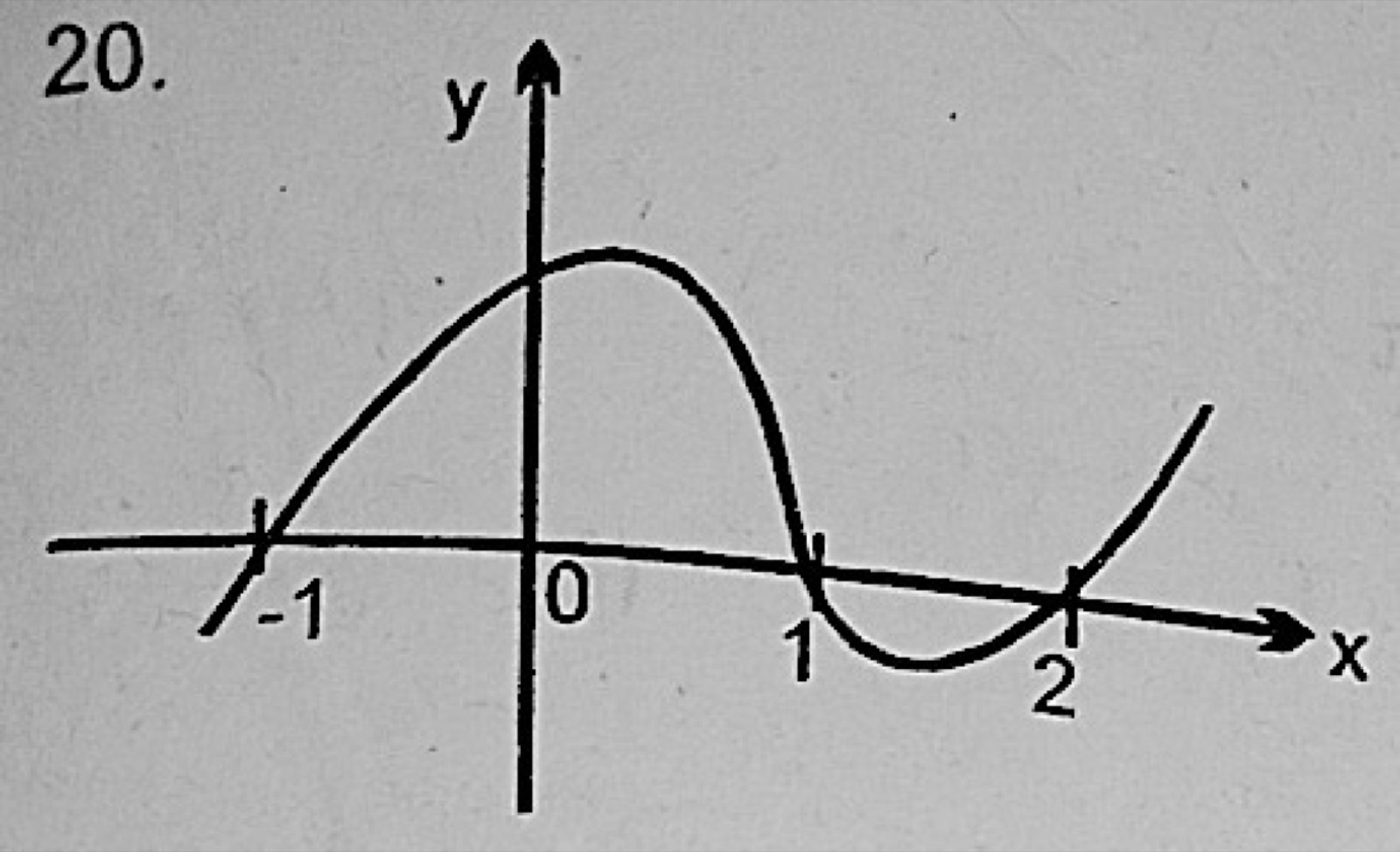
Use the graph of the curve y = f(x) above to solve the inequality f(x) ≥ 0.

Diagram for this question
  1. A.−1 ≤ x ≤ 1, x ≥ 2
  2. B.x ≥ −1, 1 ≤ x ≤ 2
  3. C.x ≤ −1, 1 ≤ x ≤ 2
  4. D.x ≤ 2, −1 ≤ x ≤ 1
Show the answer and explanation

Answer: A (−1 ≤ x ≤ 1, x ≥ 2)

Explanation

f(x) ≥ 0 where the curve is on or above the x-axis. It cuts the axis at −1, 1 and 2, is above it between −1 and 1, dips below between 1 and 2, then rises after 2. So −1 ≤ x ≤ 1 or x ≥ 2.

Open this question

Question 21

Binary Operations

Which of the following binary operations is commutative in the set of integers?

  1. A.a*b = a + 2b
  2. B.a*b = a + b − ab
  3. C.a*b = a2 + b
  4. D.a*b = a(b + 1)/2
Show the answer and explanation

Answer: B (a*b = a + b − ab)

Explanation

Commutative means a*b = b*a. Swapping a and b in a + b − ab gives b + a − ba, which is the same. The others change, e.g. 1 + 2(2) ≠ 2 + 2(1).

Open this question

Question 22

Binary Operations

If a*b = +√(ab), evaluate 2*(12*27).

  1. A.12
  2. B.9
  3. C.6
  4. D.2
Show the answer and explanation

Answer: C (6)

Explanation

Work out the bracket first: 12*27 = √324 = 18. Then 2*18 = √36 = 6.

Open this question

Question 23

Progressions

Find the sum to infinity of the following sequence: 1, 9/10, (9/10)2, (9/10)3

  1. A.1/10
  2. B.9/10
  3. C.10/9
  4. D.10
Show the answer and explanation

Answer: D (10)

Explanation

This is a GP with a = 1 and r = 9/10. Sum to infinity = a/(1 − r) = 1/(1/10) = 10.

Open this question

Question 25

Matrices and Determinants

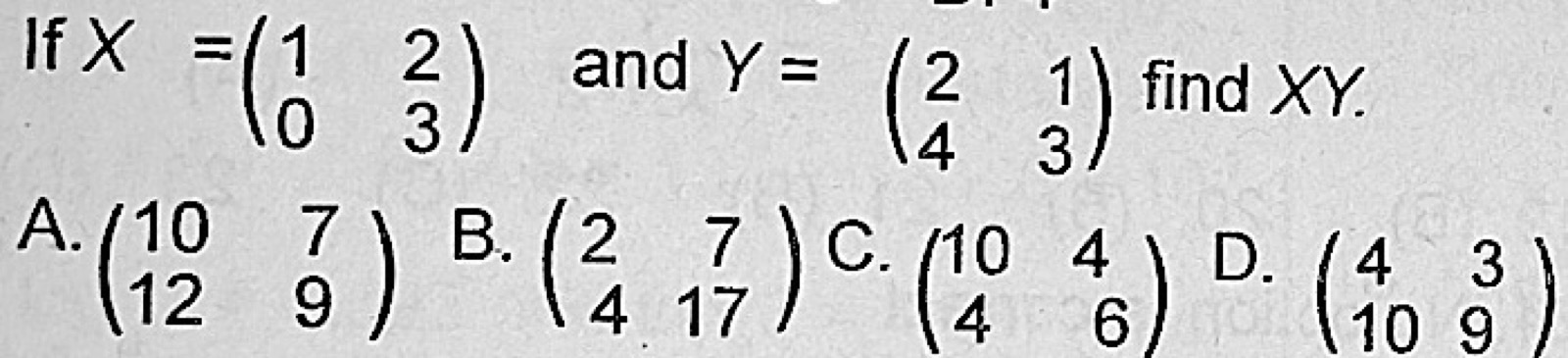
If X = (1 2; 0 3) and Y = (2 1; 4 3) find XY.

Diagram for this question
  1. A.(10 7; 12 9)
  2. B.(2 7; 4 17)
  3. C.(10 4; 4 6)
  4. D.(4 3; 10 9)
Show the answer and explanation

Answer: A ((10 7; 12 9))

Explanation

Multiply rows of X by columns of Y: first row (1×2 + 2×4, 1×1 + 2×3) = (10, 7); second row (0×2 + 3×4, 0×1 + 3×3) = (12, 9).

Open this question

Question 26

Triangles and Quadrilaterals

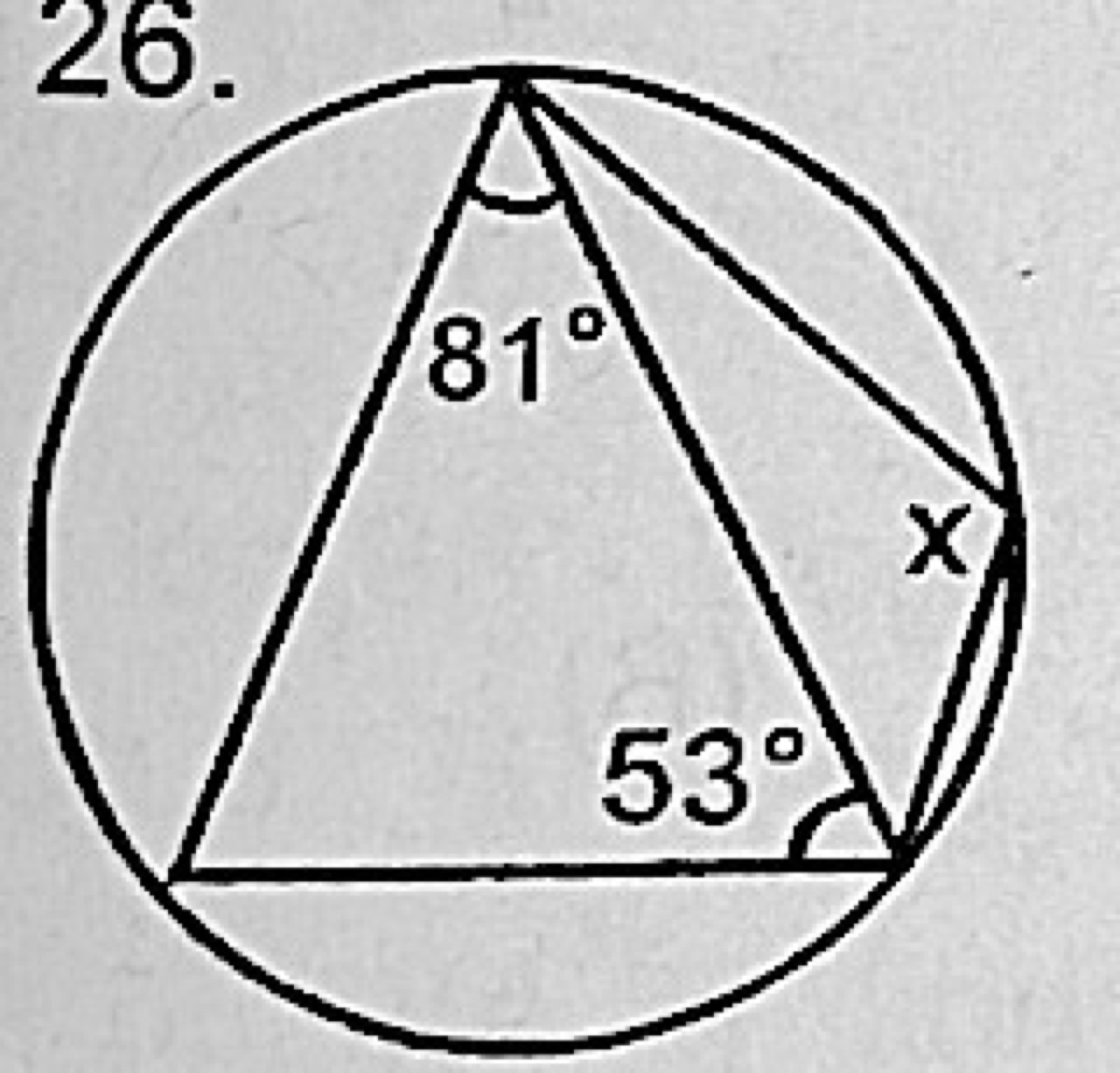
Determine the value of x in the fig. above.

Diagram for this question
  1. A.134°
  2. B.81°
  3. C.53°
  4. D.46°
Show the answer and explanation

Answer: A (134°)

Explanation

In the triangle, the third angle (bottom left) is 180° − 81° − 53° = 46°. The angle x is opposite it in a cyclic quadrilateral, so x = 180° − 46° = 134°.

Open this question

Question 27

Circle Theorems

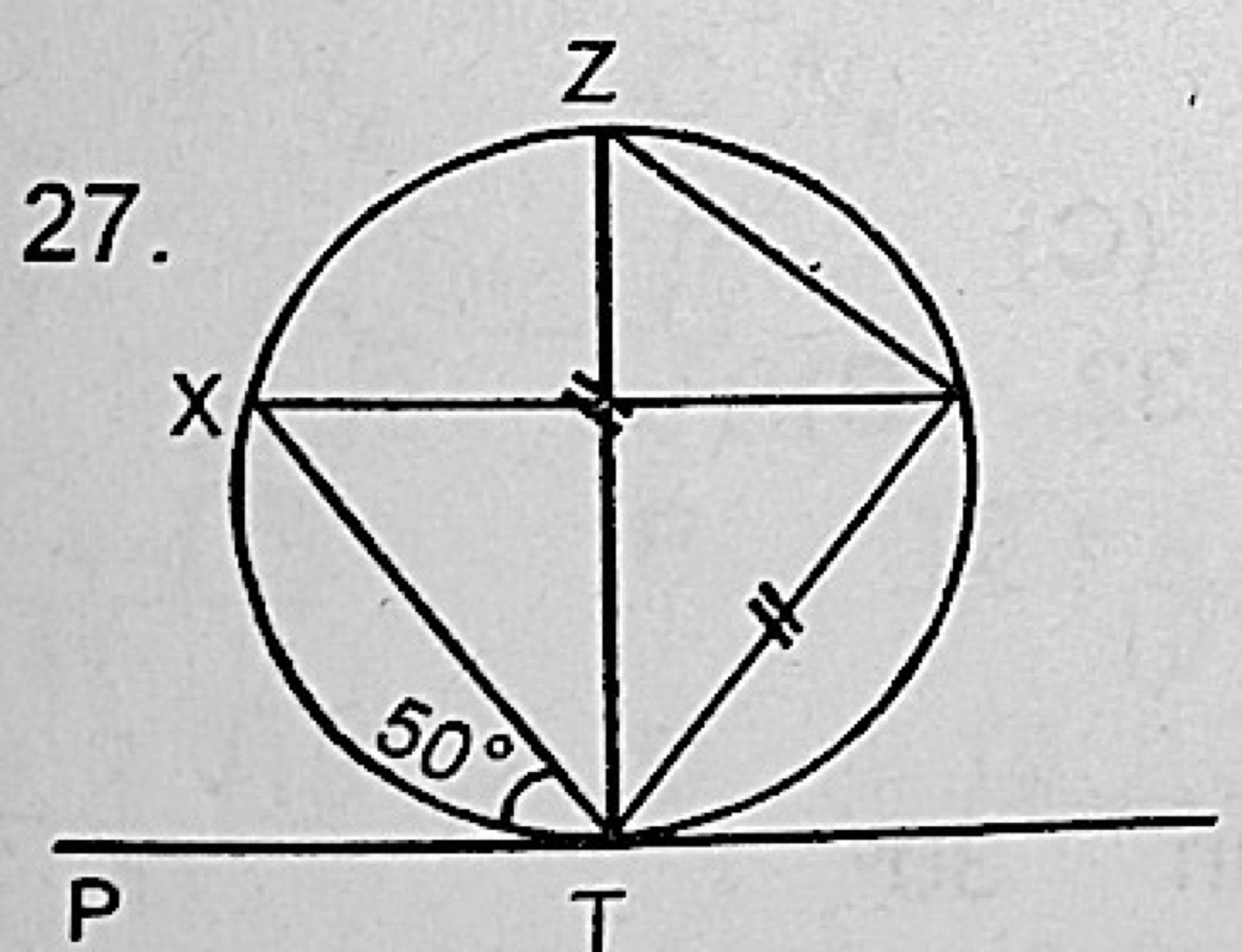
PT is a tangent to the circle TYZX, YT = YX and ∠PTX = 50°. Calculate ∠TZY

Diagram for this question
  1. A.50°
  2. B.65°
  3. C.85°
  4. D.130°
Show the answer and explanation

Answer: B (65°)

Explanation

By the alternate segment theorem, angle XYT = angle PTX = 50°. Triangle XYT is isosceles (YT = YX), so angle TXY = (180° − 50°)/2 = 65°. Angle TZY stands on the same arc TY, so it is also 65°.

Open this question

Question 28

Triangles and Quadrilaterals

In a triangle XYZ, ∠YXZ = 44° and ∠XYZ = 112°. Calculate the acute angle between the internal bisectors of ∠XYZ and ∠XZY.

  1. A.12°
  2. B.56°
  3. C.68°
  4. D.78°
Show the answer and explanation

Answer: C (68°)

Explanation

∠XZY = 180° − 44° − 112° = 24°. The bisectors make 56° and 12° with YZ, so they meet at 180° − 56° − 12° = 112°. The acute angle between them is 180° − 112° = 68°.

Open this question

Question 29

Latitude and Longitude

Find the distance between two towns P(45°N, 30°W) and Q(15°S, 30°W) if the radius of the earth is 7 000km. (π = 22/7)

  1. A.1 100/3
  2. B.2 200/3
  3. C.22 000/3
  4. D.11 000/3
Show the answer and explanation

Answer: C (22 000/3)

Explanation

Both towns are on longitude 30°W, so the angle between them is 45° + 15° = 60°. Distance = 60/360 × 2 × 22/7 × 7000 = 44 000/6 = 22 000/3 km.

Open this question

Question 30

Coordinate Geometry

Two perpendicular lines PQ and QR intersect at (1, −1). If the equation of PQ is x − 2y + 4 = 0, find the equation of QR.

  1. A.x − 2y + 1 = 0
  2. B.2x + y − 3 = 0
  3. C.x − 2y − 3 = 0
  4. D.2x + y − 1 = 0
Show the answer and explanation

Answer: D (2x + y − 1 = 0)

Explanation

PQ has gradient ½, so QR has gradient −2. Through (1, −1): y + 1 = −2(x − 1), i.e. 2x + y − 1 = 0.

Open this question

Question 31

Loci

P is on the locus of point equidistant from two given points X and Y. UV is a straight line through Y parallel to the locus. If ∠PYU is 40°, find ∠XPY

  1. A.100°
  2. B.80°
  3. C.50°
  4. D.40°
Show the answer and explanation

Answer: B (80°)

Explanation

The locus is the perpendicular bisector of XY, and it bisects angle XPY. UV is parallel to it, so angle PYU equals the angle between PY and the bisector (alternate angles) = 40°. So angle XPY = 2 × 40° = 80°.

Open this question

Question 32

Angles and Polygons

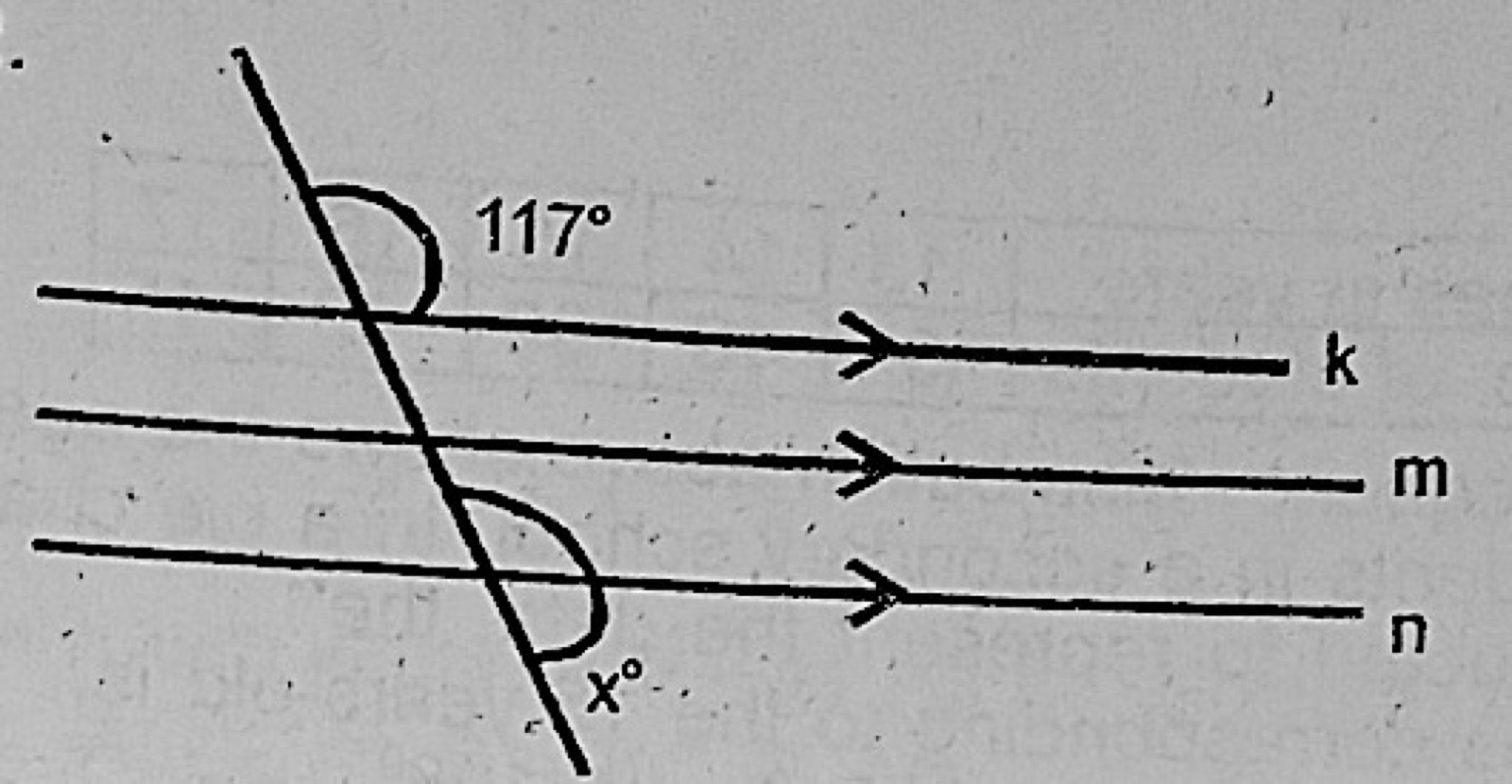
In the diagram above, k, m and n are parallel lines. What is the marked x?

Diagram for this question
  1. A.37°
  2. B.63°
  3. C.117°
  4. D.153°
Show the answer and explanation

Answer: B (63°)

Explanation

The 117° angle and x lie on opposite sides of the transversal with the parallel lines, so together they make a straight angle: x = 180° − 117° = 63°.

Open this question

Question 33

Mensuration of Solids

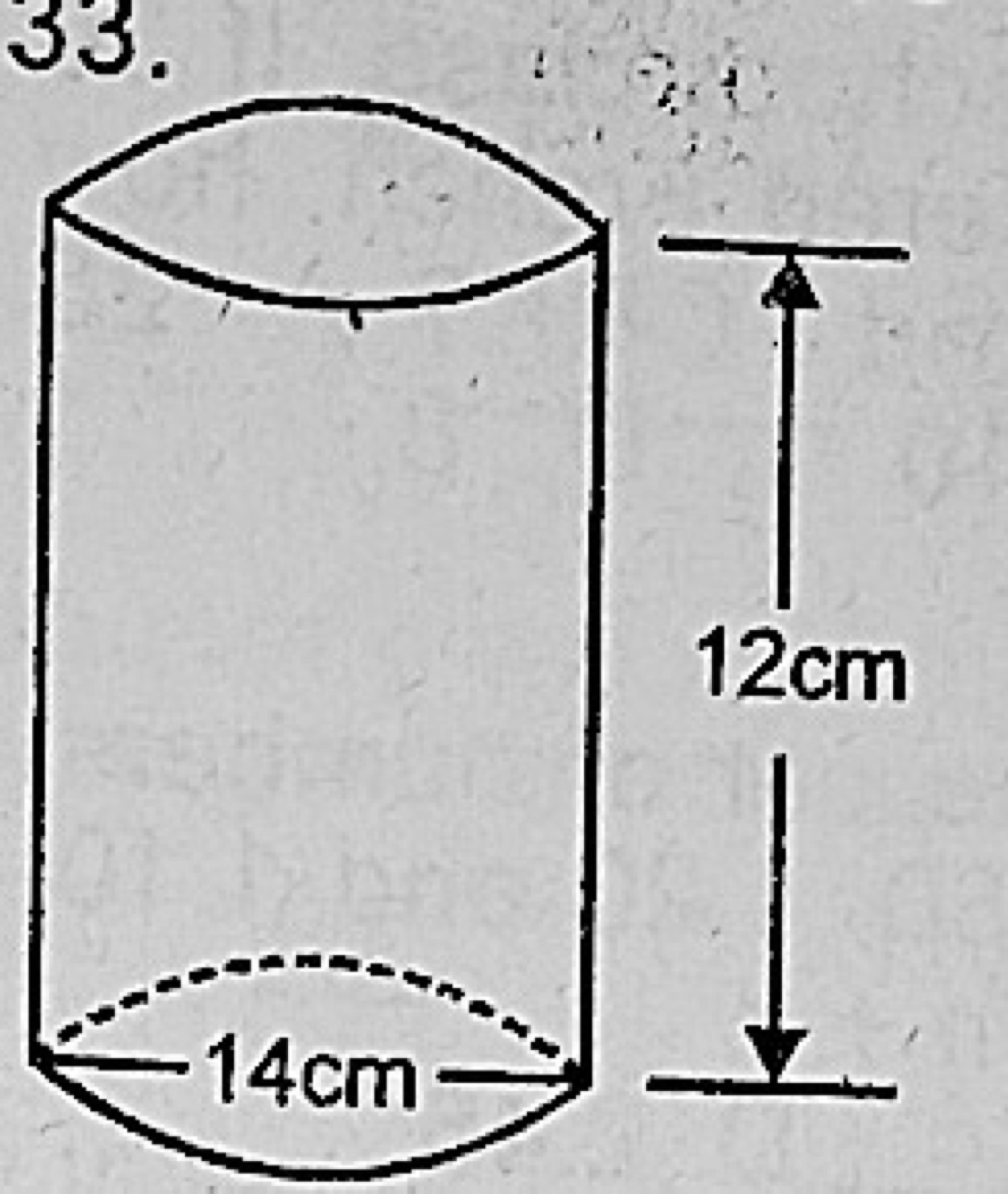
In the diagram above, the base diameter is 14cm while the height is 12cm. Calculate the total surface area if the cylinder has both a base and a top. [π = 22/7]

Diagram for this question
  1. A.836cm2
  2. B.528cm2
  3. C.308cm2
  4. D.154cm2
Show the answer and explanation

Answer: A (836cm2)

Explanation

r = 7cm. Curved surface = 2πrh = 2 × 22/7 × 7 × 12 = 528cm². Top and base = 2πr² = 308cm². Total 836cm².

Open this question

Question 34

Mensuration of Plane Shapes

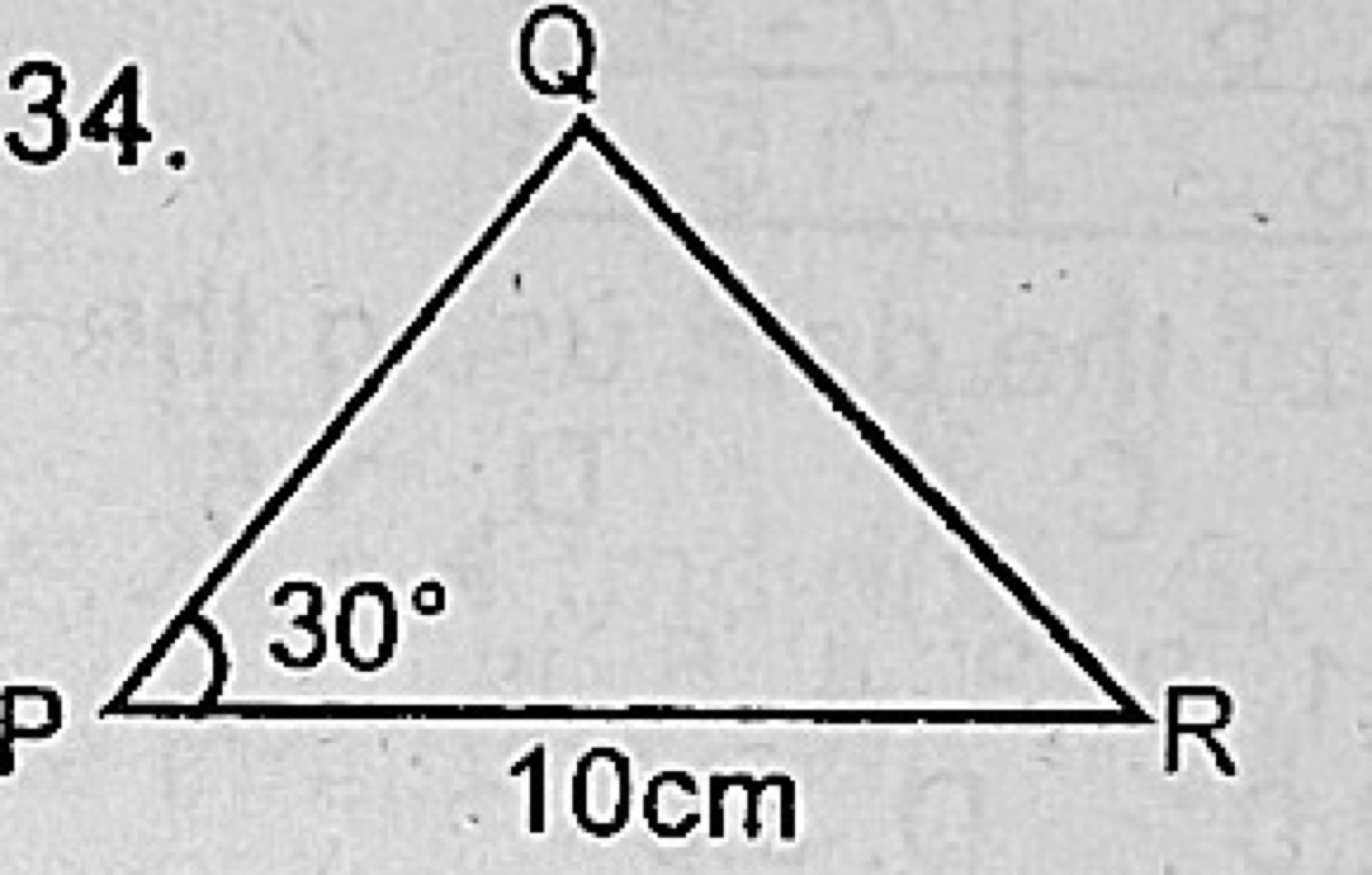
In the diagram above, find PQ if the area of triangle PQR is 35cm2.

Diagram for this question
  1. A.7cm
  2. B.10cm
  3. C.14cm
  4. D.17cm
Show the answer and explanation

Answer: C (14cm)

Explanation

Use area = ½ab sin C with the 30° angle at P: ½ × PQ × 10 × ½ = 35. So 2.5 × PQ = 35 and PQ = 14cm.

Open this question

Question 35

Trigonometry

A schoolboy lying on the ground 30m away from the foot of a water tank tower observes that the angle of elevation of the top of the tank is 60°. Calculate the height of the water tank.

  1. A.60m
  2. B.30√3m
  3. C.20√3m
  4. D.10√3m
Show the answer and explanation

Answer: B (30√3m)

Explanation

tan 60° = height/30, so height = 30 × √3 = 30√3 m.

Open this question

Question 36

Trigonometry

QRS is a triangle with QS = 12m, ∠RQS = 30° and ∠QRS = 45°. Calculate the length of RS.

  1. A.18√2m
  2. B.12√2m
  3. C.6√2m
  4. D.3√2m
Show the answer and explanation

Answer: C (6√2m)

Explanation

Sine rule: RS/sin 30° = QS/sin 45°. So RS = 12 × ½ ÷ (√2/2) = 12/√2 = 6√2 m.

Open this question

Question 37

Trigonometry

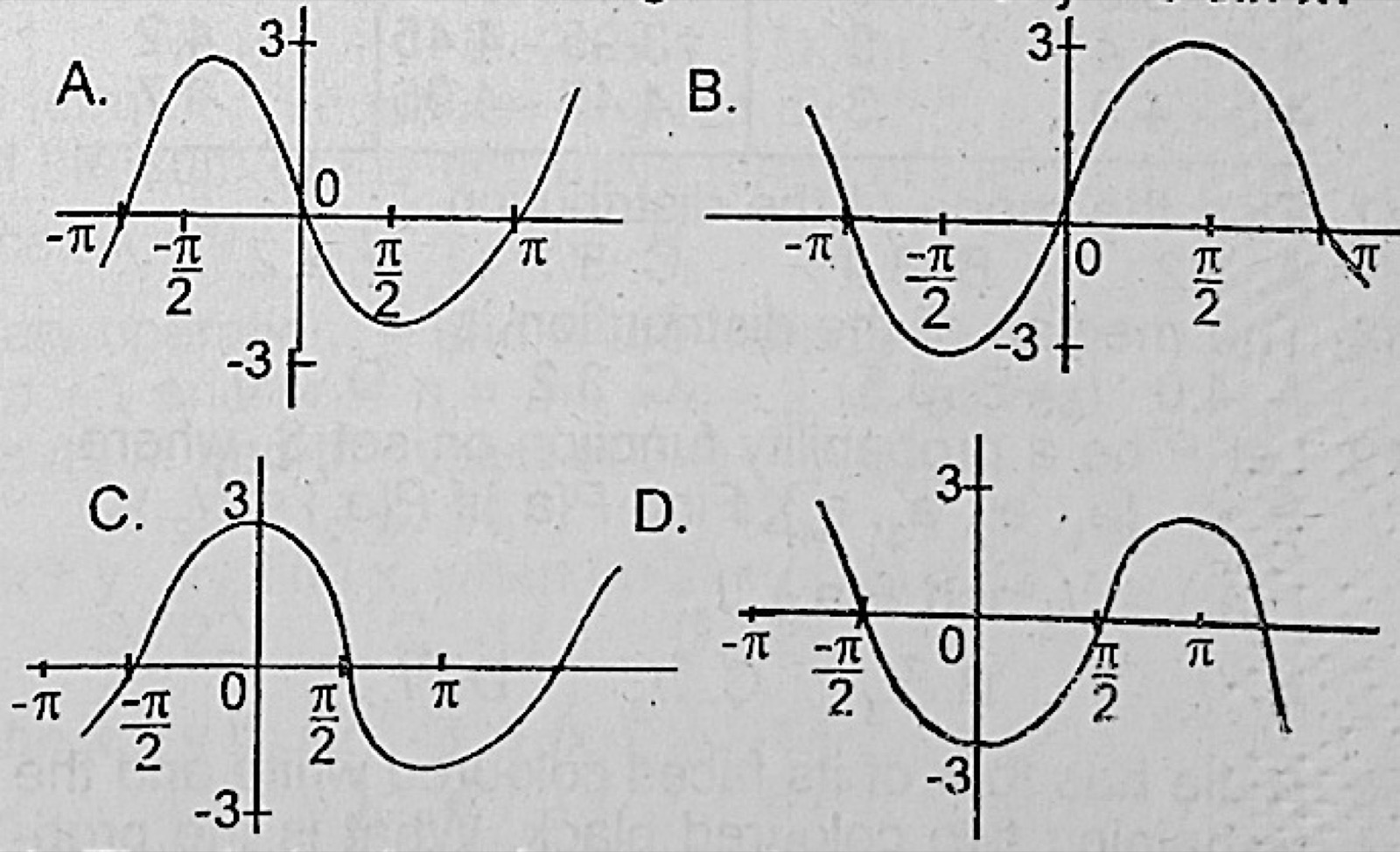
Which of the following is a sketch of y = 3 sin x?

Diagram for this question
  1. A.Graph A
  2. B.Graph B
  3. C.Graph C
  4. D.Graph D
Show the answer and explanation

Answer: B (Graph B)

Explanation

y = 3 sin x passes through the origin, rises to 3 at x = π/2, returns to 0 at π and is negative between −π and 0. Only graph B does this.

Open this question

Question 38

Differentiation

The derivative of cosec x is

  1. A.tan x cosec x
  2. B.−cot x cosec x
  3. C.tan x sec x
  4. D.−cot x sec x
Show the answer and explanation

Answer: B (−cot x cosec x)

Explanation

cosec x = (sin x)−1, so its derivative is −(sin x)−2 × cos x = −(cos x/sin x)(1/sin x) = −cot x cosec x.

Open this question

Question 39

Differentiation

For what value of x is the tangent to the curve y = x2 − 4x + 3 parallel to the x-axis?

  1. A.3
  2. B.2
  3. C.1
  4. D.0
Show the answer and explanation

Answer: B (2)

Explanation

A tangent parallel to the x-axis has gradient 0. dy/dx = 2x − 4 = 0 gives x = 2.

Open this question

Question 40

Integration

Two variables x and y are such that dy/dx = 4x − 3 and y = 5 when x = 2. Find y in terms of x.

  1. A.2x2 − 3x + 5
  2. B.2x2 − 3x + 3
  3. C.2x2 − 3x
  4. D.4
Show the answer and explanation

Answer: B (2x2 − 3x + 3)

Explanation

Integrate: y = 2x² − 3x + c. When x = 2, y = 5: 8 − 6 + c = 5, so c = 3 and y = 2x² − 3x + 3.

Open this question

Question 41

Integration

Find the area bounded by the curve y = 3x2 − 2x + 1, the ordinates x = 1 and x = 3 and the x-axis

  1. A.24
  2. B.22
  3. C.21
  4. D.20
Show the answer and explanation

Answer: D (20)

Explanation

Area = ∫ from 1 to 3 of (3x² − 2x + 1) dx = [x³ − x² + x] from 1 to 3 = 21 − 1 = 20 square units.

Open this question

Question 42

Data Presentation

Ages in years: 13, 14, 15, 16, 17
No. of students: 3, 10, 30, 42, 15
The frequency distribution above shows the ages of students in a secondary school. In a pie chart constructed to represent the data, the angles corresponding to the 15 years-old is.

  1. A.27°
  2. B.30°
  3. C.54°
  4. D.108°
Show the answer and explanation

Answer: D (108°)

Explanation

There are 100 students, and 30 are 15 years old. Angle = 30/100 × 360° = 108°.

Open this question

Question 43

Data Presentation

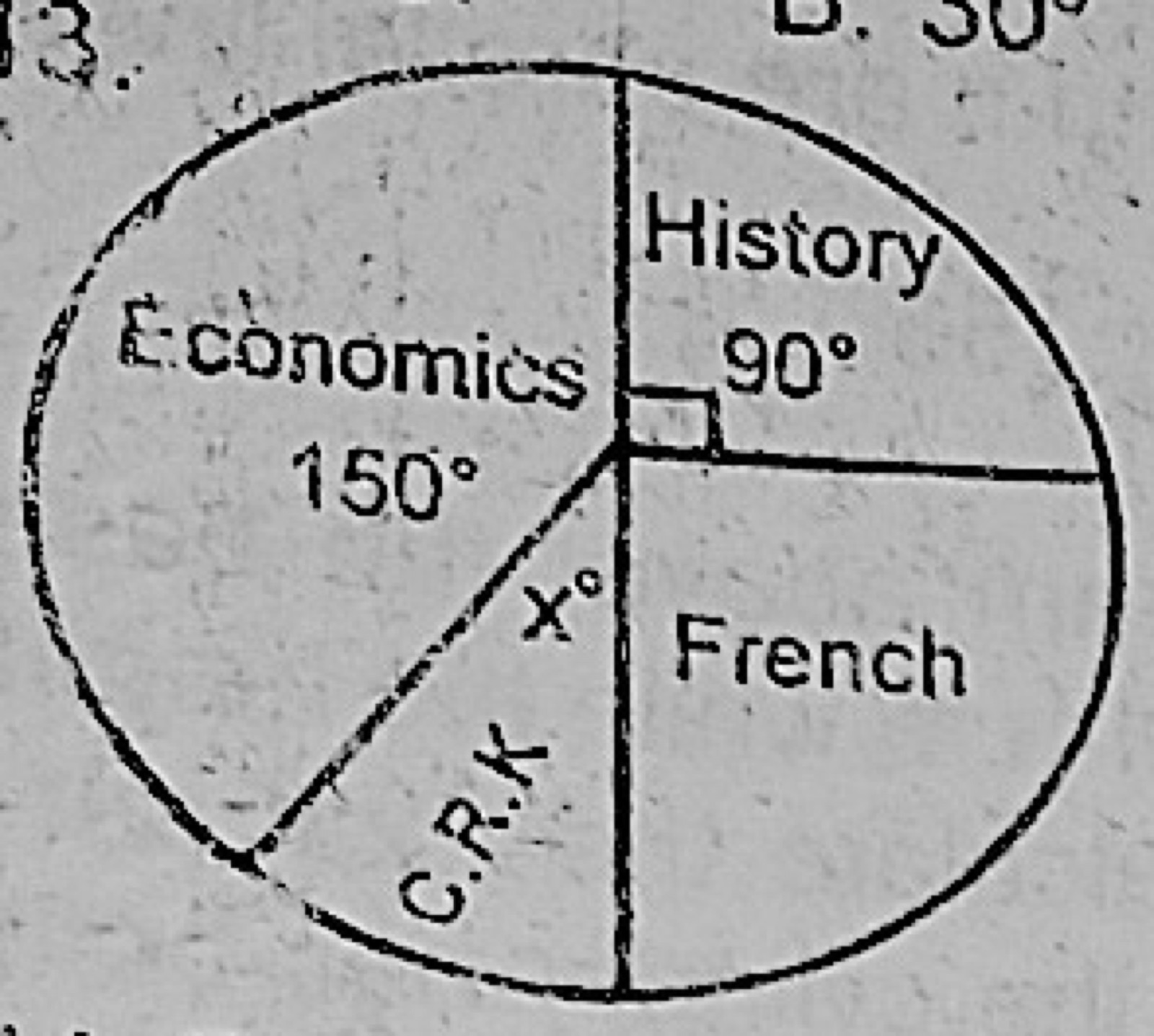
The pie chart above shows the distribution of students in a secondary school class. If 30 students offered French, how many offered CRK?

Diagram for this question
  1. A.25
  2. B.15
  3. C.10
  4. D.8
Show the answer and explanation

Answer: C (10)

Explanation

French fills a right angle, 90°. CRK's angle is x = 360° − 90° − 150° − 90° = 30°. 90° stands for 30 students, so 30° stands for 10 students.

Open this question

Question 44

Measures of Dispersion

The mean and the range of the set of numbers 1.20, 1.00, 0.90, 1.40, 0.80, 0.80, 1.20 and 1.10 are m and r respectively. Find m + r.

  1. A.1.11
  2. B.1.65
  3. C.1.85
  4. D.2.45
Show the answer and explanation

Answer: B (1.65)

Explanation

The eight numbers add up to 8.40, so m = 1.05. The range is 1.40 − 0.80 = 0.60. m + r = 1.65.

Open this question

Question 45

Measures of Dispersion

Class: 1-3, 4-6, 7-9
Frequency: 5, 8, 5
Find the standard deviation of the data using the table above.

  1. A.5
  2. B.√6
  3. C.5/3
  4. D.√5
Show the answer and explanation

Answer: D (√5)

Explanation

Use the class mid-points 2, 5, 8. The mean is 5. Σf(x − 5)² = 5(9) + 8(0) + 5(9) = 90, and 90/18 = 5 is the variance, so the standard deviation is √5.

Open this question

Question 46

Measures of Dispersion

The variance of the scores 1, 2, 3, 4, 5, is

  1. A.1.2
  2. B.1.4
  3. C.2.0
  4. D.3.0
Show the answer and explanation

Answer: C (2.0)

Explanation

The mean is 3. The squared deviations are 4, 1, 0, 1, 4, total 10. Variance = 10/5 = 2.0.

Open this question

Question 47

Measures of Central Tendency

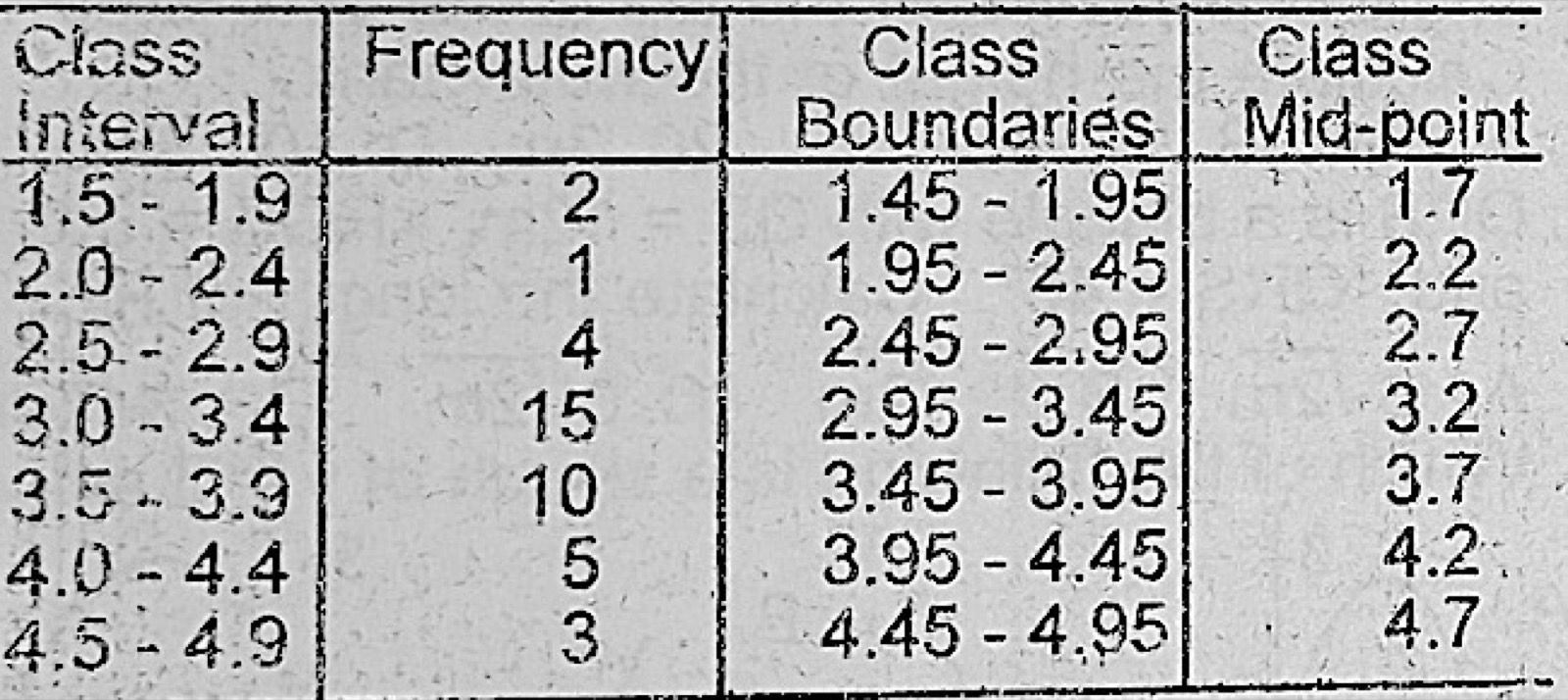
Class interval (frequency): 1.5-1.9 (2), 2.0-2.4 (1), 2.5-2.9 (4), 3.0-3.4 (15), 3.5-3.9 (10), 4.0-4.4 (5), 4.5-4.9 (3). The class boundaries are 1.45-1.95, 1.95-2.45, … , 4.45-4.95 and the class mid-points 1.7, 2.2, 2.7, 3.2, 3.7, 4.2, 4.7.
Find the mode of the distribution.

Diagram for this question
  1. A.3.2
  2. B.3.4
  3. C.3.7
  4. D.4.2
Show the answer and explanation

Answer: A (3.2)

Explanation

The modal class is 3.0–3.4 (boundaries 2.95–3.45). Mode = 2.95 + 11/(11 + 5) × 0.5 ≈ 3.29, which is closest to 3.2.

Open this question

Question 49

Probability

Let P be a probability function on set S, where S = {a1, a2, a3, a4}. Find P{a1} if P{a2} = ⅓, P(a3) = ⅙ and P(a4) = ⅕.

  1. A.7/10
  2. B.⅔
  3. C.⅓
  4. D.3/10
Show the answer and explanation

Answer: D (3/10)

Explanation

The four probabilities must add up to 1. P(a₁) = 1 − (⅓ + ⅙ + ⅕) = 1 − 21/30 = 9/30 = 3/10.

Open this question

Question 50

Probability

A die has four of its faces coloured white and the remaining two coloured black. What is the probability that when the die is thrown two consecutive times, the top face will be white in both cases?

  1. A.⅔
  2. B.1/9
  3. C.4/9
  4. D.1/36
Show the answer and explanation

Answer: C (4/9)

Explanation

P(white) = 4/6 = ⅔ on each throw, and the throws are independent: ⅔ × ⅔ = 4/9.
Open this question