Home › Past questions › JAMB › Mathematics › 1985 48 questions. Try each one, then open the answer to check yourself and read the explanation.
Sign up free to answer these questions on a CBT screen with a timer, then see your score and every answer explained.
Start practising free
Question 1 Fractions, Decimals and Approximation Arrange the following numbers in ascending order of magnitude 6/7, 13/15, 0.865
A. 6 /7 < 0.865 < 13 /15 B. 6 /7 < 13 /15 < 0.865C. 13 /15 < 6 /7 < 0.865D. 13 /15 < 0.865 < 6 /7 E. 0.865 < 6 /7 < 13 /15 Show the answer and explanation Answer: A (6 /7 < 0.865 < 13 /15
Explanation 6/7 ≈ 0.8571 and 13/15 ≈ 0.8667, so the order is 6/7 < 0.865 < 13/15.
Open this question
Question 2 Commercial Arithmetic A sum of money was invested at 8% per annum simple interest. If after 4 years the money amounts to ₦330.00, find the amount originally invested.
A. ₦180.00 B. ₦165.00 C. ₦150.00 D. ₦200.00 E. ₦250.00 Show the answer and explanation Answer: E (₦250.00 )
Explanation In 4 years at 8% the interest is 32% of the principal, so 1.32P = 330 and P = ₦250.00.
Open this question
Question 3 Number Bases In the equation below, solve for x if all the numbers are in base 2.
A. 101 B. 11 C. 110 D. 111 E. 10. Show the answer and explanation Answer: B (11 )
Explanation In base ten the equation is 3/x = 8/(x + 5), so 3x + 15 = 8x and x = 3, which is 11 in base 2.
Open this question
Question 4 Inequalities List all integers satisfying the inequality −2 ≤ 2x − 6 < 4
A. 2, 3, 4, 5 B. 2, 3, 4 C. 2, 5 D. 3, 4, 5 E. 4, 5. Show the answer and explanation Answer: B (2, 3, 4 )
Explanation Add 6: 4 ≤ 2x < 10, so 2 ≤ x < 5. The integers are 2, 3 and 4.
Open this question
Question 5 Fractions, Decimals and Approximation Find correct to two decimal places 100 + 1/100 + 3/1000 + 27/10000
A. 100.02 B. 1000.02 C. 100.22 D. 100.01 E. 100.51. Show the answer and explanation Answer: A (100.02 )
Explanation 100 + 0.01 + 0.003 + 0.0027 = 100.0157, which is 100.02 to two decimal places.
Open this question
Question 6 Fractions, Decimals and Approximation Simplify ½ + 1/(2 + 1/(2 − 1/(4 + 1 /5 )))
A. −3 /4 B. −1 /3 C. 169 /190 D. 13 /15 E. 121 /169 Show the answer and explanation Answer: C (169 /190
Explanation Work from the bottom: 4 + 1/5 = 21/5, 2 − 5/21 = 37/21, 2 + 21/37 = 95/37, and ½ + 37/95 = (95 + 74)/190 = 169/190.
Open this question
Question 7 Ratio, Percentages and Rates If three numbers p, q, r are in the ratio 6:4:5, find the value of (3p − q)/(4q + r)
A. 3 /2 B. 2 /3 C. 2 D. 3 E. 18. Show the answer and explanation Answer: B (2 /3
Explanation Put p = 6, q = 4, r = 5: (18 − 4)/(16 + 5) = 14/21 = 2/3.
Open this question
Question 8 Logarithms Without using tables, evaluate log2 4 + log4 2 − log25 5
A. 1 /2 B. 1 /5 C. 0 D. 5 E. 2. Show the answer and explanation Answer: E (2. )
Explanation log₂4 = 2, log₄2 = ½ (since √4 = 2) and log₂₅5 = ½. So 2 + ½ − ½ = 2.
Open this question
Question 9 Linear and Simultaneous Equations John gives one-third of his money to Janet who had ₦105.00. He then finds that his money is reduced to one-fourth of what Janet now has. Find how much money John had at first.
A. ₦45.00 B. ₦48.00 C. ₦52.00 D. ₦58.00 E. ₦60.00. Show the answer and explanation Answer: A (₦45.00 )
Explanation John keeps 2x/3 and Janet has 105 + x/3. 2x/3 = ¼(105 + x/3) gives 8x = 315 + x, so x = 45: ₦45.00.
Open this question
Question 10 Logarithms Find x if log9 x = 1.5
A. 72.0 B. 27.0 C. 36.0 D. 3.5 E. 24.5. Show the answer and explanation Answer: B (27.0 )
Explanation x = 9^1.5 = (√9)³ = 3³ = 27.
Open this question
Question 11 Algebraic Expressions Write h in terms of a, b, c, d if a = b(1 − ch)/(1 − dh)
A. h = (a − b)/(ad − bc) B. h = (a + b)/(ad − bc) C. h = (ad − bc)/(a − b) D. h = a(1 − b)/(d − bc) E. h = (b − a)/(ad − bc) Show the answer and explanation Answer: A (h = (a − b)/(ad − bc) )
Explanation a − adh = b − bch, so a − b = adh − bch = h(ad − bc), giving h = (a − b)/(ad − bc).
Open this question
Question 12 Commercial Arithmetic 22½% of the Nigerian naira is equal to 171 /10 % of a foreign currency M. What is the conversion rate of the M to the naira?
A. 1M = 15 /57 ₦ B. 1M = 211 /57 ₦ C. 1M = 118 /57 ₦ D. 1M = 38¼₦ E. 1M = 384¾₦. Show the answer and explanation Answer: C (1M = 118 /57 ₦ )
Explanation 0.225 naira = 0.171 M, so 1 M = 0.225/0.171 = 225/171 = 1 54/171 = 1 18/57 naira.
Open this question
Question 13 Quadratic Equations Find the values of p for which the equation x2 − (p − 2)x + 2p + 1 = 0 has equal roots.
A. (0, 12) B. (1, 2) C. (21, 0) D. (4, 5) E. (3, 4). Show the answer and explanation Answer: A ((0, 12) )
Explanation Equal roots need b² = 4ac: (p − 2)² = 4(2p + 1), i.e. p² − 12p = 0, so p = 0 or 12.
Open this question
Question 14 Indices If ex = 1 + x + x2 /1.2 + x3 /1.2.3 + … Find 1/e½
A. 1 − x/2 + x2 /1.23 − x3 /24 .3 + … B. 1 + x/2 + x2 /1.22 + x3 /23 .3 + … C. 1 + x + x2 /1.23 − x3 /23 .3 + … D. 1 − x/2 − x2 /1.2.3 − x3 /1.2.3.4 + … E. 1 + x2 /1.2 + x3 /1.2.4 + x4 /1.2.6 + … Show the answer and explanation Answer: A (1 − x/2 + x2 /1.23 − x3 /24 .3 + … )
Explanation Replace x by −x/2 in the series: 1 − x/2 + (x/2)²/2 − (x/2)³/6 + … = 1 − x/2 + x²/8 − x³/48 + …, and 1.2³ = 8, 2⁴.3 = 48.
Open this question
Question 15 Surds (∜3 + ∜2)(∜3 − ∜2)(√3 + √2) is equal to
A. 0 B. ∜3 + ∜2 C. (∜3 − ∜2)(√3 + √2) D. √3 + √2 E. 1. Show the answer and explanation Answer: E (1. )
Explanation The first two brackets give (∜3)² − (∜2)² = √3 − √2. Then (√3 − √2)(√3 + √2) = 3 − 2 = 1.
Open this question
Question 16 Variation In a restaurant, the cost of providing a particular type of food is partly constant and partly inversely proportional to the number of people. If the cost per head for 100 people is 30k and the cost for 40 people is 60k, find the cost for 50 people.
A. 15k B. 45k C. 20k D. 50k E. 40k Show the answer and explanation Answer: D (50k )
Explanation Cost per head C = a + k/N. 30 = a + k/100 and 60 = a + k/40 give k = 2000 and a = 10. For 50 people: 10 + 2000/50 = 50k.
Open this question
Question 17 Algebraic Expressions The factors of 9 − (x2 − 3x − 1)2 are
A. −(x − 4)(x + 1)(x − 1)(x − 2) B. (x − 4)(x − 2)(x − 1)(x + 1) C. −(x − 2)(x + 1)(x + 2)(x + 4) D. (x − 4)(x − 3)(x − 2)(x + 1) E. (x − 2)(x + 2)(x − 1)(x + 1). Show the answer and explanation Answer: A (−(x − 4)(x + 1)(x − 1)(x − 2) )
Explanation Difference of two squares: (3 − x² + 3x + 1)(3 + x² − 3x − 1) = −(x² − 3x − 4)(x² − 3x + 2) = −(x − 4)(x + 1)(x − 1)(x − 2).
Open this question
Question 18 Indices If 32y − 6(3y ) = 27, find y
A. 3 B. −1 C. 2 D. −3 E. 1. Show the answer and explanation Answer: C (2 )
Explanation Put u = 3ʸ: u² − 6u − 27 = 0, so (u − 9)(u + 3) = 0. 3ʸ cannot be negative, so 3ʸ = 9 and y = 2.
Open this question
Question 19 Algebraic Expressions Factorize abx2 + 8y − 4bx − 2axy
A. (ax − 4)(bx − 2y) B. (ax + b)(x − 8y) C. (ax − 2y)(by − 4) D. (abx − 4)(x − 2y) E. (bx − 4)(ax − 2y). Show the answer and explanation Answer: A ((ax − 4)(bx − 2y) )
Explanation Group the terms: bx(ax − 4) − 2y(ax − 4) = (ax − 4)(bx − 2y).
Open this question
Question 20 Graphs of Functions At what real value of x do the curves whose equations are y = x3 + x and y = x2 + 1 intersect?
A. −2 B. 2 C. −1 D. 0 E. 1. Show the answer and explanation Answer: E (1. )
Explanation x³ + x = x² + 1 gives x(x² + 1) − (x² + 1) = (x − 1)(x² + 1) = 0. Since x² + 1 is never zero, x = 1.
Open this question
Question 21 Quadratic Equations If the quadratic function 3x2 − 7x + R is a perfect square, find R
A. 49 /24 B. 49 /3 C. 49 /6 D. 49 /12 E. 49 /36 Show the answer and explanation Answer: D (49 /12
Explanation A perfect square has b² = 4ac: 49 = 4 × 3 × R, so R = 49/12.
Open this question
Question 22 Quadratic Equations Solve the following equation 2/(2r − 1) − 5/3 = 1/(r + 2)
A. (−1, 5 /2 ) B. (1, −5 /2 ) C. (5 /2 , 1) D. (2, 1) E. (1, 2). Show the answer and explanation Answer: B ((1, −5 /2 ) )
Explanation 2/(2r − 1) − 1/(r + 2) = 5/((2r − 1)(r + 2)) = 5/3, so (2r − 1)(r + 2) = 3, i.e. 2r² + 3r − 5 = 0. Then (r − 1)(2r + 5) = 0 and r = 1 or −5/2.
Open this question
Question 23 Linear and Simultaneous Equations Solve for (x,y) in the equations 2x + y = 4; x2 + xy = −12
A. (6, −8); (−2, 8) B. (3, −4); (−1, 4) C. (8, −4); (−1, 4) D. (−8, 6); (8, −2) E. (−4, 3); (4, −1) Show the answer and explanation Answer: A ((6, −8); (−2, 8) )
Explanation y = 4 − 2x, so x² + x(4 − 2x) = −12, i.e. x² − 4x − 12 = 0 and x = 6 or −2. Then y = −8 or 8.
Open this question
Question 25 Algebraic Expressions If f(x − 2) = 4x2 + x + 7 find f(1)
A. 12 B. 27 C. 7 D. 46 E. 17. Show the answer and explanation Answer: D (46 )
Explanation f(1) needs x − 2 = 1, so x = 3: 4(9) + 3 + 7 = 46.
Open this question
Question 26 Trigonometry In ΔXYZ, XY = 13cm, YZ = 9cm, XZ = 11cm and XYZ = θ°. Find cos θ°
A. 4 /39 B. 43 /39 C. 209 /286 D. −1 /6 E. 43 /78 .Show the answer and explanation Answer: E (43 /78 .
Explanation By the cosine rule, cos θ = (13² + 9² − 11²)/(2 × 13 × 9) = 129/234 = 43/78.
Open this question
Question 27 Graphs of Functions Find the missing value in the table below3 : 80, ___, 18, 8, 4, 0, 10, 32
A. −32 B. −14 C. 40 D. 22 E. 37. Show the answer and explanation Answer: C (40 )
Explanation At x = −3: y = 4 − 3(−3) − (−3)³ = 4 + 9 + 27 = 40.
Open this question
Question 28 Measures of Central Tendency The number of goals scored by a football team in 20 matches is shown below
A. (1.75, 5) B. (1.75, 2) C. (1.75, 1) D. (2, 2) E. (2, 1). Show the answer and explanation Answer: B ((1.75, 2) )
Explanation Total goals = 0 + 5 + 14 + 12 + 4 = 35 in 20 matches, so the mean is 1.75. 2 goals happened most often (7 times), so the mode is 2.
Open this question
Question 29 Triangles and Quadrilaterals If the hypotenuse of a right angled isosceles triangle is 2, what is the length of each of the other sides?
A. √2 B. 1/√2 C. 2√2 D. 1 E. √2 − 1. Show the answer and explanation Answer: A (√2 )
Explanation With equal sides x: x² + x² = 2², so x² = 2 and x = √2.
Open this question
Question 30 Probability If two fair coins are tossed, what is the probability of getting at least one head?
A. 1 /4 B. 1 /2 C. 1 D. 2 /3 E. 3 /4 Show the answer and explanation Answer: E (3 /4
Explanation The only outcome with no head is TT, with probability ¼. So P(at least one head) = 1 − ¼ = ¾.
Open this question
Question 31 Mensuration of Solids The ratio of the length of two similar rectangular blocks is 2:3. If the volume of the larger block is 351cm3 , then the volume of the other block is
A. 234.00cm3 B. 526.50cm3 C. 166.00cm3 D. 729.75cm3 E. 104.00cm3 . Show the answer and explanation Answer: E (104.00cm3 . )
Explanation Lengths 2:3 means volumes 2³ : 3³ = 8 : 27. So the smaller volume is 351 × 8/27 = 104cm³.
Open this question
Question 32 Bearings The bearing of a bird on a tree from a hunter on the ground is N72°E. What is the bearing of the hunter from the bird?
A. S18°W B. S72°W C. S72°E D. S27°E E. S27° W. Show the answer and explanation Answer: B (S72°W )
Explanation A back bearing points the opposite way: north becomes south and east becomes west, with the same angle. So N72°E becomes S72°W.
Open this question
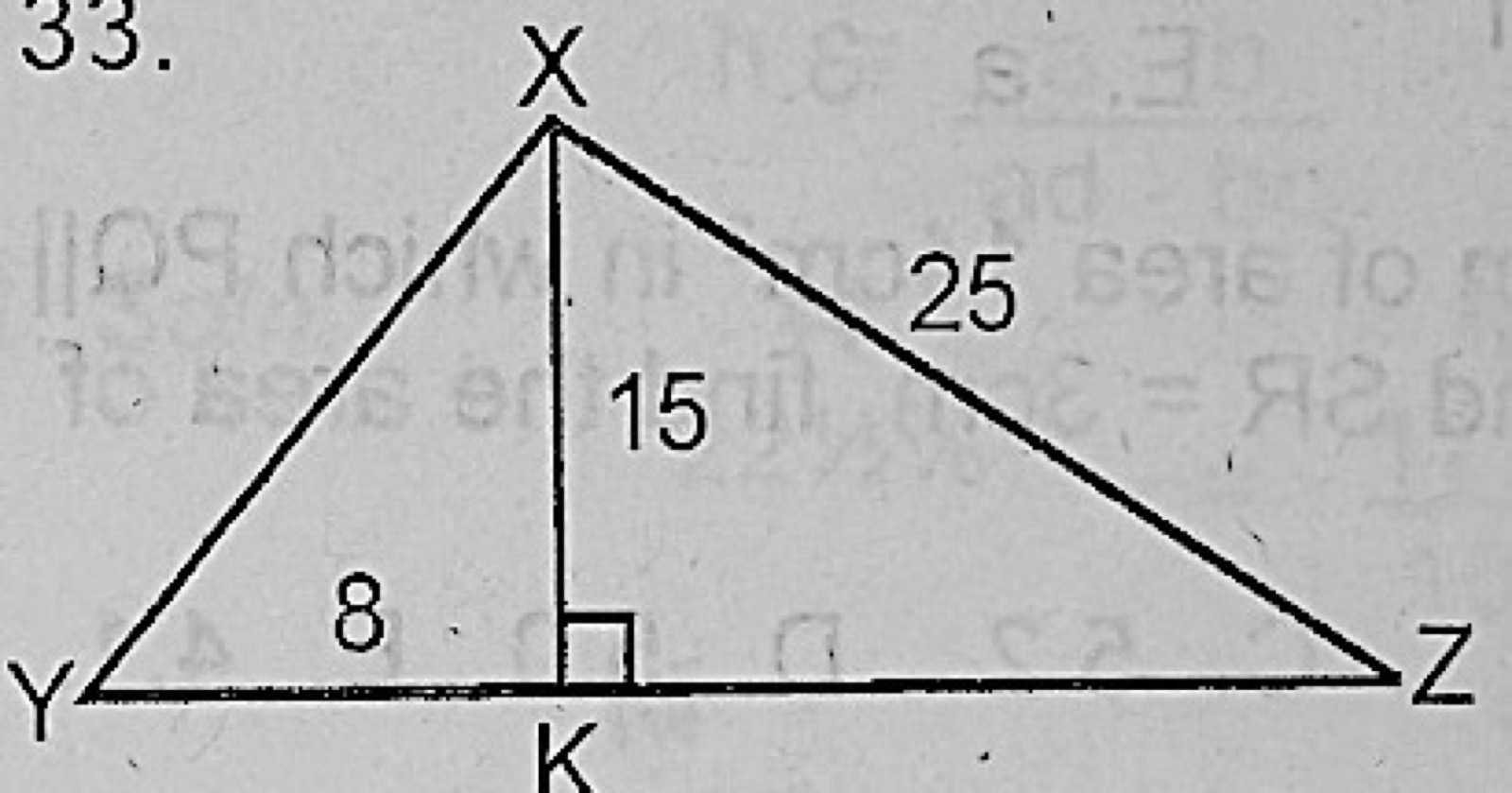
Question 33 Mensuration of Plane Shapes In ΔXYZ above, XKZ = 90°, XK = 15cm, XZ = 25cm and YK = 8cm. Find the area of ΔXYZ.
A. 180sq. cm B. 210sq.cm C. 160sq. cm D. 320sq.cm E. 390sq. cm. Show the answer and explanation Answer: B (210sq.cm )
Explanation KZ = √(25² − 15²) = 20cm, so YZ = 8 + 20 = 28cm. Area = ½ × 28 × 15 = 210sq.cm.
Open this question
Question 34 Trigonometry Without using tables, calculate the value of 1 + sec2 30°.
A. 2⅓ B. 2 C. 1⅓ D. 3 /4 E. 3 /7 Show the answer and explanation Answer: A (2⅓ )
Explanation sec 30° = 2/√3, so sec² 30° = 4/3 and 1 + 4/3 = 2⅓.
Open this question
Question 35 Probability What is the probability that a number chosen at random from the integers between 1 and 10 inclusive is either a prime or a multiple of 3?
A. 7 /10 B. 3 /5 C. 4 /5 D. 1 /2 E. 3 /10 Show the answer and explanation Answer: B (3 /5
Explanation Primes: 2, 3, 5, 7. Multiples of 3: 3, 6, 9. Together (counting 3 once) that is 6 numbers out of 10, so the probability is 3/5.
Open this question
Question 36 Mensuration of Plane Shapes Find the area of a regular hexagon inscribed in a circle of radius 8cm.
A. 16√3cm2 B. 96√3cm2 C. 192√3cm2 D. 16cm2 E. 32cm2 . Show the answer and explanation Answer: B (96√3cm2 )
Explanation The hexagon is six equilateral triangles of side 8cm: 6 × (√3/4) × 64 = 96√3cm².
Open this question
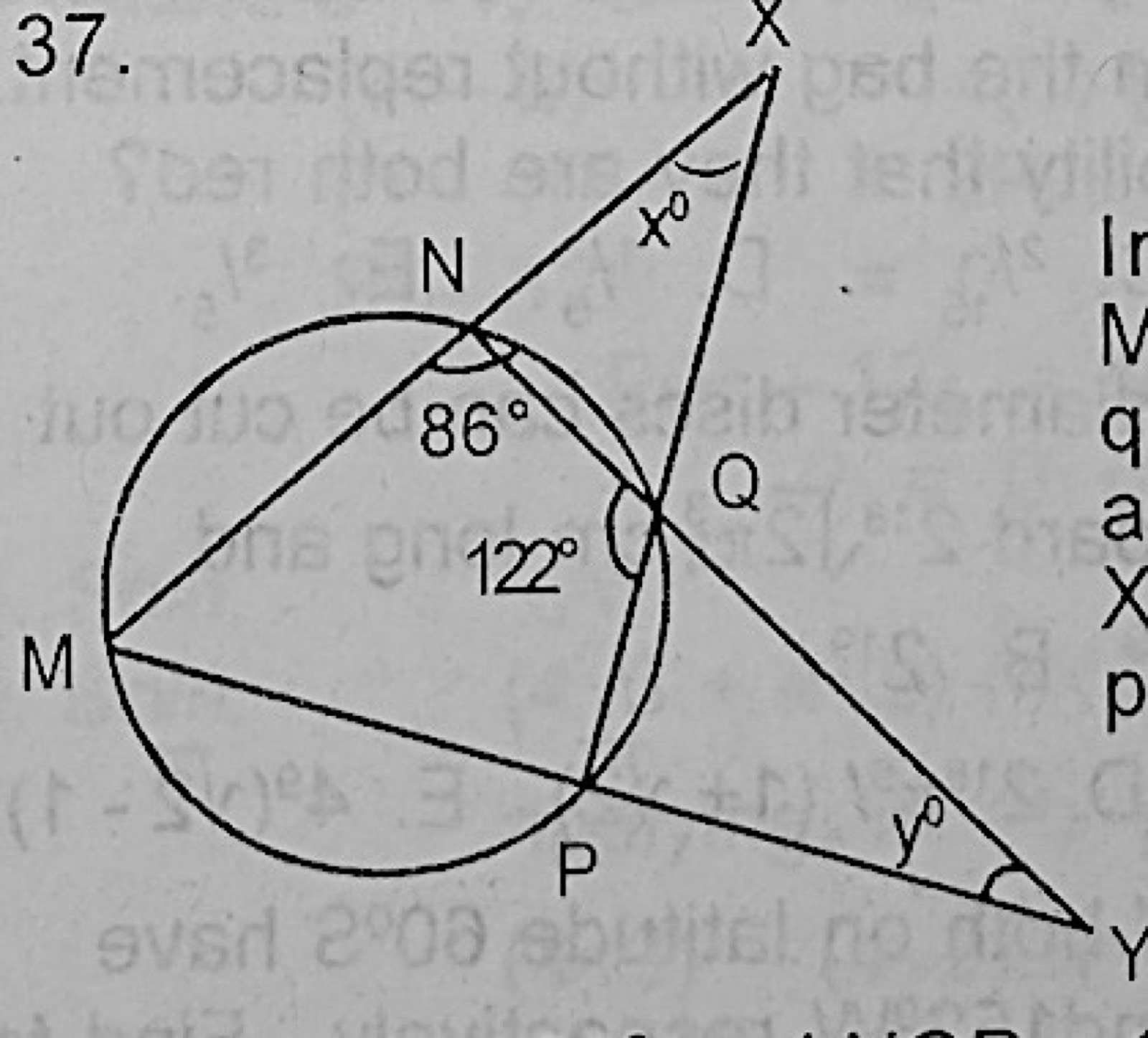
Question 37 Circle Theorems In the figure above, MNQP is a cyclic quadrilateral. MN and PQ are produced to meet at X and NQ and MP are produced to meet at Y. If MNQ = 86° and NQP = 122°, find (x°, y°).
A. (28°, 36°) B. (36°, 28°) C. (43°, 61°) D. (61°, 43°) E. (36°, 43°). Show the answer and explanation Answer: A ((28°, 36°) )
Explanation Opposite angles of a cyclic quadrilateral add to 180°, so <M = 58° and <MPQ = 94°. In triangle MXP, x = 180° − 58° − 94° = 28°. In triangle MNY, y = 180° − 58° − 86° = 36°.
Open this question
Question 38 Trigonometry If cos θ = √3/2 and θ is less than 90°, calculate cot (90 − θ)/sin2 θ
A. 4√3/3 B. 4√3 C. √3/√2 D. 1/√3 E. 2/√3 Show the answer and explanation Answer: A (4√3/3 )
Explanation θ = 30°. cot 60° = 1/√3 and sin² 30° = ¼, so the value is 4/√3 = 4√3/3.
Open this question
Question 39 Mensuration of Solids A solid sphere of radius 4cm has a mass of 64kg. What will be the mass of a shell of the same metal whose internal and external radii are 2cm and 3cm respectively?
A. 5kg B. 16kg C. 19kg D. 25kg E. 48kg. Show the answer and explanation Answer: C (19kg )
Explanation Mass ∝ r³. The shell's volume is proportional to 3³ − 2³ = 19 and the solid sphere's to 4³ = 64, so the mass is 64 × 19/64 = 19kg.
Open this question
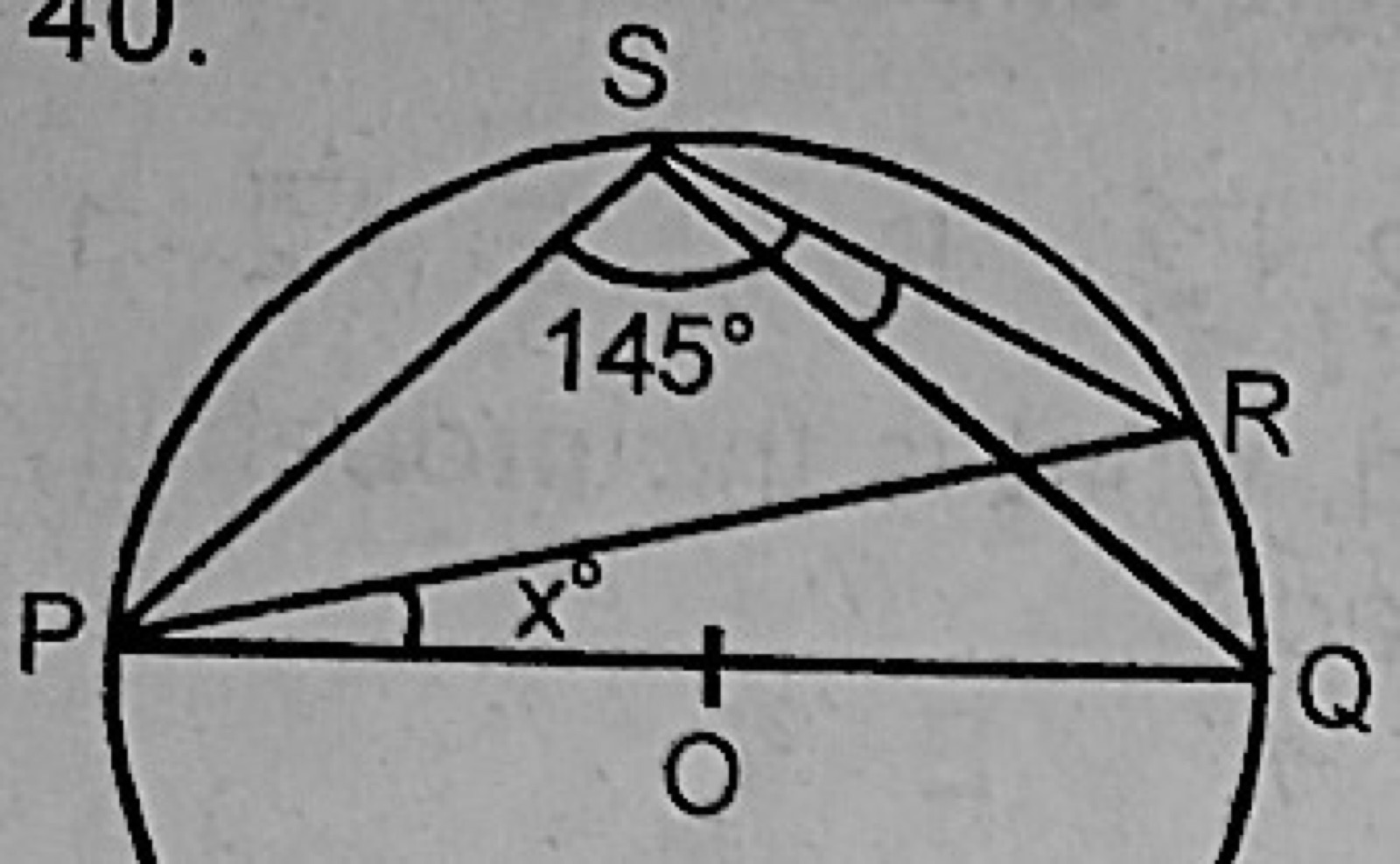
Question 40 Circle Theorems In the figure above POQ is the diameter of the circle PQRS. If PSR = 145°, find x°
A. 25° B. 35° C. 45° D. 55° E. 25°. Show the answer and explanation Answer: D (55° )
Explanation PQRS is cyclic, so <PQR = 180° − 145° = 35°. <PRQ = 90° (angle in a semicircle), so x = <QPR = 180° − 90° − 35° = 55°.
Open this question
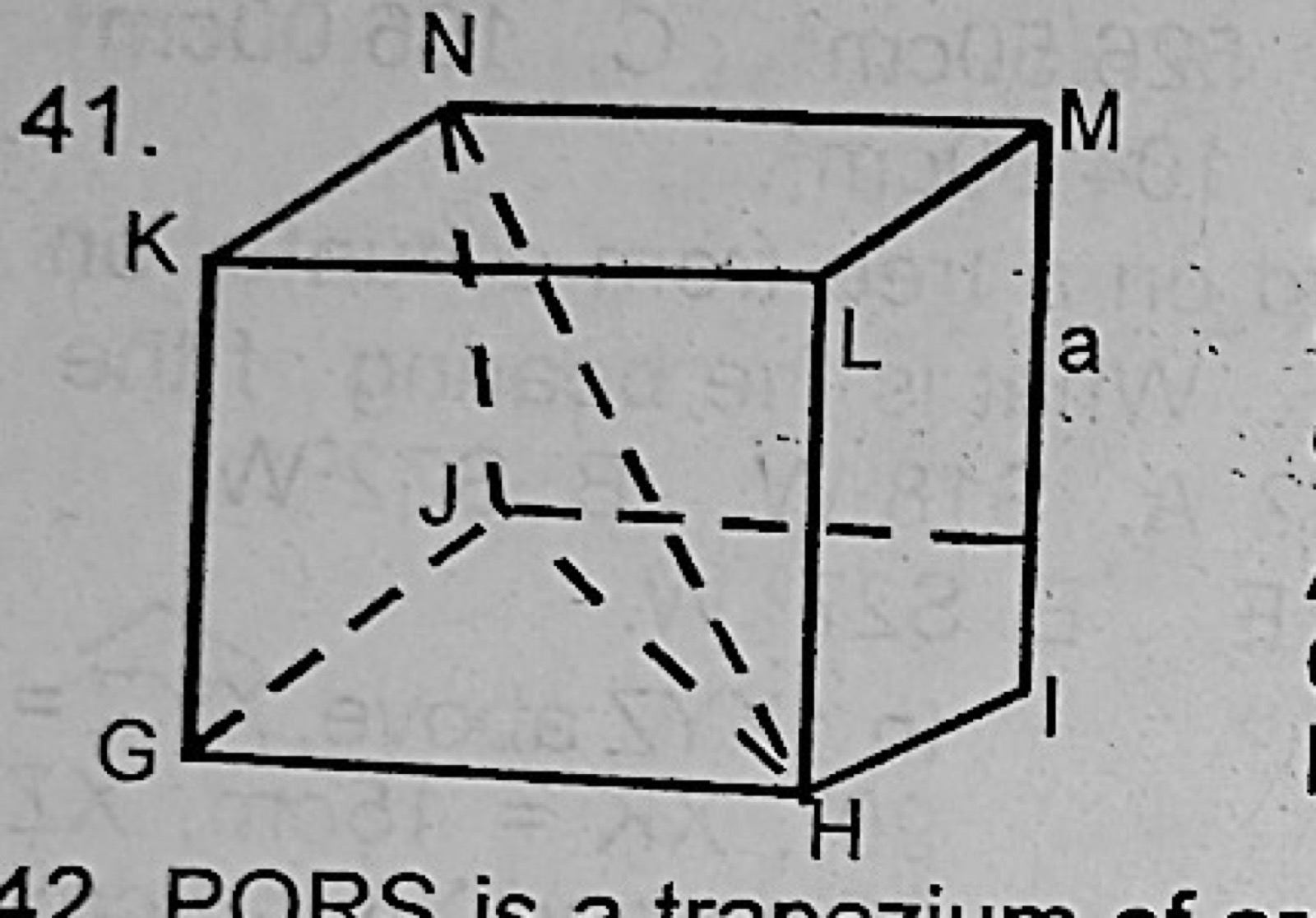
Question 41 Mensuration of Solids In the figure above GHIJKLMN is a cube of side a. Find the length of HN.
A. √3a B. √3a C. 3a2 D. a√2 E. a 3. Show the answer and explanation Answer: A (√3a )
Explanation HN goes from a bottom front corner to the opposite top back corner. HN² = a² + a² + a² = 3a², so HN = √3a.
Open this question
Question 42 Mensuration of Plane Shapes PQRS is a trapezium of area 14cm2 in which PQ∥RS. If PQ = 4cm and SR = 3cm, find the area of ΔSQR in cm2 .
A. 7.0 B. 6.0 C. 5.2 D. 5.0 E. 4.1. Show the answer and explanation Answer: B (6.0 )
Explanation ½(4 + 3)h = 14 gives h = 4cm. Triangle SQR has base SR = 3cm and the same height: ½ × 3 × 4 = 6.0cm².
Open this question
Question 44 Probability A bag contains 4 white balls and 6 red balls. Two balls are taken from the bag without replacement. What is the probability that they are both red?
A. 1 /3 B. 2 /9 C. 2 /15 D. 1 /5 E. 3 /5 .Show the answer and explanation Answer: A (1 /3
Explanation P(first red) = 6/10 and P(second red) = 5/9, so P(both red) = 6/10 × 5/9 = 1/3.
Open this question
Question 45 Mensuration of Plane Shapes How many 2√2cm diameter discs can be cut out of a sheet of cardboard 218 √2π¾ cm long and √2π¼ cm wide?
A. 49 B. 219 C. 217 π¾ (√2 + 2) D. 218 π5/4 (1 + √2) E. 49 (√2 − 1) Show the answer and explanation Answer: A (49 )
Explanation Divide the areas: the sheet is 2¹⁸√2π^¾ × √2π^¼ = 2¹⁹π cm² and each disc is π(√2)² = 2π cm², giving 2¹⁸ = 4⁹ discs.
Open this question
Question 46 Latitude and Longitude Two points X and Y both on latitude 60°S have longitudes 147°E and 153°W respectively. Find to the nearest kilometre the distance between X and Y measured along the parallel of latitude. (Take 2πR = 4 × 10⁴ km, where R is the radius of the earth).
A. 28,850km B. 16,667km C. 8,333km D. 6,667km E. 3,333km. Show the answer and explanation Answer: E (3,333km. )
Explanation Going across the 180° line, the angle between 147°E and 153°W is 33° + 27° = 60°. The parallel at 60° has length 2πR cos 60° = 20 000km, so the distance is 60/360 × 20 000 ≈ 3,333km.
Open this question
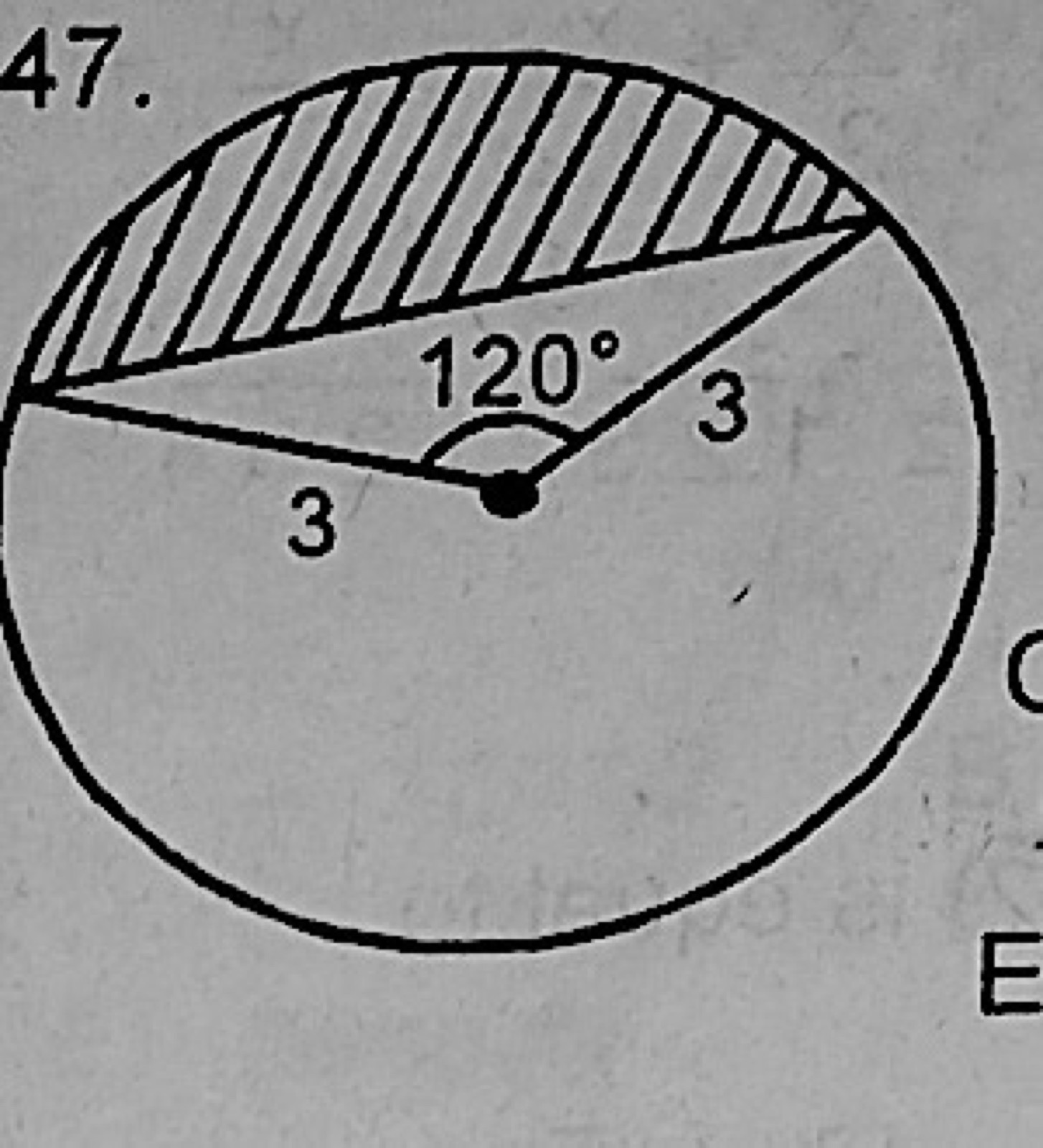
Question 47 Mensuration of Plane Shapes In the figure above the area of the shaded segment is
A. 3π B. 9√3/4 C. 3(π − 3√3/4) D. 3(√3 − π)/4 E. π + 9√3/4 Show the answer and explanation Answer: C (3(π − 3√3/4) )
Explanation Sector = 120/360 × π × 3² = 3π. Triangle = ½ × 3 × 3 × sin 120° = 9√3/4. Segment = 3π − 9√3/4 = 3(π − 3√3/4).
Open this question
Question 48 Data Presentation In a class of 120 students, 18 of them scored an A grade in Mathematics. If the section representing the A grade students on a pie chart has angle Z° at the centre of the circle, what is Z?
A. 15 B. 27 C. 50 D. 52 E. 54. Show the answer and explanation Answer: E (54. )
Explanation Z = 18/120 × 360° = 54°.
Open this question
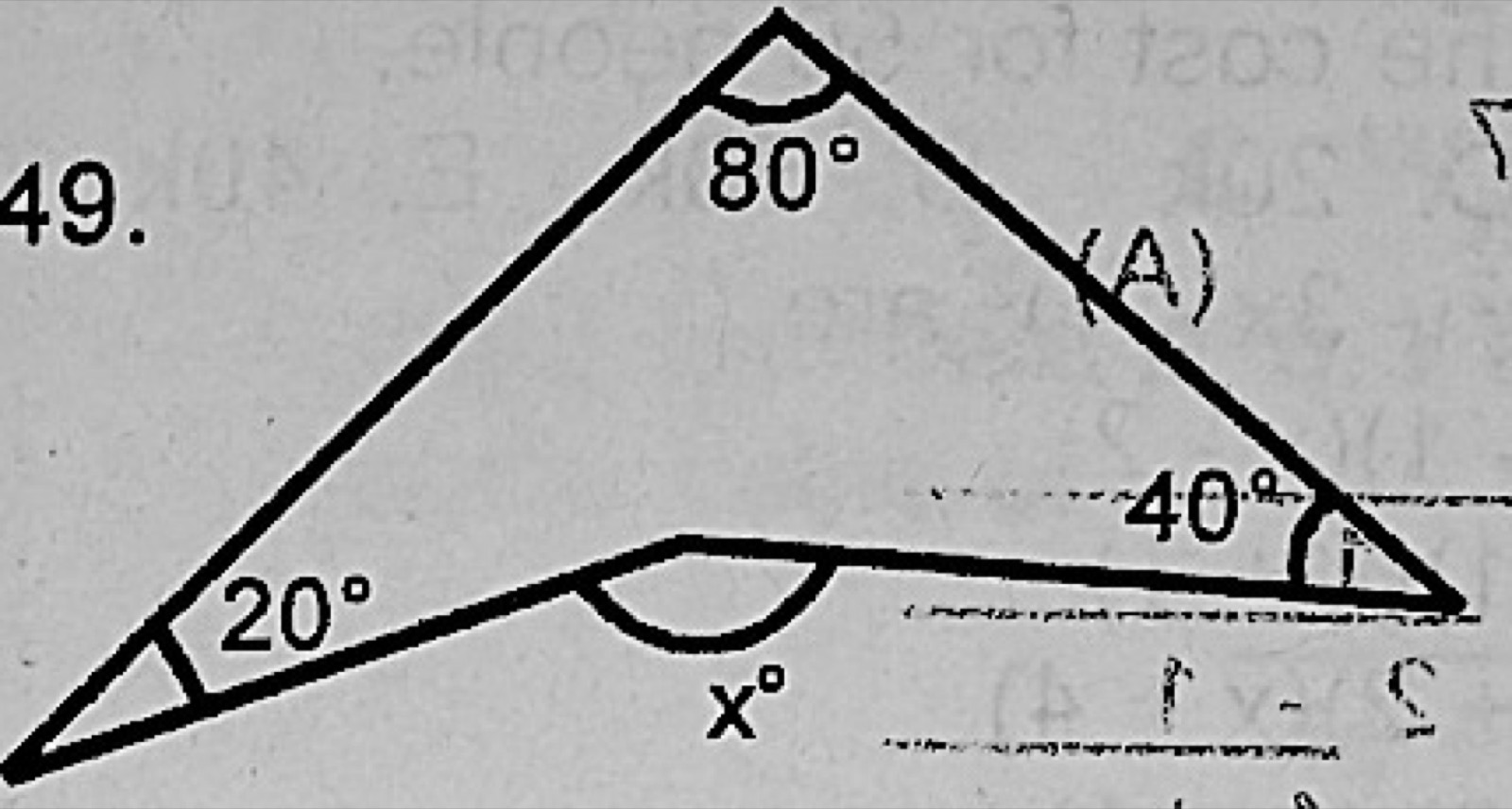
Question 49 Triangles and Quadrilaterals In the figure above find angle x
A. 100° B. 120° C. 60° D. 110° E. 140°. Show the answer and explanation Answer: E (140°. )
Explanation In this arrowhead shape the angle x at the inner corner equals the sum of the other three angles: 20° + 80° + 40° = 140°.
Open this question
Question 50 Algebraic Expressions If a{(x + 1)/(x − 2) − (x − 1)/(x + 2)} = 6x, find a in its simplest form.
A. x2 − 1 B. x2 + 1 C. x2 + 4 D. 1 E. x2 − 4. Show the answer and explanation Answer: E (x2 − 4. )
Explanation The bracket is ((x + 1)(x + 2) − (x − 1)(x − 2))/(x² − 4) = 6x/(x² − 4). So a × 6x/(x² − 4) = 6x and a = x² − 4.
Open this question Sign up free for every JAMB Mathematics year, practice by topic and timed mocks.
Start practising free