Home › Past questions › JAMB › Economics › 2004 50 questions. Try each one, then open the answer to check yourself and read the explanation.
Sign up free to answer these questions on a CBT screen with a timer, then see your score and every answer explained.
Start practising free
Question 1 Market Structures By advertising, a monopolistic competitive firm tries to shift its
A. supply curve to the right B. demand curve to the right C. supply curve to the left D. demand curve to the left Show the answer and explanation Answer: B (demand curve to the right )
Explanation Advertising aims to persuade more people to buy the firm's product at every price, which shifts its demand curve to the right.
Open this question
Question 2 National Income Given that Y = C + I and C = bY where b = 0.8, what is the multiplier?
A. 5 B. 10 C. 4 D. 2 Show the answer and explanation Answer: A (5 )
Explanation b is the marginal propensity to consume. Multiplier = 1/(1 − b) = 1/(1 − 0.8) = 1/0.2 = 5.
Open this question
Question 3 Financial Institutions The role of the Central Bank in the economic development of Nigeria is to
A. give short-and medium-term loans to the public B. give financial and technical advice to customers C. use cheques and bankdrafts to facilitate business transactions D. maintain a stable price system Show the answer and explanation Answer: D (maintain a stable price system )
Explanation The Central Bank controls money and credit to keep prices stable, which supports development. It does not lend to or advise the general public.
Open this question
Question 4 Financial Institutions The primary function of non-bank financial institutions is to
A. manage investment portfolios for government B. mobilize savings for investment C. grant loans to banks D. receive deposits from banks Show the answer and explanation Answer: B (mobilize savings for investment )
Explanation Insurance companies, pension funds, building societies and similar bodies collect people's savings and channel them into investment.
Open this question
Question 5 Theory of Production At the maximum point of the total product curve of a firm, marginal revenue is
A. decreasing B. increasing C. constant D. zero Show the answer and explanation Answer: D (zero )
Explanation At the top of the total product curve, adding one more unit of the variable factor adds nothing to output, so the marginal (product) is zero.
Open this question
Question 6 National Income In an open economy, the GNP is measured as
A. C + I + G + X B. C + I + G + (X – M) C. C + I + G + M D. C + I + G Show the answer and explanation Answer: B (C + I + G + (X – M) )
Explanation An open economy trades with others, so national expenditure adds net exports: consumption + investment + government spending + (exports − imports).
Open this question
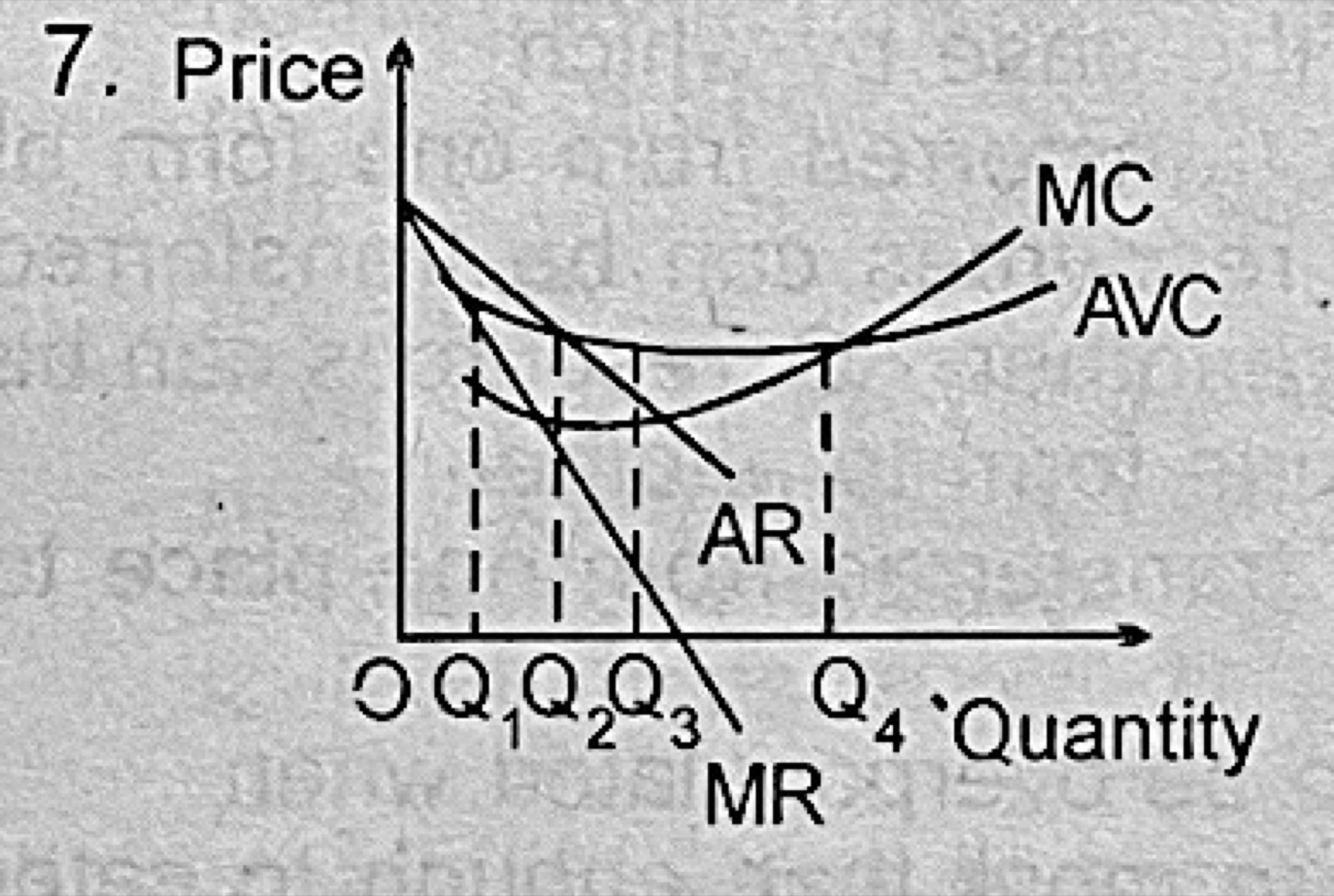
Question 7 Market Structures The diagram above represents the short-run position of a monopolist. The profit-maximizing output is
A. Q3 B. Q4 C. Q1 D. Q2 Show the answer and explanation Answer: D (Q2 )
Explanation Use the diagram. A monopolist maximises profit where marginal revenue equals marginal cost; the MR line cuts the MC curve at output Q2 .
Open this question
Question 8 Financial Institutions The capital market provides business firms with the avenue to
A. lease capital equipment B. obtain long-term funds C. obtain short-term funds D. purchase capital equipment Show the answer and explanation Answer: B (obtain long-term funds )
Explanation The capital market is where firms raise long-term funds by issuing shares and bonds.
Open this question
Question 9 Financial Institutions Which financial institution is charged with the formulation of monetary policies in Nigeria?
A. The Central Bank of Nigeria. B. The Nigerian Deposit Insurance Corporation. C. The Abuja Commodity Exchange. D. The Lagos Stock Exchange. Show the answer and explanation Answer: A (The Central Bank of Nigeria. )
Explanation The Central Bank of Nigeria is responsible for monetary policy: controlling money supply, credit and interest rates.
Open this question
Question 10 National Income GDP differs from GNP because GDP
A. is inclusive of depreciation B. emphasizes the final goods and services produced within the country at a particular period C. emphasizes the goods and services produced within the country D. emphasizes the market value of all final goods and services produced by nationals Show the answer and explanation Answer: B (emphasizes the final goods and services produced within the country at a particular period )
Explanation GDP measures final goods and services produced within the country's borders in a period, whoever produces them; GNP measures output by the country's nationals wherever they are.
Open this question
Question 11 Market Structures The distinction between perfect competition and monopolistic competition is that the latter is characterized by
A. a single market price B. many buyers and sellers C. product differentiation D. homogeneity of product Show the answer and explanation Answer: C (product differentiation )
Explanation Both have many buyers and sellers, but in monopolistic competition each firm's product is slightly different (branded), i.e. differentiated.
Open this question
Question 12 Natural Resources and Petroleum The downstream activities of oil companies in Nigeria involve
A. refining and distribution B. prospecting and exploration C. off-shore drilling D. management of spillage and pollution Show the answer and explanation Answer: A (refining and distribution )
Explanation Upstream covers finding and producing crude oil; downstream covers refining it and distributing and marketing the products.
Open this question
Question 13 Distributive Trade The movement of goods and services from the producers to the consumers is referred to as
A. external trade B. the distribution chain C. the circular flow D. consumption Show the answer and explanation Answer: B (the distribution chain )
Explanation The channel through which goods pass from producers to consumers (often via wholesalers and retailers) is the chain of distribution.
Open this question
Question 14 Population The purpose of conducting a census is to enable a country to
A. plan her capital inflow and outflow B. determine the growth rate of population C. determine the optimum level of population D. plan her growth and development Show the answer and explanation Answer: D (plan her growth and development )
Explanation A census gives accurate figures on the size and structure of the population, which government needs to plan for development.
Open this question
Question 15 Industrialisation A major cause of the slow pace of industrialization in Nigeria is inadequate
A. raw materials B. landmass C. skilled labour D. communal labour Show the answer and explanation Answer: C (skilled labour )
Explanation Nigeria has plenty of land and raw materials, but shortage of skilled manpower (technicians, engineers, managers) slows industrial growth.
Open this question
Question 16 Labour Market Maximum wage legislation seeks to
A. fix wages above the equilibrium wage rate B. set wages below the equilibrium wage rate C. deter employers from exploiting their employees D. ensure an upper limit to the wages payable Show the answer and explanation Answer: B (set wages below the equilibrium wage rate )
Explanation A maximum wage is a legal ceiling; to have any effect it is set below the market (equilibrium) wage rate.
Open this question
Question 17 Agriculture The marketing of agricultural commodities in Nigeria is hampered by
A. lack of adequate storage facilities B. the existence of farmers' associations C. the existence of commodity exchange D. the abolition of marketing boards Show the answer and explanation Answer: A (lack of adequate storage facilities )
Explanation Many farm products are perishable; without good storage, farmers must sell quickly at low prices or lose their produce.
Open this question
Question 18 Industrialisation Import duty concessions on the industrial inputs directly benefit the
A. consumers B. external sector C. commercial sector D. manufacturers Show the answer and explanation Answer: D (manufacturers )
Explanation Lower duties on imported machinery and raw materials reduce the production costs of the manufacturers who import them.
Open this question
Question 19 Labour Market The labour force in Nigeria falls between the ages of
A. 18 and 45 B. 18 and 55 C. 18 and 60 D. 18 and 30 Show the answer and explanation Answer: C (18 and 60 )
Explanation In Nigeria the working population is usually taken as people aged 18 to 60, the legal working and retirement ages.
Open this question
Question 20 Agriculture Government's involvement in agricultural business in Nigeria is most manifested in the
A. establishment of farm settlements in each state of the federation B. establishment of credit guarantee schemes for small-scale farmers C. formation of farmers' cooperative societies D. procurement and distribution of fertilizers Show the answer and explanation Answer: D (procurement and distribution of fertilizers )
Explanation Government's most visible role in farming has been buying fertilizers and distributing them to farmers, often at subsidised prices.
Open this question
Question 21 Population The difference between birth and death rates of a given population is referred to as the
A. mortality rate B. fertility rate C. natural growth rate D. linear growth rate Show the answer and explanation Answer: C (natural growth rate )
Explanation Birth rate minus death rate gives the natural rate of population growth (ignoring migration).
Open this question
Question 22 Public Finance Fiscal policy is the government's plan to control aggregate demand by manipulating
A. the demand and supply of money B. revenue and expenditure C. tastes and preferences of consumers D. the structure of production and employment Show the answer and explanation Answer: B (revenue and expenditure )
Explanation Fiscal policy uses government taxation (revenue) and spending (expenditure) to influence the economy. Controlling money is monetary policy.
Open this question
Question 23 International Trade A country is said to have absolute advantage when she
A. has a higher opportunity cost in the production of a good B. can sell to other countries without buying from them C. can produce more of any good with fewer resources D. has a lower opportunity cost in the production of good Show the answer and explanation Answer: C (can produce more of any good with fewer resources )
Explanation Absolute advantage means producing more of a good with the same (or fewer) resources than another country. A lower opportunity cost is comparative advantage.
Open this question
Question 24 International Economic Organisations The European Union was formed to
A. promote free trade within member nations B. promote economic integration in non-member countries C. assist countries to achieve their economic goals D. finance development projects in member nations Show the answer and explanation Answer: A (promote free trade within member nations )
Explanation The EU began as a common market to remove trade barriers among its member countries.
Open this question
Question 25 Public Finance If budget deficits are financed by borrowing, the crowding-out effect can be offset by an increase in
A. government expenditure B. savings C. interest rates D. exchange rates Show the answer and explanation Answer: B (savings )
Explanation Government borrowing competes with private firms for loanable funds and pushes up interest rates. More savings add to the funds available, so private investment need not be squeezed out.
Open this question
Question 26 International Trade When the importation of a commodity is limited to a definite quantity, the trade control means used is known as
A. exchange control B. tax relief C. devaluation D. quotas Show the answer and explanation Answer: D (quotas )
Explanation A quota is a fixed limit on the quantity of a good that may be imported.
Open this question
Question 27 National Income The excess of aggregate expenditure over full employment level of output is referred to as
A. GNP gap B. deflationary gap C. inflationary gap D. recessionary gap Show the answer and explanation Answer: C (inflationary gap )
Explanation When spending is more than the economy can produce at full employment, the excess pushes prices up: an inflationary gap.
Open this question
Question 28 Public Finance The tax levied on goods and services at each stage of production is
A. surtax B. VAT C. ad valorem tax D. PAYE Show the answer and explanation Answer: B (VAT )
Explanation Value Added Tax is charged on the value added at each stage of production and distribution.
Open this question
Question 29 Business Organisations The number of shareholders in a private limited liability company ranges from
A. two to seven B. two to three C. two to fifty D. two to twenty Show the answer and explanation Answer: C (two to fifty )
Explanation Under Nigerian company law, a private limited company has a minimum of two and a maximum of fifty members.
Open this question
Question 30 Economic Growth and Development A major reason for having national development plans is to
A. ensure efficient use of available resources B. involve people in national programmes C. make government spend more on production D. ensure that more citizens are involved in planning Show the answer and explanation Answer: A (ensure efficient use of available resources )
Explanation Planning sets priorities so that a country's scarce resources are used efficiently to achieve its goals.
Open this question
Question 31 Balance of Payments and Exchange Rates The difference between payments and receipts for visible trade is called
A. bilateral trade B. current balance C. balance of payments D. balance of trade Show the answer and explanation Answer: D (balance of trade )
Explanation The balance of trade compares a country's earnings from visible exports with its payments for visible imports.
Open this question
Question 32 Money and Inflation One of the causes of the present high rate of inflation in Nigeria is
A. increasing budget surplus B. increasing factor costs C. exchange rate appreciation D. high capacity utilization Show the answer and explanation Answer: B (increasing factor costs )
Explanation Rising costs of inputs such as labour, fuel and imported materials push up prices (cost-push inflation). An appreciating currency would make imports cheaper and reduce inflation.
Open this question
Question 33 Distributive Trade The final stage in the production process of any commodity involves its movement from the
A. retailer to the wholesaler B. producer to the wholesaler C. retailer to the consumer D. wholesaler to the retailer Show the answer and explanation Answer: C (retailer to the consumer )
Explanation Production is complete only when the good reaches the final consumer, which is the retailer-to-consumer stage.
Open this question
Question 34 Theory of Demand A change in demand for a normal good means
A. a shift in the demand curve B. a change in the price elasticity C. the demand changes as price changes D. a movement along a given demand curve Show the answer and explanation Answer: A (a shift in the demand curve )
Explanation A change in demand is caused by factors other than the good's own price (income, tastes, etc.) and shows as a shift of the whole demand curve.
Open this question
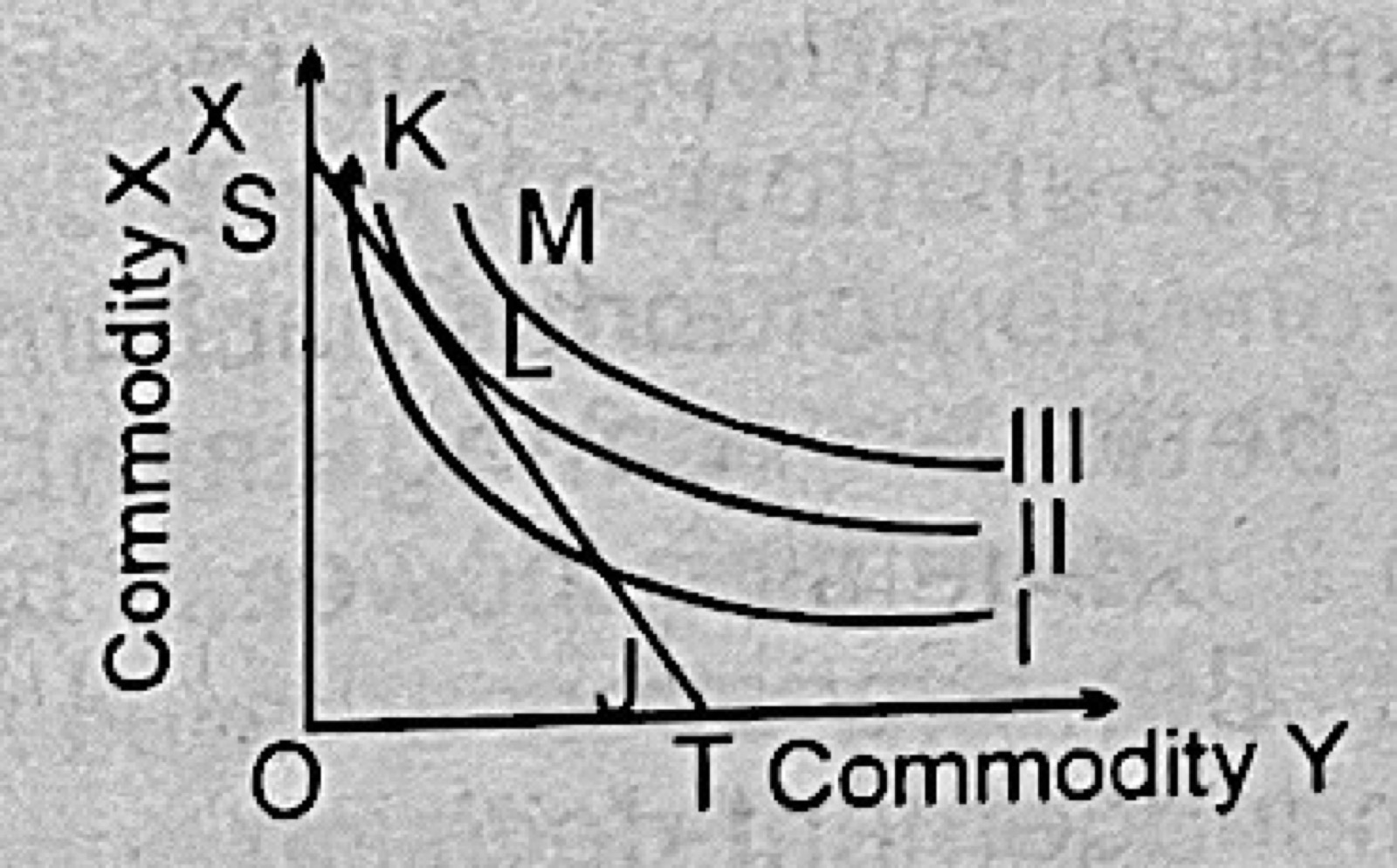
Question 35 Theory of Consumer Behaviour In the diagram above, ST is the budget line while I, II and III represent indifference curves. A rational consumer will choose to consume at point
A. M B. J C. K D. L Show the answer and explanation Answer: D (L )
Explanation Use the diagram. The consumer reaches the highest indifference curve the budget allows where the budget line just touches a curve; that is point L on curve II. M is unaffordable, and K and J give lower satisfaction.
Open this question
Question 36 Elasticity In order to increase revenue, the seller of a commodity whose demand is fairly elastic is advised to
A. increase price B. reduce output C. reduce price D. retain price Show the answer and explanation Answer: C (reduce price )
Explanation With elastic demand, a price cut raises quantity sold by a larger proportion, so total revenue rises.
Open this question
Question 37 Tools of Economic Analysis In any set of data, median represents the
A. value that is most representative of the data B. mid-position when the values are arranged in ascending or descending order C. mid-position when the values are arranged randomly D. difference between the highest and the lowest values when arranged in ascending order Show the answer and explanation Answer: B (mid-position when the values are arranged in ascending or descending order )
Explanation The median is the middle value once the data are arranged in order of size.
Open this question
Question 38 Basic Concepts Combination | Beans (Units) | Rice (Units)
A. 2 units of rice B. 5 units of beans C. 17 units of rice D. 20 units of beans Show the answer and explanation Answer: A (2 units of rice )
Explanation Moving from K to L gives 5 more units of beans but rice falls from 19 to 17, so 2 units of rice are given up.
Open this question
Question 39 Theory of Consumer Behaviour One of the assumptions of ordinal utility in consumer behaviour is that
A. consumers are irrational; B. marginal utility rises continuously C. utility is measurable D. utility can only be ranked Show the answer and explanation Answer: D (utility can only be ranked )
Explanation Ordinal utility theory (indifference curves) assumes consumers can rank combinations in order of preference, not measure utility in units.
Open this question
Question 40 Tools of Economic Analysis A large standard deviation is an indication of
A. the size of the sample B. a wide spread around the mean C. a wide difference between the mean and the mode D. the difference between the highest and the lowest values Show the answer and explanation Answer: B (a wide spread around the mean )
Explanation Standard deviation measures how far values are spread around the mean; a large value means a wide spread.
Open this question
Question 41 Economic Systems A major characteristic of a mixed economy is that
A. economic decisions are made by both the rich and the poor B. both primary and secondary production are undertaken C. the federal and the state governments undertake joint projects D. economic activities are undertaken by both the public and private sectors Show the answer and explanation Answer: D (economic activities are undertaken by both the public and private sectors )
Explanation In a mixed economy both government (public sector) and private individuals and firms own resources and carry out economic activities.
Open this question
Question 42 Theory of Costs and Revenue Given the cost function C = 160 + 36Q, what is the average cost at 20 units of output?
A. ₦720.00 B. ₦216.00 C. ₦44.00 D. ₦880.00 Show the answer and explanation Answer: C (₦44.00 )
Explanation Total cost = 160 + 36 × 20 = ₦880. Average cost = 880 ÷ 20 = ₦44.
Open this question
Question 43 Theory of Supply If an increase in the price of good X leads to an increase in the supply of good Y, X and Y are said to be
A. jointly supplied B. competitive C. composite D. jointly demanded Show the answer and explanation Answer: A (jointly supplied )
Explanation Goods in joint supply are produced together (e.g. beef and hides); producing more X for its higher price automatically gives more Y.
Open this question
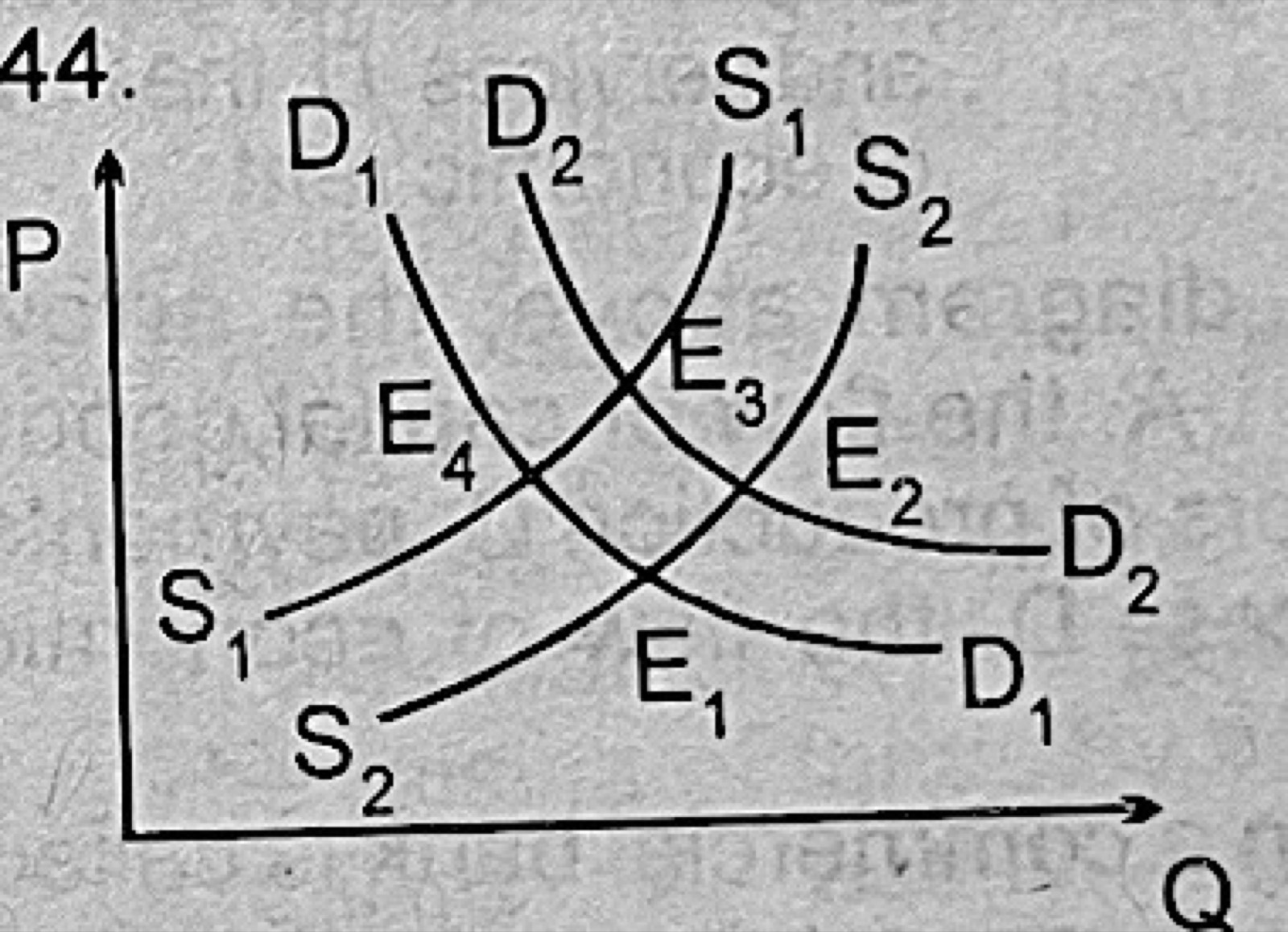
Question 44 Price Determination The diagram above shows the shifts in both demand and supply curves. What is the new equilibrium point after the shifts?
A. E3 B. E1 C. E4 D. E2 Show the answer and explanation Answer: D (E2 )
Explanation Use the diagram. Demand shifts from D1 to D2 and supply from S1 to S2 ; the new equilibrium is where D2 crosses S2 , at E2 .
Open this question
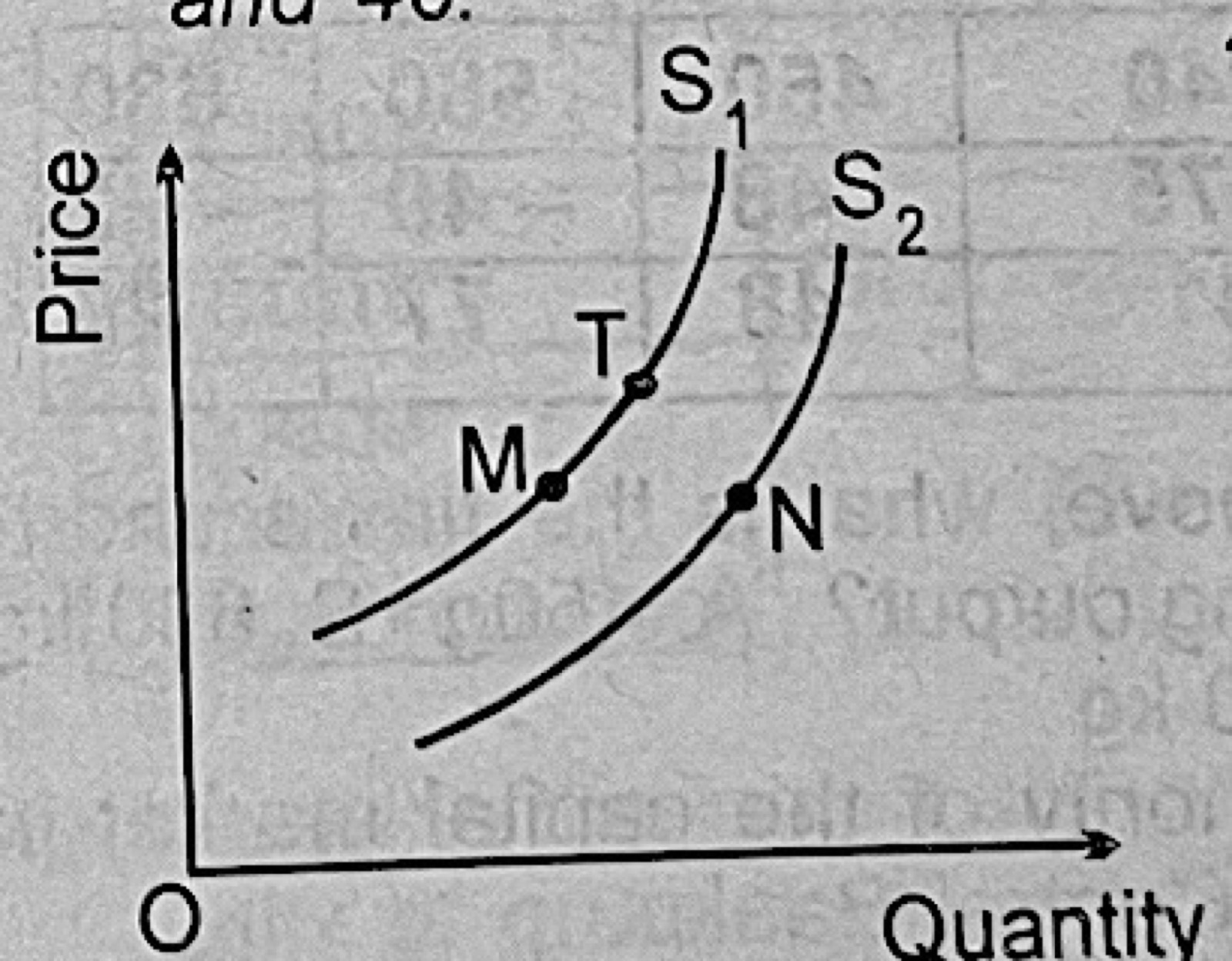
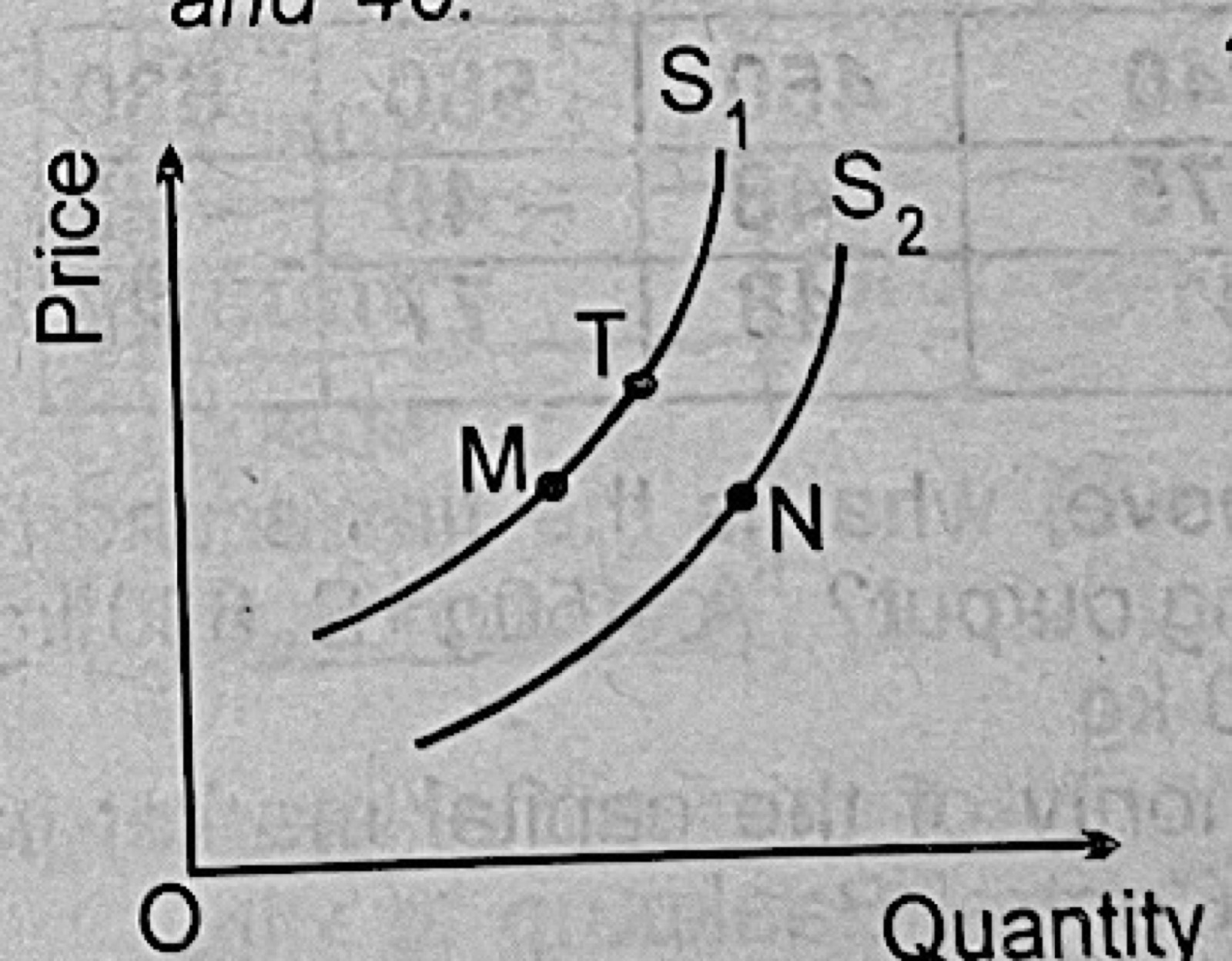
Question 45 Price Determination Use the diagram above to answer this question. When there is a change from T to N, it implies that
A. supply has increased B. quantity supplied has increased C. quantity demanded has increased D. price has fallen Show the answer and explanation Answer: A (supply has increased )
Explanation Use the diagram. T is on S1 and N is on S2 , which lies to the right; moving to a new curve to the right means supply has increased.
Open this question
Question 46 Price Determination Use the diagram above to answer this question. A movement from M to T implies that there has been
A. a decrease in supply B. an increase in demand C. a decrease in price D. an increase in price Show the answer and explanation Answer: D (an increase in price )
Explanation Use the diagram. M and T are on the same supply curve S1 , and T is higher, so the move along the curve is caused by an increase in price.
Open this question
Question 47 Theory of Production A necessary condition for specialization in an economy is the existence of
A. a regulated market B. a competitive market C. a medium of exchange D. adequate capital Show the answer and explanation Answer: C (a medium of exchange )
Explanation Specialists must exchange their output for the other things they need, and exchange on a large scale needs money as a medium of exchange.
Open this question
Question 48 Theory of Costs and Revenue A firm operating at full capacity will experience rising short-run total costs when
A. prices of its variable inputs rise B. prices of its variable inputs fall C. there is a change in management D. labour productivity increases Show the answer and explanation Answer: A (prices of its variable inputs rise )
Explanation With output fixed at full capacity, total cost rises if the inputs it uses, such as raw materials and labour, become dearer.
Open this question
Question 49 Theory of Costs and Revenue In a textile factory, the cost of cotton used is a typical example of
A. an average cost B. a variable cost C. a total cost D. a fixed cost Show the answer and explanation Answer: B (a variable cost )
Explanation The amount of cotton used rises and falls with output, so its cost is a variable cost.
Open this question
Question 50 Price Determination A black market can occur when
A. supply is in excess of demand B. consumption of the commodity is restricted C. prices are set by government above the equilibrium D. prices are set by government below the equilibrium Show the answer and explanation Answer: D (prices are set by government below the equilibrium )
Explanation A maximum price below equilibrium causes shortages, so some buyers pay more illegally: a black market.
Open this question Sign up free for every JAMB Economics year, practice by topic and timed mocks.
Start practising free