Home › Past questions › JAMB › Chemistry › 2023 17 questions. Try each one, then open the answer to check yourself and read the explanation.
Sign up free to answer these questions on a CBT screen with a timer, then see your score and every answer explained.
Start practising free
Question 1 Separation of Mixtures Sodium chloride can be obtained from brine through
A. decantation B. titration C. evaporation D. distillation Show the answer and explanation Answer: C (evaporation )
Explanation Brine is salt dissolved in water; evaporating the water leaves the solid sodium chloride behind.
Open this question
Question 2 Mole Concept and Stoichiometry NH4 NO2(s) → (heat) N2(g) + 2H2 O(l) 2(g) that would be produced at S.T.P from 3.20g of NH4 NO2(s) [N=14, H=1, O = 16] Molar volume at s.t.p. = 22.4dm3
A. 2.24cm3 B. 2.24dm3 C. 1.12dm3 D. 1.12cm3 Show the answer and explanation Answer: C (1.12dm3 )
Explanation Molar mass of NH4 NO2 = 64 g, so 3.20 g = 0.05 mol, giving 0.05 mol of N2 . Volume = 0.05 × 22.4 = 1.12 dm3 .
Open this question
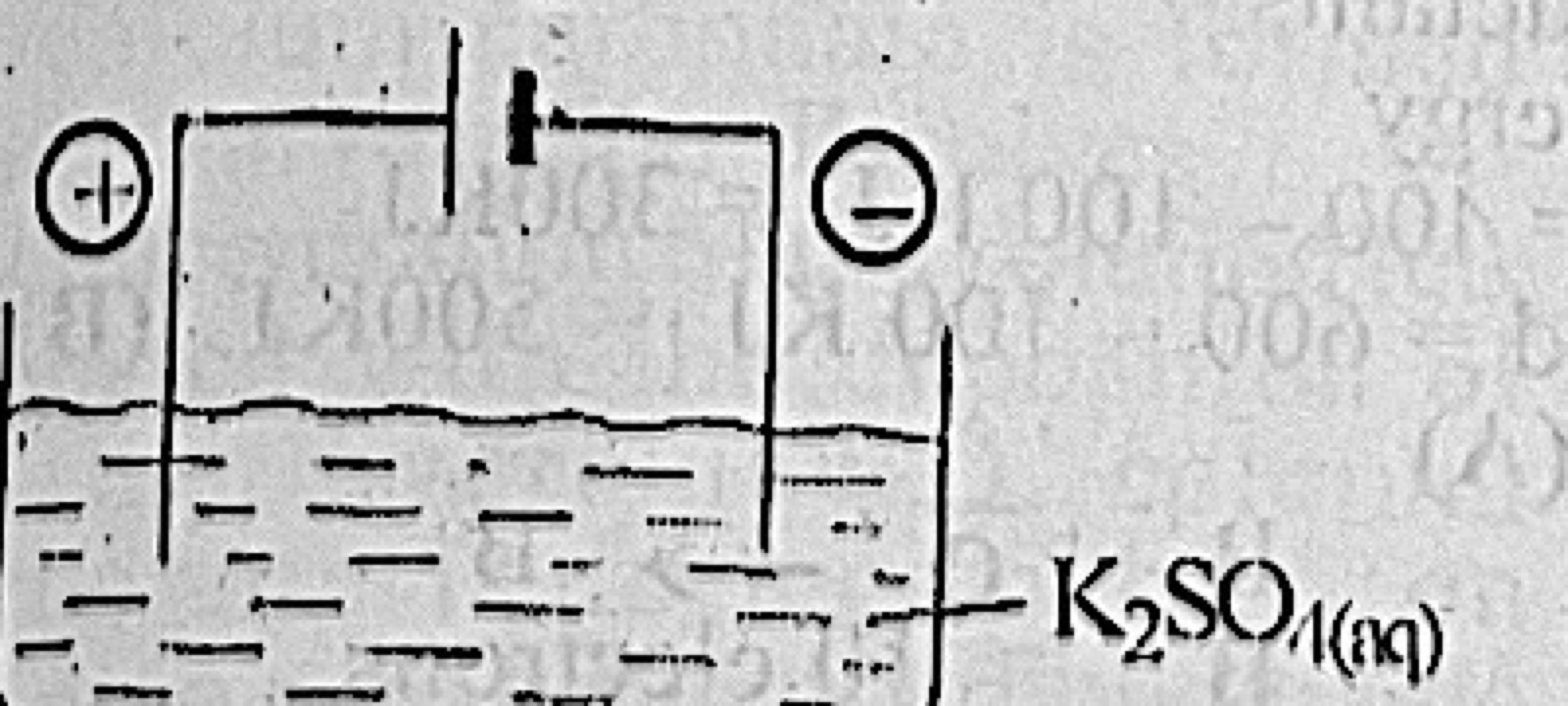
Question 5 Electrolysis In the above electrolyte cell, which species migrate to the anode?
A. K+ and SO4 2− B. SO4 2− and OH− C. H3 O+ and K+ D. OH− and H3 O+ Show the answer and explanation Answer: B (SO4 2− and OH− )
Explanation The anode is positive, so the negative ions in K2 SO4 (aq), SO4 2− and OH− , move to it.
Open this question
Question 6 Air What is the approximate volume of air containing 10cm3 of oxygen?
A. 25cm3 B. 20cm3 C. 100cm3 D. 50cm3 Show the answer and explanation Answer: D (50cm3 )
Explanation Air is about one-fifth (20%) oxygen, so 10 cm3 of oxygen is in about 5 × 10 = 50 cm3 of air.
Open this question
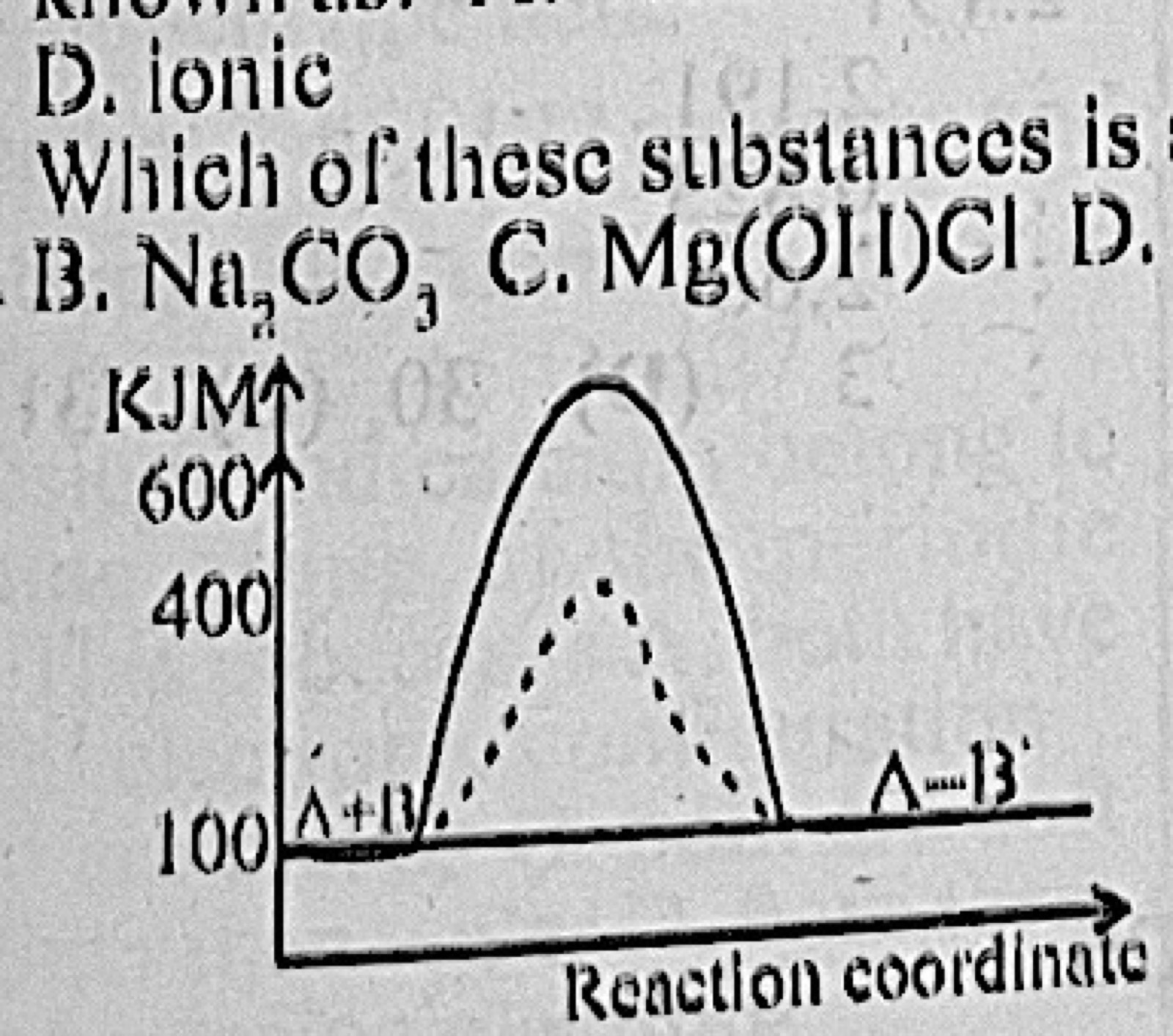
Question 11 Rates of Reaction The above diagram illustrates the energy profile of the catalyst and uncatalysed reaction of A(g) + B(g) → AB(g) . Calculate the activation energies in KJ of the catalysed and uncatalysed unreverse reactions.
A. 500, 300 B. 300, 500 C. −500, −300 D. −300, −500 Show the answer and explanation Answer: B (300, 500 )
Explanation Activation energy = peak energy − reactant energy. Catalysed: 400 − 100 = 300 kJ; uncatalysed: 600 − 100 = 500 kJ.
Open this question
Question 16 Solubility and Solutions A property found in a colloidal dispersion which is absent in a true solution is
A. homogeneity B. the Tyndale effect C. surface polarity D. Osmotic pressure Show the answer and explanation Answer: B (the Tyndale effect )
Explanation Colloid particles are big enough to scatter a beam of light (the Tyndall effect); a true solution does not.
Open this question
Question 17 Environmental Pollution A gas when dissolved in water vapour, produced acid rain during rainfall. The gas is
A. carbon (II) oxide B. oxygen C. sulphur (IV) oxide D. nitrogen Show the answer and explanation Answer: C (sulphur (IV) oxide )
Explanation SO2 dissolves in rainwater to form trioxosulphate(IV) acid, a major cause of acid rain.
Open this question
Question 18 Chemical Bonding The carbon atoms in H2 C=CH2 are
A. Sp hybridized B. Sp3 hybridized C. not hybridized D. Sp2 hybridized Show the answer and explanation Answer: D (Sp2 hybridized )
Explanation Each carbon in ethene forms three σ bonds and one π bond, so it uses sp2 hybrid orbitals.
Open this question
Question 20 Electrolysis Half cell reaction — Eθ 2+ (aq) + 2e− → Cu(s) +0.34V2+ (aq) + 2e− → Zn(s) −0.76V2+ (aq) + 2e− → Fe(s) −0.44V2+ (aq) + 2e− → Ba(s) −2.90V
A. Fe B. Cu C. Zn D. Ba Show the answer and explanation Answer: D (Ba )
Explanation The most negative electrode potential (−2.90 V for Ba) means the metal loses electrons most easily, so barium is the strongest reducing agent.
Open this question
Question 24 Alkanoic Acids and Esters CH3 CH2 OH + CH3 COOH → (Conc H2 SO4 ) Y + Z
A. CH3 CH2 COCH3 and H2 O B. CH3 COCH3 and H2 O C. CH3 CH2 CHO and CH4 D. CH3 COOCH2 CH3 and H2 O Show the answer and explanation Answer: D (CH3 COOCH2 CH3 and H2 O )
Explanation An alkanol and an alkanoic acid react (esterification) to give an ester, ethyl ethanoate, and water.
Open this question
Question 30 Redox Reactions Write out the increasing oxidation number of the transition metal ion for the compounds K2 Cr2 O7 , V2 O5 and KMnO4 .
A. K2 Cr2 O7 < KMnO4 < V2 O5 B. V2 O5 < K2 Cr2 O7 < KMnO4 C. KMnO4 < K2 Cr2 O7 < V2 O5 D. KMnO4 < V2 O5 < K2 Cr2 O7 Show the answer and explanation Answer: B (V2 O5 < K2 Cr2 O7 < KMnO4 )
Explanation V in V2 O5 is +5, Cr in K2 Cr2 O7 is +6 and Mn in KMnO4 is +7.
Open this question
Question 32 Periodic Table Given the distance between the nuclei of chlorine atoms in a chlorine molecule as 0.194mm, calculate its atomic radius.
A. 0.194mm B. 0.097mm C. 2.388mm D. 0.388mm Show the answer and explanation Answer: B (0.097mm )
Explanation The nucleus-to-nucleus distance is two atomic radii, so r = 0.194/2 = 0.097.
Open this question
Question 35 Energy Changes Which of these equations shows that a reaction is in equilibrium?
A. ΔG = ΔH − TΔS B. ΔG < O C. ΔG = O D. ΔG > O Show the answer and explanation Answer: C (ΔG = O )
Explanation At equilibrium there is no driving force in either direction, so the free energy change ΔG is zero.
Open this question
Question 36 Alkanoic Acids and Esters The formula CH2 O for ethanoic acid represents its
A. general formula B. molecular formula C. structural formula D. empirical formula Show the answer and explanation Answer: D (empirical formula )
Explanation Ethanoic acid is C2 H4 O2 = (CH2 O)2 ; CH2 O is the simplest whole-number ratio, the empirical formula.
Open this question
Question 38 Halogens How is Cl2(g) prepared in the laboratory? by
A. adding concentrated tetraoxosulphate (VI) acid to solid sodium chloride B. adding concentrated hydro chloric acid to solid manganese (IV) oxide C. dropping concentrated hydrochloric acid unto potassium tetraoxomanganate (VI) crystals and heating the mixture D. dropping concentrated hydrochloric acid unto potassium tetraoxomanganate(VI) crystals Show the answer and explanation Answer: D (dropping concentrated hydrochloric acid unto potassium tetraoxomanganate(VI) crystals )
Explanation Concentrated HCl is oxidised to chlorine by potassium permanganate crystals without heating (option A gives HCl gas, not chlorine).
Open this question
Question 39 Introduction to Organic Chemistry Which of the following is an isomer of C5 H12 ?
A. 2-methylbutane B. butane C. 2-ethylbutane D. 2-methylpropane Show the answer and explanation Answer: A (2-methylbutane )
Explanation 2-methylbutane has five carbons and twelve hydrogens, the same formula as pentane but a branched chain.
Open this question
Question 40 Gas Laws According to Charles's law, at what temperature does the volume of gas becomes zero?
A. −100°C B. 0°C C. 373°C D. −273°C Show the answer and explanation Answer: D (−273°C )
Explanation Extending the volume-temperature line to zero volume gives absolute zero, −273 °C (0 K).
Open this question Sign up free for every JAMB Chemistry year, practice by topic and timed mocks.
Start practising free JAMB, UTME, WAEC, WASSCE, NECO, NABTEB and GCE are names of their respective examining bodies. Passwella is an independent practice platform and is not affiliated with or endorsed by any of them.