Home › Past questions › JAMB › Chemistry › 2011 45 questions. Try each one, then open the answer to check yourself and read the explanation.
Sign up free to answer these questions on a CBT screen with a timer, then see your score and every answer explained.
Start practising free
Question 2 Mole Concept and Stoichiometry What is the concentration of a solution containing 2g of NaOH in 100cm3 of solution? {Na = 23, O = 16, H = 1}
A. 0.40 mol dm−3 B. 0.50 mol dm−3 C. 0.05 mol dm−3 D. 0.30 mol dm−3 Show the answer and explanation Answer: B (0.50 mol dm−3 )
Explanation NaOH = 40 g/mol, so 2 g = 0.05 mol. In 0.1 dm3 : 0.05/0.1 = 0.50 mol dm−3 .
Open this question
Question 3 Kinetic Theory and States of Matter Which of the following properties is NOT peculiar to matter?
A. Kinetic energy of particles increases from solid to gas. B. Random motion of particles increases from liquid to gas. C. Orderliness of particles increases from gas to liquid. D. Random motion of particles increases from gas to solid. Show the answer and explanation Answer: D (Random motion of particles increases from gas to solid. )
Explanation Particles move most randomly in a gas and least in a solid, so random motion decreases (not increases) from gas to solid.
Open this question
Question 4 Separation of Mixtures The principle of column chromatography is based on the ability of the constituents to
A. move at different speeds in the column B. dissolve in each other in the column C. react with the solvent in the column D. react with each other in the column Show the answer and explanation Answer: A (move at different speeds in the column )
Explanation Each component is held by the column material to a different extent, so they travel at different speeds and separate.
Open this question
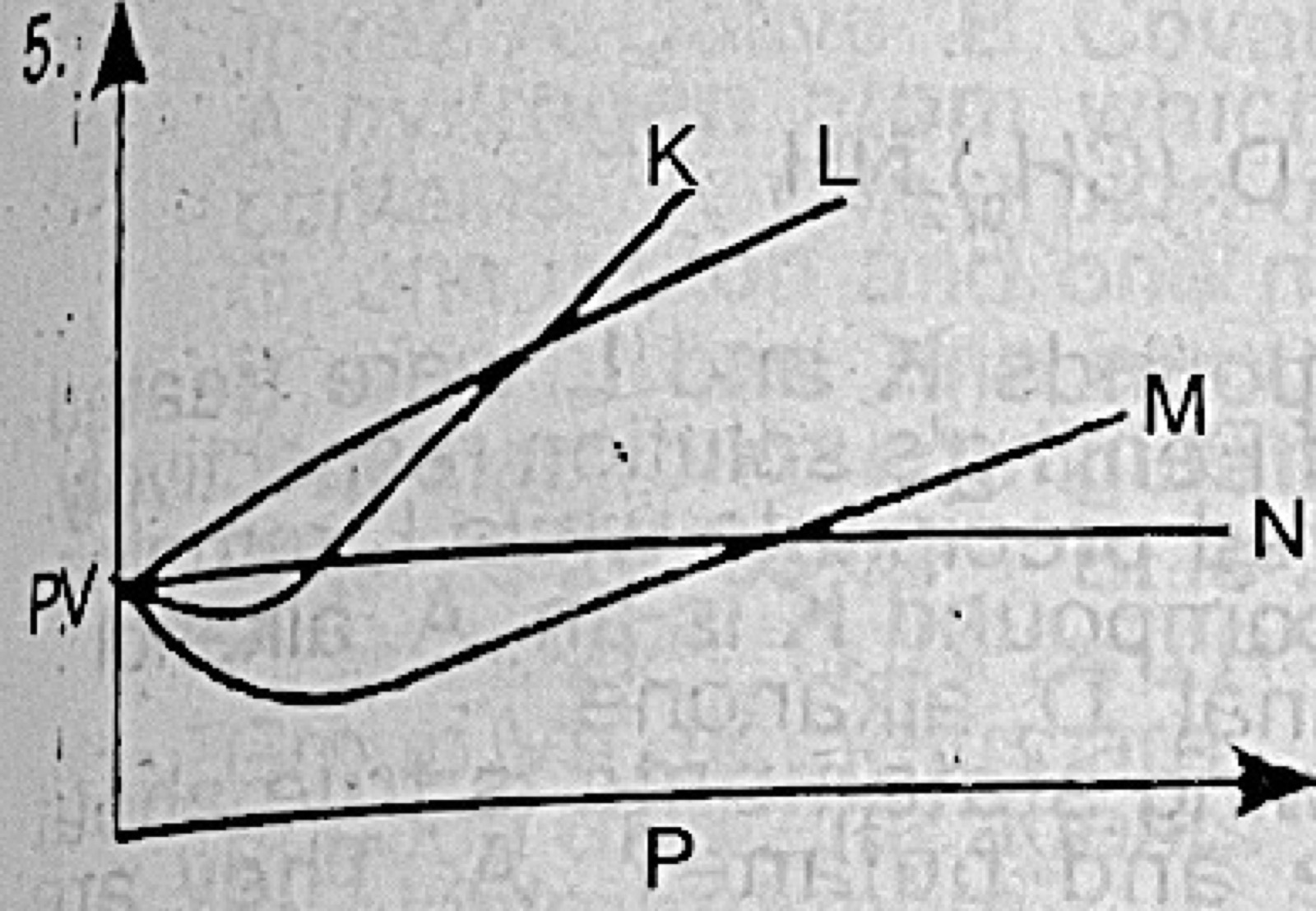
Question 5 Gas Laws From the diagram above, an ideal gas can be represented by
A. M B. N C. K D. L Show the answer and explanation Answer: B (N )
Explanation For an ideal gas at constant temperature PV is constant (Boyle's law), so a graph of PV against P is a horizontal line, N.
Open this question
Question 8 Atomic Structure An isotope has an atomic number of 15 and a mass number of 31. The number of protons it contains is
A. 16 B. 15 C. 46 D. 31 Show the answer and explanation Answer: B (15 )
Explanation The atomic number is the number of protons: 15.
Open this question
Question 9 Chemical Bonding The molecular lattice of iodine is held together by
A. dative bond B. metallic bond C. hydrogen bond D. van der Waal's forces Show the answer and explanation Answer: D (van der Waal's forces )
Explanation Each I2 molecule is covalent inside, but the molecules are held to each other only by weak van der Waals forces.
Open this question
Question 10 Chemical Bonding The arrangement of particles in crystal lattices can be studied using
A. x-rays B. γ-rays C. α-rays D. β-rays Show the answer and explanation Answer: A (x-rays )
Explanation X-ray diffraction reveals how the particles are arranged in a crystal.
Open this question
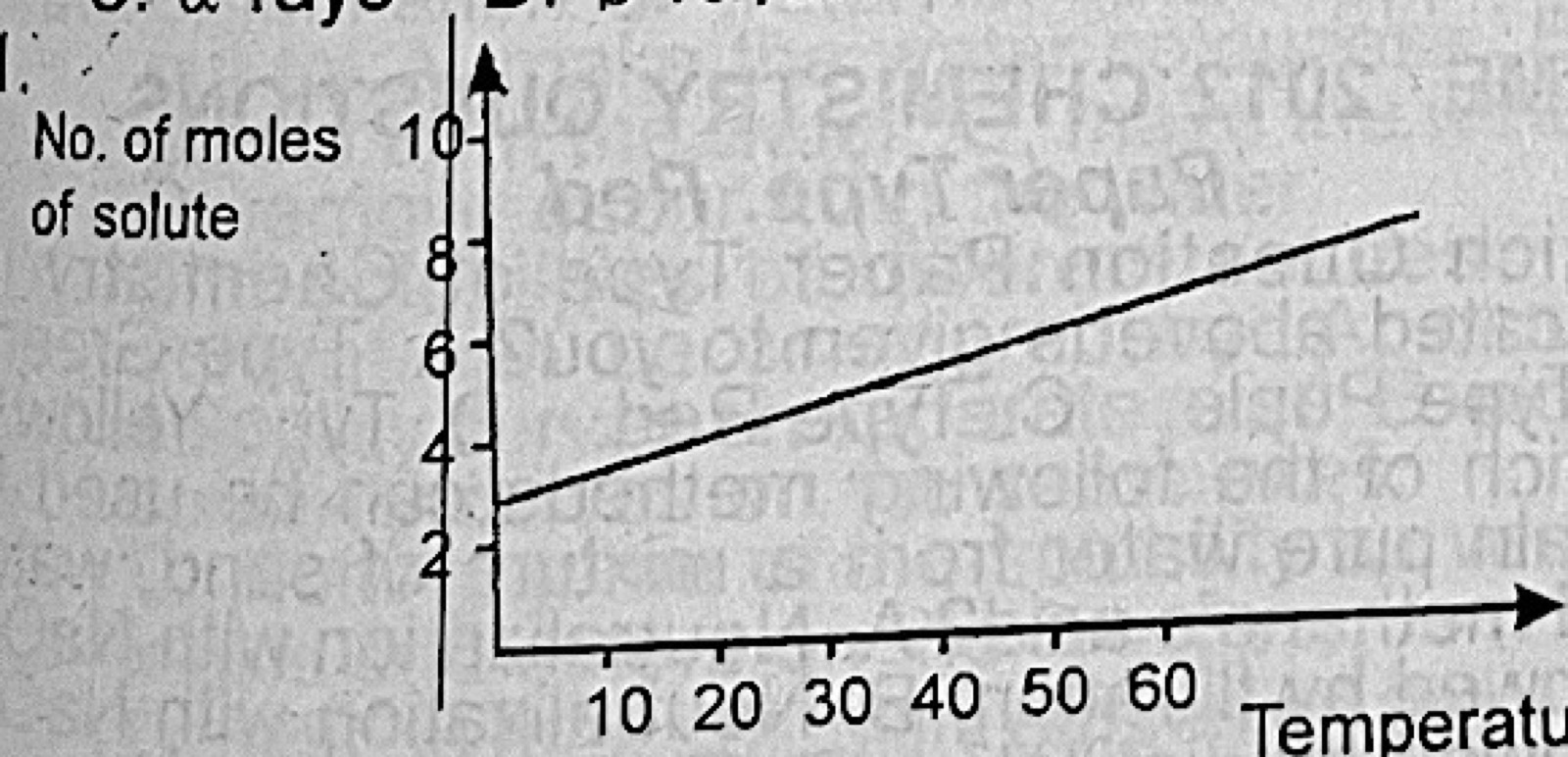
Question 11 Solubility and Solutions From the diagram above, find the amount of solute deposited when 200cm3 of the solution is cooled from 55°C to 40°C.
A. 0.10 mole B. 0.20 mole C. 0.01 mole D. 0.02 mole Show the answer and explanation Answer: B (0.20 mole )
Explanation From the graph the solubility falls by about 1 mole per dm3 between 55 °C and 40 °C. For 200 cm3 (0.2 dm3 ): 1 × 0.2 = 0.20 mole is deposited.
Open this question
Question 12 Water The importance of sodium aluminate (III) in the treatment of water is to
A. cause coagulation B. neutralize acidity C. prevent goitre and tooth decay D. kill germs Show the answer and explanation Answer: A (cause coagulation )
Explanation Sodium aluminate forms a sticky aluminium hydroxide floc that clumps fine particles together (coagulation) so they settle out.
Open this question
Question 13 Chemical Bonding What type of bond exists between an element X with atomic number 12 and Y with atomic number 17?
A. Electrovalent. B. Metallic. C. Covalent. D. Dative. Show the answer and explanation Answer: A (Electrovalent. )
Explanation X is magnesium (a metal, gives 2 electrons) and Y is chlorine (a non-metal, gains 1), so they form an ionic (electrovalent) bond in MgCl2 .
Open this question
Question 14 Water Hardness of water is mainly due to the presence of
A. calcium hydroxide or magnesium hydroxide B. calcium trioxocarbonate (IV) or calcium tetraoxosulphate (VI) C. sodium hydroxide or magnesium hydroxide D. calcium chloride or sodium chloride salts Show the answer and explanation Answer: B (calcium trioxocarbonate (IV) or calcium tetraoxosulphate (VI) )
Explanation Hard water contains dissolved calcium (and magnesium) salts, chiefly the hydrogen trioxocarbonate(IV) and the tetraoxosulphate(VI).
Open this question
Question 16 Air Which of the following noble gases is commonly found in the atmosphere?
A. Xenon. B. Neon. C. Helium. D. Argon. Show the answer and explanation Answer: D (Argon. )
Explanation Argon makes up almost 1% of air, far more than any other noble gas.
Open this question
Question 17 Chemical Equilibrium N2 O4(g) ⇌ 2NO2(g) ΔH = +ve
A. increase the value of the equilibrium constant B. decrease the value of the equilibrium constant C. increase the reactant production D. shift the equilibrium to the left Show the answer and explanation Answer: A (increase the value of the equilibrium constant )
Explanation The forward reaction is endothermic, so heating favours it and K increases.
Open this question
Question 18 Acids, Bases and Salts CH3 COOH(aq) + OH− (aq) ⇌ CH3 COO− (aq) + H2 O(l) 3 COO− (aq) is the
A. conjugate base B. acid C. base D. conjugate acid Show the answer and explanation Answer: A (conjugate base )
Explanation CH3 COOH loses a proton to become CH3 COO− , so CH3 COO− is its conjugate base.
Open this question
Question 19 Acids, Bases and Salts How many cations will be produced from a solution of potassium aluminium tetraoxosulphate (VI)?
A. 3 B. 4 C. 1 D. 2 Show the answer and explanation Answer: D (2 )
Explanation KAl(SO4 )2 (a double salt) gives two kinds of cation in solution: K+ and Al3+ .
Open this question
Question 20 Acids, Bases and Salts Which of the following is NOT an alkali?
A. NH3 B. Mg(OH)2 C. Ca(OH)2 D. NaOH Show the answer and explanation Answer: B (Mg(OH)2 )
Explanation An alkali is a base that dissolves in water. Magnesium hydroxide is practically insoluble, so it is a base but not an alkali.
Open this question
Question 21 Environmental Pollution An effect of thermal pollution on water bodies is that the
A. volume of water reduces B. volume of chemical waste increases C. level of oxides of nitrogen increases D. level of oxygen reduces Show the answer and explanation Answer: D (level of oxygen reduces )
Explanation Gases are less soluble in warm water, so heating a river or lake lowers its dissolved oxygen.
Open this question
Question 22 Water Which of the following is a deliquescent compound?
A. Na2 CO3 B. CaCl2 C. CuO D. Na2 CO3 .10H2 O Show the answer and explanation Answer: B (CaCl2 )
Explanation Anhydrous calcium chloride absorbs so much water from the air that it dissolves in it, which is deliquescence.
Open this question
Question 23 Energy Changes A chemical reaction in which the hydration energy is greater than the lattice energy is referred to as
A. a spontaneous reaction B. an endothermic reaction C. an exothermic reaction D. a reversible reaction Show the answer and explanation Answer: C (an exothermic reaction )
Explanation If more energy is released when the ions are hydrated than is needed to break the lattice, there is a net release of heat: exothermic.
Open this question
Question 24 Electrolysis The function of zinc electrode in a galvanic cell is that it
A. undergoes reduction B. serves as the positive electrode C. produces electons D. uses up electrons Show the answer and explanation Answer: C (produces electons )
Explanation Zinc is the anode: it is oxidised (Zn → Zn2+ + 2e− ), releasing electrons into the circuit.
Open this question
Question 25 Rates of Reaction CH4(g) + Cl2(g) → CH3 Cl(s) + HCl(g)
A. catalyst B. temperature C. concentration D. light Show the answer and explanation Answer: D (light )
Explanation Chlorination of methane is a photochemical reaction: it needs light to split Cl2 into free radicals.
Open this question
Question 26 Metals and their Compounds The condition required for corrosion to take place is the presence of
A. water and carbon (IV) oxide B. water, carbon (IV) oxide and oxygen C. oxygen and carbon (IV) oxide D. water and oxygen Show the answer and explanation Answer: D (water and oxygen )
Explanation Iron rusts only when both water and oxygen are present.
Open this question
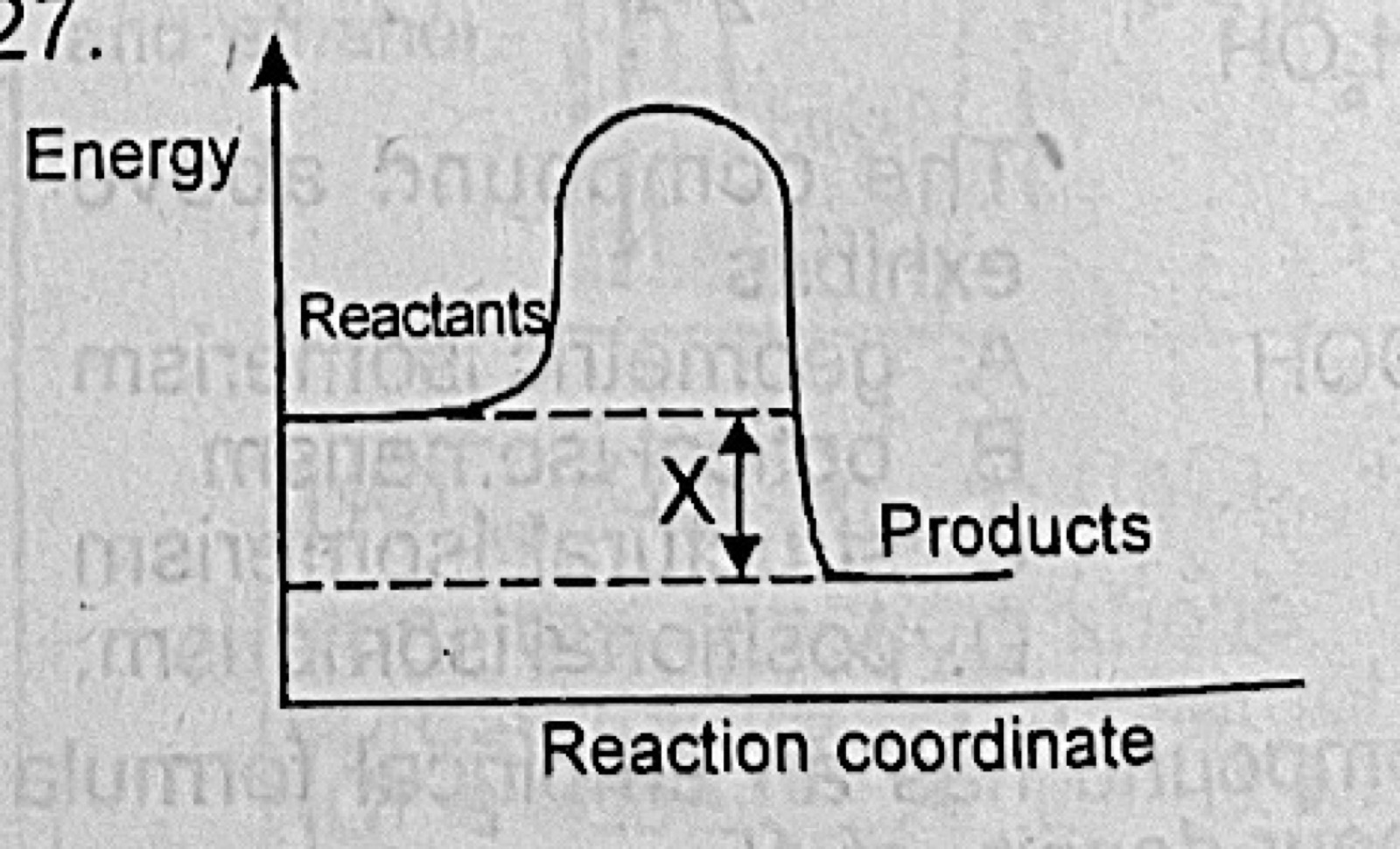
Question 27 Energy Changes In the diagram above, X is the
A. enthalpy B. enthalpy change C. activation energy D. activated complex Show the answer and explanation Answer: B (enthalpy change )
Explanation X is the energy gap between reactants and products, which is the enthalpy change (ΔH) of the reaction.
Open this question
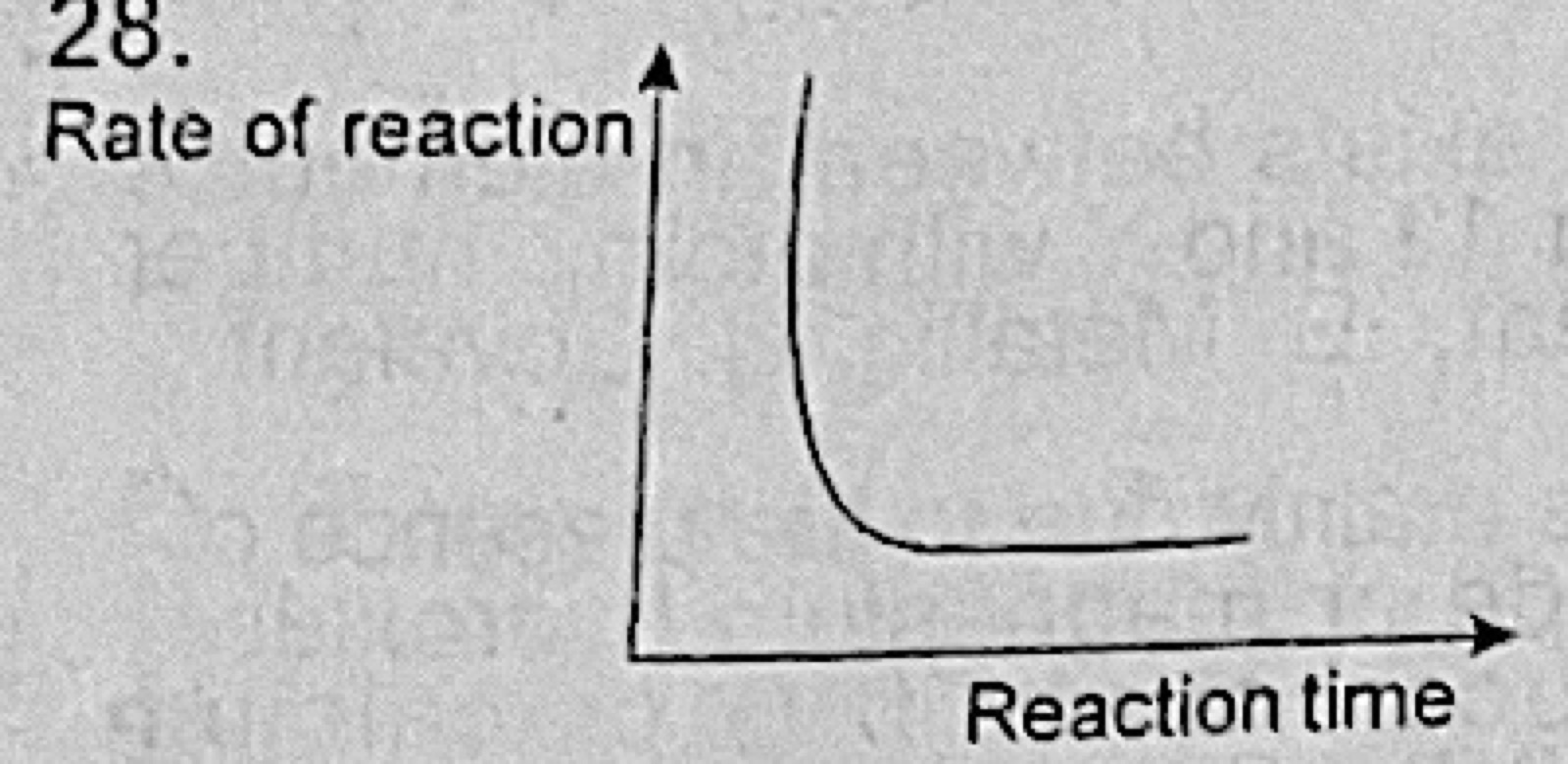
Question 28 Rates of Reaction The diagram above best illustrates the effect of decrease in
A. concentration B. temperature C. surface area D. presssure Show the answer and explanation Answer: A (concentration )
Explanation As the reaction goes on, reactants are used up and their concentration falls, so the rate drops with time as shown.
Open this question
Question 29 Redox Reactions MnO4 − (aq) + Y + 5Fe2+ (aq) → Mn2+ (aq) + 5Fe3+ (aq) + 4H2 O(l)
A. 5H+ (aq) B. 4H+ (aq) C. 10H+ (aq) D. 8H+ (aq) Show the answer and explanation Answer: D (8H+ (aq) )
Explanation The 4 O atoms of MnO4 − form 4H2 O, which needs 8 H atoms, so Y = 8H+ . Charges check: −1 + 8 + 10 = +17 = +2 + 15.
Open this question
Question 30 Electrolysis Given that M is the mass of a substance deposited during electrolysis and Q is the quantity of electricity consumed, then Faraday's first law can be written as [E = Electrochemical equivalent]
A. M = E/Q B. M = EQ C. M = Q/E D. M = E/2Q Show the answer and explanation Answer: B (M = EQ )
Explanation Faraday's first law: mass deposited is proportional to charge passed, M = EQ, where E is the electrochemical equivalent.
Open this question
Question 31 Halogens The impurities formed during the laboratory preparation of chlorine gas are removed by
A. H2 O B. NH3 C. H2 SO4 D. HCl Show the answer and explanation Answer: A (H2 O )
Explanation The main impurity is hydrogen chloride gas, which is removed by bubbling the chlorine through water (conc. H2 SO4 then only dries it).
Open this question
Question 32 Metals and their Compounds The effect of the presence of impurities such as carbon and sulphur on iron is that they
A. give it high tensile strength B. make it malleable and ductile C. increase its melting point D. lower its melting point Show the answer and explanation Answer: D (lower its melting point )
Explanation Impurities lower the melting point of iron (cast iron melts lower than pure iron) and make it brittle.
Open this question
Question 33 Qualitative Analysis A few drops of concentrated HNO3 is added to an unknown solution and boiled for a while. If this produces a brown solution, the cation present is likely to be
A. Pb2+ B. Cu2+ C. Fe3+ D. Fe2+ Show the answer and explanation Answer: D (Fe2+ )
Explanation Concentrated HNO3 oxidises pale-green Fe2+ to Fe3+ , giving a yellow-brown solution.
Open this question
Question 34 Halogens The bleaching action of chlorine gas is effective due to the presence of
A. hydrogen chloride B. water C. air D. oxygen Show the answer and explanation Answer: B (water )
Explanation Chlorine bleaches only when moist: with water it forms HOCl, which releases oxygen that oxidises the dye.
Open this question
Question 35 Hydrogen, Oxygen and Oxides In the laboratory preparation of oxygen, dried oxygen is usually collected over
A. hydrochloric acid B. mercury C. calcium chloride D. tetraoxosulphate (VI) acid Show the answer and explanation Answer: B (mercury )
Explanation Collecting over water would make the gas wet again, so dry oxygen is collected over mercury (it is dried with conc. H2 SO4 first).
Open this question
Question 36 Nitrogen and its Compounds The property of concentrated H2 SO4 that makes it suitable for preparing HNO3 is its
A. boiling point B. density C. oxidizing property D. dehydrating property Show the answer and explanation Answer: A (boiling point )
Explanation Concentrated H2 SO4 has a high boiling point (it is non-volatile), so it displaces the more volatile HNO3 from a nitrate, which distils off.
Open this question
Question 37 Metals and their Compounds Bronze is preferred to copper in the making of medals because it
A. is stronger B. can withstand low temperature C. is lighter D. has low tensile strength Show the answer and explanation Answer: A (is stronger )
Explanation Alloying copper with tin makes bronze harder and stronger, and more resistant to corrosion, so medals keep their shape and look.
Open this question
Question 38 Carbon and its Compounds The constituent of baking powder that makes the dough to rise is
A. NaHCO3 B. NaOH C. Na2 CO3 D. NaCl Show the answer and explanation Answer: A (NaHCO3 )
Explanation Sodium hydrogen trioxocarbonate(IV) releases CO2 when heated or with acid, and the gas bubbles make the dough rise.
Open this question
Question 39 Petroleum and Coal Which of the following compounds is used as a gaseous fuel?
A. CH3 − C ≡ CH B. HOCH2 − CH2 − CH3 C. CH3 − CH2 − CH2 − COOH D. CH3 − CH2 − CH2 − CH3 Show the answer and explanation Answer: D (CH3 − CH2 − CH2 − CH3 )
Explanation Butane is the gas in cooking-gas cylinders (LPG).
Open this question
Question 40 Carbon and its Compounds The ability of carbon to form long chains is referred to as
A. alkylation B. acylation C. catenation D. carbonation Show the answer and explanation Answer: C (catenation )
Explanation Catenation is the joining of atoms of the same element into chains or rings.
Open this question
Question 41 Polymers Which of the following compounds will undergo polymerization reaction?
A. C2 H4 B. C2 H5 COOH C. C2 H6 D. C2 H5 OH Show the answer and explanation Answer: A (C2 H4 )
Explanation Ethene has a C=C double bond, so many molecules can add together to form poly(ethene).
Open this question
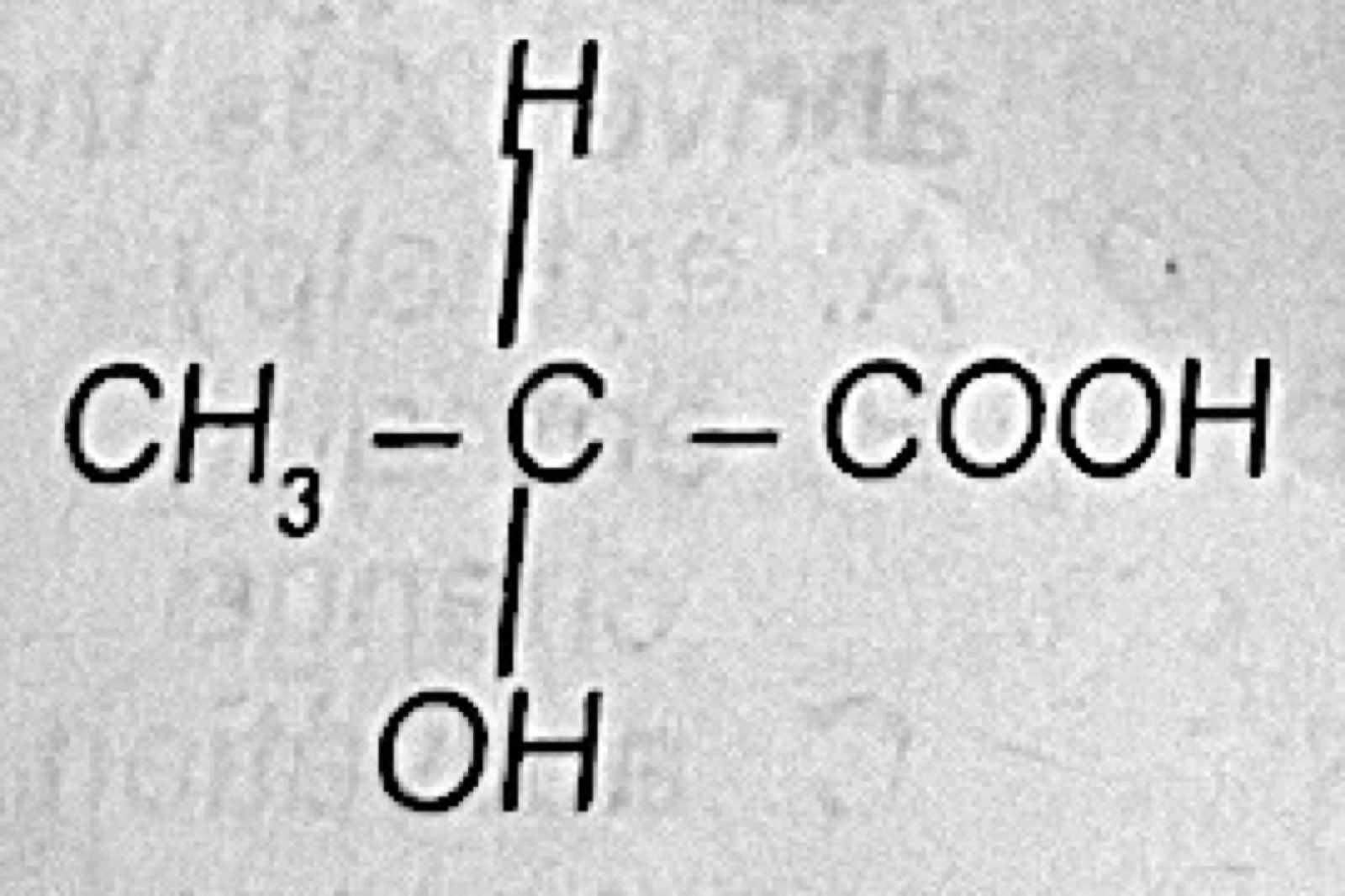
Question 42 Introduction to Organic Chemistry The compound above exhibits
A. geometric isomerism B. optical isomerism C. structural isomerism D. positional isomerism Show the answer and explanation Answer: B (optical isomerism )
Explanation The central carbon carries four different groups (H, OH, CH3 , COOH), so it is chiral and shows optical isomerism.
Open this question
Question 43 Introduction to Organic Chemistry An organic compound has an empirical formula CH2 O and vapour density of 45. What is its molecular formula? [C = 12, H = 1, O = 16]
A. C3 H7 OH B. C2 H5 OH C. C3 H6 O3 D. C2 H4 O2 Show the answer and explanation Answer: C (C3 H6 O3 )
Explanation Molar mass = 2 × 45 = 90. CH2 O = 30, so n = 3 and the formula is C3 H6 O3 .
Open this question
Question 44 Alkanols C6 H12 O6 → 2C2 H5 OH + 2CO2 + Energy (zymase, 250 C)
A. propanol B. butanol C. methanol D. ethanol Show the answer and explanation Answer: D (ethanol )
Explanation This is fermentation of glucose by yeast (zymase), which produces ethanol.
Open this question
Question 45 Introduction to Organic Chemistry The number of isomers that can be obtained from C4 H10 is
A. 3 B. 4 C. 1 D. 2 Show the answer and explanation Answer: D (2 )
Explanation C4 H10 exists as butane and 2-methylpropane: 2 isomers.
Open this question
Question 47 Carbohydrates, Proteins and Amines Which of the following is a primary amine?
A. (CH3 )3 N B. CH3 NH2 C. CH3 CONH2 D. (CH3 )2 NH Show the answer and explanation Answer: B (CH3 NH2 )
Explanation A primary amine has one alkyl group on the nitrogen (R−NH2 ). CH3 CONH2 is an amide, not an amine.
Open this question
Question 48 Alkanals and Alkanones Two organic compounds K and L were treated with a few drops of Fehling's solution respectively. K formed a brick-red precipitate while L remains unaffected. The compound K is an
A. alkanol B. alkane C. alkanal D. alkanone Show the answer and explanation Answer: C (alkanal )
Explanation Alkanals (aldehydes) reduce Fehling's solution to red Cu2 O; alkanones do not.
Open this question
Question 49 Introduction to Organic Chemistry Which of the following statements is true about 2-methylpropane and butane?
A. They are members of the same homologous series. B. They have the same boiling points. C. They have different number of carbon atoms. D. They have the same chemical properties. Show the answer and explanation Answer: A (They are members of the same homologous series. )
Explanation Both are C4 H10 alkanes, so they belong to the alkane series; being isomers, they have different boiling points.
Open this question
Question 50 Alkanoic Acids and Esters CH3 COOH + C2 H5 OH → CH3 COOC2 H5 + H2 O (conc. H2 SO4 )
A. esterification B. condensation C. saponification D. neutralization Show the answer and explanation Answer: A (esterification )
Explanation An alkanoic acid reacting with an alkanol to give an ester and water is esterification.
Open this question Sign up free for every JAMB Chemistry year, practice by topic and timed mocks.
Start practising free