Home › Past questions › JAMB › Chemistry › 2008 46 questions. Try each one, then open the answer to check yourself and read the explanation.
Sign up free to answer these questions on a CBT screen with a timer, then see your score and every answer explained.
Start practising free
Question 1 Separation of Mixtures Chlorophyll obtained from given leaves of plant can be shown to be composed of more than one coloured component by the technique of
A. crystallization B. hydrolysis C. chromatography D. sublimation. Show the answer and explanation Answer: C (chromatography )
Explanation Chromatography separates the pigments in a leaf extract because each travels at a different speed through the paper or column, showing several coloured bands.
Open this question
Question 2 Solubility and Solutions In countries where the temperature falls below 273K, salt is always sprinkled on the icy roads in order to
A. lower the melting point of the ice B. increase the density of the ice C. make the ice impure D. raise the melting point of the ice. Show the answer and explanation Answer: A (lower the melting point of the ice )
Explanation Dissolved salt lowers the freezing (melting) point of water, so the ice melts even below 0°C (273 K).
Open this question
Question 3 Mole Concept and Stoichiometry 2Na(s) + 2H2 O(l) → 2NaOH(aq) + H2(g)
A. 0.40g B. 0.80g C. 4.00g D. 8.00g. Show the answer and explanation Answer: C (4.00g )
Explanation 2.3 g Na = 0.1 mol, which gives 0.1 mol NaOH (1 : 1). Mass = 0.1 × 40 = 4.00 g.
Open this question
Question 4 Mole Concept and Stoichiometry 16.8g of sodium hydrogen trioxocarbonate (IV) is completely decomposed by heat. Calculate the volume of carbon (IV) oxide given off at s.t.p [Na = 23, C = 12, O = 16, H = 1, Molar volume of a gas at s.t.p. = 22.4 dm3 ]
A. 22.40 dm3 B. 11.20 dm3 C. 2.24 dm3 D. 1.12 dm3 . Show the answer and explanation Answer: C (2.24 dm3 )
Explanation 2NaHCO3 → Na2 CO3 + H2 O + CO2 . 16.8 g ÷ 84 = 0.2 mol NaHCO3 , giving 0.1 mol CO2 = 0.1 × 22.4 = 2.24 dm3 .
Open this question
Question 5 Gas Laws 300 cm3 of a gas has a pressure of 800 mm Hg. If the pressure is reduced to 650 mm Hg, find its volume.
A. 243.75 cm3 B. 369.23 cm3 C. 738.46 cm3 D. 1733.36 cm3 . Show the answer and explanation Answer: B (369.23 cm3 )
Explanation Boyle's law: V2 = P1 V1 /P2 = 800 × 300/650 = 369.23 cm3 .
Open this question
Question 6 Kinetic Theory and States of Matter Diffusion is slowest in solid particles than in particles of liquids and gases because
A. solid particles have more kinetic energy than the particles of liquids and gases B. solid particles have less kinetic energy than the particles of liquids and gases C. solid particles have less restrictions in their movement than liquid and gas particles D. the particles in solids are far apart and the cohesive forces between them are negligible. Show the answer and explanation Answer: B (solid particles have less kinetic energy than the particles of liquids and gases )
Explanation Particles in a solid have the least kinetic energy and only vibrate about fixed positions, so they mix (diffuse) most slowly.
Open this question
Question 7 Atomic Structure The experiment that showed that atoms have tiny positively charged nucleus was first carried out by
A. Moseley B. Rutherford C. Millikan D. Dalton. Show the answer and explanation Answer: B (Rutherford )
Explanation Rutherford's alpha-particle scattering experiment showed that an atom's positive charge and most of its mass are in a tiny nucleus.
Open this question
Question 8 Atomic Structure The atom of an element X is represented as Y Z X. The basic chemical properties of X depend on the value of
A. Y B. Z C. Y − Z D. Z − Y Show the answer and explanation Answer: B (Z )
Explanation Z is the atomic number, which fixes the number of electrons and so how the atom reacts. Y (mass number) and Y − Z (neutrons) do not affect chemical properties.
Open this question
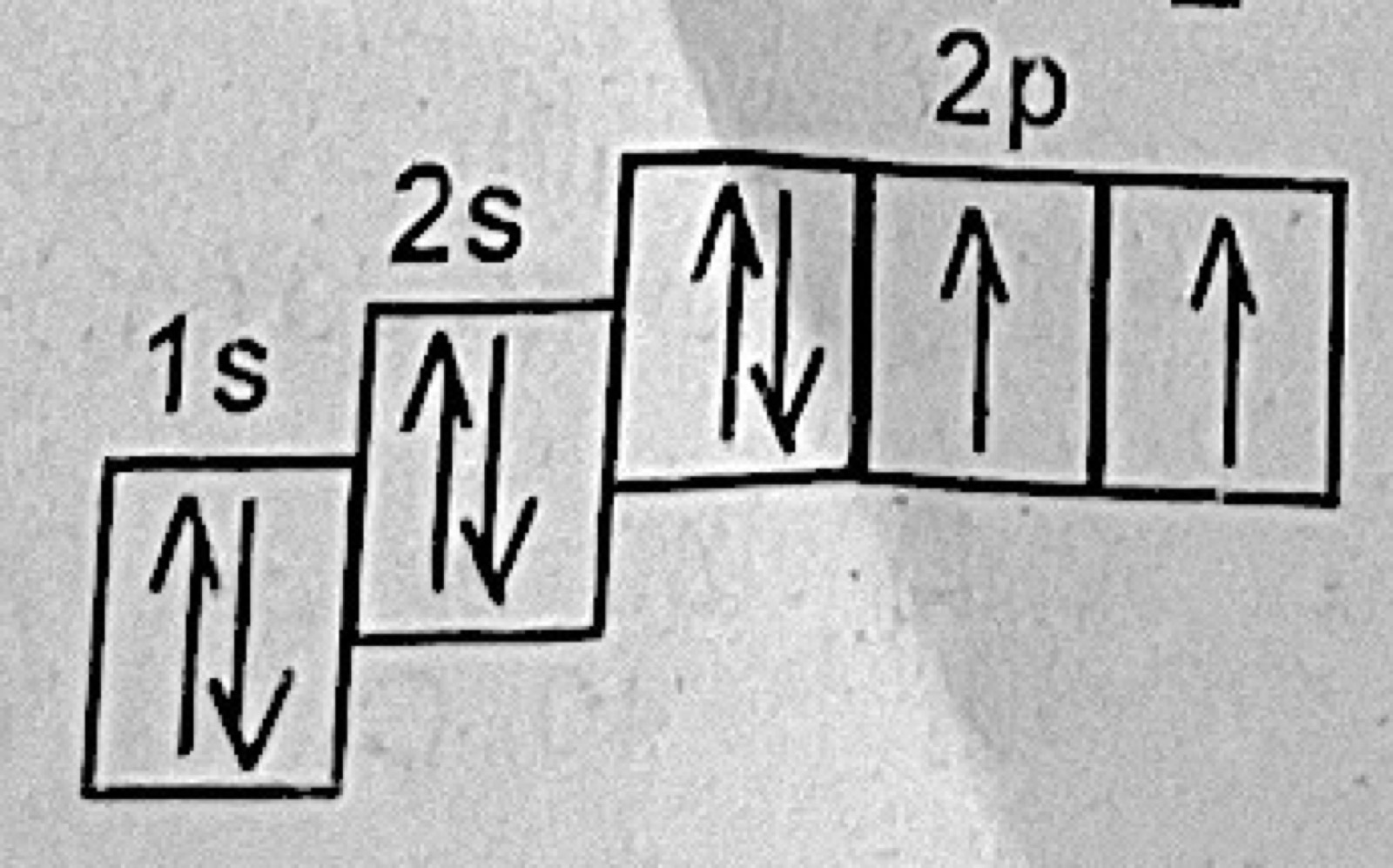
Question 9 Atomic Structure The diagram above represents the electron sub-level for
A. carbon B. nitrogen C. oxygen D. fluorine. Show the answer and explanation Answer: C (oxygen )
Explanation The boxes show 1s2 2s2 2p4 (one paired and two single electrons in 2p): 8 electrons, which is oxygen.
Open this question
Question 10 Periodic Table In the periodic table, electrical and thermal conductivities are properties of elements that
A. decrease across the period and increase down the group B. increase across the period and decrease down the group C. decrease across the period and down the group D. increase across the period and down the group. Show the answer and explanation Answer: A (decrease across the period and increase down the group )
Explanation Conductivity follows metallic character, which falls across a period (metals to non-metals) and rises down a group.
Open this question
Question 11 Radioactivity 23 11 Na + 1 0 n → 24 11 Na
A. nuclear fission B. nuclear fusion C. artificial transmutation D. beta decay. Show the answer and explanation Answer: C (artificial transmutation )
Explanation A nucleus is bombarded with a particle (a neutron) to make a new isotope. Changing a nucleus artificially this way is artificial transmutation.
Open this question
Question 12 Air Air boiled out of water as steam is richer in
A. nitrogen and oxygen B. carbon (IV) oxide and oxygen C. noble gases and carbon (IV) oxide D. oxygen and noble gases. Show the answer and explanation Answer: B (carbon (IV) oxide and oxygen )
Explanation CO2 and O2 are more soluble in water than nitrogen, so air dissolved in water (and boiled out of it) contains a higher share of them than ordinary air.
Open this question
Question 13 Water In the course of purifying water for town supply, the water is passed through large settling tanks containing sodium aluminate (III) to remove
A. large particles B. germs C. fine particles D. odour. Show the answer and explanation Answer: C (fine particles )
Explanation Sodium aluminate forms a sticky aluminium hydroxide floc that traps tiny suspended particles so they settle out (coagulation). Germs are killed later by chlorination.
Open this question
Question 14 Water When a few drops of water is added to a blue anhydrous cobalt (II) chloride, the colour changes to
A. white B. pink C. red D. blue. Show the answer and explanation Answer: B (pink )
Explanation Anhydrous cobalt(II) chloride is blue and turns pink when it takes up water; this is a test for water.
Open this question
Question 16 Solubility and Solutions 117.0g of sodium chloride was dissolved in 1.0dm3 of distilled water at 25°C. Determine the solubility in mol dm−3 of sodium chloride at that temperature. [Na = 23, Cl = 35.5]
A. 1.0 B. 2.0 C. 3.0 D. 4.0 Show the answer and explanation Answer: B (2.0 )
Explanation Molar mass of NaCl = 58.5 g. 117.0 ÷ 58.5 = 2.0 mol in 1.0 dm3 , so 2.0 mol dm−3 .
Open this question
Question 17 Environmental Pollution The uncovered raw food that is sold along major roads is likely to contain some amounts of
A. Pb B. Cu C. Ag D. Na Show the answer and explanation Answer: A (Pb )
Explanation Vehicle exhaust (especially from leaded petrol) releases lead compounds that settle on food sold by the roadside.
Open this question
Question 18 Acids, Bases and Salts What is the pH of a 0.001 mol dm−3 solution of sodium hydroxide?
A. 14 B. 13 C. 12 D. 11 Show the answer and explanation Answer: D (11 )
Explanation [OH− ] = 10−3 , so pOH = 3 and pH = 14 − 3 = 11.
Open this question
Question 19 Acids, Bases and Salts The basicity of CH3 COOH is
A. 1 B. 2 C. 3 D. 4 Show the answer and explanation Answer: A (1 )
Explanation Only the hydrogen in the −COOH group can ionise, so ethanoic acid has one replaceable hydrogen: basicity 1.
Open this question
Question 20 Volumetric Analysis 0.05 mol dm−3 HCl is neutralized by 25cm3 NaOH. If the volume of acid used is 32.00cm3 , what is the concentration of the base?
A. 0.016 mol dm−3 B. 0.032 mol dm−3 C. 0.0… mol dm−3 D. 0.064 mol dm−3 . Show the answer and explanation Answer: D (0.064 mol dm−3 . )
Explanation HCl and NaOH react 1 : 1, so CB = 0.05 × 32/25 = 0.064 mol dm−3 .
Open this question
Question 21 Acids, Bases and Salts Insoluble salts can be prepared by
A. titrating an alkali against an appropriate acid B. reacting an acid with trioxocarbonate (IV) salt C. direct combination of the elements which make up the salt. D. mixing two soluble compounds containing the metallic radical and the acidic radical. Show the answer and explanation Answer: D (mixing two soluble compounds containing the metallic radical and the acidic radical. )
Explanation Insoluble salts are made by double decomposition (precipitation): mixing two soluble salts, e.g. AgNO3 + NaCl → AgCl↓ + NaNO3 .
Open this question
Question 22 Redox Reactions The oxidation state of carbon in HCOOH is
A. −1 B. +2 C. +3 D. 0 Show the answer and explanation Answer: B (+2 )
Explanation 2 H at +1 and 2 O at −2: 2 + x − 4 = 0, so carbon is +2.
Open this question
Question 23 Chemical Formulae and Equations What is the IUPAC nomenclature of the compound NaClO?
A. Sodium oxochlorate(I) B. Sodium chloro(I) oxide C. Sodium monooxochlorate(II) D. sodium chloro(I) monoxide Show the answer and explanation Answer: A (Sodium oxochlorate(I) )
Explanation ClO− has one oxygen (oxo) and chlorine at +1, so NaClO is sodium oxochlorate(I).
Open this question
Question 24 Electrolysis In recharging a lead-acid accumulator, the reaction at the cathode can be represented as
A. Pb2+ (aq) + SO4(aq) 2− → PbSO4(s) B. Pb2+ (aq) + 2e− → Pb(s) C. Pb2+ (aq) + 2H2 O(l) → PbO2(s) + 4H+ (aq) + 4e− D. Pb(s) → Pb2+ (aq) + 2e− Show the answer and explanation Answer: B (Pb2+ (aq) + 2e− → Pb(s) )
Explanation During recharging the cathode is where reduction takes place: Pb2+ ions (from PbSO4 ) gain electrons and become lead metal again.
Open this question
Question 25 Electrolysis If a given quantity of electricity liberates 0.65g of Zn2+ , what amount of Hg2+ would be liberated by the same quantity of current? [Zn = 65, Hg = 201]
A. 1.00g B. 2.01g C. 4.02 g D. 8.04 g Show the answer and explanation Answer: B (2.01g )
Explanation Both ions carry a 2+ charge, so equal charge discharges equal moles. 0.65/65 = 0.01 mol, so 0.01 × 201 = 2.01 g of mercury.
Open this question
Question 27 Energy Changes Which of the following reactions is endothermic?
A. C(s) + O2(g) → CO2(g) B. CaO(s) + H2 O(l) → Ca(OH)2(s) C. C(s) + H2 O(g) → CO(g) + H2(g) D. HCl(aq) + NaOH(aq) → NaCl(aq) + H2 O(l) Show the answer and explanation Answer: C (C(s) + H2 O(g) → CO(g) + H2(g) )
Explanation Making water gas from steam and red-hot coke absorbs heat (the coke cools down). Burning carbon, slaking lime and neutralisation all release heat.
Open this question
Question 28 Rates of Reaction A catalyst speeds up the rate of a chemical reaction by
A. taking part in the reaction B. increasing the activation energy of the reaction C. lowering the activation energy of the reaction D. increasing the heat content. Show the answer and explanation Answer: C (lowering the activation energy of the reaction )
Explanation A catalyst provides an alternative pathway with a lower activation energy, so more collisions are successful.
Open this question
Question 29 Rates of Reaction The rate of a reaction usually decreases with a decrease in the concentration of reactants because
A. kinetic energy decreases B. temperature increases C. speed increases D. reactants collision decreases. Show the answer and explanation Answer: D (reactants collision decreases. )
Explanation With fewer reactant particles in a given volume, they collide less often, so the reaction slows down.
Open this question
Question 30 Chemical Equilibrium N2 O4(g) ⇌ 2NO2(g)
A. [NO2 ]/[N2 O4 ] B. [2NO2 ]/[N2 O4 ] C. [N2 O4 ]/[NO2 ]2 D. [NO2 ]2 /[N2 O4 ] Show the answer and explanation Answer: D ([NO2 ]2 /[N2 O4 ] )
Explanation K = [products]/[reactants], each raised to the power of its coefficient: [NO2 ]2 /[N2 O4 ].
Open this question
Question 31 Metals and their Compounds The substance that is used in the steel industry for the removal of carbon, sulphur and phosphorus impurities from pig iron is
A. oxygen B. chlorine C. nitrogen D. hydrogen Show the answer and explanation Answer: A (oxygen )
Explanation In steel making, oxygen is blown through molten pig iron to oxidise carbon, sulphur and phosphorus into oxides that escape as gas or go into the slag.
Open this question
Question 32 Nitrogen and its Compounds Which of the following compounds of trioxonitrate(V) will decompose to give dinitrogen(I) oxide and water when heated?
A. NaNO3 B. Zn(NO3 )2 C. Cu(NO3 )2 D. NH4 NO3 Show the answer and explanation Answer: D (NH4 NO3 )
Explanation Ammonium trioxonitrate(V) decomposes on gentle heating: NH4 NO3 → N2 O + 2H2 O.
Open this question
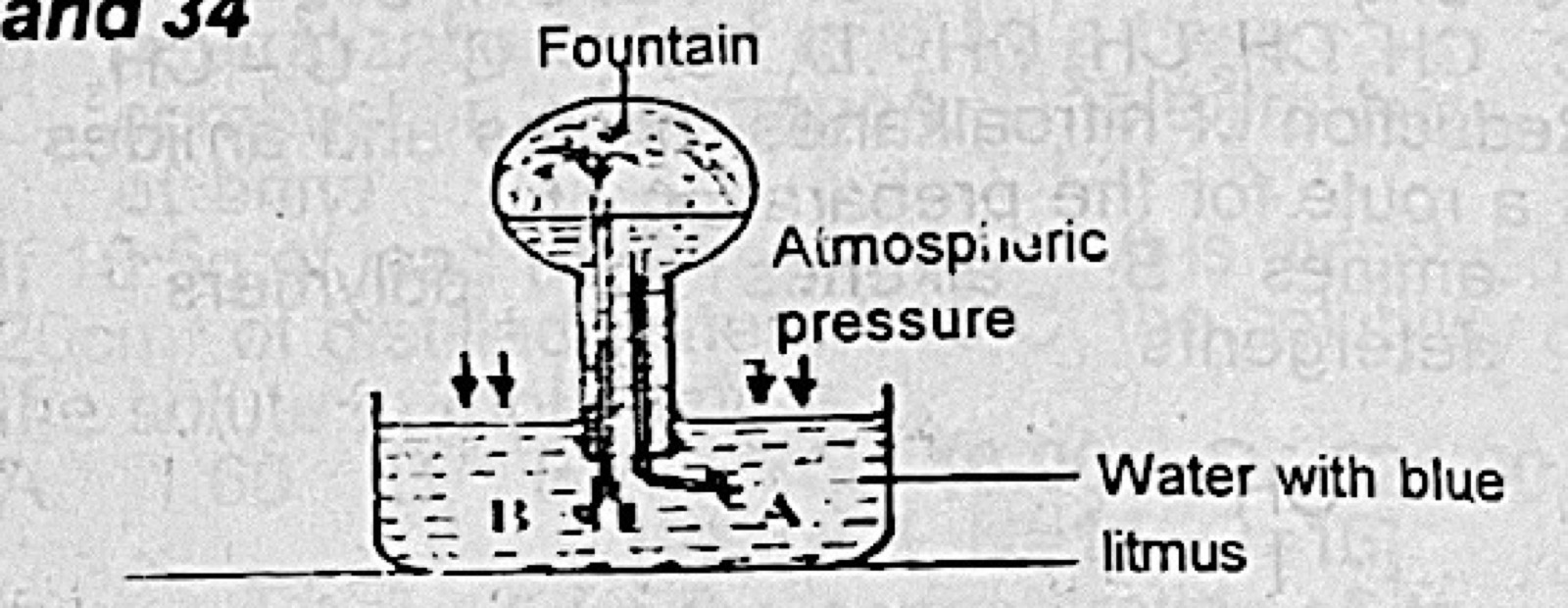
Question 33 Halogens Use the diagram to answer questions 33 and 34.
A. hydrogen chloride B. hydrogen sulphide C. nitrogen(II) oxide D. dinitrogen(I) oxide. Show the answer and explanation Answer: A (hydrogen chloride )
Explanation The fountain experiment needs a gas that is extremely soluble in water. Hydrogen chloride dissolves so fast that water rushes up into the flask.
Open this question
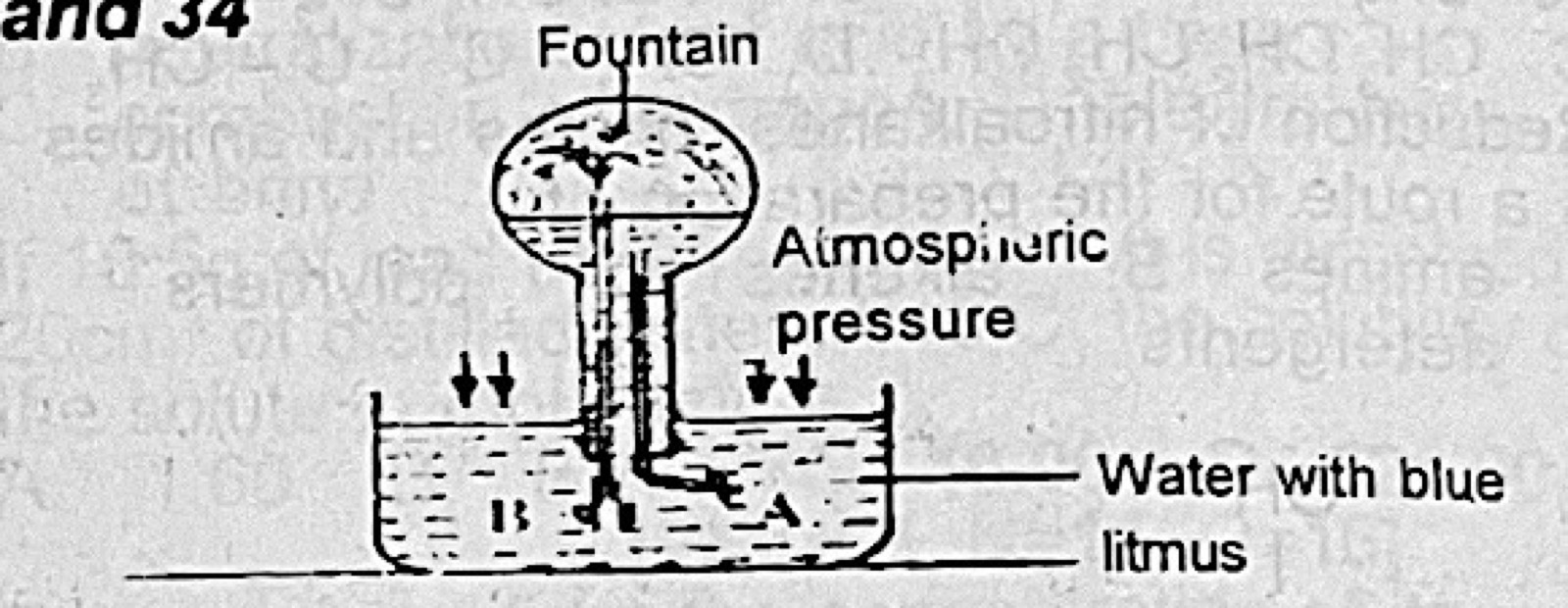
Question 34 Halogens Use the diagram to answer questions 33 and 34.
A. blue B. orange C. red D. yellow. Show the answer and explanation Answer: C (red )
Explanation Hydrogen chloride dissolves to form hydrochloric acid, which turns the blue litmus in the water red.
Open this question
Question 35 Qualitative Analysis When a solution of ammonium trioxocarbonate(IV) is added to a solution of an unknown salt, a white precipitate which is soluble in dilute hydrochloric acid but insoluble in ethanoic acid is formed. This indicates the presence of
A. Ca2+ B. Na+ C. Zn2+ D. K+ Show the answer and explanation Answer: A (Ca2+ )
Explanation Ammonium carbonate precipitates calcium as white CaCO3 , which dissolves in dilute HCl. Na+ and K+ carbonates are soluble, and the zinc precipitate redissolves in excess ammonium salt.
Open this question
Question 36 Metals and their Compounds Lead is used for making bullets and lead shots because of its
A. resistance to corrosion B. low melting point C. high density D. flexibility. Show the answer and explanation Answer: C (high density )
Explanation Lead is very dense, so a small bullet or shot is heavy and carries a lot of momentum.
Open this question
Question 38 Metals and their Compounds The most common ores of iron include
A. haematite, malachite and limonite B. chalcocite, calamine and bornite C. magnetite, haematite and limonite D. malachite, chalcocite and bornite Show the answer and explanation Answer: C (magnetite, haematite and limonite )
Explanation Magnetite (Fe3 O4 ), haematite (Fe2 O3 ) and limonite (hydrated iron oxide) are iron ores. Malachite, chalcocite and bornite are copper ores; calamine is a zinc ore.
Open this question
Question 39 Introduction to Organic Chemistry The type of isomerism shown by cis- and trans- isomers is
A. optical isomerism B. positional isomerism C. functional isomerism D. geometrical isomerism. Show the answer and explanation Answer: D (geometrical isomerism. )
Explanation Cis and trans isomers differ only in the arrangement of groups in space around a C=C bond; this is geometrical isomerism.
Open this question
Question 40 Alkanals and Alkanones If the silver mirror test is positive, it indicates the presence of an
A. alkyne B. alkanol C. alkanone D. alkanal. Show the answer and explanation Answer: D (alkanal. )
Explanation Alkanals (aldehydes) reduce Tollens' reagent to metallic silver, forming a mirror; alkanones do not.
Open this question
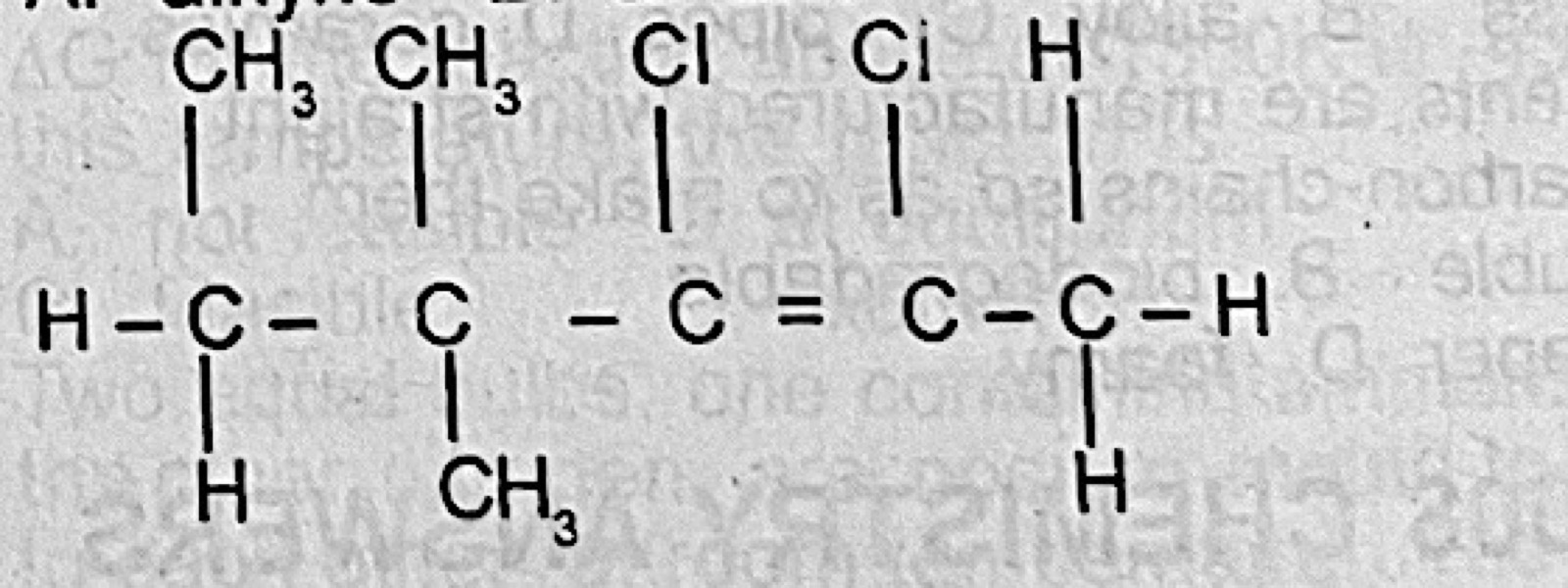
Question 41 Introduction to Organic Chemistry The IUPAC nomenclature for the structure above is
A. 2, 3 − dichloro − 4, 4, 5 − trimethyl pent - 2- ene B. 4, 5 − dichloro − 2, 3 − dimethyl hex − 2 − ene C. 2, 3 − dichloro − 4, 4 − dimethyl hex − 2 − ene D. 2, 3 dichloro − 2, 2 − dimethyl hex − 2 − ene Show the answer and explanation Answer: C (2, 3 − dichloro − 4, 4 − dimethyl hex − 2 − ene )
Explanation The structure is CH3 CH2 C(CH3 )2 C(Cl)=C(Cl)CH3 . The longest chain has 6 carbons; numbering from the right puts the double bond at C2, both Cl on C2 and C3 and two methyls on C4.
Open this question
Question 42 Carbohydrates, Proteins and Amines If glucose is heated with concentrated tetraoxosulphate(VI) acid, it will be dehydrated to
A. carbon B. carbon(IV) oxide C. ethene D. ethanol. Show the answer and explanation Answer: A (carbon )
Explanation Concentrated H2 SO4 removes the elements of water from glucose (C6 H12 O6 → 6C + 6H2 O), leaving black carbon.
Open this question
Question 43 Chemical Formulae and Equations A hydrocarbon X with a molar mass of 26 consists of 92.3% carbon. What is its molecular formula?
A. C2 H2 B. C3 H3 C. C4 H4 D. C5 H5 . Show the answer and explanation Answer: A (C2 H2 )
Explanation C : H = 92.3/12 : 7.7/1 = 7.7 : 7.7 = 1 : 1, so the empirical formula is CH (13). 26 ÷ 13 = 2, giving C2 H2 .
Open this question
Question 45 Carbohydrates, Proteins and Amines Reduction of nitroalkanes, nitrites and amides is a route for the preparation of
A. amines B. alkenes C. polymers D. detergents Show the answer and explanation Answer: A (amines )
Explanation Reducing nitro compounds, nitriles or amides adds hydrogen to the nitrogen-containing group and produces amines (−NH2 ).
Open this question
Question 46 Alkanols CH3 − C(OH)(CH3 ) − CH2 − CH3
A. CH3 − C(=CH2 ) − CH2 − CH3 B. CH3 − CH(CH3 ) − CH = CH2 C. CH3 − C(CH3 ) = CH − CH3 D. CH3 − CH(CH3 ) − CH2 − CH3 Show the answer and explanation Answer: C (CH3 − C(CH3 ) = CH − CH3 )
Explanation Removing water from 2-methylbutan-2-ol mostly forms the more substituted alkene (Saytzeff's rule): 2-methylbut-2-ene, CH3 C(CH3 )=CHCH3 .
Open this question
Question 47 Alkanals and Alkanones Reduction of alkanonoes with LiAlH4 produces
A. primary alkanols B. secondary alkanols C. tertiary alkanols D. polyhydric alkanols Show the answer and explanation Answer: B (secondary alkanols )
Explanation In an alkanone the C=O carbon is joined to two carbon groups; adding hydrogen to it gives a secondary alkanol, e.g. propanone → propan-2-ol.
Open this question
Question 48 Hydrocarbons The product obtained when a mixture of benzene vapour and hydrogen are passed over a nickel catalyst at 180°C is
A. cyclohexane B. cyclopentane C. n-hexane D. n-pentane. Show the answer and explanation Answer: A (cyclohexane )
Explanation Benzene adds three molecules of hydrogen across its ring: C6 H6 + 3H2 → C6 H12 (cyclohexane). The ring stays intact.
Open this question
Question 49 Polymers Polyvinyl chloride is used in the production of
A. glass B. alloy C. pipes D. ceramics. Show the answer and explanation Answer: C (pipes )
Explanation PVC is a tough, water-resistant plastic, widely used for water and drainage pipes.
Open this question
Question 50 Fats, Oils and Soaps Detergents are manufactured with straight hydrocarbon chains so as to make them
A. soluble B. biodegradable C. cheaper D. foamy. Show the answer and explanation Answer: B (biodegradable )
Explanation Bacteria can easily break down unbranched hydrocarbon chains, so straight-chain detergents are biodegradable and do not build up as foam in rivers.
Open this question Sign up free for every JAMB Chemistry year, practice by topic and timed mocks.
Start practising free