JAMB Chemistry 1997 past questions and answers

49 questions. Try each one, then open the answer to check yourself and read the explanation.

Question 1

Gas Laws

35 cm3 of hydrogen was sparked with 12 cm3 of oxygen at 110°C and 760 mm Hg to produce steam. What percentage of the total volume of gas left after the reaction is hydrogen?

  1. A.11%
  2. B.31%
  3. C.35%
  4. D.69%
Show the answer and explanation

Answer: B (31%)

Explanation

2H2 + O2 → 2H2O: 12 cm3 of O2 uses 24 cm3 of H2 and makes 24 cm3 of steam (a gas at 110°C). 11 cm3 of H2 is left in a total of 35 cm3, so 11/35 × 100 ≈ 31%.

Open this question

Question 2

Chemical Formulae and Equations

2.85 g of an oxide of copper gave 2.52 g of copper on reduction and 1.90 g of another oxide gave 1.52 g of copper on reduction. The data above illustrates the law of

  1. A.constant composition
  2. B.conservation of mass
  3. C.reciprocal proportions
  4. D.multiple proportions
Show the answer and explanation

Answer: D (multiple proportions)

Explanation

Two different oxides of the same two elements are compared. Per gram of oxygen the copper masses are 2.52/0.33 ≈ 7.6 g and 1.52/0.38 = 4.0 g, a simple ratio of about 2 : 1, which is the law of multiple proportions.

Open this question

Question 3

Separation of Mixtures

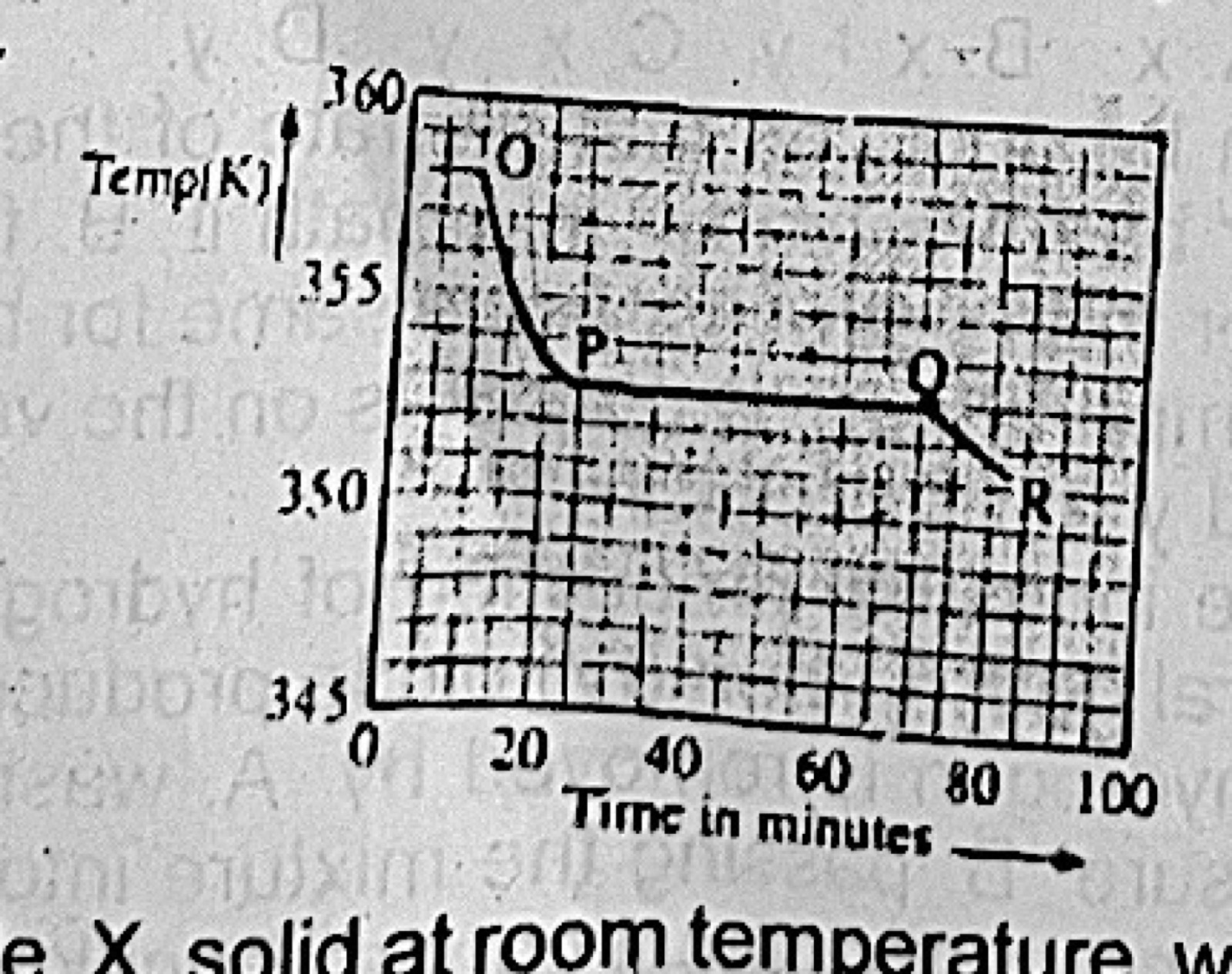
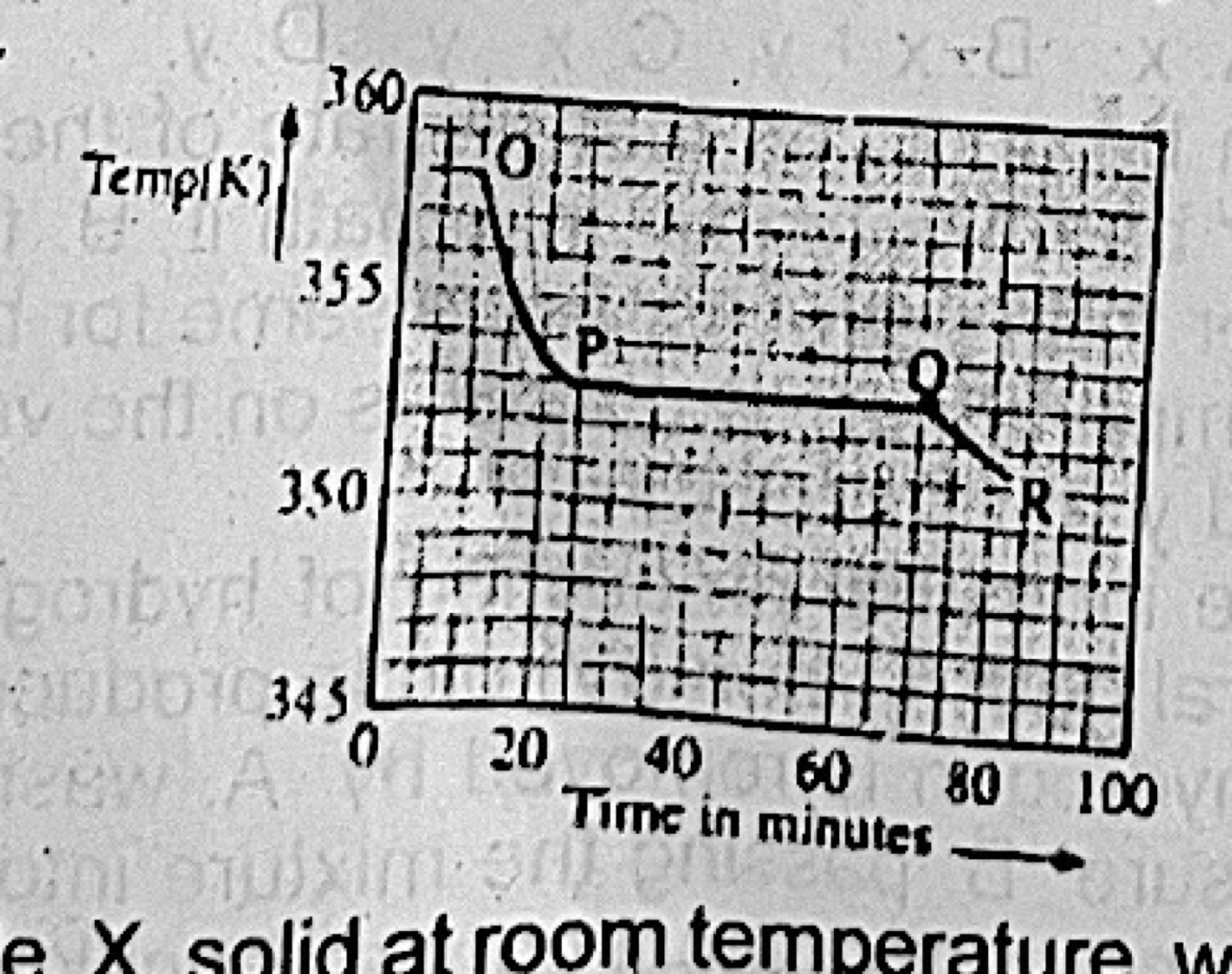
Use the graph below to answer this question. A sample, X, solid at room temperature, was melted, heated to a temperature of 358 K and allowed to cool as shown in OPQR. The section PQ indicates that X is

Diagram for this question
  1. A.a mixture of salts
  2. B.a hydrated salt
  3. C.an ionic salt
  4. D.a pure compound
Show the answer and explanation

Answer: D (a pure compound)

Explanation

PQ is flat: the temperature stays constant while the liquid freezes. A sharp, fixed freezing point is a sign of a pure substance; a mixture freezes over a range of temperatures.

Open this question

Question 4

Kinetic Theory and States of Matter

Use the graph below to answer this question. A sample, X, solid at room temperature, was melted, heated to a temperature of 358 K and allowed to cool as shown in OPQR. The section OP suggests that X is in the

Diagram for this question
  1. A.liquid state
  2. B.solid/liquid state
  3. C.solid state
  4. D.gaseous state
Show the answer and explanation

Answer: A (liquid state)

Explanation

X was melted and heated to 358 K, so along OP the liquid is simply cooling down until it starts to freeze at P.

Open this question

Question 5

Gas Laws

An element, X, forms a volatile hydride XH3 with a vapour density of 17.0. The relative atomic mass of X is [H = 1]

  1. A.34.0
  2. B.31.0
  3. C.20.0
  4. D.14.0
Show the answer and explanation

Answer: B (31.0)

Explanation

Relative molecular mass = 2 × vapour density = 34. Taking away 3 for the three hydrogens leaves 31 for X.

Open this question

Question 6

Gas Laws

A mixture of 0.20 mole of Ar, 0.20 mole of N2 and 0.30 mole of He exerts a total pressure of 2.1 atm. The partial pressure of He in the mixture is

  1. A.0.90 atm
  2. B.0.80 atm
  3. C.0.70 atm
  4. D.0.60 atm
Show the answer and explanation

Answer: A (0.90 atm)

Explanation

Total moles = 0.70. Mole fraction of He = 0.30/0.70, so its partial pressure = (0.30/0.70) × 2.1 = 0.90 atm.

Open this question

Question 7

Gas Laws

If 30 cm3 of oxygen diffuses through a porous plug in 7s, how long will it take 60 cm3 of chlorine to diffuse through the same plug? [O = 16, Cl = 35.5]

  1. A.12s
  2. B.14s
  3. C.21s
  4. D.30s
Show the answer and explanation

Answer: C (21s)

Explanation

By Graham's law, time is proportional to volume × √(molar mass). t = 7 × (60/30) × √(71/32) = 14 × 1.49 ≈ 21 s.

Open this question

Question 8

Kinetic Theory and States of Matter

The temperature of a body decreases when drops of liquid placed on it evaporate because

  1. A.the atmospheric vapour pressure has a cooling effect on the body
  2. B.a temperature gradient exists between the drops of liquid and the body causing the latter to evaporate
  3. C.the heat of vaporization is drawn from the body causing it to cool
  4. D.the random motion of the liquid molecules causes a cooling effect on the body.
Show the answer and explanation

Answer: C (the heat of vaporization is drawn from the body causing it to cool)

Explanation

Evaporating molecules need energy (latent heat of vaporization). They take this heat from the body they are on, so the body cools.

Open this question

Question 9

Atomic Structure

The electron configurations of two elements with similar chemical properties are represented by

  1. A.1s22s22p5 and 1s22s22p4
  2. B.1s22s22p4 and 1s22s22p63s1
  3. C.1s22s22p63s1 and 1s22s1
  4. D.1s22s22p4 and 1s22s1.
Show the answer and explanation

Answer: C (1s22s22p63s1 and 1s22s1)

Explanation

Elements with similar properties are in the same group, so they have the same number of outer electrons. Both configurations in C end in s1 (sodium and lithium, Group 1).

Open this question

Question 10

Periodic Table

In the periodic table, what is the property that decreases along the period and increases down the group?

  1. A.Atomic number
  2. B.Electron affinity
  3. C.Ionization potential
  4. D.Atomic radius.
Show the answer and explanation

Answer: D (Atomic radius.)

Explanation

Across a period the rising nuclear charge pulls the electrons closer, so atoms get smaller; down a group new shells are added, so atoms get bigger.

Open this question

Question 11

Atomic Structure

Two elements, P and Q with atomic numbers 11 and 8 respectively, combine chemically to form the compound PxQy. The respective values of x and y are

  1. A.1 and 1
  2. B.1 and 2
  3. C.2 and 1
  4. D.3 and 1
Show the answer and explanation

Answer: C (2 and 1)

Explanation

P (2,8,1) is sodium, which forms Na+; Q (2,6) is oxygen, which forms O2−. Two Na+ balance one O2−, giving P2Q (Na2O).

Open this question

Question 12

Atomic Structure

Oxygen is a mixture of two isotopes 168O and 188O with relative abundances of 90% and 10% respectively. The relative atomic mass of oxygen is

  1. A.16.0
  2. B.16.2
  3. C.17.0
  4. D.18.0
Show the answer and explanation

Answer: B (16.2)

Explanation

Relative atomic mass = (90 × 16 + 10 × 18)/100 = (1440 + 180)/100 = 16.2.

Open this question

Question 13

Air

200 cm3 of air was passed over heated copper in a syringe several times to produce copper (II) oxide. When cooled, the final volume of air recorded was 158 cm3. Estimate the percentage of oxygen in the air

  1. A.31%
  2. B.27%
  3. C.21%
  4. D.19%
Show the answer and explanation

Answer: C (21%)

Explanation

The copper removes the oxygen, so oxygen = 200 − 158 = 42 cm3. 42/200 × 100 = 21%.

Open this question

Question 14

Environmental Pollution

Which of the following gases is the most dangerous pollutant?

  1. A.Hydrogen sulphide
  2. B.Carbon (IV) oxide
  3. C.Sulphur (IV) oxide
  4. D.Carbon (II) oxide.
Show the answer and explanation

Answer: D (Carbon (II) oxide.)

Explanation

Carbon(II) oxide is colourless and odourless, so it is not noticed, and it binds to haemoglobin far more strongly than oxygen, quickly causing suffocation and death.

Open this question

Question 15

Water

A major process involved in the softening of hard water is the

  1. A.conversion of a soluble calcium salt to its trioxocarbonate (IV)
  2. B.decomposition of calcium trioxocarbonate (IV)
  3. C.conversion of an insoluble calcium salt to its trioxocarbonate (IV)
  4. D.oxidation of calcium atoms to its ions.
Show the answer and explanation

Answer: A (conversion of a soluble calcium salt to its trioxocarbonate (IV))

Explanation

Hardness is caused by dissolved calcium salts. Softening (by boiling or adding washing soda) changes these soluble salts into insoluble calcium trioxocarbonate(IV), which settles out and removes Ca2+ from the water.

Open this question

Question 16

Mole Concept and Stoichiometry

On recrystallization, 20 g of magnesium tetraoxosulphate (IV) forms 41 g of magnesium tetraoxosulphate (IV) crystals, MgSO4.yH2O. The value of y is [Mg = 24, S = 32, O = 16, H = 1]

  1. A.1
  2. B.3
  3. C.5
  4. D.7
Show the answer and explanation

Answer: D (7)

Explanation

Water taken up = 41 − 20 = 21 g = 21/18 ≈ 1.17 mol. MgSO4 = 20/120 ≈ 0.167 mol. y = 1.17/0.167 = 7.

Open this question

Question 17

Solubility and Solutions

A saturated solution of AgCl was found to have a concentration of 1.30 x 10⁻⁵ mol dm−3. The solubility product of AgCl therefore is

  1. A.1.30 x 10−5 mol2 dm−6
  2. B.1.30 x 10−7 mol2 dm−6
  3. C.1.69 x 10−10 mol2 dm−6
  4. D.2.60 x 10−12 mol2 dm−6.
Show the answer and explanation

Answer: C (1.69 x 10⁻¹⁰ mol2 dm−6)

Explanation

AgCl gives one Ag+ and one Cl−, so Ksp = (1.30 × 10⁻⁵)2 = 1.69 × 10⁻¹⁰ mol2 dm−6.

Open this question

Question 18

Acids, Bases and Salts

The hydroxyl ion concentration, [OH−], in a solution of sodium hydroxide of pH 10.0 is

  1. A.10−10 mol dm−3
  2. B.10−6 mol dm−3
  3. C.10−4 mol dm−3
  4. D.10−2 mol dm−3
Show the answer and explanation

Answer: C (10−4 mol dm−3)

Explanation

pOH = 14 − 10 = 4, so [OH−] = 10−4 mol dm−3.

Open this question

Question 19

Acids, Bases and Salts

Which of the aqueous solutions with the pH values below will liberate hydrogen when it reacts with magnesium metal?

  1. A.13.0
  2. B.7.0
  3. C.6.5
  4. D.3.0
Show the answer and explanation

Answer: D (3.0)

Explanation

Magnesium gives off hydrogen with acids. pH 3.0 is the only clearly acidic solution with plenty of H+ ions.

Open this question

Question 20

Volumetric Analysis

Given that 15.00 cm3 of H2SO4 was required to completely neutralize 25.00 cm3 of 0.125 mol dm−3 NaOH, calculate the molar concentration of the acid solution:

  1. A.0.925 mol dm−3
  2. B.0.156 mol dm−3
  3. C.0.104 mol dm−3
  4. D.0.023 mol dm−3.
Show the answer and explanation

Answer: C (0.104 mol dm−3)

Explanation

H2SO4 + 2NaOH → Na2SO4 + 2H2O. Moles NaOH = 0.025 × 0.125 = 0.003125, so acid = 0.0015625 mol in 0.015 dm3 = 0.104 mol dm−3.

Open this question

Question 21

Electrolysis

When platinum electrodes are used during the electrolysis of copper (II) tetraoxosulphate (VI) solution, the solution gets progressively

  1. A.acidic
  2. B.basic
  3. C.neutral
  4. D.amphoteric
Show the answer and explanation

Answer: A (acidic)

Explanation

Cu2+ is removed at the cathode and OH− is discharged at the anode as oxygen. H+ and SO42− are left behind, so the solution becomes tetraoxosulphate(VI) acid.

Open this question

Question 22

Electrolysis

How many faradays of electricity are required to deposit 0.20 mole of nickel, if 0.10 faraday of electricity deposited 2.98 g of nickel during electrolysis of its aqueous solution? [Ni = 58.7, 1F = 96 500 C mol−1]

  1. A.0.20
  2. B.0.30
  3. C.0.40
  4. D.0.50
Show the answer and explanation

Answer: C (0.40)

Explanation

2.98 g of Ni is 2.98/58.7 ≈ 0.05 mol, and it needed 0.10 F (Ni2+ takes 2 F per mole). 0.20 mol therefore needs 0.20 × 2 = 0.40 F.

Open this question

Question 23

Redox Reactions

What is the oxidation number of Z in K3ZCl6?

  1. A.−3
  2. B.+3
  3. C.−6
  4. D.+6
Show the answer and explanation

Answer: B (+3)

Explanation

The compound is neutral: 3(+1) + Z + 6(−1) = 0, so Z = +3.

Open this question

Question 24

Redox Reactions

2H2S(g) + SO2(g) + H2O(l) → 3S(s) + 3H2O(l) ......(i)
3CuO(s) + 2NH3(g) → 3Cu(s) + 3H2O(l) + N2(g) ......(ii)
In the equations above, the oxidizing agent (i) and the reducing agent in (ii) respectively are

  1. A.H2S and NH3
  2. B.SO2 and CuO
  3. C.SO2 and NH3
  4. D.H2S and CuO.
Show the answer and explanation

Answer: C (SO2 and NH3)

Explanation

In (i) sulphur in SO2 goes from +4 to 0, so SO2 is reduced and is the oxidizing agent. In (ii) nitrogen in NH3 goes from −3 to 0 (N2), so NH3 is oxidized and is the reducing agent.

Open this question

Question 25

Energy Changes

2SO2(g) + O2(g) ⇌ 2SO3(g). In the reaction above, the standard heats of formation of SO2(g) and SO3(g) are −297 kJ mol−1 and −396 kJ mol−1 respectively. The heat change of the reaction is

  1. A.−99 kJ mol−1
  2. B.−198 kJ mol−1
  3. C.+198 kJ mol−1
  4. D.+683 kJ mol−1.
Show the answer and explanation

Answer: B (−198 kJ mol−1)

Explanation

ΔH = ΣΔHf(products) − ΣΔHf(reactants) = 2(−396) − 2(−297) = −792 + 594 = −198 kJ mol−1 (O2 is zero).

Open this question

Question 26

Energy Changes

½N2(g) + ½O2(g) → NO(g) ΔH° 89 kJ mol−1. If the entropy change for the reaction above at 25°C is 11.8 J mol−1, calculate the change in free energy, ΔG°, for the reaction at 25°C.

  1. A.88.71 kJ
  2. B.85.48 kJ
  3. C.−204.00 kJ
  4. D.−3427.40 kJ.
Show the answer and explanation

Answer: B (85.48 kJ)

Explanation

ΔG = ΔH − TΔS. Change ΔS to kJ: 11.8 J = 0.0118 kJ. ΔG = 89 − 298 × 0.0118 = 89 − 3.52 = 85.48 kJ.

Open this question

Question 27

Rates of Reaction

If the rate law obtained for a given reaction is rate = k [X]n [Y]m, what is the overall order of the reaction?

  1. A.nm
  2. B.n/m
  3. C.n + m
  4. D.n − m
Show the answer and explanation

Answer: C (n + m)

Explanation

The overall order is the sum of the powers of the concentrations in the rate law: n + m.

Open this question

Question 28

Chemical Equilibrium

One method of driving the position of equilibrium of an endothermic reaction forward is to

  1. A.increase temperature at constant pressure
  2. B.decrease pressure at constant temperature
  3. C.cool down the apparatus with water
  4. D.decrease temperature at constant pressure.
Show the answer and explanation

Answer: A (increase temperature at constant pressure)

Explanation

An endothermic forward reaction absorbs heat. By Le Chatelier's principle, raising the temperature favours the reaction that takes in heat, so the equilibrium moves forward.

Open this question

Question 29

Halogens

Oxidation of concentrated hydrochloric acid with manganese (IV) oxide liberates a gas used in the

  1. A.manufacture of tooth pastes
  2. B.treatment of simple goitre
  3. C.vulcanization of rubber
  4. D.sterilization of water
Show the answer and explanation

Answer: D (sterilization of water)

Explanation

MnO2 oxidizes HCl to chlorine gas. Chlorine kills germs, so it is used to sterilize drinking water.

Open this question

Question 30

Chemical Equilibrium

mE + nF ⇌ pG + qH. In the equation above, the equilibrium constant is given by

  1. A.[E]m[F]n/[G]p[H]q
  2. B.[E][F]/[G][H]
  3. C.[G]p[H]q/[E]m[F]n
  4. D.[G][H]/[E][F]
Show the answer and explanation

Answer: C ([G]p[H]q/[E]m[F]n)

Explanation

K is the product of the product concentrations divided by the product of the reactant concentrations, each raised to the power of its coefficient in the balanced equation.

Open this question

Question 31

Hydrogen, Oxygen and Oxides

A compound that will NOT produce oxygen on heating is

  1. A.potassium dioxonitrate (III)
  2. B.lead (IV) oxide
  3. C.potassium trioxochlorate (V)
  4. D.potassium trioxonitrate (V).
Show the answer and explanation

Answer: A (potassium dioxonitrate (III))

Explanation

Lead(IV) oxide, KClO3 and KNO3 all give off oxygen when heated. Potassium dioxonitrate(III), KNO2, is the product of heating KNO3 and does not decompose further to give oxygen.

Open this question

Question 32

Petroleum and Coal

Coal gas is made up of carbon (II) oxide, hydrogen and

  1. A.nitrogen
  2. B.air
  3. C.argon
  4. D.methane
Show the answer and explanation

Answer: D (methane)

Explanation

Coal gas, made by heating coal without air, is mainly hydrogen, methane and carbon(II) oxide.

Open this question

Question 33

Halogens

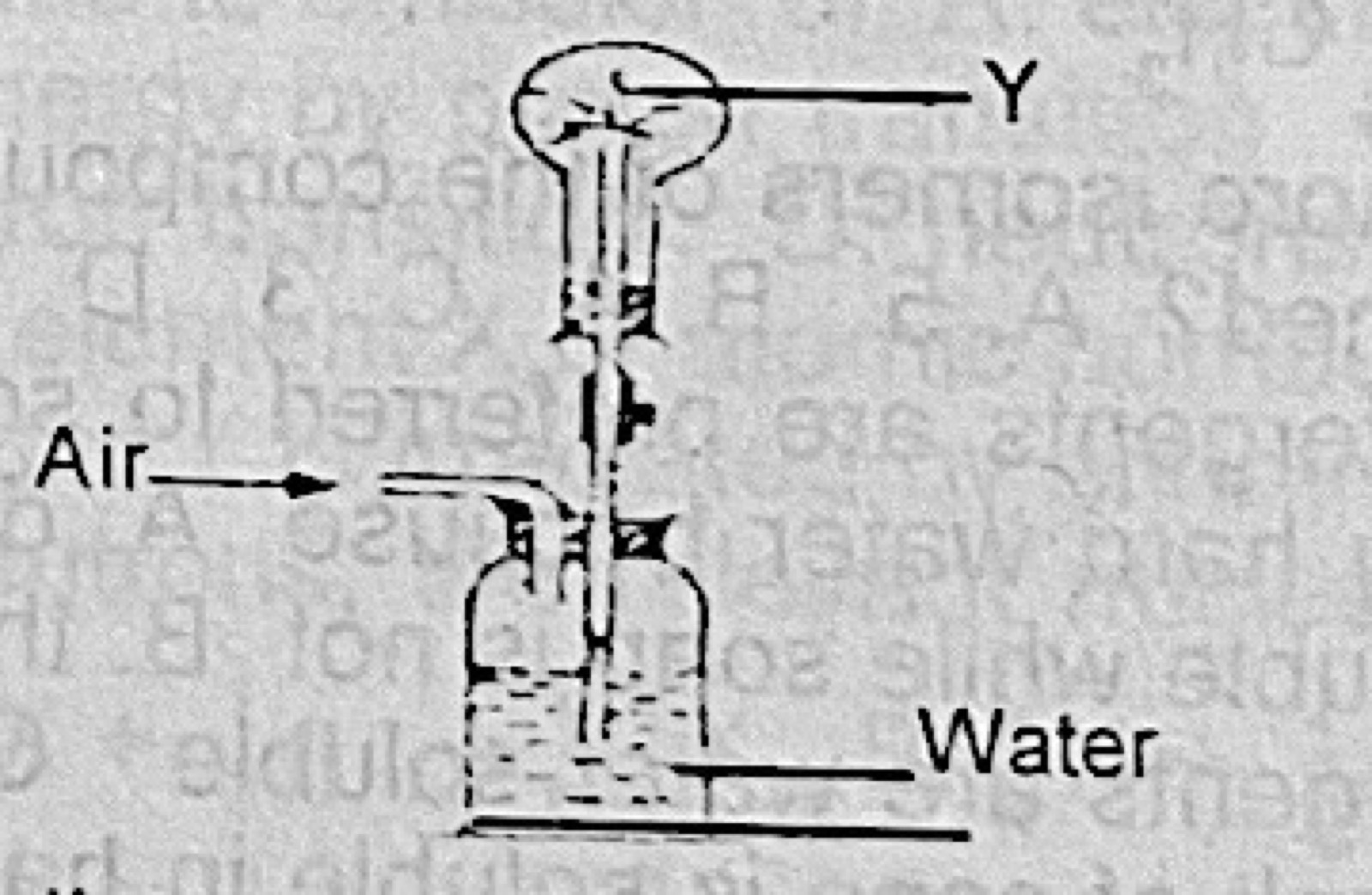
In the diagram above the gas Y could be

Diagram for this question
  1. A.hydrogen chloride
  2. B.oxygen
  3. C.carbon (IV) oxide
  4. D.chlorine
Show the answer and explanation

Answer: A (hydrogen chloride)

Explanation

The set-up is a fountain experiment: water is forced up into the flask because the gas dissolves very quickly in it. Hydrogen chloride is extremely soluble in water; the other gases are not.

Open this question

Question 35

Qualitative Analysis

The reaction that occurs during the laboratory test for the presence of tetraoxosulphate (VI) ion is

  1. A.SO42−(aq) + Ba2+(aq) → BaSO4 (dil HNO3)
  2. B.Cu(s) + 4H+(aq) + 2SO42−(aq) → CuSO4(s) + 2H2O + SO2(g)
  3. C.4H+(aq) + 2SO42−(aq) + 2e− → SO42−(aq) + 2H2O(l) + SO2(g)
  4. D.CuO(s) + 2H+(aq) + SO4(aq) → CuSO4(aq) + H2O(l).
Show the answer and explanation

Answer: A (SO42−(aq) + Ba2+(aq) → BaSO4 (dil HNO3))

Explanation

The test for SO42− is to add a barium salt in dilute acid: a white precipitate of barium tetraoxosulphate(VI) forms.

Open this question

Question 36

Metals and their Compounds

The removal of rust from iron by treatment with tetraoxosulphate (VI) acid is based on the

  1. A.hydrolysis of the iron
  2. B.reaction of acid with base
  3. C.oxidation of the rust
  4. D.dehydration of the iron.
Show the answer and explanation

Answer: B (reaction of acid with base)

Explanation

Rust is hydrated iron(III) oxide, a basic oxide. It reacts with the acid to form a salt and water, which is a neutralization (acid + base) reaction.

Open this question

Question 37

Metals and their Compounds

Which of the following additives could improve the quality of steel?

  1. A.Silicon
  2. B.Sulphur and phosphorus
  3. C.Carbon
  4. D.Chromium and nickel
Show the answer and explanation

Answer: D (Chromium and nickel)

Explanation

Alloying steel with chromium and nickel makes stainless steel, which is hard and resists rusting. Sulphur and phosphorus make steel brittle.

Open this question

Question 38

Electrolysis

Sodium hydroxide is prepared commercially from sodium chloride solution by

  1. A.electrolysis using mercury as cathode
  2. B.hydrolysis in steam using a catalyst
  3. C.electrolysis using iron as anode
  4. D.treating sodium chloride with ammonia and carbon (IV) oxide.
Show the answer and explanation

Answer: A (electrolysis using mercury as cathode)

Explanation

In the mercury cathode cell, brine is electrolysed; sodium forms an amalgam with the mercury, which then reacts with water to give sodium hydroxide.

Open this question

Question 39

Introduction to Organic Chemistry

A sample of a substance containing only C and H burns in excess O2 to yield 4.4 g of CO2 and 2.7 g of H2O. The empirical formula of the substance is [C = 12, O = 16, H = 1]

  1. A.CH3
  2. B.CH2
  3. C.CH4
  4. D.C2H4
Show the answer and explanation

Answer: A (CH3)

Explanation

4.4 g CO2 = 0.1 mol, so 0.1 mol C. 2.7 g H2O = 0.15 mol, so 0.3 mol H. C : H = 0.1 : 0.3 = 1 : 3, giving CH3.

Open this question

Question 40

Petroleum and Coal

An undesirable paraffin in the petroleum industry which is particularly prone to knocking is

  1. A.iso-octane
  2. B.n-heptane
  3. C.iso-heptane
  4. D.n-octane.
Show the answer and explanation

Answer: B (n-heptane)

Explanation

Straight-chain n-heptane knocks badly and is given an octane number of 0; iso-octane is the standard for good anti-knock fuel (100).

Open this question

Question 41

Introduction to Organic Chemistry

The IUPAC nomenclature of the organic compound with the above structural formula is
CH3—CH(CH3)—CH(CH2CH3)—CH2—CH(CH3)—CH3

Diagram for this question
  1. A.3-ethyl-2, 5 - dimethylhexane
  2. B.4 - ethyl - 2, 5 - dimethylhexane
  3. C.3 - ethyl, 1, 1, 4 - trimethylpentane
  4. D.3 - ethyl - 2, 5, 5 - trimethylpentane.
Show the answer and explanation

Answer: A (3-ethyl-2, 5 - dimethylhexane)

Explanation

The longest chain has six carbons (hexane). Numbering from the end that gives the lowest locants puts methyl groups on C2 and C5 and an ethyl group on C3: 3-ethyl-2,5-dimethylhexane.

Open this question

Question 42

Alkanoic Acids and Esters

The reaction of an alkanol with an alkanoic acid in the presence of concentrated H2SO4 will produce an

  1. A.alkanal
  2. B.alkanoate
  3. C.alkanone
  4. D.alkyne
Show the answer and explanation

Answer: B (alkanoate)

Explanation

An alkanol and an alkanoic acid react (esterification) to give an ester, which is named as an alkyl alkanoate.

Open this question

Question 43

Hydrocarbons

The final product of the reaction of ethyne with hydrogen iodine is

  1. A.CH3 — CHI2
  2. B.CH2I–CH2I.
  3. C.CH3 — CI3
  4. D.CH2 = CHI.
Show the answer and explanation

Answer: A (CH3 — CHI2)

Explanation

Ethyne adds two molecules of HI. The first gives CH2=CHI; by Markovnikov's rule the second iodine goes on the carbon that already has one, giving CH3CHI2.

Open this question

Question 44

Introduction to Organic Chemistry

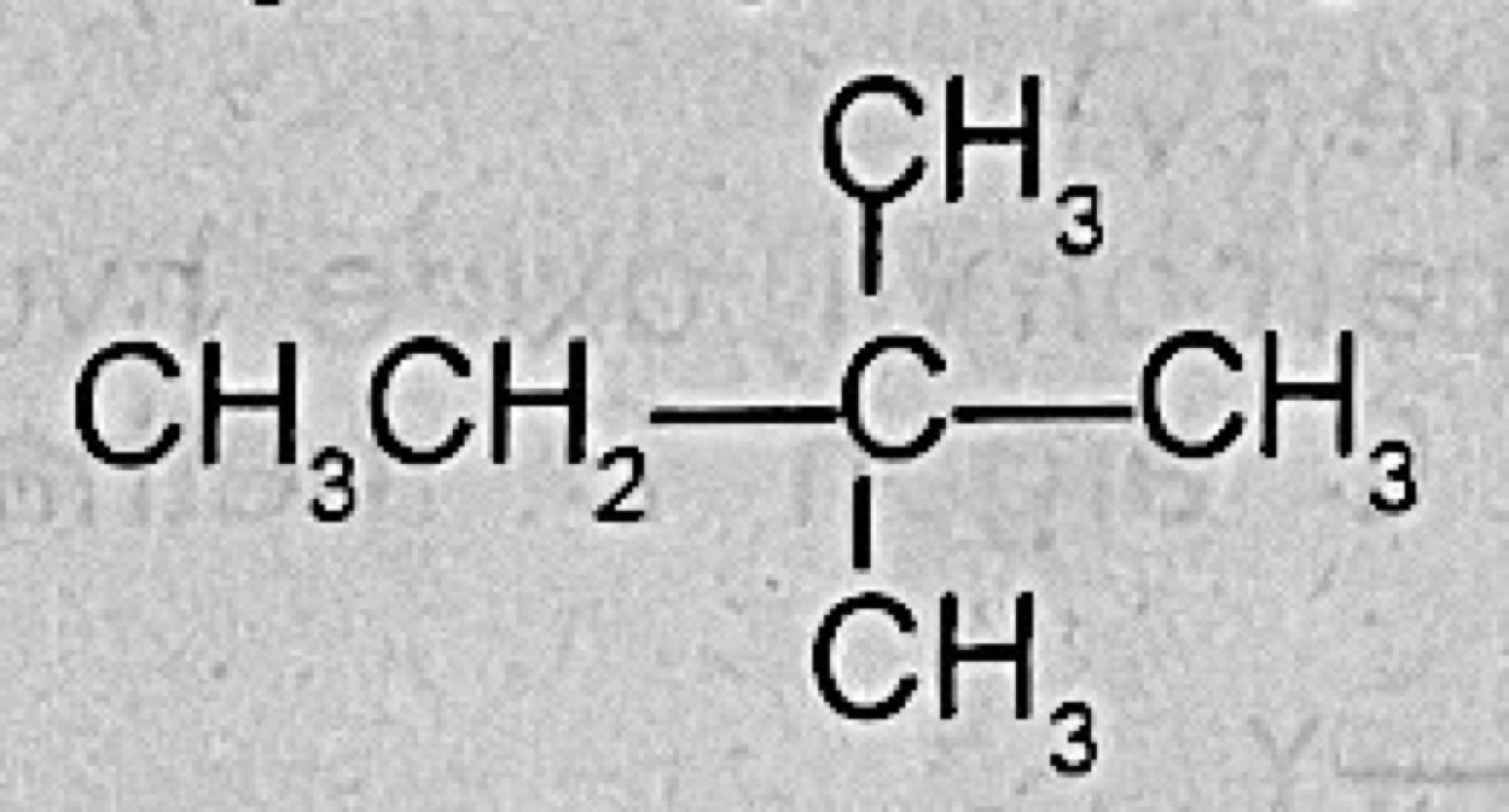
CH3CH2—C(CH3)2—CH3
How many more isomers of the compound above can be obtained?

Diagram for this question
  1. A.5
  2. B.4
  3. C.3
  4. D.2
Show the answer and explanation

Answer: B (4)

Explanation

The compound is 2,2-dimethylbutane, C6H14. Hexane has five structural isomers in all, so there are four others.

Open this question

Question 45

Fats, Oils and Soaps

Synthetic detergents are preferred to soap for laundry using hard water because

  1. A.detergents are water soluble while soap is not
  2. B.the calcium salts of detergents are water soluble
  3. C.the magnesium salt of soap is soluble in hard water
  4. D.soap does not have a hydrocarbon terminal chain.
Show the answer and explanation

Answer: B (the calcium salts of detergents are water soluble)

Explanation

Soap reacts with Ca2+ and Mg2+ in hard water to form insoluble scum. The calcium salts of detergents stay dissolved, so no scum forms and no detergent is wasted.

Open this question

Question 46

Polymers

The synthetic rubber obtained by the polymerization of chlorobutadiene in the presence of sodium is called

  1. A.teflon
  2. B.isoprene
  3. C.polythene
  4. D.neoprene.
Show the answer and explanation

Answer: D (neoprene.)

Explanation

Neoprene is the polymer of chlorobutadiene (chloroprene). Teflon comes from tetrafluoroethene and polythene from ethene.

Open this question

Question 47

Alkanoic Acids and Esters

25 cm3 of 0.02 M KOH neutralized 0.03 g of a monobasic organic acid having the general formula CnH2n + 1COOH. The molecular formula of the acid is [C = 12, H = 1, O = 16].

  1. A.HCOOH
  2. B.C2H5COOH
  3. C.CH3COOH
  4. D.C3H7COOH
Show the answer and explanation

Answer: C (CH3COOH)

Explanation

Moles of KOH = 0.025 × 0.02 = 0.0005 = moles of acid. Molar mass = 0.03/0.0005 = 60 g mol−1. 14n + 46 = 60 gives n = 1: CH3COOH.

Open this question

Question 48

Alkanals and Alkanones

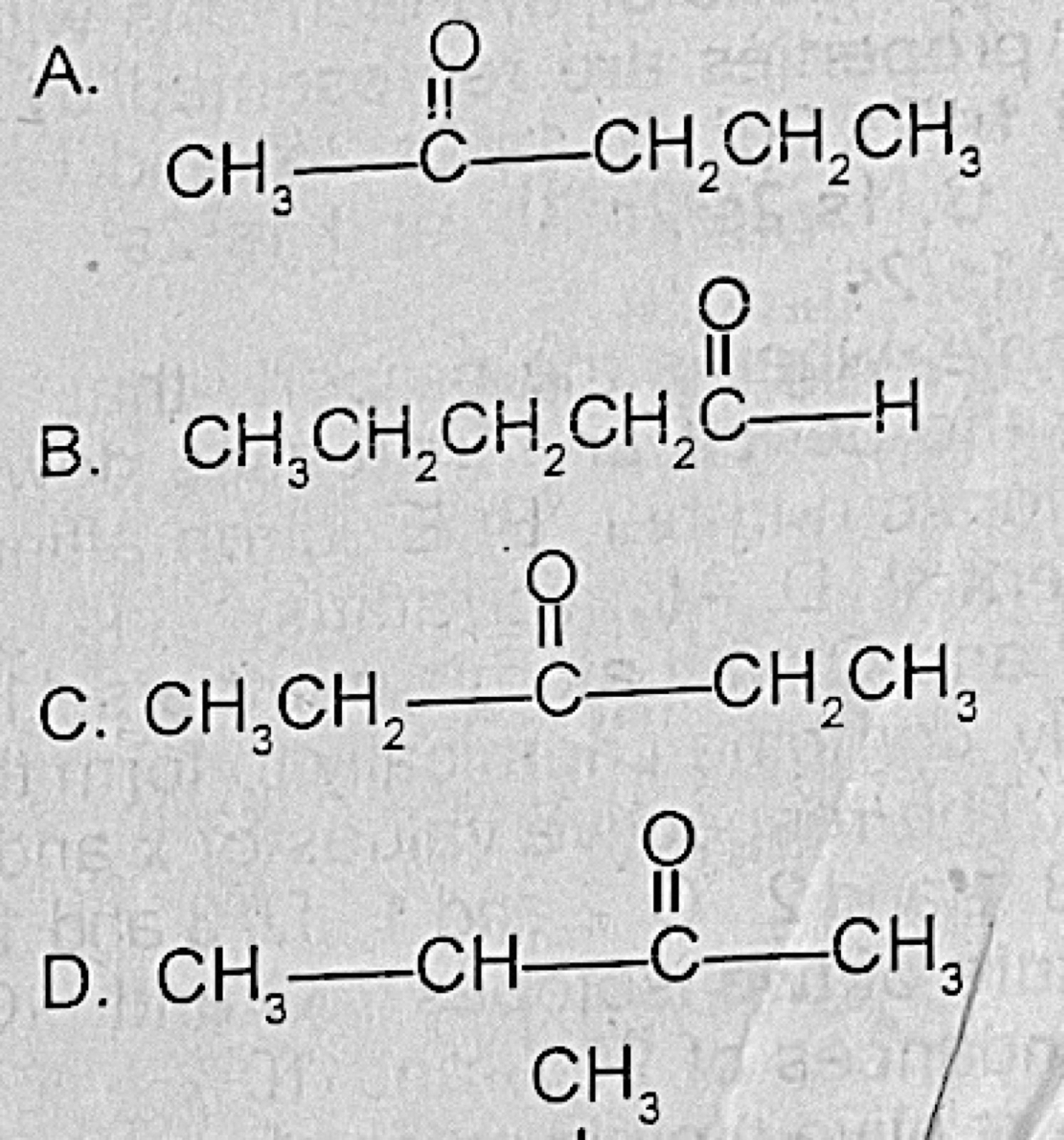
When Fehling's solution is added to two isomeric carbonyl compounds X and Y with the molecular formula C5H10O, compound X gives a red precipitate while Y does not react. It can be inferred that X is

Diagram for this question
  1. A.CH3COCH2CH2CH3
  2. B.CH3CH2CH2CH2CHO
  3. C.CH3CH2COCH2CH3
  4. D.CH3CH(CH3)COCH3
Show the answer and explanation

Answer: B (CH3CH2CH2CH2CHO)

Explanation

Fehling's solution gives a red precipitate (Cu2O) with aldehydes but not with ketones. Only B has the –CHO group (pentanal); the others are ketones.
Open this question

Question 49

Hydrocarbons

C6H5CH3
The compound above contains

Diagram for this question
  1. A.sp3 hybridized carbon atoms only
  2. B.sp2 hybridized carbon atoms only
  3. C.sp3 and sp. hybridized carbon atoms
  4. D.sp3 and sp2 hybridized carbon atoms.
Show the answer and explanation

Answer: D (sp3 and sp2 hybridized carbon atoms.)

Explanation

The six ring carbons of the benzene ring are sp2 hybridized, while the CH3 carbon has four single bonds and is sp3.

Open this question

Question 50

Alkanals and Alkanones

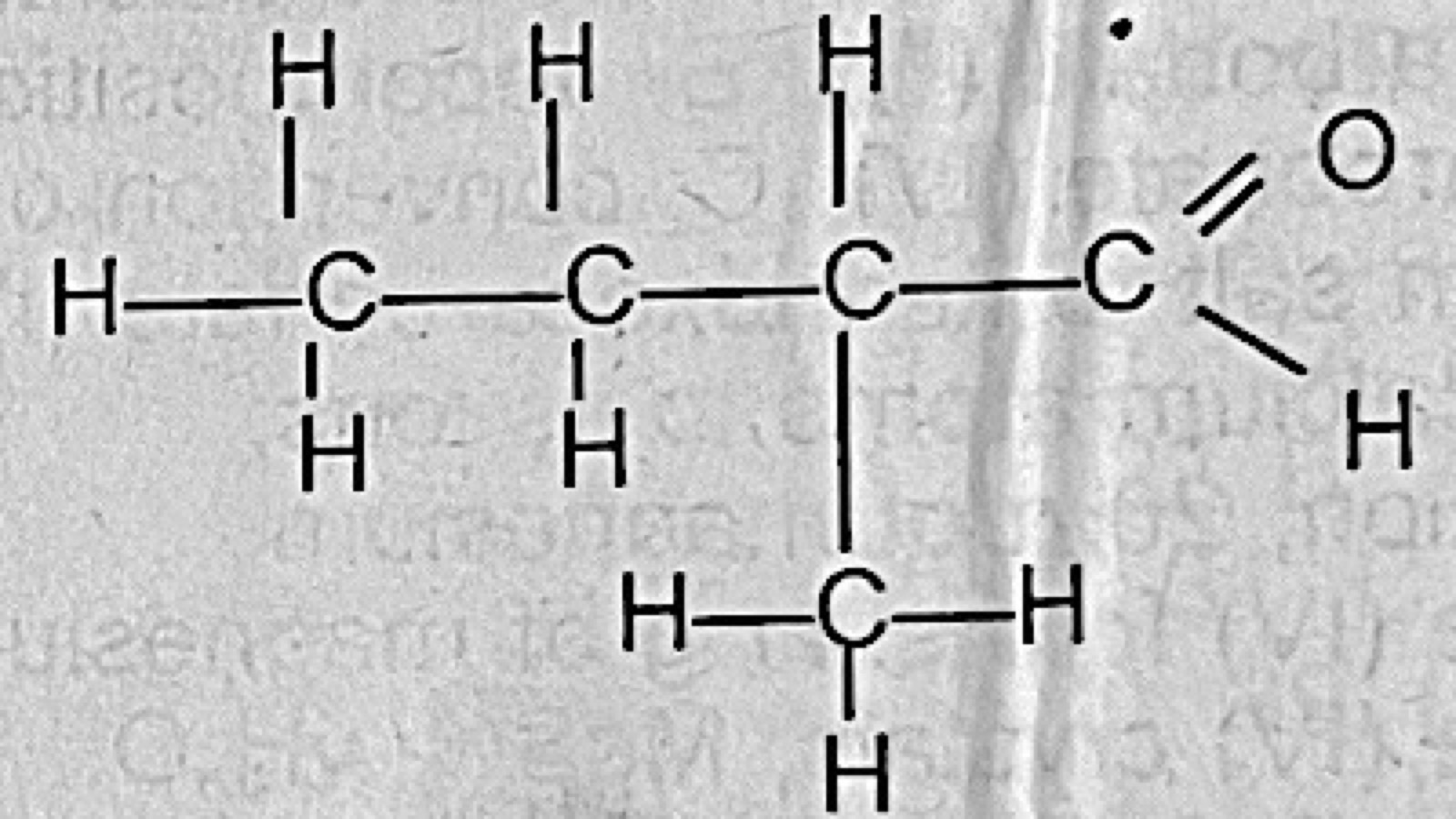
CH3CH2CH(CH3)CHO
The compound above is the product of the oxidation of

Diagram for this question
  1. A.2-methylbutan-2 -ol
  2. B.2-methylbutan - 1 - ol
  3. C.2, 3-dimethylprop 1-ol
  4. D.Pentan - 2 - ol.
Show the answer and explanation

Answer: B (2-methylbutan - 1 - ol)

Explanation

The product is an aldehyde, 2-methylbutanal. Aldehydes come from oxidizing primary alkanols with the same carbon skeleton: 2-methylbutan-1-ol.

Open this question