JAMB Chemistry 1993 past questions and answers

48 questions. Try each one, then open the answer to check yourself and read the explanation.

Question 1

Separation of Mixtures

The dissolution of common salt in water is a physical change because

  1. A.the salt can be obtained by crystallization
  2. B.the salt can be recovered by the evaporation of the water
  3. C.heat is not generated during mixing
  4. D.the solution will not boil at 100°C
Show the answer and explanation

Answer: B (the salt can be recovered by the evaporation of the water)

Explanation

A physical change produces no new substance and is easily reversed. Evaporating the water gives back the same salt, so dissolving salt is a physical change.

Open this question

Question 2

Separation of Mixtures

Which of the following substances is a mixture?

  1. A.Sulphur powder
  2. B.Bronze
  3. C.Distilled water
  4. D.Ethanol
Show the answer and explanation

Answer: B (Bronze)

Explanation

Bronze is an alloy of copper and tin, a mixture of metals. Sulphur is an element, while distilled water and ethanol are pure compounds.

Open this question

Question 3

Mole Concept and Stoichiometry

How many moles of oxygen molecules would be produced from the decomposition of 2.5 moles of potassium trioxochlorate (V)?

  1. A.2.50
  2. B.3.50
  3. C.3.75
  4. D.7.50
Show the answer and explanation

Answer: C (3.75)

Explanation

2KClO3 → 2KCl + 3O2, so 2 mol of KClO3 give 3 mol of O2. 2.5 mol gives 2.5 × 3/2 = 3.75 mol.

Open this question

Question 4

Chemical Formulae and Equations

A balanced chemical equation obeys the law of

  1. A.conservation of mass
  2. B.definite proportions
  3. C.multiple proportions
  4. D.conservation of energy
Show the answer and explanation

Answer: A (conservation of mass)

Explanation

Balancing makes the number of each kind of atom the same on both sides, so the total mass of reactants equals the total mass of products.

Open this question

Question 5

Gas Laws

At 25°C and 1 atm, a gas occupies a volume of 1.50 dm3. What volume will it occupy at 100°C and 1 atm?

  1. A.1.88 dm3
  2. B.6.00 dm3
  3. C.18.80 dm3
  4. D.60.00 dm3
Show the answer and explanation

Answer: A (1.88 dm3)

Explanation

At constant pressure V2 = V1 × T2/T1 = 1.50 × 373/298 = 1.88 dm3. Temperatures must be in kelvin.

Open this question

Question 6

Gas Laws

A gaseous mixture of 80.0 g of oxygen and 56.0 g of nitrogen has a total pressure of 1.8 atm. The partial pressure of oxygen in the mixture is [O = 16, N = 14]

  1. A.0.8 atm
  2. B.1.0 atm
  3. C.1.2 atm
  4. D.1.4 atm
Show the answer and explanation

Answer: B (1.0 atm)

Explanation

Moles of O2 = 80/32 = 2.5 and moles of N2 = 56/28 = 2.0. Partial pressure of O2 = (2.5/4.5) × 1.8 = 1.0 atm.

Open this question

Question 8

Kinetic Theory and States of Matter

For iodine crystals to sublime on heating, the molecules must acquire energy that is

  1. A.less than the forces of attraction in the solid
  2. B.equal to the forces of attraction in the solid
  3. C.necessary to melt the solid
  4. D.greater than the forces of attraction in both the solid and the liquid phases
Show the answer and explanation

Answer: D (greater than the forces of attraction in both the solid and the liquid phases)

Explanation

In sublimation the solid goes straight to vapour, skipping the liquid. The molecules need enough energy to break free of all the attractions that would hold them as a solid or a liquid.

Open this question

Question 9

Atomic Structure

An element, E, has the electronic configuration 1s22s22p63s23p3. The reaction of E with a halogen X can give

  1. A.EX3 and EX5
  2. B.EX3 only
  3. C.EX5 only
  4. D.EX2 and EX3
Show the answer and explanation

Answer: A (EX3 and EX5)

Explanation

E is phosphorus (5 valence electrons). It can use 3 of them or, using its empty 3d orbitals, all 5, giving EX3 and EX5 (e.g. PCl3 and PCl5).

Open this question

Question 10

Atomic Structure

Two atoms represented as U and U are

  1. A.isomers
  2. B.allotropes
  3. C.isotopes
  4. D.anomers
Show the answer and explanation

Answer: C (isotopes)

Explanation

Atoms of the same element (same symbol, same atomic number) with different mass numbers are isotopes, like uranium-235 and uranium-238.

Open this question

Question 11

Chemical Bonding

As the difference in electronegativity between bonded atoms increases, polarity of the bond

  1. A.decreases
  2. B.increases
  3. C.remains unchanged
  4. D.reduces to zero
Show the answer and explanation

Answer: B (increases)

Explanation

The more one atom pulls the shared electrons towards itself, the more uneven the charge in the bond, so the bond becomes more polar.

Open this question

Question 12

Chemical Bonding

Which group of elements forms hydrides that are pyramidal in structure?

  1. A.III
  2. B.IV
  3. C.V
  4. D.VI
Show the answer and explanation

Answer: C (V)

Explanation

Group V hydrides such as NH3 and PH3 have three bonding pairs and one lone pair on the central atom, which gives a pyramidal shape.

Open this question

Question 13

Chemical Bonding

Water has a rather high boiling point despite its low molecular mass because of the presence of

  1. A.hydrogen bonding
  2. B.covalent bonding
  3. C.ionic bonding
  4. D.metallic bonding
Show the answer and explanation

Answer: A (hydrogen bonding)

Explanation

Water molecules are held together by strong hydrogen bonds, which need extra energy to break, so water boils at 100°C instead of far lower.

Open this question

Question 15

Environmental Pollution

The air around a petroleum refinery is most likely to contain

  1. A.CO2, SO3 and N2O
  2. B.CO2, CO and N2O
  3. C.SO2, CO and NO2
  4. D.PH3, H2O and CO2
Show the answer and explanation

Answer: C (SO2, CO and NO2)

Explanation

Crude oil contains sulphur, and burning fuel in refineries forms carbon monoxide and nitrogen oxides, so SO2, CO and NO2 are the typical pollutants.

Open this question

Question 16

Water

Water can be identified by the use of

  1. A.anhydrous copper (II) tetraoxosulphate (VI)
  2. B.anhydrous sodium trioxocarbonate (IV)
  3. C.potassium heptaoxochromate (VII)
  4. D.copper (II) trioxocarbonate (IV)
Show the answer and explanation

Answer: A (anhydrous copper (II) tetraoxosulphate (VI))

Explanation

White anhydrous copper(II) sulphate turns blue when water is added, which is the standard test for water.

Open this question

Question 17

Water

The phenomenon whereby sodium trioxocarbonate (IV) decahydrate loses some of its water of crystallization on exposure to the atmosphere is known as

  1. A.deliquescence
  2. B.hygroscopy
  3. C.effervescence
  4. D.efflorescence
Show the answer and explanation

Answer: D (efflorescence)

Explanation

Efflorescence is when a hydrated crystal gives off some of its water of crystallization to the air and becomes powdery, as washing soda (Na2CO3·10H2O) does.

Open this question

Question 18

Acids, Bases and Salts

A student prepares 0.5 M solution each of hydrochloric and ethanoic acids and then measured their pH. The result would show that the

  1. A.pH values are equal
  2. B.HCl solution has a higher pH
  3. C.sum of the pH values is 14
  4. D.ethanoic acid solution has a higher pH
Show the answer and explanation

Answer: D (ethanoic acid solution has a higher pH)

Explanation

HCl is a strong acid and ionizes fully, while ethanoic acid is weak and ionizes only slightly. Ethanoic acid gives fewer H+ ions at the same concentration, so its pH is higher.

Open this question

Question 19

Solubility and Solutions

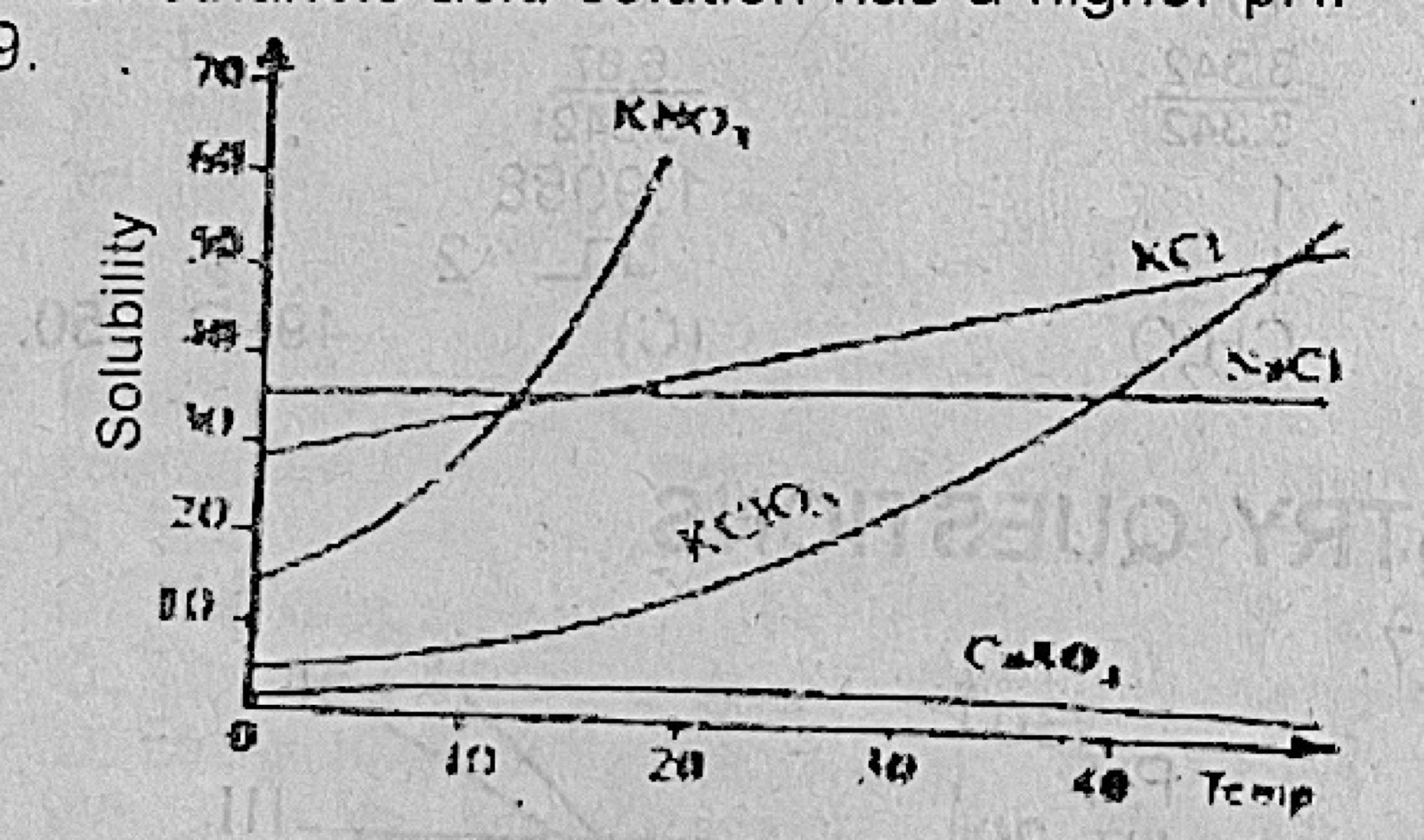
For which salt in the graph above does the solubility increase most rapidly with rise in temperature?

Diagram for this question
  1. A.CaSO4
  2. B.KNO3
  3. C.NaCl
  4. D.KCl
Show the answer and explanation

Answer: B (KNO3)

Explanation

The steepest curve on a solubility graph shows the fastest rise in solubility with temperature. The KNO3 curve is the steepest.

Open this question

Question 20

Acids, Bases and Salts

NH3 + H3O+ → NH4+ + H2O. It may be deduced from the reaction above that

  1. A.a redox reaction has occurred
  2. B.H3O+ acts as an oxidizing agent
  3. C.H3O+ acts as an acid
  4. D.water acts as an acid
Show the answer and explanation

Answer: C (H3O+ acts as an acid)

Explanation

H3O+ gives a proton (H+) to NH3. A proton donor is an acid, and no oxidation numbers change.

Open this question

Question 21

Mole Concept and Stoichiometry

4.0 g of sodium hydroxide in 250 cm3 of solution contains

  1. A.0.40 moles per dm3
  2. B.0.10 moles per dm3
  3. C.0.04 moles per dm3
  4. D.0.02 moles per dm3
Show the answer and explanation

Answer: A (0.40 moles per dm3)

Explanation

Moles of NaOH = 4.0/40 = 0.10 mol in 0.250 dm3. Concentration = 0.10/0.250 = 0.40 mol dm-3.

Open this question

Question 22

Electrolysis

During the electrolysis of a salt of a metal M, a current of 0.5 A flows for 32 minutes 10 seconds and deposits 0.325 g of M. What is the charge of the metal ion? [M = 65, 1F = 96,500 C per mole of electron]

  1. A.1
  2. B.2
  3. C.3
  4. D.4
Show the answer and explanation

Answer: B (2)

Explanation

Q = 0.5 × 1930 s = 965 C = 0.01 mol of electrons. Moles of M = 0.325/65 = 0.005 mol, so each ion took 0.01/0.005 = 2 electrons: the charge is +2.

Open this question

Question 23

Electrolysis

Which of the following reactions occurs at the anode during the electrolysis of a very dilute aqueous solution of sodium chloride?

  1. A.OH− − e → OH
  2. B.Cl− − e− → Cl
  3. C.OH− + Cl− → HCl + O2−
  4. D.Na+ − e− → Na/Hg amalgam (over Hg)
Show the answer and explanation

Answer: A (OH− − e → OH)

Explanation

In very dilute NaCl, OH− ions are discharged at the anode in preference to Cl− because they are lower in the discharge series. Each OH− loses an electron, and oxygen is given off.

Open this question

Question 24

Electrolysis

Half-cell reactions and E° values:
Cu2+(aq) + 2e− → Cu(s): +0.34 V
Fe2+(aq) + 2e− → Fe(s): −0.44 V
Ba2+(aq) + 2e− → Ba(s): −2.90 V
Zn2+(aq) + 2e− → Zn(s): −0.76 V
From the data above, it can be deduced that the most powerful reducing agent of the four metals is

  1. A.Cu
  2. B.Fe
  3. C.Ba
  4. D.Zn
Show the answer and explanation

Answer: C (Ba)

Explanation

The metal with the most negative electrode potential loses electrons most readily, so it is the strongest reducing agent. Barium (−2.90 V) is the most negative.

Open this question

Question 25

Redox Reactions

The oxidation states of chlorine in HOCl, HClO3 and HClO4 are respectively

  1. A.-1, +5 and +7
  2. B.-1, +5 and 7
  3. C.+1, +3 and +4
  4. D.+1, +5 and +7
Show the answer and explanation

Answer: D (+1, +5 and +7)

Explanation

With H = +1 and O = −2: in HOCl, Cl = +1; in HClO3, 1 + Cl − 6 = 0 gives +5; in HClO4, 1 + Cl − 8 = 0 gives +7.

Open this question

Question 26

Energy Changes

A reaction takes place spontaneously if

  1. A.ΔG = O
  2. B.ΔS < O and ΔH > O
  3. C.ΔH < TΔS
  4. D.ΔG > O
Show the answer and explanation

Answer: C (ΔH < TΔS)

Explanation

ΔG = ΔH − TΔS, and a reaction is spontaneous when ΔG is negative. That happens when ΔH is less than TΔS.

Open this question

Question 27

Energy Changes

The standard enthalpies of formation of CO2(g), H2O(g) and CO(g) in kJ mol−1 are −394, −242 and −110 respectively. What is the standard enthalpy change for the reaction CO(g) + H2O(g) → CO2(g) + H2(g)?

  1. A.−42 kJ mol−1
  2. B.+42 kJ mol−1
  3. C.−262 kJ mol−1
  4. D.+262 kJ mol−1
Show the answer and explanation

Answer: A (−42 kJ mol−1)

Explanation

ΔH = ΣΔHf(products) − ΣΔHf(reactants) = (−394 + 0) − (−110 − 242) = −394 + 352 = −42 kJ mol−1.

Open this question

Question 28

Chemical Equilibrium

10 g of a solid is in equilibrium with its own vapour. When 1 g of a small amount of solid is added, the vapour pressure

  1. A.remains the same
  2. B.drops
  3. C.increases by 1%
  4. D.increases by 99%
Show the answer and explanation

Answer: A (remains the same)

Explanation

The vapour pressure of a substance at a given temperature is fixed. Adding more solid does not change it, as long as the temperature stays the same.

Open this question

Question 29

Rates of Reaction

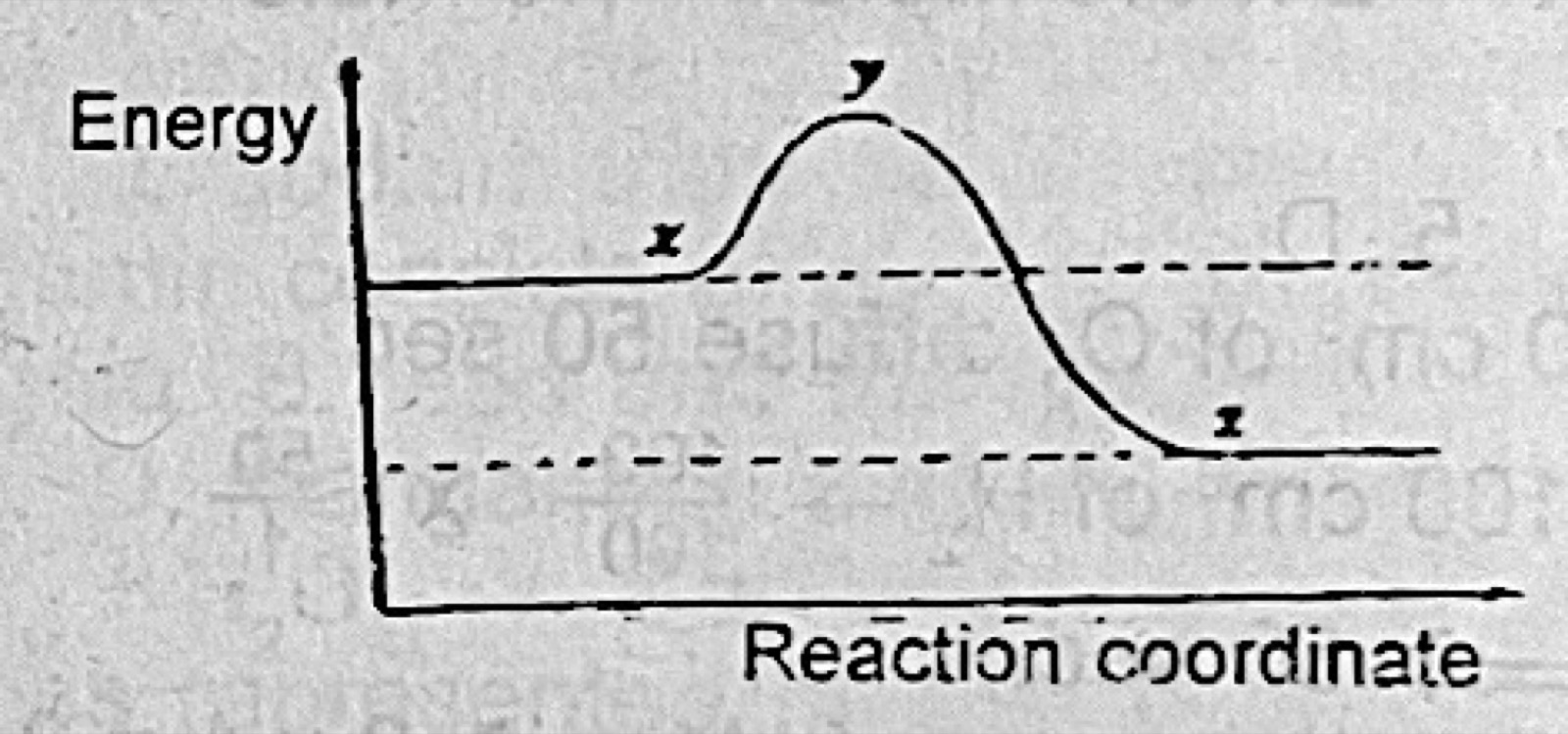
In the diagram above, curve X represents the energy profile for a homogeneous gaseous reaction. Which of the following conditions would produce curve Y for the same reaction?

Diagram for this question
  1. A.Increase in temperature
  2. B.Increase in the concentration of a reactant
  3. C.Addition of a catalyst
  4. D.Increase in pressure
Show the answer and explanation

Answer: C (Addition of a catalyst)

Explanation

Curve Y has a lower energy hump between the same reactants and products, meaning a lower activation energy. Only a catalyst lowers the activation energy.

Open this question

Question 30

Acids, Bases and Salts

NaCl(s) + H2SO4(l) → HCl(g) + NaHSO4(s). In the reaction above, H2SO4 behaves as

  1. A.a strong acid
  2. B.an oxidizing agent
  3. C.a good solvent
  4. D.a dehydrating agent
Show the answer and explanation

Answer: A (a strong acid)

Explanation

Concentrated H2SO4 is a strong, non-volatile acid. It donates H+ to chloride ions and drives off the more volatile HCl gas, leaving NaHSO4.

Open this question

Question 31

Sulphur and its Compounds

Which of these gases can be dried with concentrated H2SO4?

  1. A.HBr
  2. B.H2S
  3. C.NH3
  4. D.SO2
Show the answer and explanation

Answer: D (SO2)

Explanation

A drying agent must not react with the gas. Concentrated H2SO4 oxidizes HBr and H2S and reacts with alkaline NH3, but it does not react with acidic SO2.

Open this question

Question 32

Metals and their Compounds

Which of these salts will produce its metal, oxygen and nitrogen (IV) oxide on heating?

  1. A.Silver trioxonitrate (V)
  2. B.Sodium trioxonitrate (V)
  3. C.Calcium trioxonitrate (V)
  4. D.Lithium trioxonitrate (V)
Show the answer and explanation

Answer: A (Silver trioxonitrate (V))

Explanation

Nitrates of metals low in the activity series, like silver, decompose all the way to the metal: 2AgNO3 → 2Ag + 2NO2 + O2.

Open this question

Question 33

Carbon and its Compounds

An experiment produces a gaseous mixture of carbon (IV) oxide and carbon (II) oxide. In order to obtain pure carbon (II) oxide, the gas mixture should be

  1. A.passed over heated copper (II) oxide
  2. B.bubbled through concentrated tetraoxosulphate (VI) acid
  3. C.bubbled through sodium hydroxide solution
  4. D.bubbled through water
Show the answer and explanation

Answer: C (bubbled through sodium hydroxide solution)

Explanation

Sodium hydroxide absorbs the acidic CO2 but not the neutral CO, so the gas that passes through is CO.
Open this question

Question 34

Halogens

Which of the following is a property of ionic chlorides?

  1. A.They can be decomposed by heat
  2. B.They react with aqueous AgNO3 to give a white precipitate which is soluble in excess ammonia
  3. C.They explode when in contact with dry ammonia gas
  4. D.They react with concentrated tetraoxosulphate (VI) acid to give white fumes of chlorine gas
Show the answer and explanation

Answer: B (They react with aqueous AgNO3 to give a white precipitate which is soluble in excess ammonia)

Explanation

Chloride ions give a white precipitate of AgCl with silver nitrate, and AgCl dissolves in excess ammonia. This is the standard test for chlorides.

Open this question

Question 35

Acids, Bases and Salts

When dilute aqueous solutions of lead (II) nitrate and potassium bromide are mixed, a precipitate is observed. The products of this reaction are

  1. A.PbO(s) + Br−(aq) + KNO3
  2. B.Br2 + NO2(g) + PbBr2(s)
  3. C.PbO(s) + K+(aq) + Br−(aq) + NO2(g)
  4. D.PbBr2(s) + K+(aq) + NO3−(aq)
Show the answer and explanation

Answer: D (PbBr2(s) + K+(aq) + NO3−(aq))

Explanation

This is a double decomposition: Pb2+ and Br− form insoluble PbBr2, while K+ and NO3− stay in solution as spectator ions.

Open this question

Question 36

Metals and their Compounds

Bronze is an alloy of

  1. A.silver and copper
  2. B.silver and gold
  3. C.copper and nickel
  4. D.copper and zinc
  5. E.copper and tin
Show the answer and explanation

Answer: E (copper and tin)

Explanation

Bronze is mainly copper with tin. Copper with zinc is brass.

Open this question

Question 37

Nitrogen and its Compounds

Copper metal will react with concentrated trioxonitrate (V) acid to give

  1. A.Cu(NO3)2 + NO + N2O4 + H2O
  2. B.Cu(NO3)2 + NO + H2O
  3. C.CuO + NO2 + H2O
  4. D.Cu(NO3)2 + NO2 + H2O
Show the answer and explanation

Answer: D (Cu(NO3)2 + NO2 + H2O)

Explanation

Cu + 4HNO3(conc) → Cu(NO3)2 + 2NO2 + 2H2O. Dilute nitric acid would give NO instead.

Open this question

Question 38

Metals and their Compounds

The active reducing agent in the blast furnace for the extraction of iron is

  1. A.carbon
  2. B.limestone
  3. C.carbon (II) oxide
  4. D.calcium oxide
Show the answer and explanation

Answer: C (carbon (II) oxide)

Explanation

Coke burns to CO2, which reacts with more hot coke to form CO. The CO reduces the iron ore: Fe2O3 + 3CO → 2Fe + 3CO2.

Open this question

Question 39

Hydrogen, Oxygen and Oxides

Al2O3(s) + 3H2SO4(aq) → Al2(SO4)3(aq) + 3H2O(l)
Al2O3(s) + 2NaOH(aq) + 3H2O(l) → 2NaAl(OH)4(aq)
We can conclude from the equations above that Al2O3 is

  1. A.an acidic oxide
  2. B.an amphoteric oxide
  3. C.a basic oxide
  4. D.a neutral oxide
Show the answer and explanation

Answer: B (an amphoteric oxide)

Explanation

Al2O3 reacts with both an acid and an alkali to form salts. An oxide that behaves as both acid and base is amphoteric.

Open this question

Question 40

Carbohydrates, Proteins and Amines

H2N—CH2—COOH
The two functional groups in the above compound are

  1. A.alcohol and amine
  2. B.acid and amine
  3. C.aldehyde and acid
  4. D.ketone and amine
Show the answer and explanation

Answer: B (acid and amine)

Explanation

The compound (glycine) has an –NH2 group (amine) and a –COOH group (carboxylic acid).

Open this question

Question 41

Petroleum and Coal

The fraction of crude oil used as jet fuel is

  1. A.refinery gas
  2. B.diesel oil
  3. C.kerosene
  4. D.gasoline
Show the answer and explanation

Answer: C (kerosene)

Explanation

Kerosene (paraffin) is the fraction used as aviation (jet) fuel.

Open this question

Question 42

Introduction to Organic Chemistry

CH3CH(CH3)CH2CH(CH3)CH2CH3
The IUPAC nomenclature for the compound above is

  1. A.dimethylhexane
  2. B.3,5 dimethylhexane
  3. C.1,1 dimethyl, 3 methylpentane
  4. D.2,4 dimethylhexane
Show the answer and explanation

Answer: D (2,4 dimethylhexane)

Explanation

The longest chain has 6 carbons (hexane). Numbering from the end nearest the branches puts the two methyl groups on carbons 2 and 4.

Open this question

Question 43

Petroleum and Coal

It is not desirable to use lead tetraethyl as an anti-knock agent because

  1. A.it is expensive
  2. B.of pollution effects from the exhaust fumes
  3. C.it lowers the octane rating of petrol
  4. D.it is explosive
Show the answer and explanation

Answer: B (of pollution effects from the exhaust fumes)

Explanation

Lead tetraethyl releases poisonous lead compounds into the air through car exhausts, which is why leaded petrol has been phased out.

Open this question

Question 44

Hydrocarbons

The carbon atoms on ethane are

  1. A.sp2 hybridized
  2. B.sp3 hybridized
  3. C.sp2d hybridized
  4. D.sp hybridized
Show the answer and explanation

Answer: B (sp3 hybridized)

Explanation

Each carbon in ethane forms four single bonds arranged tetrahedrally, which uses sp3 hybrid orbitals.

Open this question

Question 45

Hydrocarbons

Catalytic hydrogenation of benzene produces

  1. A.an aromatic hydrocarbon
  2. B.margarine
  3. C.cyclohexane
  4. D.D.D.T.
Show the answer and explanation

Answer: C (cyclohexane)

Explanation

Adding hydrogen to benzene over a nickel catalyst saturates the ring: C6H6 + 3H2 → C6H12 (cyclohexane).

Open this question

Question 46

Alkanoic Acids and Esters

CH3COOCH2CH3 and CH3CH2CH2COOH are

  1. A.isomers
  2. B.esters
  3. C.carboxylic acids
  4. D.polymers
Show the answer and explanation

Answer: A (isomers)

Explanation

Ethyl ethanoate and butanoic acid both have the formula C4H8O2 but different structures, so they are (functional group) isomers.

Open this question

Question 47

Alkanols

Palm wine turns sour with time because

  1. A.the sugar content is converted into alcohol
  2. B.the carbon (IV) oxide formed during the fermentation process has a sour taste
  3. C.it is commonly adulterated by the tappers and sellers
  4. D.microbial activity results in the production of organic acids within it
Show the answer and explanation

Answer: D (microbial activity results in the production of organic acids within it)

Explanation

Microorganisms in the palm wine oxidize the alcohol to ethanoic acid and other organic acids, which taste sour.

Open this question

Question 48

Hydrocarbons

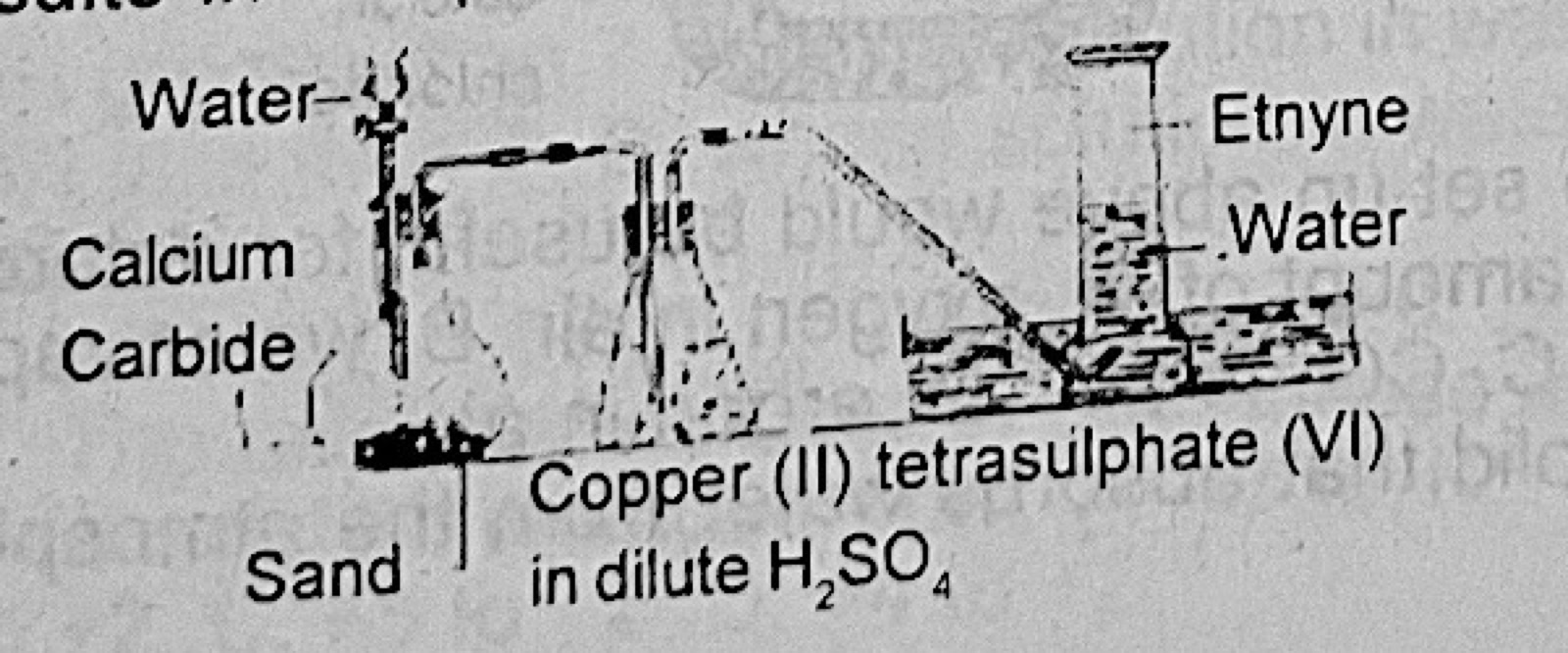
The function of the copper (II) tetraoxosulphate (VI) in dilute H2SO4 in the figure above is to

Diagram for this question
  1. A.dry the gas
  2. B.absorb phosphine impurity
  3. C.absorb ethene impurity
  4. D.form an acetylide with ethyne
Show the answer and explanation

Answer: B (absorb phosphine impurity)

Explanation

Ethyne made from calcium carbide contains phosphine (and hydrogen sulphide) impurities. Acidified copper(II) sulphate solution absorbs them.

Open this question

Question 49

Fats, Oils and Soaps

Which of the following represents saponification?

  1. A.Reaction of carboxylic acids with sodium hydroxide
  2. B.Reaction of alkanoates with acid
  3. C.Reaction of carboxylic acids with alcohols
  4. D.Reaction of alkanoates with sodium hydroxide
Show the answer and explanation

Answer: D (Reaction of alkanoates with sodium hydroxide)

Explanation

Saponification is the alkaline hydrolysis of esters (alkanoates, such as fats and oils) by sodium hydroxide, giving soap and an alcohol.

Open this question

Question 50

Alkanoic Acids and Esters

The confirmatory test for alkanoic acids in organic qualitative analysis is the

  1. A.turning of wet blue litmus paper red
  2. B.reaction with alkanols to form esters
  3. C.reaction with sodium hydroxide to form salt and water
  4. D.reaction with aqueous Na2CO3 to liberate a gas which turns lime water milky
Show the answer and explanation

Answer: D (reaction with aqueous Na2CO3 to liberate a gas which turns lime water milky)

Explanation

Alkanoic acids are strong enough to release CO2 from sodium carbonate, and the CO2 turns lime water milky. Phenols and alcohols do not do this.

Open this question