49 questions. Try each one, then open the answer to check yourself and read the explanation.
Question 1
Separation of Mixtures
Which of the following substances is not a homogeneous mixture?
A.Filtered sea water
B.Soft drink
C.Flood water
D.Writing ink.
Show the answer and explanation
Answer: C (Flood water)
Explanation
A homogeneous mixture is the same all through. Flood water has mud and other particles suspended in it that settle out, so it is heterogeneous; sea water, soft drinks and ink are uniform.
There is a large temperature interval between the melting point and the boiling point of a metal because
A.metals have very high melting points
B.metals conduct heat very rapidly
C.melting does not break the metallic bond but boiling does
D.the crystal lattice of metals is easily broken.
Show the answer and explanation
Answer: C (melting does not break the metallic bond but boiling does)
Explanation
When a metal melts, the atoms can slide past each other but the sea of electrons still holds them together. Boiling must separate the atoms completely, which needs far more energy, so the boiling point is much higher.
If 100 cm3 of oxygen pass through a porous plug in 50 seconds, the time taken for the same volume of hydrogen to pass through the same porous plug is [O = 16, H = 1].
A.10.0 s
B.12.5 s
C.17.7 s
D.32.0 s
Show the answer and explanation
Answer: B (12.5 s)
Explanation
By Graham's law time is proportional to √(molar mass): t = 50 × √(2/32) = 50 × 0.25 = 12.5 s.
An increase in temperature causes an increase in the pressure of a gas in a fixed volume due to an increase in the
A.number of molecules of the gas
B.density of the gas molecules
C.number of collisions between the gas molecules
D.number of collisions between the gas molecules and the walls of the container
Show the answer and explanation
Answer: D (number of collisions between the gas molecules and the walls of the container)
Explanation
Gas pressure comes from molecules hitting the container walls. Hotter molecules move faster and hit the walls more often and harder, so pressure rises.
On which of the following is the solubility of a gaseous substance dependent? I. Nature of solvent II. Nature of solute III. Temperature IV. Pressure
A.I, II, III and IV
B.I and II only
C.II only
D.I, III and IV only.
Show the answer and explanation
Answer: A (I, II, III and IV)
Explanation
How much gas dissolves depends on which gas it is and which solvent is used (ammonia dissolves far better in water than oxygen), and also on temperature and pressure.
Emulsion paint is tiny solid particles of pigment and polymer binder spread through water, a liquid. (A true emulsion of liquid in liquid is not what the paint is.)
An acid salt still has a replaceable hydrogen from the acid. NaHS comes from H2S with only one H replaced. Alum is a double salt and CuCO3.Cu(OH)2 is a basic salt.
Copper (II) tetraoxosulphate (VI) solution is electrolysed using carbon electrodes. Which of the following are produced at the anode and cathode respectively?
A.Copper and oxygen
B.Oxygen and copper
C.Hydrogen and copper
D.Copper and hydrogen
Show the answer and explanation
Answer: B (Oxygen and copper)
Explanation
With inert carbon electrodes, OH− ions are discharged at the anode to give oxygen, and Cu2+ ions are discharged at the cathode to give copper.
Calculate the mass, in kilograms, of magnesium produced by the electrolysis of magnesium (II) chloride in a cell operating for 24 hours at 500 amperes. [1 Faraday = 96,500 C mol−1, Mg = 24].
A.2.7
B.5.4
C.10.8
D.21.7
Show the answer and explanation
Answer: B (5.4)
Explanation
Charge = 500 × 24 × 3600 = 43 200 000 C. Mg2+ needs 2 × 96 500 C per 24 g, so mass = 43 200 000 × 24 ÷ 193 000 ≈ 5372 g ≈ 5.4 kg.
MnO2 + 2Cl− + 4H+ → Mn2+ + Cl2 + 2H2O. The changes in oxidation numbers when the manganese, chloride and hydrogen ions react according to the above equation are respectively
A.2,2,4
B.−1, −2, 4
C.−2, 1, 0
D.2, 4, 0.
Show the answer and explanation
Answer: C (−2, 1, 0)
Explanation
Mn goes from +4 to +2 (change −2), Cl goes from −1 to 0 (change +1) and H stays at +1 (change 0).
Which of the following equilibria shows little or no net reaction when the volume of the system is decreased?
A.H2(g) + I2(g) ⇌ 2HI(g)
B.2NO2(g) ⇌ N2O4(g)
C.PCl5(g) ⇌ PCl3(g) + Cl2(g)
D.ZnO(s) + CO2(g) ⇌ ZnCO3(s).
Show the answer and explanation
Answer: A (H2(g) + I2(g) ⇌ 2HI(g))
Explanation
Decreasing the volume raises the pressure, which favours the side with fewer gas molecules. H2 + I2 ⇌ 2HI has 2 moles of gas on each side, so it does not shift.
Which of these statements is TRUE about carbon (IV) oxide?
A.It supports combustion
B.It is strongly acidic in water
C.It is very soluble in water
D.It supports the burning of magnesium to produce magnesium oxide.
Show the answer and explanation
Answer: D (It supports the burning of magnesium to produce magnesium oxide.)
Explanation
CO2 puts out most fires, but burning magnesium is hot enough to take the oxygen from it: 2Mg + CO2 → 2MgO + C. CO2 is only slightly soluble and forms a weak acid.
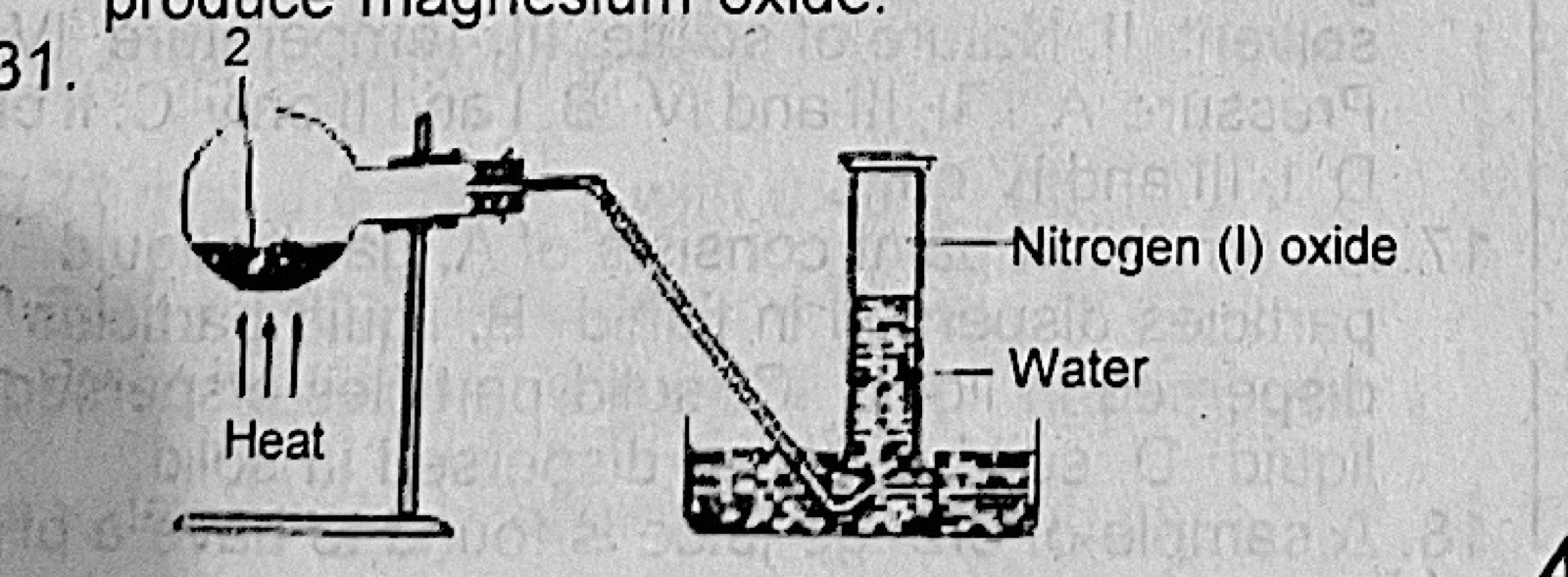
In the experiment above (Z is heated in the flask and nitrogen (I) oxide is collected over water), Z can be
A.a solution of sodium dioxonitrate (III) and ammonium chloride
B.a solution of lead trioxonitrate (V)
C.a solution of sodium trioxonitrate (V) and ammonium chloride
D.concentrated tetraoxosulphate (VI) acid and sodium trioxonitrate (V).
Show the answer and explanation
Answer: C (a solution of sodium trioxonitrate (V) and ammonium chloride)
Explanation
Heating ammonium trioxonitrate(V) gives nitrogen(I) oxide: NH4NO3 → N2O + 2H2O. A mixture of sodium trioxonitrate(V) and ammonium chloride produces ammonium trioxonitrate(V) when heated, so it gives N2O.
Which of the following combination of gases is used for metal welding? I. Oxygen and ethyne. II. Hydrogen and ethyne III. Hydrogen and oxygen IV. Ethyne, hydrogen and oxygen
A.I and II
B.II and IV
C.I and III
D.II and IV
Show the answer and explanation
Answer: C (I and III)
Explanation
A welding flame needs a fuel burning in pure oxygen. The oxy-acetylene flame (I) and the oxy-hydrogen flame (III) are both used.
Addition of an aqueous solution of barium chloride to the aqueous solution of a salt gives a white precipitate. The salt is likely to be a
A.nitrate
B.carbonate
C.chloride
D.sulphide
Show the answer and explanation
Answer: B (carbonate)
Explanation
Barium ions form insoluble white barium trioxocarbonate(IV) with carbonate ions: Ba2+ + CO32− → BaCO3. Barium nitrate, chloride and sulphide are soluble, so they give no precipitate.
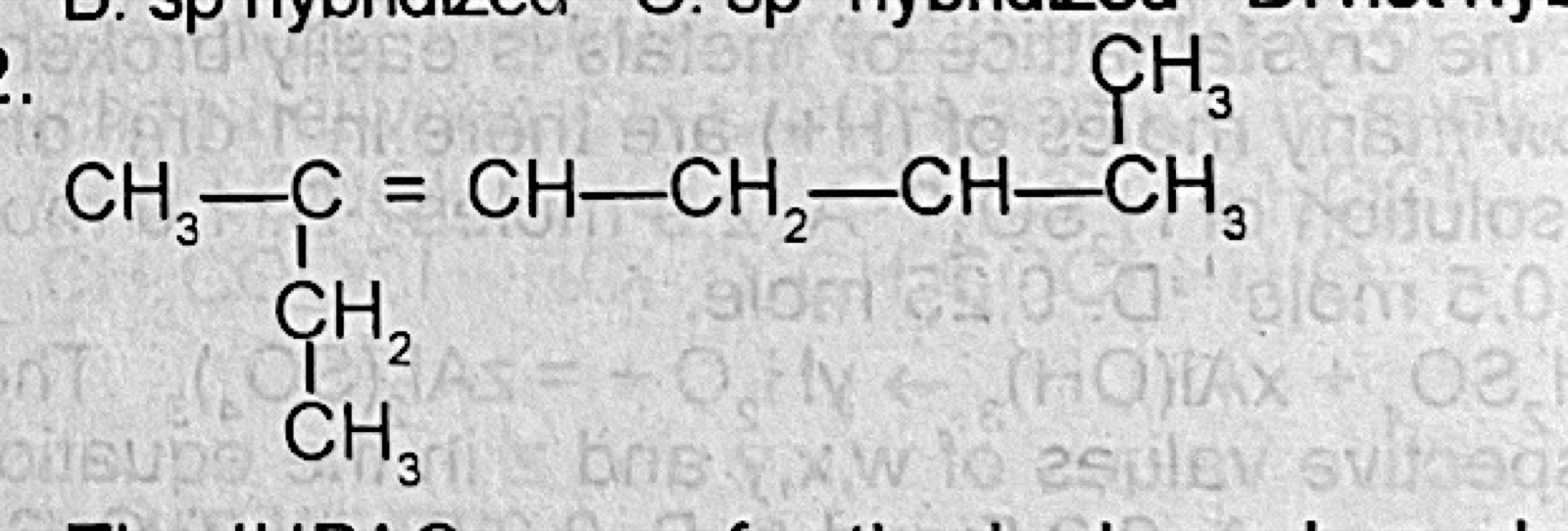
CH3—C(CH2CH3) = CH—CH2—CH(CH3)—CH3 The IUPAC name for the hydrocarbon above is
A.2 - ethyl - 5 - methylhex - 2 - ene
B.2, 5 - dimethylhex - 2 - ene
C.3, 5 - dimethylhept - 3 - ene
D.3,6 - dimethylhept - 3 - ene.
Show the answer and explanation
Answer: D (3,6 - dimethylhept - 3 - ene.)
Explanation
The longest chain runs through the ethyl group and has 7 carbons. Numbering from the ethyl end puts the double bond at C3 and methyl groups at C3 and C6: 3,6-dimethylhept-3-ene.
Which of the following compounds reacts with sodium metal as well as silver and copper salts?
A.CH3C ≡ C—CH3
B.CH3CH2CH2CH3
C.CH3C ≡ CH
D.CH3CH = CH CH3.
Show the answer and explanation
Answer: C (CH3C ≡ CH)
Explanation
Only a terminal alkyne has a hydrogen on a C≡C carbon, which is acidic enough to be replaced by sodium, silver or copper. Propyne is a terminal alkyne; but-2-yne is not.