46 questions. Try each one, then open the answer to check yourself and read the explanation.
Question 1
Separation of Mixtures
Which of the following is a physical change?
A.The bubbling of chlorine into water.
B.The bubbling of chlorine into a jar containing hydrogen
C.The dissolution of sodium chloride in water.
D.The passing of steam over heated iron
Show the answer and explanation
Answer: C (The dissolution of sodium chloride in water.)
Explanation
Dissolving salt in water makes no new substance; evaporating the water gives the salt back. Chlorine reacts with water and with hydrogen, and steam reacts with hot iron, so those are chemical changes.
In the reaction: SnO2 + 2C → Sn + 2CO, the mass of coke containing 80% carbon required to reduce 0.302 kg of pure tin oxide is [Sn = 119, O = 16, C = 12]
A.0.40 kg
B.0.20 kg
C.0.06 kg
D.0.04 kg
Show the answer and explanation
Answer: C (0.06 kg)
Explanation
151 g of SnO2 needs 24 g of carbon, so 0.302 kg needs 0.048 kg of carbon. Coke is only 80% carbon, so mass of coke = 0.048 ÷ 0.80 = 0.06 kg.
Equal volumes of CO, SO2, NO2 and H2S were released into a room at the same point and time. Which of the following gives the order of diffusion of the gases to the opposite corner of the room? [S = 32, C = 12, O = 16, N = 14, H = 1].
A.CO, SO2, NO2, H2S
B.SO2, NO2, H2S, CO
C.CO, H2S, SO2, NO2
D.CO, H2S, NO2, SO2
Show the answer and explanation
Answer: D (CO, H2S, NO2, SO2)
Explanation
By Graham's law lighter gases diffuse faster. The molar masses are CO 28, H2S 34, NO2 46 and SO2 64, so they arrive in that order.
A basic postulate of the kinetic theory of gases is that the molecules of a gas move in straight lines between collisions. This implies that
A.collisions are perfectly elastic
B.forces of repulsion exist
C.forces of repulsion and attraction are in equilibrium
D.collisions are inelastic.
Show the answer and explanation
Answer: C (forces of repulsion and attraction are in equilibrium)
Explanation
An object moves in a straight line when there is no net force on it. So between collisions the attractive and repulsive forces on a gas molecule must cancel out.
10.0 dm3 of air containing H2S as an impurity was passed through a solution of Pb(NO3)2 until all the H2S had reacted. The precipitate of PbS was found to weigh 5.02 g. According to the equation: Pb(NO3)2 + H2S → PbS + 2HNO3 the percentage by volume of hydrogen sulphide in the air is [Pb = 207, S = 32, GMV at s.t.p = 22.4 dm3]
A.50.2
B.47.0
C.4.70
D.0.47
Show the answer and explanation
Answer: C (4.70)
Explanation
Moles of PbS = 5.02 ÷ 239 = 0.021, which equals moles of H2S. Volume = 0.021 × 22.4 = 0.470 dm3, which is 4.70% of 10.0 dm3.
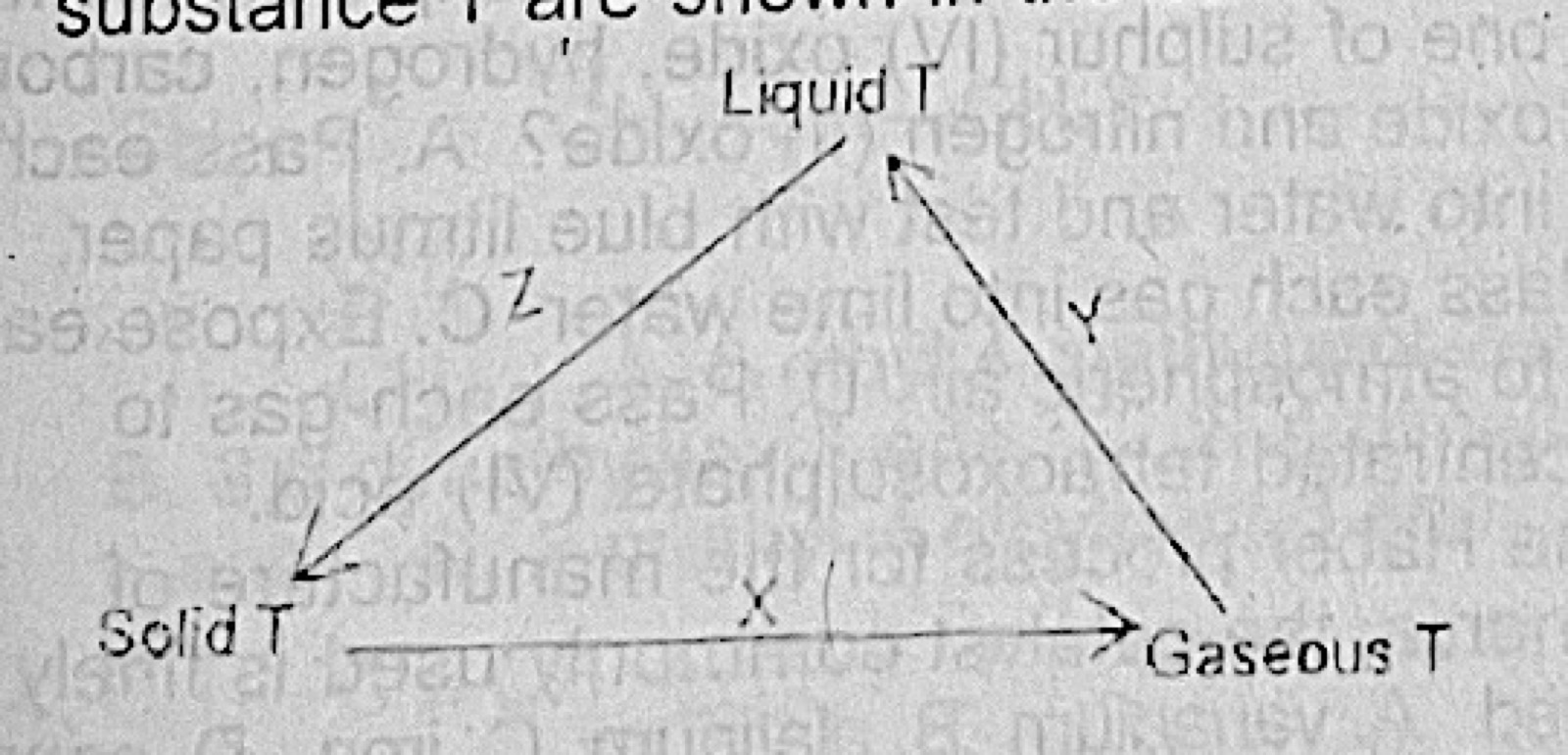
A blue solid, T, which weighed 5.0 g was placed on a table. After 8 hours, the resulting pink solid was found to weigh 5.5 g. It can be inferred that substance T
A.is deliquescent
B.is hydroscopic
C.has some molecules of water of crystallization
D.is efflorescent
Show the answer and explanation
Answer: B (is hydroscopic)
Explanation
T gained mass by absorbing water vapour from the air, yet it was still a solid. Absorbing moisture without forming a solution is what a hygroscopic substance does.
Na2C2O4 + CaCl2 → CaC2O4 + 2NaCl. Given a solution of 1.9 g of sodium oxalate in 50 g of water at room temperature, calculate the minimum volume of 0.1 M calcium chloride required to produce maximum calcium oxalate using the above equation.
A.1.40 × 102 dm3
B.1.40 × 102 cm3
C.1.40 × 10−2 dm−2
D.1.40 × 10−2 cm3.
Show the answer and explanation
Answer: B (1.40 × 102 cm3)
Explanation
Moles of Na2C2O4 = 1.9 ÷ 134 = 0.0142, and the same number of moles of CaCl2 is needed. Volume = 0.0142 ÷ 0.1 = 0.142 dm3 = 1.40 × 102 cm3.
2.0 g of a monobasic acid was made up to 250 cm3 with distilled water. 25.00 cm3 of this solution required 20.00 cm3 of 0.1 M NaOH solution for complete neutralization. The molar mass of the acid is
A.200 g
B.160 g
C.100 g
D.50 g
Show the answer and explanation
Answer: C (100 g)
Explanation
Moles of NaOH = 0.1 × 20/1000 = 0.002, so 25 cm3 holds 0.002 mol of acid and 250 cm3 holds 0.02 mol. Molar mass = 2.0 ÷ 0.02 = 100 g/mol.
If 10.8 g of silver is deposited in a silver coulometer connected in series with a copper coulometer, the volume of oxygen liberated is [Ag = 108, Cu = 64, GMV at s.t.p = 22.40 dm3]
A.0.56 dm3
B.5.60 dm3
C.11.20 dm3
D.22.40 dm3
Show the answer and explanation
Answer: A (0.56 dm3)
Explanation
10.8 g of silver is 0.1 mol, so 0.1 faraday passed. Oxygen needs 4 faradays per mole (4OH− → O2 + 2H2O + 4e−), giving 0.025 mol × 22.4 = 0.56 dm3.
0.1 faraday of electricity deposited 2.95 g of nickel during electrolysis of an aqueous solution. Calculate the number of moles of nickel that will be deposited by 0.4 faraday. [Ni = 58.7]
A.0.20
B.0.30
C.0.04
D.5.87
Show the answer and explanation
Answer: A (0.20)
Explanation
0.1 F deposits 2.95 ÷ 58.7 = 0.0503 mol of nickel. Four times the charge (0.4 F) deposits 4 × 0.0503 ≈ 0.20 mol.
Fe2O3(s) + 2Al(s) → Al2O3(s) + 2Fe(s). If the heats of formation of Al2O3 and Fe2O3 are −1670 kJ mol−1 and −822 kJ mol−1 respectively, the enthalpy change in kJ for the reaction is
A.+2492
B.+848
C.−848
D.−2492.
Show the answer and explanation
Answer: C (−848)
Explanation
ΔH = sum of heats of formation of products − reactants = (−1670) − (−822) = −848 kJ. Elements (Al, Fe) have zero heat of formation.
Iron galvanized with zinc is cathodically protected from corrosion. This is because
A.zinc has a more positive oxidation potential than iron
B.zinc has a less positive oxidation potential than iron
C.both have the same oxidation potential
D.zinc is harder than iron.
Show the answer and explanation
Answer: A (zinc has a more positive oxidation potential than iron)
Explanation
Zinc is higher in the activity series, so it loses electrons more easily than iron (more positive oxidation potential). Zinc corrodes instead of the iron.
In the reaction 2HI(g) ⇌ H2(g) + I2(g), ΔH = 10 kJ; the concentration of iodine in the equilibrium mixture can be increased by
A.raising the pressure
B.raising the temperature
C.adding a catalyst
D.lowering the pressure
Show the answer and explanation
Answer: B (raising the temperature)
Explanation
The forward reaction is endothermic (ΔH positive), so heating shifts the equilibrium to the right, making more I2. Pressure has no effect because both sides have 2 moles of gas.
Which of the following gases can be collected by the upward displacement of air?
A.NO
B.H2
C.NH3
D.Cl2.
Show the answer and explanation
Answer: D (Cl2.)
Explanation
Upward displacement of air (downward delivery) is used for gases denser than air: the gas sinks and pushes the air up. Chlorine is much denser than air.
Which of the following tests will completely identify any one of sulphur (IV) oxide, hydrogen, carbon (IV) oxide and nitrogen (II) oxide?
A.Pass each gas into water and test with blue litmus paper.
B.Pass each gas into lime water
C.Expose each gas to atmospheric air
D.Pass each gas to concentrated tetraoxosulphate (VI) acid.
Show the answer and explanation
Answer: C (Expose each gas to atmospheric air)
Explanation
Nitrogen(II) oxide is the only one of these gases that changes on meeting air: it turns brown as it forms NO2. Lime water and litmus each give the same result for both SO2 and CO2.
Which of the following metals will liberate hydrogen from steam or dilute acid?
A.Copper
B.Iron
C.Lead
D.Mercury
Show the answer and explanation
Answer: B (Iron)
Explanation
Iron is above hydrogen in the activity series, so it reacts with steam and with dilute acids to give hydrogen. Copper and mercury do neither, and lead barely reacts.
The major component of the slag from the production of iron is
A.an alloy of calcium and iron
B.coke
C.impure iron
D.calcium trioxosilicate (IV).
Show the answer and explanation
Answer: D (calcium trioxosilicate (IV).)
Explanation
In the blast furnace, calcium oxide from limestone reacts with silica impurities to form calcium silicate, CaSiO3 (calcium trioxosilicate(IV)), which is the slag.
To make coloured glasses, small quantities of oxides of metals which form coloured silicates are often added to the reaction mixture consisting of Na2CO3 and SiO2. Such a metal is
A.potassium
B.barium
C.zinc
D.copper
Show the answer and explanation
Answer: D (copper)
Explanation
Transition metals such as copper form coloured compounds; copper oxide gives glass a blue-green colour. Potassium, barium and zinc compounds are colourless.
Which of the following compounds gives a yellow residue when heated and also reacts with aqueous sodium hydroxide to give a white gelatinous precipitate soluble in excess sodium hydroxide solution?
A.(NH4)2CO3
B.ZnCO3
C.Al2(SO4)3
D.PbCO3.
Show the answer and explanation
Answer: B (ZnCO3)
Explanation
ZnCO3 decomposes on heating to ZnO, which is yellow when hot. Zn2+ gives a white gelatinous Zn(OH)2 precipitate that dissolves in excess NaOH.
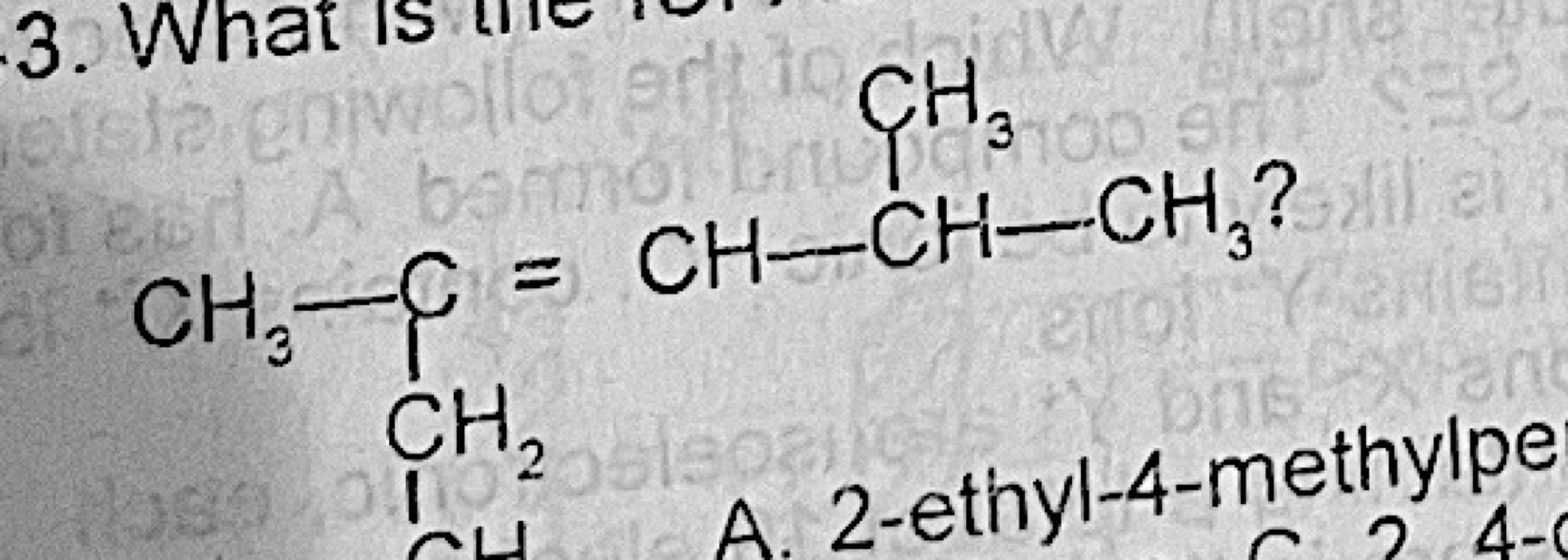
What is the IUPAC name for the hydrocarbon CH3—C(CH2CH3) = CH—CH(CH3)—CH3? (structure in the figure)
A.2-ethyl-4-methylpent-2-ene
B.3,5-dimethylhex-3-ene
C.2, 4-dimethylhex-3-ene
D.2-methyl-4-ethylpent-3-ene.
Show the answer and explanation
Answer: C (2, 4-dimethylhex-3-ene)
Explanation
The longest chain with the double bond has six carbons (it runs through the ethyl group). Numbered to give the lowest locants, the double bond is at C3 and the methyl groups at C2 and C4: 2,4-dimethylhex-3-ene.
CH3—C ≡ CH (Na, liq NH3) → P. Compound P, in the above reaction, is
A.CH3—C(Na) = CH NH2
B.CH3—C(NH2) = CH Na
C.CH3—C ≡ C—Na
D.CH3—C ≡ C—NH2.
Show the answer and explanation
Answer: C (CH3—C ≡ C—Na)
Explanation
The hydrogen on a C≡C carbon at the end of a chain is slightly acidic. Sodium (in liquid ammonia) replaces it to form sodium propynide, CH3—C≡C—Na, and the triple bond stays.
The label on a reagent bottle containing a clear organic liquid dropped off. The liquid was neutral to litmus and gave a colourless gas with metallic sodium. The liquid must be an
A.alkanoate
B.alkene
C.alkanol
D.alkane.
Show the answer and explanation
Answer: C (alkanol)
Explanation
Alkanols are neutral to litmus but their –OH group reacts with sodium to give hydrogen gas. Alkanoic acids would turn litmus red; alkanes and alkenes don't react with sodium.
Alkanoic acids have low volatility compared with alkanols because they
A.are more polar than alkanols
B.have two oxygen atoms while alkanols have one
C.form hydrogen bonds while alkanols do not
D.form two hydrogen bonds while alkanols form one.
Show the answer and explanation
Answer: D (form two hydrogen bonds while alkanols form one.)
Explanation
Two acid molecules join by two hydrogen bonds to form a dimer, while alkanol molecules link by single hydrogen bonds. The stronger attraction makes acids less volatile.