49 questions. Try each one, then open the answer to check yourself and read the explanation.
Question 1
Gas Laws
Which of the following statements is correct?
A.The average kinetic energy of a gas is directly proportional to its temperature
B.At constant temperature, the volume of a gas increases as the pressure increases
C.The pressure of a gas is inversely proportional to its volume
D.The temperature of a gas is directly proportional to its volume
E.The collisions of molecules with each other are inelastic
Show the answer and explanation
Answer: A (The average kinetic energy of a gas is directly proportional to its temperature)
Explanation
Kinetic theory says the average kinetic energy of gas molecules is proportional to the absolute temperature. B is the reverse of Boyle's law, C and D leave out the condition that the other variable is constant, and collisions are taken as elastic.
When sodium chloride and metallic sodium are each dissolved in water
A.both processes are exothermic
B.both processes are endothermic
C.the dissolution of metallic sodium is endothermic
D.the dissolution of metallic sodium is exothermic
E.the dissolution of sodium chloride is explosive.
Show the answer and explanation
Answer: D (the dissolution of metallic sodium is exothermic)
Explanation
Sodium reacts vigorously with water, giving out a lot of heat, so it is exothermic. Dissolving sodium chloride absorbs a little heat (slightly endothermic).
In the reaction between sodium hydroxide and sulphuric acid solutions, what volume of 0.5 molar sodium hydroxide would exactly neutralise 10cm3 of 1.25 molar sulphuric acid?
A small quantity of solid ammonium chloride (NH4Cl) was heated gently in a test tube, the solid gradually disappeared to produce a mixture of two gases. Later, a white cloudy deposit was observed on the cooler part of the test tube. The ammonium chloride is said to have undergone
A.distillation
B.sublimation
C.precipitation
D.evaporation
E.decomposition.
Show the answer and explanation
Answer: B (sublimation)
Explanation
The solid turns to vapour on heating and the solid re-forms on the cool part of the tube without passing through a liquid, which is sublimation.
Elements P, Q, R, S, have 6, 11, 15, and 17 electrons respectively, therefore,
A.P will form an electrovalent bond with R
B.Q will form a covalent bond with S
C.R will form an electrovalent bond with S
D.Q will form an electrovalent bond with S
E.Q will form a covalent bond with R.
Show the answer and explanation
Answer: D (Q will form an electrovalent bond with S)
Explanation
Q (2,8,1) is sodium, a metal that loses one electron, and S (2,8,7) is chlorine, which gains one. A metal and a non-metal like this form an electrovalent (ionic) bond.
An element X forms the following compounds with chlorine: XCl4, XCl3, XCl2. This illustrates the
A.law of multiple proportions
B.law of chemical proportions
C.law of simple proportions
D.law of conservation of mass
E.law of definite proportions.
Show the answer and explanation
Answer: A (law of multiple proportions)
Explanation
The same two elements form several compounds, and the masses of chlorine combining with a fixed mass of X are in a simple ratio (4:3:2). That is the law of multiple proportions.
When air, which contains the gases: oxygen, nitrogen, carbondioxide, water vapour and the rare gases, is passed through alkaline pyrogallol and then over quicklime, the only gases left are:
A.nitrogen and carbondioxide
B.the rare gases
C.nitrogen and oxygen
D.nitrogen and the rare gases
E.nitrogen, carbondioxide and the rare gases.
Show the answer and explanation
Answer: D (nitrogen and the rare gases)
Explanation
Alkaline pyrogallol absorbs oxygen (and carbon dioxide), and quicklime absorbs carbon dioxide and water vapour. Only nitrogen and the rare gases pass through.
When each of the nitrates of potassium magnesium and iron is heated,
A.all the nitrates decompose to their oxides
B.the nitrate of magnesium gives the nitrite and oxygen
C.the nitrates of magnesium and iron give the oxides
D.the nitrate of iron gives the nitrite and oxygen
E.the nitrate of the magnesium is not decomposed.
Show the answer and explanation
Answer: C (the nitrates of magnesium and iron give the oxides)
Explanation
Potassium nitrate (very reactive metal) gives the nitrite and oxygen, but nitrates of less reactive metals such as magnesium and iron decompose to the oxide, nitrogen(IV) oxide and oxygen.
A sample of hard water contains some calcium sulphate and calcium hydrogen carbonate. The total hardness may therefore be removed by:
A.boiling the water
B.adding excess calcium hydroxide
C.adding a calculated amount of calcium hydroxide
D.adding sodium carbonate
E.adding magnesium hydroxide.
Show the answer and explanation
Answer: D (adding sodium carbonate)
Explanation
Sodium carbonate precipitates the calcium ions from both the sulphate (permanent hardness) and the hydrogen carbonate (temporary hardness) as calcium carbonate. Boiling and calcium hydroxide only remove temporary hardness.
If 30cm3 of oxygen diffuses through a porous pot in 7 seconds, how long will it take 60cm3 of chlorine to diffuse through the same pot, if the vapour densities of oxygen and chlorine are 16 and 36 respectively?
A.9.3 sec
B.14 sec
C.21 sec
D.28 sec
E.30.3 sec
Show the answer and explanation
Answer: C (21 sec)
Explanation
By Graham's law, time is proportional to √(density) for the same volume. 30 cm3 of chlorine takes 7 × √(36/16) = 7 × 1.5 = 10.5 s, so 60 cm3 takes 21 s.
Which of the following reactions does not take place in the smelting of iron in a blast furnace?
A.CaCO3(s) → CaO(s) + CO2(g)
B.C(s) + O2(g) → CO2(g)
C.3Fe(s) + 2O2(g) → Fe3O4(s)
D.SiO2(s) + CaO(s) → CaSiO3(s)
E.CO2(g) + C(s) → 2CO(g).
Show the answer and explanation
Answer: C (3Fe(s) + 2O2(g) → Fe3O4(s))
Explanation
The blast furnace reduces iron ore to iron; iron is not oxidised there. Limestone decomposes, coke burns to CO2, CO2 is reduced to CO, and CaO removes silica as slag (CaSiO3).
The normal boiling point of a liquid is defined as
A.the temperature at which its vapour pressure equals the atmospheric pressure
B.the temperature at which bubbles begin to form
C.the temperature at which the vapour pressure equals 1 temperature
D.the temperature at which the rate of condensation of vapour equals the rate of vaporisation of the liquid
E.the temperature at which the space above the liquid is saturated.
Show the answer and explanation
Answer: A (the temperature at which its vapour pressure equals the atmospheric pressure)
Explanation
A liquid boils when its vapour pressure becomes equal to the external (atmospheric) pressure; the normal boiling point is at standard atmospheric pressure.
Consider the following exothermic reaction. 2SO2(g) + O2(g) ⇌ 2SO3(g). If the temperature of the reaction is reduced from 800°C to 500°C, and no other change takes place, then
A.the reaction rate increases
B.concentration of SO3 decreases
C.concentration of SO3 increases
D.SO2 gas becomes unreactive
E.O2 gas becomes unreactive.
Show the answer and explanation
Answer: C (concentration of SO3 increases)
Explanation
For an exothermic forward reaction, lowering the temperature shifts the equilibrium to the right (Le Chatelier), so more SO3 forms.
If excess zinc is added to a bluish green solution of copper(II) sulphate, and the excess zinc filtered off after completion of reaction, a colourless solution is obtained because
A.both zinc and copper are metals
B.the sulphate radical and the zinc ion are divalent
C.zinc is more electropositive than copper
D.both zinc and copper form dipositive ions in solution
E.zinc is a reducing agent
Show the answer and explanation
Answer: C (zinc is more electropositive than copper)
Explanation
Zinc is higher than copper in the electrochemical series, so it displaces the blue Cu2+ ions, leaving colourless zinc sulphate solution.
Three solutions contain carbonate, sulphate and sulphide ions respectively. One test that will identify just ONE of them completely is by addition to each of them of
A.barium chloride solution
B.dilute hydrochloric acid
C.lead nitrate solution
D.calcium chloride solution
E.sodium hydroxide solution.
Show the answer and explanation
Answer: C (lead nitrate solution)
Explanation
Lead nitrate gives a black precipitate (PbS) only with the sulphide; the carbonate and sulphate both give white precipitates, so only the sulphide is picked out.
Two gas cylinders contain ethylene (ethene) and acetylene respectively. One test which can be used to distinguish between them is by
A.passing each gas through bromine water
B.passing each gas through dilute potassium permanganate solution
C.passing each gas through silver nitrate solution
D.passing each gas through ammoniacal copper (I) chloride solution
E.treating each gas catalytically with excess hydrogen gas.
Show the answer and explanation
Answer: D (passing each gas through ammoniacal copper (I) chloride solution)
Explanation
Ethyne (acetylene) has an acidic terminal hydrogen and gives a red-brown precipitate with ammoniacal copper(I) chloride; ethene does not. Both decolourise bromine water and permanganate.
If hydrogen sulphide gas is passed into a solution of a pure iron chloride, a yellow deposit appears. If the deposit is filtered, a pale green solution is left behind. The pale green solution is
A.dilute sulphuric acid
B.dilute hydrochloric acid
C.unreacted hydrogen sulphide in water
D.iron (III) chloride
E.iron (II) chloride.
Show the answer and explanation
Answer: E (iron (II) chloride.)
Explanation
H2S reduces iron(III) chloride to pale green iron(II) chloride and is itself oxidised to yellow sulphur.
C.Cooling a solution of iron (II) sulphate to obtain the hydrated salt
D.Cooling water to obtain ice
E.Burning the domestic gas (Utilgas) for cooking.
Show the answer and explanation
Answer: D (Cooling water to obtain ice)
Explanation
Freezing water only changes its state; no new substance forms and it is easily reversed. The others form new substances (rust, NaOH, combustion products, a hydrated salt with water of crystallisation).
Five atoms T, W, X, Y, Z, consist of the following particles: Proton: T 13, W 16, X 17, Y 19, Z 20 Electron: T 13, W 16, X 17, Y 19, Z 20 Neutron: T 14, W 16, X 35, Y 20, Z 20 Which of the five atoms can be described by the following properties: Relative atomic mass is greater than 30 but less than 40, it has odd atomic number and forms a unipositive ion in solution?
A.T
B.W
C.X
D.Y
E.Z.
Show the answer and explanation
Answer: D (Y)
Explanation
Y has 19 protons (odd atomic number) and mass number 19 + 20 = 39, between 30 and 40. With electrons 2,8,8,1 it is potassium, which forms K+.
A solid X when heated gives off a brown gas. If X is soluble in excess sodium hydroxide solution but insoluble in excess ammonium hydroxide solution, then X is
A.basic lead carbonate
B.lead (II) nitrate
C.sodium carbonate
D.zinc nitrate
E.sodium nitrate
Show the answer and explanation
Answer: B (lead (II) nitrate)
Explanation
The brown gas (NO2) shows a nitrate of a heavy metal. Lead hydroxide dissolves in excess NaOH but not in excess ammonia; zinc hydroxide would dissolve in both.
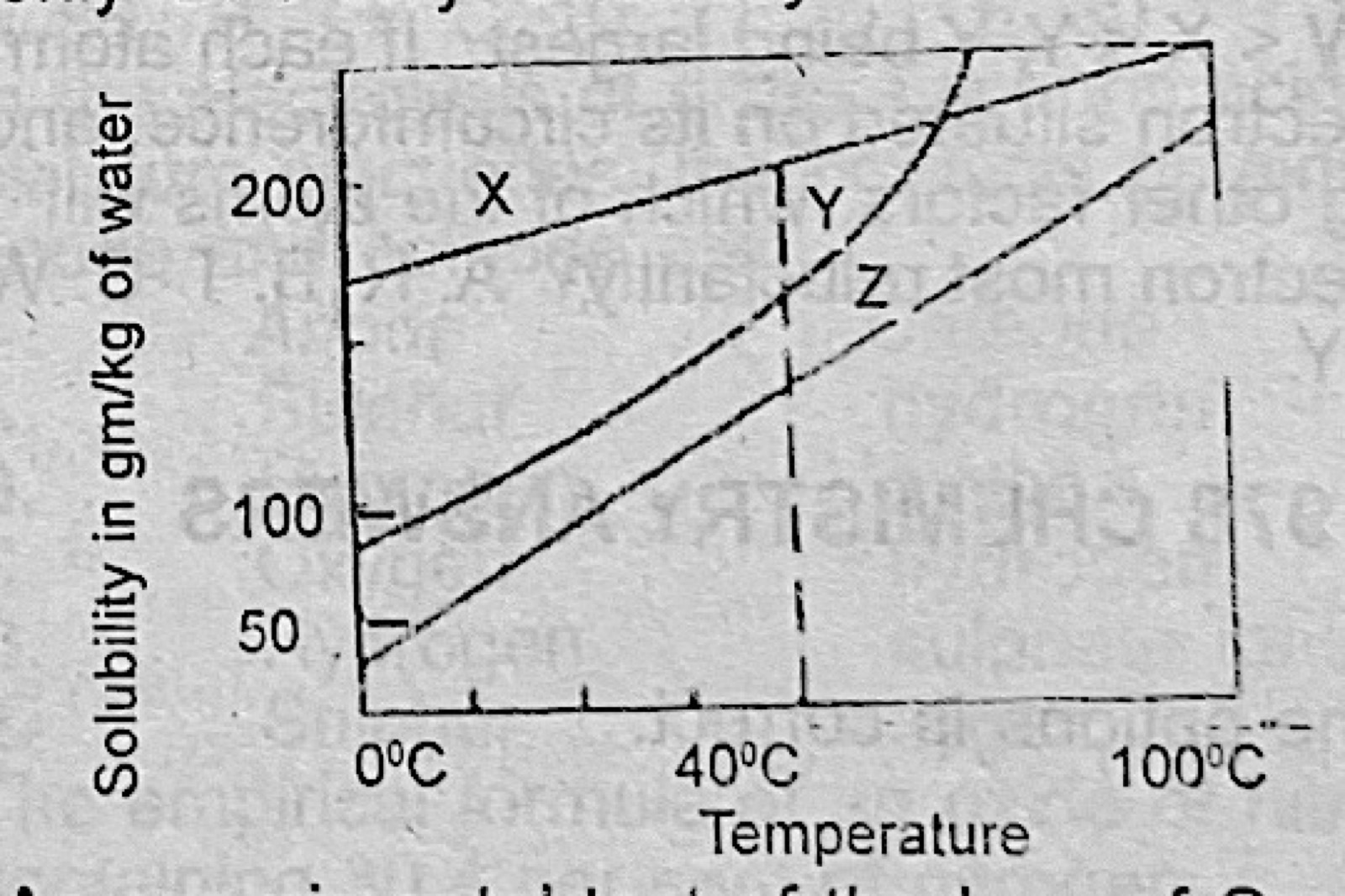
Consider the solubility curves of three salts X, Y and Z given in the diagram. If each solution of the salt contains 200 g, and is heated to 100°C, which solution or solutions will deposit more than 100 g of the solute when suddenly cooled to 0°C?
A.X only
B.Y only
C.Z only
D.X and Z
E.Y and Z
Show the answer and explanation
Answer: E (Y and Z)
Explanation
At 0°C the solubility of Y is about 80 g and of Z about 35 g, so cooling 200 g drops out over 100 g of each. X still dissolves about 170 g at 0°C, so it deposits only about 30 g.
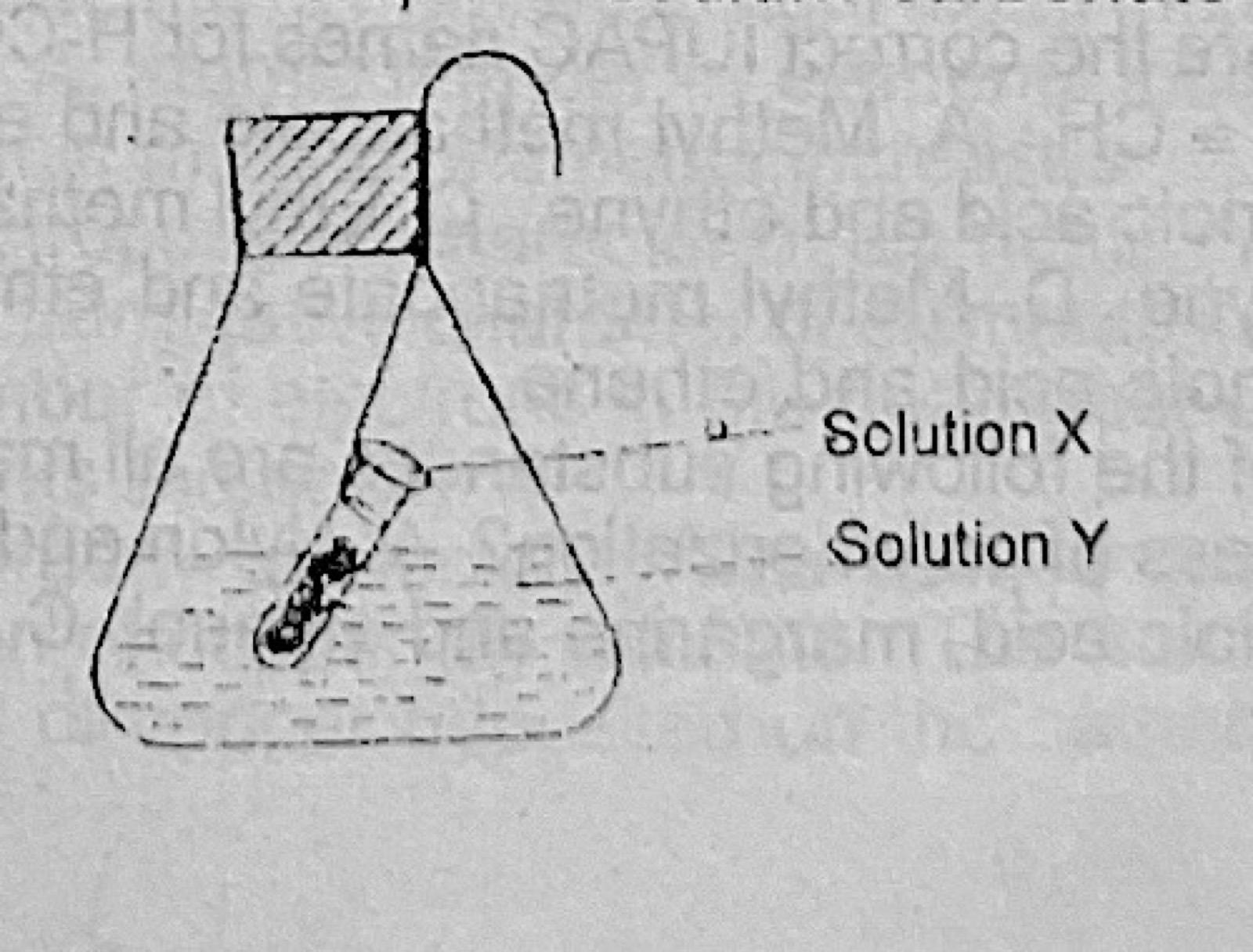
An experimental test of the Law of Conservation of Mass is illustrated in the diagram. In practice, the flask is weighed before and after reaction between solutions X and Y. Which of the following pairs of solutions will be unsuitable for the experiment?
A.X = hydrochloric acid; Y = silver nitrate
B.X = barium chloride Y = dilute sulphuric acid
C.X = hydrochloric acid; Y = sodium hydroxide
D.X = hydrochloric acid; Y = lead nitrate
E.X = hydrochloric acid; Y = sodium carbonate
Show the answer and explanation
Answer: E (X = hydrochloric acid; Y = sodium carbonate)
Explanation
Hydrochloric acid and sodium carbonate give off carbon dioxide gas, which can escape or build up pressure and push out the stopper, so the mass may not stay the same. The other pairs form only precipitates or water.
A gas jar was inverted over burning yellow phosphorus floating over water in a beaker. After burning, the water level was found to rise in the gas jar. The water level rises because
A.pressure inside the gas jar is greater than pressure outside it
B.the air in the gas jar had been used up by burning
C.oxygen in the gas jar had been used up by burning
D.nitrogen in the gas jar had been used up by burning
E.the temperature in the jar had risen considerably.
Show the answer and explanation
Answer: C (oxygen in the gas jar had been used up by burning)
Explanation
Phosphorus burns using up the oxygen (about one-fifth of the air) and the oxide dissolves; water rises to take its place. Nitrogen is not used.
You are provided with five gas jars containing SO2, CO2, H2, CO and NO respectively. Select a test from A to E which will identify ANY ONE of the gases completely
A.pass each gas into lime water
B.pass each gas into water and test with litmus paper
C.pass each gas into concentrated sulphuric acid
D.expose each gas to atmospheric air
E.expose each gas to fumes of hydrogen chloride.
Show the answer and explanation
Answer: D (expose each gas to atmospheric air)
Explanation
Nitrogen(II) oxide reacts with oxygen in air to form brown nitrogen(IV) oxide: 2NO + O2 → 2NO2. None of the other gases changes colour in air, so this test picks out NO for certain. (Lime water fails because both SO2 and CO2 turn it milky.)
Which of the following substances would you see as an indicator in the titration of sodium carbonate solution against hydrochloric acid (complete neutralisation)?
A.Litmus paper
B.Phenolphthalein
C.Methyl orange
D.Universal indicator
E.None of these.
Show the answer and explanation
Answer: C (Methyl orange)
Explanation
Sodium carbonate is a weak base and HCl a strong acid, so the end point is acidic; methyl orange changes colour in that range. Phenolphthalein would only show the first (half) neutralisation.
Five compounds R, T, W, X, and Y form the following compounds: a basic hydride R.H, an acidic hydride YH, amphoteric oxide W2O3, XO2. Which of the elements is an alkali?
A.R
B.T
C.W
D.X
E.Y.
Show the answer and explanation
Answer: A (R)
Explanation
Only reactive metals such as the alkali metals form basic (ionic) hydrides like NaH, so R is the alkali metal. YH is acidic like HCl.
The size (diameters) of five atoms are in the order: R < T < W < X < Y, Y being largest. If each atom has an electron situated on its circumference, and neglecting other factors, which of the atoms will lose its electron most reluctantly?
A.R
B.T
C.W
D.X
E.Y.
Show the answer and explanation
Answer: A (R)
Explanation
The smaller the atom, the closer the outer electron is to the nucleus and the more strongly it is held. R is the smallest, so it loses its electron least easily.