JAMB Biology 2003 past questions and answers

48 questions. Try each one, then open the answer to check yourself and read the explanation.

Question 1

Reproduction in Animals

In the egg of a bird, the embryo is located in the

  1. A.chalaza
  2. B.yolk
  3. C.albumen
  4. D.embryo disc.
Show the answer and explanation

Answer: D (embryo disc.)

Explanation

The embryo grows from the small embryo (germinal) disc that sits on the surface of the yolk. The yolk and albumen feed it, and the chalazae hold the yolk in place.

Open this question

Question 4

Plant Kingdom

One distinctive feature in the life history of liverworts is that they exhibit

  1. A.Alternation of generation
  2. B.Vegetative reproduction
  3. C.Asexual reproduction
  4. D.Sexual reproduction.
Show the answer and explanation

Answer: A (Alternation of generation)

Explanation

Liverworts alternate between a gametophyte generation (the green plant) and a sporophyte generation that grows on it. This alternation of generations is typical of bryophytes.

Open this question

Question 5

Adaptation

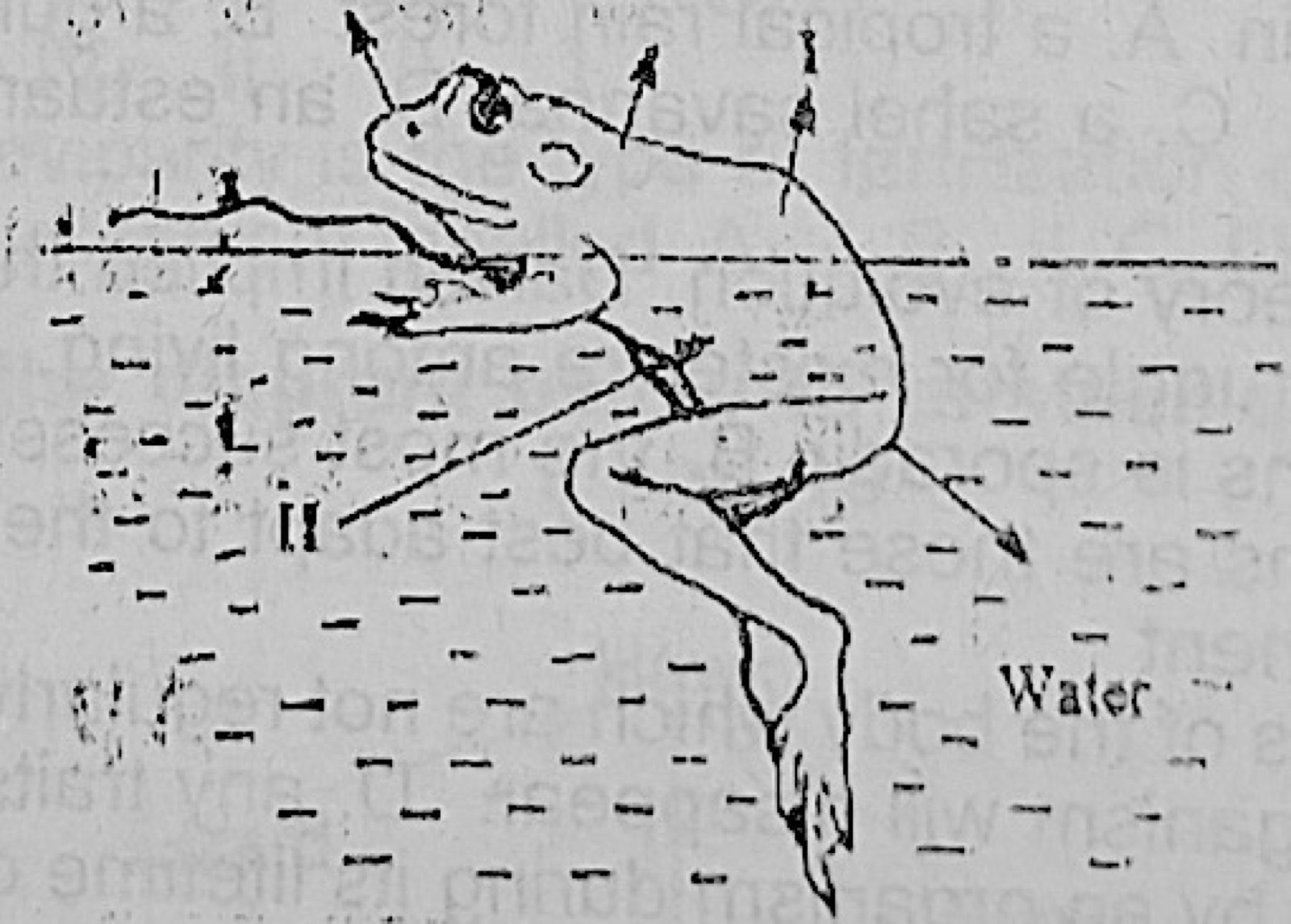
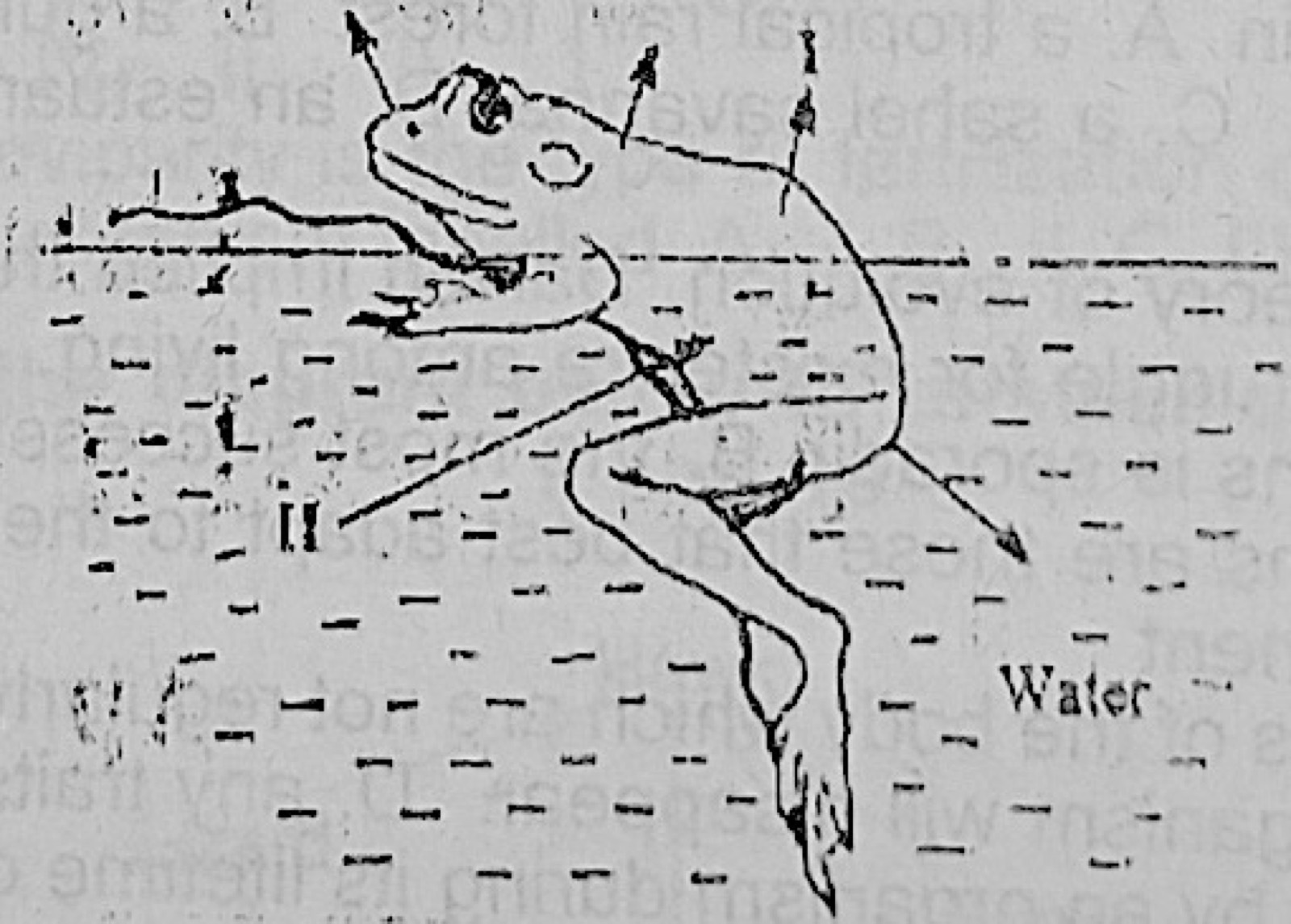
Use the diagram to answer: A noticeable adaptation of the animal to its aquatic habitat is the possession of

Diagram for this question
  1. A.a wide mouth
  2. B.large eyes
  3. C.webbed digits
  4. D.fore limbs
Show the answer and explanation

Answer: C (webbed digits)

Explanation

The frog's toes are joined by skin (webbed). Webbed feet act like paddles for swimming.

Open this question

Question 6

Excretion

Use the diagram to answer: The processes of water loss and intake indicated by the arrows labelled I and II are respectively.

Diagram for this question
  1. A.exhalation and osmosis
  2. B.urination and diffusion
  3. C.osmosis and diffusion
  4. D.evaporation and osmosis.
Show the answer and explanation

Answer: D (evaporation and osmosis.)

Explanation

Arrow I shows water leaving the moist skin into the air, which is evaporation. Arrow II shows water entering through the skin from the pond by osmosis, because the frog's body fluids are more concentrated than fresh water.

Open this question

Question 7

Viruses, Monera, Protista and Fungi

The umbrella-shaped fruiting body of a fully developed mushroom is the

  1. A.Pileus
  2. B.Mycelium
  3. C.Basidium
  4. D.Stipe.
Show the answer and explanation

Answer: A (Pileus)

Explanation

The cap of a mushroom is called the pileus, and it sits on a stalk called the stipe. The gills under the cap carry basidia that make spores.

Open this question

Question 8

Characteristics and Classification of Living Things

The similarity among organisms belonging to the same group will be least within each

  1. A.family
  2. B.order
  3. C.kingdom
  4. D.species.
Show the answer and explanation

Answer: C (kingdom)

Explanation

The kingdom is the largest and widest group, so its members have the fewest features in common. Members of a species are the most alike.

Open this question

Question 9

Reproduction in Animals

Hermaphroditic reproduction can be found among the

  1. A.Arthropods and nematodes
  2. B.Pisces and amphibians
  3. C.Annelids and molluscs
  4. D.Coelenterates and platyhelminthes.
Show the answer and explanation

Answer: C (Annelids and molluscs)

Explanation

Earthworms (annelids) and land snails (molluscs) are the standard examples of hermaphrodites: each animal has both male and female organs.

Open this question

Question 10

Animal Kingdom

An insect whose economic importance is both harmful and beneficial is the

  1. A.Tsetsefly
  2. B.Blackfly
  3. C.Mosquito
  4. D.Butterfly.
Show the answer and explanation

Answer: D (Butterfly.)

Explanation

Butterfly caterpillars eat crop leaves (harmful), but the adults pollinate flowers (beneficial). The tsetse fly, blackfly and mosquito are mainly harmful disease carriers.

Open this question

Question 11

Cell Structure and Organisation

The cell component that is present in a prokaryotic cell is the

  1. A.Chloroplast
  2. B.Ribosome
  3. C.Mitochondrion
  4. D.Nuclear envelope.
Show the answer and explanation

Answer: B (Ribosome)

Explanation

Prokaryotes such as bacteria have no membrane-bound organelles or nuclear envelope. They do have ribosomes for making proteins.

Open this question

Question 12

Photosynthesis and Plant Nutrition

The stunted growth of a leguminous plant suffering from nitrogen deficiency may be corrected by inoculating the soil with

  1. A.Denitrifying bacteria
  2. B.Saprophytic bacteria
  3. C.Rhizobium
  4. D.Nitrosomonas.
Show the answer and explanation

Answer: C (Rhizobium)

Explanation

Rhizobium lives in the root nodules of legumes and fixes nitrogen from the air for the plant. Adding it to the soil helps a nitrogen-starved legume grow.

Open this question

Question 13

Transport in Plants

If water that has been coloured red is poured at the base of a wilting plant, it will appear as a red stain in the cells of the

  1. A.xylem
  2. B.epidermis
  3. C.phloem
  4. D.parenchyma.
Show the answer and explanation

Answer: A (xylem)

Explanation

Water is carried up from the roots through the xylem. So the red dye shows up in the xylem vessels.

Open this question

Question 14

Respiration

Use the diagram of the bell jar set-up to answer: The aim of the experiment is to demonstrate

Diagram for this question
  1. A.that in mammals gaseous exchange takes place in the lungs.
  2. B.the part played by the pleural cavity and diaphragm in respiration
  3. C.that a large amount of oxygen is absorbed by the lungs.
  4. D.the presence of carbon(IV) oxide in exhaled air.
Show the answer and explanation

Answer: B (the part played by the pleural cavity and diaphragm in respiration)

Explanation

Pulling the rubber sheet down makes the space in the jar bigger, so the balloons fill with air; pushing it up deflates them. This models how the diaphragm and chest cavity work in breathing.

Open this question

Question 15

Respiration

Use the diagram of the bell jar set-up to answer: In the experimental set-up, the rubber sheet represents the organ called

Diagram for this question
  1. A.pleural cavity
  2. B.lungs
  3. C.diaphragm
  4. D.intercostal muscle.
Show the answer and explanation

Answer: C (diaphragm)

Explanation

The rubber sheet closes the bottom of the jar the way the diaphragm closes the bottom of the chest. Moving it up and down changes the volume inside.

Open this question

Question 16

Photosynthesis and Plant Nutrition

The dark reaction of photosynthesis involves the

  1. A.reduction of carbon (IV) oxide to organic compounds.
  2. B.release of oxygen and the splitting of water.
  3. C.photolysis of water and the production of starch.
  4. D.splitting of water into hydrogen ions.
Show the answer and explanation

Answer: A (reduction of carbon (IV) oxide to organic compounds.)

Explanation

In the dark (light-independent) stage, hydrogen from the light stage reduces carbon(IV) oxide to sugars. Splitting water and releasing oxygen happen in the light stage.

Open this question

Question 17

Transport in Plants

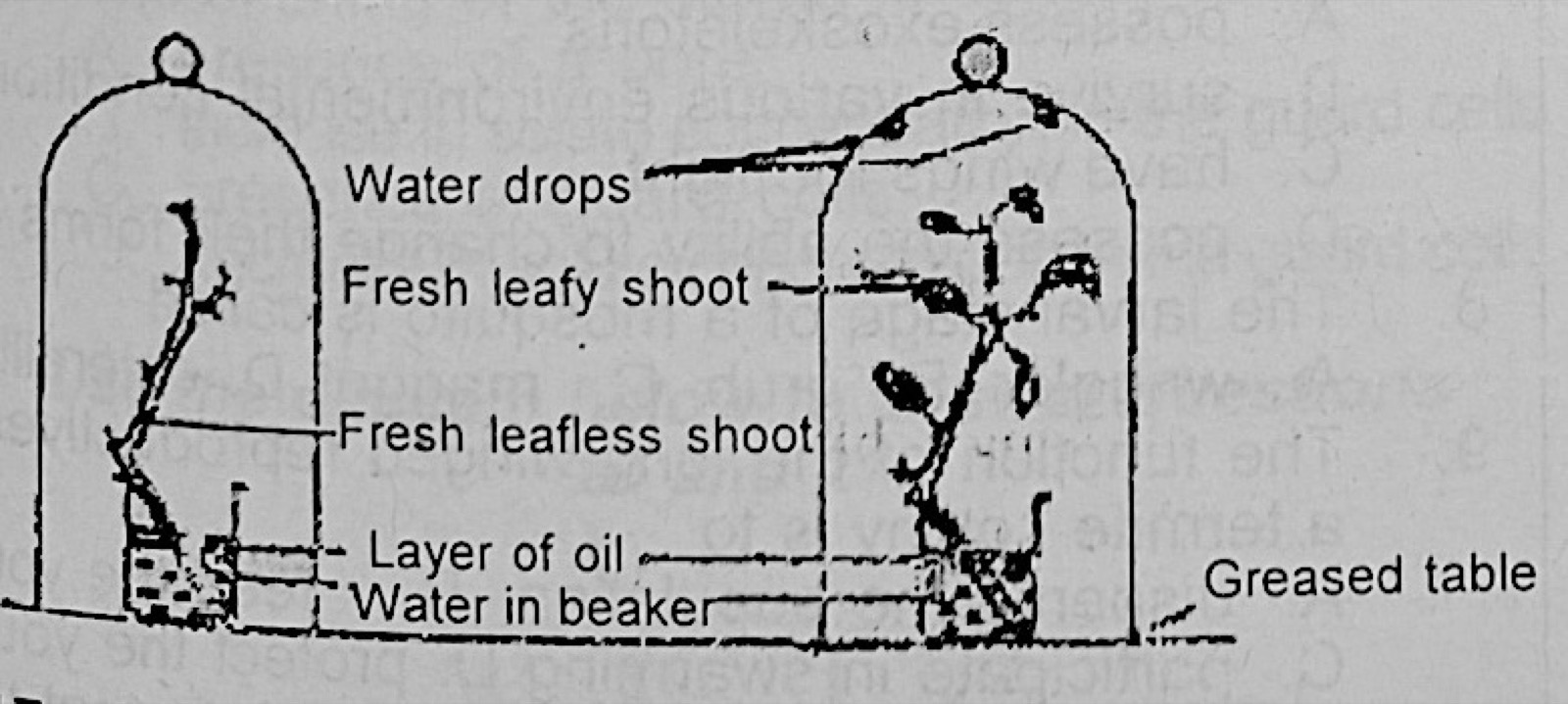
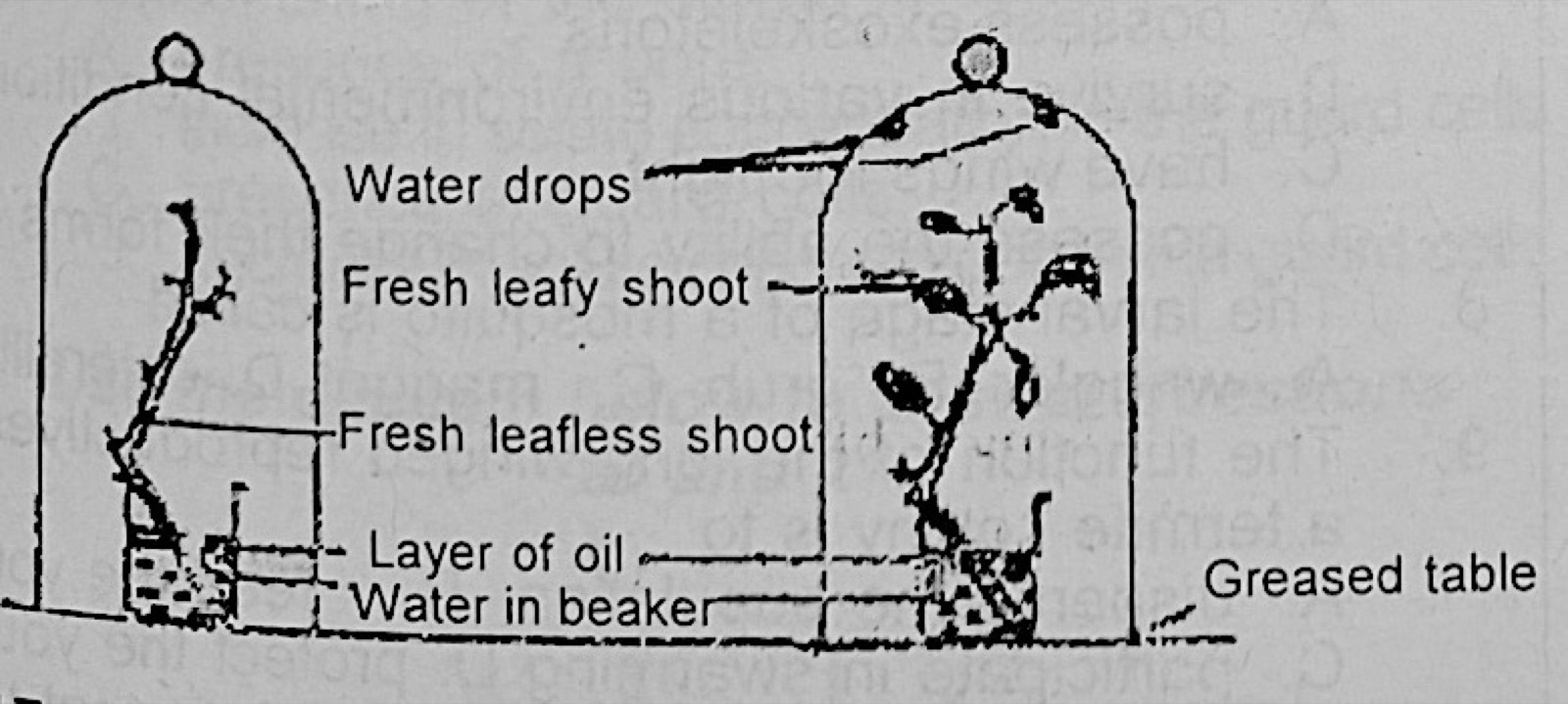
Use the diagram of the experiment to answer: The experiment is used to demonstrate that

Diagram for this question
  1. A.plants lose water through guttation
  2. B.transpiration occurs through the leaves
  3. C.water is necessary for photosynthesis.
  4. D.leaves are important to photosynthesis.
Show the answer and explanation

Answer: B (transpiration occurs through the leaves)

Explanation

Water drops collect on the inside of the bell jar with the leafy shoot but not with the leafless one. This shows that plants lose water vapour mainly through their leaves.

Open this question

Question 18

Transport in Plants

Use the diagram of the experiment to answer: In the experiment, the layer of oil serves to prevent water loss by

Diagram for this question
  1. A.transpiration
  2. B.evaporation
  3. C.osmosis
  4. D.guttation.
Show the answer and explanation

Answer: B (evaporation)

Explanation

The oil covers the water in the beaker so none of it can evaporate. Any droplets in the jar must then come from the plant.

Open this question

Question 19

Cell and Its Environment

Organisms I, II, III and IV have surface/volume ratios of 1:2, 1:3, 1:4 and 1:5 respectively. The organism that is likely to have the most complex transport system is

  1. A.IV
  2. B.III
  3. C.I
  4. D.II.
Show the answer and explanation

Answer: A (IV)

Explanation

The smaller the surface area compared with volume, the less an organism can rely on diffusion alone. IV has the smallest ratio (1:5), so it needs the most complex transport system.

Open this question

Question 20

Animal Nutrition

The part of the mammalian digestive system where absorption of nutrients takes place is the

  1. A.ileum
  2. B.colon
  3. C.oesophagus
  4. D.duodenum.
Show the answer and explanation

Answer: A (ileum)

Explanation

The ileum is long and lined with villi that give a huge surface area. Most digested food is absorbed there.

Open this question

Question 21

Reproduction in Plants

The best method of propagating sugarcane is by

  1. A.Seed sowing
  2. B.Layering
  3. C.Grafting
  4. D.Stem cuttings.
Show the answer and explanation

Answer: D (Stem cuttings.)

Explanation

Sugarcane is grown from pieces of stem that have nodes and buds. Each cutting sprouts into a new plant.

Open this question

Question 22

Excretion

In mammalian males, the excretory and reproductive systems share the

  1. A.Ureter
  2. B.Vas deferens
  3. C.Urethra
  4. D.Testes
Show the answer and explanation

Answer: C (Urethra)

Explanation

In males the urethra carries urine from the bladder and also carries semen. It is shared by both systems.

Open this question

Question 23

Excretion

Metabolic production of urea is carried out in the

  1. A.Urinary bladder and kidney
  2. B.Liver
  3. C.Pancreas
  4. D.Kidney and Malphigian tubule.
Show the answer and explanation

Answer: B (Liver)

Explanation

The liver breaks down excess amino acids (deamination) and turns the ammonia into urea. The kidneys then filter the urea out of the blood.

Open this question

Question 24

Nervous Coordination

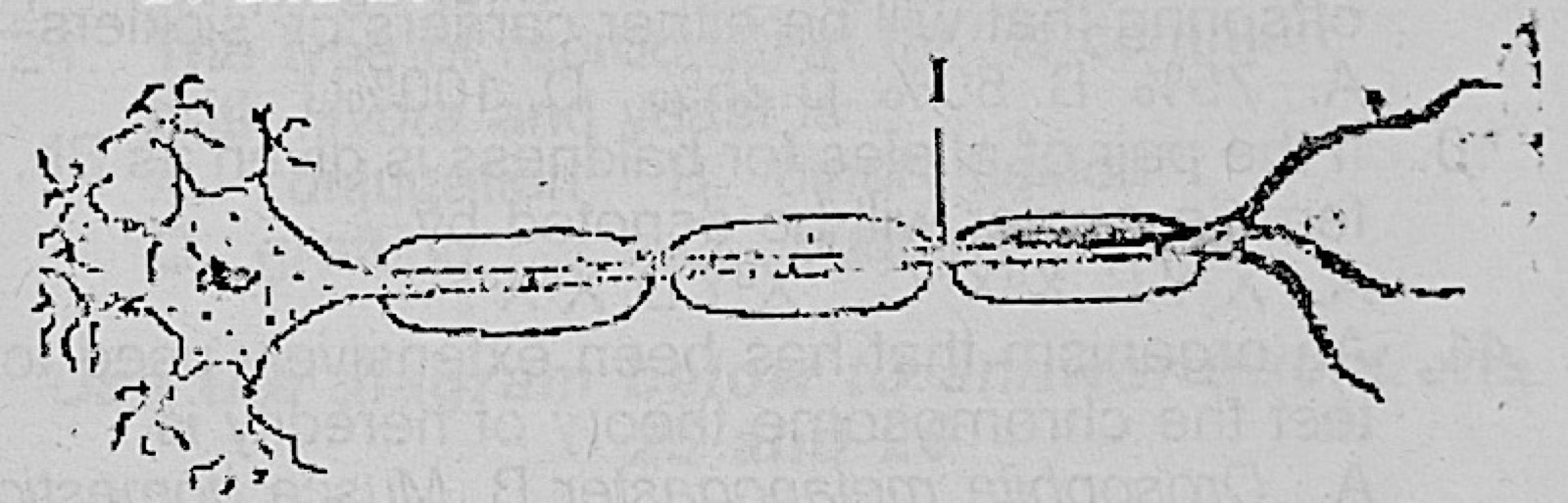
Use the diagram of the neurone to answer: The structure can be found in the

Diagram for this question
  1. A.Sympathetic and parasympathetic nervous systems.
  2. B.Peripheral and central nervous systems
  3. C.Peripheral nervous system only
  4. D.Central nervous system only.
Show the answer and explanation

Answer: B (Peripheral and central nervous systems)

Explanation

Neurones like this are found in both the brain and spinal cord (central nervous system) and in the nerves of the body (peripheral nervous system).

Open this question

Question 25

Nervous Coordination

Use the diagram of the neurone to answer: The point marked I is referred to as

Diagram for this question
  1. A.myelin sheath
  2. B.dendrites
  3. C.axon
  4. D.node of Ranvier.
Show the answer and explanation

Answer: D (node of Ranvier.)

Explanation

Point I is the gap between two sections of the myelin sheath along the axon. These gaps are nodes of Ranvier, where the impulse jumps from node to node.

Open this question

Question 26

Cell Division

Homologous pairs of chromosomes separate during

  1. A.Cytolysis
  2. B.Cleavage
  3. C.Mitosis
  4. D.Meiosis.
Show the answer and explanation

Answer: D (Meiosis.)

Explanation

In the first division of meiosis, homologous chromosomes pair up and then move to opposite poles. This halves the chromosome number for gametes.

Open this question

Question 27

Reproduction in Plants

An example of a caryopsis is

  1. A.Guava
  2. B.Maize grain
  3. C.Coconut
  4. D.Tomato.
Show the answer and explanation

Answer: B (Maize grain)

Explanation

A maize grain is a caryopsis: a dry one-seeded fruit whose wall is fused to the seed coat.

Open this question

Question 28

Plant Responses and Hormones

The response of plants to external stimuli in a non-directional manner is known as

  1. A.Tactic movement
  2. B.Phototropism
  3. C.Geotropism
  4. D.Nastic movement.
Show the answer and explanation

Answer: D (Nastic movement.)

Explanation

Nastic movements do not depend on the direction of the stimulus, such as the folding of Mimosa leaves when touched. Tropisms are directional growth responses.

Open this question

Question 29

Plant Responses and Hormones

The most important hormone that induces the ripening of fruit is

  1. A.Ethylene
  2. B.Indole acetic acid
  3. C.Gibberallin
  4. D.Cytokinin.
Show the answer and explanation

Answer: A (Ethylene)

Explanation

Ethylene is a gas given off by ripening fruits. It speeds up ripening, which is why one ripe fruit can ripen others nearby.

Open this question

Question 30

Population Ecology

A density-dependent factor that regulates the population size of organisms is

  1. A.Disease
  2. B.Sudden flood
  3. C.Drought
  4. D.Fire outbreak.
Show the answer and explanation

Answer: A (Disease)

Explanation

Disease spreads more easily when organisms are crowded together, so its effect grows with population density. Floods, droughts and fires strike whatever the population size.

Open this question

Question 31

Conservation of Natural Resources

One example of fossil fuels is

  1. A.Limestone
  2. B.Coral
  3. C.Coal
  4. D.Firewood.
Show the answer and explanation

Answer: C (Coal)

Explanation

Coal formed over millions of years from buried plant remains, so it is a fossil fuel. Firewood is a renewable fuel from living trees.

Open this question

Question 32

Pollution

The most effective method of dealing with non-biodegradable pollutants is by

  1. A.Dumping
  2. B.Recycling
  3. C.Incineration
  4. D.Burying.
Show the answer and explanation

Answer: B (Recycling)

Explanation

Non-biodegradable waste such as plastic and metal does not rot. Recycling turns it into new products instead of leaving it in the environment.

Open this question

Question 33

Habitats and Biomes

The correct sequence of biomes from northern to southern Nigeria is

  1. A.Guinea savanna → sudan savanna → tropical rain forest → sahel savanna → estuarine
  2. B.Estuarine → tropical rain forest → guinea savanna → sahel savanna
  3. C.Sahel savanna → tropical rain forest → estuarine → guinea savanna
  4. D.Sahel savanna → sudan savanna → guinea savanna → tropical rainforest → estuarine.
Show the answer and explanation

Answer: D (Sahel savanna → sudan savanna → guinea savanna → tropical rainforest → estuarine.)

Explanation

Rainfall increases from north to south. So the order is Sahel savanna, Sudan savanna, Guinea savanna, rain forest, and finally the estuarine (mangrove) swamps at the coast.

Open this question

Question 34

Ecological Associations

Mycorrhiza is an association between fungi and

  1. A.Protozoans
  2. B.Roots of higher plants
  3. C.Bacteria
  4. D.Filamentous algae.
Show the answer and explanation

Answer: B (Roots of higher plants)

Explanation

Mycorrhiza is a fungus living on or in plant roots. The fungus helps the root absorb minerals and gets sugars in return.

Open this question

Question 35

Population Ecology

A limiting factor in a plant population near a chemical factory is likely to be

  1. A.Light
  2. B.Humidity
  3. C.Wind
  4. D.pH.
Show the answer and explanation

Answer: D (pH.)

Explanation

Chemical factories release acidic gases and waste that change the acidity (pH) of the soil and water. This limits which plants can grow there.

Open this question

Question 36

Soil

Soil fertility can best be conserved and renewed by the activities of

  1. A.Earthworms
  2. B.Man
  3. C.Rodents
  4. D.Microbes.
Show the answer and explanation

Answer: D (Microbes.)

Explanation

Bacteria and fungi decompose dead matter and release minerals back into the soil, and some fix nitrogen. This recycling keeps the soil fertile.

Open this question

Question 37

Population Ecology

The pioneer organisms in ecological succession are usually the

  1. A.mosses
  2. B.lichens
  3. C.ferns
  4. D.algae.
Show the answer and explanation

Answer: B (lichens)

Explanation

Lichens can grow on bare rock. They break it down slowly and start forming soil, so other plants can follow.

Open this question

Question 38

Chromosomes, DNA and Sex Linkage

If a DNA strand has a base sequence TCA, its complementary strand must be

  1. A.ATG
  2. B.TAG
  3. C.GAT
  4. D.AGT.
Show the answer and explanation

Answer: D (AGT.)

Explanation

In DNA, A pairs with T and C pairs with G. So T-C-A pairs with A-G-T.

Open this question

Question 39

Mendelian Inheritance

A man and his wife are both heterozygous for the sickle-cell trait. The likely percentage of their offspring that will be either carriers or 'sicklers' is

  1. A.75%
  2. B.50%
  3. C.25%
  4. D.100%.
Show the answer and explanation

Answer: A (75%)

Explanation

AS × AS gives AA, AS, AS and SS. Carriers (AS) and sicklers (SS) make 3 out of 4, which is 75%.

Open this question

Question 40

Chromosomes, DNA and Sex Linkage

If the pair of alleles for baldness is given as Bb, a female carrier will be denoted by

  1. A.XbY
  2. B.XBXB
  3. C.XBY
  4. D.XBXb.
Show the answer and explanation

Answer: D (XBXb.)

Explanation

A female has two X chromosomes. A carrier has one normal (B) and one recessive (b) allele: XBXb.

Open this question

Question 41

Chromosomes, DNA and Sex Linkage

An organism that has been extensively used to test the chromosome theory of heredity is

  1. A.Drosophila melanogaster
  2. B.Musca domestica
  3. C.Zea mays
  4. D.Homo sapiens.
Show the answer and explanation

Answer: A (Drosophila melanogaster)

Explanation

The fruit fly Drosophila breeds quickly, has few chromosomes and shows clear traits. T. H. Morgan used it to show that genes are carried on chromosomes.

Open this question

Question 42

Chromosomes, DNA and Sex Linkage

A feature associated with the Y-chromosome in humans is

  1. A.long eyelashes
  2. B.prominent fingernails
  3. C.facial hairs
  4. D.enlarged breast.
Show the answer and explanation

Answer: C (facial hairs)

Explanation

The Y chromosome makes a baby develop as a male. Male features such as facial hair follow from it.

Open this question

Question 43

Variation

The type of reproduction that leads to variation in animal and plant populations is

  1. A.budding
  2. B.sexual
  3. C.vegetative
  4. D.asexual.
Show the answer and explanation

Answer: B (sexual)

Explanation

Sexual reproduction mixes genes from two parents, so the offspring differ from each other and from their parents. Asexual methods produce copies.

Open this question

Question 44

Animal Nutrition

An insect with a mandibulate mouth part will obtain its food by

  1. A.biting and chewing
  2. B.chewing and sucking
  3. C.chewing
  4. D.sucking.
Show the answer and explanation

Answer: A (biting and chewing)

Explanation

Mandibles are strong jaws for biting and chewing solid food, as in cockroaches and grasshoppers.

Open this question

Question 45

Evolution

An argument against Lamarck's theory of evolution is that

  1. A.disuse of body part cannot weaken the part
  2. B.disused part is dropped off in the offspring
  3. C.acquired traits cannot be passed on to the offspring.
  4. D.traits cannot be acquired through constant use of body parts.
Show the answer and explanation

Answer: C (acquired traits cannot be passed on to the offspring.)

Explanation

Lamarck said features gained during life are inherited. But changes to body cells, such as big muscles, do not change the genes in the gametes, so they are not passed on.

Open this question

Question 46

Adaptation

The presence of sunken stomata and the folding of leaves are adaptations to

  1. A.Prevent entry of pathogens
  2. B.Reduce water loss
  3. C.Remove excess water
  4. D.Prevent guttation.
Show the answer and explanation

Answer: B (Reduce water loss)

Explanation

Sunken stomata and rolled leaves trap moist air around the stomata. This slows transpiration, which helps plants in dry places.

Open this question

Question 47

Adaptation

Spines and shells on animals are adaptations for

  1. A.camouflage
  2. B.chemical defence
  3. C.physical defence
  4. D.mimicry.
Show the answer and explanation

Answer: C (physical defence)

Explanation

Spines (as on a porcupine) and shells (as on a snail or tortoise) physically block or hurt attackers. This is physical defence.

Open this question

Question 48

Adaptation

An example of cryptic colouration is the

  1. A.Mottled colours on moths that rest on lichens
  2. B.Bright colour of an insect pollinated flower
  3. C.Green colour of a plant
  4. D.Bright marks on a poisonous tropical frog on variegated leaves.
Show the answer and explanation

Answer: A (Mottled colours on moths that rest on lichens)

Explanation

Cryptic colouration helps an animal blend into its background. A mottled moth resting on lichens is hard to see, while a poisonous frog's bright marks are a warning.
Open this question

Question 49

Evolution

Which of the following requires the use of carbon dating to prove that evolution has occurred?

  1. A.Comparative anatomy
  2. B.Biochemical similarities
  3. C.Molecular records
  4. D.Fossil records
Show the answer and explanation

Answer: D (Fossil records)

Explanation

Radioactive (carbon) dating tells how old fossils and rocks are. This lets scientists put fossils in time order and see how organisms changed.

Open this question

Question 50

Adaptation

The inactive state exhibited by an animal during hot dry seasons is termed

  1. A.Aestivation
  2. B.Dormancy
  3. C.Resting
  4. D.Hibernation
Show the answer and explanation

Answer: A (Aestivation)

Explanation

Aestivation is a resting state during hot, dry seasons. Hibernation is the same kind of rest during cold seasons.

Open this question