Home › Past questions › JAMB › Biology › 1984 50 questions. Try each one, then open the answer to check yourself and read the explanation.
Sign up free to answer these questions on a CBT screen with a timer, then see your score and every answer explained.
Start practising free
Question 1 Animal Kingdom The mouth parts of the housefly are adapted for
A. lapping and sponging B. sucking and chewing C. piercing and sucking D. chewing and lapping E. biting and chewing. Show the answer and explanation Answer: A (lapping and sponging )
Explanation The housefly pours saliva on its food and mops up the liquid with its spongy proboscis, so its mouthparts are for lapping and sponging.
Open this question
Question 2 Animal Kingdom The male toad differs from the female by having
A. vocal sacs B. shorter hind limbs C. longer fore limbs D. bulging eyes E. nictating membrane. Show the answer and explanation Answer: A (vocal sacs )
Explanation Only the male toad has vocal sacs, which swell up when it croaks to call females.
Open this question
Question 3 Plant Kingdom Mosses, liverworts and ferns can be grouped together because they
A. are all aquatic plants B. all grow in deserts C. are seedless plants D. have undifferentiated plant bodies E. all produce colourless flowers. Show the answer and explanation Answer: C (are seedless plants )
Explanation Mosses, liverworts and ferns reproduce by spores and never form seeds or flowers.
Open this question
Question 4 Viruses, Monera, Protista and Fungi Spirogyra and Mucor can be grouped together as Thallophyta because
A. they are unicellular organisms B. their spores could be dispersed by wind C. they are capable of living independent lives D. they reproduce sexually only E. their bodies are made up of thallus and filaments alternatively. Show the answer and explanation Answer: E (their bodies are made up of thallus and filaments alternatively. )
Explanation Thallophytes have a simple body (a thallus) that is not divided into root, stem and leaves; both Spirogyra and Mucor have simple filamentous bodies of this kind.
Open this question
Question 5 Animal Kingdom Which of the following invertebrates does NOT possess antennae?
A. Centipede B. Crustacean C. Millipede D. Insect E. Spider. Show the answer and explanation Answer: E (Spider. )
Explanation Spiders (arachnids) have no antennae; they have pedipalps instead. Insects, crustaceans, centipedes and millipedes all have antennae.
Open this question
Question 6 Plant Kingdom Which of the following is INCORRECT? The prothallus of a fern
A. is a flattened heart-shaped structure B. is green because its cells contain chloroplasts C. is the dominant plant D. bears the sexual organs E. is attached to the ground by numerous rhizoids. Show the answer and explanation Answer: C (is the dominant plant )
Explanation In ferns the dominant plant is the leafy sporophyte. The prothallus is the small, short-lived gametophyte.
Open this question
Question 7 Cell Structure and Organisation Which of the following cell constituents is NOT common in both plants and animals?
A. Mitochondria B. Chloroplasts C. Ribosomes D. Golgi apparatus E. Vacuoles Show the answer and explanation Answer: B (Chloroplasts )
Explanation Chloroplasts are found only in plant cells (for photosynthesis). Animal cells have mitochondria, ribosomes, Golgi apparatus and small vacuoles too.
Open this question
Question 8 Chromosomes, DNA and Sex Linkage The character-producing factors in living organisms are
A. chromomeres B. alleles C. chromatids D. chromosomes E. genes Show the answer and explanation Answer: E (genes )
Explanation Genes are the units of heredity that control characters; Mendel called them 'factors'.
Open this question
Question 9 Food Substances and Enzymes A mixture of mercurous and mercuric nitrates is added to a food substance. A white precipitate is formed which on gentle heating turns red. The food substance is
A. protein B. oil C. carbohydrate D. fat E. fatty acid Show the answer and explanation Answer: A (protein )
Explanation This is Millon's test: a white precipitate that turns red on warming shows that protein is present.
Open this question
Question 10 Reproduction in Animals The mammalian organ through which nourishment and oxygen diffuse into a developing embryo is called
A. amnion B. chorion C. umbilical cord D. oviduct E. placenta Show the answer and explanation Answer: E (placenta )
Explanation In the placenta the mother's blood and the embryo's blood come very close, so food and oxygen diffuse across into the embryo's blood.
Open this question
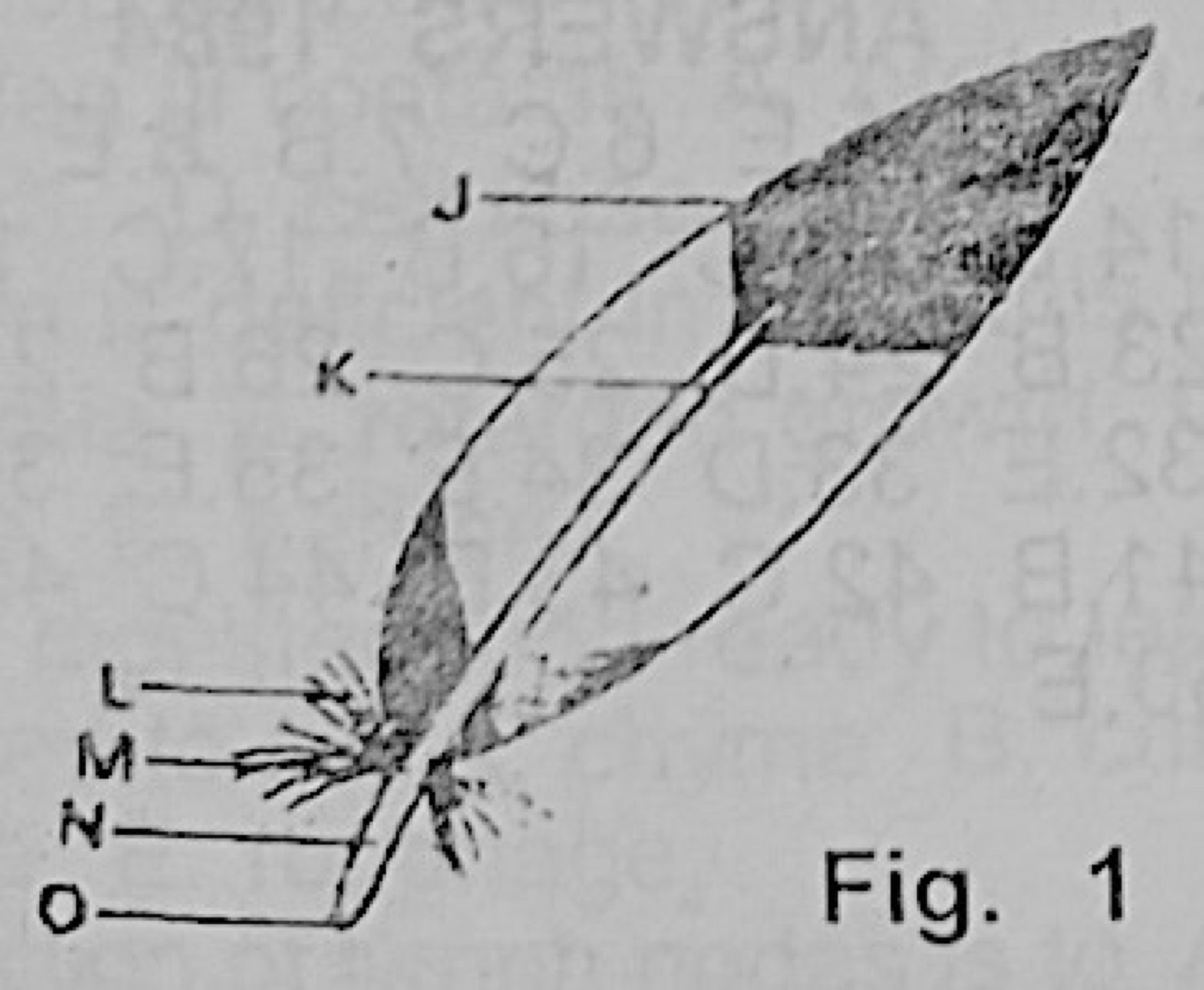
Question 11 Animal Kingdom Fig.1 below represents a quill feather. The structure labelled 'M' is the
A. quill B. rachis C. superior umbilicus D. inferior umbilicus E. aftershaft. Show the answer and explanation Answer: C (superior umbilicus )
Explanation M marks the small opening where the quill joins the vane, the superior umbilicus. The inferior umbilicus is the hole at the tip of the quill.
Open this question
Question 12 Cell and Its Environment Osmosis can be defined as the movement of
A. molecules from solution of high concentration to low concentration B. molecules from solution of low concentration to high concentration C. water from solution of high concentration to low concentration D. water across a semi-permeable membrane from solution of low concentration to high concentration E. water across a semi-permeable membrane from solution of high concentration to low concentration Show the answer and explanation Answer: D (water across a semi-permeable membrane from solution of low concentration to high concentration )
Explanation Osmosis is the movement of water molecules through a semi-permeable membrane from a dilute (low concentration) solution to a more concentrated one.
Open this question
Question 13 Food Substances and Enzymes Which of the following statements is NOT true of enzymes? They
A. are proteins B. need cofactors to activate them C. are sensitive to hydrogen ion concentration D. are specific in their action E. can withstand high temperatures. Show the answer and explanation Answer: E (can withstand high temperatures. )
Explanation Enzymes are proteins, so high temperatures denature them and they stop working.
Open this question
Question 14 Support and Movement The dorsal and anal fins of fish are used for
A. upward movements B. controlling rolling movements C. downward movements D. steering E. buoyancy. Show the answer and explanation Answer: B (controlling rolling movements )
Explanation The unpaired dorsal and anal fins keep the fish upright, stopping it from rolling and yawing.
Open this question
Question 15 Animal Kingdom Exoskeleton is NOT found in the
A. maggot B. mosquito larva C. earthworm D. caterpillar E. termite Show the answer and explanation Answer: C (earthworm )
Explanation The earthworm is an annelid with a hydrostatic skeleton. The others are insects or insect larvae with a chitin exoskeleton.
Open this question
Question 16 Transport in Animals Blood clotting is initiated by
A. leucocytes B. platelets C. haemolymph D. haemoglobin E. erythrocytes. Show the answer and explanation Answer: B (platelets )
Explanation At a wound, platelets break down and release thrombokinase, which starts the chain of reactions that forms a clot.
Open this question
Question 17 Animal Nutrition Pepsin is a digestive enzyme which breaks
A. cellulose into glucose molecules B. carbohydrates into simple sugars C. protein into peptones D. fats into glycerol and fatty acids E. sucrose into glucose and fructose. Show the answer and explanation Answer: C (protein into peptones )
Explanation Pepsin, made in the stomach, starts protein digestion by breaking proteins into peptones (shorter chains).
Open this question
Question 18 Respiration Anaerobic respiration in yeast produces
A. carbondioxide and ethanol B. carbondioxide and water C. carbondioxide and oxygen D. carbondioxide and glucose E. ethanol and water Show the answer and explanation Answer: A (carbondioxide and ethanol )
Explanation Without oxygen, yeast ferments glucose into ethanol (alcohol) and carbon dioxide, releasing a little energy.
Open this question
Question 19 Reproduction in Plants Underground stems which grow horizontally through the soil are
A. bulbs B. rhizomes C. runners D. corms E. stolons. Show the answer and explanation Answer: B (rhizomes )
Explanation A rhizome, e.g. ginger, is a stem that grows horizontally under the ground. Runners and stolons grow along the surface.
Open this question
Question 20 Mendelian Inheritance A man with a normal haemoglobin (AA) marries a woman who has sickle-cell haemoglobin (SS). They have a child who has a sickle-cell trait. Which of the following genotypes could be associated with the child's haemoglobin?
A. AA B. OO C. AO D. AS E. SS. Show the answer and explanation Answer: D (AS )
Explanation The child gets A from the father and S from the mother, so every child is AS, which is the sickle-cell trait (carrier).
Open this question
Question 21 Food Substances and Enzymes In a Biuret test, some protein was mixed with sodium hydroxide solution. Which of the following chemicals should be added to the mixture for a positive result?
A. Mercurous nitrate B. Copper sulphate C. Mercuric nitrate D. Sodium carbonate E. Ammonium hydroxide. Show the answer and explanation Answer: B (Copper sulphate )
Explanation In the Biuret test a few drops of dilute copper sulphate are added to the food and sodium hydroxide; a violet colour shows protein.
Open this question
Question 22 Animal Nutrition The removal of a man's pancreas by surgical operation can affect only the digestion of
A. starch B. starch, protein and fats C. oils and fats D. proteins E. carbohydrates and fats. Show the answer and explanation Answer: B (starch, protein and fats )
Explanation Pancreatic juice contains amylase, trypsin and lipase, so without the pancreas the digestion of starch, proteins and fats is all affected.
Open this question
Question 23 Animal Kingdom The parts used by the tapeworm to fasten itself to the host's intestine are the
A. neck and suckers B. hooks and suckers C. rostellum and suckers D. young proglottis and neck E. rostellum, hooks and suckers. Show the answer and explanation Answer: B (hooks and suckers )
Explanation The scolex (head) of the tapeworm holds on to the gut wall with its hooks and suckers.
Open this question
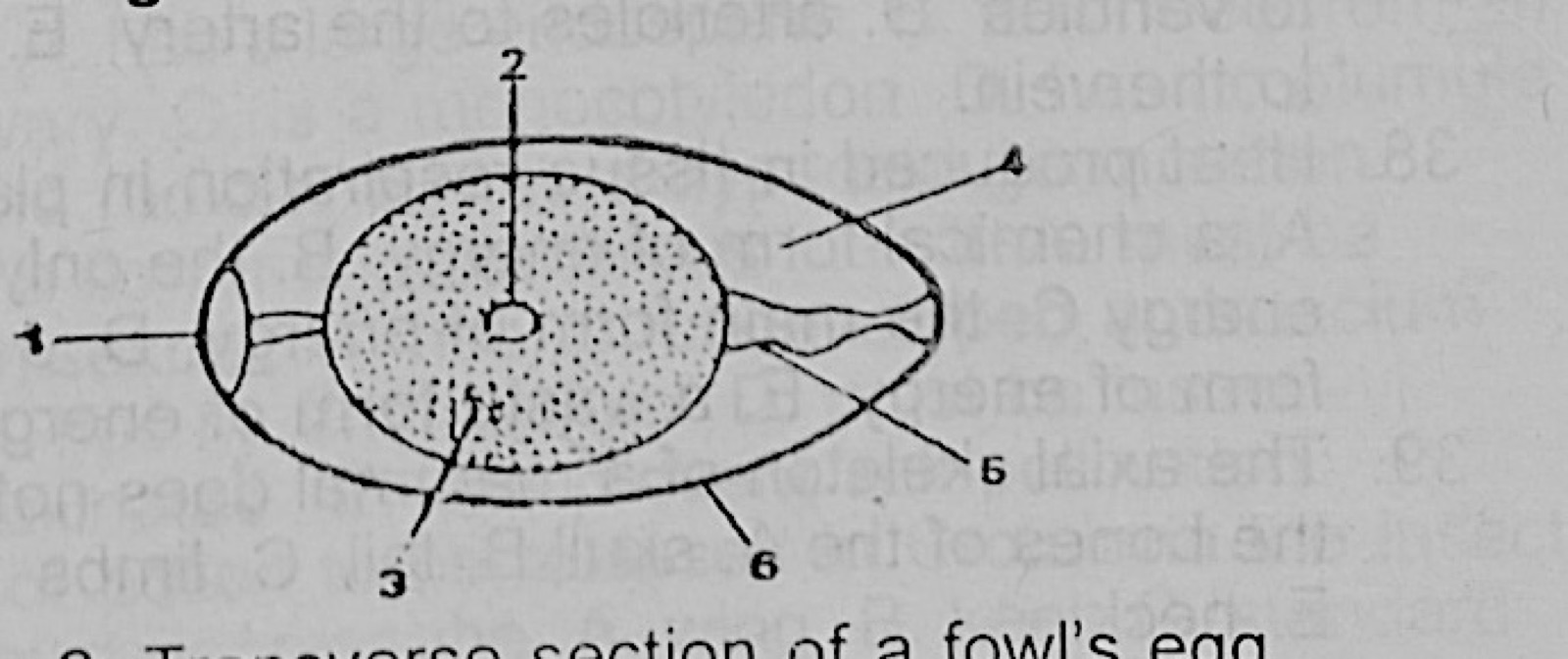
Question 24 Reproduction in Animals Use Fig. 2 (transverse section of a fowl's egg) to answer this question. The young chick is formed from
A. 3 B. 3 and 4 C. 1, 3 and 5 D. 2. E. 4. Show the answer and explanation Answer: D (2. )
Explanation The chick develops from the germinal disc (part 2), the small spot on the yolk where the embryo begins.
Open this question
Question 25 Reproduction in Animals Use Fig. 2 (transverse section of a fowl's egg) to answer this question. Which parts provide food for the developing chick?
A. 2 and 3 B. 4 and 5 C. 3 and 4 D. 2 and 5 E. 1 and 2. Show the answer and explanation Answer: C (3 and 4 )
Explanation The yolk (3) and the albumen or egg white (4) are the food stores used by the growing chick.
Open this question
Question 26 Support and Movement Which of the following types of vertebrae occur in equal numbers in the rabbit, rat and man?
A. Caudal B. Thoracic C. Lumbar D. Cervical E. Sacral Show the answer and explanation Answer: D (Cervical )
Explanation Nearly all mammals, from rats to giraffes and man, have seven cervical (neck) vertebrae. The numbers of thoracic, lumbar, sacral and caudal vertebrae vary between species.
Open this question
Question 27 Structure of Flowering Plants Which of the following statements is NOT true of the piliferous layer of a root? It
A. has a very thin cuticle B. is the outermost layer of the cortex C. may bear root hairs D. breaks down as the root ages. E. is replaced by cork in old roots. Show the answer and explanation Answer: B (is the outermost layer of the cortex )
Explanation The piliferous layer is the epidermis of the root, which lies outside the cortex and is not part of it. It bears root hairs, has little or no cuticle and is replaced by cork as the root ages.
Open this question
Question 28 Reproduction in Plants A flowering plant is monoecious if
A. the androecium is found on one plant B. the gynoecium is monocarpous C. it produces essential organs D. the gynoecium and androecium are on the same plant E. the flowers are unisexual. Show the answer and explanation Answer: D (the gynoecium and androecium are on the same plant )
Explanation A monoecious plant (e.g. maize) bears both male (androecium) and female (gynoecium) parts on the same plant, usually in separate flowers.
Open this question
Question 29 Reproduction in Plants How many nuclei are found in a pollen tube during fertilization?
A. 2 B. 3 C. 5 D. 6 E. 7. Show the answer and explanation Answer: B (3 )
Explanation The pollen tube contains one tube nucleus and two male (generative) nuclei, three in all.
Open this question
Question 30 Excretion Which of the following is NOT a waste product of plants?
A. Tannins B. Oxygen C. Carbondioxide D. Sap E. Alkaloids. Show the answer and explanation Answer: D (Sap )
Explanation Sap is the watery fluid in the plant's vessels and cells, not a waste. Tannins, alkaloids, oxygen (from photosynthesis) and carbon dioxide (from respiration) are wastes.
Open this question
Question 31 Nervous Coordination If an animal is very active and has good muscular control, it is likely to have well-developed
A. olfactory lobes B. cerebral hemispheres C. optic lobes D. cerebellum E. spinal cord. Show the answer and explanation Answer: D (cerebellum )
Explanation The cerebellum coordinates muscle movement and balance, so it is large in very active animals such as birds.
Open this question
Question 32 Adaptation Which of the following adaptations is NOT concerned with the flight of birds?
A. Streamlined shape B. Presence of powerful muscles C. Reduced body weight D. Broad sternum E. Webbed feet Show the answer and explanation Answer: E (Webbed feet )
Explanation Webbed feet help water birds to swim, not to fly. The other features reduce drag and weight or power the wings.
Open this question
Question 33 Population Ecology The transect method can be used in ecology to show the
A. number of plants and animals in a habitat B. population of a particular plant species C. distribution of organisms along a line D. heights of trees in a section of a forest E. number of young plants across a forest. Show the answer and explanation Answer: C (distribution of organisms along a line )
Explanation In a line transect, a rope is laid across the habitat and the organisms touching it are recorded. It shows how organisms change (are distributed) along that line.
Open this question
Question 34 Reproduction in Plants Asexual reproduction does NOT occur in
A. Mucor, Spirogyra and Paramecium B. Penicillium, Paramecium and Amoeba C. Mucor, Rhizopus and Penicillium D. Amoeba, Spirogyra and Mucor E. Rhizopus, Ascaris and Amoeba. Show the answer and explanation Answer: E (Rhizopus, Ascaris and Amoeba. )
Explanation Ascaris (a roundworm) reproduces only sexually. Every organism in the other groups can reproduce asexually by spores, fission or fragmentation.
Open this question
Question 35 Food Substances and Enzymes Fehling's solution will readily change colour from blue to a reddish colour when it is
A. mixed with sugar solution in the cold B. warmed or heated by itself C. mixed with reducing sugar in the cold D. Warmed or heated with a complex solution E. Warmed with a solution of reducing sugar. Show the answer and explanation Answer: E (Warmed with a solution of reducing sugar. )
Explanation Fehling's test needs heat: a reducing sugar warmed with Fehling's solution gives a brick-red precipitate.
Open this question
Question 36 Animal Nutrition The presence of a diastema in the jawbone indicates that the mammal lacks the teeth suitable for
A. tearing B. chewing C. cutting D. chewing and tearing E. cutting and grinding. Show the answer and explanation Answer: A (tearing )
Explanation The diastema is the gap where canines would be. Canines are for tearing flesh, so herbivores like the rabbit lack them.
Open this question
Question 37 Transport in Animals Normally the flow of blood is NEVER from
A. artery to arterioles B. arterioles to capillaries C. capillaries to venules D. arterioles to the artery E. venules to the vein. Show the answer and explanation Answer: D (arterioles to the artery )
Explanation Blood flows from arteries to arterioles, capillaries, venules and then veins. Flow from arterioles back into an artery would be in the wrong direction.
Open this question
Question 38 Respiration Heat produced in tissue respiration in plants is
A. a chemical form of energy B. the only form of energy C. the main form of energy D. a useful form of energy E. a waste form of energy. Show the answer and explanation Answer: E (a waste form of energy. )
Explanation Respiration releases energy partly as ATP (chemical energy) and partly as heat. Plants do not use this heat to keep warm, so it is lost as waste.
Open this question
Question 39 Support and Movement The axial skeleton of a mammal does not include the bones of the
A. skull B. tail C. limbs D. back E. neck. Show the answer and explanation Answer: C (limbs )
Explanation The axial skeleton is the skull, vertebral column (neck, back, tail) and ribs. Limb bones belong to the appendicular skeleton.
Open this question
Question 40 Transport in Animals Which of the following sequences represents the process of blood clotting? 1. Fibrin forms a network of threads 2 Red blood cells are caught and a clot is formed 3. Fibrinogen in plasma changes into soluble fibrin 4 Blood is exposed to air
A. 4,3,2,1 B. 4,3,1,2 C. 3,1,4,2 D. 1,2,3,4 E. 3, 1, 2, 4. Show the answer and explanation Answer: B (4,3,1,2 )
Explanation Blood is first exposed to air at the wound (4), fibrinogen is changed to fibrin (3), fibrin forms a mesh of threads (1) and red cells are trapped in it to make the clot (2).
Open this question
Question 41 Feeding Relationships and Energy Flow Green plants are important in the ecosystem because they are
A. primary consumers B. producers C. decomposers D. secondary consumers E. scavengers. Show the answer and explanation Answer: B (producers )
Explanation Green plants make food by photosynthesis, so they are the producers on which all other organisms depend.
Open this question
Question 42 Ecosystem and Ecological Factors An anemometer is an instrument for measuring
A. relative humidity B. altitude C. wind speed D. turbidity E. salinity. Show the answer and explanation Answer: C (wind speed )
Explanation An anemometer has spinning cups that measure wind speed.
Open this question
Question 43 Pollution Which of the following is NOT regarded as a pollutant on land or in the air?
A. Smoke B. Noise C. Sulphur dioxide D. Carbon monoxide E. Nitrogen. Show the answer and explanation Answer: E (Nitrogen. )
Explanation Nitrogen gas makes up about 78% of normal air and is harmless. Smoke, noise, sulphur dioxide and carbon monoxide are pollutants.
Open this question
Question 44 Ecosystem and Ecological Factors Which of the following groups of factors is completely abiotic?
A. Salinity, tide, plankton, turbidity B. Temperature, pH, soil, insect C. Wind, altitude, humidity, light. D. Conifers, wind, pH, rainfall E. Soil, water, bacteria, salinity. Show the answer and explanation Answer: C (Wind, altitude, humidity, light. )
Explanation Abiotic factors are non-living. Option C contains no living thing; the others include plankton, insects, conifers or bacteria.
Open this question
Question 45 Microorganisms and Health Which of the following lists of diseases, their causes and transmission is CORRECT?
A. Cholera, virus, severe diarrhoea, infected water B. Malaria, protozoan, high fever, contact with infected person C. Syphilis, virus, veneral disease, sexual intercourse D. Smallpox, virus, skin with blister, close contact with infected person E. Sleeping sickness, bacteria, tiredness, headache and dozing, tsetsefly bite. Show the answer and explanation Answer: D (Smallpox, virus, skin with blister, close contact with infected person )
Explanation Smallpox is caused by a virus, causes blisters on the skin and spreads by close contact. Cholera and syphilis are bacterial, malaria spreads by mosquitoes, and sleeping sickness is caused by a protozoan.
Open this question
Question 46 Soil Erosion can be reduced along a slope by
A. ridging across slope B. ridging up slope C. ridging down slope D. crop rotation E. bush fallowing system. Show the answer and explanation Answer: A (ridging across slope )
Explanation Ridges made across the slope (contour ridging) slow down running water and hold the soil in place.
Open this question
Question 47 Soil If a handful of soil is shaken with water and left to settle, the soil particles will settle from light to heavy particles as follows
A. humus, clay, silt, sand, stones B. humus, silt, clay, sand, stones C. humus, clay, silt, stones, sand D. humus, sand, silt, clay, stones E. clay, humus, silt, sand, stones. Show the answer and explanation Answer: A (humus, clay, silt, sand, stones )
Explanation Heavier particles sink first, so from lightest to heaviest the order is humus (floats on top), clay, silt, sand and then stones.
Open this question
Question 48 Nutrient Cycling Denitrifying bacteria in nature liberate gaseous nitrogen directly from
A. ammonium salts B. soil nitrates C. thunderstorms D. soil nitrites E. plant and animal proteins. Show the answer and explanation Answer: B (soil nitrates )
Explanation Denitrifying bacteria break down nitrates in the soil and release nitrogen gas into the air.
Open this question
Question 49 Soil Leaching is
A. washing away of humus from the soil surface B. reduction of soil aeration by pressure C. soil erosion by means other than rainfall D. loss of organic matter due to exposure to direct sunlight E. washing out of chalk and limestone from upper layers of soil by heavy rains. Show the answer and explanation Answer: E (washing out of chalk and limestone from upper layers of soil by heavy rains. )
Explanation Leaching happens when rain water sinks through the soil and dissolves soluble minerals (e.g. chalk and lime), carrying them down out of the topsoil where roots can reach them.
Open this question
Question 50 Soil The process of soil erosion is usually from
A. rill → sheet → gully B. gully → rill → sheet C. sheet → gully → rill D. sheet → rill → gully E. rill → gully → sheet. Show the answer and explanation Answer: D (sheet → rill → gully )
Explanation Running water first removes a thin layer evenly (sheet erosion), then cuts small channels (rills), which grow into deep gullies.
Open this question Sign up free for every JAMB Biology year, practice by topic and timed mocks.
Start practising free