WAEC Mathematics 2021 past questions and answers

63 questions. Try each one, then open the answer to check yourself and read the explanation.

Question 1

Fractions, Decimals and Approximation

Correct, 0.00798516 to three significant figures.

  1. A.0.0109
  2. B.0.0800
  3. C.0.00799
  4. D.0.008
Show the answer and explanation

Answer: C (0.00799)

Explanation

The first three significant figures are 7, 9, 8 and the next digit is 5, so round up: 0.00799.

Open this question

Question 2

Number Bases

Simplify: (11two)2.

  1. A.1001two
  2. B.1101two
  3. C.101two
  4. D.10001two
Show the answer and explanation

Answer: A (1001two)

Explanation

11two = 3 and 32 = 9 = 8 + 1 = 1001two.

Open this question

Question 3

Indices

Solve: 2√(2x + 1) = 32.

  1. A.13
  2. B.24
  3. C.12
  4. D.11
Show the answer and explanation

Answer: C (12)

Explanation

32 = 25, so √(2x + 1) = 5. Squaring, 2x + 1 = 25 and x = 12.

Open this question

Question 4

Logarithms

If log102 = m and log103 = n, find log1024 in terms of m and n.

  1. A.3m + n
  2. B.m + 3n
  3. C.4mn
  4. D.3mn
Show the answer and explanation

Answer: A (3m + n)

Explanation

24 = 23 × 3, so log 24 = 3 log 2 + log 3 = 3m + n.

Open this question

Question 5

Progressions

Find the 5th term of the sequence 2, 5, 10, 17, … .

  1. A.22
  2. B.24
  3. C.36
  4. D.26
Show the answer and explanation

Answer: D (26)

Explanation

The differences are 3, 5, 7, so the next difference is 9: 17 + 9 = 26. (The terms are n2 + 1.)

Open this question

Question 6

Sets

If P = {−3 < x < 1} and Q = {−1 < x < 3}, where x is a real number, find P ∩ Q.

  1. A.{−1 < x < 1}
  2. B.{−3 ≤ x ≤ 1}
  3. C.{−3 < x < 1}
  4. D.{−1 ≤ x ≤ 1}
Show the answer and explanation

Answer: A ({−1 < x < 1})

Explanation

The overlap of the two intervals starts at −1 and ends at 1, with both ends excluded: −1 < x < 1.

Open this question

Question 7

Algebraic Expressions

Factorize 6pq − 3rs − 3ps + 6qr.

  1. A.3(r − p)(2q + s)
  2. B.3(p + r)(2q − s)
  3. C.3(p − r)(2q − s)
  4. D.3(r − p)(s − 2q)
Show the answer and explanation

Answer: B (3(p + r)(2q − s))

Explanation

Group: 6pq + 6qr − 3ps − 3rs = 6q(p + r) − 3s(p + r) = 3(p + r)(2q − s).

Open this question

Question 8

Fractions, Decimals and Approximation

What number should be subtracted from the sum of 2⅙ and 2 7/12 to give 3¼?

  1. A.⅓
  2. B.1½
  3. C.1⅙
  4. D.½
Show the answer and explanation

Answer: B (1½)

Explanation

2⅙ + 2 7/12 = 4 9/12 = 4¾. Then 4¾ − 3¼ = 1½.

Open this question

Question 9

Linear and Simultaneous Equations

Mensah is 5 years old and Joyce is thrice as old as Mensah. In how many years will Joyce be twice as old as Mensah?

  1. A.3 years
  2. B.10 years
  3. C.5 years
  4. D.15 years
Show the answer and explanation

Answer: C (5 years)

Explanation

Joyce is 15. In n years: 15 + n = 2(5 + n), so 15 + n = 10 + 2n and n = 5.

Open this question

Question 10

Indices

If 16 × 2(x + 1) = 4x × 8(1 − x), find the value of x.

  1. A.−4
  2. B.4
  3. C.1
  4. D.−1
Show the answer and explanation

Answer: D (−1)

Explanation

In base 2: 24 + x + 1 = 22x × 23 − 3x, so x + 5 = 3 − x. Then 2x = −2 and x = −1.

Open this question

Question 11

Fractions, Decimals and Approximation

The circumference of a circular track is 9 km. A cyclist rides round it a number of times and stops after covering a distance of 302 km. How far is the cyclist from the starting point?

  1. A.5 km
  2. B.6 km
  3. C.7 km
  4. D.3 km
Show the answer and explanation

Answer: A (5 km)

Explanation

302 = 33 × 9 + 5, so after 33 full laps the cyclist has gone a further 5 km along the track.

Open this question

Question 12

Surds

Simplify: 2√7 − 14/√7 + 7/√21

  1. A.√21/21
  2. B.7√21/3
  3. C.√21/3
  4. D.3√21
Show the answer and explanation

Answer: C (√21/3)

Explanation

14/√7 = 2√7, which cancels with 2√7. And 7/√21 = 7√21/21 = √21/3.

Open this question

Question 13

Linear and Simultaneous Equations

If 4x + 2y = 16 and 6x − 2y = 4, find the value of (y − x).

  1. A.8
  2. B.2
  3. C.4
  4. D.6
Show the answer and explanation

Answer: B (2)

Explanation

Adding gives 10x = 20, so x = 2. Then 8 + 2y = 16 gives y = 4, and y − x = 2.

Open this question

Question 14

Variation

Given that R is directly proportional to L and inversely proportional to P, R = 3 when L = 9 and P = 0.8, find R when L = 15 and P = 1.8.

  1. A.2.2
  2. B.3.3
  3. C.6.6
  4. D.0.3
Show the answer and explanation

Answer: A (2.2)

Explanation

R = kL/P: 3 = 9k/0.8 so k = 0.8/3. Then R = (0.8/3) × 15/1.8 ≈ 2.2.

Open this question

Question 15

Triangles and Quadrilaterals

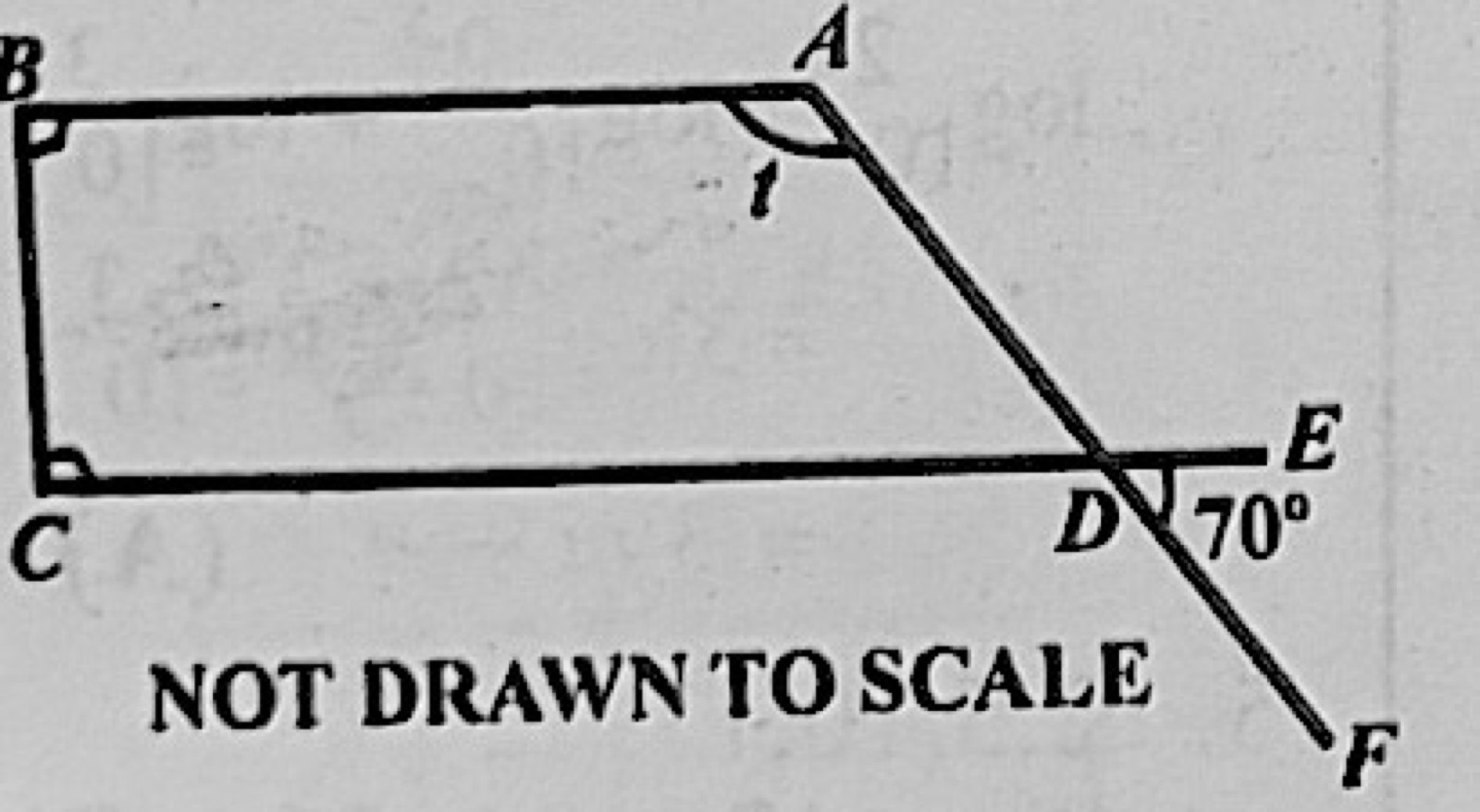
In the diagram, ∠ABC and ∠BCD are right angles, ∠BAD = t and ∠EDF = 70°. Find the value of t.

Diagram for this question
  1. A.70°
  2. B.165°
  3. C.140°
  4. D.110°
Show the answer and explanation

Answer: D (110°)

Explanation

∠ADC = ∠EDF = 70° (vertically opposite). AB ∥ CD because both are perpendicular to BC, so t + 70° = 180° and t = 110°.

Open this question

Question 16

Angles and Polygons

The sum of the interior angles of a regular polygon with k sides is (3k − 10) right angles. Find the size of the exterior angle.

  1. A.60°
  2. B.40°
  3. C.90°
  4. D.120°
Show the answer and explanation

Answer: A (60°)

Explanation

(k − 2) × 180° = (3k − 10) × 90°, so 2k − 4 = 3k − 10 and k = 6. Each exterior angle is 360° ÷ 6 = 60°.

Open this question

Question 17

Algebraic Expressions

Make U the subject of the relation: x = (2U − 3)/(3U + 2).

  1. A.U = (2x + 3)/(3x − 2)
  2. B.U = (2x − 3)/(3x − 2)
  3. C.U = (2x + 3)/(2 − 3x)
  4. D.U = (2x + 3)/(3x + 2)
Show the answer and explanation

Answer: C (U = (2x + 3)/(2 − 3x))

Explanation

3Ux + 2x = 2U − 3, so 3Ux − 2U = −3 − 2x and U(3x − 2) = −(2x + 3). Hence U = (2x + 3)/(2 − 3x).

Open this question

Question 18

Commercial Arithmetic

A trader paid import duty of 38 kobo in the naira on the cost of an engine. If a total of ₦22,800.00 was paid as import duty, calculate the cost of the engine.

  1. A.₦60,000.00
  2. B.₦120,000.00
  3. C.₦24,000.00
  4. D.₦18,000.00
Show the answer and explanation

Answer: A (₦60,000.00)

Explanation

Duty is ₦0.38 for every ₦1, so the cost = 22,800 ÷ 0.38 = ₦60,000.

Open this question

Question 19

Mensuration of Plane Shapes

The height of an equilateral triangle is 10√3 cm. Calculate its perimeter.

  1. A.20 cm
  2. B.60 cm
  3. C.40 cm
  4. D.30 cm
Show the answer and explanation

Answer: B (60 cm)

Explanation

Height = side × sin 60° = side × √3/2, so side = 20 cm and the perimeter is 60 cm.

Open this question

Question 20

Mensuration of Plane Shapes

In ΔLMN, |LM| = 6 cm, ∠LMN = 90°, ∠LNM = x and sin x = 3/5. Find the area of ΔLMN.

  1. A.60 cm2
  2. B.48 cm2
  3. C.24 cm2
  4. D.30 cm2
Show the answer and explanation

Answer: C (24 cm2)

Explanation

LM is opposite x, so LN = 6 ÷ (3/5) = 10 cm and MN = √(100 − 36) = 8 cm. Area = ½ × 6 × 8 = 24 cm2.

Open this question

Question 21

Logic

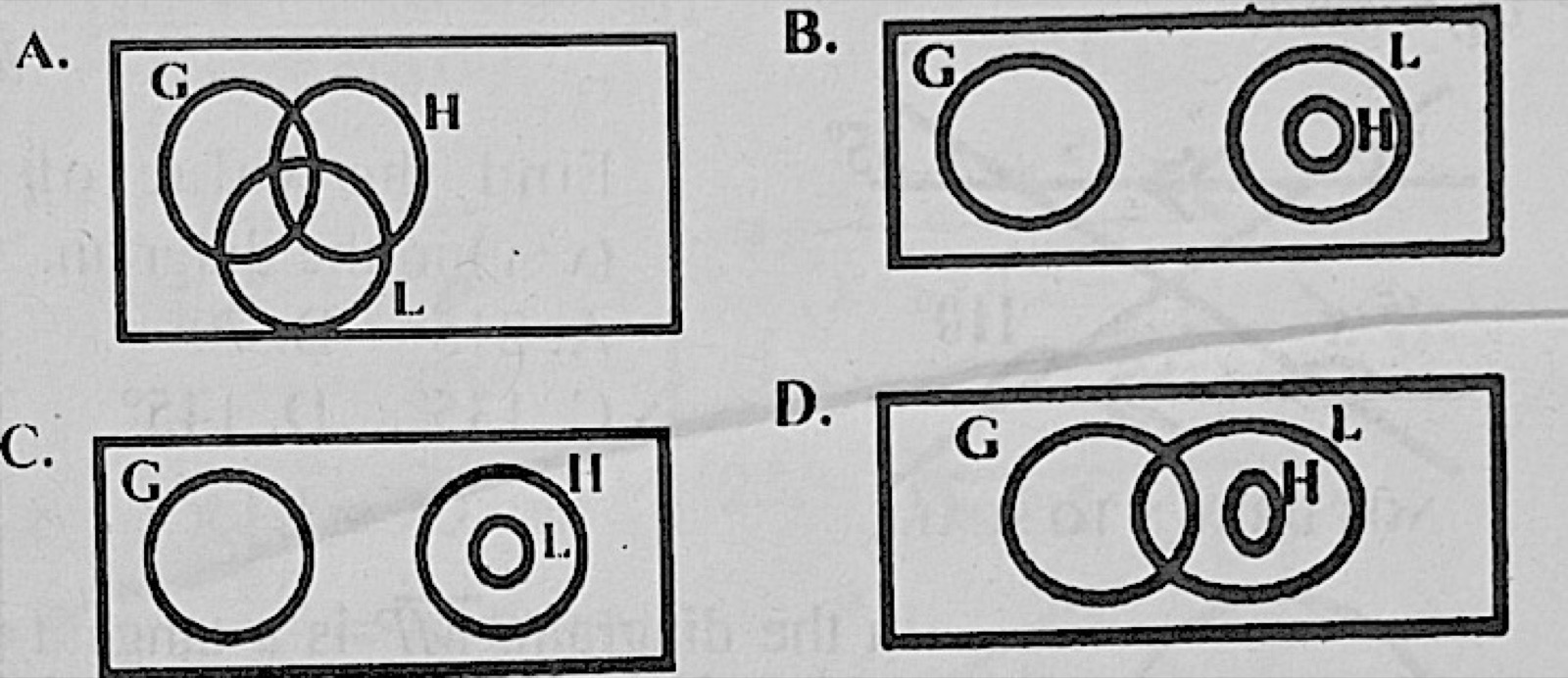
Consider the statements: P: All students offering Literature (L) also offer History (H); Q: Students offering History (H) do not offer Geography (G). Which of the venn diagrams correctly illustrates the two statements?

Diagram for this question
  1. A.Diagram A
  2. B.Diagram B
  3. C.Diagram C
  4. D.Diagram D
Show the answer and explanation

Answer: C (Diagram C)

Explanation

P puts the L circle inside the H circle, and Q makes the H circle separate from G. Only diagram C shows L inside H with G apart.

Open this question

Question 22

Quadratic Equations

Find the quadratic equation whose roots are −2q and 5q.

  1. A.x2 + 3qx − 10q2 = 0
  2. B.x2 + 3qx + 10q2 = 0
  3. C.x2 − 3qx + 10q2 = 0
  4. D.x2 − 3qx − 10q2 = 0
Show the answer and explanation

Answer: D (x2 − 3qx − 10q2 = 0)

Explanation

(x + 2q)(x − 5q) = x2 − 3qx − 10q2 = 0.

Open this question

Question 23

Trigonometry

If tan θ = 3/4, 180° < θ < 270°, find the value of cos θ.

  1. A.4/5
  2. B.3/5
  3. C.−4/5
  4. D.−3/5
Show the answer and explanation

Answer: C (−4/5)

Explanation

From a 3-4-5 triangle, |cos θ| = 4/5. In the third quadrant cosine is negative, so cos θ = −4/5.

Open this question

Question 24

Algebraic Expressions

If 2/(x − 3) − 3/(x − 2) = P/((x − 3)(x − 2)), find P.

  1. A.(5 − x)
  2. B.−(x + 5)
  3. C.(13 − x)
  4. D.−(5x − 13)
Show the answer and explanation

Answer: A ((5 − x))

Explanation

P = 2(x − 2) − 3(x − 3) = 2x − 4 − 3x + 9 = 5 − x.

Open this question

Question 25

Mensuration of Plane Shapes

The diagonals of a rhombus are 12 cm and 5 cm. Calculate its perimeter.

  1. A.26 cm
  2. B.24 cm
  3. C.17 cm
  4. D.34 cm
Show the answer and explanation

Answer: A (26 cm)

Explanation

The diagonals bisect each other at right angles, so each side = √(62 + 2.52) = 6.5 cm. Perimeter = 4 × 6.5 = 26 cm.

Open this question

Question 26

Triangles and Quadrilaterals

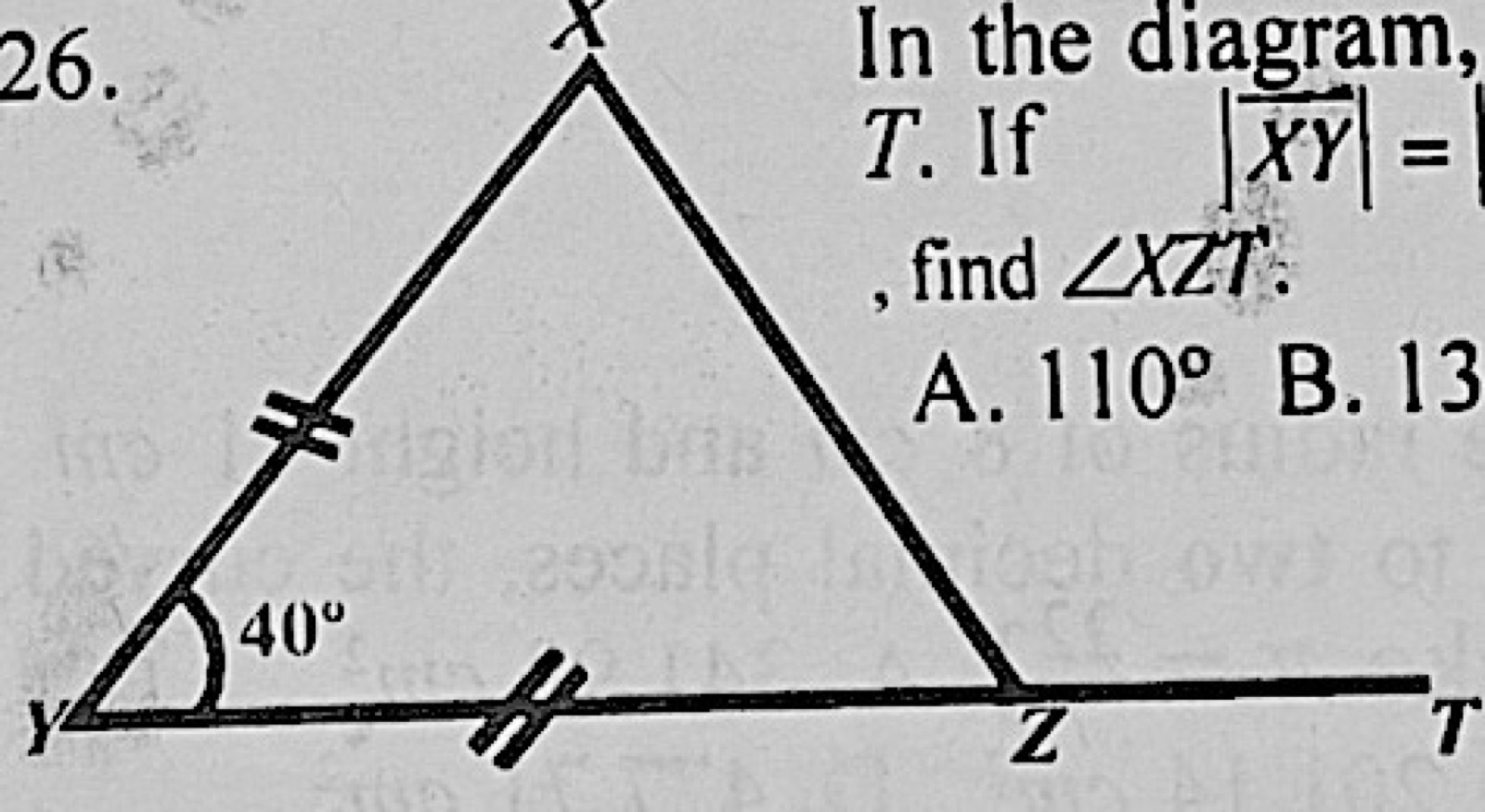
In the diagram, ΔXYZ is produced to T. If |XY| = |ZY| and ∠XYT = 40°, find ∠XZT.

Diagram for this question
  1. A.110°
  2. B.130°
  3. C.120°
  4. D.140°
Show the answer and explanation

Answer: A (110°)

Explanation

The triangle is isosceles with the 40° angle at Y, so ∠YXZ = ∠YZX = 70°. ∠XZT is on the straight line: 180° − 70° = 110°.

Open this question

Question 27

Mensuration of Solids

A solid brass cube is melted and recast as a solid cone of height h and base radius r. If the height of the cube is h, find r in terms of h.

  1. A.r = h
  2. B.r = √(3h/π)
  3. C.r = πh
  4. D.r = h√(3/π)
Show the answer and explanation

Answer: D (r = h√(3/π))

Explanation

Volumes are equal: h3 = ⅓πr2h, so r2 = 3h2/π and r = h√(3/π).

Open this question

Question 28

Angles and Polygons

Which of the following is not an exterior angle of a regular polygon?

  1. A.66°
  2. B.72°
  3. C.24°
  4. D.15°
Show the answer and explanation

Answer: A (66°)

Explanation

The exterior angle of a regular polygon must divide 360° exactly. 360 ÷ 66 is not a whole number.

Open this question

Question 29

Bearings

From a point T, a man moves 12 km due West and then moves 12 km due South to another point Q. Calculate the bearing of T from Q.

  1. A.225°
  2. B.315°
  3. C.045°
  4. D.135°
Show the answer and explanation

Answer: C (045°)

Explanation

Q is 12 km west and 12 km south of T, so T is 12 km east and 12 km north of Q. That is exactly north-east: 045°.

Open this question

Question 30

Circle Theorems

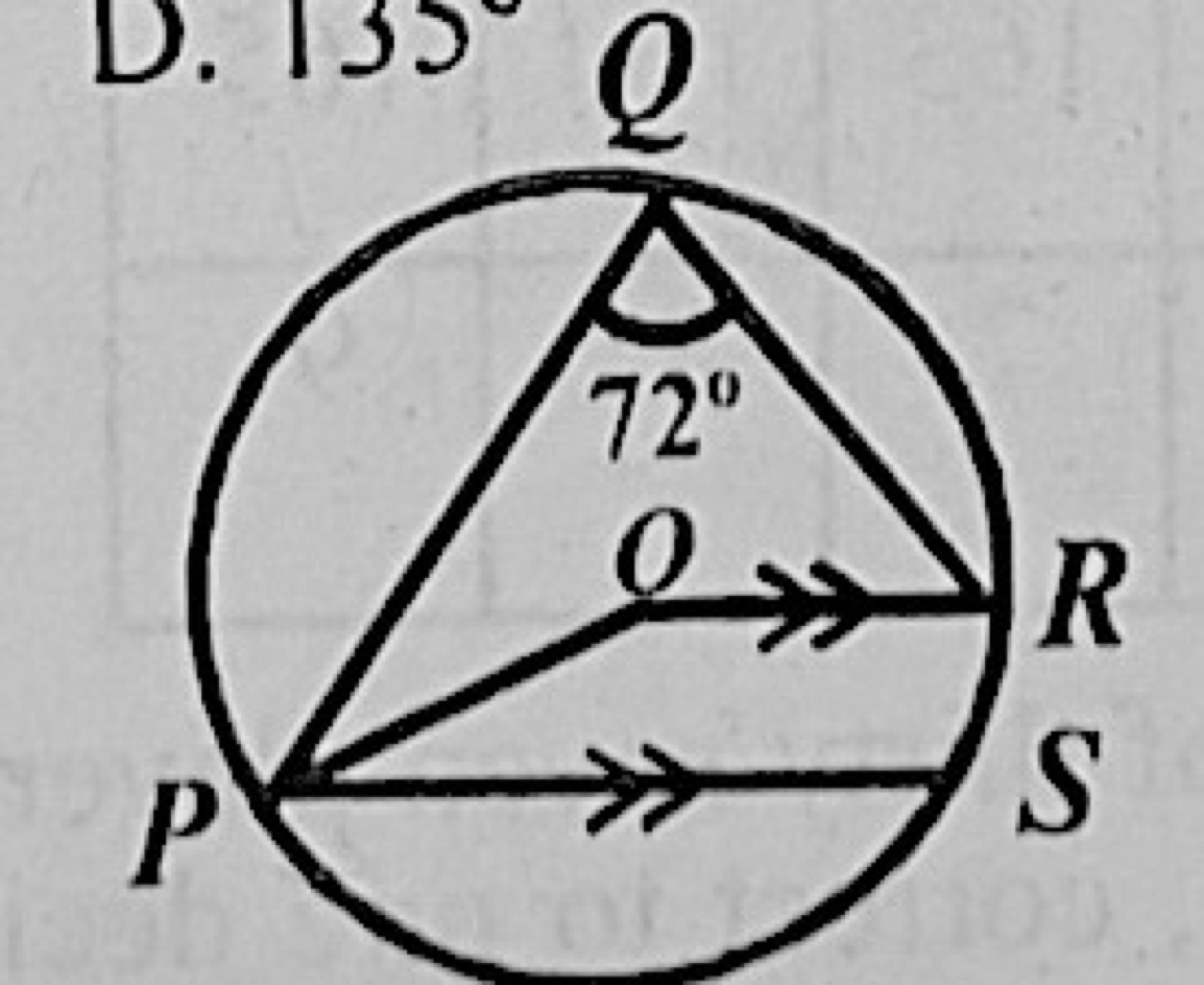
In the diagram, O is the centre of circle PQRS, ∠PQR = 72° and OR ∥ PS. Find ∠OPS.

Diagram for this question
  1. A.18°
  2. B.108°
  3. C.54°
  4. D.36°
Show the answer and explanation

Answer: D (36°)

Explanation

∠POR = 2 × 72° = 144°, so in isosceles triangle OPR, ∠OPR = ∠ORP = 18°. ∠RPS = ∠ORP = 18° (alternate angles), so ∠OPS = 18° + 18° = 36°.

Open this question

Question 31

Mensuration of Plane Shapes

A trapezium of sides 10 cm and 21 cm and height 8 cm is inscribed in a circle of radius 7cm. Calculate the area of the region not covered by the trapezium. [Take π = 22/7]

  1. A.84 cm2
  2. B.80 cm2
  3. C.30 cm2
  4. D.94 cm2
Show the answer and explanation

Answer: C (30 cm2)

Explanation

Circle = (22/7) × 49 = 154 cm2. Trapezium = ½(10 + 21) × 8 = 124 cm2. Uncovered = 154 − 124 = 30 cm2.

Open this question

Question 32

Measures of Central Tendency

Find, correct to two decimal places, the mean of 1½, 2⅔, 3¾, 4⅘ and 5⅚.

  1. A.3.71
  2. B.3.70
  3. C.3.69
  4. D.3.72
Show the answer and explanation

Answer: A (3.71)

Explanation

Sum = 1.5 + 2.667 + 3.75 + 4.8 + 5.833 = 18.55. Mean = 18.55 ÷ 5 = 3.71.

Open this question

Question 33

Linear and Simultaneous Equations

A cyclist moved at a speed of X km/h for 2 hours. He then increased his speed by 2 km/h for the next 3 hours. If the total distance covered is 36 km, calculate his intial speed, X.

  1. A.12 km/h
  2. B.3 km/h
  3. C.4 km/h
  4. D.6 km/h
Show the answer and explanation

Answer: D (6 km/h)

Explanation

Distance = 2X + 3(X + 2) = 5X + 6 = 36, so X = 6 km/h.

Open this question

Question 34

Triangles and Quadrilaterals

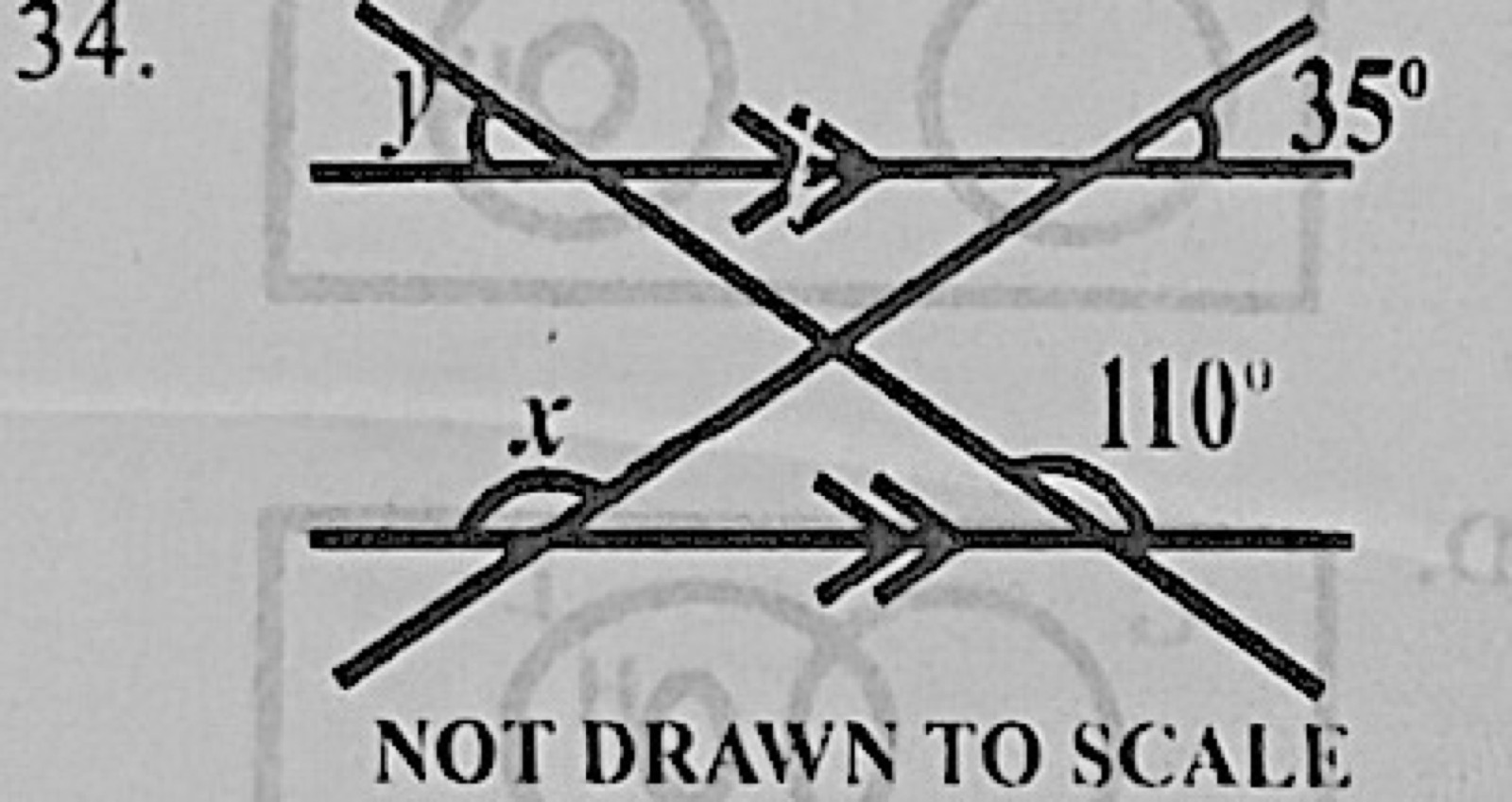
Find the value of (x + y) in the diagram.

Diagram for this question
  1. A.215°
  2. B.70°
  3. C.135°
  4. D.145°
Show the answer and explanation

Answer: A (215°)

Explanation

Using the parallel lines, y = 180° − 110° = 70° and x = 180° − 35° = 145°. So x + y = 215°.

Open this question

Question 35

Circle Theorems

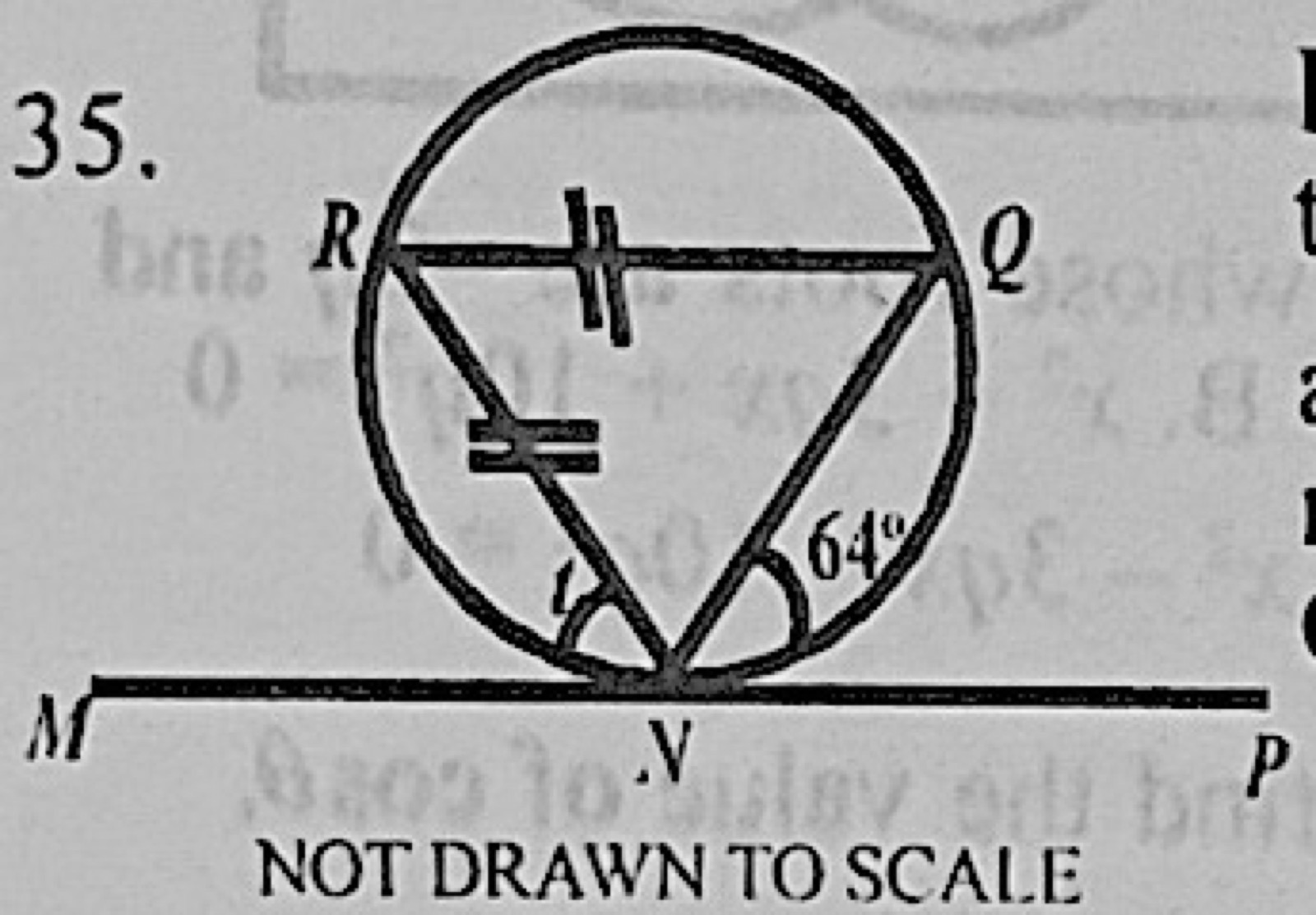
In the diagram, MP is a tangent to the circle NQR, ∠PNQ = 64° and |RQ| = |RN|. Find the angle marked t.

Diagram for this question
  1. A.130°
  2. B.115°
  3. C.58°
  4. D.64°
Show the answer and explanation

Answer: C (58°)

Explanation

By the alternate segment theorem ∠NRQ = 64°. Triangle RQN is isosceles, so ∠RQN = (180° − 64°)/2 = 58°, and t = ∠RQN = 58° (alternate segment again).

Open this question

Question 36

Measures of Dispersion

Find the first quartile of 7, 8, 7, 9, 11, 8, 7, 9, 6, and 8.

  1. A.8.5
  2. B.7.0
  3. C.7.5
  4. D.8.0
Show the answer and explanation

Answer: B (7.0)

Explanation

In order: 6, 7, 7, 7, 8, 8, 8, 9, 9, 11. The lower quartile is the middle of the lower half (6, 7, 7, 7, 8), which is 7.

Open this question

Question 37

Circle Theorems

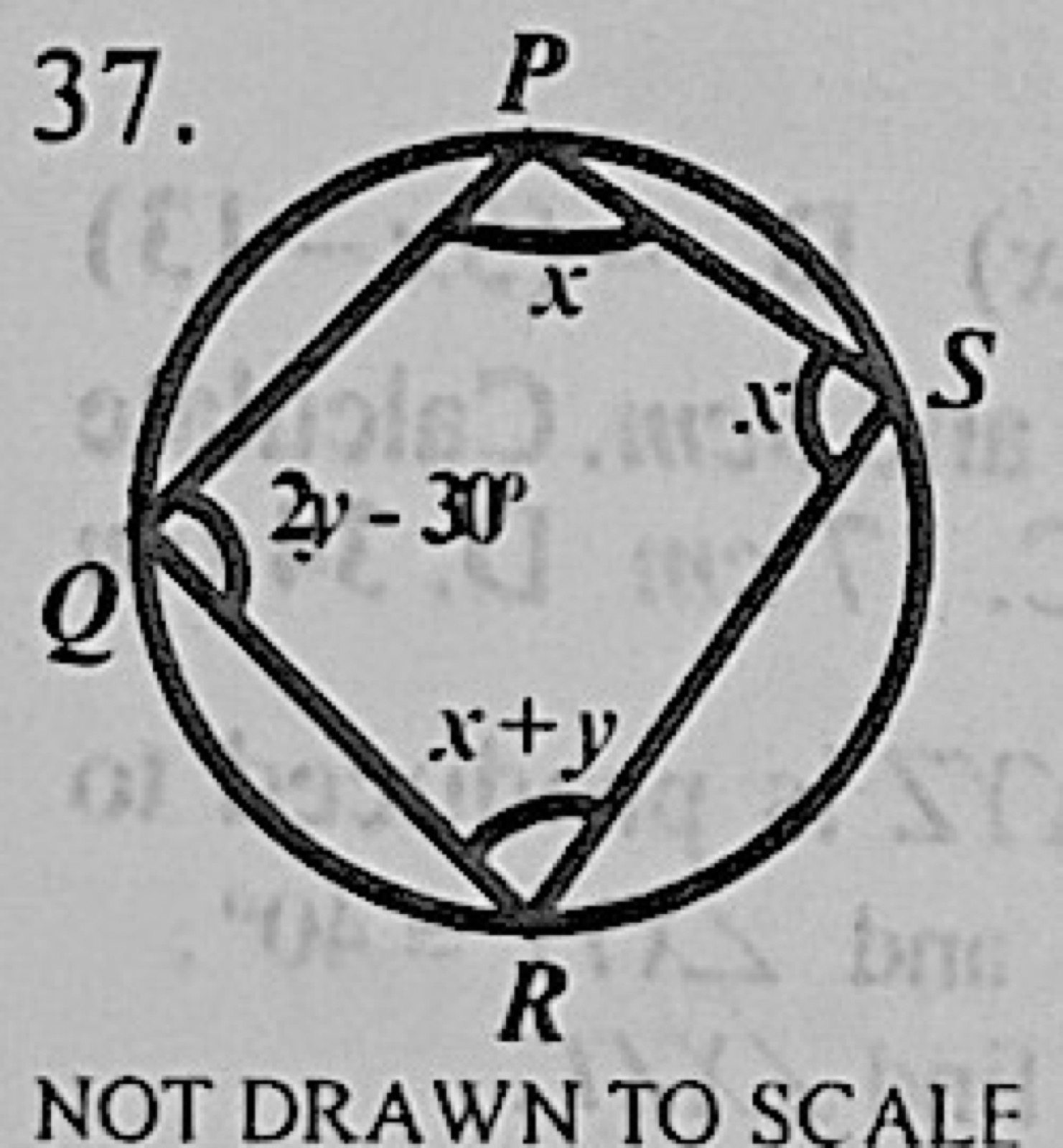
In the diagram, PQRS is a circle. Find the value of x.

Diagram for this question
  1. A.50°
  2. B.30°
  3. C.80°
  4. D.100°
Show the answer and explanation

Answer: A (50°)

Explanation

Opposite angles of a cyclic quadrilateral add to 180°: x + (x + y) = 180° and x + (2y − 30°) = 180°. So 2x + y = 180 and x + 2y = 210, giving x = 50°.

Open this question

Question 38

Mensuration of Solids

A cone has a base radius of 8 cm and height 11 cm. Calculate, correct to two decimal places, the curved surface area. [Take π = 22/7]

  1. A.341.98 cm2
  2. B.276.57 cm2
  3. C.201.14 cm2
  4. D.477.71 cm2
Show the answer and explanation

Answer: A (341.98 cm2)

Explanation

Slant height l = √(82 + 112) = √185 ≈ 13.601 cm. Curved surface = πrl = (22/7) × 8 × 13.601 ≈ 341.98 cm2.

Open this question

Question 39

Trigonometry

Given that sin x = 3/5, 0° ≤ x ≤ 90°, evaluate (tan x + 2 cos x).

  1. A.2 11/20
  2. B.2 7/20
  3. C.11/20
  4. D.1/20
Show the answer and explanation

Answer: B (2 7/20)

Explanation

From a 3-4-5 triangle, tan x = 3/4 and cos x = 4/5. So 3/4 + 8/5 = 47/20 = 2 7/20.

Open this question

Question 40

Circle Theorems

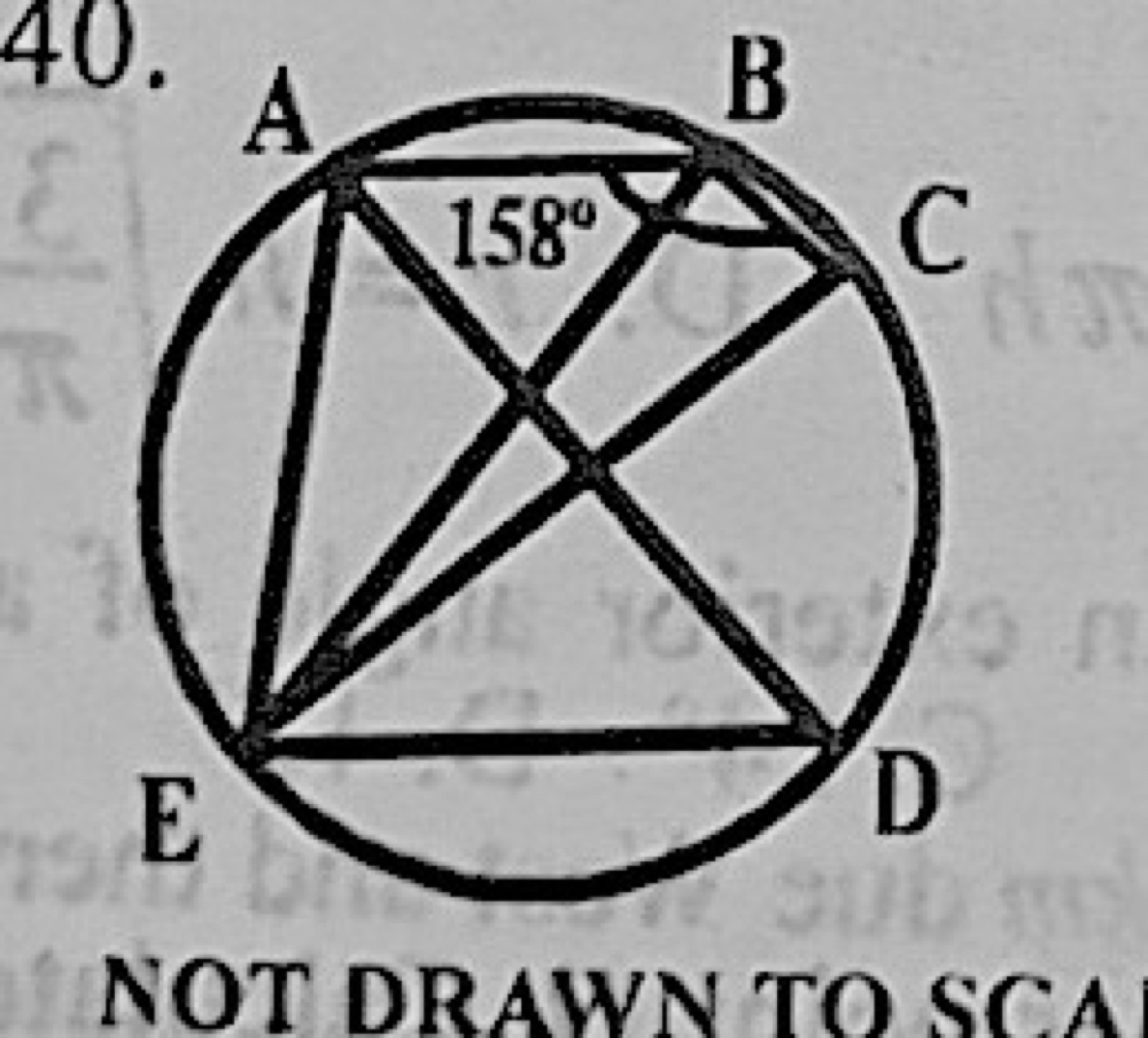
In the diagram, EC is a diameter of the circle ABCDE. If ∠ABC = 158°, find ∠ADE.

Diagram for this question
  1. A.112°
  2. B.90°
  3. C.68°
  4. D.22°
Show the answer and explanation

Answer: C (68°)

Explanation

ABCE is cyclic, so ∠AEC = 180° − 158° = 22°. ∠EAC = 90° (angle in a semicircle), so ∠ACE = 68°, and ∠ADE = ∠ACE = 68° (same segment).

Open this question

Question 41

Measures of Central Tendency

The table shows the heights of thirty-seven players of a basketball team. Calculate, correct to one decimal place, the mean height of the players.
Height (cm): 160, 161, 162, 163, 164, 165
No of Players: 4, 6, 3, 7, 8, 9

  1. A.163.0
  2. B.162.0
  3. C.160.0
  4. D.165.0
Show the answer and explanation

Answer: A (163.0)

Explanation

Σfx = 640 + 966 + 486 + 1141 + 1312 + 1485 = 6030. Mean = 6030 ÷ 37 ≈ 162.97, which is 163.0.

Open this question

Question 42

Coordinate Geometry

XY is a line segment with the coordinates X(−8, −12) and Y(p, q). If the midpoint of XY is (−4, −2), find the coordinates of Y.

  1. A.(−6, −10)
  2. B.(0, 8)
  3. C.(4, 10)
  4. D.(0, 4)
Show the answer and explanation

Answer: B ((0, 8))

Explanation

(−8 + p)/2 = −4 gives p = 0, and (−12 + q)/2 = −2 gives q = 8. So Y is (0, 8).

Open this question

Question 43

Linear and Simultaneous Equations

Five hundred tickets were sold for a concert. Tickets for adults and children were sold at $4.50 and $3.00 respectively. If the total receipts for the concert was $1,987.50, how many tickets for adults were sold?

  1. A.325
  2. B.235
  3. C.175
  4. D.400
Show the answer and explanation

Answer: A (325)

Explanation

If all 500 were child tickets: $1,500. The extra $487.50 comes from $1.50 more per adult ticket, so 487.50 ÷ 1.50 = 325 adults.

Open this question

Question 44

Inequalities

The distance (d) between two villages is more than 18 km but not more than 23 km. Which of these inequalities represents the statement?

  1. A.18 ≤ d ≤ 23
  2. B.18 < d < 23
  3. C.18 ≤ d < 23
  4. D.18 < d ≤ 23
Show the answer and explanation

Answer: D (18 < d ≤ 23)

Explanation

'More than 18' means d > 18 and 'not more than 23' means d ≤ 23: 18 < d ≤ 23.

Open this question

Question 45

Data Presentation

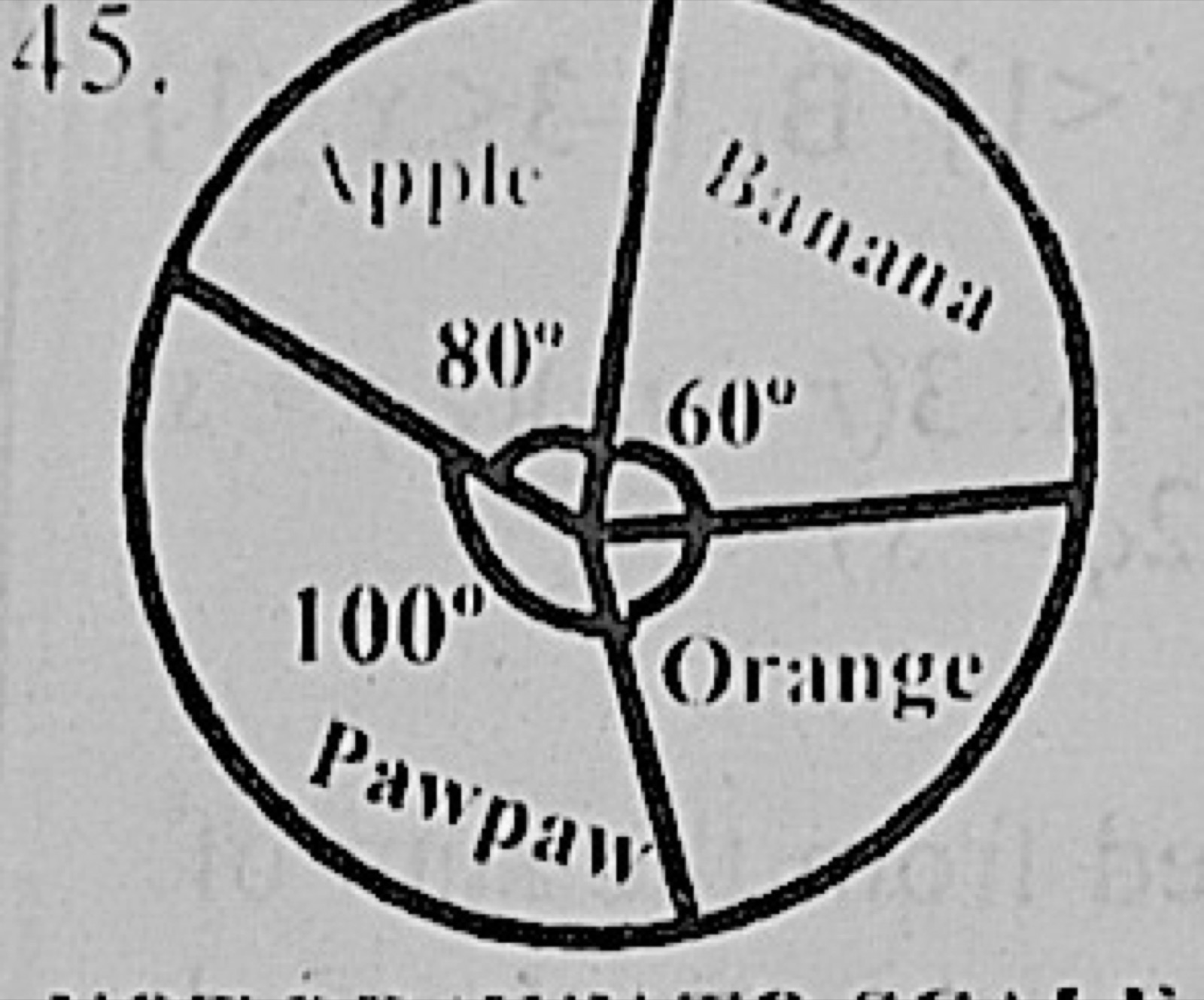
The pie chart represents the distribution of fruits on display in a shop. If there are 60 apples on display, how many oranges are there?

Diagram for this question
  1. A.80
  2. B.270
  3. C.120
  4. D.90
Show the answer and explanation

Answer: D (90)

Explanation

The orange sector is 360° − (80° + 60° + 100°) = 120°. 80° stands for 60 apples, so 120° stands for 60 × 120/80 = 90 oranges.

Open this question

Question 46

Probability

A box contains 40 identical balls of which 10 are red and 12 are blue. If a ball is selected at random from the box, what is the probability that it is neither red nor blue?

  1. A.9/20
  2. B.3/10
  3. C.1/4
  4. D.11/20
Show the answer and explanation

Answer: A (9/20)

Explanation

40 − 10 − 12 = 18 balls are neither colour, so the probability is 18/40 = 9/20.

Open this question

Question 47

Probability

A fair die is tossed twice. What is the probability of getting a sum of at least 10?

  1. A.5/36
  2. B.2/3
  3. C.5/18
  4. D.1/6
Show the answer and explanation

Answer: D (1/6)

Explanation

Sums of 10 or more: (4,6), (5,5), (6,4), (5,6), (6,5), (6,6) – 6 of the 36 outcomes, so 6/36 = 1/6.

Open this question

Question 48

Linear and Simultaneous Equations

A man will be (x + 10) years old in 8 years time. If 2 years ago, he was 63 years, find the value of x.

  1. A.55
  2. B.63
  3. C.57
  4. D.67
Show the answer and explanation

Answer: B (63)

Explanation

He is 63 + 2 = 65 now, so in 8 years he will be 73. x + 10 = 73 gives x = 63.

Open this question

Question 49

Coordinate Geometry

The equation of a line is given as 3x − 5y = 7. Find its gradient (slope).

  1. A.5/3
  2. B.3/5
  3. C.−3/5
  4. D.−5/3
Show the answer and explanation

Answer: B (3/5)

Explanation

Rearrange: 5y = 3x − 7, so y = (3/5)x − 7/5 and the gradient is 3/5.

Open this question

Question 50

Algebraic Expressions

For what value of x is (4 − 2x)/(x + 1) undefined?

  1. A.2
  2. B.−1
  3. C.1
  4. D.−2
Show the answer and explanation

Answer: B (−1)

Explanation

The fraction is undefined when the denominator is zero: x + 1 = 0, so x = −1.

Open this question

Theory question 101

Commercial Arithmetic

(a) Mr Sarto borrowed $25,000 from Afiak Financial Services at 21% simple interest per annum for 3 years. If he was able to pay back the loan in 2 years at equal yearly instalments, how much did he pay each year?
(b) Two consecutive numbers are such that the sum of thrice the smaller and twice the larger is 17. Find, correct to three significant figures, the smaller number as a percentage of the sum of the two numbers.

Show the model answer
Model answer

(a) Interest = 25,000 × 21 × 3/100 = $15,750
Total to repay = $40,750
Each year = 40,750 ÷ 2 = $20,375
(b) Let the numbers be n and n + 1: 3n + 2(n + 1) = 17 → 5n = 15 → n = 3
Numbers 3 and 4, sum 7
Percentage = 3/7 × 100 ≈ 42.9%

Explanation

Work out the full amount owed for 3 years first, then split it into 2 payments.

Open this question

Theory question 102

Linear and Simultaneous Equations

A man left town M at 10:00 a.m. and travelled by car to town N at an average speed of 72 km/h. He spent 2 hours for a meeting and returned to town M by bus at an average speed of 40 km/h. If the distance covered by the bus was 2 km longer than that of the car and he arrived at town M at 1:55 p.m., calculate the distance from M to N.

Show the model answer
Model answer

Total time 10:00 to 1:55 = 3 h 55 min; travelling time = 1 h 55 min = 23/12 h
Let MN = x km: x/72 + (x + 2)/40 = 23/12
Multiply by 360: 5x + 9(x + 2) = 690 → 14x = 672
x = 48 km

Explanation

Take away the 2-hour meeting before setting up the time equation.

Open this question

Theory question 103

Bearings

The points X, Y and Z are located such that Y is 15 km south of X, Z is 20 km from X on a bearing of 270°. Calculate, correct to: (a) two significant figures, |YZ|; (b) the nearest degree, the bearing of Y from Z.

Show the model answer
Model answer

Sketch: Z is 20 km due west of X, Y is 15 km due south of X; ∠ZXY = 90°
(a) |YZ| = √(202 + 152) = √625 = 25 km
(b) At Z: tan θ = 15/20 → θ = 36.87° below east
Bearing of Y from Z = 90° + 36.87° ≈ 127°

Explanation

The right angle is at X, between the west and south directions.

Open this question

Theory question 104

Circle Theorems

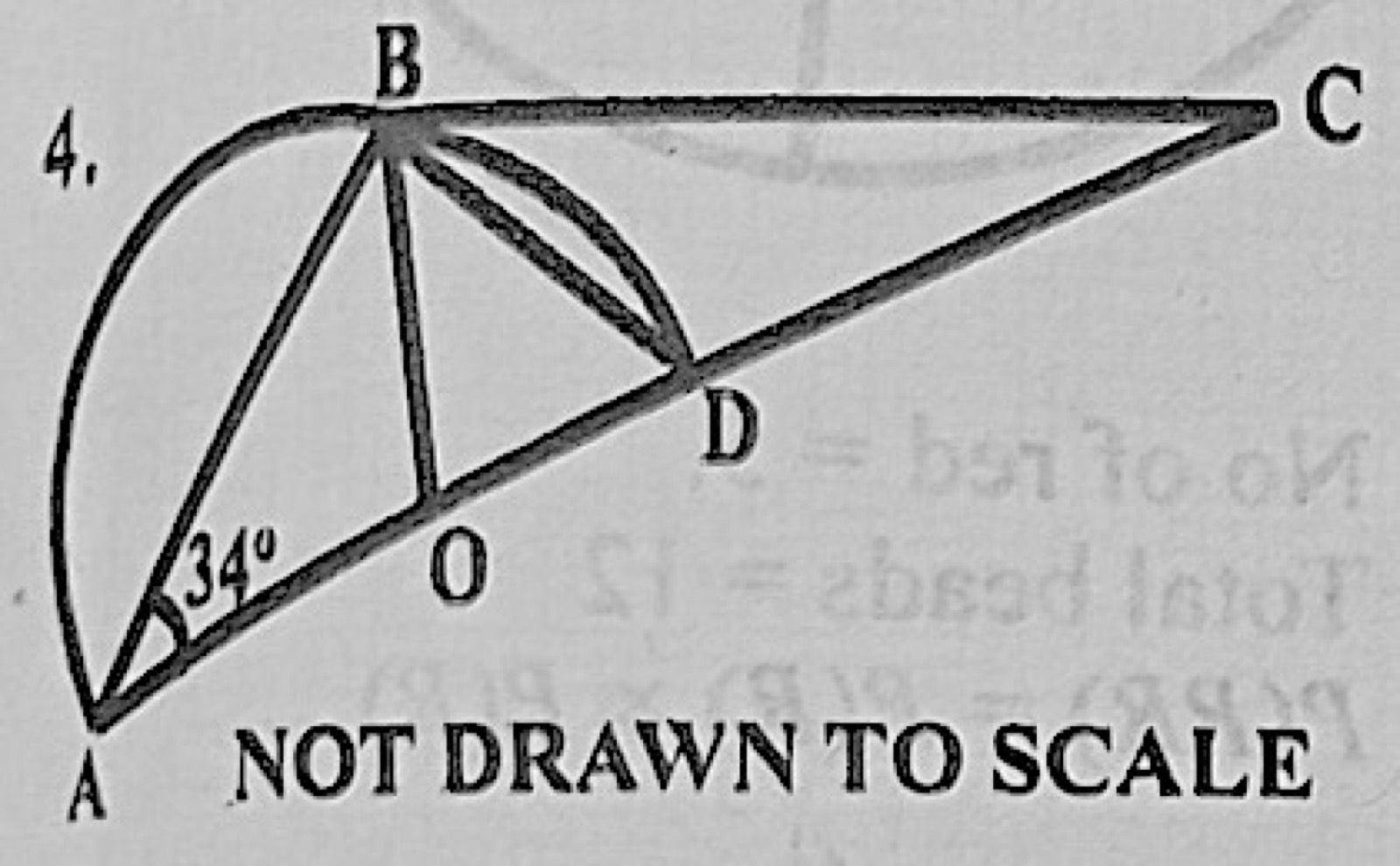
In the diagram, AD is a diameter of a circle with centre O. If ABD is a triangle in a semi-circle and ∠OAB = 34°, find: (a) ∠OBD; (b) ∠OCB.

Diagram for this question
Show the model answer
Model answer

(a) OA = OB (radii) → ∠OBA = 34°
∠ABD = 90° (angle in a semicircle)
∠OBD = 90° − 34° = 56°
(b) BC touches the circle at B, so ∠OBC = 90° (radius ⊥ tangent)
∠BOC = 34° + 34° = 68° (exterior angle of ΔOAB)
∠OCB = 180° − 90° − 68° = 22°

Explanation

Look for the isosceles triangle made by two radii.

Open this question

Theory question 105

Data Presentation

(a) A man shared his property among his children as follows:
Child's name: Ann, Afia, Kojo, Nuno, Akosua
Percentage share: 5, 15, 10, 45, 25
Represent the information on a pie chart.
(b) A box contains 5 red, 3 green and 4 blue identical beads. Calculate the probability that a girl takes away two red beads, one after the other, from the box.

Show the model answer
Model answer

(a) Angles = percentage × 3.6°: Ann 18°, Afia 54°, Kojo 36°, Nuno 162°, Akosua 90° (total 360°)
Draw the circle, measure each sector with a protractor and label it
(b) 12 beads, taken without replacement:
P(red, red) = 5/12 × 4/11 = 20/132 = 5/33

Explanation

Taking beads away one after the other means without replacement.

Open this question

Theory question 106

Sets

(a) In a class of 80 students, ¾ study Biology and ⅗ study Physics. If each student studies at least one of the subjects: (i) draw a venn diagram to represent this information; (ii) how many students study both subjects; (iii) find the fraction of the class that study Biology but not Physics.
(b) Johnson and Jocatol Ltd. owned a business office with floor measuring 15 m by 8 m which was to be carpeted. The cost of carpeting was GH¢ 890.00 per square metre. If a total of GH¢ 216,120.00 was spent on painting and carpeting, how much was the cost of painting?

Show the model answer
Model answer

(a) n(B) = 60, n(P) = 48, n(U) = 80
(i) Two overlapping circles B and P with regions 60 − x, x, 48 − x and nothing outside
(ii) 60 − x + x + 48 − x = 80 → x = 28
(iii) Biology only = 60 − 28 = 32; fraction = 32/80 = 2/5
(b) Floor area = 15 × 8 = 120 m2; carpeting = 120 × 890 = GH¢106,800
Painting = 216,120 − 106,800 = GH¢109,320

Explanation

Every student is in at least one circle, so nothing goes outside the circles.

Open this question

Theory question 107

Graphs of Functions

(a) Copy and complete the table of values for the relation y = 2x2 − x − 2 for −4 ≤ x ≤ 4.
x: −4, −3, −2, −1, 0, 1, 2, 3, 4
y: __, 19, __, __, −2, __, __, __, 26
(b) Using a scale of 2 cm to 1 unit on the x-axis and 2 cm to 5 units on the y-axis, draw the graph of y = 2x2 − x − 2 for −4 ≤ x ≤ 4.
(c) On the same axis, draw the graph of y = 2x + 3.
(d) Use the graph to find the: (i) roots of the equation 2x2 − 3x − 5 = 0; (ii) range of values of x for which 2x2 − x − 2 < 0.

Show the model answer
Model answer

(a) y = 34, 19, 8, 1, −2, −1, 4, 13, 26
(b) Plot the points and draw a smooth U-shaped curve
(c) Straight line through e.g. (−4, −5), (0, 3), (4, 11)
(d)(i) 2x2 − 3x − 5 = 0 is where the curve meets y = 2x + 3: x = −1 and x = 2.5
(ii) The curve is below the x-axis between its x-intercepts: about −0.8 < x < 1.3

Explanation

Subtracting 2x + 3 from the curve's equation gives 2x2 − 3x − 5, so the intersections give its roots.

Open this question

Theory question 108

Mensuration of Plane Shapes

(a) In ΔPQR, ∠PQR = 90°. If its area is 216 cm2 and |PQ| : |QR| is 3 : 4, find |PR|.
(b) The present ages of a man and his son are 47 years and 17 years respectively. In how many years would the man's age be twice that of his son?

Show the model answer
Model answer

(a) Let PQ = 3k, QR = 4k: ½ × 3k × 4k = 216 → 6k2 = 216 → k = 6
PQ = 18 cm, QR = 24 cm
|PR| = √(182 + 242) = 30 cm
(b) 47 + n = 2(17 + n) → 47 + n = 34 + 2n
n = 13 years

Explanation

The right angle is at Q, so PQ and QR are the base and height.

Open this question

Theory question 109

Mensuration of Plane Shapes

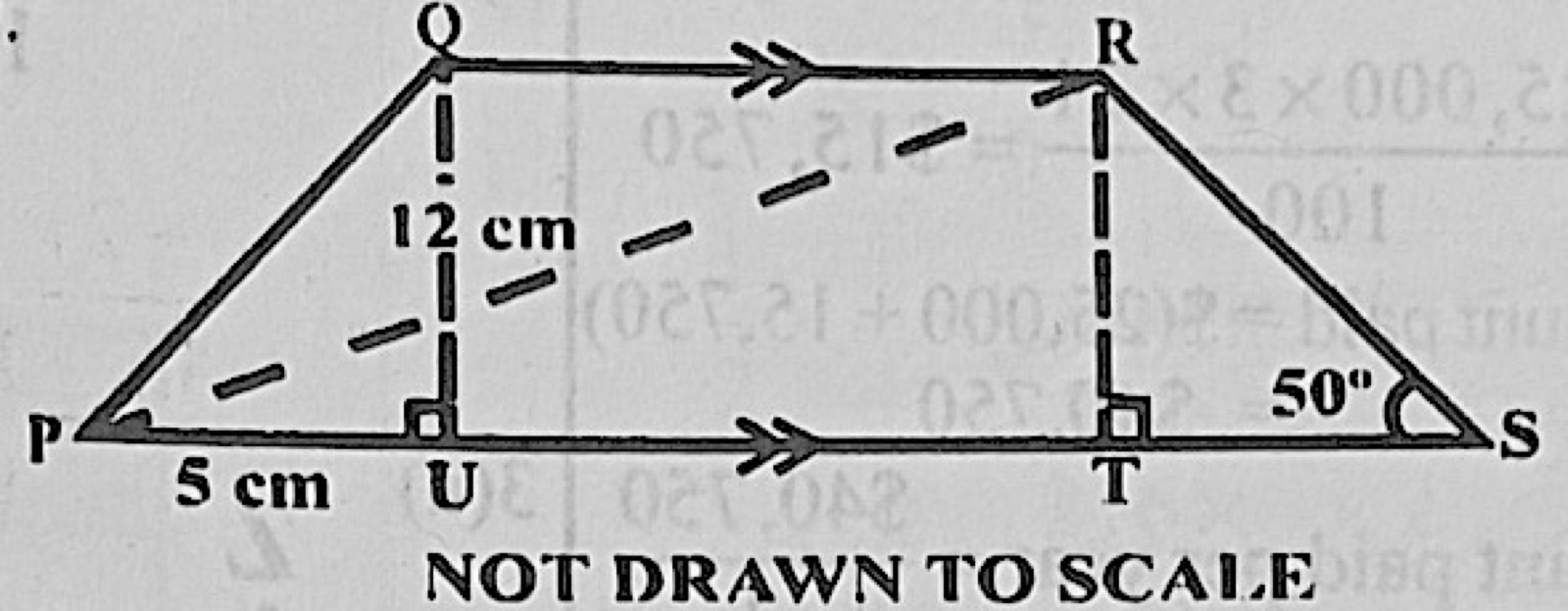
In the diagram, PQRS is a trapezium with QR ∥ PS. U and T are points on PS such that |PU| = 5 cm, |QU| = 12 cm and ∠PUQ = ∠STR = 90°. If the area of ΔPQR = 20 cm2, calculate, correct to the nearest whole number, the: (a) perimeter; (b) area; of the trapezium.

Diagram for this question
Show the model answer
Model answer

Area ΔPQR = ½ × |QR| × 12 = 20 → |QR| = 10/3 ≈ 3.33 cm
|PQ| = √(52 + 122) = 13 cm; |RT| = 12 cm and ∠RST = 50° (from the diagram)
|RS| = 12/sin 50° ≈ 15.66 cm; |TS| = 12/tan 50° ≈ 10.07 cm
|PS| = 5 + 3.33 + 10.07 ≈ 18.40 cm
(a) Perimeter = 13 + 3.33 + 15.66 + 18.40 ≈ 50 cm
(b) Area = ½(3.33 + 18.40) × 12 ≈ 130 cm2

Explanation

The height of ΔPQR on base QR is the same 12 cm as the trapezium's height.

Open this question

Theory question 110

Bearings

(a) A cottage is on a bearing of 200° and 110° from Dogbe's and Manu's farms respectively. If Dogbe walked 5 km and Manu 3 km from the cottage to their farms, find, correct to: (i) two significant figures, the distance between the two farms; (ii) the nearest degree, the bearing of Manu's farm from Dogbe's.
(b) A ladder 10 m long leaned against a vertical wall x m high. The distance between the wall and the foot of the ladder is 2 m longer than the height of the wall. Calculate the value of x.

Show the model answer
Model answer

(a) From the cottage, Dogbe's farm is on 020° (5 km) and Manu's on 290° (3 km); the angle between them = 290° − 20° = 270°, i.e. 90°
(i) Distance = √(52 + 32) = √34 ≈ 5.8 km
(ii) At Dogbe's farm, tan θ = 3/5 → θ ≈ 31.0°; bearing of Manu's farm = 200° + 31° ≈ 231°
(b) x2 + (x + 2)2 = 102 → 2x2 + 4x − 96 = 0 → x2 + 2x − 48 = 0
(x + 8)(x − 6) = 0 → x = 6 (length must be positive)

Explanation

Turn each bearing round by 180° to get the direction from the cottage to each farm.

Open this question

Theory question 111

Measures of Dispersion

The table shows the distribution of the number of hours per day spent in studying by 50 students.
Number of hours per day: 4, 5, 6, 7, 8, 9, 10, 11
Number of students: 5, 7, 5, 9, 12, 4, 3, 5
Calculate, correct to two decimal places, the: (a) mean; (b) standard deviation.

Show the model answer
Model answer

(a) Σfx = 20 + 35 + 30 + 63 + 96 + 36 + 30 + 55 = 365
Mean = 365/50 = 7.30
(b) Σfx2 = 2873; variance = 2873/50 − 7.32 = 57.46 − 53.29 = 4.17
Standard deviation = √4.17 ≈ 2.04

Explanation

Use either Σf(x − mean)2 or Σfx2/Σf − mean2; both give 4.17.

Open this question

Theory question 112

Circle Theorems

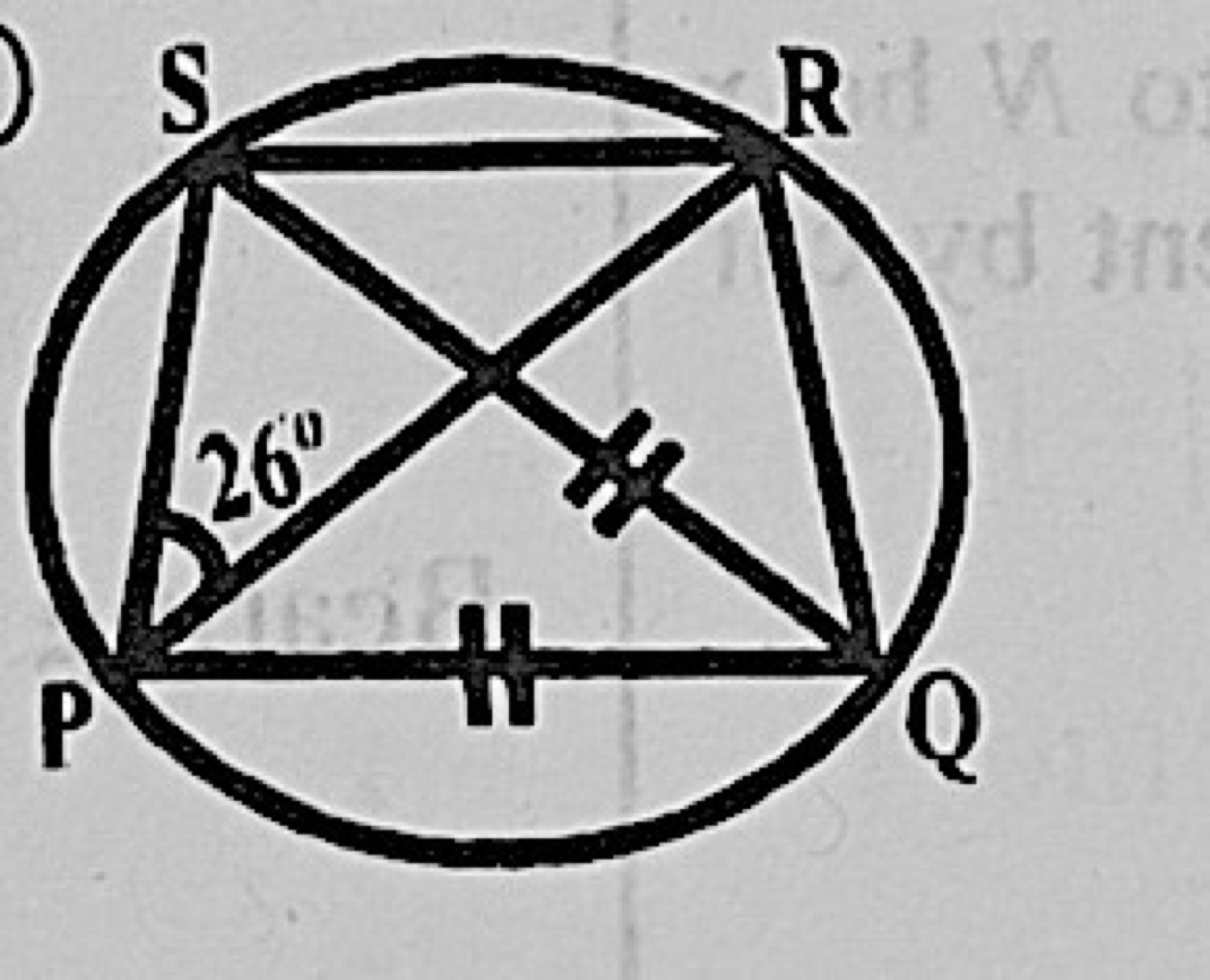
(a) In the diagram, PQRS is a circle. |PQ| = |QS|, ∠SPR = 26° and the interior angles of ΔPQS are in the ratio 2 : 3 : 3. Calculate: (i) ∠PQR; (ii) ∠RPQ; (iii) ∠PRQ.
(b) The coordinates of two points P and Q in a plane are (7, 3) and (5, x) respectively, where x is a real number. If |PQ| = √29 units, find the value of x.

Diagram for this question
Show the model answer
Model answer

(a) Angles of ΔPQS: 2/8 × 180° = 45° at Q; 67.5° at P and at S (equal sides PQ = QS)
(i) ∠SQR = ∠SPR = 26° (same segment); ∠PQR = 45° + 26° = 71°
(ii) ∠RPQ = ∠SPQ − ∠SPR = 67.5° − 26° = 41.5°
(iii) ∠PRQ = 180° − 71° − 41.5° = 67.5°
(b) (5 − 7)2 + (x − 3)2 = 29 → (x − 3)2 = 25
x − 3 = ±5 → x = 8 or x = −2

Explanation

The angle 45° is at Q, opposite the base PS of the isosceles triangle.

Open this question

Theory question 113

Commercial Arithmetic

(a) On Sam's first birthday celebration, his grandfather deposited an amount of $1,000.00 in a bank compounded at 4% interest annually. Find how much is in the account if Sam is 4 years old.
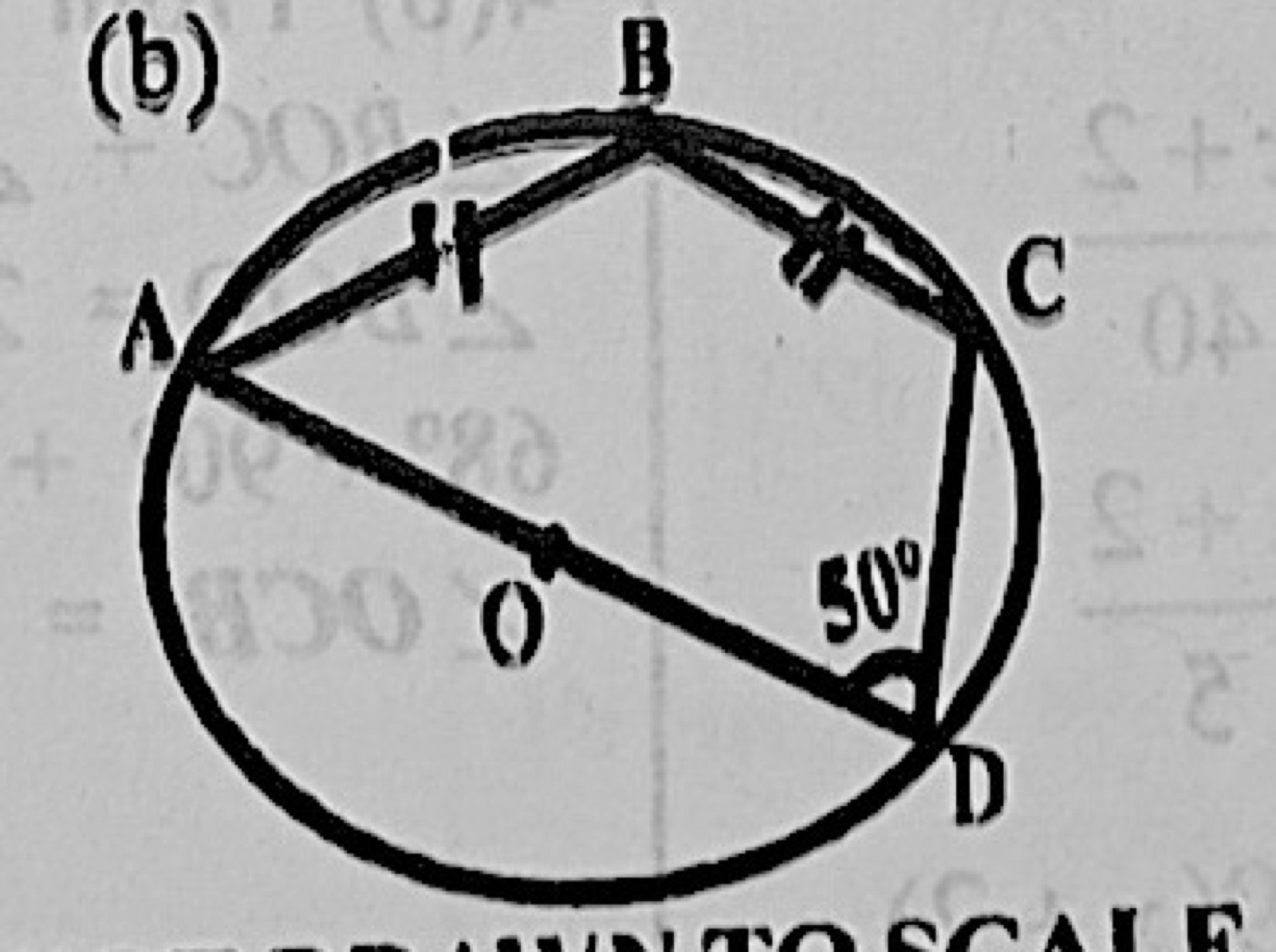
(b) In the diagram, ABCD are points on the circle centre O. If |AB| = |BC| and ∠ADC = 50°, find ∠BAD.

Diagram for this question
Show the model answer
Model answer

(a) From age 1 to age 4 is 3 years
Amount = 1,000 × (1.04)3 = $1,124.86
(b) ∠ABC = 180° − 50° = 130° (opposite angles of cyclic quadrilateral)
AB = BC → ∠BAC = (180° − 130°)/2 = 25°
AD is a diameter → ∠ACD = 90°, so ∠CAD = 180° − 90° − 50° = 40°
∠BAD = 25° + 40° = 65°

Explanation

Count the years from the first birthday, not from birth.
Open this question