Question 1
Fractions, Decimals and ApproximationSimplify: 10⅖ − 6⅔ + 3.
- A.6 4/15
- B.6 11/15
- C.7 4/15
- D.7 11/15
Show the answer and explanation
Answer: B (6 11/15)
Explanation
52/5 − 20/3 + 3 = (156 − 100 + 45)/15 = 101/15 = 6 11/15.
60 questions. Try each one, then open the answer to check yourself and read the explanation.
Simplify: 10⅖ − 6⅔ + 3.
Answer: B (6 11/15)
52/5 − 20/3 + 3 = (156 − 100 + 45)/15 = 101/15 = 6 11/15.
If 23x = 325, find the value of x.
Answer: A (7)
2x + 3 = 3 × 5 + 2 = 17, so 2x = 14 and x = 7.
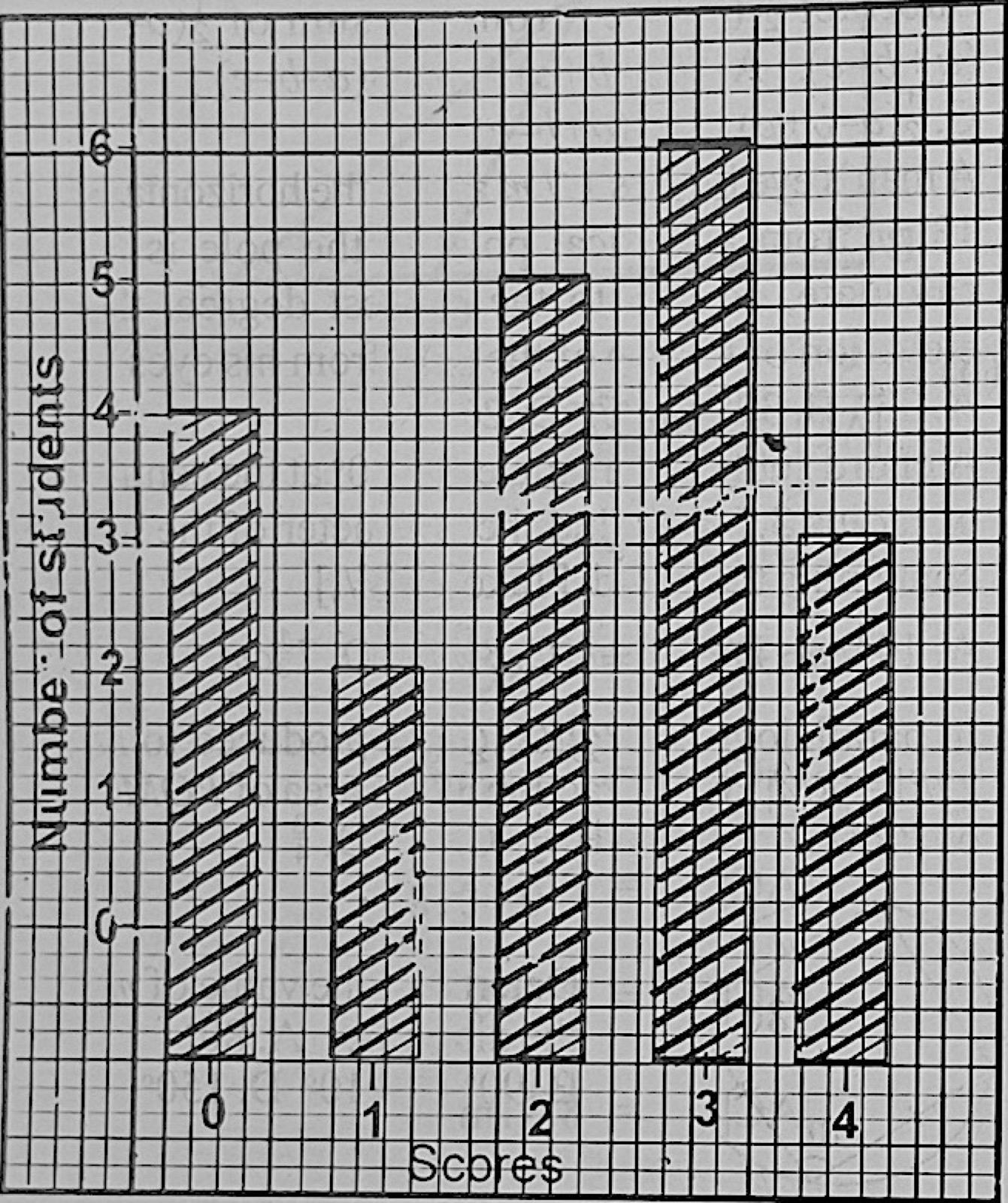
The bar chart shows the scores of some students in a test. How many students took the test?
Answer: C (20)
Add the bar heights for scores 0 to 4: 4 + 2 + 5 + 6 + 3 = 20.
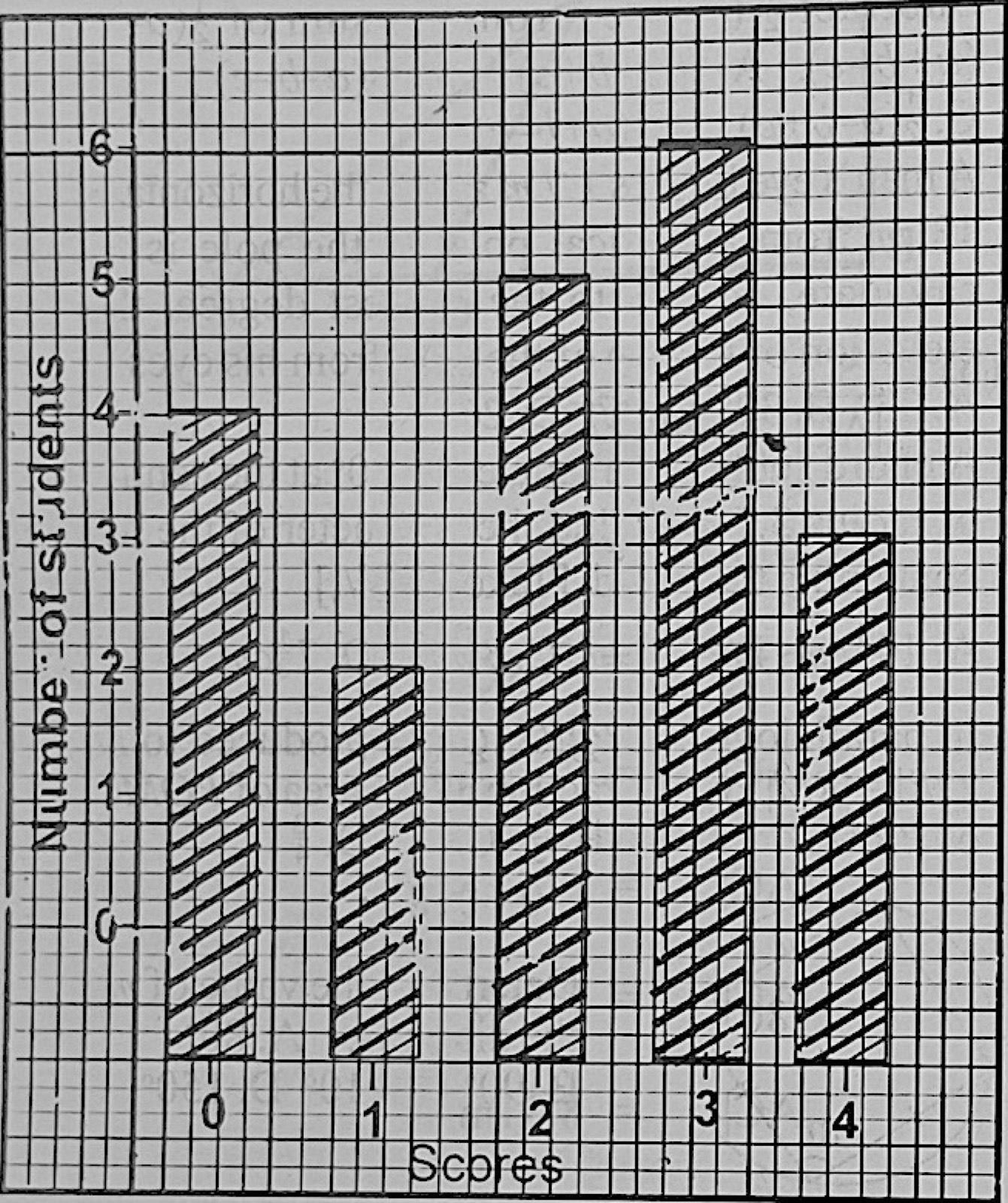
The bar chart shows the scores of some students in a test. If one student is selected at random, find the probability that he/she scored at most 2 marks.
Answer: B (11/20)
Scores 0, 1 or 2: 4 + 2 + 5 = 11 of the 20 students, so the probability is 11/20.
Simplify: √12(√48 − √3).
Answer: A (18)
√12 = 2√3 and √48 − √3 = 4√3 − √3 = 3√3. 2√3 × 3√3 = 18.
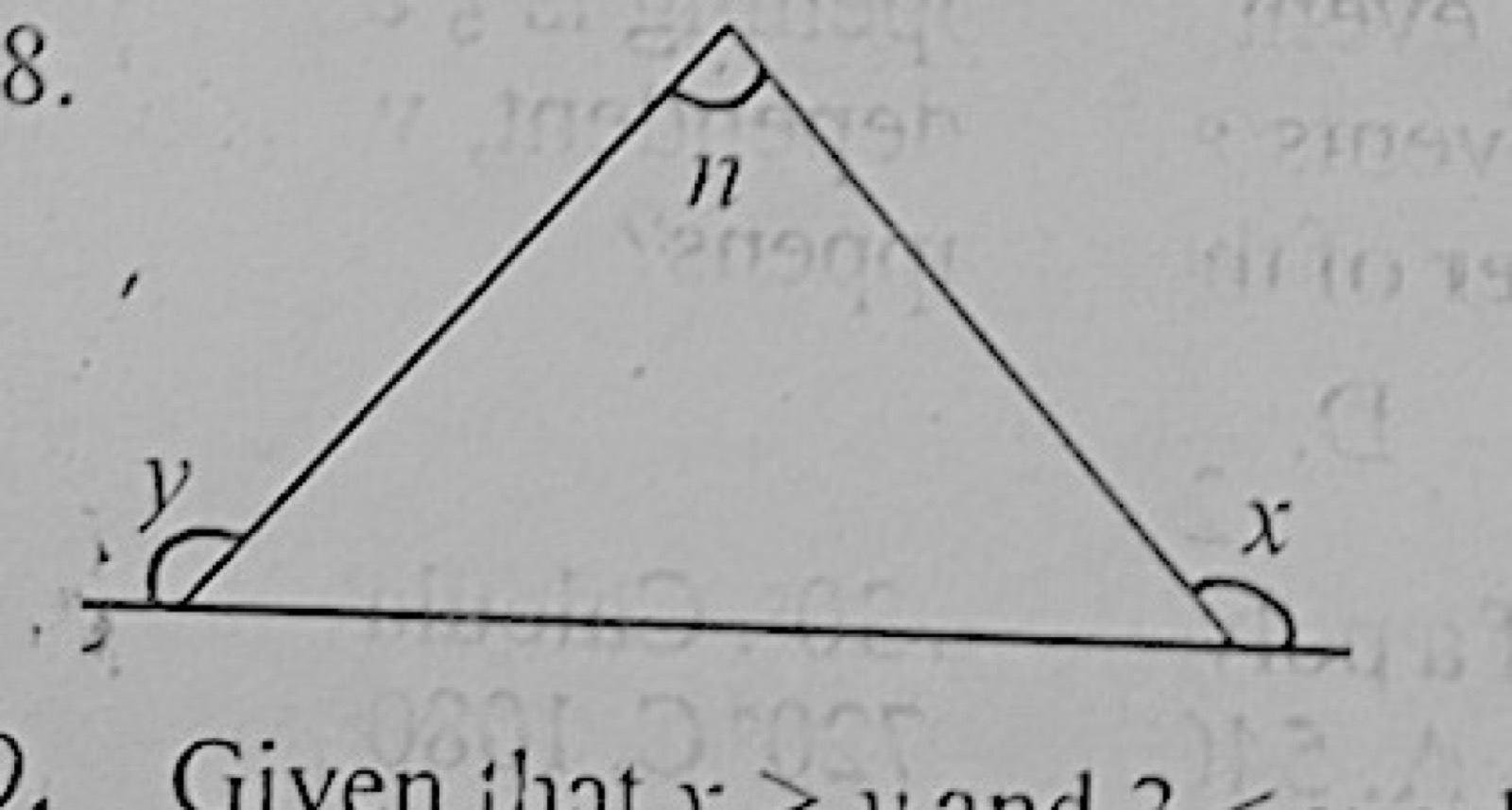
In the diagram, the value of x + y = 220°. Find the value of n.
Answer: B (40°)
x and y are exterior angles at the base. The interior base angles are 180° − x and 180° − y, which add to 360° − 220° = 140°. So n = 180° − 140° = 40°.
Given that x > y and 3 < y, which of the following is/are true?
I. y > 3
II. x < 3
III. x > y > 3
Answer: C (I and III only)
3 < y means y > 3 (I), and x > y > 3 (III). Then x > 3, so II is false.
Three quarters of a number added to two and a half of that number gives 13. Find the missing number.
Answer: A (4)
¾n + 2½n = 13 gives (13/4)n = 13, so n = 4.
If X = {0, 2, 4, 6}, Y = {1, 2, 3, 4} and Z = {1, 3} are subsets of U = {x: 0 ≤ x ≤ 6}, find X ∩ (Y′ ∪ Z).
Answer: C ({0, 6})
Y′ = {0, 5, 6}, so Y′ ∪ Z = {0, 1, 3, 5, 6}. The elements of X in it are 0 and 6.
Find the truth set of the equation x2 = 3(2x + 9).
Answer: D ({x : x = −3, x = 9})
x2 − 6x − 27 = 0 factorises as (x − 9)(x + 3) = 0, so x = 9 or x = −3.
The coordinates of points P and Q are (4,3) and (2, −1) respectively. Find the shortest distance between P and Q.
Answer: D (2√5)
|PQ| = √((4 − 2)2 + (3 + 1)2) = √(4 + 16) = √20 = 2√5.
Make u the subject of the formula, E = (m/2g)(v2 − u2).
Answer: A (u = √(v2 − 2Eg/m))
2gE = m(v2 − u2), so v2 − u2 = 2Eg/m and u = √(v2 − 2Eg/m).
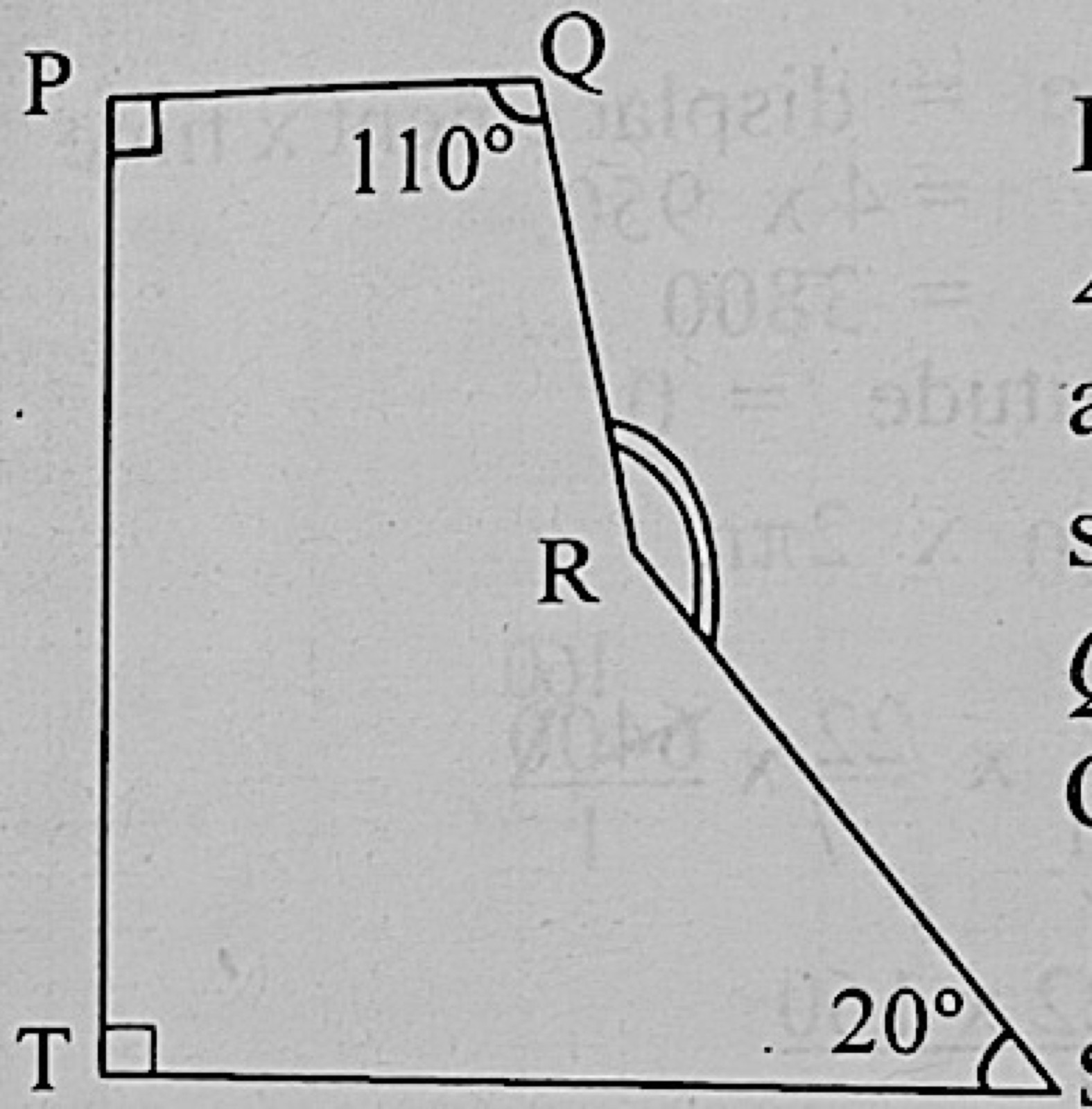
In the diagram, ∠QPT = ∠PTS = 90°, ∠PQR = 110° and ∠TSR = 20°. Find the size of the obtuse angle QRS.
Answer: B (130°)
PQRST is a pentagon, so its angles add to 540°: the reflex angle at R = 540° − 90° − 90° − 110° − 20° = 230°. The obtuse angle QRS = 360° − 230° = 130°.
If x varies inversely as y and y varies directly as z, what is the relationship between x and z?
Answer: B (x ∝ 1/z)
x = k/y and y = cz, so x = k/(cz): x varies inversely as z.
Find the gradient of the line joining the points (2, −3) and (2, 5).
Answer: D (undefined.)
Gradient = (5 + 3)/(2 − 2) = 8/0, which is undefined (the line is vertical).
If (x − a) is a factor of bx − ax + x2 − ab, find the other factor.
Answer: A ((x + b))
x2 + bx − ax − ab = x(x + b) − a(x + b) = (x − a)(x + b).
The table shows the distribution of the height of plants in a nursery.
Height: 2, 3, 4, 5, 6
Frequency: 2, 4, 5, 3, 1
Calculate the mean height of the plants.
Answer: A (3.8)
Σfx = 4 + 12 + 20 + 15 + 6 = 57 and Σf = 15. Mean = 57/15 = 3.8.
In the diagram, PQR is a straight line, (m + n) = 120° and (n + r) = 100°. Find (m + r).
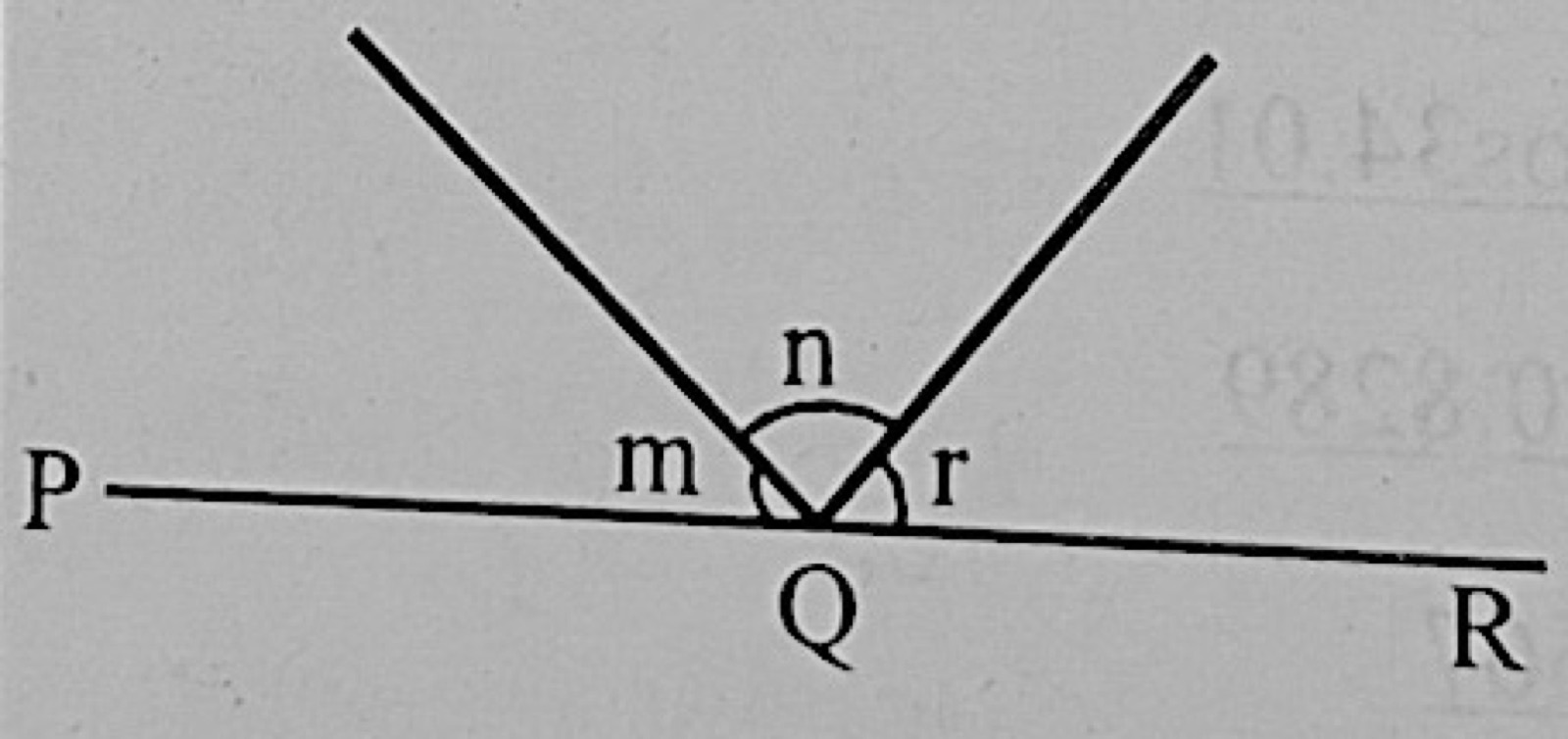
Answer: C (140°)
m + n + r = 180°. Adding the two given sums: m + 2n + r = 220°, so n = 40° and m + r = 140°.
In the diagram, SR is parallel to UW, ∠WVT = x°, ∠VUT = y°, ∠RSV = 45° and ∠VTU = 20°. Find the value of x.
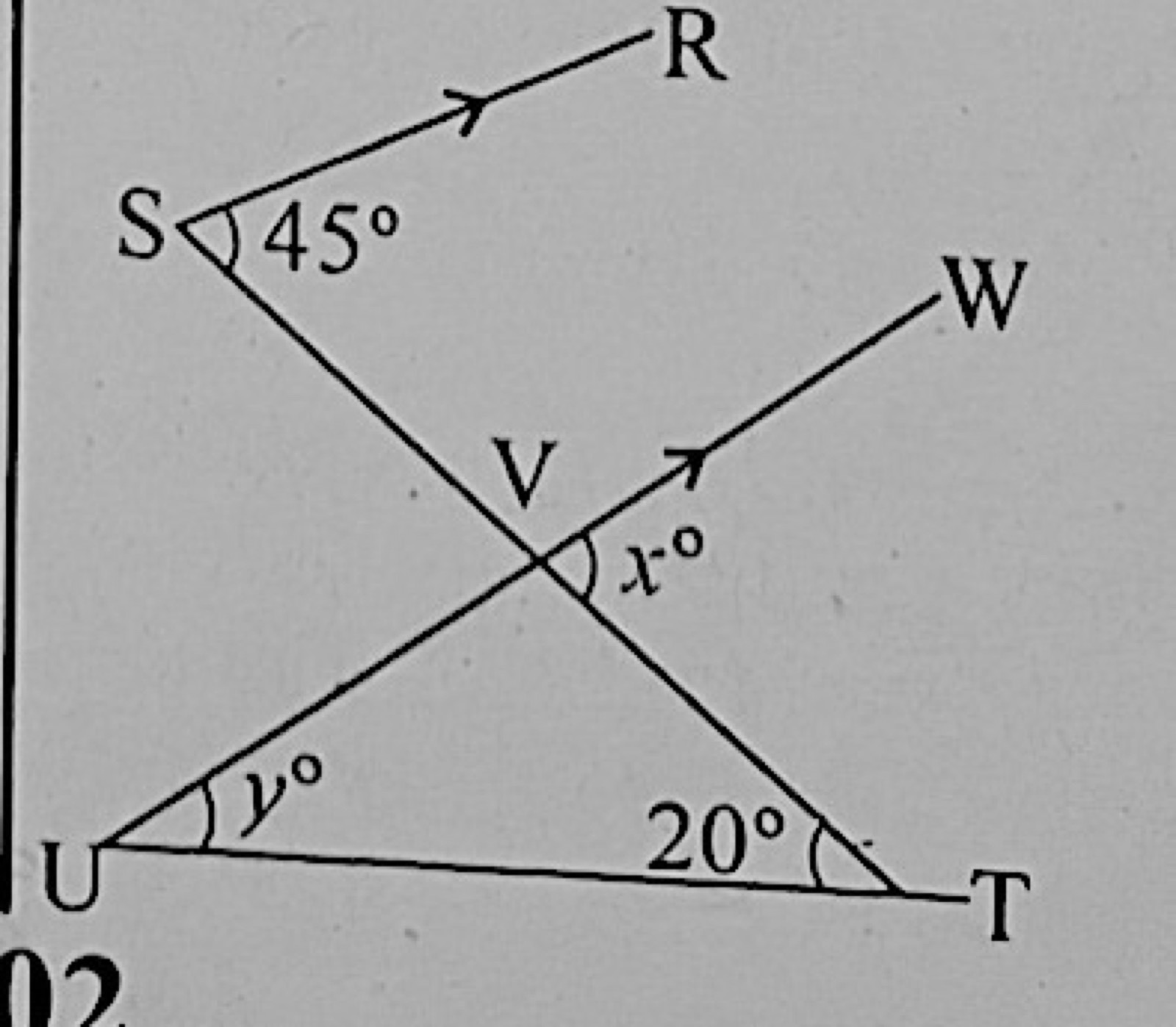
Answer: B (45)
SVT is a straight line crossing the parallel lines SR and UW, so x equals the corresponding angle ∠RSV = 45°.
In the diagram, SR is parallel to UW, ∠WVT = x°, ∠VUT = y°, ∠RSV = 45° and ∠VTU = 20°. Calculate the value of y.
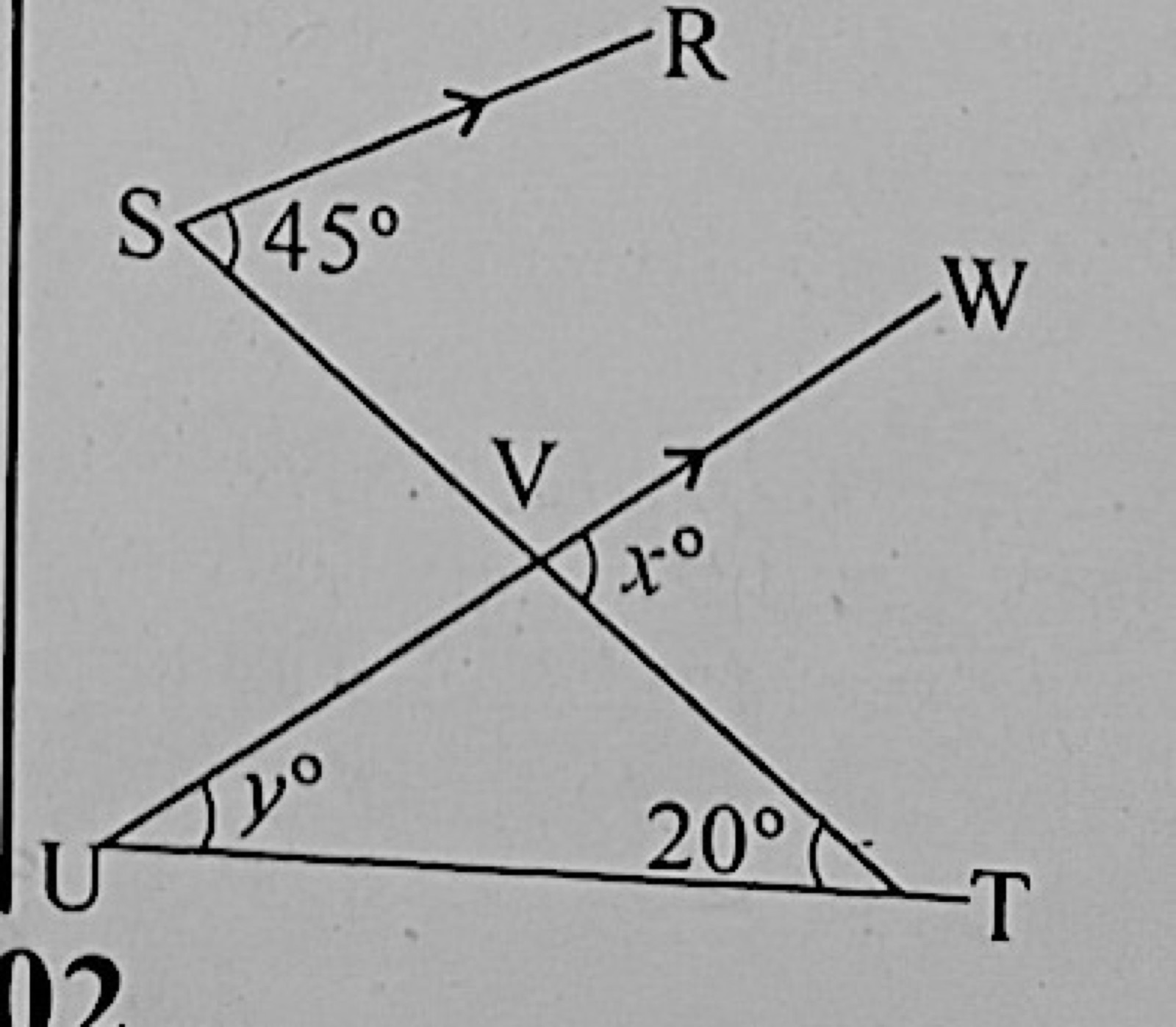
Answer: B (25)
x = 45° is an exterior angle of triangle VUT, so x = y + 20°. Hence y = 25.
The area of a sector of a circle with diameter 12 cm is 66 cm2. If the sector is folded to form a cone, calculate the radius of the base of the cone. [Take π = 22/7]
Answer: B (3.5 cm)
The sector's radius 6 cm becomes the slant height. The cone's curved area πrl = 66, so 22/7 × r × 6 = 66 and r = 3.5 cm.
A chord, 7 cm long, is drawn in a circle with radius 3.7 cm. Calculate the distance of the chord from the centre of the circle.
Answer: B (1.2 cm)
Half the chord is 3.5 cm. Distance = √(3.72 − 3.52) = √1.44 = 1.2 cm.
Which of the following is a measure of dispersion?
Answer: A (Range)
The range measures how spread out the data are; the others describe positions in the data.
A box contains 13 currency notes, all of which are either ₦50 or ₦20 notes. The total value of the currency notes is ₦530. How many ₦50 notes are in the box?
Answer: D (9)
50x + 20(13 − x) = 530 gives 30x + 260 = 530, so x = 9.
The graph is for the relation y = 2x2 + x − 1. What are the coordinates of the point S?
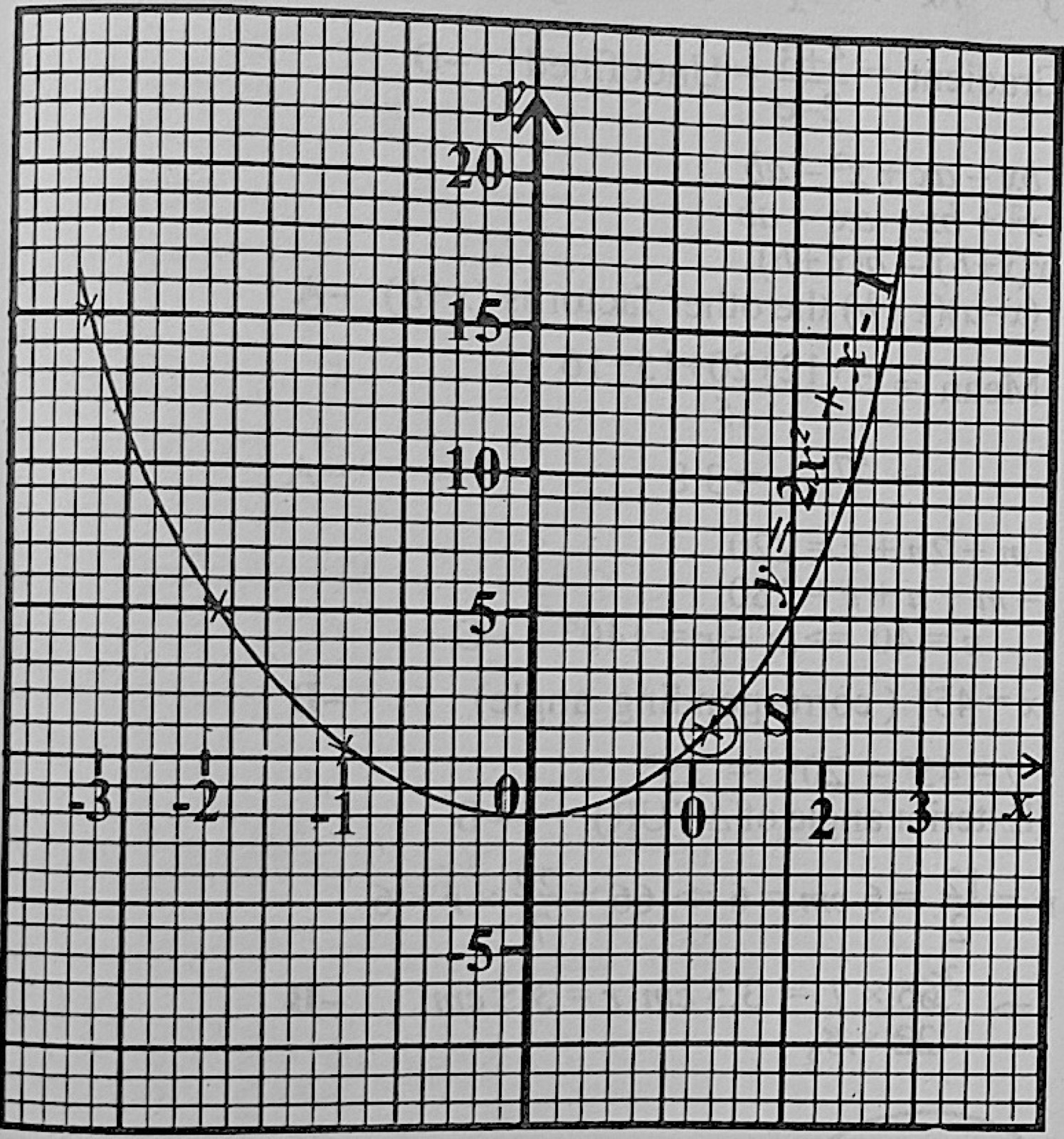
Answer: C ((1, 2.0))
All options have x = 1. On the curve, y = 2(1)2 + 1 − 1 = 2, so S is (1, 2.0).
A ship sails x km due east to a point E and continues x km due north to F. Find the bearing of F from the starting point.
Answer: A (045°)
Equal distances east and north make a 45° angle with north, so the bearing is 045°.
If x : y = 3 : 2 and y : z = 5 : 4, find the value of x in the ratio x : y : z.
Answer: C (15)
Make y equal: x : y = 15 : 10 and y : z = 10 : 8, so x : y : z = 15 : 10 : 8 and x = 15.
A trader bought sachet water for GH¢ 55.00 per dozen and sold them at 10 for GH¢ 50.00. Calculate, correct to 2 decimal places, his percentage gain.
Answer: C (9.09%)
Cost per sachet = 55/12 ≈ GH¢4.583; selling price = GH¢5.00. Gain = 0.417/4.583 × 100% ≈ 9.09%.
In the figure, PQ is a tangent to the circle at R and UT is parallel to PQ. If ∠TRQ = x°, find ∠URT in terms of x.
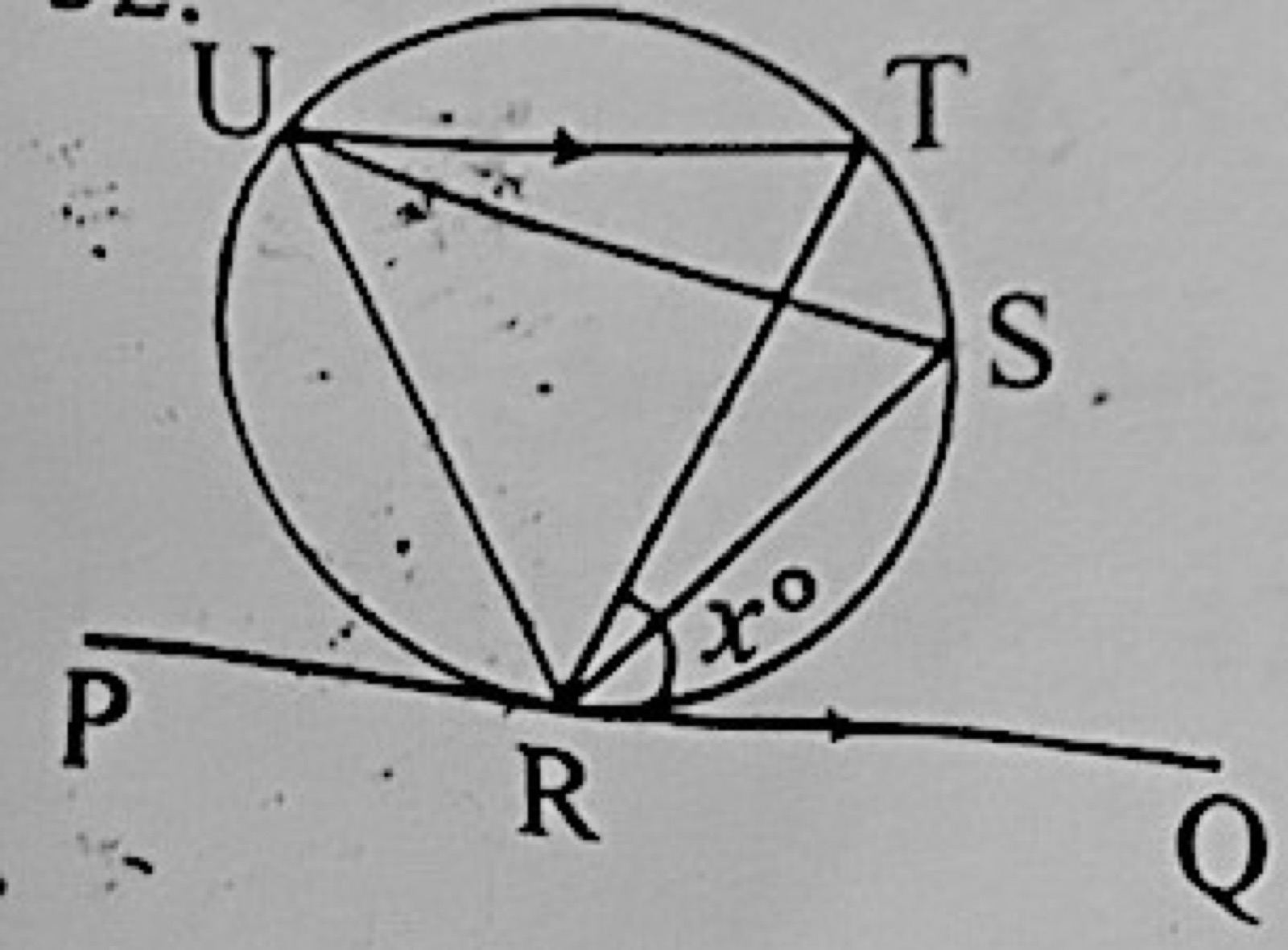
Answer: D ((180 − 2x)°)
UT ∥ PQ gives ∠UTR = ∠TRQ = x (alternate). The alternate segment theorem gives ∠TUR = ∠TRQ = x. So ∠URT = 180° − 2x.
Given that cos x = 12/13, evaluate (1 − tan x)/tan x.
Answer: C (7/5)
tan x = 5/12, so (1 − 5/12)/(5/12) = (7/12) × (12/5) = 7/5.
Approximate 0.0033780 to 3 significant figures.
Answer: C (0.00338)
The significant figures start at 3: 3, 3, 7, and the next digit 8 rounds the 7 up, giving 0.00338.
Simplify: √((82 × 4n+1)/(22n × 16))
Answer: C (4)
In powers of 2: (26 × 22n+2)/(22n × 24) = 24 = 16, and √16 = 4.
If 2/(x − 3) − 3/(x − 2) is equal to P/((x − 3)(x − 2)), find P.
Answer: D (5 − x)
2(x − 2) − 3(x − 3) = 2x − 4 − 3x + 9 = 5 − x.
Subtract ½(a − b − c) from the sum of ½(a − b + c) and ½(a + b − c).
Answer: A (½(a + b + c))
The sum is ½(2a) = a. Then a − ½(a − b − c) = ½(a + b + c).
A man's eye level is 1.7 m above the horizontal ground and 13 m from a vertical pole. If the pole is 8.3 m high, calculate, correct to the nearest degree, the angle of elevation of the top of the pole from his eyes.
Answer: C (27°)
The top is 8.3 − 1.7 = 6.6 m above eye level. tan θ = 6.6/13 ≈ 0.5077, so θ ≈ 27°.
A chord subtends an angle of 120° at the centre of a circle of radius 3.5 cm. Find the perimeter of the minor sector containing the chord. [Take π = 22/7].
Answer: A (14⅓ cm)
Arc = 120/360 × 2 × 22/7 × 3.5 = 22/3 cm. Perimeter = 22/3 + 3.5 + 3.5 = 14⅓ cm.
In parallelogram, PQRS, QR is produced to M such that |QR| = |RM|. What fraction of the area of PQMS is the area of PRMS?
Answer: C (2/3)
With base QR = b and height h: PQMS is a trapezium of area ½(b + 2b)h = 1.5bh. PRMS is a parallelogram (RM = PS and RM ∥ PS) of area bh. bh ÷ 1.5bh = 2/3.
Determine the value of m in the diagram.
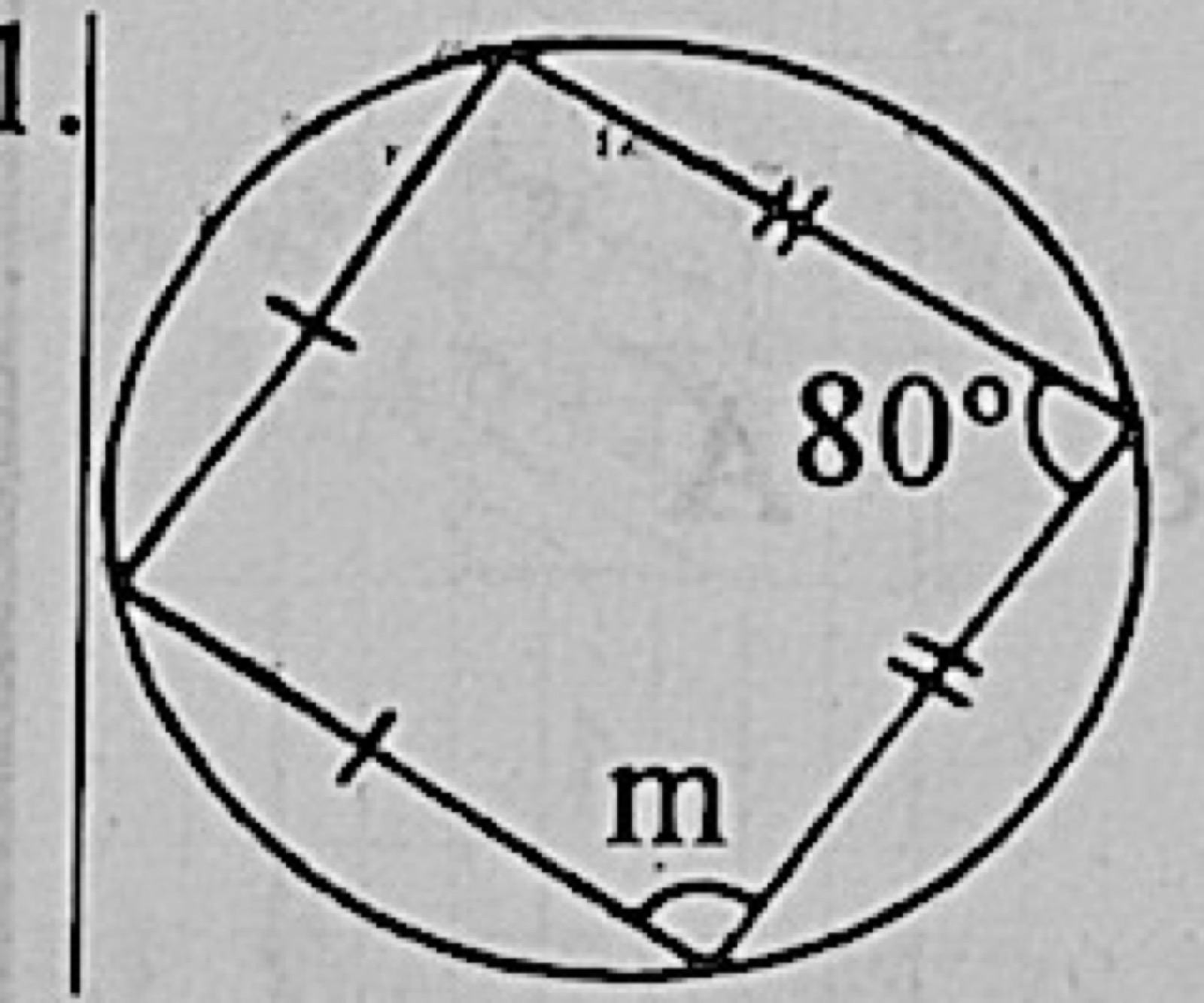
Answer: B (90°)
The marked sides make the cyclic quadrilateral a kite symmetric about the diagonal through the 80° angle, so the angle opposite m equals m. Opposite angles of a cyclic quadrilateral add to 180°, so 2m = 180° and m = 90°.
In a cumulative frequency graph, the lower quartile is 18 years while the 60th percentile is 48 years. What percentage of the distribution is at most 18 years or greater than 48 years.
Answer: C (65%)
25% are at most 18 (lower quartile) and 100% − 60% = 40% are above 48. Total 65%.
If a number is selected at random from each of the sets P = {1, 2, 3} and Q = {2, 3, 5}, find the probability that the sum of the numbers is prime.
Answer: B (4/9)
The 9 sums are 3, 4, 6, 4, 5, 7, 5, 6, 8. The primes are 3, 5, 7 and 5, so the probability is 4/9.
In the diagram, O is the centre of the circle, PR is a tangent to the circle at Q and ∠SOQ = 86°. Calculate the value of ∠SQR.
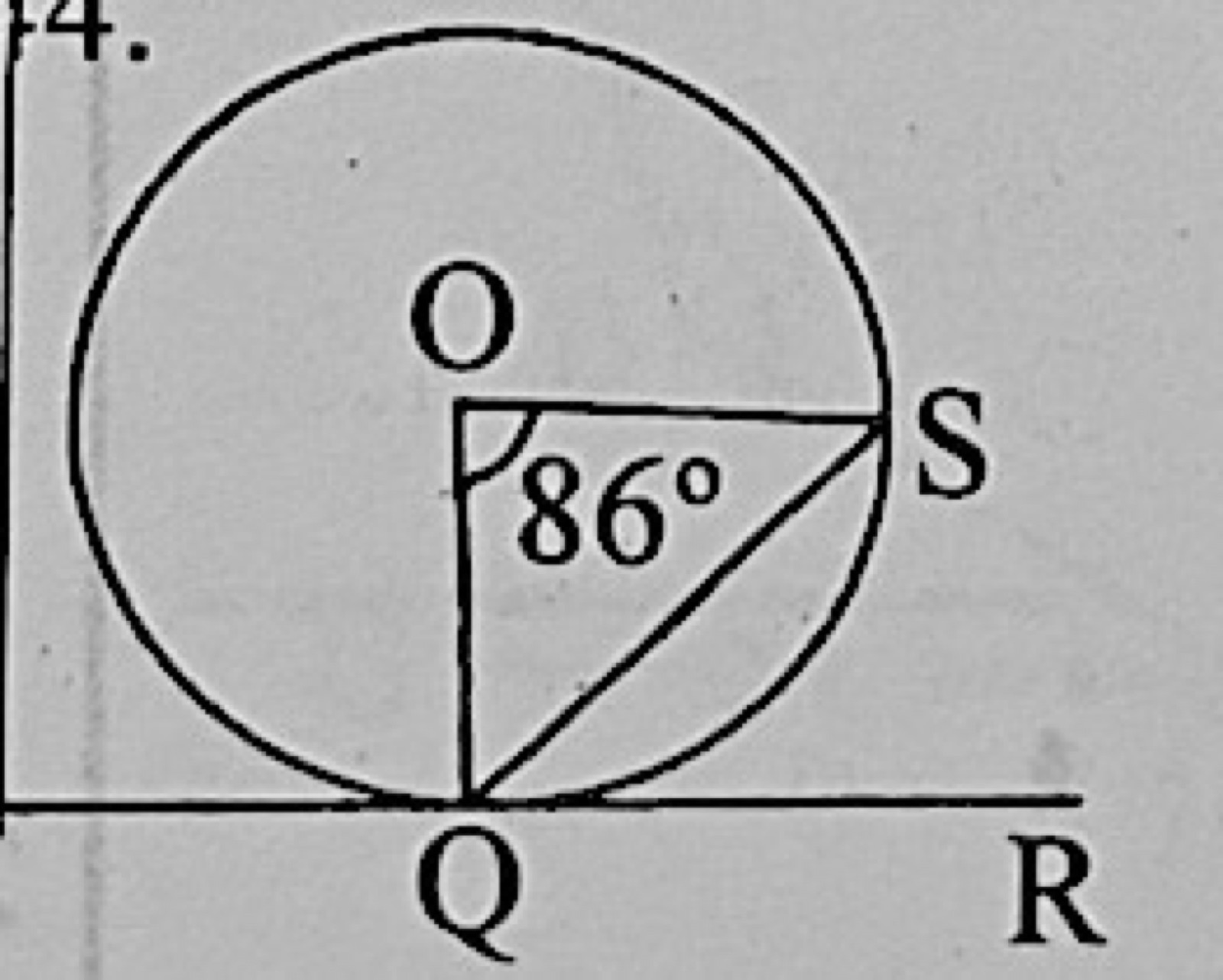
Answer: A (43°)
OS = OQ, so ∠OQS = (180° − 86°)/2 = 47°. The radius OQ is perpendicular to the tangent, so ∠SQR = 90° − 47° = 43°.
If log 5.957 = 0.7750, find log ∛0.0005957.
Answer: B (2̄.9250)
log 0.0005957 = 4̄.7750 = −3.225. Divide by 3: −1.075 = 2̄.9250.
The probability of an event P happening is 1/5 and that of event Q is 1/4. If the events are independent, what is the probability that neither of them happens?
Answer: C (3/5)
P(neither) = (1 − 1/5)(1 − 1/4) = 4/5 × 3/4 = 3/5.
Each exterior angle of a polygon is 30°. Calculate the sum of the interior angles.
Answer: D (1800°)
n = 360 ÷ 30 = 12 sides. Sum = (12 − 2) × 180° = 1800°.
Find the number of terms in the Arithmetic Progression (A.P.) 2, −9, −20, …, −141.
Answer: D (14)
a = 2, d = −11: 2 + (n − 1)(−11) = −141, so n − 1 = 13 and n = 14.
In what modulus is it true that 9 + 8 = 5?
Answer: C (mod 12)
9 + 8 = 17 and 17 − 12 = 5, so 17 ≡ 5 (mod 12).
The radii of the base of two cylindrical tins, P and Q are r and 2r respectively. If the water level in P is 10 cm high, what would be the height of the same quantity of water in Q?
Answer: A (2.5 cm)
πr2 × 10 = π(2r)2 × h = 4πr2h, so h = 10/4 = 2.5 cm.
(a) Without using tables or calculator, simplify: (0.6 × 32 × 0.004)/(1.2 × 0.008 × 0.16) leaving the answer in standard form (scientific notation).
(b) In the diagram, EF is parallel to GH. If ∠AEF = 3x°, ∠ABC = 120° and ∠CHG = 7x°, find the value of ∠GHB.
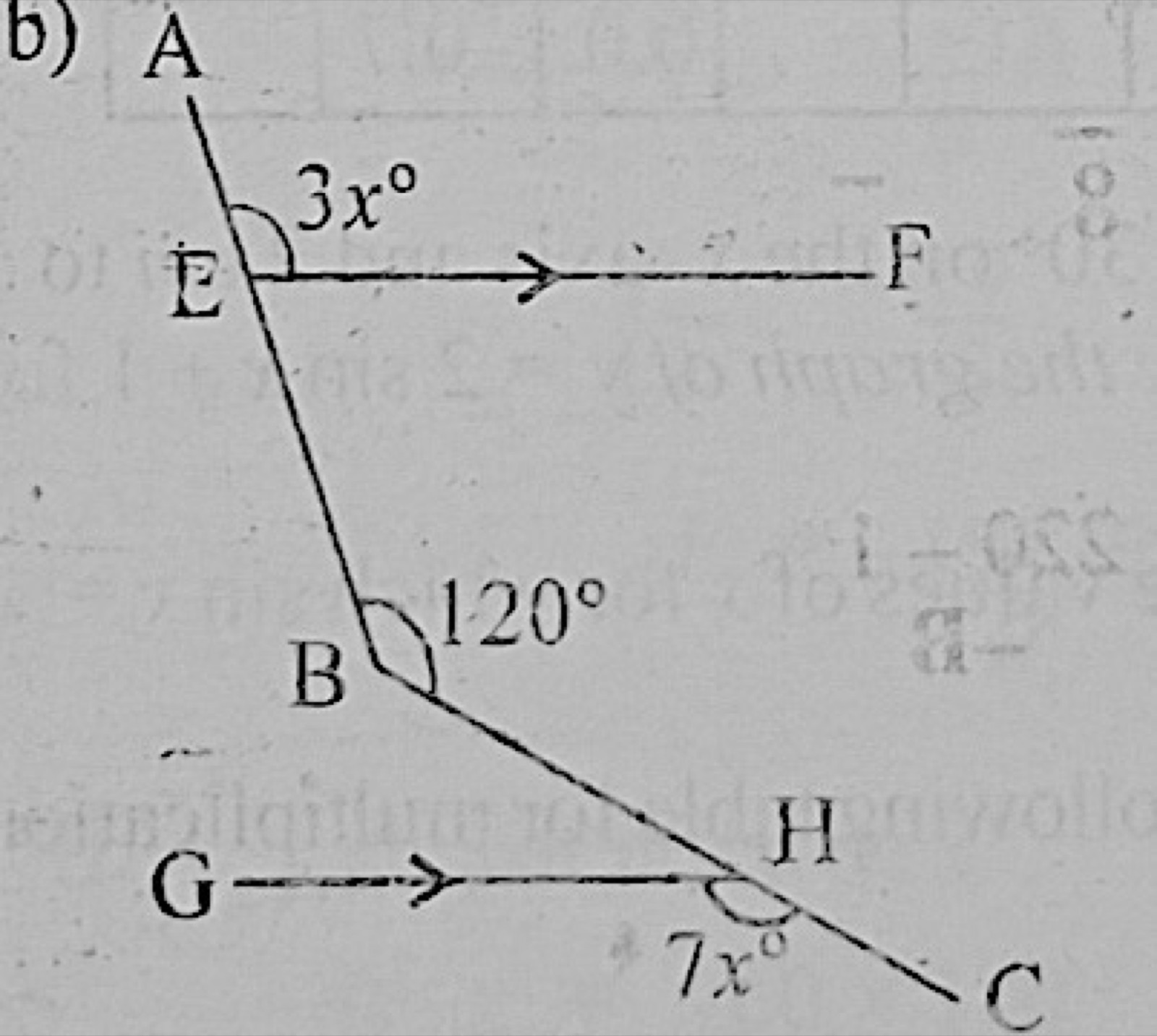
(a) Numerator = 0.0768; denominator = 0.001536. 0.0768 ÷ 0.001536 = 50 = 5.0 × 101.
(b) Through B draw a line parallel to EF and GH. BA makes 3x with it (corresponding to ∠AEF), so BC makes 120° − 3x with it.
∠GHB = 120° − 3x (alternate angles).
B, H, C are on a straight line: (120 − 3x) + 7x = 180 → x = 15.
∠GHB = 120° − 45° = 75°.
Draw a line through the bend parallel to the given lines.
(a) Simplify 3√75 − √12 + √108, leaving the answer in surd form (radicals).
(b) If 124n = 232five, find n.
(a) 3√75 = 15√3, √12 = 2√3, √108 = 6√3. 15√3 − 2√3 + 6√3 = 19√3.
(b) 232five = 50 + 15 + 2 = 67. n2 + 2n + 4 = 67 → n2 + 2n − 63 = 0 → (n + 9)(n − 7) = 0. A base must be positive, so n = 7.
Write each surd as a multiple of √3.
(a) Solve the simultaneous equations: 1/x + 1/y = 5; 1/y − 1/x = 1.
(b) A man drives from Ibadan to Oyo, a distance of 48 km in 45 minutes. If he drives at 72 km/h where the surface is good and 48 km/h where it is bad, find the number of kilometres of good surface.
(a) Adding: 2/y = 6, so y = ⅓. Then 1/x = 5 − 3 = 2, so x = ½.
(b) Let x km be good surface: x/72 + (48 − x)/48 = ¾.
Multiply by 144: 2x + 3(48 − x) = 108 → 144 − x = 108 → x = 36 km.
Time = distance ÷ speed for each part; the times add to 45 minutes = ¾ hour.
(a) In the diagram, O is the centre of the circle radius r cm and ∠XOY = 90°. If the area of the shaded part is 504 cm2, calculate the value of r. [Take π = 22/7]
(b) Two isosceles triangles PQR and PQS are drawn on opposite sides of a common base PQ. If ∠PQR = 66° and ∠PSQ = 109°, calculate the value of ∠RQS.
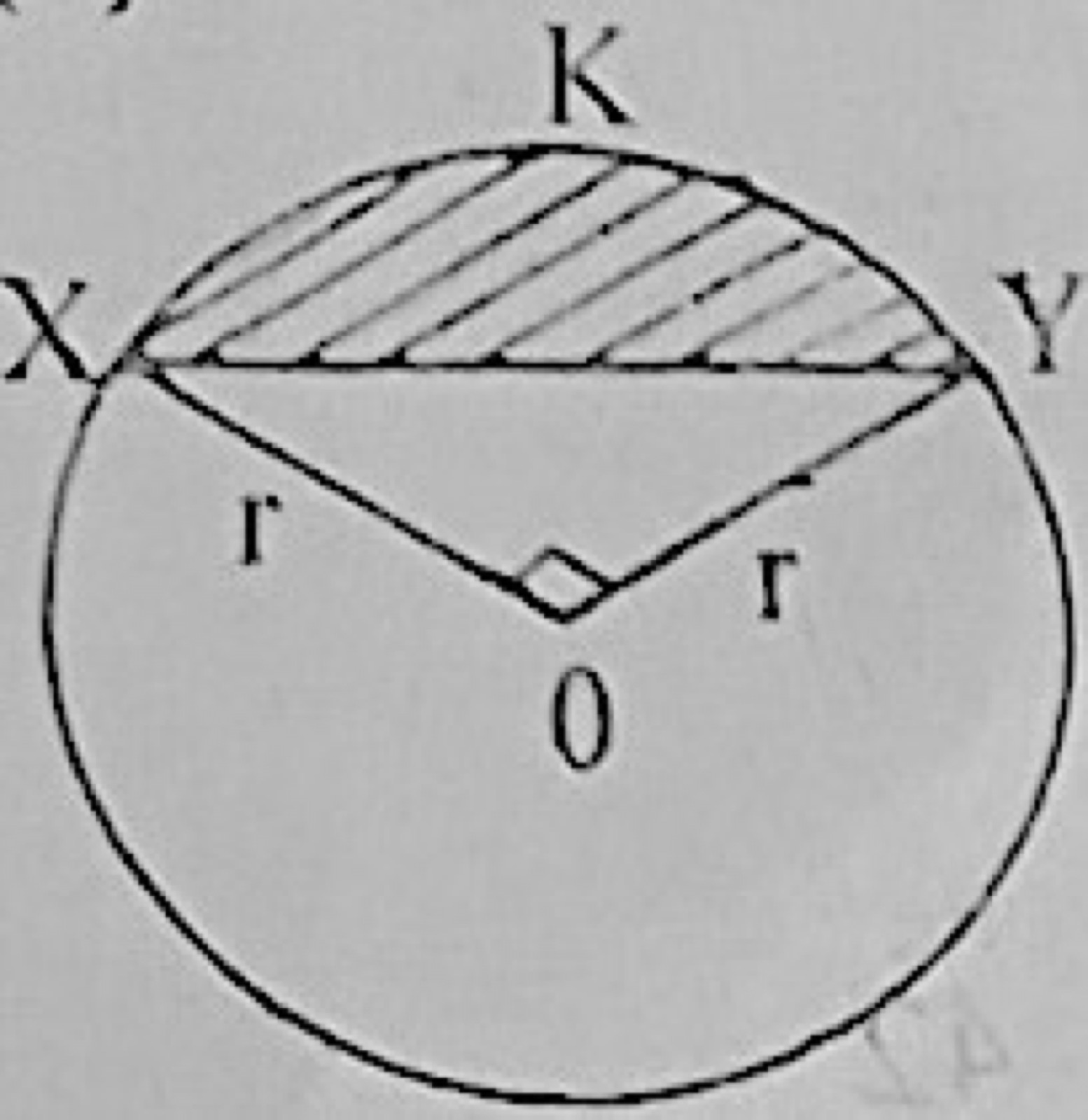
(a) Segment = sector − triangle: (90/360)(22/7)r2 − ½r2 = (11/14 − 7/14)r2 = (2/7)r2 = 504.
r2 = 1764, so r = 42 cm.
(b) In isosceles ΔPQS (PS = QS): ∠SQP = (180° − 109°)/2 = 35.5°.
∠RQS = ∠PQR + ∠PQS = 66° + 35.5° = 101.5°.
The shaded part is a minor segment: sector minus the right-angled triangle.
A building contractor tendered for two independent contracts, X and Y. The probabilities that he will win contract X is 0.5 and not win contract Y is 0.3. What is the probability that he will win: (a) both contracts; (b) exactly one of the contracts; (c) neither of the contracts?
P(X) = 0.5, P(not X) = 0.5, P(Y) = 0.7, P(not Y) = 0.3.
(a) 0.5 × 0.7 = 0.35.
(b) 0.5 × 0.3 + 0.5 × 0.7 = 0.15 + 0.35 = 0.50.
(c) 0.5 × 0.3 = 0.15.
For independent events, multiply the probabilities.
(a) If 3/(2p − ½) = (⅓)/(¼p + 1), find p.
(b) A television set was marked for sale at GH¢ 760.00 in order to make a profit of 20%. The television set was actually sold at a discount of 5%. Calculate, correct to 2 significant figures, the actual percentage profit.
(a) Cross-multiply: 3(¼p + 1) = ⅓(2p − ½) → ¾p + 3 = ⅔p − ⅙ → (1/12)p = −19/6 → p = −38.
(b) Cost price = 760 × 100/120 ≈ GH¢633.33. Selling price = 95% of 760 = GH¢722.
Profit = 722 − 633.33 = GH¢88.67. Percentage profit = 88.67/633.33 × 100% ≈ 14%.
Find the cost price from the marked price first.
(a) Copy and complete the table of values for the relation y = 2 sin x + 1.
x: 0°, 30°, 60°, 90°, 120°, 150°, 180°, 210°, 240°, 270°
y: 1.0, __, __, __, 2.7, __, __, 0.0, −0.7, __
(b) Using scales of 2 cm to 30° on the x-axis and 2 cm to 1 unit on the y-axis, draw the graph of y = 2 sin x + 1 for 0° ≤ x ≤ 270°.
(c) Use the graph to find the values of x for which sin x = ¼.
(a) 30°: 2.0; 60°: 2.7; 90°: 3.0; 150°: 2.0; 180°: 1.0; 270°: −1.0.
(b) Plot the points and draw a smooth curve.
(c) sin x = ¼ means 2 sin x + 1 = 1.5. Draw y = 1.5: x ≈ 15° and x ≈ 165°.
Change the equation so it matches the graph: 2(¼) + 1 = 1.5.
(a) Copy and complete the following table for multiplication modulo 11.
⊗: 1, 5, 9, 10
1: 1, 5, 9, 10
5: 5, __, __, __
9: 9, __, __, __
10: 10, __, __, __
Use the table to: (i) evaluate (9 ⊗ 5) ⊗ (10 ⊗ 10); (ii) find the truth set of I. 10 ⊗ m = 2; II. n ⊗ n = 4.
(b) When a fraction is reduced to its lowest term, it is equal to ¾. The numerator of the fraction when doubled would be 34 greater than the denominator. Find the fraction.
(a) Row 5: 5, 3, 1, 6. Row 9: 9, 1, 4, 2. Row 10: 10, 6, 2, 1.
(i) 9 ⊗ 5 = 1 and 10 ⊗ 10 = 1, so the answer is 1 ⊗ 1 = 1.
(ii) I. 10 ⊗ m = 2 → m = 9, truth set {9}. II. n ⊗ n = 4 → n = 9, truth set {9}.
(b) Let the fraction be 3k/4k. 2(3k) = 4k + 34 → k = 17. The fraction is 51/68.
Each entry is the remainder when the ordinary product is divided by 11.
(a) In the Venn diagram, P, Q and R are subsets of the universal set U. If n(U) = 125, find: (i) the value of x; (ii) n(P ∪ Q ∩ R′).
(b) In the diagram, O is the centre of the circle. If WX is parallel to YZ and ∠WXY = 50°, find the value of: (i) ∠WYZ; (ii) ∠YEZ.
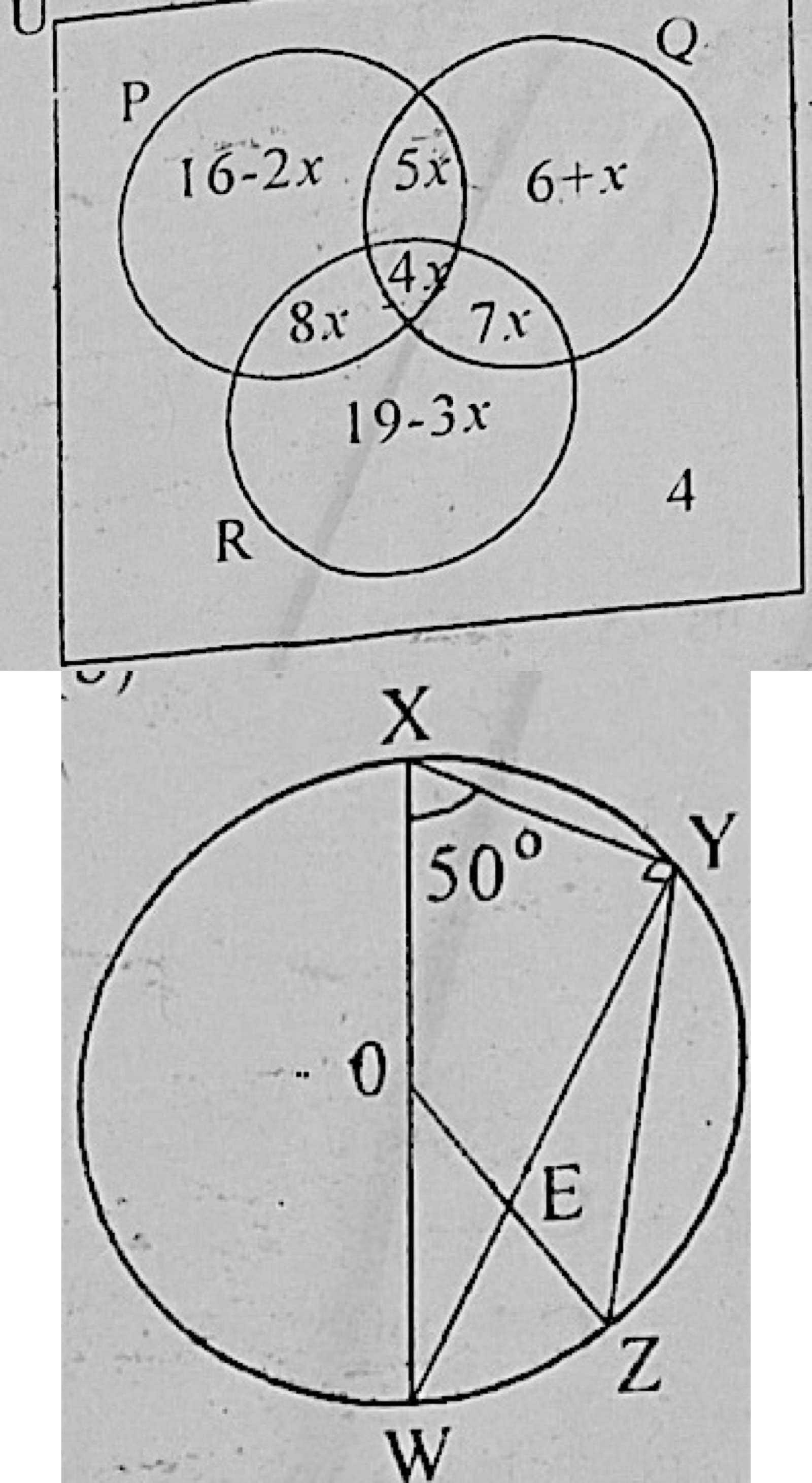
(a)(i) (16 − 2x) + 5x + (6 + x) + 4x + 8x + 7x + (19 − 3x) + 4 = 125 → 45 + 20x = 125 → x = 4.
(ii) (P ∪ Q) ∩ R′ = the parts of P and Q outside R: (16 − 2x) + 5x + (6 + x) = 22 + 4x = 38.
(b) XW is a diameter, so ∠XYW = 90° and ∠XWY = 180° − 90° − 50° = 40°.
(i) WX ∥ YZ, so ∠WYZ = ∠XWY = 40° (alternate).
(ii) ∠WOZ = 2 × ∠WYZ = 80°. In ΔOEW: ∠OEW = 180° − 80° − 40° = 60°. ∠YEZ = ∠OEW = 60° (vertically opposite).
The angle in a semicircle is 90°; the angle at the centre is twice the angle at the circumference.
(a) Solve: (x − 2)(x − 3) = 12.
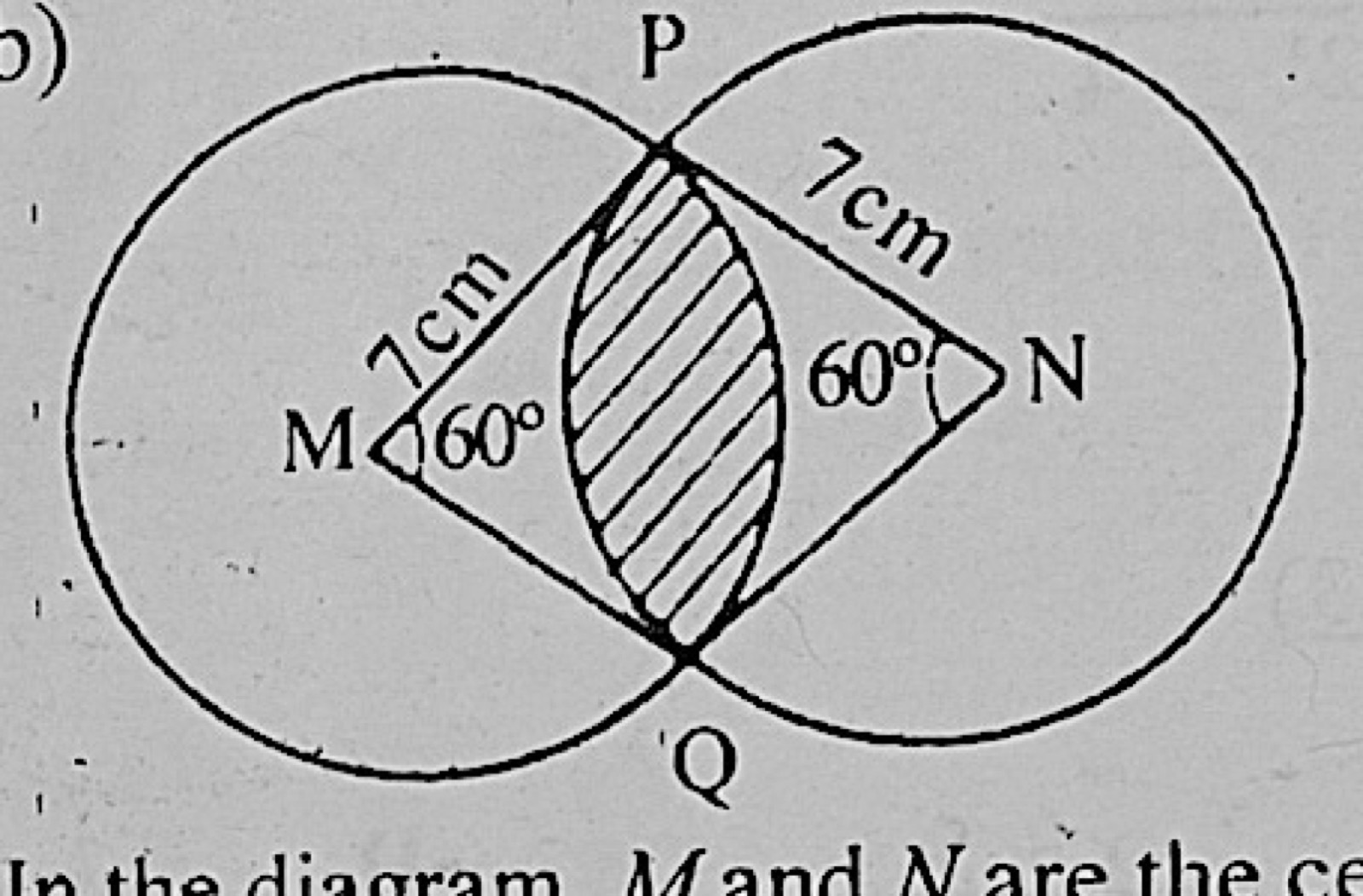
(b) In the diagram, M and N are the centres of two circles of equal radii 7 cm. The circles intercept at P and Q. If ∠PMQ = ∠PNQ = 60°, calculate, correct to the nearest whole number, the area of the shaded portion. [Take π = 22/7].
(a) x2 − 5x + 6 = 12 → x2 − 5x − 6 = 0 → (x − 6)(x + 1) = 0 → x = 6 or x = −1.
(b) One segment = sector − triangle = 60/360 × 22/7 × 72 − ½ × 72 × sin 60° = 25.667 − 21.218 = 4.449 cm2.
The shaded part is two such segments: 2 × 4.449 ≈ 8.9 ≈ 9 cm2.
The shaded lens is made of two equal segments, one from each circle.
The table shows the distribution of outcomes when a die is thrown 50 times.
Scores: 1, 2, 3, 4, 5, 6
Frequency: 2, 5, 13, 11, 9, 10
Calculate the: (a) mean deviation of the distribution; (b) probability that a score selected at random is at least a 4.
(a) Σfx = 2 + 10 + 39 + 44 + 45 + 60 = 200, so the mean = 200/50 = 4.
|x − 4|: 3, 2, 1, 0, 1, 2. Σf|x − 4| = 6 + 10 + 13 + 0 + 9 + 20 = 58.
Mean deviation = 58/50 = 1.16.
(b) Scores 4, 5, 6: 11 + 9 + 10 = 30. Probability = 30/50 = 3/5 (0.6).
Mean deviation is the average distance of the scores from the mean.
(a) Given that 5 cos (x + 8.5)° − 1 = 0, 0° ≤ x ≤ 90°, calculate, correct to the nearest degree, the value of x.
(b) The bearing of Q from P is 150° and the bearing of P from R is 015°. If Q and R are 24 km and 32 km respectively from P: (i) represent this information in a diagram; (ii) calculate the distance between Q and R, correct to two decimal places; (iii) find the bearing of R from Q, correct to the nearest degree.
(a) cos(x + 8.5)° = 0.2 → x + 8.5 = 78.46 → x ≈ 70°.
(b)(i) Sketch with north lines at P, Q and R: PQ = 24 km on bearing 150° from P; R is 32 km from P on bearing 195° (back bearing of 015°).
(ii) ∠QPR = 195° − 150° = 45°. QR2 = 322 + 242 − 2(32)(24) cos 45° = 1600 − 1086.1 = 513.9, so QR ≈ 22.67 km.
(iii) sin ∠PQR = 32 sin 45°/22.67 ≈ 0.998, so ∠PQR ≈ 86.5° (the angles 45° + 86.5° + 48.5° add to 180°).
The bearing of P from Q is 330°, so the bearing of R from Q = 330° − 86.5° ≈ 243.5°, i.e. about 243° (244° accepted).
Find the angle at P from the two bearings, then use the cosine rule.
(a) Two functions, f and g, are defined by f : x → 2x2 − 1 and g : x → 3x + 2 where x is a real number. (i) If f(x − 1) − 7 = 0, find the values of x. (ii) Evaluate: f(−½) . g(3)/(f(4) − g(5)).
(b) An operation (∗) is defined on the set R, of real numbers by m ∗ n = −n/(m2 + 1), where m, n ∈ R. If −3, −10 ∈ R, show whether or not (∗) is commutative.
(a)(i) 2(x − 1)2 − 1 − 7 = 0 → (x − 1)2 = 4 → x − 1 = ±2 → x = 3 or x = −1.
(ii) f(−½) = −½, g(3) = 11, f(4) = 31, g(5) = 17. (−½ × 11)/(31 − 17) = −11/28.
(b) −3 ∗ −10 = 10/(9 + 1) = 1. −10 ∗ −3 = 3/(100 + 1) = 3/101.
Since 1 ≠ 3/101, the operation is not commutative.
An operation is commutative only if swapping the two numbers never changes the result.