Question 1
Fractions, Decimals and ApproximationSimplify: (3½ + 4⅓) ÷ (5/6 − 2/3)
- A.1¼
- B.8½
- C.35
- D.47
Show the answer and explanation
Answer: D (47)
Explanation
3½ + 4⅓ = 7 5/6 = 47/6 and 5/6 − 2/3 = 1/6. 47/6 ÷ 1/6 = 47.
64 questions. Try each one, then open the answer to check yourself and read the explanation.
Simplify: (3½ + 4⅓) ÷ (5/6 − 2/3)
Answer: D (47)
3½ + 4⅓ = 7 5/6 = 47/6 and 5/6 − 2/3 = 1/6. 47/6 ÷ 1/6 = 47.
In a particular year, the exchange rate of Naira (₦) varies directly with the Dollar ($). If ₦1122 is equivalent to $8, find the Naira equivalent of $36.
Answer: B (₦5049)
$1 = 1122 ÷ 8 = ₦140.25, so $36 = 36 × 140.25 = ₦5049.
If log 2 = x, log 3 = y and log 7 = z, find, in terms of x, y and z, the value of log(28/3).
Answer: B (2x + z − y)
28/3 = 22 × 7 ÷ 3, so log(28/3) = 2 log 2 + log 7 − log 3 = 2x + z − y.
Arrange the following numbers in descending order of magnitude: 22three, 34five, 21six.
Answer: D (34five, 21six, 22three)
In base ten: 22three = 8, 34five = 19 and 21six = 13. Largest to smallest: 34five, 21six, 22three.
Find the value to which N3000.00 will amount in 5 years at 6% per annum simple interest.
Answer: A (₦3,900.00)
Interest = 3000 × 6 × 5/100 = ₦900, so the amount is ₦3,900.00.
Express the square root of 0.000144 in the standard form.
Answer: C (1.2 × 10⁻²)
√0.000144 = 0.012 = 1.2 × 10⁻².
Two sets are disjoint if
Answer: C (their intersection is an empty set)
Disjoint sets have no element in common, so their intersection is empty.
Solve the following simultaneous equations: 2x + 3y = 7, x + 5y = 0.
Answer: A (x = 5, y = −1)
From the second equation x = −5y. Then −10y + 3y = 7, so y = −1 and x = 5.
If 3/2x − 2/3x = 4, solve for x.
Answer: C (5/24)
Over 6x: (9 − 4)/6x = 4, so 5 = 24x and x = 5/24.
The following is the graph of a quadratic function. Find the co-ordinates of point P.
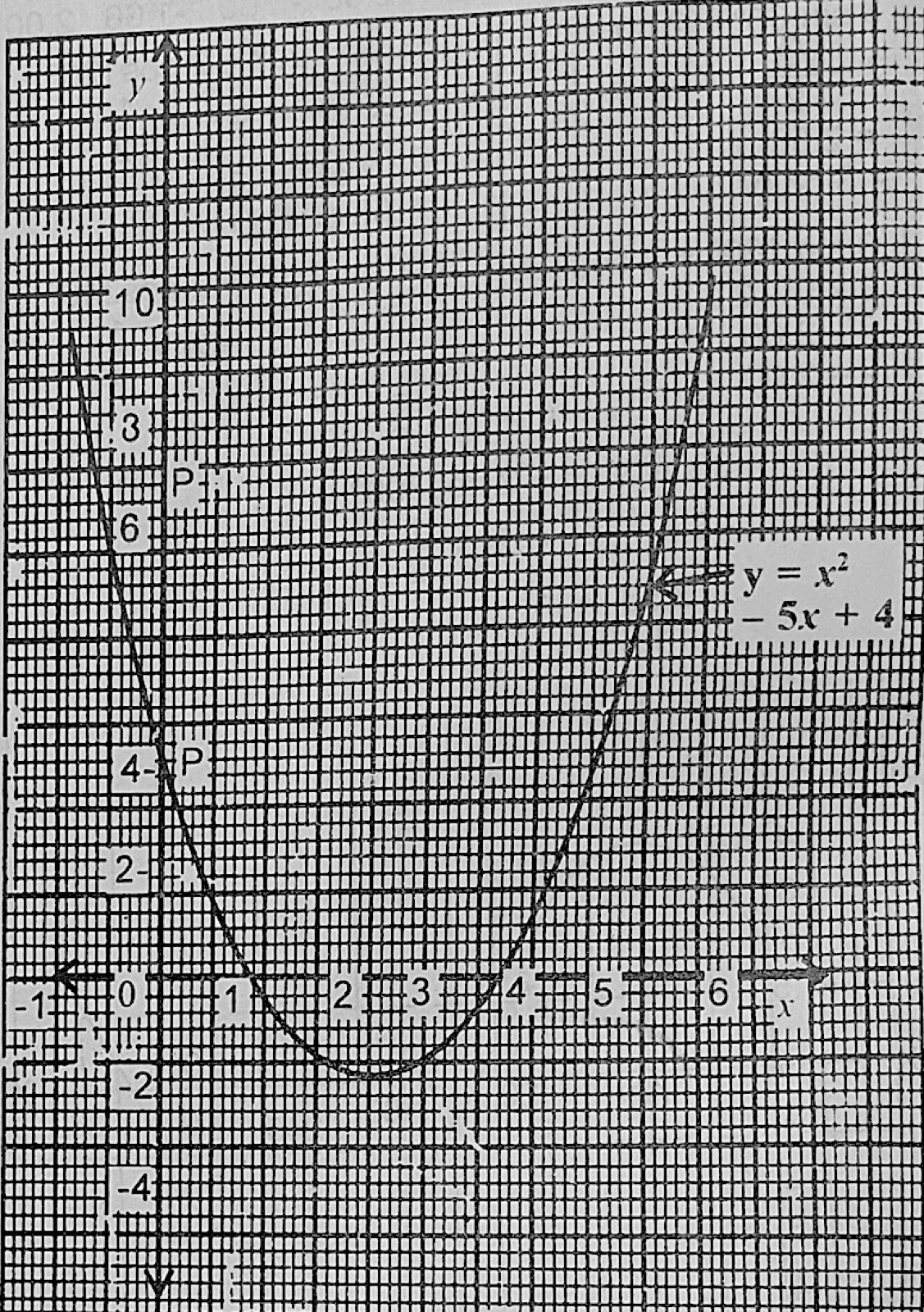
Answer: A ((0, 4))
P is where the curve y = x2 − 5x + 4 crosses the y-axis: x = 0 gives y = 4, so P is (0, 4).
The following is the graph of a quadratic function. Find the values of x when y = 0.
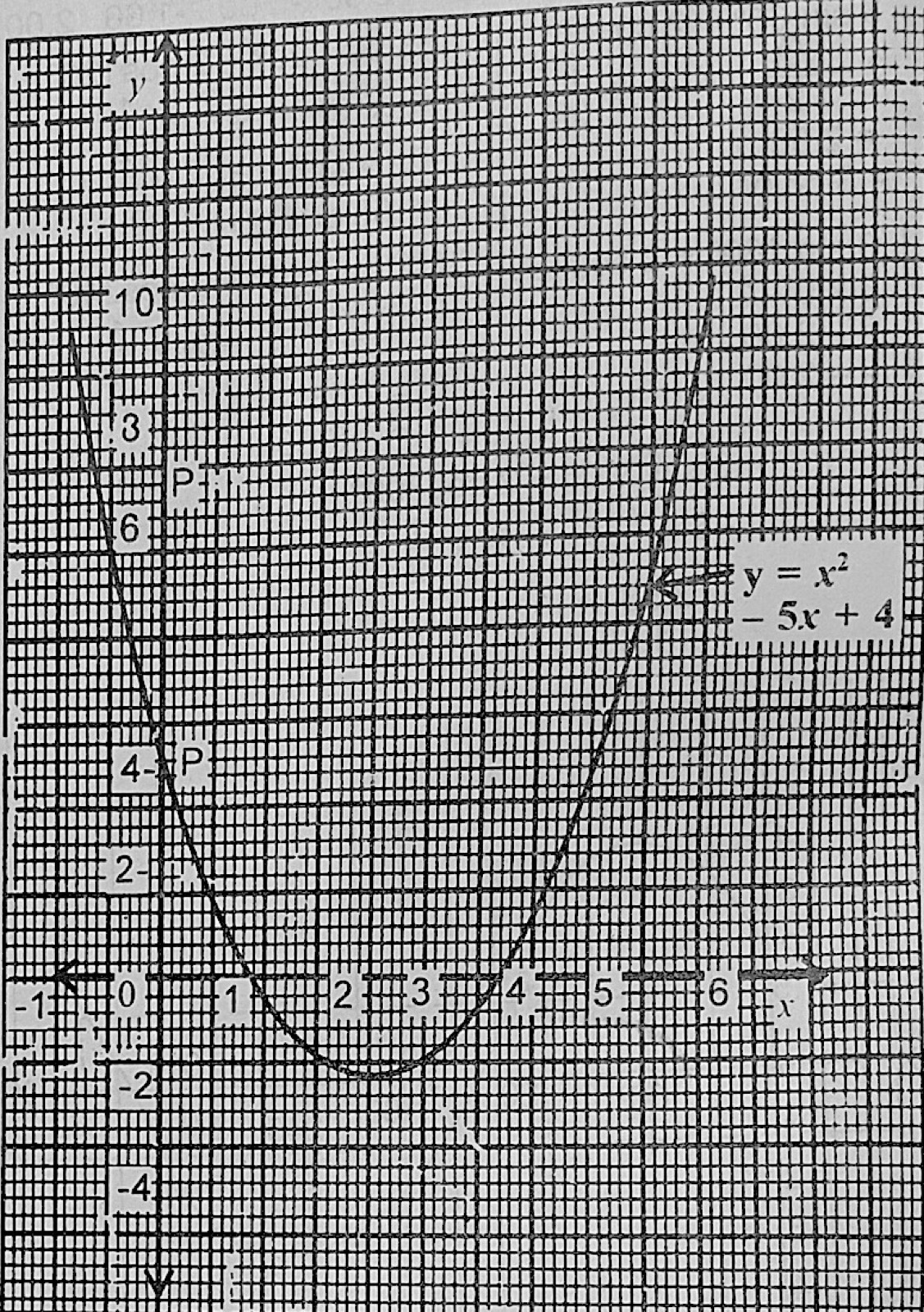
Answer: B (1, 4)
The curve cuts the x-axis at x = 1 and x = 4 (x2 − 5x + 4 = (x − 1)(x − 4)).
Five bottles of Fanta and two packets of biscuits cost Gh¢6.00. Three bottles of Fanta and four packets of biscuits cost Gh¢5.00. Find the cost of a bottle of Fanta.
Answer: B (Gh¢1.00)
5f + 2b = 6 and 3f + 4b = 5. Doubling the first: 10f + 4b = 12; subtracting the second: 7f = 7, so f = Gh¢1.00.
Factorize x2 − 2x − 3xy + 6y completely.
Answer: B ((x − 3y)(x − 2))
Group: x(x − 2) − 3y(x − 2) = (x − 2)(x − 3y).
Which of the following illustrates the solution of (3x + 4)/2 < x + 3?
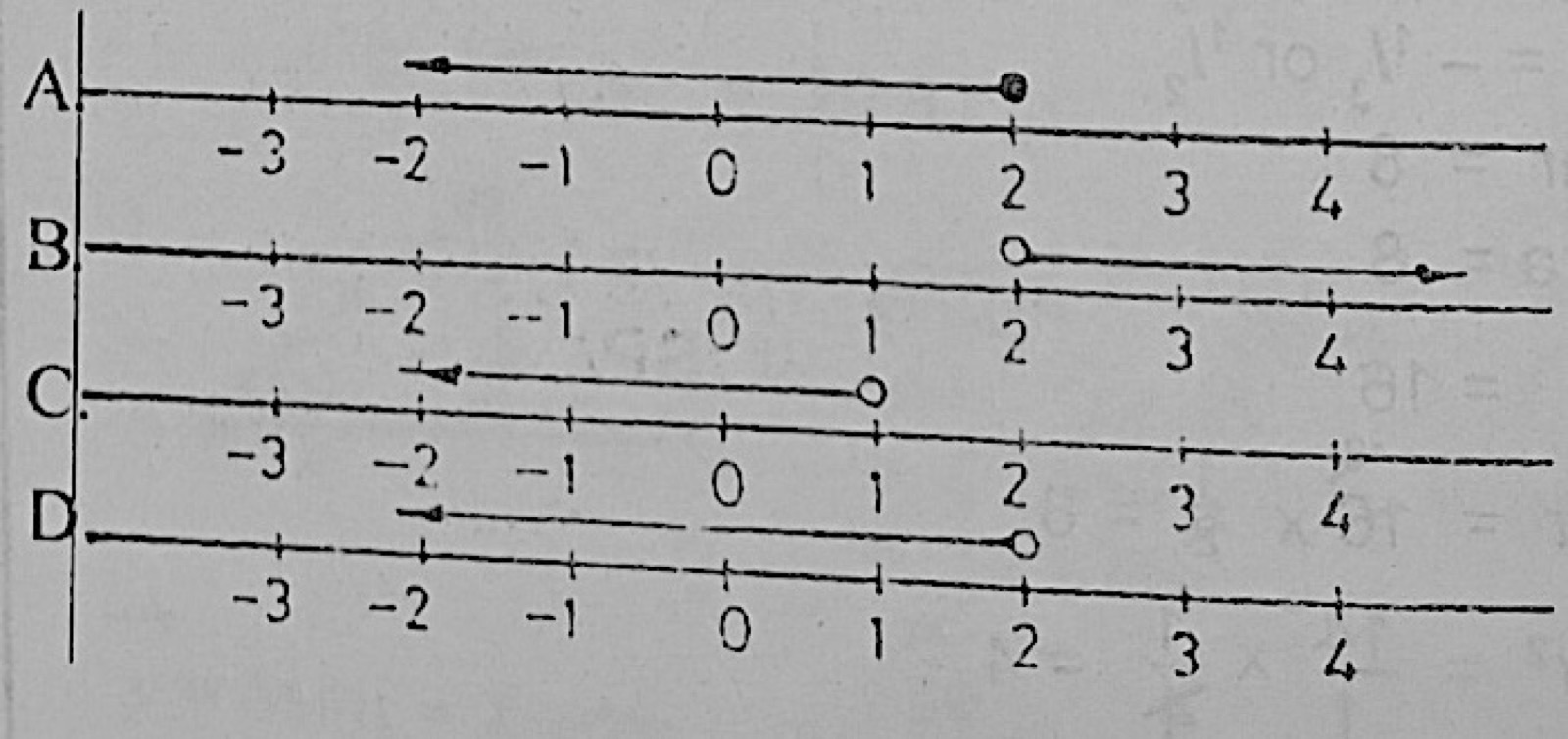
Answer: D (Diagram D)
Multiply by 2: 3x + 4 < 2x + 6, so x < 2. Use an open circle at 2 (2 is not included) and shade to the left.
The diameter of a bicycle wheel is 42 cm. If the wheel makes 16 complete revolutions, what will be the total distance covered by the wheel? [Take π = 22/7]
Answer: C (2112 cm)
One revolution = πd = 22/7 × 42 = 132 cm. 16 revolutions = 2112 cm.
PQRS is a trapezium. QR//PS, |PQ| = 5 cm, |QR| = 6 cm, |PS| = 10 cm and angle QPS = 42°. Calculate the perpendicular distance between the parallel sides.
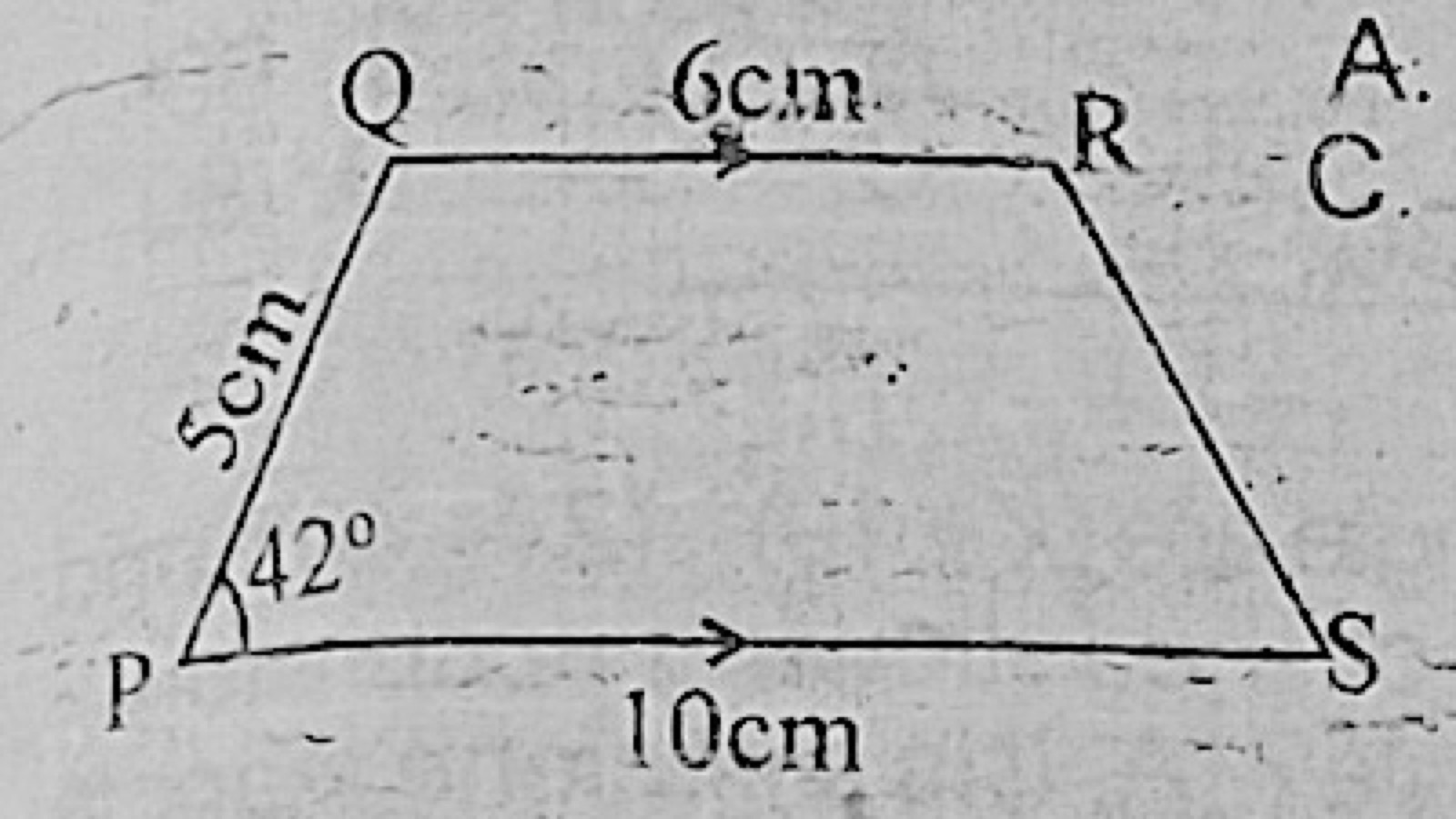
Answer: A (3.35 cm)
Height = 5 sin 42° = 5 × 0.6691 ≈ 3.35 cm.
PQRS is a trapezium. QR//PS, |PQ| = 5 cm, |QR| = 6 cm, |PS| = 10 cm and angle QPS = 42°. Calculate, correct to the nearest cm2, the area of the trapezium.
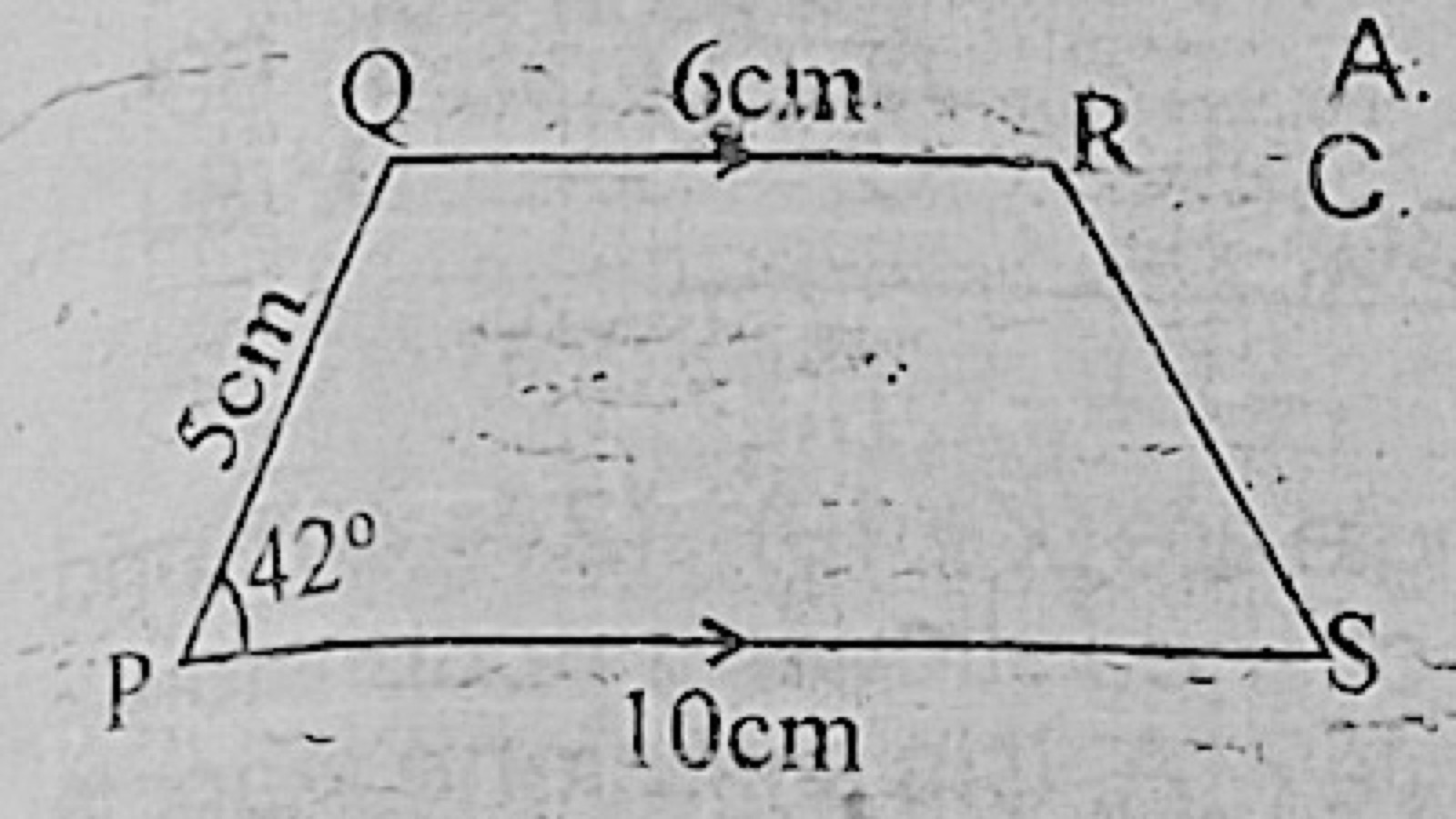
Answer: A (27 cm2)
Area = ½(6 + 10) × 3.346 ≈ 26.8 ≈ 27 cm2.
In the diagram, |TP| = 12 cm and it is 6 cm from O, the centre of the circle. Calculate ∠TOP.
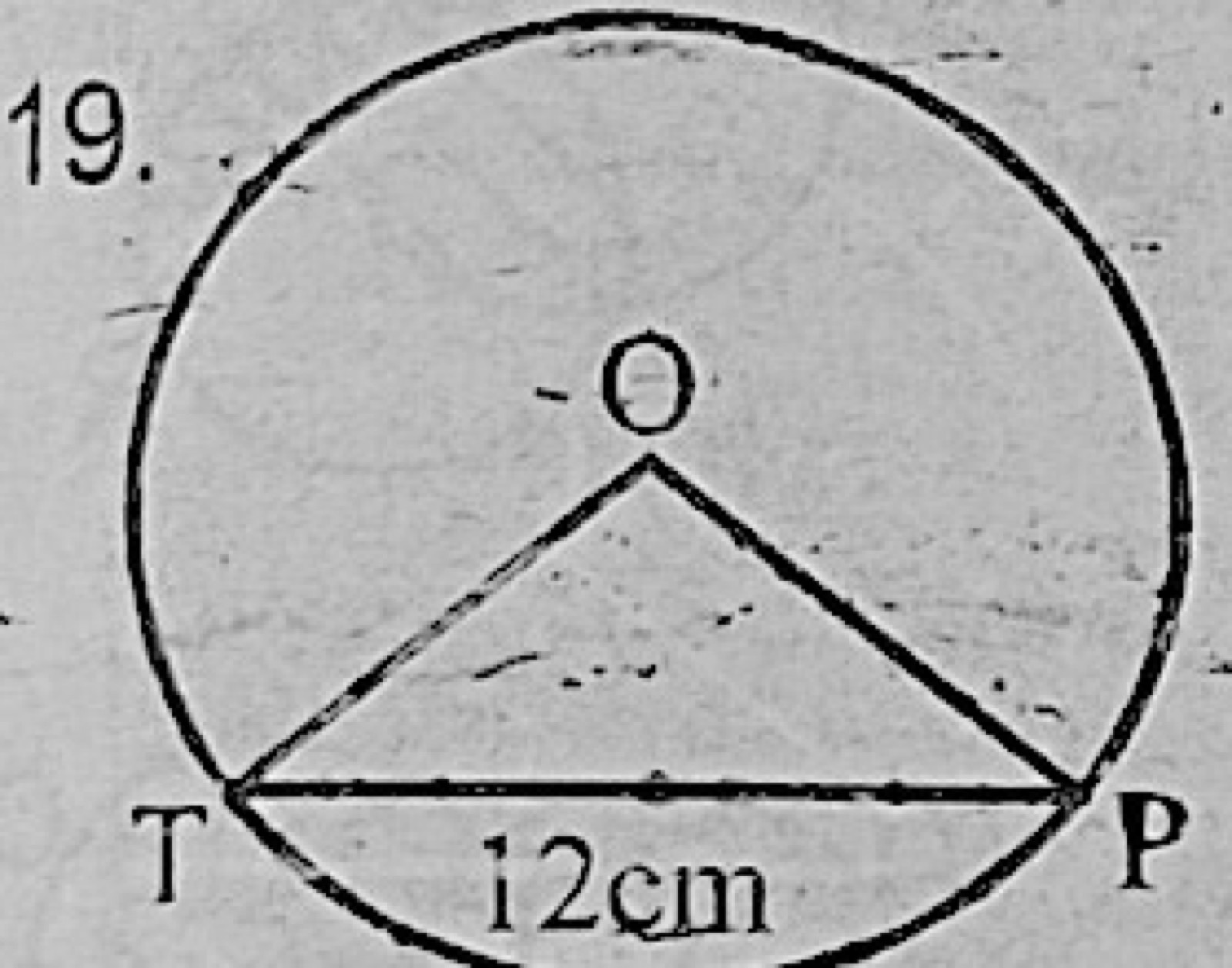
Answer: B (90°)
The perpendicular from O bisects TP into 6 cm halves. Each half-angle has tan = 6/6 = 1, so it is 45°, and ∠TOP = 90°.
The interior angles of a pentagon are (2x + 5)°, (x + 20)°, x°, (3x − 20)° and (x + 15)°. Find the value of x.
Answer: C (65°)
A pentagon's angles add to 540°: 8x + 20 = 540, so x = 65.
In the diagram, IG is parallel to JE, JÊF = 120° and FĤG = 130°. Find the angle marked t.
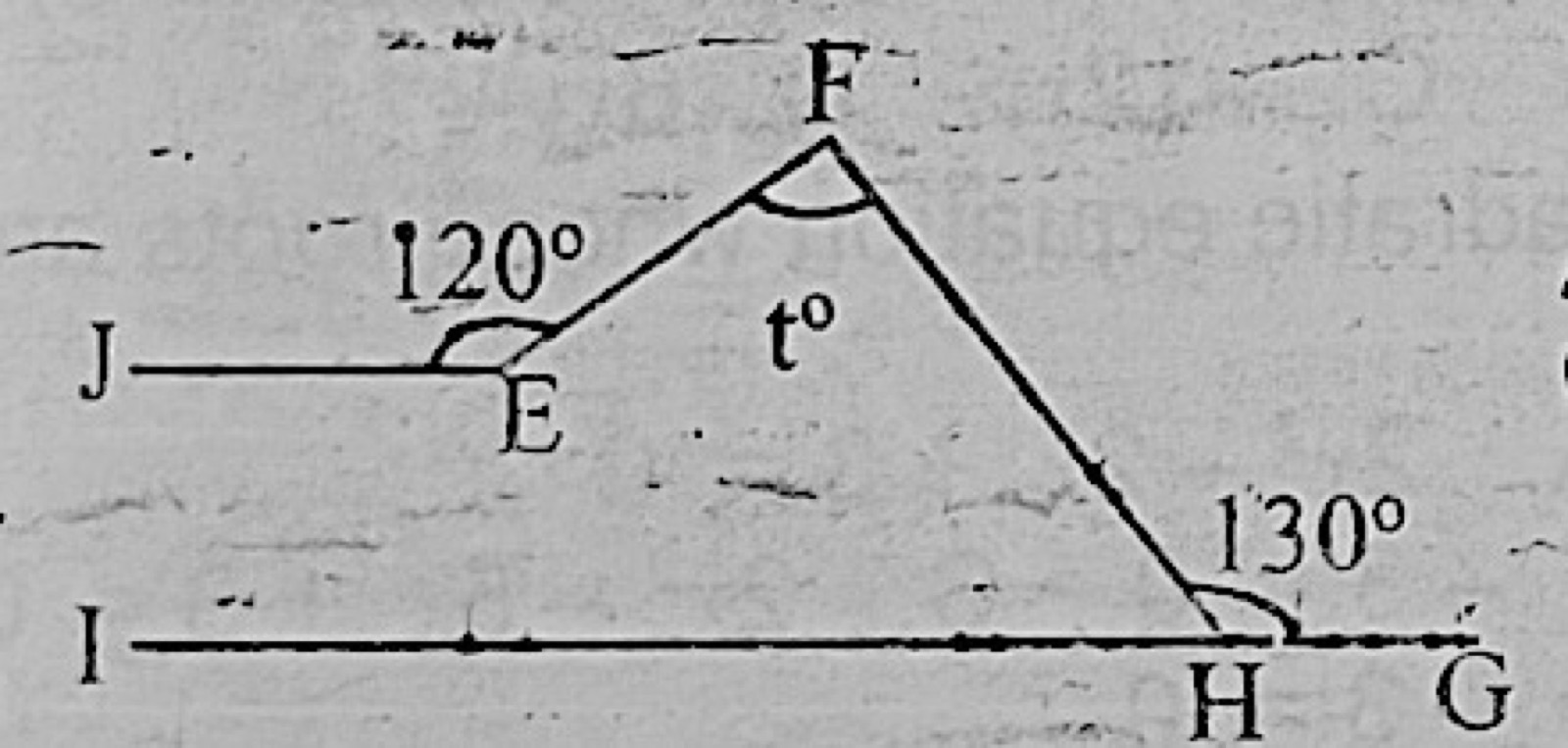
Answer: B (70°)
Draw a line through F parallel to JE and IG. FE makes 180° − 120° = 60° with it and FH makes 180° − 130° = 50° with it (co-interior angles). The angles at F on that straight line add to 180°, so t = 180° − 60° − 50° = 70°.
If M and N are two fixed points in a plane, find the locus L = {P : PM = PN}.
Answer: C (Perpendicular bisector of MN)
Points equidistant from two fixed points lie on the perpendicular bisector of the line joining them.
Find the value of x in the diagram.
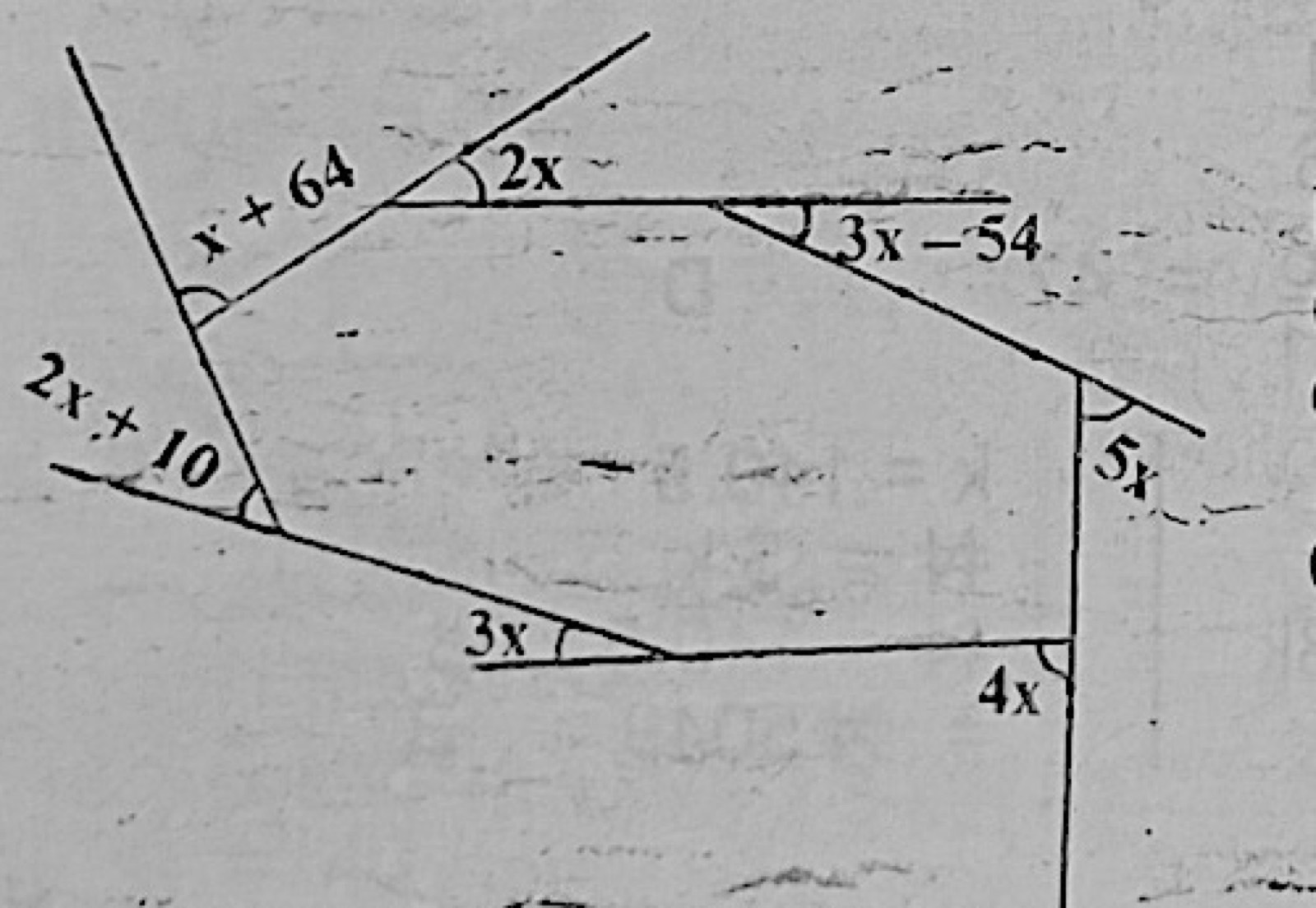
Answer: D (17°)
The marked angles are the exterior angles of the polygon, which add to 360°: (x + 64) + 2x + (3x − 54) + 5x + 4x + 3x + (2x + 10) = 20x + 20 = 360, so x = 17.
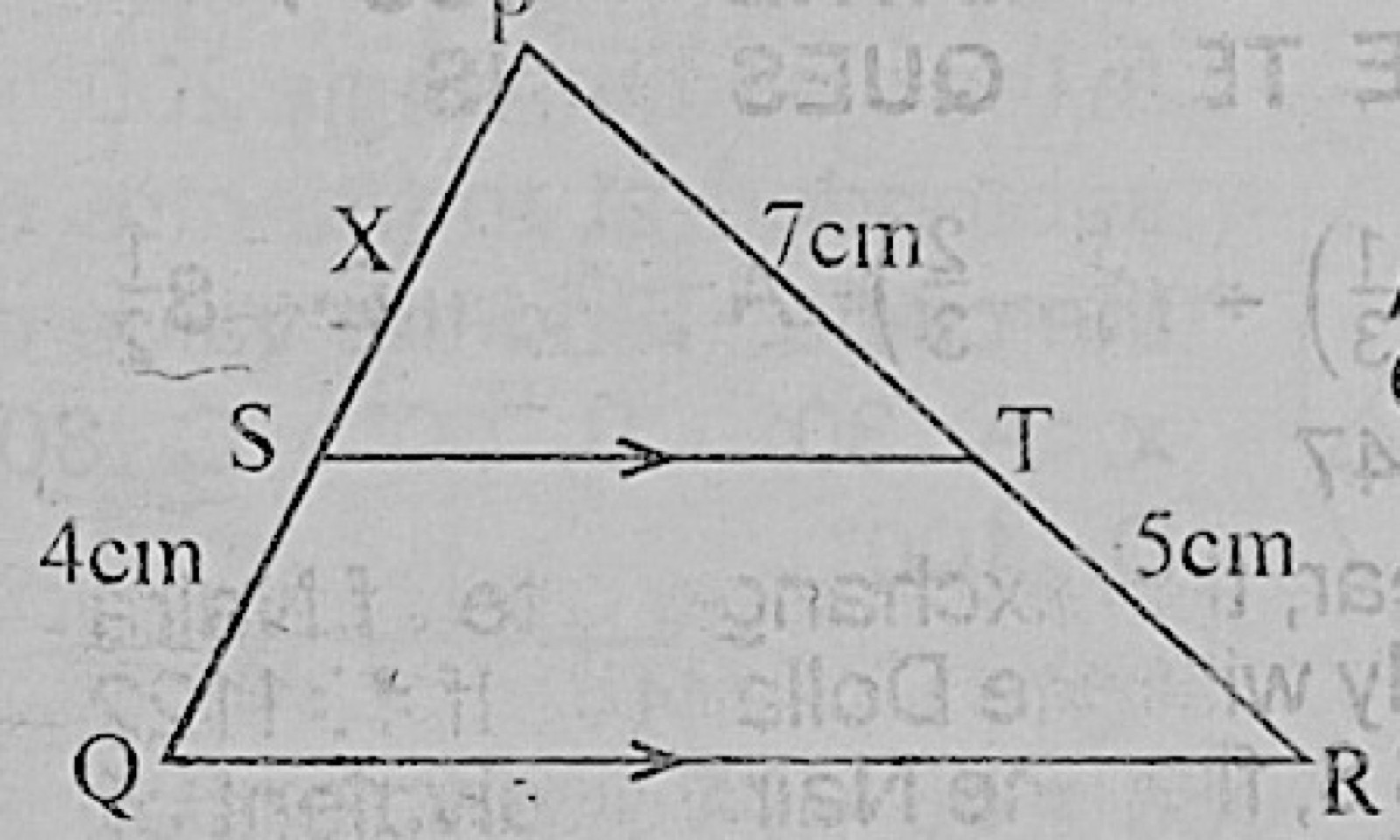
In the diagram, |SQ| = 4 cm, |PT| = 7 cm, |TR| = 5 cm and ST//QR. If |SP| = x cm, find the value of x.
Answer: A (5.6)
ST ∥ QR divides the sides in the same ratio: PS/SQ = PT/TR, so x/4 = 7/5 and x = 5.6.
Given that sin 60° = √3/2 and cos 60° = 1/2, evaluate: (1 − sin 60°)/(1 + cos 60°)
Answer: D ((2 − √3)/3)
(1 − √3/2)/(3/2) = ((2 − √3)/2) × (2/3) = (2 − √3)/3.
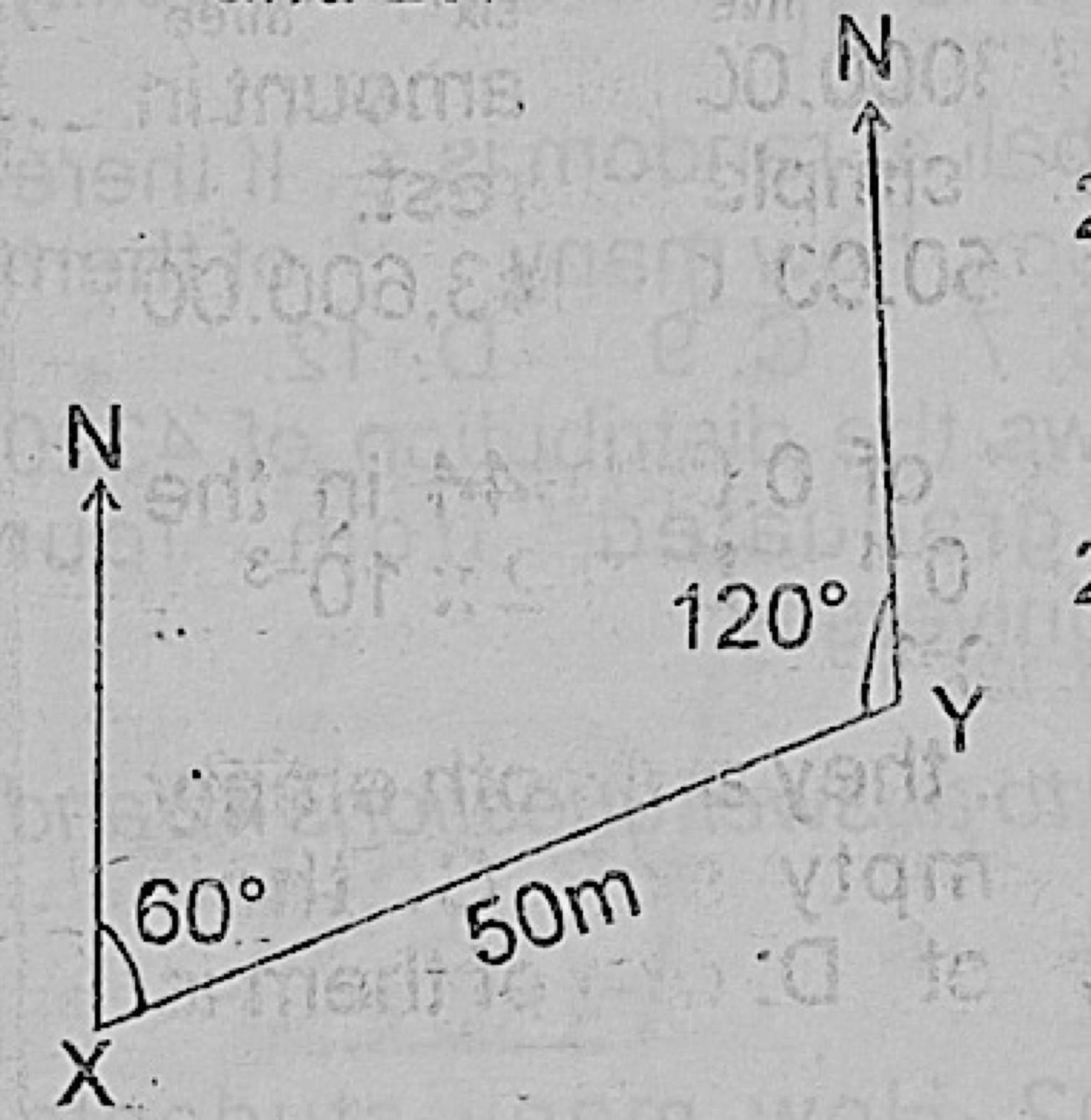
Use the diagram to answer this question. Find the bearing of X from Y.
Answer: B (240°)
The bearing of Y from X is 060°. The back bearing is 060° + 180° = 240°.
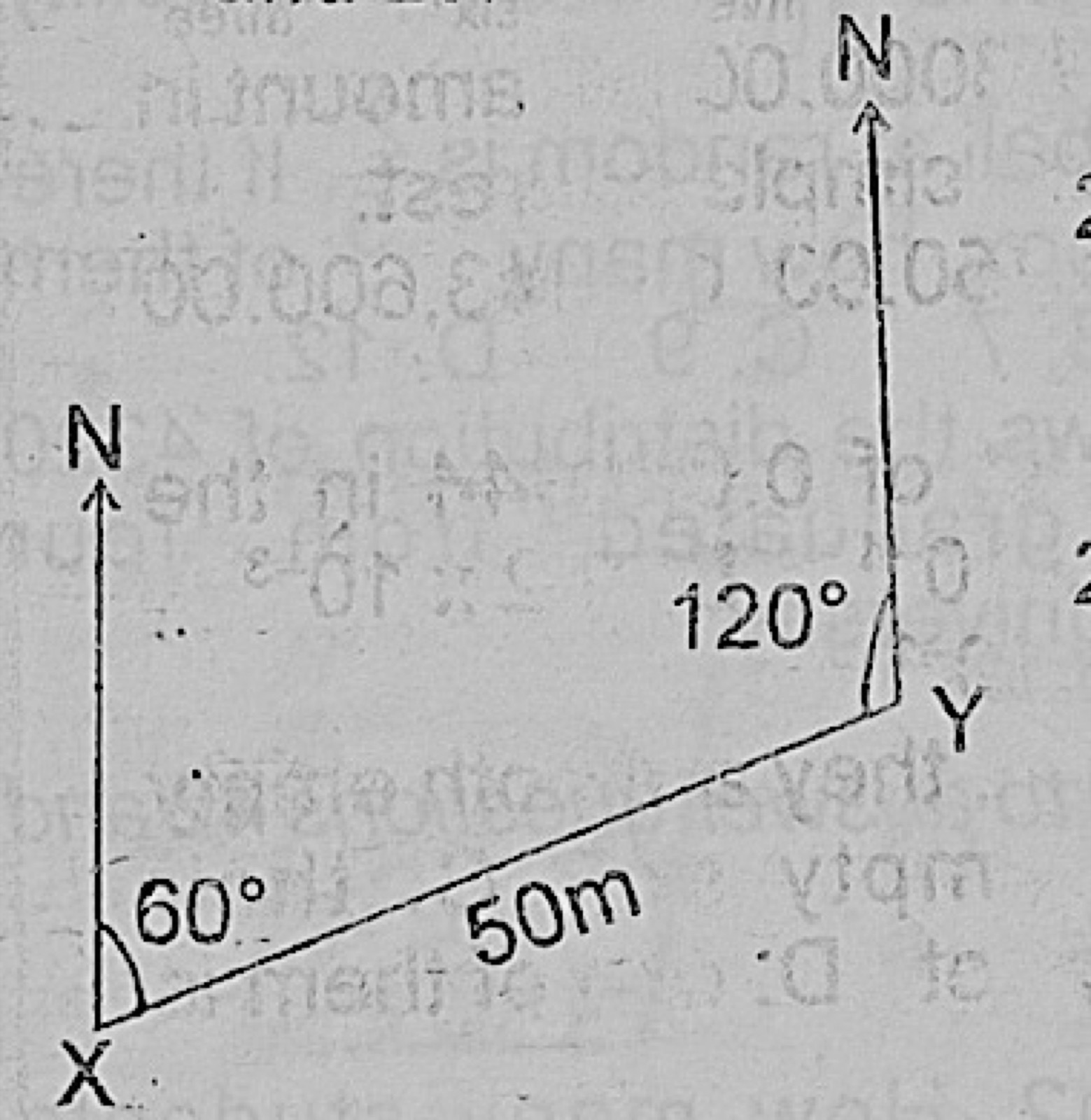
Use the diagram to answer this question. If |XY| = 50 m, how far east of X is Y?
Answer: D (43.3 m)
Y is on a bearing of 060° from X, so the distance east = 50 sin 60° ≈ 43.3 m.
In an examination, Kofi scored x % in Physics, 50% in Chemistry and 70 % in Biology. If his mean score for the three subjects was 55 %, find x.
Answer: B (45)
(x + 50 + 70)/3 = 55, so x + 120 = 165 and x = 45.
What is the median of the following scores: 22, 41, 35, 63, 82, 74?
Answer: B (52)
In order: 22, 35, 41, 63, 74, 82. The median is the mean of the middle two: (41 + 63)/2 = 52.
Express 2.7864 × 10⁻³ to two significant figures.
Answer: C (0.0028)
2.7864 × 10−3 = 0.0027864, which is 0.0028 to 2 significant figures.
If 92x = (1/3)(27x), find x.
Answer: C (−1)
Powers of 3: 34x = 3−1 × 33x = 33x − 1, so 4x = 3x − 1 and x = −1.
If 85% of x is ₦3230, what is the value of x?
Answer: C (₦3800.00)
x = 3230 × 100/85 = ₦3800.00.
The capacity of a water tank is 1,800 litres. If the tank is in the form of a cuboid with base 600 cm by 150 cm, find the height of the tank.
Answer: B (20 cm)
1,800 litres = 1,800,000 cm3. Height = 1,800,000 ÷ (600 × 150) = 20 cm.
An arc of a circle subtends an angle of 60° at the centre. If the radius of the circle is 3 cm, find, in terms of π, the length of the arc.
Answer: A (π cm)
Arc = 60/360 × 2π × 3 = π cm.
Solve: (2x + 1)/6 − (3x − 1)/4 = 0.
Answer: A (1)
Multiply by 12: 2(2x + 1) − 3(3x − 1) = 0, so 4x + 2 − 9x + 3 = 0, −5x = −5 and x = 1.
If x is a positive integer, list the values of x which satisfy the equations 3x − 4 < 6 and x − 1 > 0.
Answer: B ({2, 3})
3x < 10 gives x < 3⅓ and x − 1 > 0 gives x > 1. The integers between are 2 and 3.
If c and k are the roots of 6 − x − x2 = 0, find c + k.
Answer: C (−1)
6 − x − x2 = (2 − x)(3 + x), so the roots are 2 and −3, and c + k = −1.
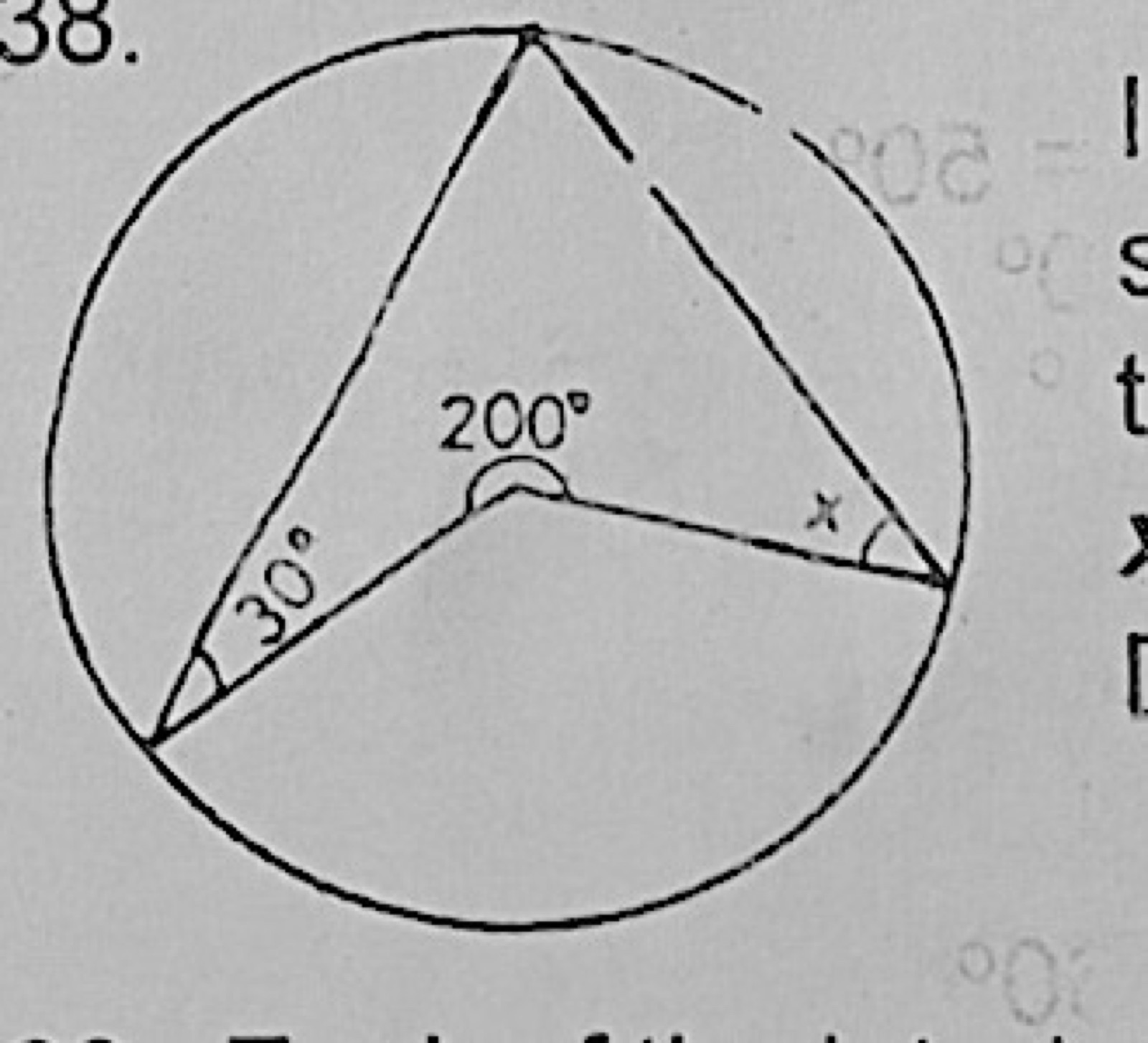
In the diagram, angle 200° is subtended at the centre of the circle. Find the value of x.
Answer: B (50°)
The angle at the top of the circle is half the non-reflex angle at the centre: ½(360° − 200°) = 80°. The radii make isosceles triangles, so this top angle equals 30° + x. Hence x = 50°.
Each of the interior angles of a regular polygon is 140°. Calculate the sum of all the interior angles of the polygon.
Answer: B (1260°)
Each exterior angle is 40°, so n = 360/40 = 9 sides. Sum = 9 × 140° = 1260°.
A bucket holds 10 litres of water. How many buckets of water will fill a reservoir of size 8 m × 7 m × 5 m. (1 litre = 1000 cm3).
Answer: D (28000)
Volume = 280 m3 = 280,000 litres (1 m3 = 1000 litres). 280,000 ÷ 10 = 28,000 buckets.
A box contains black, white and red identical balls. The probability of picking a black ball at random from the box is 3/10 and the probability of picking a white ball at random is 2/5. If there are 30 balls in the box, how many of them are red?
Answer: C (9)
P(red) = 1 − 3/10 − 4/10 = 3/10, so there are 3/10 × 30 = 9 red balls.
The pie chart shows the distribution of 4320 students who graduated from four Departments in a University. How many students graduated from the Science Department?
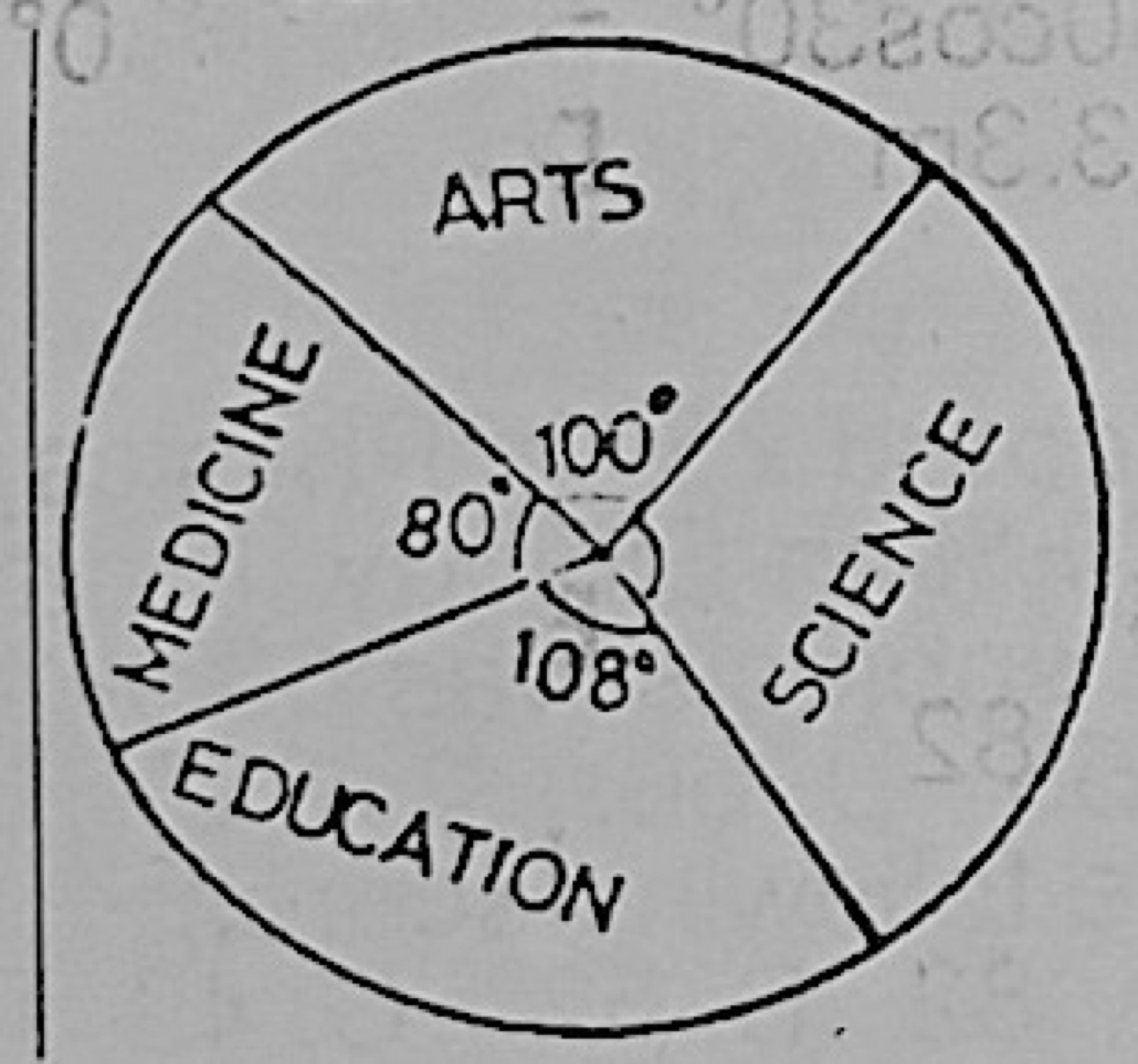
Answer: B (864)
Science angle = 360° − (100° + 80° + 108°) = 72°. 72/360 × 4320 = 864.
The pie chart shows the distribution of 4320 students who graduated from four Departments in a University. If a student is picked at random from the four departments, what is the probability that he is not from the Education Department?
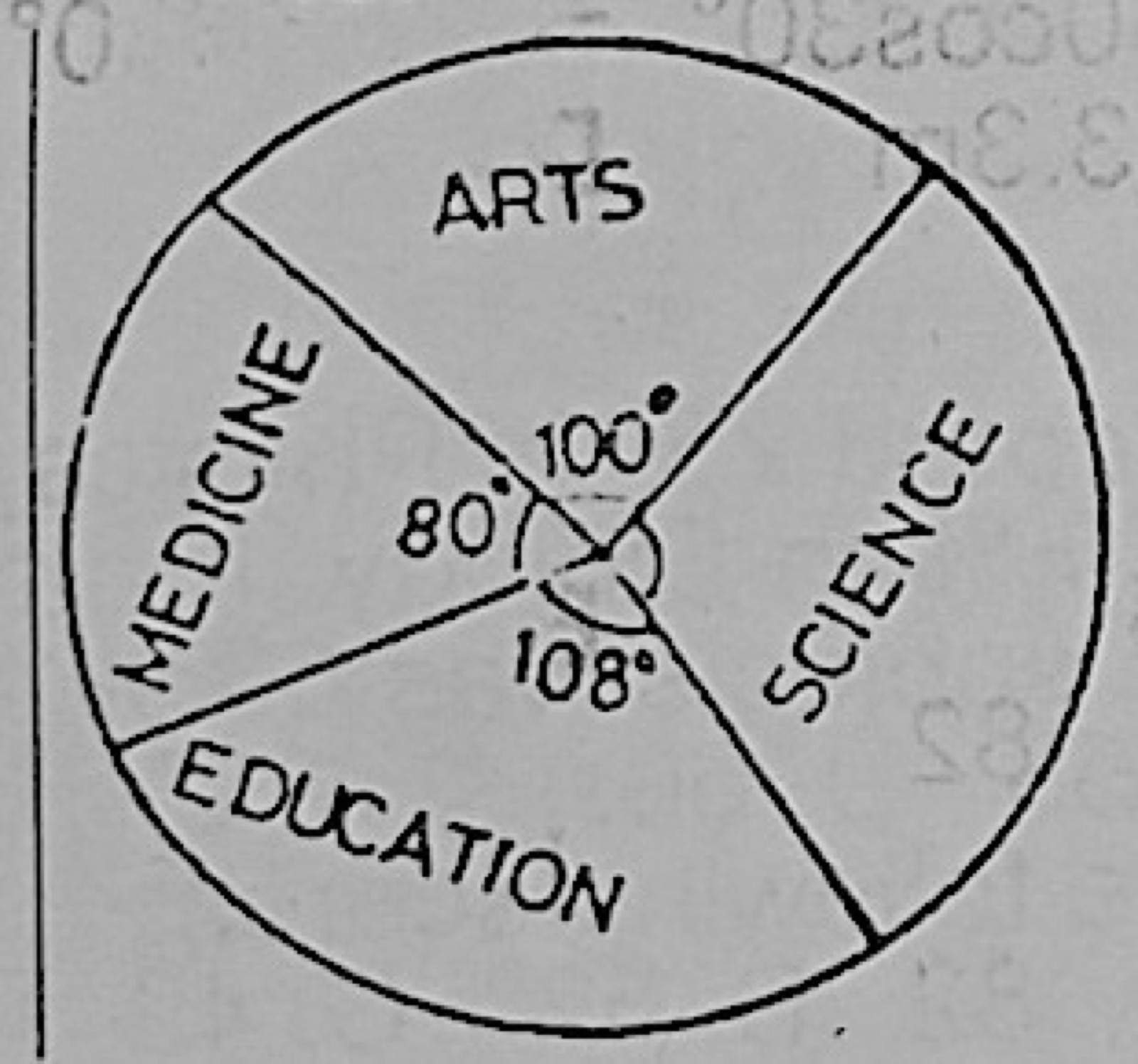
Answer: D (7/10)
Education has 108° of 360°, i.e. 3/10. So P(not Education) = 1 − 3/10 = 7/10.
Simplify: ½√32 − √18 + √2.
Answer: A (0)
½√32 = 2√2 and √18 = 3√2, so 2√2 − 3√2 + √2 = 0.
From the diagram, which of the following statements is/are correct?
I. XQ is a radius of a circle centre Q.
II. |XQ| = |QY|
III. |QX| = |XY|
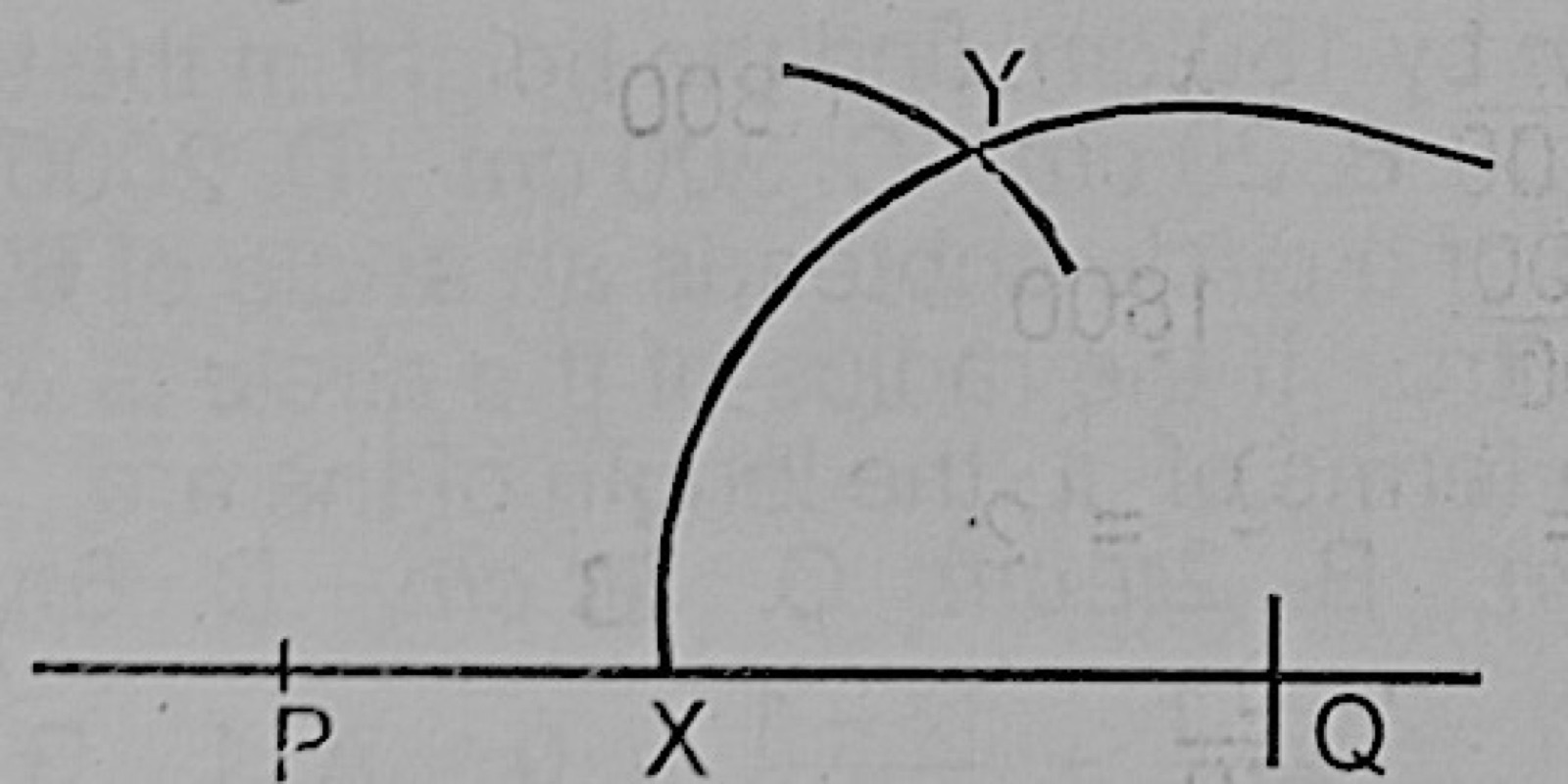
Answer: D (I, II and III.)
The large arc is drawn with centre Q and radius QX, so I is true and QY = QX (II). The small arc cutting it at Y is drawn from X with the same radius, so XY = QX (III).
Find the value of X in the diagram.
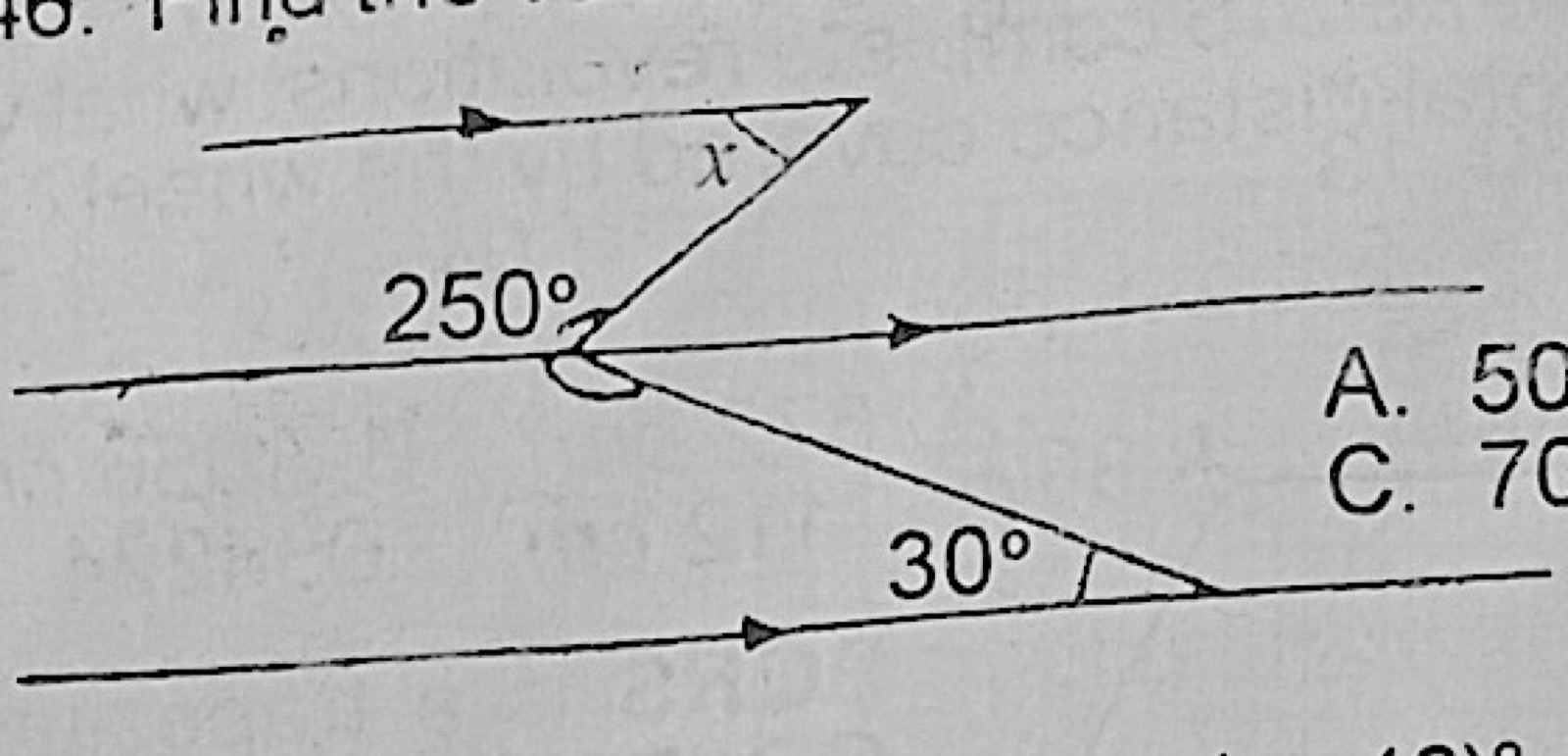
Answer: D (80°)
At the middle vertex the angle between the two arms (on the right) is 360° − 250° = 110°. Split it with the parallel line through the vertex: the lower part is 30° (alternate to the 30°), so the upper part is 80°, and x equals it (alternate angles).
The angles of a triangle are (x + 10)°, (2x − 40)° and (3x − 90)°. Which of the following accurately describes the triangle?
Answer: C (It is an equilateral triangle)
6x − 120 = 180 gives x = 50, so the angles are 60°, 60° and 60°: equilateral.
Which shaded region in the following diagrams represents (P ∪ Q) ∩ R?
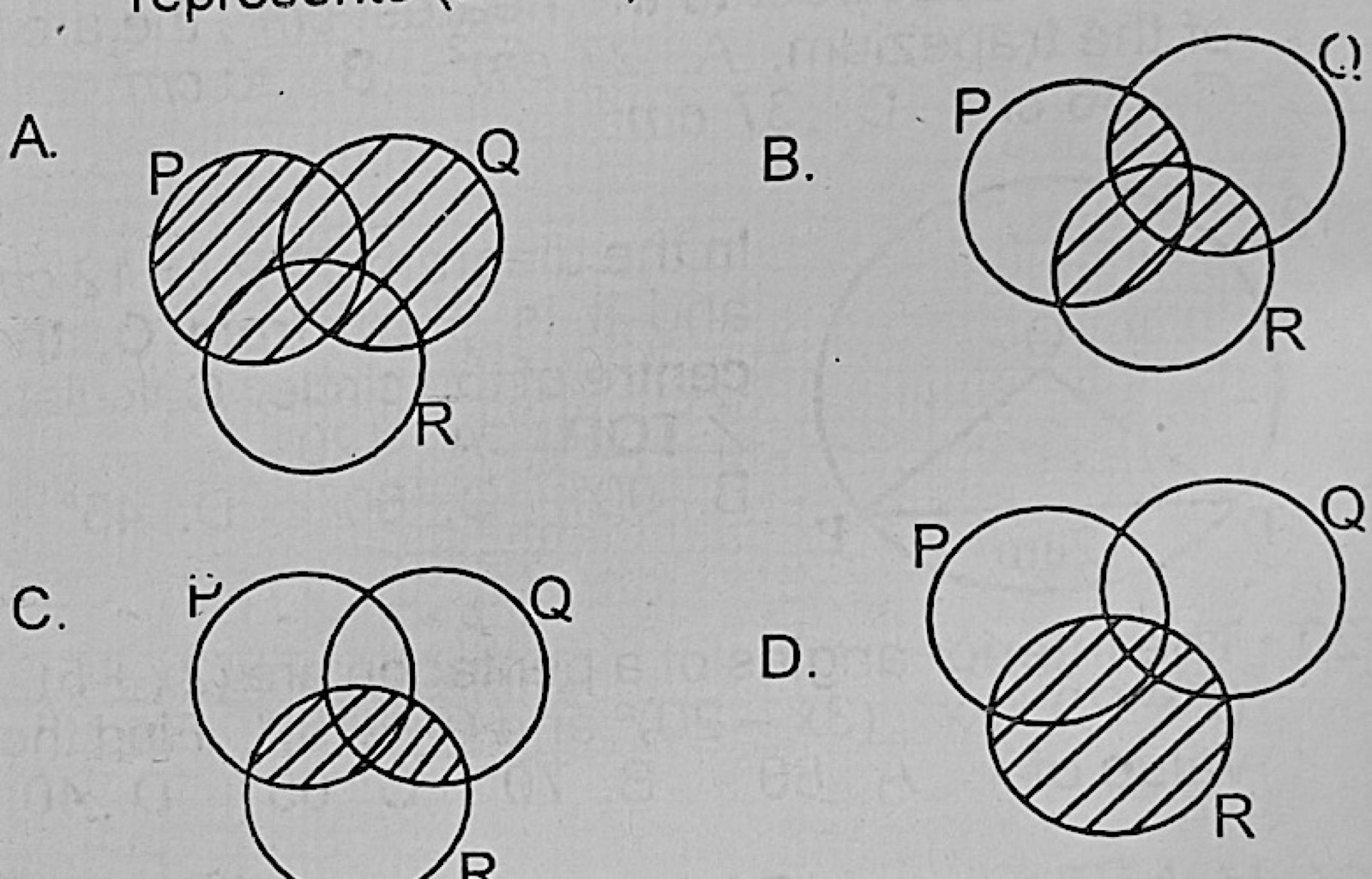
Answer: C (Diagram C)
First take P ∪ Q (everything in P or Q), then keep only the part that is also inside R. That is the top part of circle R overlapping P and Q, as in C.
Simplify: (x − 3y)2 − (x + 3y)2.
Answer: C (−12xy)
(x2 − 6xy + 9y2) − (x2 + 6xy + 9y2) = −12xy.
Find the quadratic equation whose roots are −1/2 and 3.
Answer: D (2x2 − 5x − 3 = 0)
(2x + 1)(x − 3) = 0 gives 2x2 − 5x − 3 = 0.
(a) Given that (√3 − 5√2)(√3 + √2) = a + b√6, find a and b.
(b) If (21−y × 2y−1)/2y+2 = 82−3y, find y.
(a) Expand: 3 + √6 − 5√6 − 5 × 2 = −7 − 4√6, so a = −7 and b = −4.
(b) Left side = 2(1 − y) + (y − 1) − (y + 2) = 2−y − 2; right side = 23(2 − 3y) = 26 − 9y.
−y − 2 = 6 − 9y → 8y = 8 → y = 1.
Write everything as a power of 2 and equate the indices.
(a) If 9 cos x° − 7 = 1 and 0° ≤ x ≤ 90°, find x.
(b) Given that x is an integer, find the three greatest values of x which satisfy the inequality 7x < 2x − 13.
(a) 9 cos x = 8 → cos x = 0.8889 → x ≈ 27.3°.
(b) 5x < −13 → x < −2.6. The three greatest integers are −3, −4 and −5.
Be careful: the greatest integers less than −2.6 are −3, −4, −5.
The table shows the number of children per family in a community.
No. of children: 0, 1, 2, 3, 4, 5
No. of families: 3, 5, 7, 4, 3, 2
(a) Find the: (i) mode; (ii) third quartile; (iii) probability that a family has at least 2 children.
(b) If a pie chart were to be drawn for the data, what would be the sectorial angle representing families with one child?
Total families = 24.
(a)(i) Mode = 2 children (highest frequency, 7).
(ii) Third quartile = ¾ × 24 = 18th family. Cumulative frequencies 3, 8, 15, 19, …, so the 18th family has 3 children: Q3 = 3.
(iii) At least 2 children: 7 + 4 + 3 + 2 = 16. P = 16/24 = 2/3.
(b) 5/24 × 360° = 75°.
Use cumulative frequency to locate the quartile.
(a) Out of 30 candidates applying for a post, 17 have degrees, 15 diplomas and 4 neither degree nor diploma. How many of them have both?
(b) In triangle PQR, M and N are points on the sides PQ and PR respectively such that MN is parallel to QR. If ∠PRQ = 75°, PN = QN and ∠PNQ = 125°, determine (i) ∠NQR; (ii) ∠NPM.
(a) 30 − 4 = 26 have at least one. Both = 17 + 15 − 26 = 6.
(b)(i) PNR is a straight line, so ∠QNR = 180° − 125° = 55°. In ΔNQR: ∠NQR = 180° − 55° − 75° = 50°.
(ii) ΔPNQ is isosceles (PN = QN), so ∠NPQ = ∠NQP = (180° − 125°)/2 = 27.5°. M is on PQ, so ∠NPM = 27.5°.
Use n(D ∪ Dip) = n(D) + n(Dip) − n(both).
In the diagram, ABCDEF is a triangular prism. ∠ABC = ∠DEF = 90°, |AB| = 24 cm, |BC| = 7 cm and |CD| = 40 cm. Calculate: (a) |AC|; (b) the total surface area of the prism.
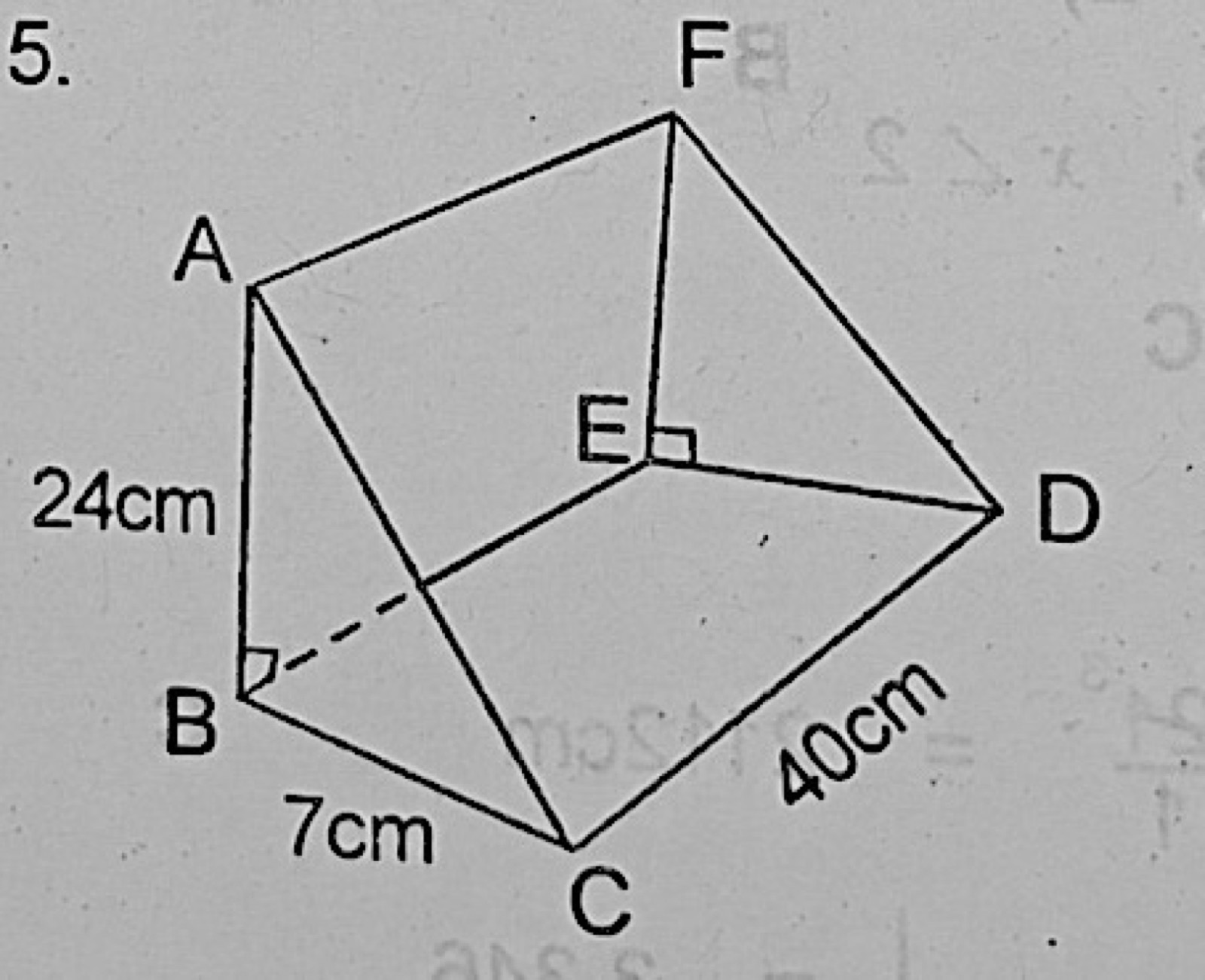
(a) |AC| = √(242 + 72) = √625 = 25 cm.
(b) Two triangular ends: 2 × ½ × 24 × 7 = 168 cm2.
Three rectangles: 40 × (24 + 7 + 25) = 40 × 56 = 2240 cm2.
Total surface area = 2408 cm2.
The rectangular faces together equal the perimeter of the triangle times the length.
(a) If log 5 = 0.6990, log 7 = 0.8451 and log 8 = 0.9031, calculate: log ((35 × 49)/(40 ÷ 56))
(b) For a musical show, x children were present. There were 60 more adults than children. An adult paid D5 and a child D2. If a total of D1280 was collected, calculate the (i) value of x; (ii) ratio of the number of children to the number of adults; (iii) average amount paid per person; (iv) percentage profit if the organisers spent D720 on the show.
(a) (35 × 49)/(40 ÷ 56) = (5 × 7)(72)(8 × 7)/(8 × 5) = 74.
log 74 = 4 × 0.8451 = 3.3804.
(b)(i) 2x + 5(x + 60) = 1280 → 7x = 980 → x = 140.
(ii) Children : adults = 140 : 200 = 7 : 10.
(iii) 1280 ÷ 340 ≈ D3.76 per person.
(iv) Profit = 1280 − 720 = D560; percentage = 560/720 × 100% ≈ 77.8%.
Break each number into prime factors before using the logs.
(a) A woman looking out from the window of a building at a height of 30 m, observed that the angle of depression of the top of a flag pole was 44°. If the foot of the pole is 25 m from the foot of the building and on the same horizontal ground, find, correct to the nearest whole number, the (i) angle of depression of the foot of the pole from the woman; (ii) height of the flag pole.
(b) In the diagram, O is the centre of the circle, ∠OQR = 32° and ∠TPQ = 15°. Calculate: (i) ∠QPR; (ii) ∠TQO.
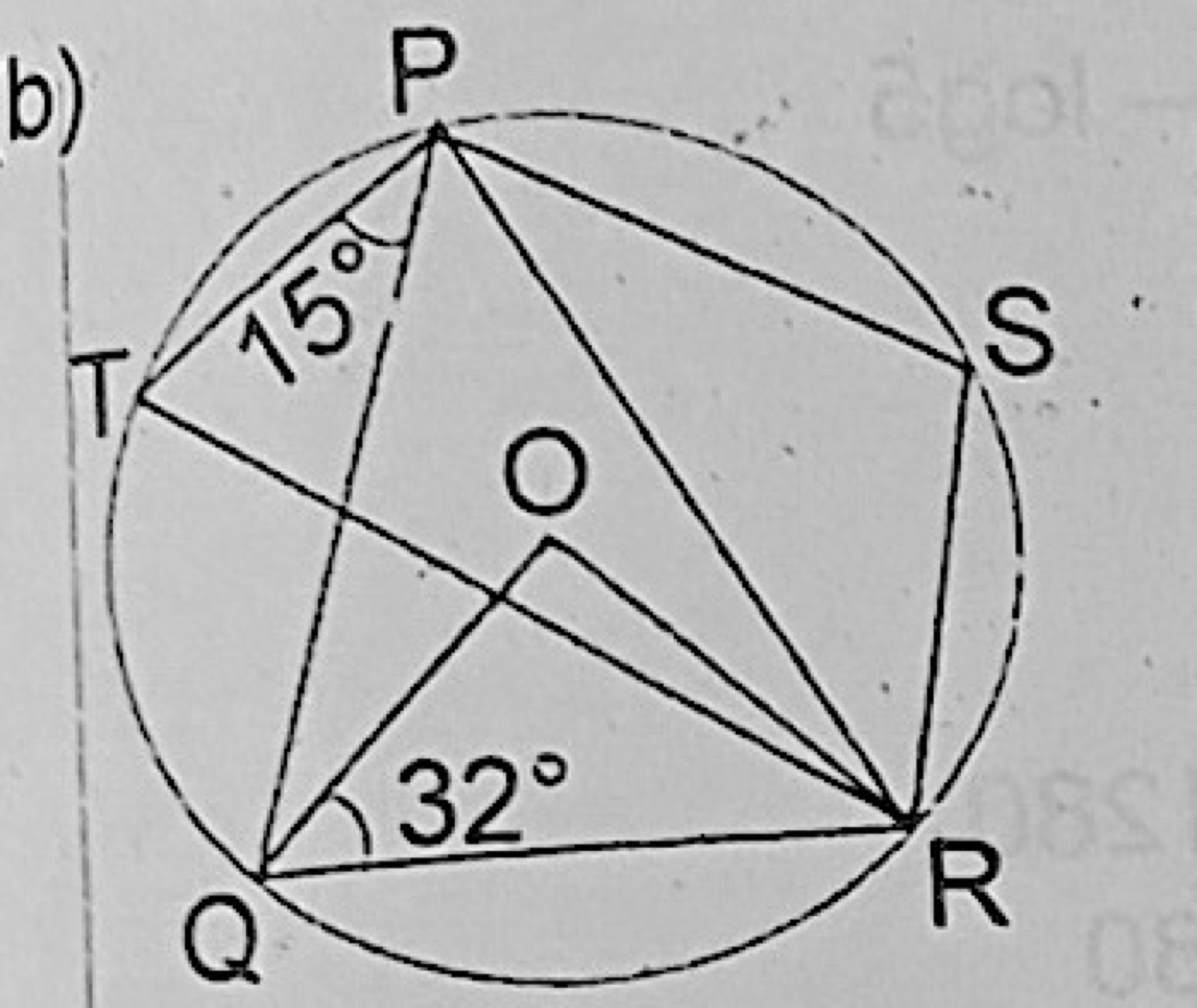
(a)(i) tan θ = 30/25 = 1.2 → θ ≈ 50°.
(ii) Drop from the window to the level of the pole's top: 30 − h = 25 tan 44° ≈ 24.14, so h ≈ 5.86 ≈ 6 m.
(b)(i) OQ = OR, so ∠ORQ = 32° and ∠QOR = 180° − 64° = 116°. ∠QPR = ½ × 116° = 58°.
(ii) ∠TOQ = 2 × ∠TPQ = 30°. OT = OQ, so ∠TQO = (180° − 30°)/2 = 75°.
Radii make isosceles triangles; the angle at the centre is twice the angle at the circumference.
The marks scored by 50 students in a Geography examination are as follows:
60 54 40 67 53 73 37 55 62 43
44 69 39 32 45 58 48 67 39 51
46 59 40 52 61 48 23 60 59 47
65 58 74 47 40 59 68 51 50 50
71 51 26 36 38 70 46 40 51 42
(a) Using class intervals 21 − 30, 31 − 40, …, prepare a frequency distribution table.
(b) Calculate the mean mark of the distribution.
(c) What percentage of the students scored more than 60%?
(a) 21–30: 2; 31–40: 10; 41–50: 12; 51–60: 15; 61–70: 8; 71–80: 3 (total 50).
(b) Class marks 25.5, 35.5, 45.5, 55.5, 65.5, 75.5: Σfx = 51 + 355 + 546 + 832.5 + 524 + 226.5 = 2535. Mean = 2535/50 = 50.7.
(c) Marks above 60: 11 students (from the list). 11/50 × 100% = 22%.
Check the frequencies add up to 50 before working out the mean.
(a) Simplify (x + 2)/(x − 2) − (x + 3)/(x − 1)
(b) The graph of the equation y = Ax2 + Bx + C passes through the points (0, 0), (1, 4) and (2, 10). Find the: (i) value of C; (ii) values of A and B; (iii) co-ordinates of the other point where the graph cuts the x-axis.
(a) [(x + 2)(x − 1) − (x + 3)(x − 2)]/[(x − 2)(x − 1)] = [(x2 + x − 2) − (x2 + x − 6)]/[(x − 2)(x − 1)] = 4/[(x − 2)(x − 1)].
(b)(i) (0, 0): C = 0.
(ii) A + B = 4 and 4A + 2B = 10 → 2A = 2 → A = 1, B = 3.
(iii) y = x2 + 3x = x(x + 3) = 0 → the other point is (−3, 0).
Substitute each point into the equation to get simultaneous equations.
(a) Using ruler and a pair of compasses only, construct: (i) quadrilateral PQRS such that |PQ| = 10 cm, |QR| = 8 cm, |PS| = 6 cm, ∠PQR = 60° and ∠QPS = 75°; (ii) the locus l1 of points equidistant from QR and RS; (iii) locus l2 of points equidistant from R and S.
(b) Measure |RS|.
(a)(i) Draw PQ = 10 cm. Construct 60° at Q and mark QR = 8 cm; construct 75° at P (60° + half of 30°) and mark PS = 6 cm. Join RS.
(ii) l1 is the bisector of ∠QRS.
(iii) l2 is the perpendicular bisector of RS.
(b) |RS| ≈ 4.6 cm.
Points equidistant from two lines lie on the bisector of the angle between them.
(a) A circle is inscribed in a square. If the sum of the perimeter of the square and the circumference of the circle is 100 cm, calculate the radius of the circle. [Take π = 22/7]
(b) A rope 60 cm long is made to form a rectangle. If the length is 4 times its breadth, calculate, correct to one decimal place, the (i) length; (ii) diagonal of the rectangle.
(a) The square's side is 2r. 8r + 2 × 22/7 × r = 100 → r(56 + 44)/7 = 100 → r = 7 cm.
(b) 2(l + b) = 60 and l = 4b → 10b = 60 → b = 6 cm.
(i) l = 24.0 cm.
(ii) Diagonal = √(242 + 62) = √612 ≈ 24.7 cm.
A circle inscribed in a square has diameter equal to the side of the square.
(a) Copy and complete the table of values for y = sin x + 2 cos x, correct to one decimal place.
x: 0°, 30°, 60°, 90°, 120°, 150°, 180°, 210°, 240°
y: __, 2.2, __, __, __, −1.2, −2.0, __, −1.9
(b) Using a scale of 2 cm to 30° on the x-axis and 2 cm to 0.5 units on the y-axis, draw the graph of y = sin x + 2 cos x for 0° ≤ x ≤ 240°.
(c) Use your graph to solve the equation: (i) sin x + 2 cos x = 0; (ii) sin x = 2.1 − 2 cos x.
(d) From the graph, find y when x = 171°.
(a) 0°: 2.0; 60°: 1.9; 90°: 1.0; 120°: −0.1; 210°: −2.2 (given: 30°: 2.2, 150°: −1.2, 180°: −2.0, 240°: −1.9).
(b) Plot and join with a smooth curve.
(c)(i) Where the curve crosses the x-axis: x ≈ 117°.
(ii) Rewrite as sin x + 2 cos x = 2.1; draw y = 2.1: x ≈ 7° and x ≈ 47°.
(d) At x = 171°, y ≈ −1.8.
(Accept graph readings close to these.)
For (c)(ii), move 2 cos x to the left so the equation matches the graph.
(a) How many numbers between 75 and 500 are divisible by 7?
(b) The 8th term of an Arithmetic Progression (A.P) is 5 times the third term while the 7th term is 9 greater than the 4th term. Write the first five terms of the A.P.
(a) The multiples of 7 run from 77 (7 × 11) to 497 (7 × 71): 71 − 11 + 1 = 61 numbers.
(b) a + 7d = 5(a + 2d) → 4a = −3d. (a + 6d) − (a + 3d) = 9 → d = 3, so a = −9/4.
First five terms: −2¼, ¾, 3¾, 6¾, 9¾.
Count multiples of 7 as an AP from 77 to 497 with difference 7.
(Questions 14 and 15 are for candidates in Ghana, Sierra Leone and The Gambia only.)
(a) Copy and complete the multiplication table modulo 5 on the set {1, 2, 3, 4}.
(b) From your table; (i) solve the expression 2n * 4 ≡ 3; (ii) find the value of n for which 2 * (3 * n) ≡ 2.
(c) The functions f and g are defined as f : x → x − 2 and g : x → 2x2 − 1. Solve: (i) f(x) = g(−1/2); (ii) f(x) + g(x) = 0.
(a) Rows (× 1, 2, 3, 4): 1: 1, 2, 3, 4; 2: 2, 4, 1, 3; 3: 3, 1, 4, 2; 4: 4, 3, 2, 1.
(b)(i) 2n * 4 = 8n ≡ 3n ≡ 3 (mod 5), so n = 1.
(ii) 2 * (3 * n) = 6n ≡ n ≡ 2, so n = 2.
(c)(i) g(−½) = 2(¼) − 1 = −½. x − 2 = −½ → x = 3/2.
(ii) x − 2 + 2x2 − 1 = 0 → 2x2 + x − 3 = 0 → (2x + 3)(x − 1) = 0 → x = 1 or x = −3/2.
In modulo 5, replace each product by its remainder on division by 5.
(a) P(7, 4) is a vertex of triangle PQR. If QP = (3, 5) and PR = (−3, 4), find: (i) the co-ordinates of Q; (ii) PN where N is the midpoint of QR.
(b) A straight line passes through the points (1, 4) and (3, 0). Find the (i) gradient; (ii) equation of the line.
(a)(i) Q = P − QP = (7 − 3, 4 − 5) = (4, −1).
(ii) R = P + PR = (4, 8). N = midpoint of QR = (4, 3.5). PN = (4 − 7, 3.5 − 4) = (−3, −0.5).
(b)(i) Gradient = (0 − 4)/(3 − 1) = −2.
(ii) y − 4 = −2(x − 1) → y = −2x + 6.
A vector QP = (position of P) − (position of Q).