WAEC Mathematics 2003 past questions and answers

56 questions. Try each one, then open the answer to check yourself and read the explanation.

Question 2

Measures of Central Tendency

The table below gives the distribution of marks obtained by a number of pupils in a class test.
Marks: 0, 1, 2, 3, 4, 5
Frequency: 4, 7, 12, 18, 11, 8
The mode of the distribution is

  1. A.3
  2. B.5
  3. C.8
  4. D.18
Show the answer and explanation

Answer: A (3)

Explanation

The mode is the mark with the highest frequency: 3 marks (18 pupils).

Open this question

Question 3

Measures of Central Tendency

The table below gives the distribution of marks obtained by a number of pupils in a class test.
Marks: 0, 1, 2, 3, 4, 5
Frequency: 4, 7, 12, 18, 11, 8
Find the median of the distribution

  1. A.1
  2. B.2
  3. C.3
  4. D.4
Show the answer and explanation

Answer: C (3)

Explanation

There are 60 pupils, so the median is between the 30th and 31st. The cumulative frequencies are 4, 11, 23, 41, so both have 3 marks: median = 3.

Open this question

Question 4

Measures of Central Tendency

The table below gives the distribution of marks obtained by a number of pupils in a class test.
Marks: 0, 1, 2, 3, 4, 5
Frequency: 4, 7, 12, 18, 11, 8
How many pupils scored at least 2 marks?

  1. A.12
  2. B.23
  3. C.37
  4. D.49
Show the answer and explanation

Answer: D (49)

Explanation

At least 2 means 2, 3, 4 or 5 marks: 12 + 18 + 11 + 8 = 49.

Open this question

Question 5

Inequalities

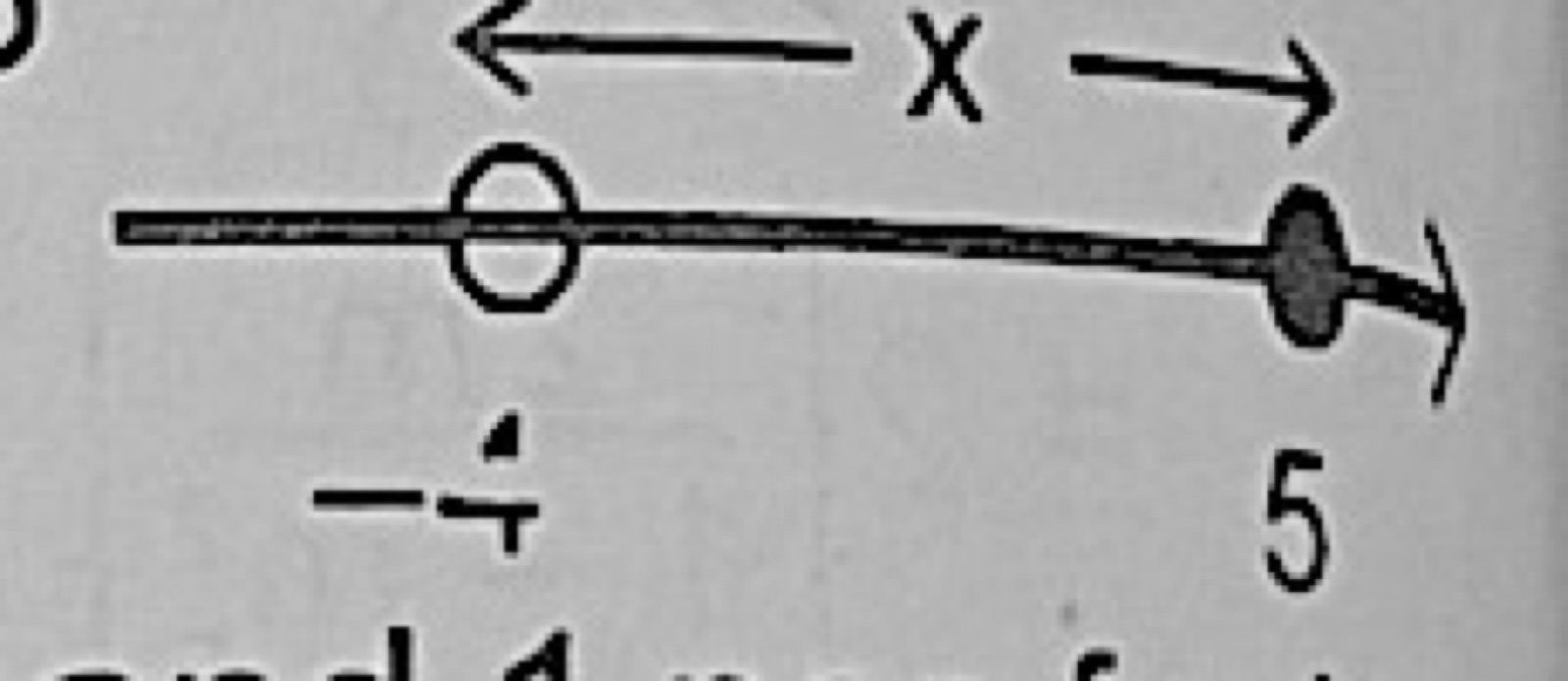
Interprete the inequality represented on the number line

Diagram for this question
  1. A.−4 < x ≤ 5
  2. B.−4 ≤ x < 5
  3. C.−4 < x < 5
  4. D.−4 ≤ x ≤ 5
Show the answer and explanation

Answer: A (−4 < x ≤ 5)

Explanation

The circle at −4 is open (−4 not included) and the dot at 5 is shaded (5 included): −4 < x ≤ 5.

Open this question

Question 6

Linear and Simultaneous Equations

A student bought 3 notebooks and 1 pen for N35. After misplacing these items, she again bought 2 notebooks and 2 pens, all of the same type for N30. What is the cost of a pen?

  1. A.N5.00
  2. B.N7.50
  3. C.N10.00
  4. D.N15.00
Show the answer and explanation

Answer: A (N5.00)

Explanation

3n + p = 35 and 2n + 2p = 30 (n + p = 15). Subtracting: 2n = 20, n = 10, so p = 5.

Open this question

Question 7

Algebraic Expressions

Simplify 4/(a − 3) − 1/(a + 2)

  1. A.(3a + 11)/((a − 3)(a − 2))
  2. B.(3a + 11)/((a + 3)(a − 2))
  3. C.(3a + 11)/((a + 3)(a + 2))
  4. D.(3a + 11)/((a − 3)(a + 2))
Show the answer and explanation

Answer: D ((3a + 11)/((a − 3)(a + 2)))

Explanation

4(a + 2) − (a − 3) = 3a + 11 over the common denominator (a − 3)(a + 2).

Open this question

Question 8

Surds

Simplify 4√18/√8

  1. A.2
  2. B.3
  3. C.6
  4. D.12
Show the answer and explanation

Answer: C (6)

Explanation

√18/√8 = √(9/4) = 3/2, so 4 × 3/2 = 6.

Open this question

Question 9

Angles and Polygons

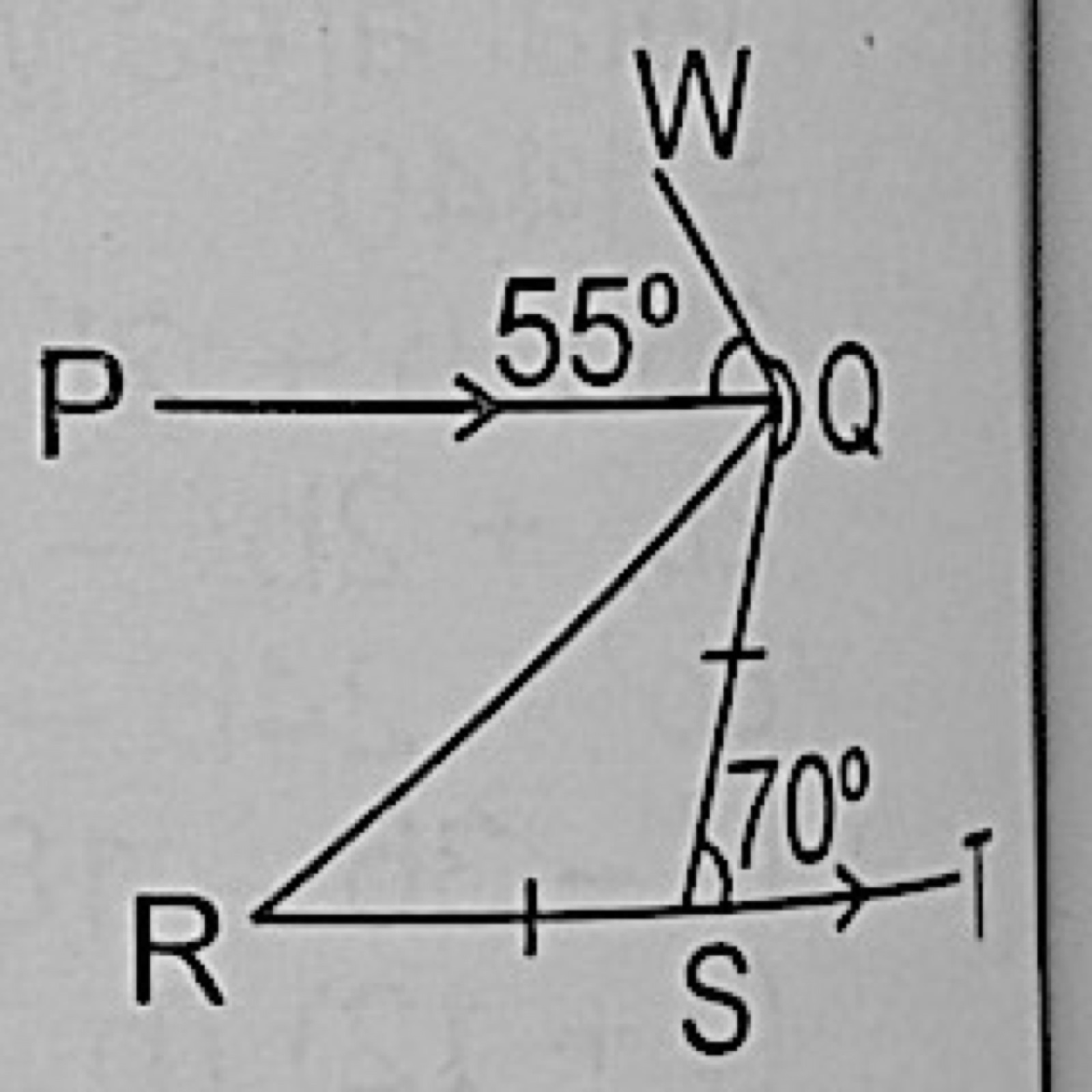
In the diagram, PQ||RT, |RS| = |QS|, ∠QST = 70° and ∠PQW = 55°. Find the size of reflex ∠WQS

Diagram for this question
  1. A.235°
  2. B.290°
  3. C.305°
  4. D.325°
Show the answer and explanation

Answer: A (235°)

Explanation

∠PQS = ∠QST = 70° (alternate angles, PQ ∥ RT). The non-reflex ∠WQS = 55° + 70° = 125°, so the reflex angle = 360° − 125° = 235°.

Open this question

Question 10

Ratio, Percentages and Rates

Three men, Bedu, Bakre and Kofi shared N500 in the ratio 3:2: x respectively. If Bedu's share is N150, find the value of x

  1. A.1
  2. B.4
  3. C.5
  4. D.6
Show the answer and explanation

Answer: C (5)

Explanation

3/(5 + x) × 500 = 150, so 5 + x = 10 and x = 5.

Open this question

Question 11

Fractions, Decimals and Approximation

Simplify (1 2/3)2 − (2/3)2

  1. A.2 1/3
  2. B.1 1/3
  3. C.1
  4. D.3/7
Show the answer and explanation

Answer: A (2 1/3)

Explanation

(5/3)2 − (2/3)2 = 25/9 − 4/9 = 21/9 = 2 1/3.

Open this question

Question 12

Linear and Simultaneous Equations

Find the value of x which satisfies the equation 5(x − 7) = 7 − 2x

  1. A.x = 2
  2. B.x = 4
  3. C.x = 6
  4. D.x = 14
Show the answer and explanation

Answer: C (x = 6)

Explanation

5x − 35 = 7 − 2x, so 7x = 42 and x = 6.

Open this question

Question 14

Mensuration of Solids

A pyramid of volume 120cm3 has a rectangular base which measures 5cm by 6cm. Calculate the height of the pyramid

  1. A.5cm
  2. B.9cm
  3. C.12cm
  4. D.15cm
Show the answer and explanation

Answer: C (12cm)

Explanation

V = ⅓ × 30 × h = 10h = 120, so h = 12 cm.

Open this question

Question 15

Circle Theorems

PQRS is a cyclic quadrilateral. If ∠QPS = 75°, what is the size of ∠QRS?

  1. A.180°
  2. B.150°
  3. C.105°
  4. D.75°
Show the answer and explanation

Answer: C (105°)

Explanation

Opposite angles of a cyclic quadrilateral add to 180°: 180 − 75 = 105°.

Open this question

Question 16

Angles and Polygons

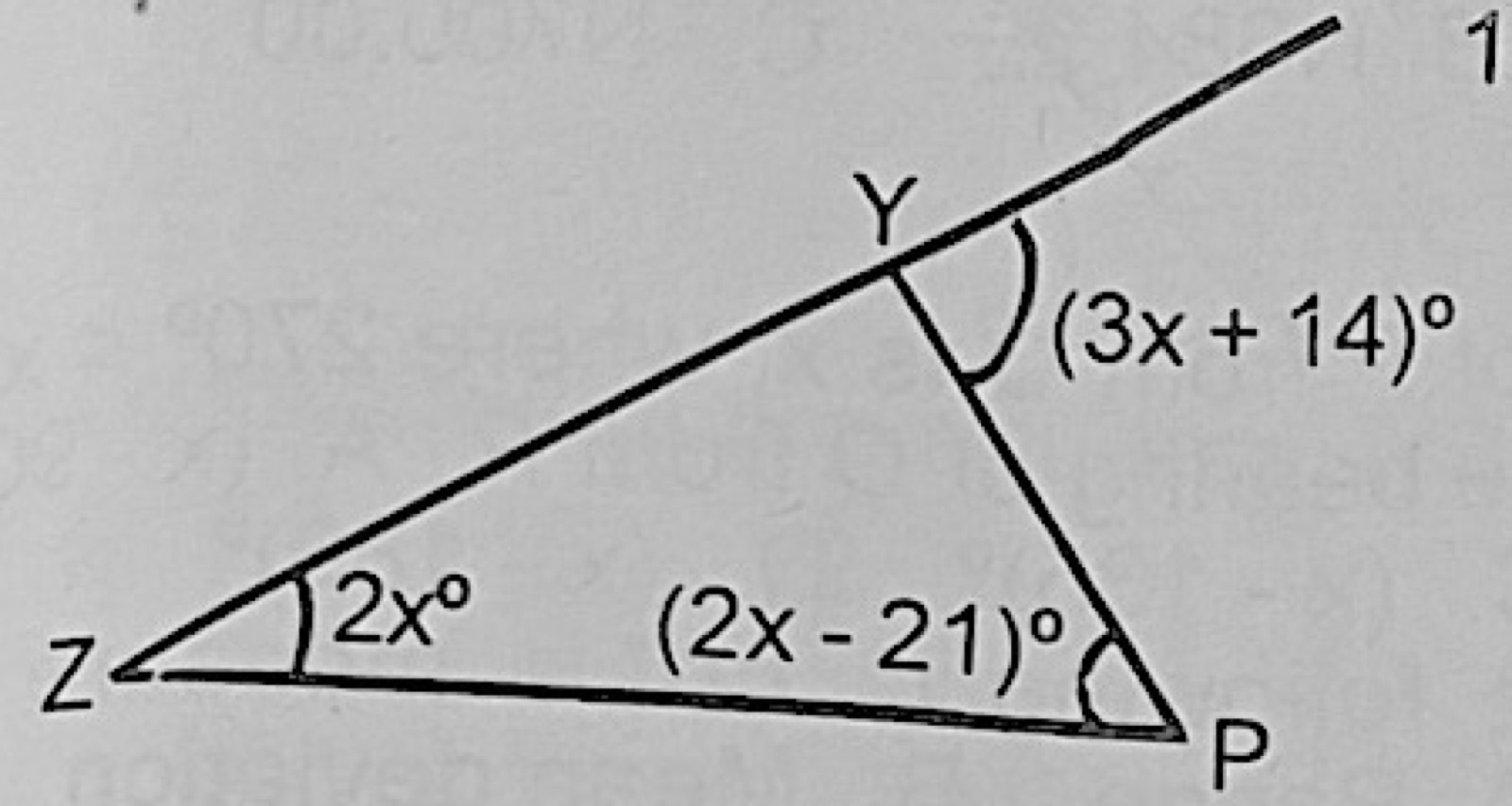
In the diagram, ZM is a straight line. Calculate the value of x.

Diagram for this question
  1. A.27°
  2. B.30°
  3. C.35°
  4. D.37°
Show the answer and explanation

Answer: C (35°)

Explanation

The exterior angle at Y equals the sum of the opposite interior angles: 3x + 14 = 2x + (2x − 21), so x = 35°.

Open this question

Question 17

Quadratic Equations

Find the value of x in the equation 3x2 − 8x − 3 = 0

  1. A.1/3, −3
  2. B.−1/3, −3
  3. C.−1/3, 3
  4. D.1/3, 3
Show the answer and explanation

Answer: C (−1/3, 3)

Explanation

3x2 − 8x − 3 = (3x + 1)(x − 3) = 0, so x = −1/3 or 3.

Open this question

Question 18

Trigonometry

In ΔPQR, ∠PQR = 84°, ∠QPR = 43° and |PQ| = 5cm. Find |QR| in cm, correct to 1 decimal place.

  1. A.3.4
  2. B.4.3
  3. C.5.9
  4. D.6.2
Show the answer and explanation

Answer: B (4.3)

Explanation

∠R = 180 − 84 − 43 = 53°. Sine rule: QR = 5 sin 43°/sin 53° = 5 × 0.6820/0.7986 ≈ 4.3 cm.

Open this question

Question 19

Number Bases

Given, that 4P45 = 11910, find the value of P

  1. A.1
  2. B.2
  3. C.3
  4. D.4
Show the answer and explanation

Answer: C (3)

Explanation

4 × 25 + 5P + 4 = 119, so 5P = 15 and P = 3.

Open this question

Question 20

Trigonometry

A ladder, 6m long, leans against a vertical wall at an angle 53° to the horizontal. How high up the wall does the ladder reach?

  1. A.3.611m
  2. B.4.521m
  3. C.4.792m
  4. D.7.962m.
Show the answer and explanation

Answer: C (4.792m)

Explanation

Height = 6 sin 53° = 6 × 0.7986 ≈ 4.792 m.

Open this question

Question 21

Triangles and Quadrilaterals

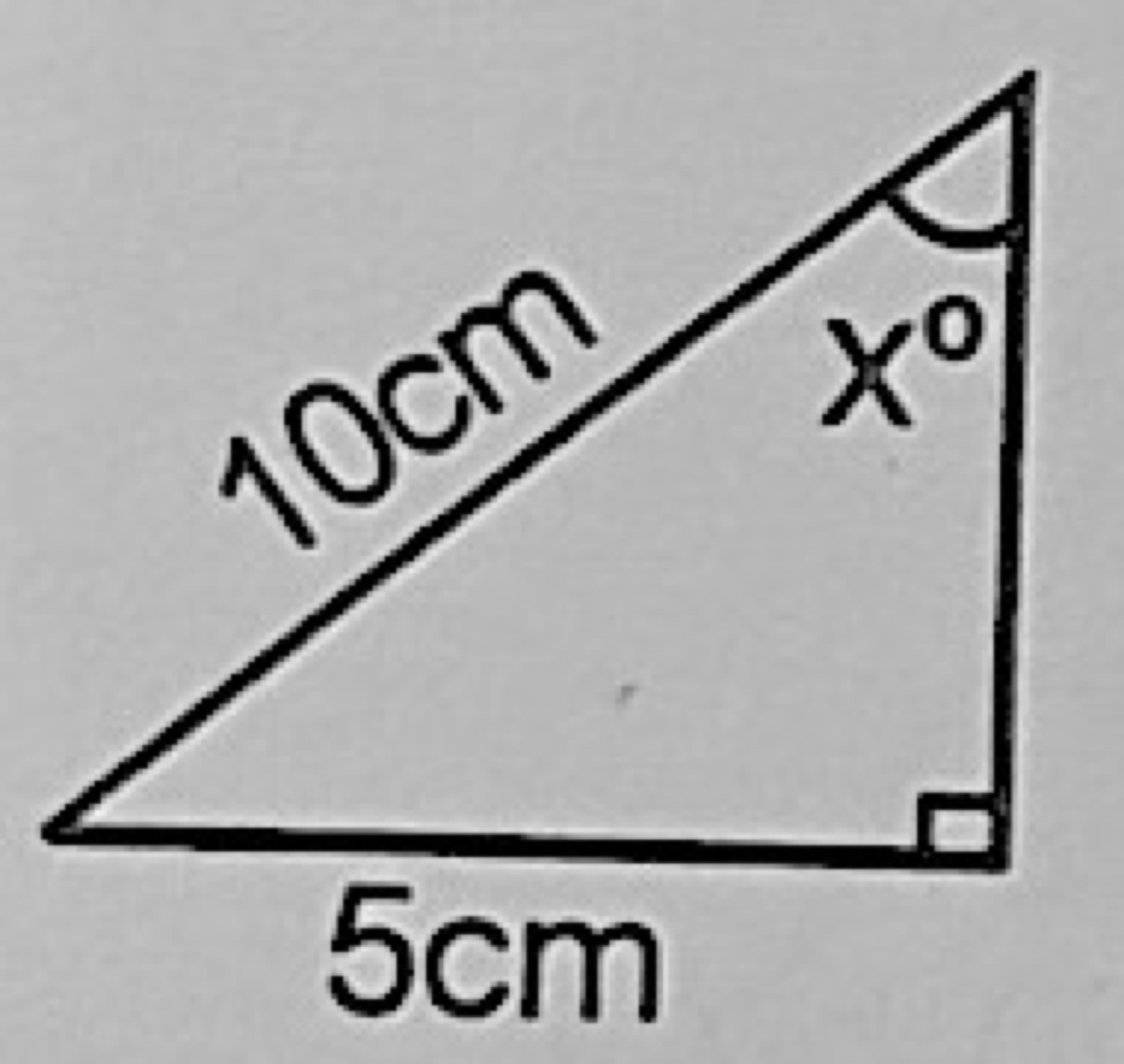
What is the size of angle x in the diagram?

Diagram for this question
  1. A.15°
  2. B.30°
  3. C.45°
  4. D.60°
Show the answer and explanation

Answer: B (30°)

Explanation

The 5 cm side is opposite x and the hypotenuse is 10 cm: sin x = 5/10 = 0.5, so x = 30°.

Open this question

Question 22

Angles and Polygons

The four interior angles of a quadrilateral are (x + 20)°, (x + 10)° (2x − 45)° and (x − 25)°. Find the value of x

  1. A.60
  2. B.80
  3. C.100
  4. D.360
Show the answer and explanation

Answer: B (80)

Explanation

The angles add to 360°: 5x − 40 = 360, so x = 80.

Open this question

Question 23

Triangles and Quadrilaterals

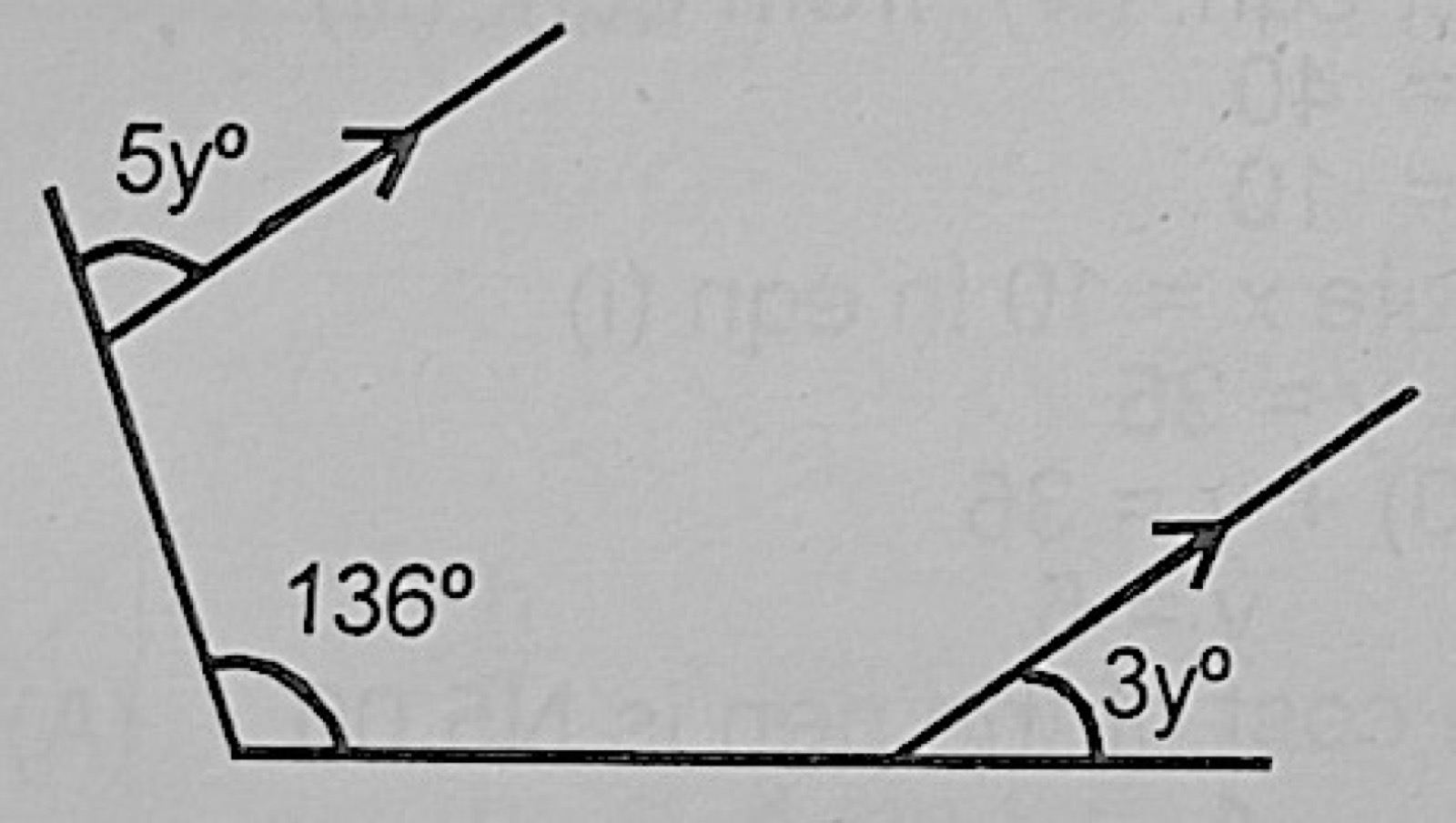
Calculate the value of y in the diagram

Diagram for this question
  1. A.17
  2. B.34
  3. C.44
  4. D.45
Show the answer and explanation

Answer: A (17)

Explanation

Through the 136° corner draw a line parallel to the two arrowed lines; the two parts of 136° are 5y and 3y (alternate angles), so 8y = 136 and y = 17.

Open this question

Question 24

Probability

Out of 60 members of an Association, 15 are Doctors and 9 are Lawyers. If a member is selected at random from the Association, what is the probability that the member is neither a Doctor nor a Lawyer?

  1. A.3/5
  2. B.9/10
  3. C.3/20
  4. D.1/4
Show the answer and explanation

Answer: A (3/5)

Explanation

Assuming no one is both, 60 − 24 = 36 members are neither: 36/60 = 3/5.

Open this question

Question 25

Algebraic Expressions

Find the values of x for which 1/(2x2 − 13x + 15) is not defined,

  1. A.5 or 3/2
  2. B.1 or 15/13
  3. C.2 or 15
  4. D.13 or 15
Show the answer and explanation

Answer: A (5 or 3/2)

Explanation

The denominator 2x2 − 13x + 15 = (2x − 3)(x − 5) is zero when x = 3/2 or 5.

Open this question

Question 26

Triangles and Quadrilaterals

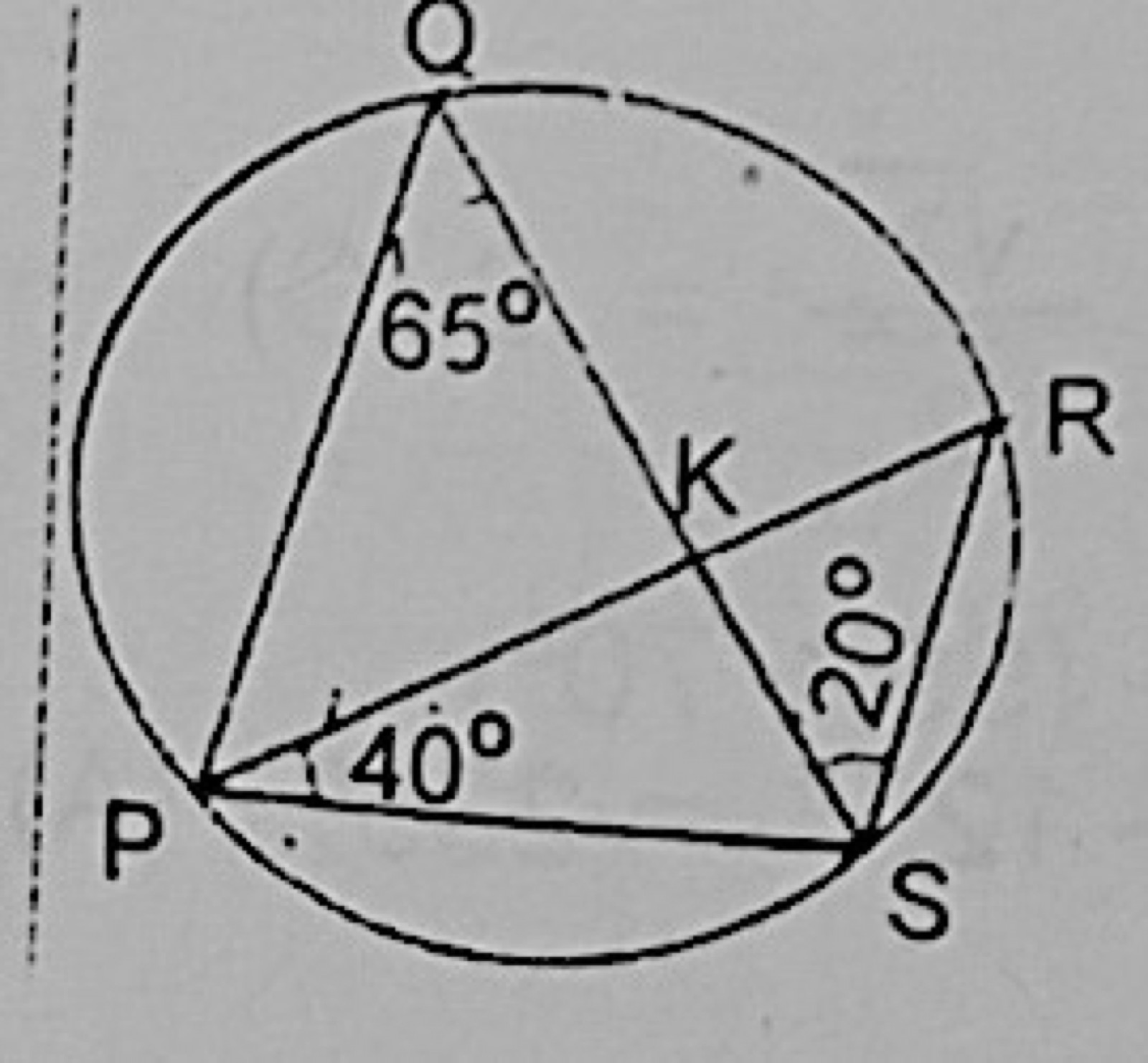
In the diagram, ∠PQS = 65°, ∠RPS = 40° and ∠QSR = 20°. Find ∠PSQ.

Diagram for this question
  1. A.85°
  2. B.60°
  3. C.55°
  4. D.45°
Show the answer and explanation

Answer: C (55°)

Explanation

∠QPR = ∠QSR = 20° (same arc QR), so ∠QPS = 20 + 40 = 60°. In triangle PQS, ∠PSQ = 180 − 65 − 60 = 55°.

Open this question

Question 27

Number Bases

Evaluate (111two)2 − (101two)2

  1. A.10two
  2. B.100two
  3. C.1100two
  4. D.11000two
Show the answer and explanation

Answer: D (11000two)

Explanation

111two = 7 and 101two = 5. 49 − 25 = 24 = 11000two.

Open this question

Question 28

Graphs of Functions

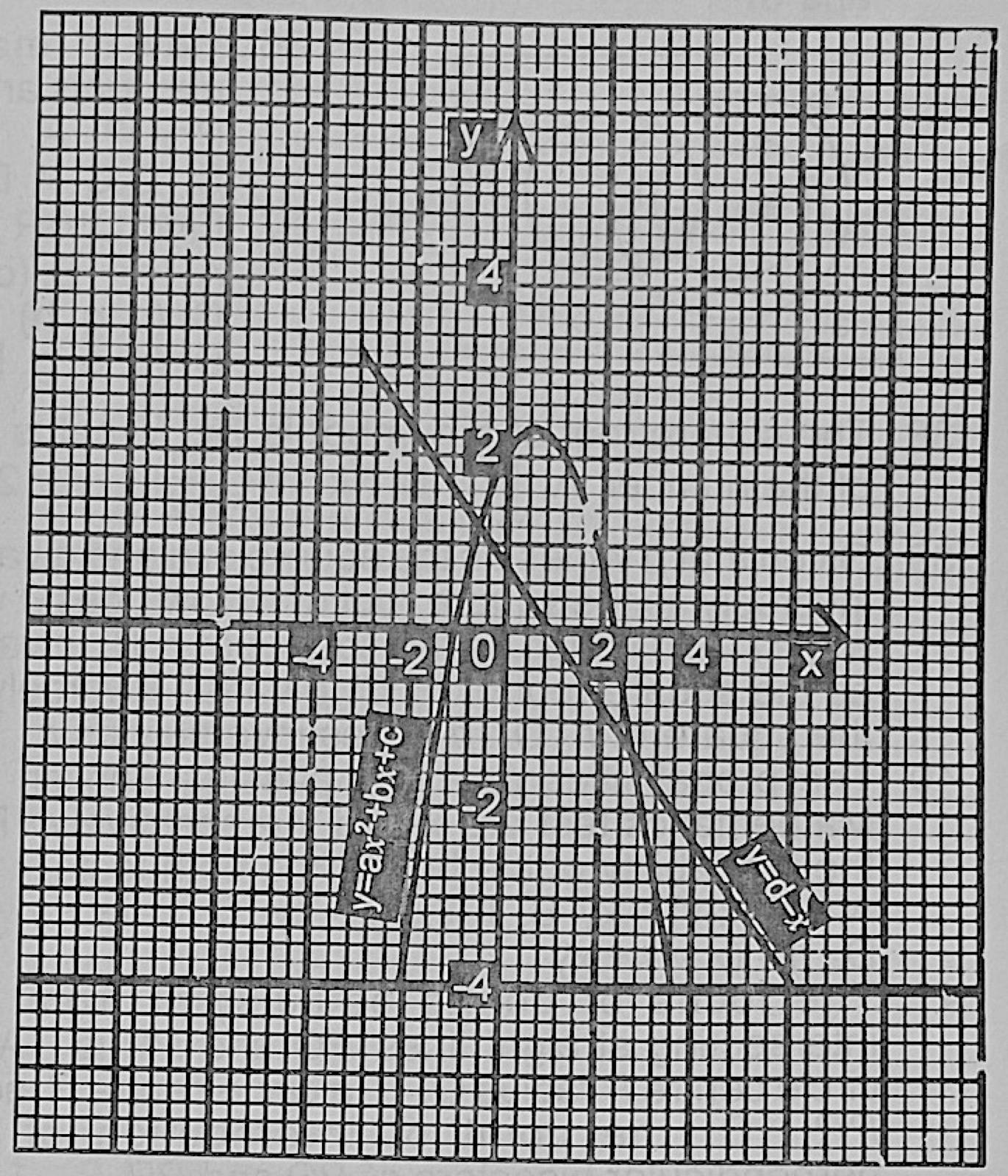
The graphs above are for the relations y = ax2 + bx + c and y = d − x. The equation y = ax2 + bx + c is equivalent to

Diagram for this question
  1. A.y = 2 − x − x2
  2. B.y = 2 − x + x2
  3. C.y = 2 + x − x2
  4. D.y = 2 + x + x2
Show the answer and explanation

Answer: C (y = 2 + x − x2)

Explanation

The curve cuts the x-axis at −1 and 2 and opens downwards, with y = 2 at x = 0: y = −(x + 1)(x − 2) = 2 + x − x2.

Open this question

Question 30

Graphs of Functions

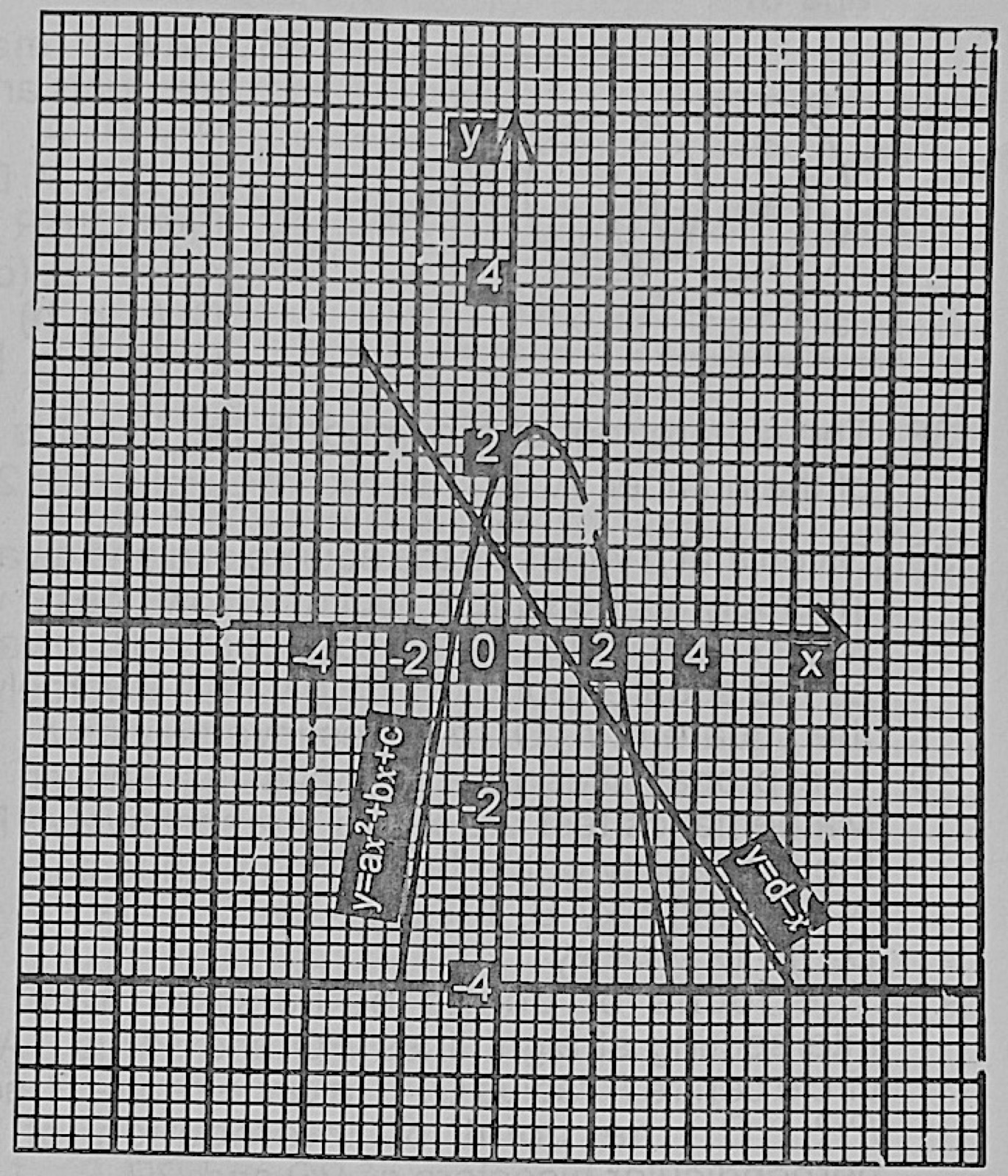
The graphs above are for the relations y = ax2 + bx + c and y = d − x. What are the values of x for which ax2 + bx + c = 0?

Diagram for this question
  1. A.2, 1
  2. B.−2, −1
  3. C.−2, 1
  4. D.−1, 2
Show the answer and explanation

Answer: D (−1, 2)

Explanation

The roots are where the curve crosses the x-axis: x = −1 and x = 2.

Open this question

Question 32

Indices

If 3(1−n)/9−2n = 1/9, find n

  1. A.−3/2
  2. B.1/3
  3. C.−1
  4. D.−3
Show the answer and explanation

Answer: C (−1)

Explanation

9−2n = 3−4n, so 31 − n + 4n = 3−2: 1 + 3n = −2 and n = −1.

Open this question

Question 33

Angles and Polygons

Which of the following is/are not the interior angle(s) of a regular polygon? I. 108° II. 116° III. 120°

  1. A.I only
  2. B.II only
  3. C.III only
  4. D.I and III only
Show the answer and explanation

Answer: B (II only)

Explanation

The exterior angles would be 72°, 64° and 60°. 360 ÷ 64 is not a whole number, so 116° is impossible; 108° (pentagon) and 120° (hexagon) are possible.

Open this question

Question 34

Trigonometry

In a ΔXYZ, |YZ| = 6cm ∠YXZ = 60° and ∠XYZ is a right angle. Calculate |XZ| in cm, leaving your answer in surd form

  1. A.2√3
  2. B.4√3
  3. C.6√3
  4. D.12√3
Show the answer and explanation

Answer: B (4√3)

Explanation

YZ is opposite the 60° angle and XZ is the hypotenuse: XZ = 6/sin 60° = 6 ÷ (√3/2) = 12/√3 = 4√3.

Open this question

Question 36

Sets

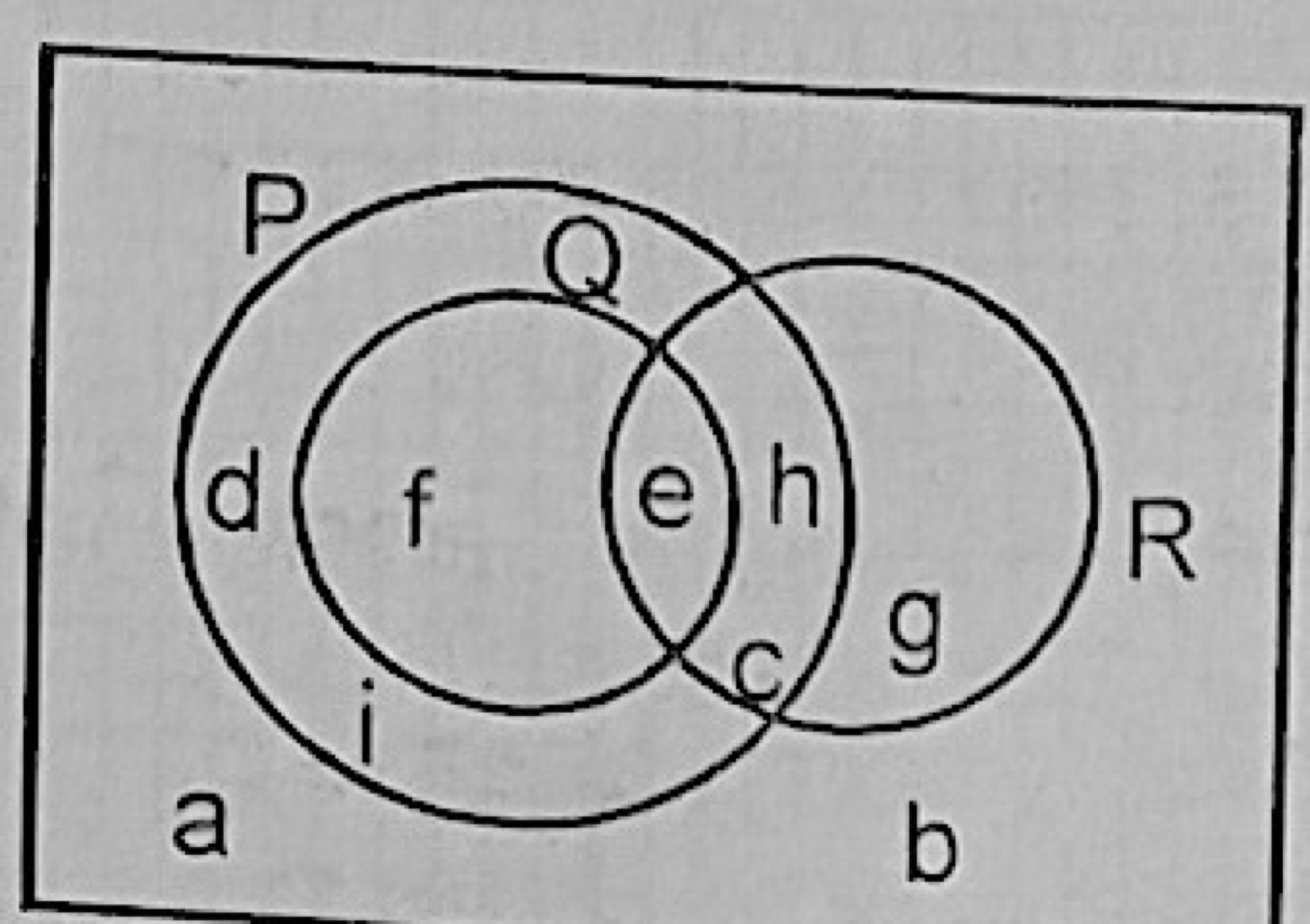
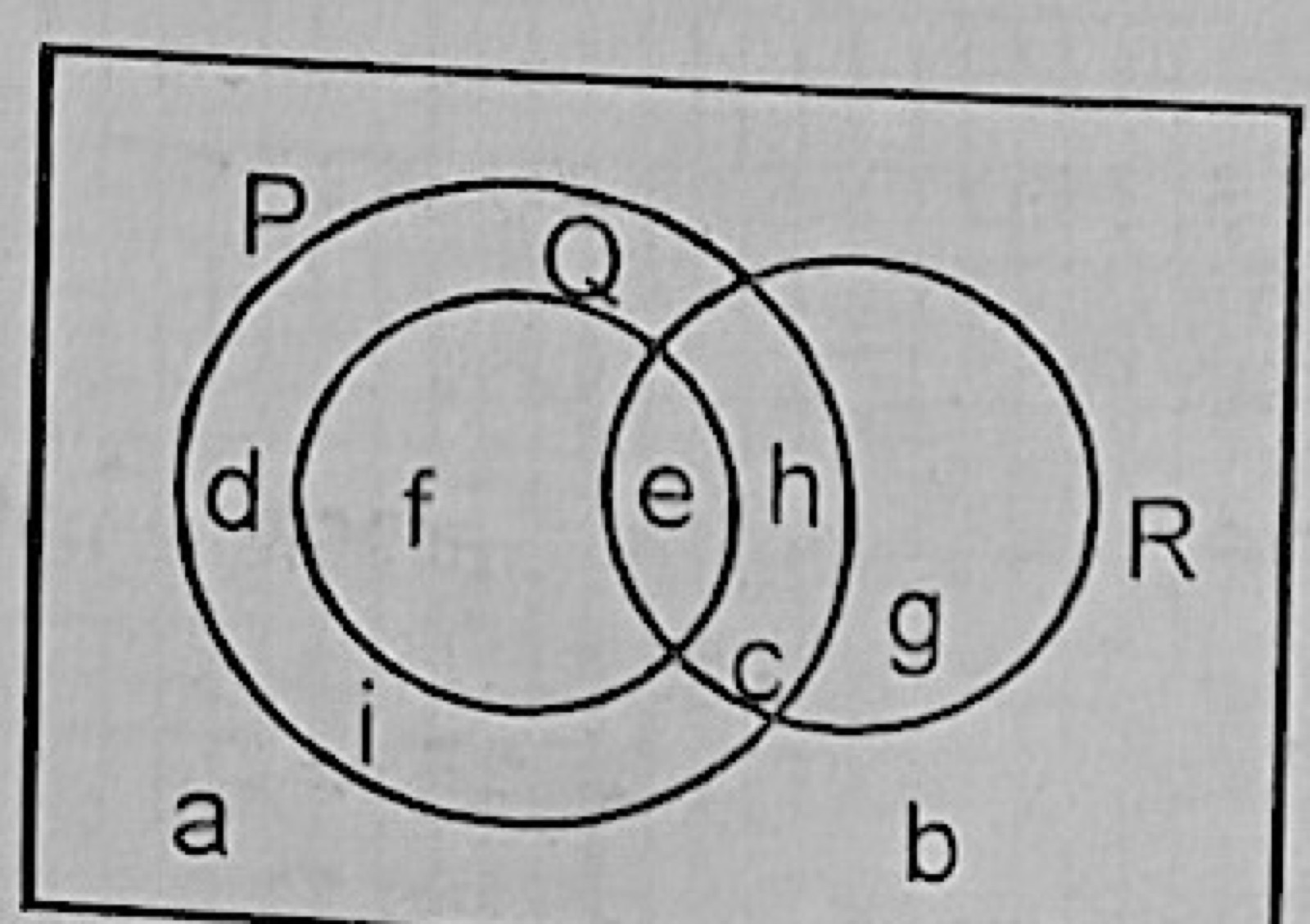
Use the Venn diagram. How many elements are in P∩Q?

Diagram for this question
  1. A.1
  2. B.2
  3. C.4
  4. D.6
Show the answer and explanation

Answer: B (2)

Explanation

Q lies inside P, so P∩Q = Q = {f, e}: 2 elements.

Open this question

Question 37

Sets

Use the Venn diagram. Find Q'∩R

Diagram for this question
  1. A.(e)
  2. B.(c, h)
  3. C.(c, g, h)
  4. D.(c, e, g, h)
Show the answer and explanation

Answer: C ((c, g, h))

Explanation

R = {e, h, c, g}. Remove e, which is in Q: Q'∩R = {c, g, h}.

Open this question

Question 38

Algebraic Expressions

The square root of a number is 2k. What is half of the number

  1. A.√(k/2)
  2. B.√k
  3. C.½k2
  4. D.2k2
Show the answer and explanation

Answer: D (2k2)

Explanation

The number is (2k)2 = 4k2, and half of it is 2k2.

Open this question

Question 39

Variation

Given that p varies as the square of q and q varies inversely as the square root of r. How does p vary with r?

  1. A.p varies as the square of r
  2. B.p varies as the square root of r
  3. C.p varies inversely as the square of r
  4. D.p varies inversely as r
Show the answer and explanation

Answer: D (p varies inversely as r)

Explanation

p = kq2 and q = c/√r, so p = kc2/r: p varies inversely as r.

Open this question

Question 40

Probability

The probabilities of a boy passing English and Mathematics test are x and y respectively. Find the probability of the boy failing both tests

  1. A.1 − (x − y) + xy
  2. B.1 − (x + y) − xy
  3. C.1 − (x + y) + xy
  4. D.1 − (x − y) + xy
Show the answer and explanation

Answer: C (1 − (x + y) + xy)

Explanation

P(fail both) = (1 − x)(1 − y) = 1 − x − y + xy = 1 − (x + y) + xy.

Open this question

Question 41

Loci

The locus of points equidistant from two intersecting straight lines PQ and PR is

  1. A.a circle centre P radius Q.
  2. B.a circle centre P radius PR
  3. C.the point of intersection of the perpendicular bisectors of PQ and PR
  4. D.the bisector of angle QPR
Show the answer and explanation

Answer: D (the bisector of angle QPR)

Explanation

Any point on the bisector of angle QPR is the same perpendicular distance from line PQ and line PR.

Open this question

Question 43

Quadratic Equations

Find the equation whose roots are −2/3 and 3

  1. A.3x2 + 11x − 6 = 0
  2. B.3x2 + 7x + 6 = 0
  3. C.3x2 − 11x − 6 = 0
  4. D.3x2 − 7x − 6 = 0
Show the answer and explanation

Answer: D (3x2 − 7x − 6 = 0)

Explanation

(3x + 2)(x − 3) = 3x2 − 7x − 6 = 0.

Open this question

Question 44

Trigonometry

Evaluate Cos 45° Cos 30° − Sin 45° Sin 30° leaving the answer in surd form

  1. A.(√2 − 1)/2
  2. B.(√3 − √2)/4
  3. C.(√6 − √2)/2
  4. D.(√6 − √2)/4
Show the answer and explanation

Answer: D ((√6 − √2)/4)

Explanation

(√2/2)(√3/2) − (√2/2)(1/2) = (√6 − √2)/4.

Open this question

Question 45

Constructions

In constructing an angle, Olu draws line OX. With centre O and a convenient radius, he draws an arc intersecting OX at P. With centres P and the same radius, he draws an arc intersecting the first arc at Q and finally joins OQ. What is the size of angle POQ so constructed?

  1. A.90°
  2. B.75°
  3. C.60°
  4. D.45°
Show the answer and explanation

Answer: C (60°)

Explanation

OP = OQ = PQ (all the same radius), so triangle OPQ is equilateral and ∠POQ = 60°.

Open this question

Question 46

Mensuration of Plane Shapes

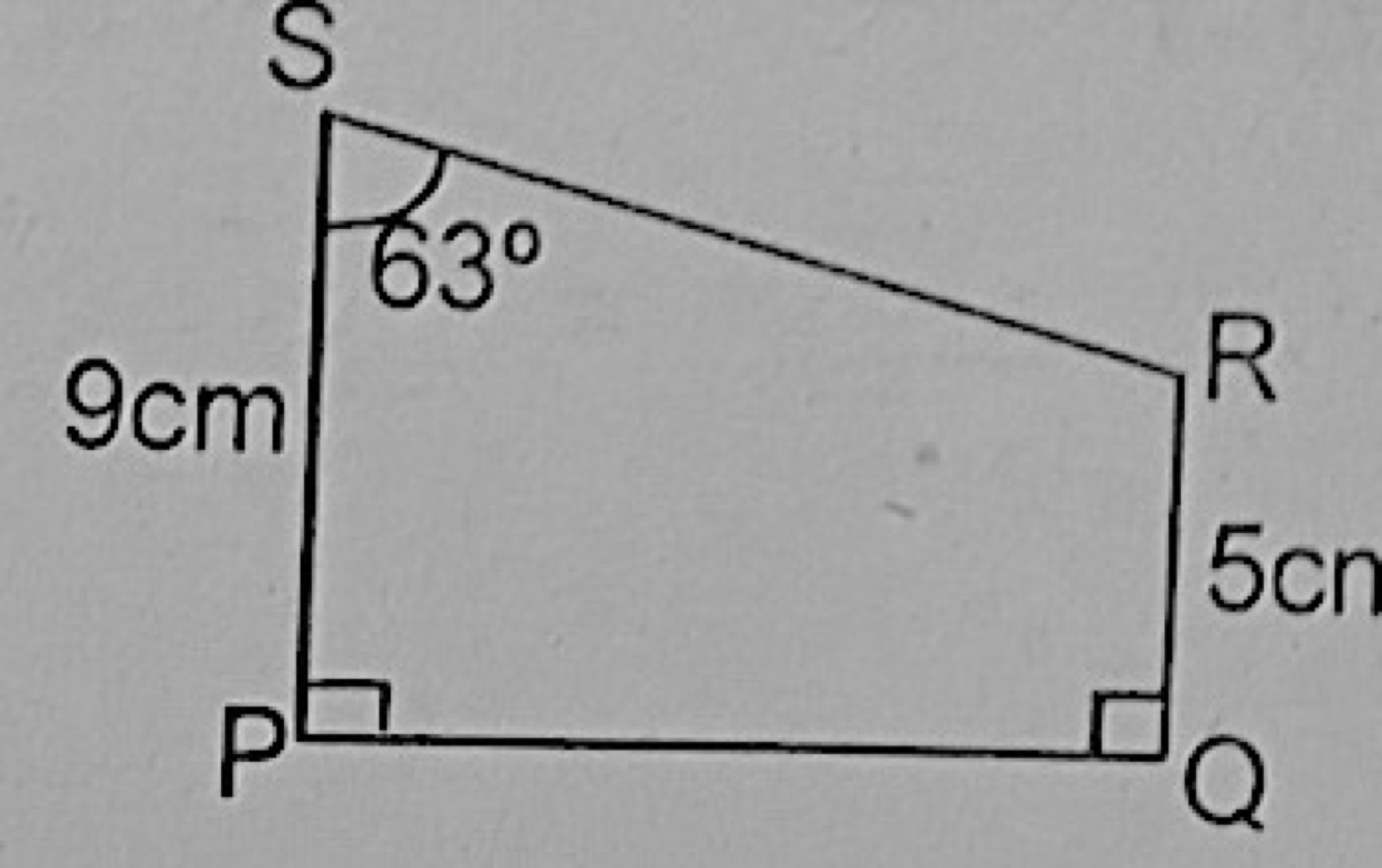
In the diagram |PS| = 9 cm, |QR| = 5cm, ∠PSR = 63° and ∠SPQ = ∠PQR = 90°. Find, correct to the nearest whole number, the area of the trapezium.

Diagram for this question
  1. A.55cm2
  2. B.25cm2
  3. C.22cm2
  4. D.13cm2
Show the answer and explanation

Answer: A (55cm2)

Explanation

Drop a line from R across to PS: it cuts off 9 − 5 = 4 cm, so the height PQ = 4 tan 63° ≈ 7.85 cm. Area = ½(9 + 5) × 7.85 ≈ 55 cm2.

Open this question

Question 47

Mensuration of Solids

A right circular cone is such that its radius r is twice its height h. Find its volume in terms of h

  1. A.⅔πh2
  2. B.1/12 πh3
  3. C.4/3 πh2
  4. D.4/3 πh3
Show the answer and explanation

Answer: D (4/3 πh3)

Explanation

V = ⅓π(2h)2h = 4/3 πh3.

Open this question

Question 48

Commercial Arithmetic

A man made a loss of 15% by selling an article for N595. Find the cost price of the article

  1. A.N600.00
  2. B.N684.25
  3. C.N700.00
  4. D.N892.50
Show the answer and explanation

Answer: C (N700.00)

Explanation

N595 is 85% of the cost price: 595 ÷ 0.85 = N700.

Open this question

Question 49

Bearings

The bearing of P from Q is x, where 270° < x < 360°. Find the bearing of Q from P

  1. A.(x − 90)°
  2. B.(x − 270)°
  3. C.(x − 135)°
  4. D.(x − 180)°
Show the answer and explanation

Answer: D ((x − 180)°)

Explanation

A back bearing differs by 180°; since x is more than 180°, the bearing of Q from P is x − 180°.

Open this question

Theory question 101

Variation

(a) If p varies directly as r2 and p = 3.2 when r = 4, find the value of p when r = 6.5
(b) Solve the simultaneous equations x/2 + y/4 = 1; x/3 − y/4 = −1/6

Show the model answer
Model answer

(a) p = kr2: 3.2 = 16k, k = 0.2. p = 0.2 × 6.52 = 8.45.
(b) Add the equations: x/2 + x/3 = 1 − 1/6, so 5x/6 = 5/6 and x = 1.
Then 1/2 + y/4 = 1, y/4 = 1/2, y = 2.

Explanation

Adding removes the y terms because they have opposite signs.

Open this question

Theory question 102

Surds

Without using Mathematical Tables or a Calculator, simplify
(a) √50 − 3√2(2√2 − 5) − 5√32
(b) ½ log10(25/4) − 2log10(4/5) + log10(320/125)

Show the model answer
Model answer

(a) √50 = 5√2; 3√2(2√2 − 5) = 12 − 15√2; 5√32 = 20√2.
5√2 − 12 + 15√2 − 20√2 = −12.
(b) ½ log(25/4) = log(5/2); 2 log(4/5) = log(16/25).
log[(5/2) × (25/16) × (320/125)] = log 10 = 1.

Explanation

Turn coefficients into powers, then combine into one log.

Open this question

Theory question 103

Indices

(a) Simplify: 6253/8 × 51/2 ÷ 25
(b) Solve the following equations, correct to one decimal place. (i) tan (θ + 25°) = 5.145 (ii) 5 cos θ − 1 = 0, where 0 ≤ θ ≤ 90°

Show the model answer
Model answer

(a) 6253/8 = (54)3/8 = 53/2. 53/2 × 51/2 ÷ 52 = 50 = 1.
(b)(i) θ + 25° = tan−15.145 = 79.0°, so θ = 54.0°.
(ii) cos θ = 0.2, so θ = 78.5°.

Explanation

Write 625 and 25 as powers of 5.

Open this question

Theory question 104

Circle Theorems

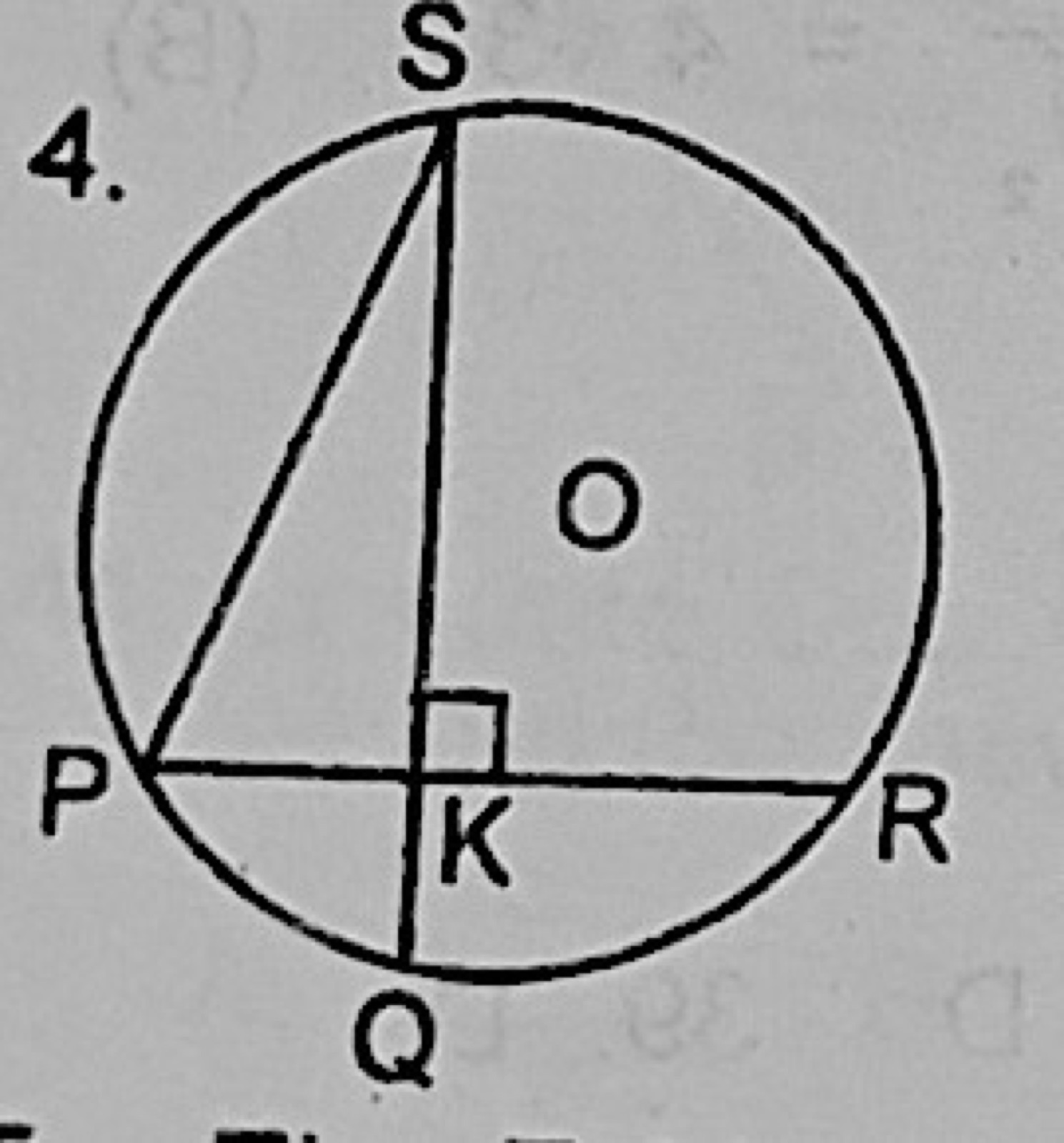
In the diagram, PQRS is a circle with centre O and radius 7cm. SQ and PR intersect at K and ∠SKR = 90°. If the length of the arc SR is four times that of arc PQ, find the length of arc SR. [Take π = 22/7]

Diagram for this question
Show the model answer
Model answer

The angle between two chords equals half the sum of the arcs they cut off: ∠SKR = ½(arc SR + arc PQ) in degrees.
So arc SR + arc PQ = 180°. With arc SR = 4 × arc PQ: 5 × arc PQ = 180°, arc PQ = 36°, arc SR = 144°.
Length of arc SR = 144/360 × 2 × 22/7 × 7 = 17.6 cm.

Explanation

When two chords cross, the angle between them is half the sum of the two arcs they cut off.

Open this question

Theory question 105

Data Presentation

The Table shows the number of suitcases possessed by a group of travellers
No. of suitcases: 0, 1, 2, 3, 4, 5
Travellers: 2, 7, 7, 2, 3, 9
(a) Calculate the (i) median (ii) mean, correct to the nearest whole number (b) Draw a bar chart to represent the information

Show the model answer
Model answer

There are 30 travellers.
(a)(i) The median is between the 15th and 16th; cumulative frequencies 2, 9, 16…, so both have 2 suitcases: median = 2.
(ii) Σfx = 0 + 7 + 14 + 6 + 12 + 45 = 84; mean = 84/30 = 2.8 ≈ 3.
(b) Bars of equal width, separated by gaps, with heights 2, 7, 7, 2, 3, 9 above 0–5 suitcases; label both axes.

Explanation

The median of 30 values is the average of the 15th and 16th.

Open this question

Theory question 106

Algebraic Expressions

(a) Simplify (1/3 c2 − 2/3 cd)/(1/2 d2 − 1/4 cd)
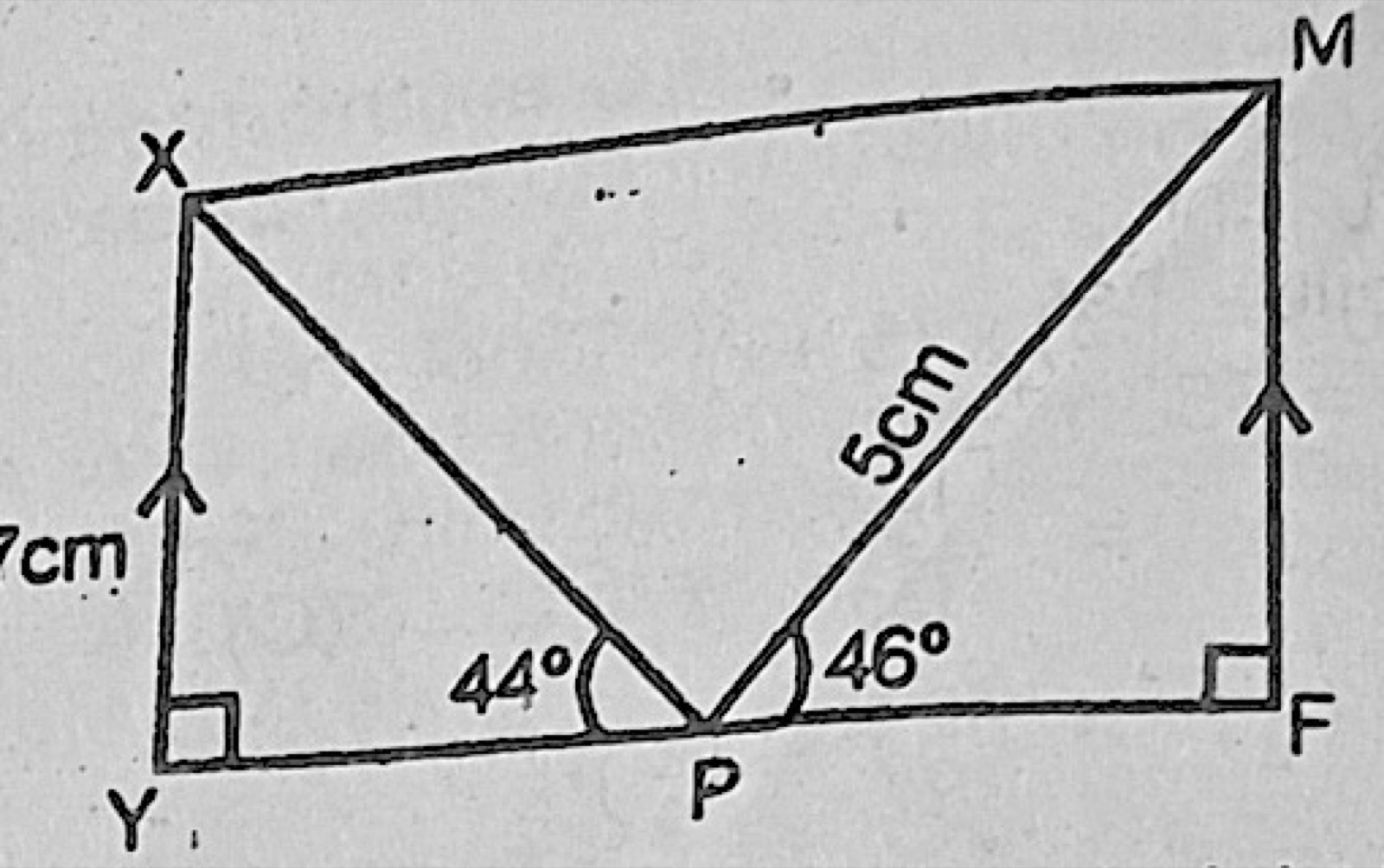
(b) In the diagram, YPF is a straight line. ∠XPY = 44°, ∠MPF = 46°, ∠XYP = ∠MFP = 90°, |XY| = 7cm and |MP| = 9cm. (i) Calculate, correct to 3 significant figures, |XM| and |YF|. (ii) Find ∠XMP

Diagram for this question
Show the model answer
Model answer

(a) Numerator = c(c − 2d)/3; denominator = d(2d − c)/4. Result = 4c(c − 2d)/[3d(2d − c)] = −4c/(3d).
(b)(i) XP = 7/sin 44° = 10.08 cm; YP = 7/tan 44° = 7.249 cm; PF = 9 cos 46° = 6.252 cm.
YF = 7.249 + 6.252 = 13.5 cm.
∠XPM = 180 − 44 − 46 = 90°, so XM = √(10.082 + 92) = √182.5 ≈ 13.5 cm.
(ii) tan ∠XMP = XP/MP = 10.08/9 = 1.120, so ∠XMP ≈ 48.2°.

Explanation

Notice ∠XPM is a right angle because the three angles at P make a straight line.

Open this question

Theory question 107

Data Presentation

The table shows the monthly contributions and expenditure pattern of an employee in 1999.
Pension – 5%
Income Tax – 25%
Food – 40%
Transport – 10%
Rent – 12.5%
Others – 7.5%
(a) Draw a pie chart to illustrate the data (b) If the employee's gross monthly salary was N10,800.00, calculate. (i) the pension contribution of the employee (ii) the income tax paid by the employee (c) If the pension contribution and income tax were deducted from the gross monthly salary, before payment, calculate the take-home pay of the employee.

Show the model answer
Model answer

(a) Angles (percentage × 3.6°): Pension 18°, Income Tax 90°, Food 144°, Transport 36°, Rent 45°, Others 27°. Draw and label the sectors.
(b)(i) 5% of 10,800 = N540.00.
(ii) 25% of 10,800 = N2,700.00.
(c) Take-home pay = 10,800 − 540 − 2,700 = N7,560.00.

Explanation

1% of the whole is 3.6° on a pie chart.

Open this question

Theory question 108

Sets

(a) A = {1,2,5,7} and B = {1,3,6,7} are subsets of the universal set U = {1,2,3,....., 10}. Find: (i) A' (ii) (A∩B)'; (iii) (A∪B)', (iv) the subsets of B each of which has three elements.
(b) Write down the 15th term of the sequence 2/(1 × 3), 3/(2 × 4), 4/(3 × 5), 5/(4 × 6), ..........
(c) An Arithmatic Progression (A.P) has 3 as its first term and 4 as the common difference. (i) Write an expression, in its simplest form for the nth term. (ii) find the least term of the AP that is greater than 100.

Show the model answer
Model answer

(a)(i) A' = {3, 4, 6, 8, 9, 10}.
(ii) A∩B = {1, 7}, so (A∩B)' = {2, 3, 4, 5, 6, 8, 9, 10}.
(iii) A∪B = {1, 2, 3, 5, 6, 7}, so (A∪B)' = {4, 8, 9, 10}.
(iv) {1, 3, 6}, {1, 3, 7}, {1, 6, 7}, {3, 6, 7}.
(b) Tn = (n + 1)/[n(n + 2)], so T15 = 16/(15 × 17) = 16/255.
(c)(i) Tn = 3 + 4(n − 1) = 4n − 1.
(ii) 4n − 1 > 100 gives n > 25.25, so n = 26 and the term is 103.

Explanation

Spot the pattern in the numerator and each factor of the denominator separately.

Open this question

Theory question 109

Data Presentation

The marks obtained by 40 students in an examination are as follows:
85 77 87 74 77 78 79 89 85 90
78 73 86 83 91 74 84 81 83 75
77 70 81 69 75 63 76 87 61 78
69 96 65 80 84 80 77 74 88 72
(a) Copy and complete the table for the distribution using the above data.
Class Boundaries: 59.5 – 64.5, 64.5 – 69.5, 69.5 – 74.5, 74.5 – 79.5, 79.5 – 84.5, 84.5 – 89.5, 89.5 – 94.5, 94.5 – 99.5 (with Tally and Frequency columns)
(b) Draw a histogram to represent the distribution (c) Using your histogram, estimate the modal mark (d) If a student is chosen at random, find the probability that the student obtains a mark greater than 79.

Show the model answer
Model answer

(a) Frequencies: 59.5–64.5: 2; 64.5–69.5: 3; 69.5–74.5: 6; 74.5–79.5: 11; 79.5–84.5: 8; 84.5–89.5: 7; 89.5–94.5: 2; 94.5–99.5: 1 (total 40).
(b) Bars on the class boundaries with heights equal to the frequencies.
(c) In the tallest bar (74.5–79.5) join its top corners to the tops of the next bars; the lines cross at about 77.6, so the modal mark ≈ 78.
(d) Marks above 79: 8 + 7 + 2 + 1 = 18, so P = 18/40 = 9/20.

Explanation

Tally the marks one by one and check the frequencies add up to 40.

Open this question

Theory question 110

Angles and Polygons

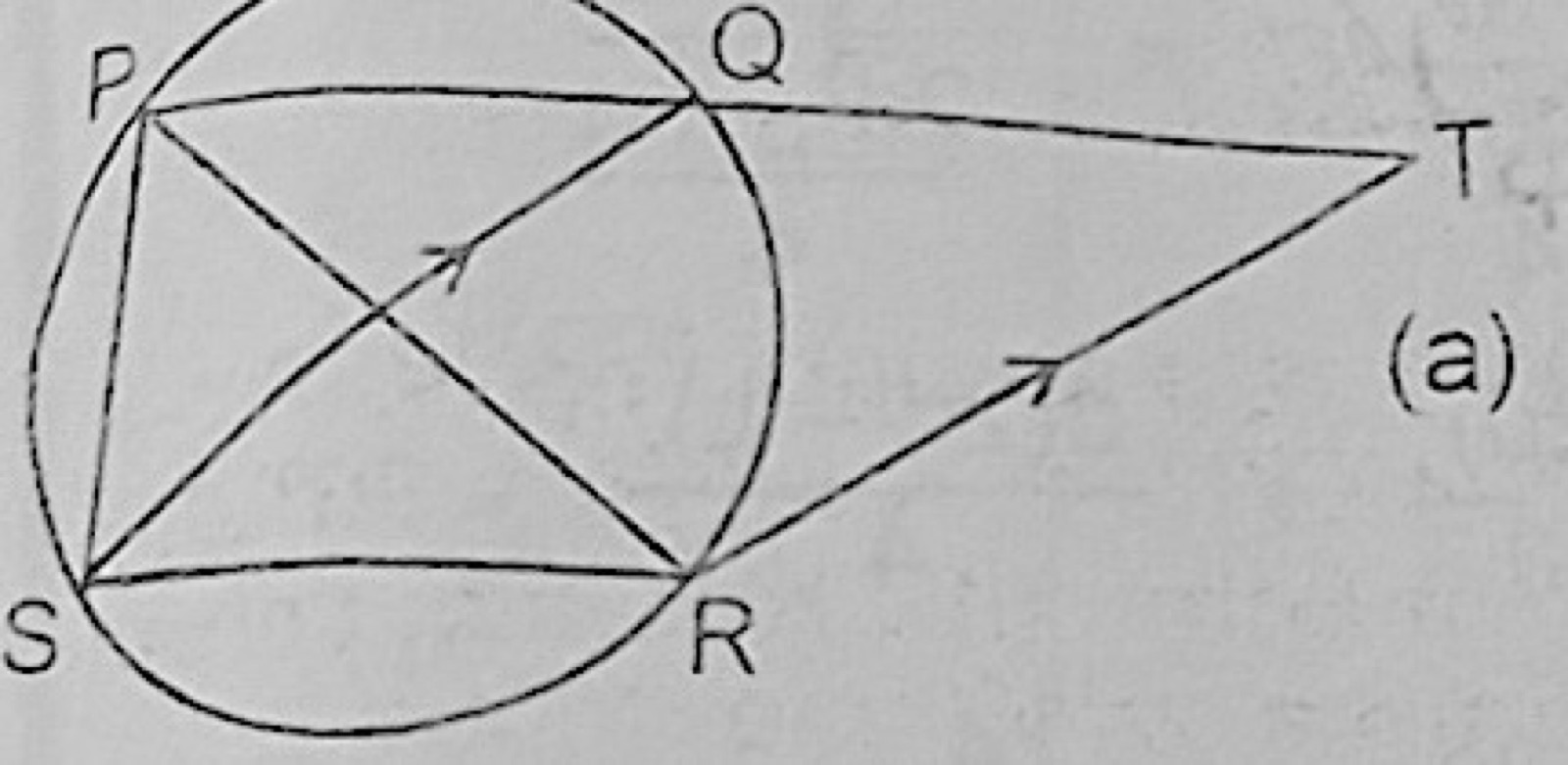
In the diagram, PQT is a straight line and SQ//RT.
(a) Join QR and show that: (i) ∠RPS = ∠QRT, (ii) ∠PRS = ∠QTR
(b) ABC is a triangle. The sides AB and AC are produced to D and E respectively such that ∠DBC = 132° and ∠ECB = 96°. Show that ΔABC is isosceles.

Diagram for this question
Show the model answer
Model answer

(a)(i) ∠RPS = ∠RQS (angles in the same segment, on chord RS).
∠RQS = ∠QRT (alternate angles, SQ ∥ RT). Hence ∠RPS = ∠QRT.
(ii) ∠PRS = ∠PQS (angles in the same segment, on chord PS).
∠PQS = ∠QTR (corresponding angles, SQ ∥ RT, PQT a straight line). Hence ∠PRS = ∠QTR.
(b) ∠ABC = 180 − 132 = 48° and ∠ACB = 180 − 96 = 84° (angles on a straight line).
∠BAC = 180 − 48 − 84 = 48°. ∠BAC = ∠ABC, so CA = CB and triangle ABC is isosceles.

Explanation

Give a reason for every equal pair of angles.

Open this question

Theory question 111

Latitude and Longitude

An aeroplane flies due west for 3 hours from P(lat 50°N, long 60°W) to point Q at an average speed of 600kmh−1. The aeroplane then flies due south from Q to a point Y 500 km away. Calculate, correct to 3 significant figures. (a) the longitude of Q (b) the latitude of Y. [Take the radius of the earth to be 6400 km and π = 22/7]

Show the model answer
Model answer

(a) Distance PQ = 600 × 3 = 1800 km along latitude 50°N.
1800 = θ/360 × 2 × 22/7 × 6400 cos 50°, so θ = 1800 × 360/(2 × 22/7 × 6400 × 0.6428) ≈ 25.1°.
Flying west from 60°W: longitude of Q = 60 + 25.1 = 85.1°W.
(b) 500 = α/360 × 2 × 22/7 × 6400, so α ≈ 4.47°.
Flying south from 50°N: latitude of Y = 50 − 4.47 ≈ 45.5°N.

Explanation

Along a latitude use radius R cos(latitude); along a meridian use the full radius R.

Open this question

Theory question 112

Constructions

Using ruler and a pair of compasses only. (a) construct a quadrilateral PXYQ such that |PX| = 9.9cm, |QX| = 10.2cm, ∠QPX = 75°, |QY| = 10.4cm and PQ//XY. (b) construct the: (i) locus l1 of points equidistant from X and Y, (ii) locus l2 of point equidistant from QY and YX (c) Locate M, the point of intersection of l1 and l2 (d) Measure |PM|.

Show the model answer
Model answer

(a) Draw PX = 9.9 cm. Construct 75° at P (60° plus half of the 30° between 60° and 90°). With centre X radius 10.2 cm cut this arm at Q (PQ ≈ 6.1 cm). Through X construct a line parallel to PQ; with centre Q radius 10.4 cm cut it at Y. Join QY.
(b)(i) l1: perpendicular bisector of XY.
(ii) l2: bisector of ∠QYX.
(c) M is where l1 and l2 cross.
(d) |PM| ≈ 9.5 cm (accept 9.3–9.7 cm).

Explanation

Equidistant from two points: perpendicular bisector. Equidistant from two lines: angle bisector.

Open this question

Theory question 113

Graphs of Functions

The table shows the values of the relation y = 11 − 2x − 2x2 for −4 ≤ x ≤ 3
x: −4, −3, −2, −1, 0, 1, 2, 3
y: −13, , , , 11, , ,
(a) Copy and complete the table (b) Using a scale of 2cm to 1 unit on the x-axis and 2 cm to 5 units on the y-axis, draw the graph of y = 11 − 2x − 2x2. (c) Use your graph to find: (i) the roots of the equation 11 − 2x − 2x2 = 0, (ii) the values of x for which 3 − 2x − 2x2 = 0, (iii) the gradient of the curve at x = 1

Show the model answer
Model answer

(a) x = −3: −1; −2: 7; −1: 11; 1: 7; 2: −1; 3: −13.
(b) Plot the points and join with a smooth upside-down parabola.
(c)(i) The curve crosses y = 0 at x ≈ −2.9 and x ≈ 1.9.
(ii) 3 − 2x − 2x2 = 0 means 11 − 2x − 2x2 = 8; draw y = 8: x ≈ −1.8 and x ≈ 0.8.
(iii) Draw the tangent at (1, 7); its gradient is about −6.

Explanation

Add 8 to both sides of the new equation so it matches the drawn curve.
Open this question