Question 1
Ratio, Percentages and RatesExpress 7/19 as a percentage, correct to 1 decimal place.
- A.2.7%
- B.3.7%
- C.27.1%
- D.36.8%.
Show the answer and explanation
Answer: D (36.8%.)
Explanation
7/19 × 100% = 36.84…% ≈ 36.8%.
61 questions. Try each one, then open the answer to check yourself and read the explanation.
Express 7/19 as a percentage, correct to 1 decimal place.
Answer: D (36.8%.)
7/19 × 100% = 36.84…% ≈ 36.8%.
Express 398753 correct to three significant figures.
Answer: D (399000)
Keep 3, 9, 8; the next digit is 7, so round up: 399000.
Simplify 10/√32
Answer: A ((5/4)√2)
√32 = 4√2, so 10/(4√2) = 10√2/8 = (5/4)√2.
Find the missing number in the addition of the following numbers, in base seven.
4321 + 1234 + **** = 12341
Answer: A (3453)
In base ten: 123417 = 3263, 43217 = 1534, 12347 = 466. The missing number is 3263 − 2000 = 1263 = 34537.
What fraction must be subtracted from the sum of 2 1/6 and 2 7/12 to give 3 1/4?
Answer: D (1 1/2)
2 1/6 + 2 7/12 = 4 9/12 = 4 3/4. Then 4 3/4 − 3 1/4 = 1 1/2.
Simplify (16/81)−3/4 × √(100/81)
Answer: D (15/4)
(16/81)−3/4 = (81/16)3/4 = (3/2)3 = 27/8, and √(100/81) = 10/9. 27/8 × 10/9 = 15/4.
Which of the following numbers is a perfect cube?
Answer: D (1728.)
1728 = 12 × 12 × 12 = 123.
If 104x = 68, find the value of x
Answer: C (8)
104x = x2 + 4 = 68, so x2 = 64 and x = 8.
The ages of three men are in the ratio 3 : 4 : 5. If the difference between the ages of the oldest and youngest is 18 years, find the sum of the ages of the three men.
Answer: C (108 years)
The difference is 5 − 3 = 2 parts = 18 years, so 1 part = 9. Sum = 12 parts = 108 years.
Given that log4x = −3, find x.
Answer: B (1/64)
x = 4−3 = 1/64.
Given that the logarithm of a number is 1̄.8732, find, correct to 2 significant figures, the square root of the number.
Answer: C (0.86)
The number is antilog 1̄.8732 = 0.747. Its square root is about 0.864 ≈ 0.86 (or halve the log: 1̄.9366 gives 0.864).
A car moves at an average speed of 30kmh−1, how long does it take to cover 200 metres?
Answer: B (24 sec)
30 km/h = 30000 m ÷ 3600 s = 25/3 m/s. Time = 200 ÷ 25/3 = 24 seconds.
A man bought a television set on hire purchase for N25,000, out of which he paid N10,000. If he is allowed to pay the balance in eight equal instalments, find the value of each instalment.
Answer: C (N1875)
Balance = 25000 − 10000 = N15000; 15000 ÷ 8 = N1875.
A tree is 8km due south of a building. Kofi is standing 8km west of the tree. How far is Kofi from the building?
Answer: C (8√2km)
The two 8 km distances are at right angles, so the distance is √(82 + 82) = 8√2 km.
A tree is 8km due south of a building. Kofi is standing 8km west of the tree. Find the bearing of Kofi from the building.
Answer: C (225°)
Kofi is equally far south and west of the building, so he is exactly south-west: bearing 225°.
Which of the following bearings is equivalent to S50°W?
Answer: D (230°.)
Start at south (180°) and turn 50° towards west: 180 + 50 = 230°.
The bar chart shows the distribution of marks scored by a group of students in a test. How many students scored 4 marks and above?
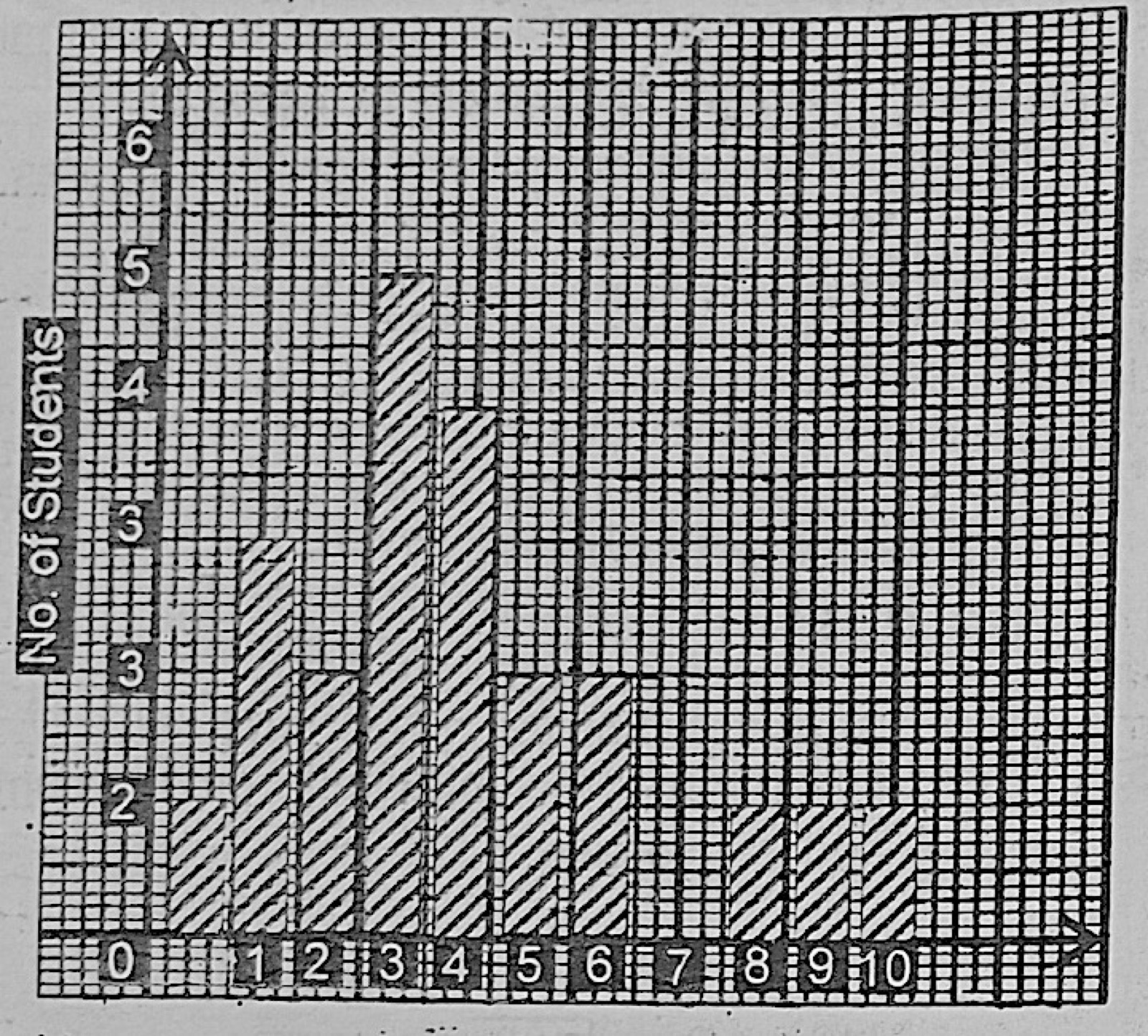
Answer: B (11)
Reading the bars for marks 4 to 10: 4 + 2 + 2 + 0 + 1 + 1 + 1 = 11 students.
The bar chart shows the distribution of marks scored by a group of students in a test. How many students took the test?

Answer: B (22)
Add all the bars (marks 0 to 10): 1 + 3 + 2 + 5 + 4 + 2 + 2 + 0 + 1 + 1 + 1 = 22.
Calculate the standard deviation of the following marks: 2, 3, 6, 2, 5, 0, 4, 2.
Answer: C (1.8)
Mean = 24/8 = 3. Squared deviations add to 1 + 0 + 9 + 1 + 4 + 9 + 1 + 1 = 26. Variance = 26/8 = 3.25, so SD ≈ 1.8.
The probabilities that Kodjo and Adoga pass an examination are 3/4 and 3/5 respectively. Find the probability of both boys failing the examination.
Answer: A (1/10)
P(both fail) = (1 − 3/4)(1 − 3/5) = 1/4 × 2/5 = 1/10.
Which of the following triangles is congruent?
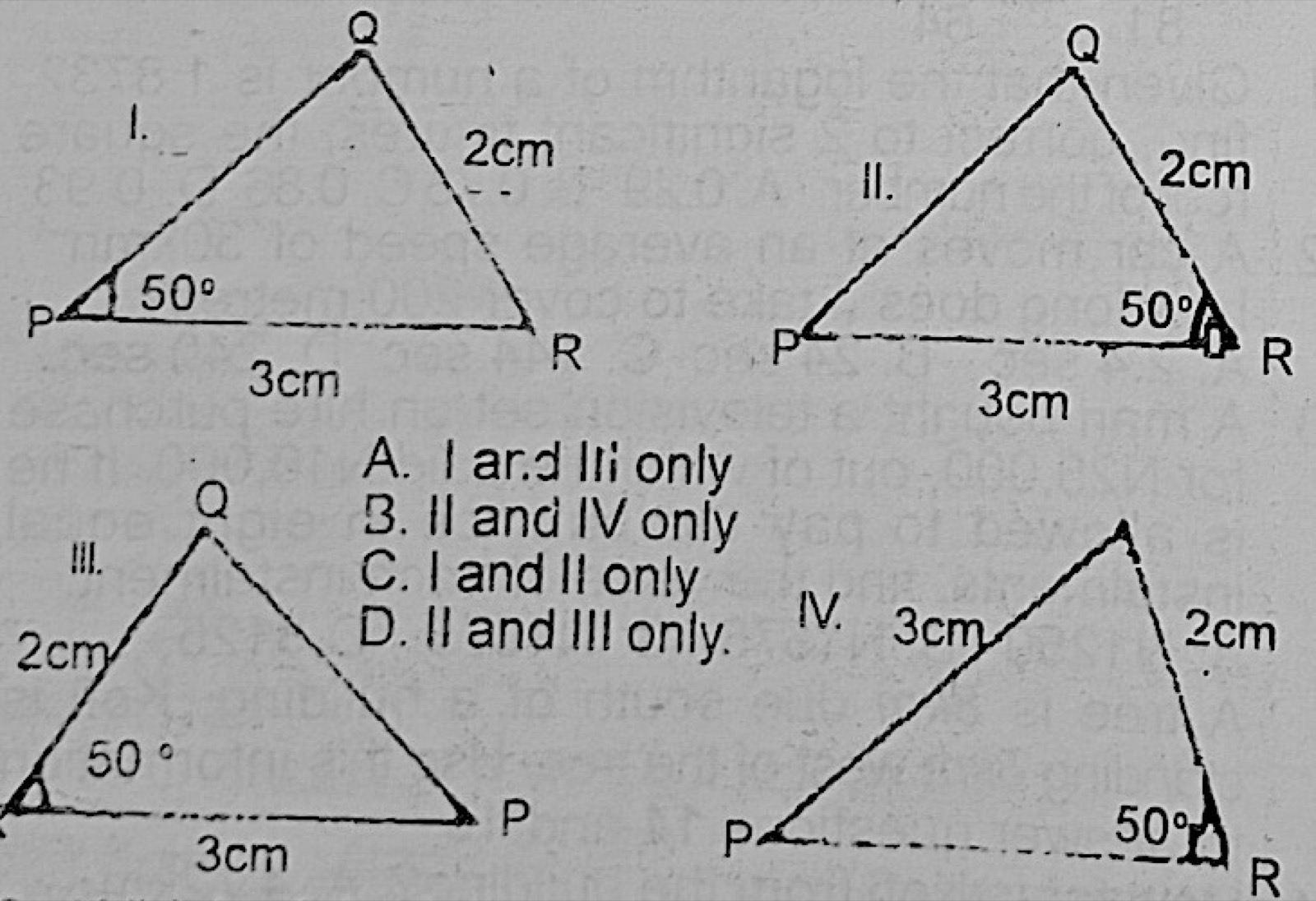
Answer: D (II and III only.)
In II and III the 50° angle lies between the 2 cm and 3 cm sides, so they are congruent by SAS. In I and IV the 50° angle is not between those two sides.
Which of the following statements is/are not true about a rectangle? I. Each diagonal cuts the rectangle into two congruent triangles. II. A rectangle has four lines of symmetry. III. The diagonals intersect at right angles.
Answer: D (II and III only.)
A rectangle has only two lines of symmetry and its diagonals are not perpendicular (unless it is a square). Statement I is true.
In the diagram, PQRS is a circle centre O. POR is a diameter and ∠PRQ = 40°. Calculate ∠QSR.
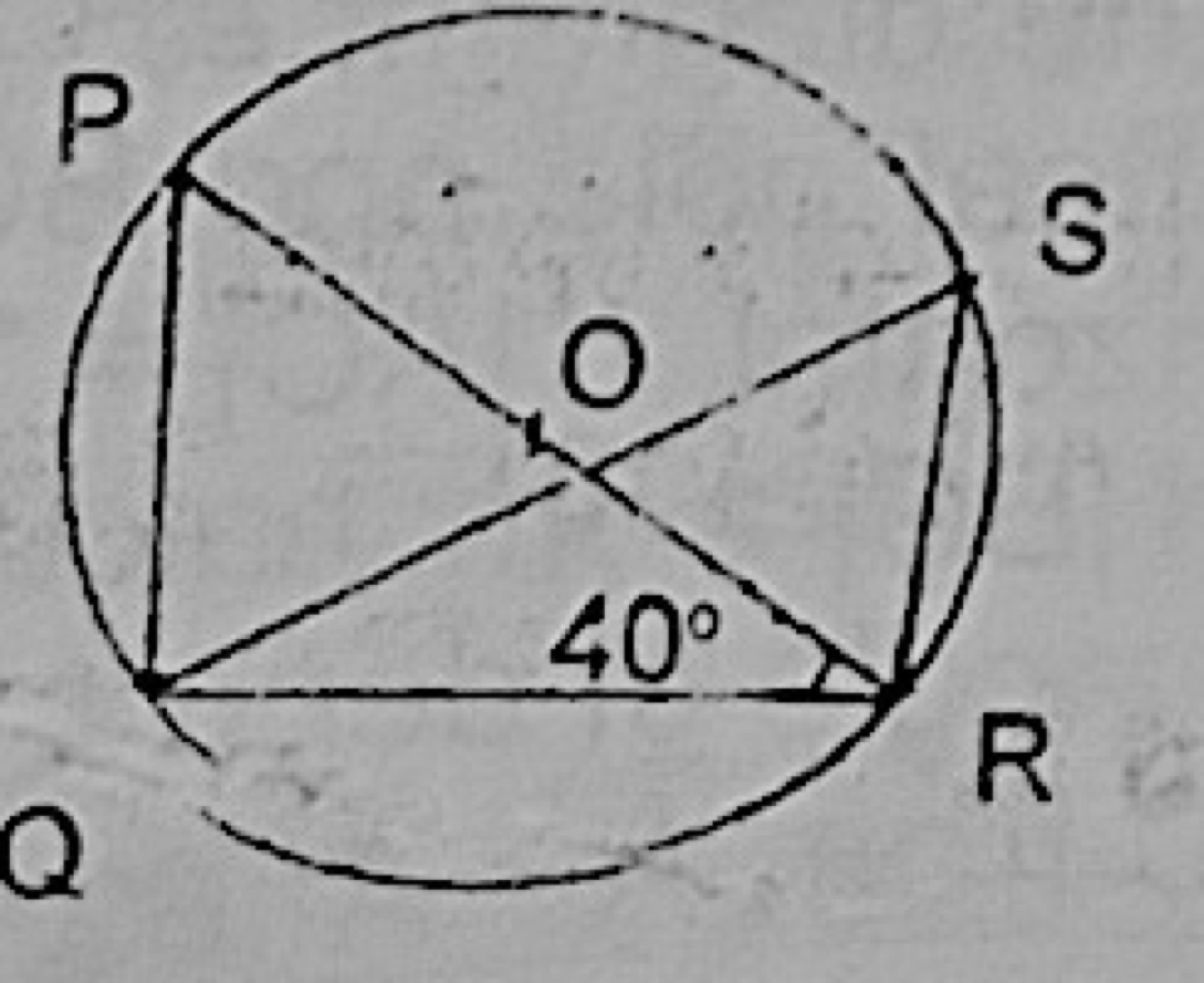
Answer: D (50°)
∠PQR = 90° (angle in a semicircle), so ∠QPR = 50°. ∠QSR = ∠QPR (same arc QR) = 50°.
Each side of a regular convex polygon subtends an angle of 30° at its centre. Calculate each interior angle
Answer: B (150°)
The central angle equals the exterior angle, 30°, so the interior angle is 180 − 30 = 150°.
If the interior angles of a hexagon are 107°, 2x°, 150°, 95°, (2x − 15)° and 123°, find x.
Answer: B (65°)
Hexagon angles add to 720°: 475 + 4x − 15 = 720, so 4x = 260 and x = 65°.
In the diagram, POS and ROT are straight lines. OPQR is a parallelogram. |OS| = |OT| and ∠OST = 50°. Calculate ∠OPQ.
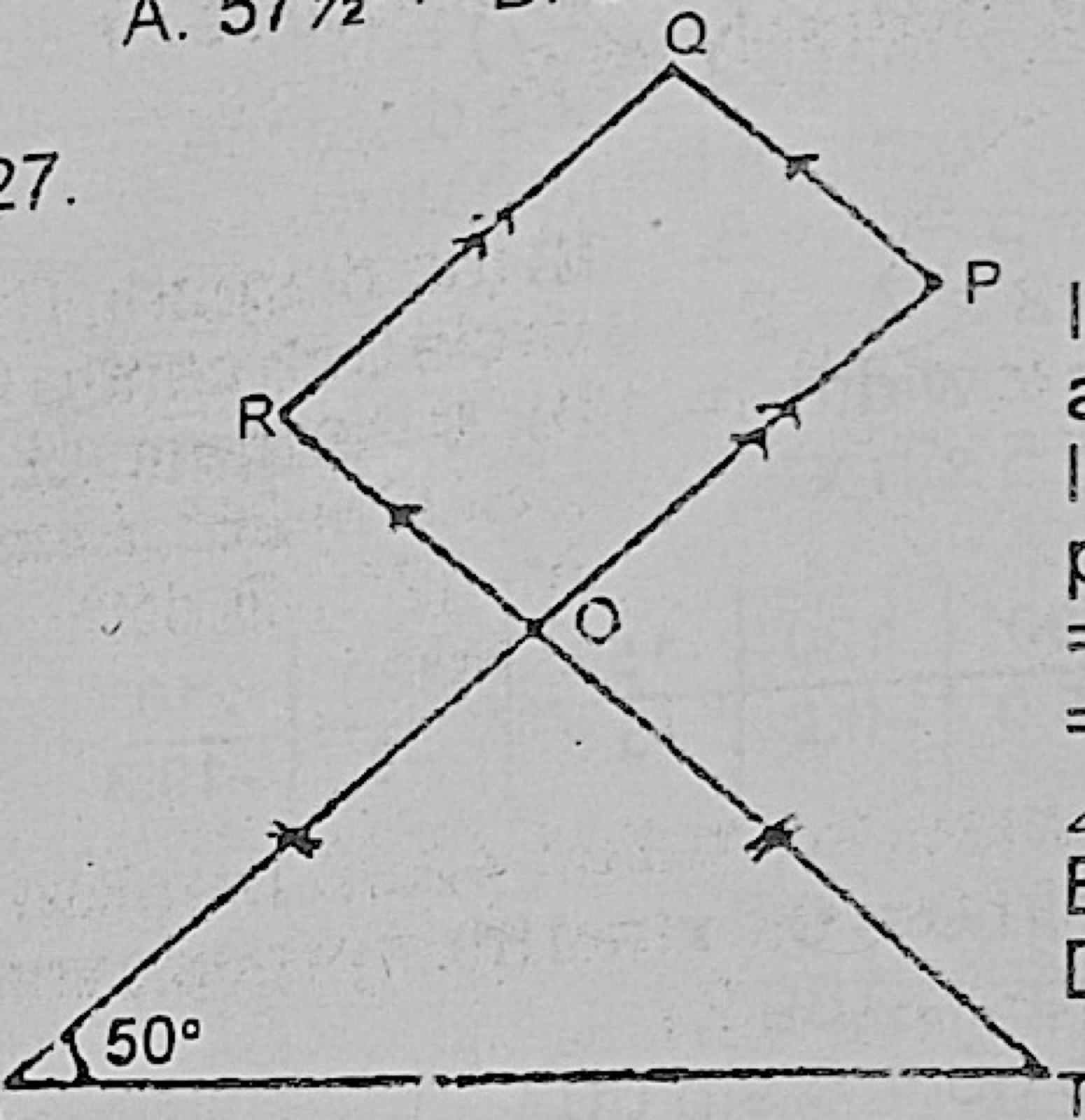
Answer: D (100°)
Triangle OST is isosceles, so ∠SOT = 180 − 100 = 80°, and ∠POR = 80° (vertically opposite). Adjacent angles of a parallelogram add to 180°, so ∠OPQ = 100°.
Given that x = 1/2 and y = 4, evaluate 3x2y + xy2.
Answer: D (11.)
3x2y = 3 × 1/4 × 4 = 3 and xy2 = 1/2 × 16 = 8, so the total is 11.
Given that 27(1 + x) = 9, find x.
Answer: B (−1/3)
33(1 + x) = 32, so 3 + 3x = 2 and x = −1/3.
If x varies inversely as y and x = 2/3 when y = 9, find the value of y when x = 3/4
Answer: D (8)
xy is constant: 2/3 × 9 = 6. So y = 6 ÷ 3/4 = 8.
Given that (2x + 7) is a factor of 2x2 + 3x − 14, find the other factor.
Answer: C (x − 2)
(2x + 7)(x − 2) = 2x2 − 4x + 7x − 14 = 2x2 + 3x − 14.
Simplify 1/(x − 3) − 3(x − 1)/(x2 − 9)
Answer: B (−2/(x + 3))
Over (x − 3)(x + 3): (x + 3) − 3(x − 1) = −2x + 6 = −2(x − 3). Cancel (x − 3) to get −2/(x + 3).
Which of the following number lines represents the inequality 2 ≤ x < 9?
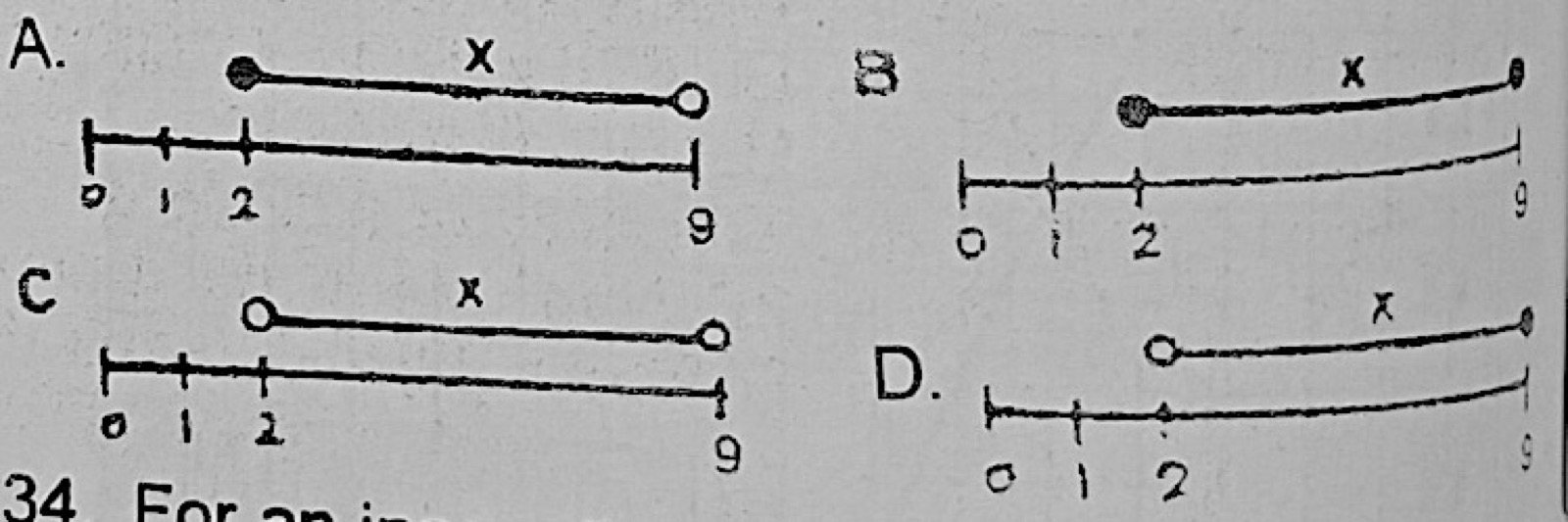
Answer: A (Number line A)
2 is included (shaded dot) and 9 is not (open circle). Only line A has a shaded dot at 2 and an open circle at 9.
For an inequality for a distance d metres which is more than 18m, but not more than 23m.
Answer: B (18 < d ≤ 23)
'More than 18' means d > 18 and 'not more than 23' means d ≤ 23.
Find the equation whose roots are −8 and 5.
Answer: D (x2 + 3x − 40 = 0.)
(x + 8)(x − 5) = x2 + 3x − 40 = 0.
Make t the subject of the formula k = m√((t − p)/r)
Answer: B ((rk2 + pm2)/m2)
k2/m2 = (t − p)/r, so t = rk2/m2 + p = (rk2 + pm2)/m2.
Solve the equation 3y2 = 27y.
Answer: B (y = 0 or 9)
3y2 − 27y = 3y(y − 9) = 0, so y = 0 or y = 9.
Find the value of x such that the expression 1/x + 4/(3x) − 5/(6x) + 1 equals zero
Answer: C (−3/2)
Multiply by 6x: 6 + 8 − 5 + 6x = 0, so 6x = −9 and x = −3/2.
Given that p varies directly as q while q varies inversely as r, which of the following statements is true?
Answer: B (p varies inversely as r)
p = kq and q = c/r, so p = kc/r: p varies inversely as r.
In the diagram, PQS is a circle with centre O. RST is a tangent at S and ∠SOP = 96°. Find ∠PST

Answer: B (48°)
The angle between a tangent and a chord is half the angle the chord subtends at the centre: ½ × 96° = 48°.
A bicycle wheel of radius 42cm is rolled over a distance 66 metres. How many revolutions does it make? [Take π = 22/7]
Answer: C (25)
Circumference = 2 × 22/7 × 42 = 264 cm. 6600 ÷ 264 = 25 revolutions.
The height of a pyramid on a square base is 15cm. If the volume is 80cm3, find the area of the square base.
Answer: C (16cm2)
V = ⅓ × base area × 15 = 5 × base area = 80, so the base area is 16 cm2.
A tap leaks at the rate of 2cm3 per second. How long will it take the tap to fill a container of 45 litres capacity? (1 litre = 1000cm3)
Answer: B (6hr 15min.)
45 litres = 45000 cm3; at 2 cm3/s that is 22500 s = 6.25 hours = 6 hr 15 min.
The lengths of the parallel sides of a trapezium are 5cm and 7cm. If its area is 120cm2, find the perpendicular distance between the parallel sides.
Answer: D (20.0cm.)
½ × (5 + 7) × h = 120, so 6h = 120 and h = 20 cm.
The arc of a circle 50cm long, subtends an angle of 75° at the centre of the circle. Find, correct to 3 significant figures, the radius of the circle. [Take π = 22/7]
Answer: B (38.2 cm)
50 = 75/360 × 2 × 22/7 × r, so r = 50 × 360 × 7/(75 × 44) ≈ 38.2 cm.
In the diagram, |PQ| = |PS|. Which of the following statements is true?
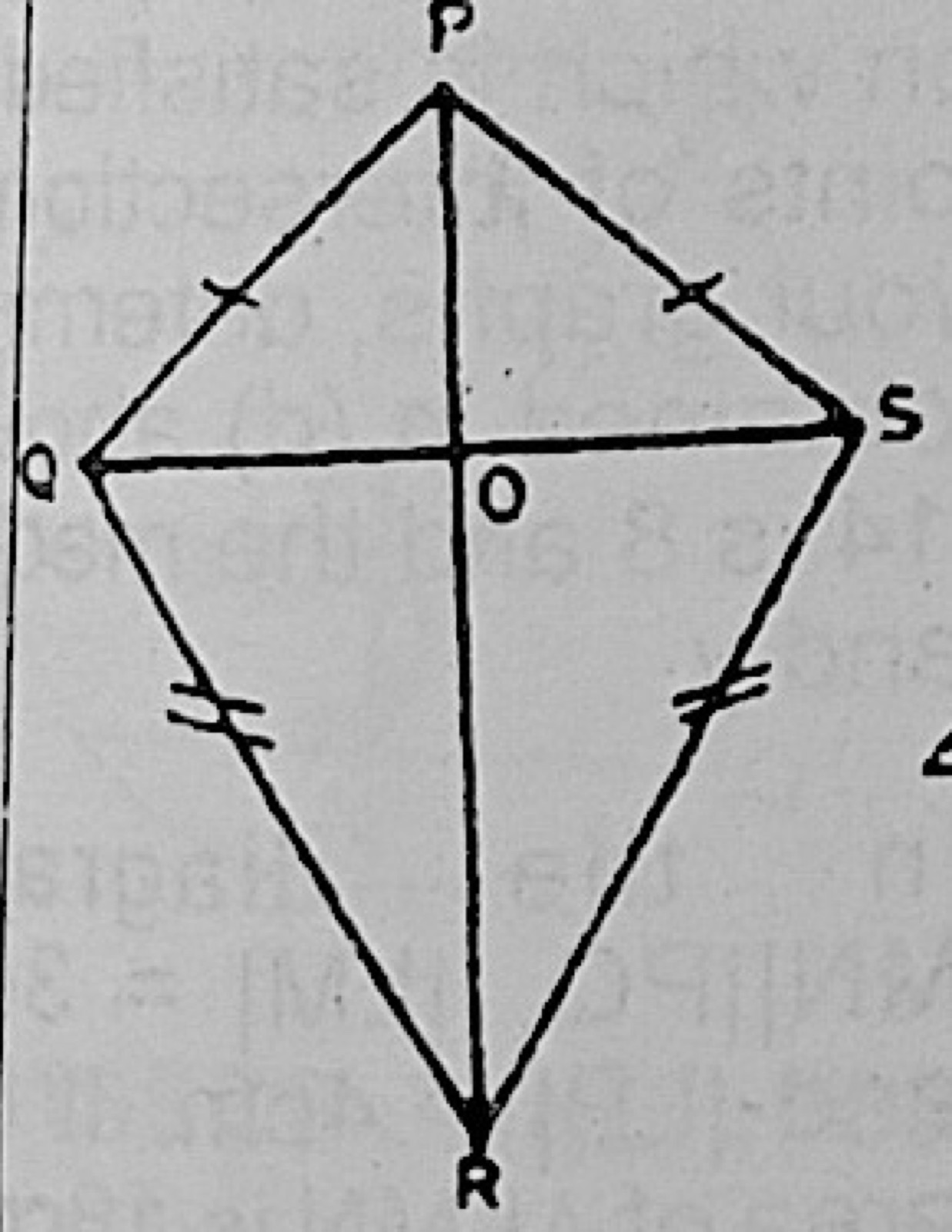
Answer: D (∠PQR = ∠PSR)
PQRS is a kite (PQ = PS and RQ = RS), symmetric about PR, so the angles at Q and S are equal: ∠PQR = ∠PSR.
The area of a circle is 38.5cm2. Find its diameter. [Take π = 22/7]
Answer: C (7cm)
r2 = 38.5 × 7/22 = 12.25, so r = 3.5 cm and the diameter is 7 cm.
Solve the equation 3 + 5x − 2x2 = 0
Answer: D (−1/2, 3)
2x2 − 5x − 3 = (2x + 1)(x − 3) = 0, so x = −1/2 or 3.
If the simple interest on N2,000 after 9 months is N60, at what rate per annum is the interest charged?
Answer: B (4%)
I = PRT/100 with T = 9/12 year: 60 = 2000 × R × 0.75/100, so R = 4%.
(a) Evaluate and express your answer in standard form; (4.56 × 3.6)/0.12
(b) Without using mathematical tables or calculator, evaluate (73.8)2 − (26.2)2
(c) Simplify √(1 19/81), expressing your answer in the form a/b where a and b are positive integers.
(a) (4.56 × 3.6)/0.12 = 4.56 × 30 = 136.8 = 1.368 × 10².
(b) Difference of two squares: (73.8 − 26.2)(73.8 + 26.2) = 47.6 × 100 = 4760.
(c) 1 19/81 = 100/81, so √(100/81) = 10/9.
Spot the difference of two squares: a² − b² = (a − b)(a + b).
(a) Given that cos x = 0.7431, 0 < x < 90°, use tables to find the values of (i) 2 sin x; (ii) tan (x/2)
(b) The interior angles of a pentagon are in ratio 2 : 3 : 4 : 4 : 5. Find the value of the largest angle.
(a) cos x = 0.7431 gives x = 42°.
(i) 2 sin 42° = 2 × 0.6691 = 1.3382.
(ii) tan 21° = 0.3839.
(b) Angles of a pentagon add to 540°. Ratio total = 18, so the largest angle = 5/18 × 540° = 150°.
Find x from the cosine table first, then use it for the other ratios.
(a) Given the expression y = ax2 − bx − 12, find the values of x when a = 1, b = 2 and y = 3
(b) If √(x2 + 1) = 5/4 find the positive value of x.
(a) x2 − 2x − 12 = 3, so x2 − 2x − 15 = 0, (x − 5)(x + 3) = 0: x = 5 or x = −3.
(b) x2 + 1 = 25/16, so x2 = 9/16 and the positive value is x = 3/4.
Substitute the given values, then rearrange to a quadratic equal to zero.
Using ruler and a pair of compasses only, (a) construct ΔPQR such that |PQ| = 7cm, |PR| = 6cm and ∠PQR = 60° (b) Locate point M, the mid-point of PQ. (c) Measure ∠RMQ.
(a) Draw PQ = 7 cm. At Q construct 60° (equilateral-triangle arc). With centre P, radius 6 cm, draw an arc to meet the 60° arm at R.
Note: the distance from P to that arm is 7 sin 60° ≈ 6.06 cm, so a 6 cm arc only just touches it; R is at (or very near) the foot of the perpendicular from P, with QR ≈ 3.5 cm.
(b) Bisect PQ (perpendicular bisector) to get M, so QM = 3.5 cm.
(c) Triangle MQR has QM ≈ QR ≈ 3.5 cm and ∠Q = 60°, so it is (nearly) equilateral: ∠RMQ ≈ 60°.
Construct 60° with compasses by drawing an equilateral triangle on the line.
The pie chart shows the distribution of marks scored by 200 pupils in a test. (a) How many pupils scored (i) between 41 and 50 marks? (ii) above 60 marks? (b) What fraction of the pupils scored at most 50 marks? (c) What is the modal class?
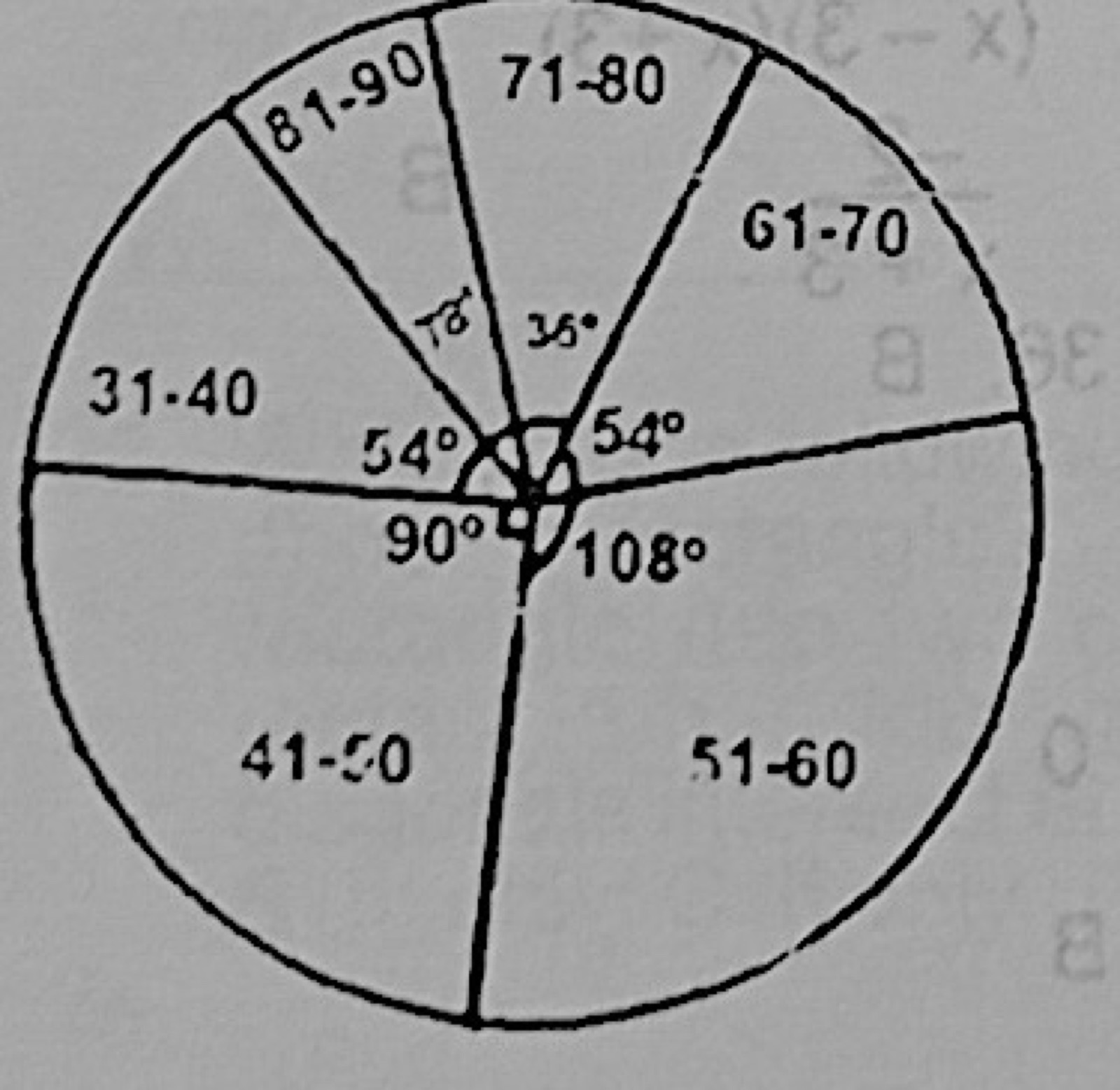
Angles from the chart: 31–40: 54°, 41–50: 90°, 51–60: 108°, 61–70: 54°, 71–80: 36°, 81–90: 18°.
(a)(i) 90/360 × 200 = 50 pupils.
(ii) Above 60: 54 + 36 + 18 = 108°, so 108/360 × 200 = 60 pupils.
(b) At most 50: 54 + 90 = 144°, so 144/360 = 2/5 of the pupils (80 pupils).
(c) The modal class is 51–60 (largest sector, 108°).
Number in a class = angle/360 × total.
(a) The table shows the number of limes and apples of the same size in a bag.
Good: Limes 10, Apples 8
Bad: Limes 6, Apples 6
If two of the fruits are picked at random, one at a time, without replacement, find the probability that: (i) both are good limes; (ii) both are bad fruits; (iii) one is a good apple and the other a bad lime
(b) Solve the equation log3(4x + 1) − log3(3x − 5) = 2
Total fruits = 30.
(a)(i) P = 10/30 × 9/29 = 3/29.
(ii) There are 12 bad fruits: P = 12/30 × 11/29 = 22/145.
(iii) Good apple then bad lime or bad lime then good apple: 2 × (8/30 × 6/29) = 16/145.
(b) log3[(4x + 1)/(3x − 5)] = 2, so (4x + 1)/(3x − 5) = 9.
4x + 1 = 27x − 45, 23x = 46, x = 2 (check: 3x − 5 = 1 > 0).
Without replacement, the second fraction has one fewer in the denominator (29).
(a) A man earns N150,000 per annum. He is allowed a tax free pay of N40,000. If he pays 25 kobo in the naira as tax on his taxable income, how much has he left?
(b) A bookshop had 650 copies of a book for sale. The books were marked at N75 per copy in order to make a profit of 30%. A bookseller bought 300 copies at 5% discount. If the remaining copies are sold at N75 each, calculate the percentage profit the bookshop would make on the whole?
(a) Taxable income = 150,000 − 40,000 = N110,000. Tax = 0.25 × 110,000 = N27,500. Left = 150,000 − 27,500 = N122,500.
(b) Cost price per copy = 75 ÷ 1.3; total cost = 650 × 75/1.3 = N37,500.
Sales: 300 × 75 × 0.95 = N21,375 and 350 × 75 = N26,250; total N47,625.
Profit = 47,625 − 37,500 = N10,125; percentage profit = 10,125/37,500 × 100% = 27%.
The marked price is 130% of cost, so divide by 1.3 to get the cost.
(a) Copy and complete the following table of values for the relation y = x2 − 2x − 5.
x: −3, −2, −1, 0, 1, 2, 3, 4, 5
y: , , −2, , −6, , −2, 3, 10
(b) Draw the graph of the relation y = x2 − 2x − 5, using a scale of 2cm to 1 unit on the x-axis, and 2cm to 2 units on the y-axis.
(c) Using the same axes, draw the graph of y = 2x − 3.
(d) Obtain in the form ax2 + bx + c = 0 where a, b and c are integers, the equation which is satisfied by the x-coordinate of the points of intersection of the two graphs.
(e) From your graphs, determine the roots of the equation obtained in (d) above.
(a) x = −3: 10; x = −2: 3; x = 0: −5; x = 2: −5.
(b) Plot and join with a smooth U-shaped curve (lowest point (1, −6)).
(c) Straight line through (0, −3) and (3, 3).
(d) x2 − 2x − 5 = 2x − 3 gives x2 − 4x − 2 = 0.
(e) Read the x-values where the line meets the curve: x ≈ −0.4 and x ≈ 4.4 (exact 2 ± √6 = −0.45, 4.45).
At an intersection both equations give the same y, so set them equal.
(a) The mean of 1, 2, x, 11, y, 14 is 8 and the median is 9. Find the values of x and y.
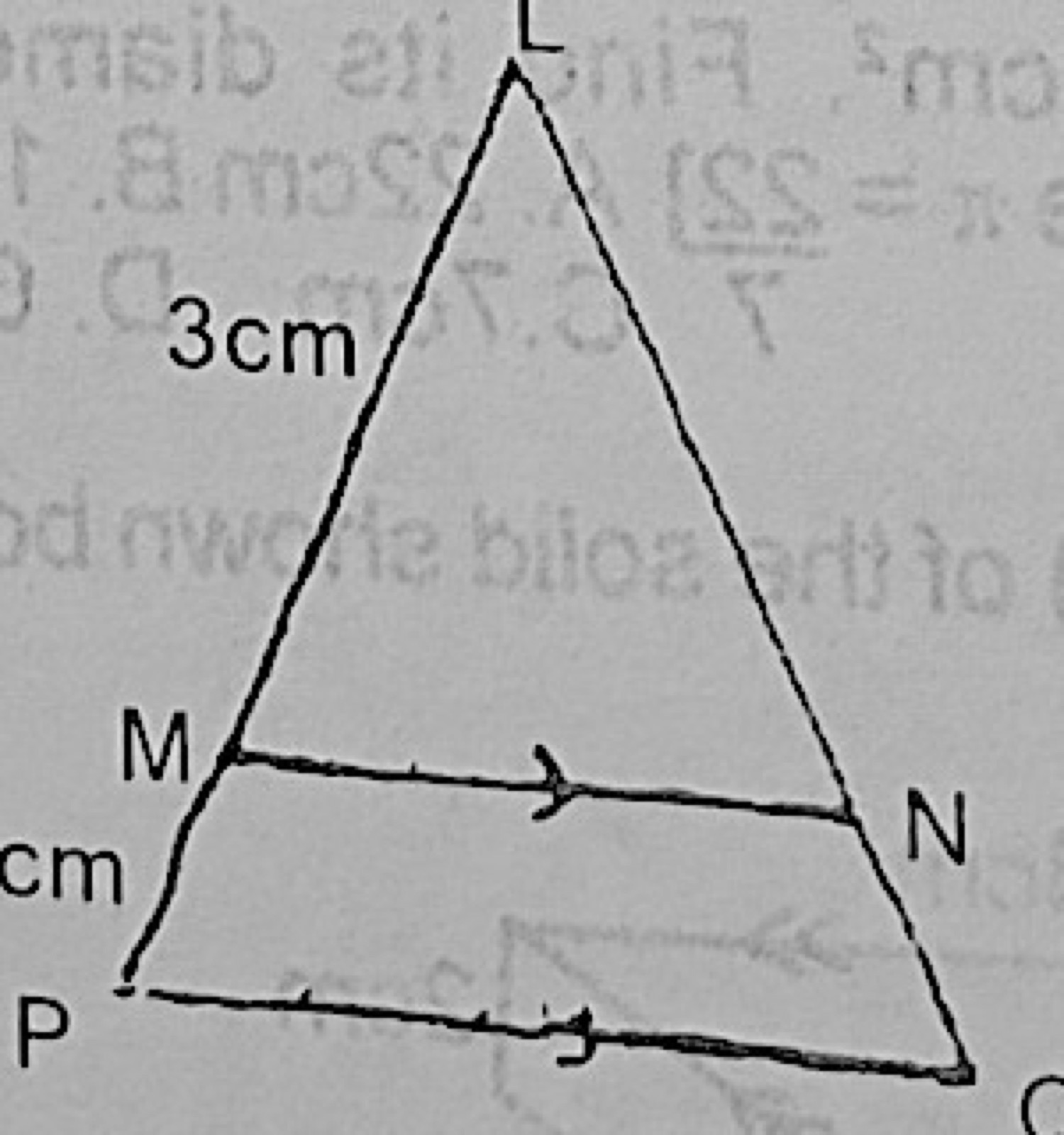
(b) In the diagram, MN||PQ, |LM| = 3cm and |LP| = 4cm. If the area of ΔLMN is 18cm2, find the area of quadrilateral MPQN.
(a) Sum = 6 × 8 = 48, so x + y = 20.
With x < 11 < y the order is 1, 2, x, 11, y, 14 and the median = (x + 11)/2 = 9, so x = 7 and y = 13.
(b) Triangles LMN and LPQ are similar with ratio 3 : 4, so areas are in ratio 9 : 16.
Area LPQ = 18 × 16/9 = 32 cm2; area MPQN = 32 − 18 = 14 cm2.
Areas of similar figures are in the ratio of the squares of their sides.
(a) A surveyor walks 100m up a hill which slopes at an angle of 24° to the horizontal. Calculate, correct to the nearest metre, the height through which he rises
(b) In the diagram, ABC is an isosceles triangle. |AB| = |AC| = 5cm and |BC| = 8cm. Calculate, correct to the nearest degree, ∠BAC.
(c) Two boats, 70 metres apart and on opposite sides of a light house, are in a straight line with the light-house. The angles of elevation of the top of the light-house from the two boats are 71.6° and 45°. Find the height of the light-house. [Take tan 71.6° = 3]
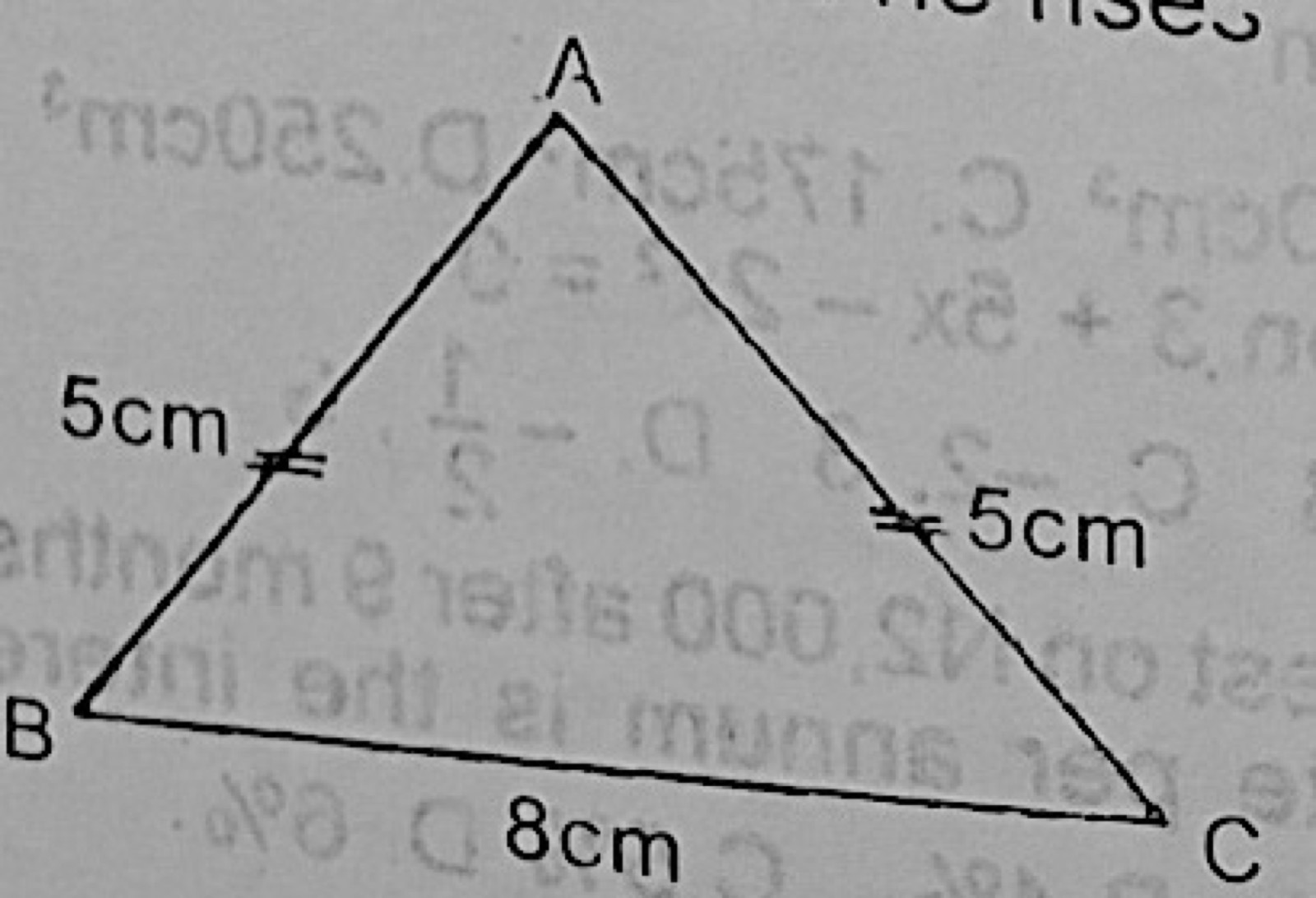
(a) Height = 100 sin 24° = 100 × 0.4067 ≈ 41 m.
(b) The perpendicular from A bisects BC: sin(½∠BAC) = 4/5 = 0.8, so ½∠BAC = 53.13° and ∠BAC ≈ 106°.
(c) Let the height be h. Distances from the foot: h/tan 71.6° = h/3 and h/tan 45° = h.
h/3 + h = 70, so 4h/3 = 70 and h = 52.5 m.
In (c) the two horizontal distances add up to the 70 m between the boats.
(a) A cylindrical well of radius 1 metre is dug out to a depth of 8 metres. (i) Calculate, in m3, the volume of soil dug out (ii) If the soil is used to raise the level of the rectangular floor of a room 4m by 12m, calculate, correct to the nearest cm, the thickness of the new layer of soil. [Take π = 22/7]
(b) The diagram shows a quadrilateral ABCD in which ∠DAB is a right angle. |AB| = 3.3cm, |BC| = 3.9cm, |CD| = 5.2cm and |DA| = 5.6cm (i) find the length of BD (ii) show that ∠BCD = 90°
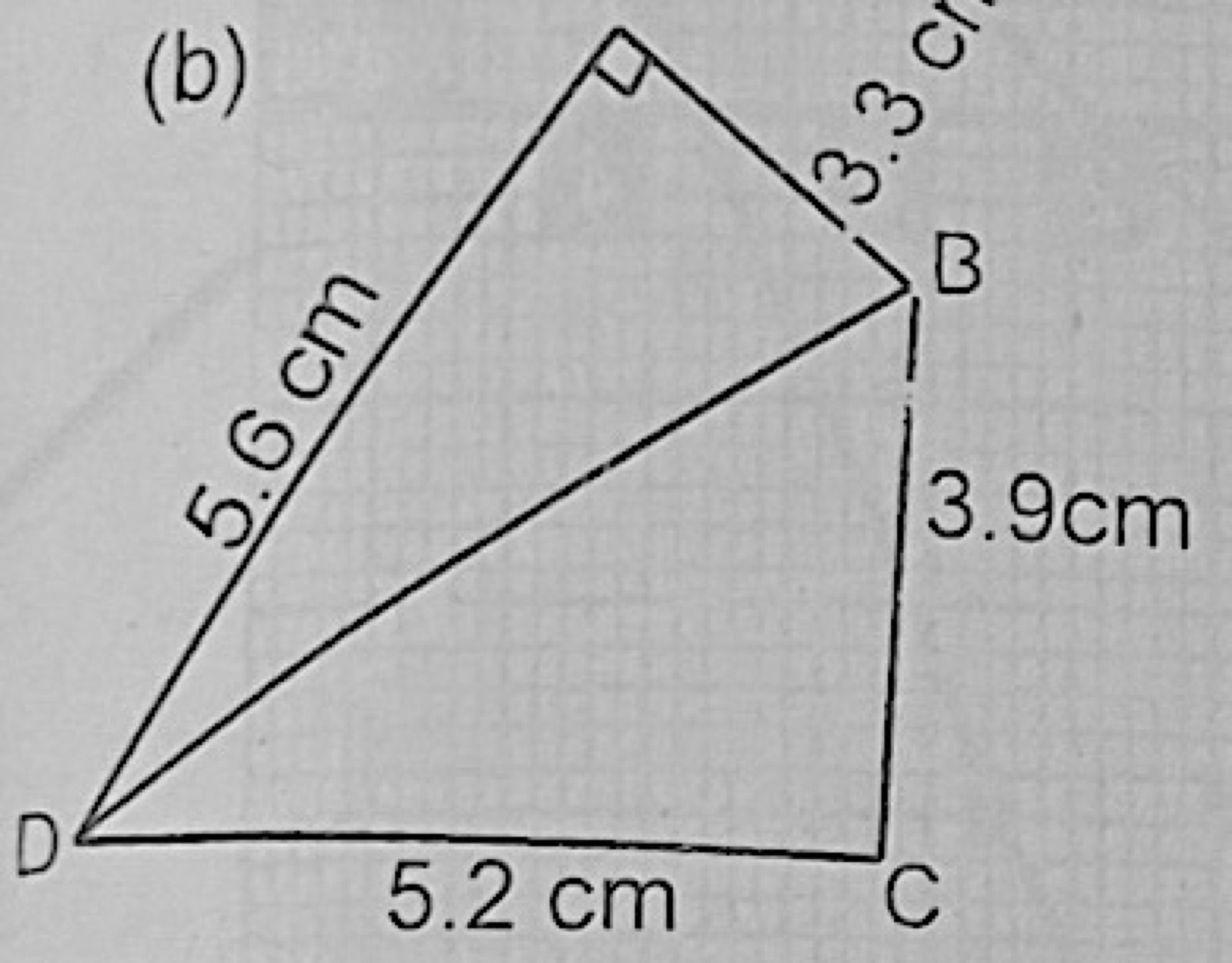
(a)(i) V = πr2h = 22/7 × 1 × 8 ≈ 25.14 m3.
(ii) Thickness = 25.14 ÷ (4 × 12) = 0.524 m ≈ 52 cm.
(b)(i) BD = √(3.32 + 5.62) = √(10.89 + 31.36) = √42.25 = 6.5 cm.
(ii) BC2 + CD2 = 15.21 + 27.04 = 42.25 = BD2, so by the converse of Pythagoras' theorem ∠BCD = 90°.
The soil's volume does not change: volume = floor area × thickness.
(a) The first term of an Arithmetic progression (A.P) is −8. The ratio of the 7th term to the 9th term is 5:8. Calculate the common difference of the progression.
(b) A sphere of radius 2cm is of mass 11.2g. Find: (i) the volume of the sphere, (ii) the density of the sphere, (iii) the mass of a sphere of the same material but with radius 3cm, [Take π = 22/7]
(a) (−8 + 6d)/(−8 + 8d) = 5/8, so 8(−8 + 6d) = 5(−8 + 8d): −64 + 48d = −40 + 40d, 8d = 24, d = 3.
(b)(i) V = 4/3 × 22/7 × 23 = 704/21 ≈ 33.5 cm3.
(ii) Density = 11.2 ÷ 33.52 ≈ 0.334 g/cm3.
(iii) Mass = density × volume = 0.334 × (4/3 × 22/7 × 27) ≈ 37.8 g (or 11.2 × 27/8 = 37.8 g).
Same material means same density; the mass scales with the cube of the radius.
(a) Two places X and Y on the equator are on longitude 67°E and 123°E respectively. (i) What is the distance between them along the equator? (ii) How far is X from the North pole? [Take π = 22/7] and radius of the Earth as 6400 km).
(b) In the diagram, PQR is a circle centre O. N is the midpoint of chord PQ. |PQ| = 8 cm, |ON| = 3cm and ∠ONR = 20°. Calculate the size of ∠ORN to the nearest degree.
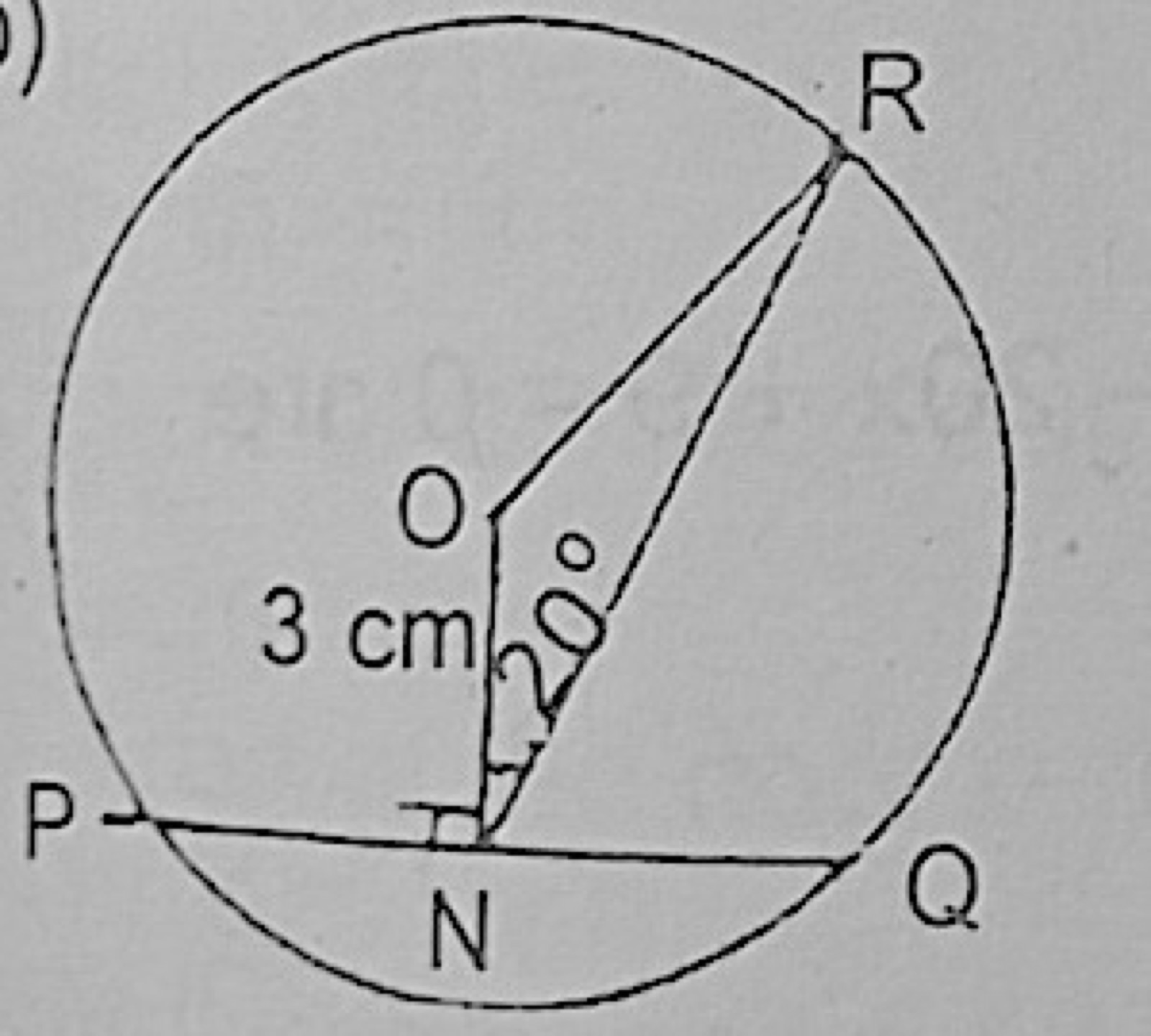
(a)(i) Difference in longitude = 123 − 67 = 56°. Distance = 56/360 × 2 × 22/7 × 6400 ≈ 6258 km.
(ii) From the equator to the North Pole is 90° of a great circle: 90/360 × 2 × 22/7 × 6400 ≈ 10057 km.
(b) ON ⟂ PQ, so the radius OP = √(42 + 32) = 5 cm = OR.
In triangle ONR, sine rule: sin ∠ORN/3 = sin 20°/5, so sin ∠ORN = 0.2052 and ∠ORN ≈ 12°.
Both places are on the equator, so the equator itself is the circle to use.