Theory question 111
Mensuration of Solids(a) A cylindrical well of radius 1 metre is dug out to a depth of 8 metres. (i) Calculate, in m3, the volume of soil dug out (ii) If the soil is used to raise the level of the rectangular floor of a room 4m by 12m, calculate, correct to the nearest cm, the thickness of the new layer of soil. [Take π = 22/7]
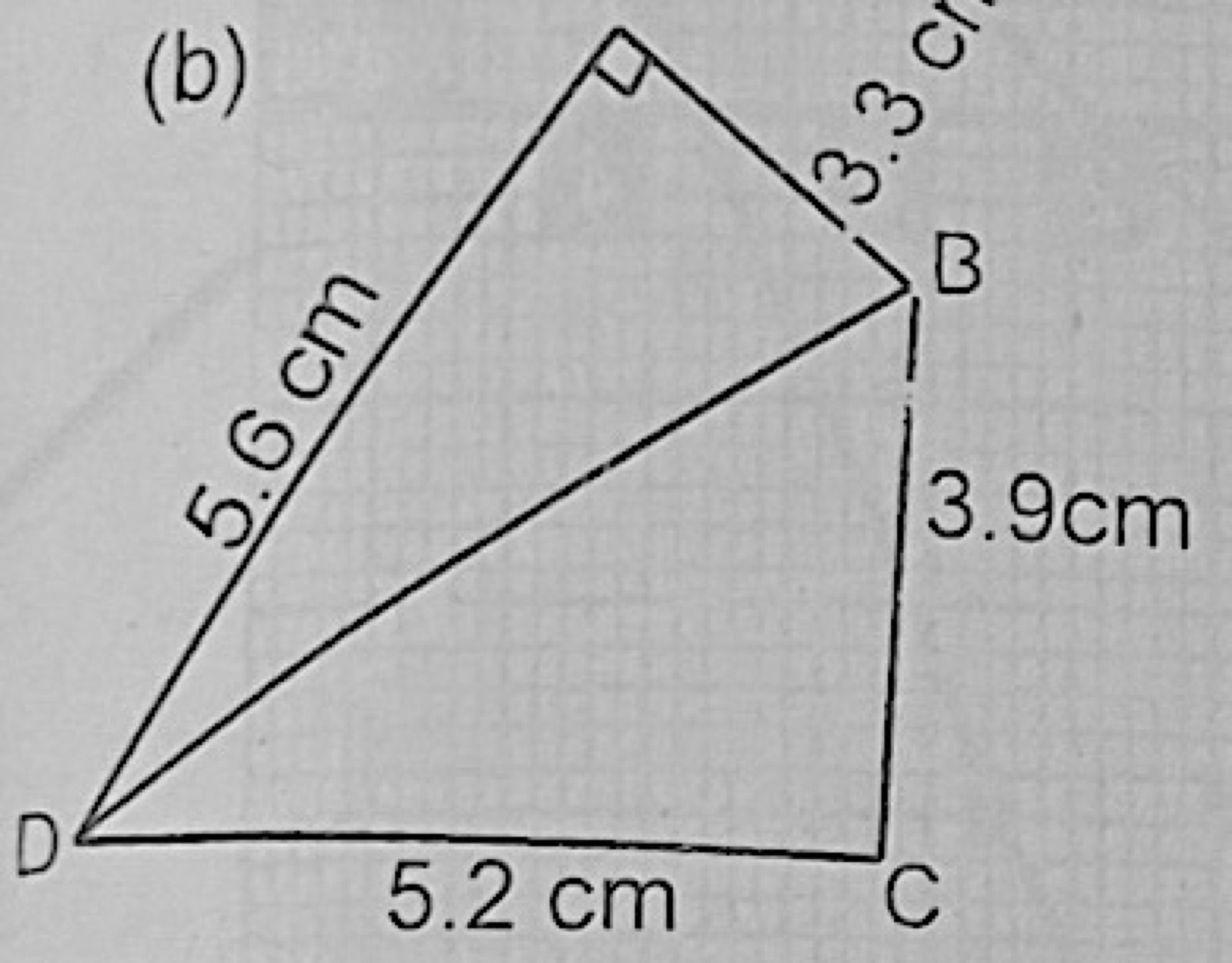
(b) The diagram shows a quadrilateral ABCD in which ∠DAB is a right angle. |AB| = 3.3cm, |BC| = 3.9cm, |CD| = 5.2cm and |DA| = 5.6cm (i) find the length of BD (ii) show that ∠BCD = 90°
Show the model answer
(a)(i) V = πr2h = 22/7 × 1 × 8 ≈ 25.14 m3.
(ii) Thickness = 25.14 ÷ (4 × 12) = 0.524 m ≈ 52 cm.
(b)(i) BD = √(3.32 + 5.62) = √(10.89 + 31.36) = √42.25 = 6.5 cm.
(ii) BC2 + CD2 = 15.21 + 27.04 = 42.25 = BD2, so by the converse of Pythagoras' theorem ∠BCD = 90°.
The soil's volume does not change: volume = floor area × thickness.