Question 1
Drama: GeneralA short speech at the end of a play is the
- A.epilogue
- B.denouement
- C.peroration
- D.conclusion
Show the answer and explanation
Answer: A (epilogue)
Explanation
An epilogue is a short speech or section that closes a play.
69 questions. Try each one, then open the answer to check yourself and read the explanation.
A short speech at the end of a play is the
Answer: A (epilogue)
An epilogue is a short speech or section that closes a play.
An elegy is a poem
Answer: C (mourning the dead)
An elegy is a sad poem lamenting someone who has died.
A couplet is formed by
Answer: B (two rhymed lines of poetry)
A couplet is two consecutive lines of verse that rhyme with each other.
Literary works are classified into
Answer: D (genres)
The classes of literature (poetry, drama, prose and their types) are called genres.
A word that sounds like what it names is a (n)
Answer: C (onomatopoeia)
Onomatopoeia: words like 'buzz' or 'bang' imitate the sound they name.
The repetition of similar vowel sounds within lines is
Answer: C (assonance)
Assonance is the repetition of vowel sounds; alliteration repeats consonant sounds at the start of words.
One of the following is a literary device
Answer: C (Suspense)
Suspense is a technique writers use; sonnet, ode and lyric are kinds of poem.
The theme of a work of art is the
Answer: B (central thought)
The theme is the central idea or message of a work.
The characters in a play constitute the
Answer: D (cast)
All the characters (and the actors who play them) make up the cast.
A play that thrives on exaggeration of humour, plot and character is a
Answer: C (farce)
Farce relies on exaggerated situations and characters to make people laugh.
The hero in a story is the
Answer: B (protagonist)
The protagonist is the hero or main character.
A verbal irony occurs when a speaker on stage
Answer: A (intends more than he says)
In verbal irony the speaker's real meaning differs from (goes beyond) the words he uses.
An 'Aside' occurs when a speaker on stage
Answer: B (mumbles words intended for the audience only)
An aside is a short remark meant for the audience, which the other characters on stage are supposed not to hear.
“The stars blinked and the wind wailed” is an example of
Answer: B (personification)
Stars 'blinking' and wind 'wailing' are human actions given to things: personification.
A stanza of four lines is a(n)
Answer: C (quatrain)
A four-line stanza is a quatrain.
A sonnet is made up of a rhyming sestet and two
Answer: B (rhyming quatrains)
A Petrarchan sonnet has an octave (two quatrains, 8 lines) and a sestet (6 lines): 14 lines.
The climax in a literary work is the
Answer: D (most intense point of the conflict.)
The climax is the turning point where the conflict is at its highest.
Which of the following is not a type of drama?
Answer: B (resolution)
Resolution is a stage of a plot, not a type of play.
The main effect of comedy on an audience is
Answer: C (laughter)
Comedy is written mainly to amuse and make people laugh.
The ending of most comedies is
Answer: A (happy)
Comedies usually end happily, often with marriages or reconciliation.
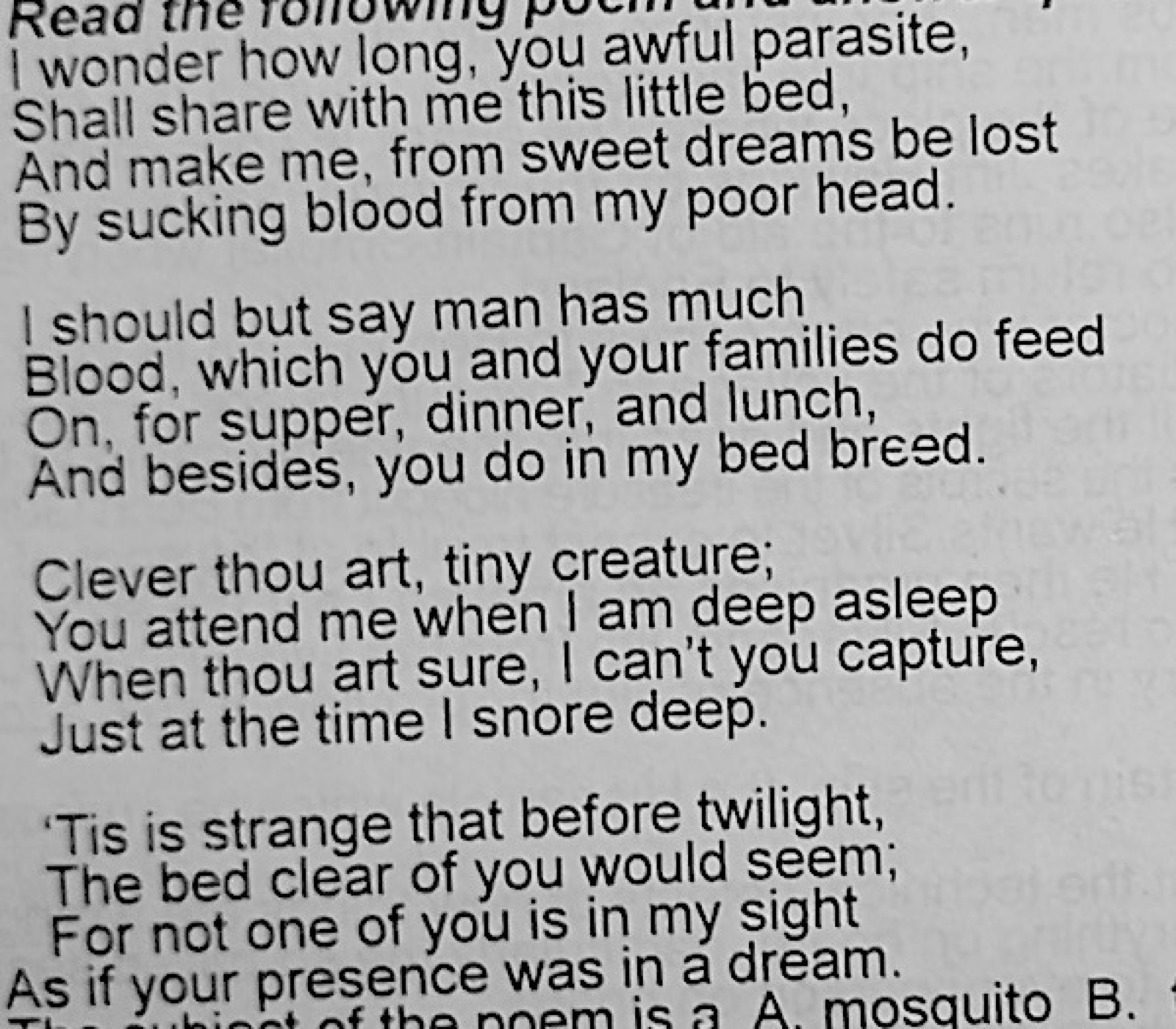
The subject of the poem is a
Answer: C (bedbug)
It lives and breeds 'in my bed', bites at night and cannot be seen 'before twilight': a bedbug.
Lines 1 and 2 of the second stanza illustrate the use of
Answer: C (enjambment)
The sentence runs on from line 1 ('man has much') into line 2 ('Blood ...') without a pause: enjambment.
The creature in the poem is best described as
Answer: A (clever)
The poet says 'Clever thou art, tiny creature', because it escapes capture and bites when he sleeps.
The person's mood is one of
Answer: C (despair)
He wonders how long the pest will torment him and admits he can't catch it: a mood of frustrated despair.
The device used in “Tis so strange” is
Answer: B (alliteration)
The repeated 's' sounds ('Tis so strange') are alliteration.
The mood of the people in the extract is that of
Answer: C (happiness and hope)
Everyone is 'full of joy' and hopes Njoroge's schooling will lift the family.
From the extract, the Howlands and the Jacobos represent the
Answer: A (oppressors)
They are the rich men who despised Ngotho's family; an educated son could match them, so they stand for the oppressors.
The theme of the extract is the
Answer: C (quest for education)
The joy is about Njoroge going to secondary school: the quest for education.
What does the expression “Instrument of Thy light and peace” tell us about the speaker?
Answer: B (His humility)
Njoroge kneels to thank God and asks only to be used as God's instrument: he is humble.
The expression “a glimmer of light” stands for
Answer: D (hope.)
The light in Ngotho's eyes shows new hope.
Twelfth Night (William Shakespeare). Who is speaking?
Answer: A (Olivia)
Olivia admits she has said too much to the cold Cesario and cannot control her love.
Twelfth Night (William Shakespeare). The figure of speech used in “a heart of stone” is
Answer: D (metaphor)
Calling Cesario's heart 'stone' is a direct comparison without 'like': a metaphor.
Twelfth Night (William Shakespeare). The person being referred to in the figure of speech is
Answer: C (Viola)
The 'heart of stone' belongs to Cesario, who is Viola in disguise.
Twelfth Night (William Shakespeare). This person has
Answer: A (refused to accept the ring)
Viola (Cesario) refused the ring Olivia sent after her, denying she had left it.
Twelfth Night (William Shakespeare). The ”headstrong potent fault” is
Answer: A (falling in love)
Olivia's 'fault' is her uncontrollable love for Cesario.
Twelfth Night (William Shakespeare). What has the speaker just done?
Answer: D (sent a ring to Cesario)
At the end of Act I Scene 5 Olivia sends Malvolio after Cesario with a ring, then speaks these lines.
Twelfth Night (William Shakespeare). In lines 1 and 2, the speaker admits
Answer: C (falling in love)
She fears her eye has flattered her mind: she has fallen in love at first sight.
Twelfth Night (William Shakespeare). How does fate treat the speaker at the end of the play?
Answer: A (She marries Sebastian)
Olivia ends up married to Sebastian, Viola's twin.
Twelfth Night (William Shakespeare). Who is speaking?
Answer: A (Orsino)
Duke Orsino describes how he fell in love with Olivia (opening scene).
Twelfth Night (William Shakespeare). The figure of speech used in the underlined expression is
Answer: C (metaphor)
Saying Olivia 'purged the air of pestilence' compares her to a cleansing force without 'like': a metaphor.
Twelfth Night (William Shakespeare). The effect of the figure of speech is to highlight Olivia's
Answer: D (beauty and purity)
Her presence seemed to make the air pure, stressing her beauty and purity.
Twelfth Night (William Shakespeare). In lines 3 to 5, the dominant image is taken from
Answer: B (hunting)
Orsino pictures himself as a deer (hart) chased by hounds: the image comes from hunting.
Twelfth Night (William Shakespeare). The image is itself based on
Answer: C (allusion)
It alludes to the myth of Actaeon, turned into a hart and killed by his own hounds.
Twelfth Night (William Shakespeare). The lines mean that the speaker
Answer: C (is a victim of his desires)
His own desires hunt him like hounds: he is a victim of his passion.
Twelfth Night (William Shakespeare). Who is speaking and to whom?
Answer: B (Viola to Olivia)
Viola, as Cesario, tells Olivia she is cruel to die without leaving a copy of her beauty.
Twelfth Night (William Shakespeare). Where are they?
Answer: D (At Olivia's house)
Act I Scene 5 takes place in Olivia's house.
Twelfth Night (William Shakespeare). What has prompted the speech?
Answer: C (The lady will not marry Orsino)
Olivia refuses Orsino's love, so Viola calls her cruel.
Twelfth Night (William Shakespeare). The underlined expression is a
Answer: A (hyperbole)
'The cruell'st she alive' is a deliberate exaggeration: hyperbole.
Twelfth Night (William Shakespeare). In the last line, the word 'copy' alludes to a
Answer: C (child)
Viola means Olivia should marry and have a child who would carry on her beauty.
Literature 2, Section A: African Drama. Ola Rotimi: The Gods Are Not to Blame
What aspect of King Odewale's character contributed to his downfall?
Main flaw: quick temper and rashness (hubris).
Kills an old man (King Adetusa) in anger over land at Ede, not knowing he is his father.
Insults Baba Fakunle ('blind bat'), provoking him to reveal the truth.
Rough handling of Alaka and the chiefs; accuses Aderopo of plotting without proof.
Pride and stubbornness: runs from Ijekun to escape fate instead of seeking advice; curses the murderer.
Tribal pride/feeling as an outsider; distrust.
Conclusion: his own character, not only the gods, brings his downfall (as he admits).
Name the flaws and link each to an incident that leads to his fall.
Literature 2, Section A. Ola Rotimi: The Gods Are Not to Blame
With reference to at least four incidents, examine Rotimi's use of irony in the play.
Dramatic irony: the audience knows from the prologue that Odewale killed his father and married his mother; he does not.
Odewale fleeing Ijekun to avoid fate takes him straight to Kutuje, where it is fulfilled.
He curses and vows to punish the murderer: he is cursing himself.
He says he is not of Kutuje, yet he is its son.
He calls Baba Fakunle blind, yet it is Odewale who cannot 'see' and ends up blinding himself.
He swears never to see Aderopo again 'with these eyes'.
The saviour of Kutuje is the cause of its plague.
Effect: suspense, tragic intensity, theme of fate.
Give four incidents and explain the irony in each.
Literature 2, Section A. Efua T. Sutherland: The Marriage of Anansewa
Discuss the character of Anansewa, bringing out her role in the play.
Young, beautiful, educated (types letters), modest.
Obedient daughter: agrees to the photographs, letters and the 'death'.
Innocent at first; later protests she will not be 'sold'.
Role: the bait in Ananse's scheme; centre of the chiefs' attention.
Her mock death is the climax; her 'revival' reveals the true suitor.
Shows the place of women and marriage customs in Akan society.
Describe traits with evidence, then her function in the plot.
Literature 2, Section A. Efua T. Sutherland: The Marriage of Anansewa
Discuss the theme of poverty and ambition in The Marriage of Anansewa
Ananse is poor: unpaid school fees, unpaid typewriter instalments, leaking house.
Poverty drives his scheme to 'sell' Anansewa to four chiefs.
Ambition: wants wealth, status, a good husband for his daughter.
Gifts improve his house and his standing in church.
His cunning nearly ruins him; the mock death solves the problem.
Comment: poverty can lead to deceit; ambition pursued by tricks is satirised.
Show how poverty pushes Ananse and how his ambition shapes the plot.
Literature 2, Section B: Non-African Drama. George Bernard Shaw: Arms and the Man
Discuss the effects of war on human society in the play.
Fear and danger: fugitives searched for in Raina's bedroom; civilians endangered.
Exposes false romantic ideas of war (Sergius's foolish cavalry charge).
Shows war as a business: Bluntschli a mercenary, horses bought and sold, Petkoff's rank.
Brings people together and changes relationships (Raina meets Bluntschli).
Soldiers hungry and exhausted (chocolate cream soldier).
Anxiety of families waiting for news; class and pride issues.
Give at least four effects with incidents.
Literature 2, Section B. George Bernard Shaw: Arms and the Man
Examine the character and role of Captain Bluntschli in Arms and the Man.
Swiss professional soldier in the Serbian army; practical, realistic, carries chocolates not cartridges.
Honest, humorous, calm under pressure; good organiser (plans troop movements for Petkoff).
Romantic at heart despite denials ('incurably romantic' disposition).
Role: Shaw's mouthpiece against romantic war and love; exposes Raina's and Sergius's poses.
The coat and photograph drive the plot; he wins Raina at the end; heir to hotels.
Traits with evidence, then his role in plot and theme.
Literature 2, Section B. Oliver Goldsmith: She Stoops to Conquer
Discuss the role of Miss Hardcastle in She Stoops to Conquer.
Heroine; Hardcastle's lively, sensible, witty daughter.
Agrees to meet Marlow; finds him shy with ladies of her class.
'Stoops' by pretending to be a barmaid so Marlow will talk freely; wins his love.
Keeps the deception going to test him; lets her father see the 'other' Marlow.
Brings about the comic resolution and her own marriage.
Shows the theme of disguise and of true character beneath appearance.
Show what she does and how it moves the plot.
Literature 2, Section B. Oliver Goldsmith: She Stoops to Conquer
Discuss how Miss Constance Neville stoops to conquer in the play.
Constance is Mrs Hardcastle's niece; her jewels are kept by her aunt, who wants her to marry Tony.
Loves Hastings; must hide this.
Pretends to love Tony and flatters Mrs Hardcastle to lull her suspicions.
Plans an elopement with Hastings; tries to get her jewels back.
When the plan fails she is taken away, but returns and appeals to Hardcastle.
She wins: Tony renounces her and she marries Hastings with her fortune.
Show how she pretends and plots to get what she wants.
Literature 2, Section C: African Poetry
What picture of rural life is presented in J.P. Clark's Night Rain?
Night storm in a poor village hut; the roof leaks.
Mother moves pots and pans to catch drips ('like a bird...').
The family huddles together on the floor; children half awake.
Rain sound like fish/drums; imagery of the forest and owls.
Peaceful acceptance; they sleep on, comforted by the rain.
Picture: simple, poor but united and peaceful village life.
Describe the scene and support each point with images from the poem.
Literature 2, Section C
Discuss Oswald Mtshali's use of language to bring out the horrors of the night in Nightfall in Soweto.
Personification: nightfall as a 'mortal enemy' / beast that attacks.
Similes: night comes like a dreaded disease; man barks like a rabid dog.
Metaphors of the poet as prey, quarry run down by a marauding beast.
Rhetorical questions: 'Where is my refuge? Where am I safe?'
Imagery of blood, violence, fear; repetition.
Effect: shows the terror and helplessness of blacks in apartheid townships.
Name each device, give an example and show its effect.
Literature 2, Section D: Non-African Poetry
Give a detailed account of the poem Richard Cory, bring out the irony.
Poem by Edwin Arlington Robinson.
Townspeople admire Richard Cory: a gentleman, 'richer than a king', graceful, polite.
They are poor, working, waiting for the light, envious of him.
Last lines: he goes home one calm summer night and shoots himself.
Irony: the man everyone envied was unhappy; outward appearance hides inner despair.
Message: wealth does not guarantee happiness.
Summarise the poem and explain the ending's irony.
Literature 2, Section D
How does Owen bring out the pity of war in Futility?
Wilfred Owen poem: a dead young soldier is moved into the sun.
The sun once woke him at home in the fields; now it cannot.
Rhetorical questions: 'Was it for this the clay grew tall?'
Contrast between life-giving sun and the dead body; 'fatuous sunbeams'.
Mood of grief and questioning of creation itself.
Pity: waste of young life; anger at the meaninglessness of war.
Show the devices and the feelings they create.
Literature 3. Camara Laye: The African Child
Discuss the role of Laye's mother in the African Child.
Loving, protective mother; reluctant to let Laye leave.
Disciplinarian in the household and over the apprentices.
Has supernatural powers (crocodile totem, makes a stubborn horse obey, protects against sorcerers).
Supports her husband, cautions him about his health in gold-smithing.
Represents traditional values and the pain of separation as Laye goes to Conakry and France.
Give her roles with incidents.
Literature 3. Camara Laye: The African Child
To what extent do Laye's holiday experiences in Tindican contribute to his growth and development?
Tindican: his mother's village; visits with his uncle.
Learns about rural life: the rice harvest, farm work, communal songs.
Strengthens ties with grandmother and uncles; good food and care.
Plays with village children who admire his school clothes; sense of identity.
Sees the contrast between village and town, and his separation from farm life.
Contributes to his social, cultural and emotional growth.
Evaluate: show what he learns and how it shapes him.
Literature 3. Elechi Amadi: The Concubine
“Madume is the architect of his own misfortune” Discuss
Greedy, jealous 'big-eyed' man; quarrels over land and property.
Fights Emenike over land; Emenike's later death associated with that fight.
After Emenike's death he tries to seize Ihuoma's land and crops and to seduce her.
Cobra spits in his eyes while he tries to cut her plantain; he goes blind.
Drives away his family; hangs himself in despair.
Conclusion: largely his own greed and lust bring his ruin (though the sea-king is also involved).
Agree or disagree with evidence from Madume's actions.
Literature 3. Elechi Amadi: The Concubine
With close reference to the text, comment on the view that Ekwueme's desperation to marry Ihuoma led to his destruction.
Ekwueme loves Ihuoma after Emenike's death; she refuses because of his betrothal to Ahurole.
Unhappy marriage to Ahurole; love potion; madness cured only by Ihuoma's care.
He insists on marrying Ihuoma despite warnings.
Anyika discovers she is the sea-king's wife; rituals planned to bind the sea-king.
Just before the ritual can be completed, a stray arrow a boy shot at a lizard strikes and kills Ekwueme.
Conclusion: his determination exposes him to fate; desperation hastens his death.
Trace his pursuit and show how it leads to his death.
Literature 3. George Orwell: Animal Farm
Give an account of the events which culminated in the expulsion of Snowball from Animal Farm.
After the Rebellion Snowball organises committees and education.
Rivalry with Napoleon at every meeting.
Napoleon secretly raises the nine puppies as his private guard.
Snowball plans the windmill; Napoleon opposes it.
At the decisive meeting Snowball's speech wins the animals.
Napoleon's dogs chase Snowball off the farm; Napoleon abolishes meetings and takes power.
Narrate the events in order.
Literature 3. George Orwell: Animal Farm
Discuss three methods used in the propaganda
Squealer's persuasive lies and twisted reasoning (milk and apples for 'brain workers').
Rewriting history: Snowball made a traitor and enemy; his bravery denied.
Scapegoating Snowball for every disaster.
Statistics and figures to prove life is better.
Changing the Seven Commandments secretly.
Slogans, songs and the sheep bleating ('Four legs good, two legs better'); fear of Jones's return.
Choose three methods and illustrate each.
Literature 3. Robert Stevenson: The Treasure Island
Give a detailed account of the treasure hunt.
Silver leads the pirates with Jim tied on a rope, using Flint's map.
They find the skeleton (Allardyce) pointing the way.
A voice singing Flint's song frightens them (Ben Gunn).
They reach the spot: the cache is empty.
Pirates turn on Silver and Jim; shots from Livesey, Gray and Ben Gunn scatter them.
Ben Gunn had already dug up the treasure and hidden it in his cave.
Treasure carried to the ship; survivors sail home; three pirates marooned; Silver escapes with some money.
Narrate the hunt clearly from start to end.
Literature 3. Robert Stevenson: The Treasure Island
How does Jim's first encounter with the old sailor contribute to the development of the plot of the novel?
Billy Bones arrives at the Admiral Benbow; Jim watches for the one-legged man for him.
Introduces mystery, fear and the pirate world (song, Black Dog, Pew, black spot).
His death leaves the sea chest with Flint's map.
Jim takes the map to Livesey and Trelawney; the voyage is planned.
Foreshadows violence and Silver's importance.
So it starts the entire plot.
Explain how each event involving the sailor moves the story forward.