Question 1
Indices and LogarithmsIf 1/5−y = 25(54 − 2y), find the value of y.
- A.4
- B.2
- C.−4
- D.−5
Show the answer and explanation
Answer: B (2)
Explanation
5^y = 5² × 5^(4 − 2y) = 5^(6 − 2y), so y = 6 − 2y and y = 2.
51 questions. Try each one, then open the answer to check yourself and read the explanation.
If 1/5−y = 25(54 − 2y), find the value of y.
Answer: B (2)
5^y = 5² × 5^(4 − 2y) = 5^(6 − 2y), so y = 6 − 2y and y = 2.
Simplify (1 − sin θ)(1 + sin θ).
Answer: D (cos2θ)
(1 − sin θ)(1 + sin θ) = 1 − sin²θ = cos²θ.
Given that the lines 3x + 4y + 6 = 0 and 4x − by + 3 = 0 are perpendicular, find the value of b.
Answer: B (3)
Gradients are −3/4 and 4/b. Perpendicular: (−3/4)(4/b) = −1, so b = 3.
Given that x * y = (x + y)/2, x o y = x2/y and (3 * b) o 48 = 1/3, find b, where b > 0.
Answer: C (5)
3 * b = (3 + b)/2. Then ((3 + b)/2)² ÷ 48 = 1/3, so ((3 + b)/2)² = 16, (3 + b)/2 = 4 and b = 5.
If f(x) = 3x3 + 8x2 + 6x + k, and f(2) = 1, find the value of k.
Answer: A (−67)
f(2) = 24 + 32 + 12 + k = 68 + k = 1, so k = −67.
If 8x ÷ (1/4)y = 1 and log2 (x − 2y) = 1, find the value of (x − y).
Answer: A (5/4)
2^(3x) × 2^(2y) = 2⁰ gives 3x + 2y = 0; x − 2y = 2. Adding: 4x = 2, x = ½, y = −¾. x − y = 5/4.
Simplify (1 + √8)/(3 − √2).
Answer: D (1 + √2)
Multiply top and bottom by 3 + √2: (1 + 2√2)(3 + √2)/7 = (7 + 7√2)/7 = 1 + √2.
Using the binomial expansion (1 + x)6 = 1 + 6x + 15x2 + 20x3 + 15x4 + 6x5 + x6, find, correct to three decimal places, the value of (1.98)6.
Answer: C (60.255)
Put x = 0.98: 1 + 5.88 + 14.406 + 18.824 + 13.836 + 5.424 + 0.886 = 60.255 (to 3 d.p.).
If (x + 2) and (3x − 1) are factors of 6x3 + x2 − 19x + 6, find the third factor.
Answer: A (2x − 3)
(x + 2)(3x − 1) = 3x² + 5x − 2, and 6x³ + x² − 19x + 6 ÷ (3x² + 5x − 2) = 2x − 3.
If 2, (k + 1), 8, … form an exponential sequence (GP), find the values of k.
Answer: D (−5 and 3)
(k + 1)/2 = 8/(k + 1), so (k + 1)² = 16, k + 1 = ±4 and k = 3 or −5.
A box contains 5 red and k blue balls. A ball is selected at random from the box. If the probability of selecting a blue ball is 2/3, find the value of k.
Answer: D (10)
k/(5 + k) = 2/3 gives 3k = 10 + 2k, so k = 10.
If T = (−2 −5 / 3 8), find T−1, the inverse of T. (Matrices written row by row; / separates the rows.)
Answer: A ((−8 −5 / 3 2))
|T| = −16 + 15 = −1. T⁻¹ = (1/−1)(8 5 / −3 −2) = (−8 −5 / 3 2).
A function is defined by h: x → 2 − 1/(2x − 3), x ≠ 3/2. Find h−1(x), the inverse of h.
Answer: B (h−1(x) = (3x − 7)/(2x − 4), x ≠ 2)
y = 2 − 1/(2x − 3) = (4x − 7)/(2x − 3). Solve for x: 2xy − 3y = 4x − 7, so x = (3y − 7)/(2y − 4).
A function is defined by h: x → 2 − 1/(2x − 3), x ≠ 3/2. Find h−1(½).
Answer: B (11/6)
h⁻¹(½) = (3/2 − 7)/(1 − 4) = (−11/2)/(−3) = 11/6.
The radius of a sphere is increasing at a rate of 3 cm s−1, find the rate of increase in the surface area, when the radius is 2cm.
Answer: D (48π cm2s−1)
A = 4πr², dA/dt = 8πr × dr/dt = 8π(2)(3) = 48π cm²/s.
The table shows the distribution of ages of members of a cultural Troupe.
Age (years): 10 − 14, 15 − 19, 20 − 24, 25 − 29, 30 − 34
Frequency: 6, 8, 14, 10, 12
What is the class-mark of the median class?
Answer: B (22)
There are 50 members; the 25th lies in 20 − 24 (cumulative 6, 14, 28). Its class mark is 22.
The table shows the distribution of ages of members of a cultural Troupe.
Age (years): 10 − 14, 15 − 19, 20 − 24, 25 − 29, 30 − 34
Frequency: 6, 8, 14, 10, 12
In which group is the upper quartile?
Answer: C ((25 − 29))
¾ × 50 = 37.5th member; cumulative frequencies 6, 14, 28, 38, so it is in 25 − 29.
The table shows the distribution of ages of members of a cultural Troupe.
Age (years): 10 − 14, 15 − 19, 20 − 24, 25 − 29, 30 − 34
Frequency: 6, 8, 14, 10, 12
Find the mean of the distribution.
Answer: A (23.4)
Class marks 12, 17, 22, 27, 32: Σfx = 72 + 136 + 308 + 270 + 384 = 1170. Mean = 1170/50 = 23.4.
If Px2 + (P + 1)x + P = 0 has equal roots, find the values of P.
Answer: C (1 and −1/3)
Equal roots: (P + 1)² = 4P², so 3P² − 2P − 1 = 0, (3P + 1)(P − 1) = 0: P = 1 or −1/3.
Integrate (x − 1/x)2 with respect to x.
Answer: D (x3/3 − 2x − 1/x + C)
(x − 1/x)² = x² − 2 + x⁻². Integrating: x³/3 − 2x − 1/x + C.
Given that AB = (4, 3) and AC = (2, −3) (column vectors), find |BC|.
Answer: C (2√10)
BC = AC − AB = (−2, −6), |BC| = √40 = 2√10.
Find the angle between (5i + 3j) and (3i − 5j).
Answer: B (90°)
Dot product = 15 − 15 = 0, so the vectors are perpendicular: 90°.
Find the coefficient of x3 in the binomial expansion of (3x + 4)4 in ascending powers of x.
Answer: A (432)
Term in x³: ⁴C₃ × 4 × (3x)³ = 4 × 4 × 27x³ = 432x³.
If a fair coin is tossed four times, what is the probability of obtaining at least one head?
Answer: D (15/16)
P(no head) = (½)⁴ = 1/16, so P(at least one) = 15/16.
The deviations from the mean of a set of numbers are (k + 3)2, (k + 7), −2, k and (k + 2)2, where k is a constant. Find the value of k.
Answer: D (−3)
Deviations from the mean add up to 0: 2k² + 12k + 18 = 0, i.e. (k + 3)² = 0, so k = −3.
Find the equation of a circle with centre (2, −3) and radius 2 units.
Answer: A (x2 + y2 − 4x + 6y + 9 = 0)
(x − 2)² + (y + 3)² = 4 expands to x² + y² − 4x + 6y + 9 = 0.
The first term of a linear sequence is 9 and the common difference is 7. If the nth term is 380, find the value of n.
Answer: B (54)
9 + 7(n − 1) = 380, so n − 1 = 53 and n = 54.
For what values of m is 9y2 + my + 4 a perfect square?
Answer: D (+12)
A perfect square needs m² = 4 × 9 × 4 = 144, so m = ±12; of the options only +12 works ((3y + 2)²).
A particle accelerates at 12 ms−2 and travels a distance of 250m in 6 seconds. Find the initial velocity of the particles.
Answer: A (5.7 ms−1)
s = ut + ½at²: 250 = 6u + 216, so u = 34/6 ≈ 5.7 m/s.
In how many ways can 9 people be seated on a bench if only 3 places are available?
Answer: B (504)
Order matters: ⁹P₃ = 9 × 8 × 7 = 504.
Find the variance of 1, 2, 0, −3, 5, −2, 4.
Answer: A (52/7)
Mean = 7/7 = 1. Squared deviations 0, 1, 1, 16, 16, 9, 9 add to 52, so variance = 52/7.
If the points (−1, t − 1), (t, t − 3) and (t − 6, 3) lie on the same straight line, find the values of t.
Answer: B (t = 2 and 3)
Equal gradients: −2/(t + 1) = (4 − t)/(t − 5), which gives t² − 5t + 6 = 0, so t = 2 or 3.
A ball is thrown vertically upwards with a velocity of 15 ms−1. Calculate the maximum height reached. [Take g = 10 ms−2]
Answer: C (11.25m)
At the top v = 0: 0 = 15² − 2(10)H, so H = 225/20 = 11.25 m.
Find the distance between the points (2, 5) and (5, 9).
Answer: B (5 units)
√((5 − 2)² + (9 − 5)²) = √25 = 5 units.
Find limx→3 ((x3 + x2 − 12x)/(x2 − 9)).
Answer: A (7/2)
x(x + 4)(x − 3)/((x − 3)(x + 3)) = x(x + 4)/(x + 3) → 3 × 7/6 = 7/2.
Evaluate (tan 120° + tan 30°)/(tan 120° − tan 60°).
Answer: C (1/3)
Numerator: −√3 + 1/√3 = −2/√3. Denominator: −√3 − √3 = −2√3. Ratio = 1/3.
Express (14N, 240°) as a column vector. (Column vectors written as (x, y).)
Answer: C ((−7√3, −7))
A bearing of 240°: x = 14 sin 240° = −7√3, y = 14 cos 240° = −7.
Solve (log2m)2 − log2m3 = 10.
Let p = log₂m: p² − 3p − 10 = 0, (p − 5)(p + 2) = 0.
p = 5: m = 2⁵ = 32.
p = −2: m = 2⁻² = ¼.
log m³ = 3 log m turns it into a quadratic.
A binary operation * is defined on the set of rational numbers by m * n = (m2 − n2)/(2mn), n ≠ 0 and m ≠ 0. (a) Find −3 * 2. (b) Show whether or not * is associative.
(a) −3 * 2 = (9 − 4)/(2(−3)(2)) = −5/12.
(b) Test with numbers: 1 * 2 = −3/4, so (1 * 2) * 3 = (9/16 − 9)/(2(−3/4)(3)) = 15/8.
2 * 3 = −5/12, so 1 * (2 * 3) = (1 − 25/144)/(2(1)(−5/12)) = −119/120.
15/8 ≠ −119/120, so * is not associative.
One counter-example is enough to show an operation is not associative.
If α and β are the roots of 3x2 + 5x + 1 = 0, evaluate 27(α3 + β3).
α + β = −5/3, αβ = 1/3.
α³ + β³ = (α + β)³ − 3αβ(α + β) = −125/27 + 5/3 = −80/27.
27(α³ + β³) = −80.
Express α³ + β³ using the sum and product of the roots.
Find the gradient of xy2 + x2y = 4xy at the point (1, 3).
y² + 2xy(dy/dx) + 2xy + x²(dy/dx) = 4y + 4x(dy/dx).
At (1, 3): 9 + 6y′ + 6 + y′ = 12 + 4y′, so 3y′ = −3.
Gradient = −1.
Differentiate each product with the product rule.
The position vectors of points P, Q and R are 11i + j, 5i + (13/3)j and 2i + 6j respectively. (a) Show that P, Q and R lie on a straight line. (b) Find the ratio |PQ| : |QR|.
(a) PQ = (−6, 10/3), QR = (−3, 5/3).
PQ = 2QR, so PQ and QR are parallel with Q in common: P, Q, R are collinear.
(b) |PQ| = 2√106/3, |QR| = √106/3, so |PQ| : |QR| = 2 : 1.
Collinear points: one connecting vector is a multiple of the other.
A committee of 3 is formed from a panel of 5 men and 3 women. Find the: (a) number of ways of forming the committee; (b) probability that at least one woman is on the committee.
(a) ⁸C₃ = 56 ways.
(b) No woman: ⁵C₃ = 10, so P(at least one woman) = 1 − 10/56 = 46/56 = 23/28.
'At least one' = 1 − P(none).
The table shows the distribution of the lengths of 20 iron rods measured in metres.
Length (m): 1.0 − 1.1, 1.2 − 1.3, 1.4 − 1.5, 1.6 − 1.7, 1.8 − 1.9
Frequency: 2, 3, 8, 5, 2
Using an assumed mean of 1.45, calculate the mean of the distribution.
Class marks 1.05, 1.25, 1.45, 1.65, 1.85; d = −0.4, −0.2, 0, 0.2, 0.4.
Σfd = −0.8 − 0.6 + 0 + 1.0 + 0.8 = 0.4; Σf = 20.
Mean = 1.45 + 0.4/20 = 1.47 m.
Mean = A + Σfd/Σf.
Find the direction of the resultant of the forces in the diagram.
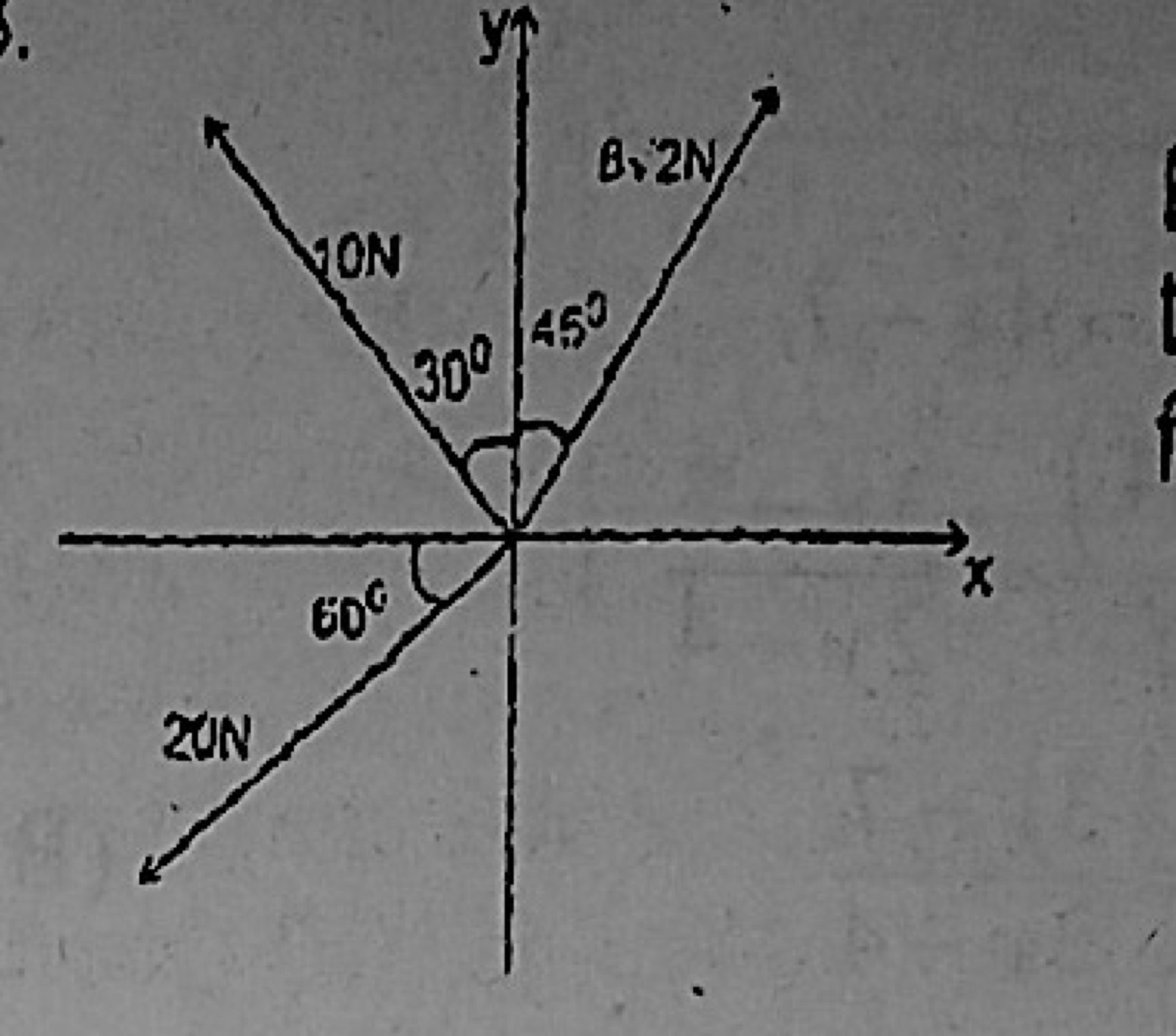
Components (x, y): 10 N at 30° to the y-axis: (−5, 8.660); 8√2 N at 45°: (8, 8); 20 N at 60° below the negative x-axis: (−10, −17.321).
Resultant = (−7, −0.660).
It points 5.39° below the negative x-axis (tan⁻¹(0.660/7)): direction 185.4° from the positive x-axis, i.e. bearing 264.6°.
Resolve every force into x and y components first.
(a) Differentiate (x − 3)(x2 + 5) with respect to x.
(b) If (x + 1)2 is a factor of f(x) = x3 + ax2 + bx + 3, where a and b are constants, find the: (i) values of a and b; (ii) zeros of f(x).
(a) d/dx = (x² + 5) + 2x(x − 3) = 3x² − 6x + 5.
(b)(i) f(x) = (x + 1)²(x + 3) (the constant term 3 fixes the third factor) = x³ + 5x² + 7x + 3, so a = 5, b = 7.
(ii) Zeros: −1 (twice) and −3.
Compare coefficients after writing f(x) = (x + 1)²(x + c).
(a) Express (5 + √2)/(3 − √2) − (5 − √2)/(3 + √2) in the form a + b√2.
(b) Solve the following equations simultaneously using the determinant method: 3x − y − z = −2; x + 5y + 2z = 5; 2x + 3y + z = 0.
(a) (5 + √2)(3 + √2)/7 = (17 + 8√2)/7 and (5 − √2)(3 − √2)/7 = (17 − 8√2)/7.
Difference = 16√2/7: a = 0, b = 16/7.
(b) Δ = 1; Δₓ = −8; Δᵧ = 19; Δ_z = −41.
x = −8, y = 19, z = −41.
Check the solution in all three equations.
(a) If f(x) = (x − 3)/(2x − 1), x ≠ ½ and g(x) = (x − 1)/(x + 1), x ≠ −1, find g o f.
(b)(i) Sketch the curve y = 9x − x3. (ii) Calculate the total area bounded by the x-axis and the curve y = 9x − x3.
(a) g(f(x)) = (f − 1)/(f + 1) = [(x − 3) − (2x − 1)]/[(x − 3) + (2x − 1)] = (−x − 2)/(3x − 4) = −(x + 2)/(3x − 4), x ≠ ½, 4/3.
(b)(i) Cuts the x-axis at −3, 0, 3; minimum at x = −√3, maximum at x = √3; falls to the right.
(ii) Area = 2∫₀³ (9x − x³) dx = 2(81/2 − 81/4) = 81/2 = 40.5 square units.
Area below the axis is counted as positive.
The probabilities that Kofi, Kwasi and Ama will pass a certain examination are 9/10, 4/5 and x respectively. If the probability that only one of them will pass examination is 9/50, find the: (a) value of x; (b) probability that at least one of them will pass examination.
(a) Only one passes: (9/10)(1/5)(1 − x) + (1/10)(4/5)(1 − x) + (1/10)(1/5)x = 9/50.
9(1 − x) + 4(1 − x) + x = 9, so 13 − 12x = 9 and x = 1/3.
(b) P(all fail) = (1/10)(1/5)(2/3) = 1/75; P(at least one) = 74/75 ≈ 0.987.
List the three 'only one passes' cases and add them.
(a) Given that x = 3i − j, y = 2i + kj and the cosine of the angle between x and y is √5/5, find the values of the constant k.
(b) In the quadrilateral ABCD, AB = (5, −1), AC = (−6, −9) and BD = (4, −7) (column vectors). Show whether or not ABCD is a parallelogram.
(a) x·y = 6 − k; |x| = √10, |y| = √(4 + k²).
(6 − k)/(√10√(4 + k²)) = 1/√5 gives (6 − k)² = 2(4 + k²), k² + 12k − 28 = 0.
k = 2 or k = −14.
(b) Take A as origin: B = (5, −1), C = (−6, −9), D = B + BD = (9, −8).
DC = C − D = (−15, −1) ≠ AB = (5, −1) (also AD = (9, −8) ≠ BC = (−11, −8)).
Opposite sides are not equal vectors, so ABCD is not a parallelogram.
A parallelogram ABCD needs AB = DC.
(a) A(−1, 2), B(3, 5) and C(4, 8) are the vertices of triangle ABC. Forces whose magnitudes are 5N and 3√10 N act along AB and CB respectively. Find the direction of the resultant of the forces.
(b) A particle starts from rest and moves in a straight line. It attains a velocity of 20 ms−1 after covering a distance of 8 metres. Calculate: (i) its acceleration; (ii) the time it will take to cover a distance of 40 metres.
(a) AB = (4, 3), |AB| = 5: force = (4, 3).
CB = (−1, −3), |CB| = √10: force = 3√10 × (−1, −3)/√10 = (−3, −9).
Resultant = (1, −6): 80.5° below the positive x-axis (279.5° anticlockwise from the x-axis; bearing 170.5°).
(b)(i) v² = 2as: 400 = 16a, a = 25 ms⁻².
(ii) 40 = ½(25)t², t² = 3.2, t ≈ 1.79 s.
Force along a line = magnitude × unit vector of that line.