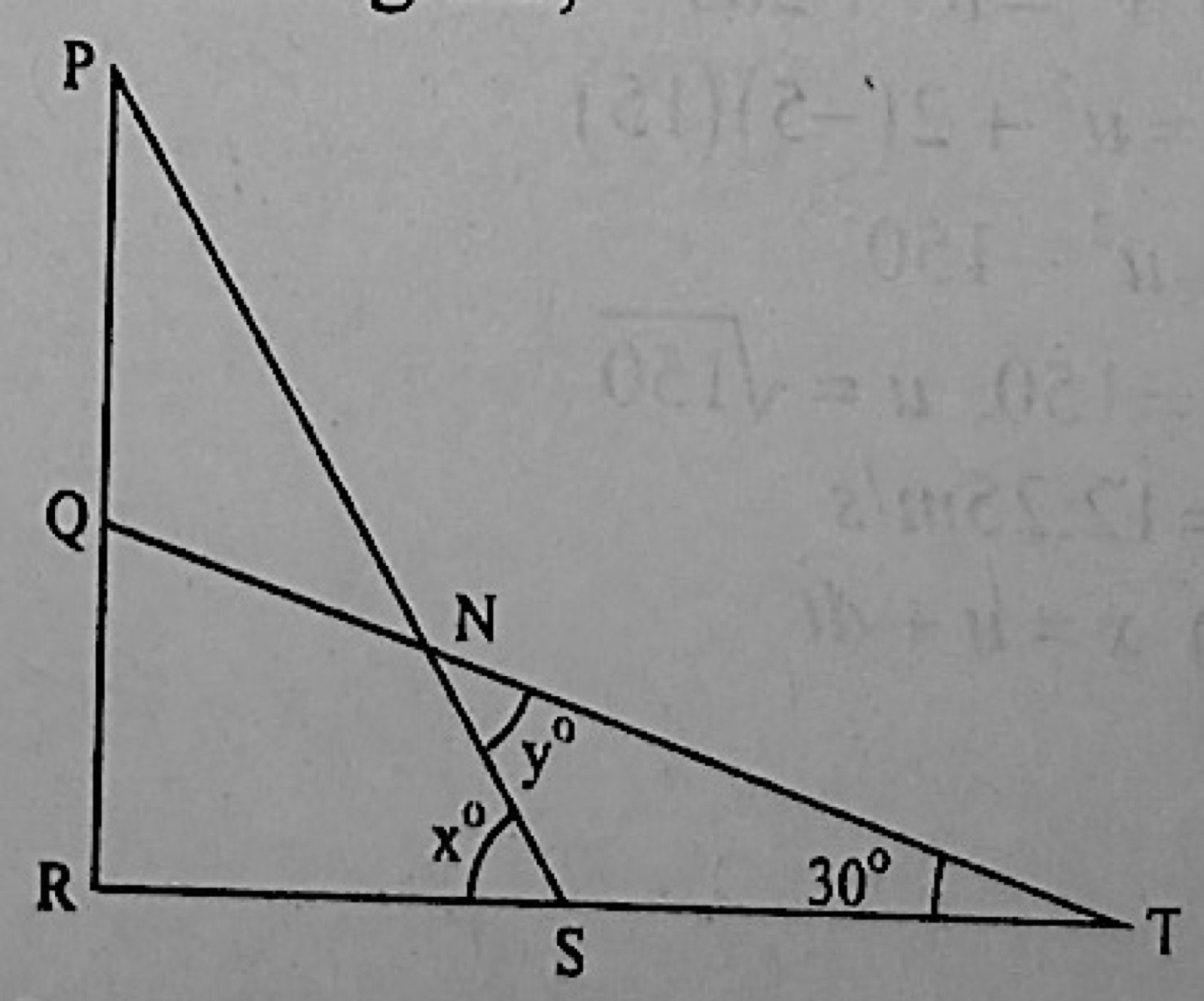
In the diagram, a ladder PS leaning against a vertical wall PR makes angle x° with the horizontal floor. The ladder slides down to a point QT such that angle QTR = 30° and angle SNT = y°. Find the relation between x and y
A.y = ½x + 30
B.y = ½x − 30
C.y = x + 30
D.y = x − 30
Show the answer and explanation
Answer: D (y = x − 30)
Explanation
In triangle NST, angle NST = 180° − x and angle NTS = 30°, so y = 180° − (180° − x) − 30° = x − 30°.
A stone is projected vertically upwards with a speed of 10ms−1 from a point 8 metres above the ground. Find the maximum height reached. [Take g = 10ms−2]
A.13 metres
B.15 metres
C.18 metres
D.23 metres
Show the answer and explanation
Answer: A (13 metres)
Explanation
It rises a further u2/2g = 100/20 = 5 m above the point, so the greatest height is 8 + 5 = 13 m above the ground.
The velocity, v ms−1 of a particle moving in a straight line given by v = 3t2 − 2t + 1 at time t seconds. Find the acceleration of the particle after 3 seconds.
A.26ms−2
B.18ms−2
C.17ms−2
D.16ms−2
Show the answer and explanation
Answer: D (16ms−2)
Explanation
a = dv/dt = 6t − 2. At t = 3, a = 18 − 2 = 16 ms−2.
Three men, P, Q and R aim at a target the probabilities that P, Q and R hit the target are ½, ⅓ and ¾ respectively. Find the probability that exactly two of them hit the target.
A.1
B.½
C.5/12
D.⅓
Show the answer and explanation
Answer: C (5/12)
Explanation
Add the three cases with one miss: (½)(⅓)(¼) + (½)(⅔)(¾) + (½)(⅓)(¾) = 1/24 + 6/24 + 3/24 = 10/24 = 5/12.
The probabilities of Rotey obtaining the highest mark in Mathematics, Physics and Biology tests are 0.9, 0.75 and 0.8 respectively. Calculate the probability of getting the highest marks in at least two subjects.
Show the model answer
Model answer
All three: 0.9 × 0.75 × 0.8 = 0.54 M, P not B: 0.9 × 0.75 × 0.2 = 0.135 M, B not P: 0.9 × 0.25 × 0.8 = 0.18 P, B not M: 0.1 × 0.75 × 0.8 = 0.06 At least two = 0.915
A student representative council consist of 8 girls and 6 boys. If an editorial board consisting of 5 persons is to be formed, what is the probability that the board consist of (a) 3 girls and 2 boys; (b) either all girls or all boys?
The coordinates of the vertices of triangle ABC are A(−2, 1), B(4, −2), and C(1, 8) respectively. If D(x, y) is the foot of the perpendicular from A to BC, find (A) an equation connecting x and y; (b) the unit vector in the direction of BC.
Show the model answer
Model answer
(a) Gradient of BC = (8 + 2)/(1 − 4) = −10/3 D lies on BC: y + 2 = −10/3(x − 4), i.e. 10x + 3y − 34 = 0 (Also AD ⟂ BC gives 3x − 10y + 16 = 0; together D = (292/109, 262/109)) (b) BC = −3i + 10j, |BC| = √109 Unit vector = (−3i + 10j)/√109
Explanation
D is on line BC, and AD is perpendicular to BC; divide a vector by its length to get a unit vector.
The position vector of a body, with respect to the origin, is given by r = 4t i + (12 − 3t) j at anytime t seconds. (a) Find the velocity of the body (b) Calculate the magnitude of the displacement between t = 0 and t = 5.
(a) The 3rd and 6th terms of a geometric progression (G.P.) are 2 and 54 respectively. Find the (i) common ratio (ii) first term (iii) sum of the first ten terms, correct the nearest whole number. (b) The ratio of the coefficient of x4 to that of x3 in the binomial expansion of (1 + 2x)n is 3 : 1. Find the value of n.
Show the model answer
Model answer
(a)(i) ar2 = 2, ar5 = 54, so r3 = 27 and r = 3 (ii) a = 2/9 (iii) S10 = (2/9)(310 − 1)/(3 − 1) = 59048/9 ≈ 6561 (b) nC4(16) : nC3(8) = 3 : 1 2(n − 3)/4 = 3, so n − 3 = 6 and n = 9
Explanation
Divide the two GP terms to find r; for (b) use ⁿC₄/ⁿC₃ = (n − 3)/4.
(a) Using the same axes, sketch the curves y = 6 − x − x2 and y = 3x2 − 2x + 3. (b) Find the x-coordinates of the points of intercession of the two curves in (a) (c) Calculate the area of the finite region bounded by the two curves (a).
Show the model answer
Model answer
(a) y = 6 − x − x2: ∩-shaped, cuts x-axis at −3 and 2, y-intercept 6, maximum at (−½, 6¼) y = 3x2 − 2x + 3: ∪-shaped, y-intercept 3, minimum at (⅓, 2⅔), does not cut the x-axis (b) 6 − x − x2 = 3x2 − 2x + 3 → 4x2 − x − 3 = 0 → (4x + 3)(x − 1) = 0 x = −3/4 or x = 1 (c) Area = ∫ from −3/4 to 1 of (3 + x − 4x2)dx = [3x + x2/2 − 4x3/3] = 13/6 − (−45/32) = 343/96 ≈ 3.57 square units
Explanation
Area between curves = ∫(upper − lower)dx between the intersection points.
(a) Use the trapezium rule with five ordinates to evaluate ∫01 3dx/(1 + x2) correct to four significant figures. (b) If A = (2 1; 3 2) find the image of the point (1, 2) under the linear transformation A2 + A + 2I, where I is the 2 x 2 unit matrix.
(a) Simplify n+1C3 − n−1C3. (b) A fair die is thrown five times. Calculate, correct to three decimal places, the probability of containing (i) at most two sixes; (ii) exactly three sixes.
The distribution of the lives (in days) of 40 transistor batteries is shown in the table. Battery life (in days): 26-30, 31-35, 36-40, 41-45, 46-50, 51-55 Frequency: 4, 7, 13, 8, 6, 2 (a) Draw a histogram for the distribution (b) Use your graph in (a) to determine the mode for the distribution. (c) Using an assumed mean of 43 days, calculate the mean of the distribution. (d) What percentage number of batteries will live for less than 31 days or more than 45 days?
Show the model answer
Model answer
(a) Bars on class boundaries 25.5, 30.5, …, 55.5 with heights 4, 7, 13, 8, 6, 2 (b) Modal class 35.5–40.5; crossing lines give mode ≈ 35.5 + 6/(6 + 5) × 5 ≈ 38.2 days (c) Mid-points 28, 33, 38, 43, 48, 53; d = −15, −10, −5, 0, 5, 10; Σfd = −145 Mean = 43 − 145/40 = 39.375 ≈ 39.4 days (d) Less than 31: 4; more than 45: 6 + 2 = 8; 12/40 × 100 = 30%
Explanation
On the histogram, join the corners of the tallest bar to the neighbouring bars; their crossing gives the mode.
The table below shows the corresponding values of two variables X and Y. X: 33, 31, 28, 25, 23, 22, 19, 17, 16, 14 Y: 4, 6, 4, 10, 12, 10, 14, 15, 18, 22 (a) Plot a scatter diagram to represent the data. (b) Calculate x̄, the mean of x and ȳ, the mean of y. (c) Draw the line of best fit to pass through (x̄, ȳ) (d) From your graph in (c), determine the (i) relationship between X and Y. (ii) value of Y when X is 24.
Show the model answer
Model answer
(a) Plot the 10 points with X on the horizontal axis (b) x̄ = 228/10 = 22.8, ȳ = 115/10 = 11.5 (c) Straight line through (22.8, 11.5) following the trend of the points (d)(i) Negative linear relationship: Y decreases as X increases, roughly Y = 31.5 − 0.88X (gradient read from the graph about −0.9) (ii) When X = 24, Y ≈ 10.4 (about 10–11 from the graph)
Explanation
Find the gradient and intercept of your line of best fit to state the relationship.
(a) The position vectors of points L and M are (5i + 6j) and (13i + 4j) respectively. If point K lies on LM such that LK : KM is 2:3, find the position vector of K. (b) Three poles are situated at points A, B and C on the same horizontal plane such that AB = (8km, 060°) and BC = (12km, 130°). Calculate: (i) |AB|, correct to three decimal places (ii) the bearing of C from A, correct to the nearest degree.
Show the model answer
Model answer
(a) LM = 8i − 2j; LK = (2/5)LM = (16/5)i − (4/5)j OK = 5i + 6j + (16/5)i − (4/5)j = (41/5)i + (26/5)j (b) Angle ABC = 180° − 130° + 60° = 110° (i) |AC|2 = 82 + 122 − 2(8)(12)cos 110° = 273.67, |AC| = 16.543 km (|AB| itself is the given 8 km) (ii) AC = (8 sin 60° + 12 sin 130°)i + (8 cos 60° + 12 cos 130°)j = 16.121i − 3.714j Bearing of C from A = 90° + tan−1(3.714/16.121) ≈ 103°
Explanation
Use the cosine rule in triangle ABC, then resolve the displacements east and north to get the bearing.
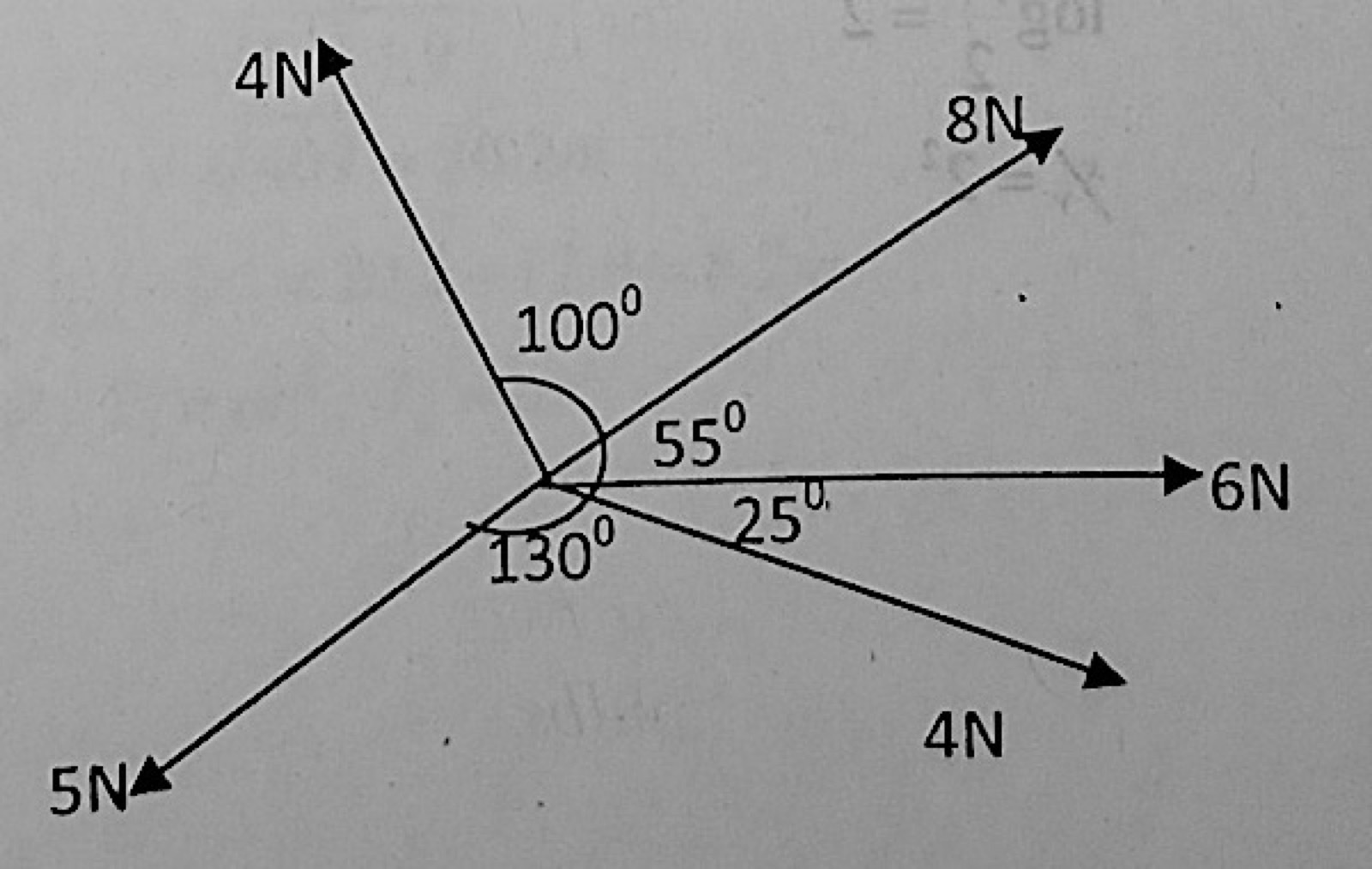
Coplanar forces 4N, 8N 6N, 4N and 5N act at a point as shown in the diagram. If the 6N force act in the direction 090°, calculate the (a) magnitude of the resultant force; (b) direction of the resultant force.
Show the model answer
Model answer
Angles measured anticlockwise from the 6N force (east): 6N at 0°, 8N at 55°, 4N at 155°, 4N at −25°, 5N at 205° East components: 6 + 8 cos 55° − 4 cos 25° + 4 cos 25° − 5 cos 25° = 6.057 N North components: 8 sin 55° + 4 sin 25° − 4 sin 25° − 5 sin 25° = 4.440 N (a) |R| = √(6.0572 + 4.4402) ≈ 7.5 N (b) tan−1(4.440/6.057) ≈ 36.2° north of east, i.e. bearing ≈ 054°
Explanation
Resolve every force along and perpendicular to the 6N force, add, then use Pythagoras and tan⁻¹.
(a) The position vectors of points A, B and C are i + 5j, 3i + 9j, and −i + j respectively. (i) Show that points A, B and C are collinear. (ii) Determine the ratio |AB| : |BC| (b) A uniform beam XY of mass 10kg and length 24m is hunged horizontally from a cross bar by two vertical inextensible strings, one attached to X and the other at a point M, 4m away from Y, a mass of 50kg is suspended at a point N which is 8m from X. If the system remains in equilibrium, calculate the tensions in the strings [Take g = 10ms−2]
Show the model answer
Model answer
(a)(i) AB = 2i + 4j, BC = −4i − 8j = −2AB; parallel with common point B, so A, B, C are collinear (ii) |AB| : |BC| = √20 : √80 = 1 : 2 (b) Weights: beam 100 N at 12 m from X, load 500 N at 8 m from X; M is 20 m from X Moments about X: 20TM = 100 × 12 + 500 × 8 = 5200, TM = 260 N Resolving: TX + TM = 600, TX = 340 N
Explanation
Take moments about one string to remove its tension, then resolve vertically.