The table below shows the supply and demand schedule for apples. Use it to answer the question. Price ($) | Quantity demanded | Quantity supplied 10 | 50 | 25 20 | 35 | 35 30 | 20 | 45 40 | 5 | 55 At what price is excess supply equal to 25?
Use the table below to answer the question. Gross National Product | $400 m Depreciation | $100 m Total population | 25 m The value of Net National Product is
Use the table below to answer the question. Gross National Product | $400 m Depreciation | $100 m Total population | 25 m The value of per capita income is
A.$20.
B.$12.
C.$8.
D.$4.
Show the answer and explanation
Answer: B ($12.)
Explanation
Per capita income = national income (NNP) ÷ population = 300 ÷ 25 = $12.
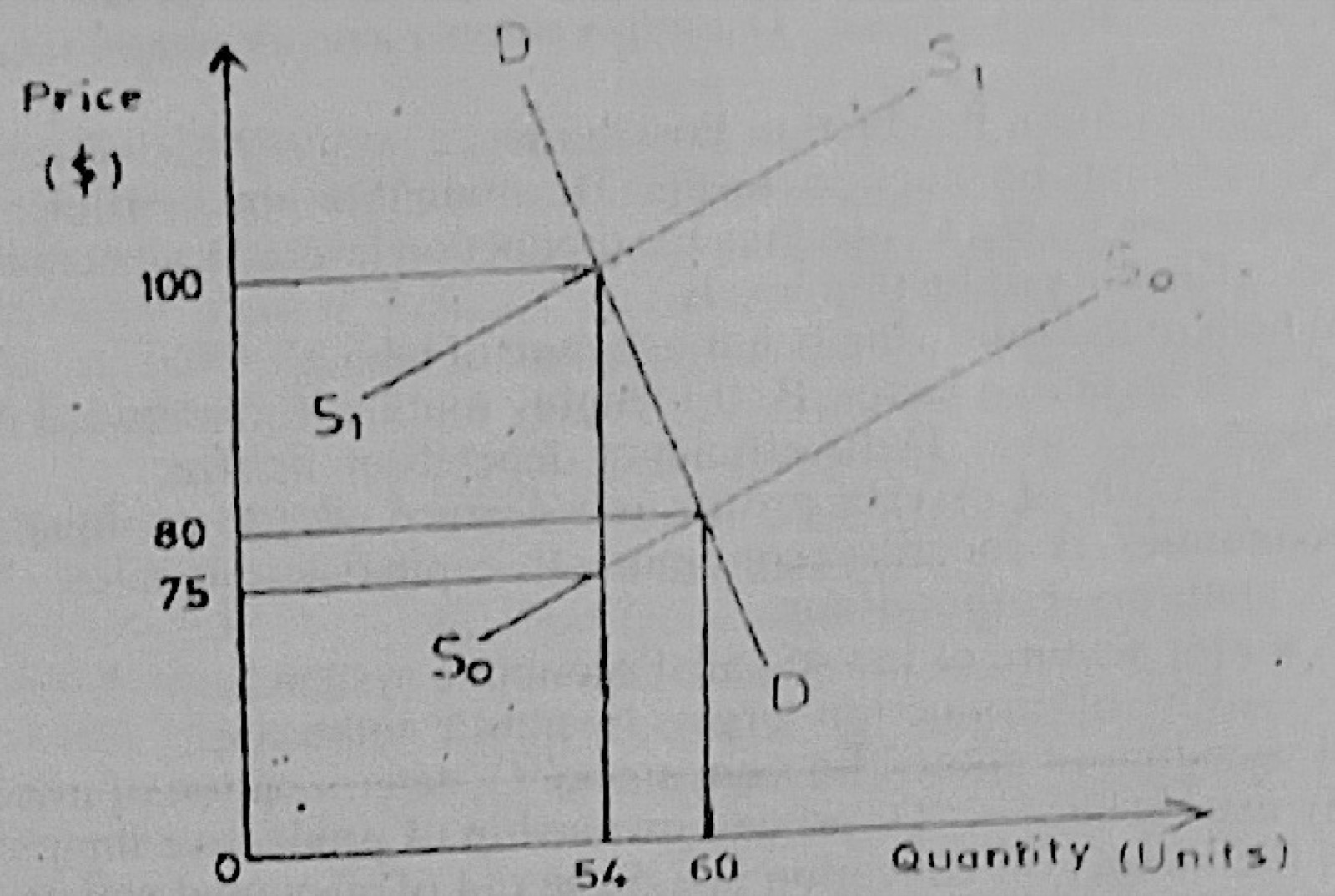
The graph below shows the imposition of tax on the sellers of a product. Study the graph and answer the questions that follow. (a) Identify the: (i) price per unit of the product before tax; (ii) quantity demanded and supplied before tax; (iii) price per unit of the product after tax; (iv) quantity demanded and supplied after tax. (b) Determine the: (i) amount of tax imposed per unit of the product; (ii) amount retained per unit by the seller after tax. (c) Calculate the percentage of the total tax imposed that is paid by: (i) buyers per unit; (ii) sellers per unit.
Show the model answer
Model answer
(a)(i) $80; (ii) 60 units; (iii) $100; (iv) 54 units (b)(i) Tax per unit = vertical gap between S1 and S0 at 54 units = 100 − 75 = $25; (ii) seller keeps 100 − 25 = $75 (c)(i) Buyers pay 100 − 80 = $20 of the $25: 20/25 × 100 = 80% (ii) Sellers bear 80 − 75 = $5: 5/25 × 100 = 20%
Explanation
The tax is the vertical distance between the two supply curves.
The management of a fruit juice production company was directed by the shareholders to increase the revenue from the sale of its product. The management decided to increase the price of the fruit juice from $7 to $10 per unit and this led to a fall in quantity demanded from 150 units to 30 units. Use the information above to answer the questions that follow. (a) Calculate the: (i) percentage increase in the price; (ii) percentage decrease in the quantity demanded; (iii) coefficient of price elasticity of demand for the fruit juice. (b) Is the demand for the fruit juice, price elastic or inelastic? Give a reason for your answer. (c) Did the management of the company achieve its objective of increasing revenue? Explain your answer. (d) From your answers in 2(a)(iii), was the increase in the price of the fruit juice a rational strategy to employ in order to increase revenue? Explain your answer.
Show the model answer
Model answer
(a)(i) (10 − 7)/7 × 100 ≈ 42.9% (ii) (150 − 30)/150 × 100 = 80% (iii) Ed = 80 ÷ 42.9 ≈ 1.87 (ignoring the minus sign) (b) Elastic: the coefficient is greater than 1 (quantity fell by a larger percentage than price rose). (c) No. Revenue before = 7 × 150 = $1,050; after = 10 × 30 = $300; revenue fell by $750. (d) No. With elastic demand, raising price reduces total revenue; to increase revenue the firm should have lowered the price (or not raised it).
Explanation
With elastic demand, price and total revenue move in opposite directions.
(a) With the aid of relevant diagrams, distinguish between an increase in supply and an increase in quantity supplied. (b) Explain how a decrease in income tax will affect the demand for a normal good and an inferior good. (c) Explain how an increase in the supply of a substitute will affect the demand for a commodity.
Show the model answer
Model answer
(a) An increase in supply: more is supplied at every price because of factors other than the good's own price (technology, lower costs, subsidies); the whole curve shifts right (S0S0 to S1S1), at price P quantity rises from q0 to q1. An increase in quantity supplied: a movement up along the same supply curve caused by a rise in the good's own price (P1 to P2, q1 to q2). (b) Lower income tax raises disposable income: demand for a normal good increases (curve shifts right); demand for an inferior good decreases (curve shifts left) as people switch to better goods. (c) More supply of the substitute lowers its price, so consumers buy more of the substitute and demand for the commodity falls (its demand curve shifts left).
(a) Define the term distribution. (b) Outline three ways in which the retailer is important to the consumer. (c) Explain three disadvantages of the operations of middlemen in the distribution process.
Show the model answer
Model answer
(a) Distribution is the process of moving goods and services from producers to final consumers, through wholesaling, retailing, transport, storage, etc. (b) Any three: stocks a variety of goods for choice; sells in small quantities; located near consumers at convenient times; gives credit; gives advice and after-sales services; delivers goods; passes consumers' wishes to producers. (c) Any three: each middleman adds a profit margin, raising prices; hoarding to create artificial scarcity; delays and spoilage of perishable goods when there are too many; adulteration or repackaging to cheat consumers; exploitation of farmers by buying cheaply; misleading advertising.
(a) Explain the following concepts: (i) labour force; (ii) over population; (iii) mobility of labour; (iv) optimum population. (b) Outline four factors responsible for the rapid growth in the population of a country.
Show the model answer
Model answer
(a)(i) Labour force: people of working age who are employed or actively looking for work. (ii) Over-population: population too large for the available resources and technology, so output per head is below its maximum. (iii) Mobility of labour: the ease with which workers move from one place (geographical) or one job (occupational) to another. (iv) Optimum population: the population size which, with the available resources and technology, gives the highest output per head. (b) Any four: high birth rate; falling death rate due to better health care; early marriage; polygamy; desire for large families (culture, religion, old-age security); ignorance of family planning; immigration; improved nutrition.
Explanation
Over-population and optimum population are both judged by output per head.
In recent times, developing countries that are predominantly agriculture-oriented are searching for ways of diversifying their economies. Many of these countries strive to exploit the available solid mineral deposits in their lands as a means of promoting industrialization. In view of the above statement: (a) define the term: (i) industrialization; (ii) mineral resources. (b) apart from promoting industrialization, identify any three benefits of exploiting mineral deposits. (c) Outline any three benefits of industrialization to a developing country.
Show the model answer
Model answer
(a)(i) Industrialization is the process of building up manufacturing and processing industries so that a larger share of output and employment comes from the industrial sector. (ii) Mineral resources are natural deposits in or on the earth, such as gold, iron ore, coal, limestone, bauxite and crude oil, that can be extracted for use. (b) Any three: foreign exchange earnings; government revenue (royalties, taxes); employment; infrastructure in mining areas; diversification of exports; attraction of foreign investment and technology. (c) Any three: employment creation; higher national income and living standards; diversification of the economy; saving and earning foreign exchange; use of local raw materials; development of skills and technology; reduced dependence on imports.
Explanation
Link mineral exploitation to diversification away from agriculture.
(a) Define Central Bank. (b) Outline three ways in which the Central Bank of a country can reduce money supply. (c) Explain how the Central Bank plays its role as: (i) banker to the government; (ii) banker to commercial banks; (iii) lender of last resort.
Show the model answer
Model answer
(a) A central bank is the apex bank of a country, owned by government, that issues currency, controls money supply and credit, and acts as banker to government and to commercial banks. (b) Any three: selling securities in the open market; raising the bank rate/monetary policy rate; raising the cash reserve ratio; raising the liquidity ratio; calling for special deposits; credit ceilings; moral suasion. (c)(i) Banker to government: keeps government accounts, receives revenue and makes payments, lends to government, manages the national debt and advises on financial matters. (ii) Banker to commercial banks: holds their reserves, provides clearing facilities and supervises them. (iii) Lender of last resort: lends to commercial banks in temporary difficulty when they cannot get funds elsewhere, preventing bank failures.
(a) Define economic development. (b) Highlight any three characteristics of a developing nation. (c) Explain any three measures a country can adopt to facilitate economic development.
Show the model answer
Model answer
(a) Economic development is a sustained increase in real income per head together with improvements in living standards (health, education, housing) and structural change in the economy. (b) Any three: low per capita income; dependence on agriculture/primary exports; high population growth; high unemployment; low technology; poor infrastructure; low savings and investment; high illiteracy. (c) Any three: invest in education and health (human capital); provide infrastructure; encourage savings and investment; attract foreign investment; diversify the economy through industrialisation; control population growth; ensure political stability and fight corruption; improve agriculture.