Theory question 101
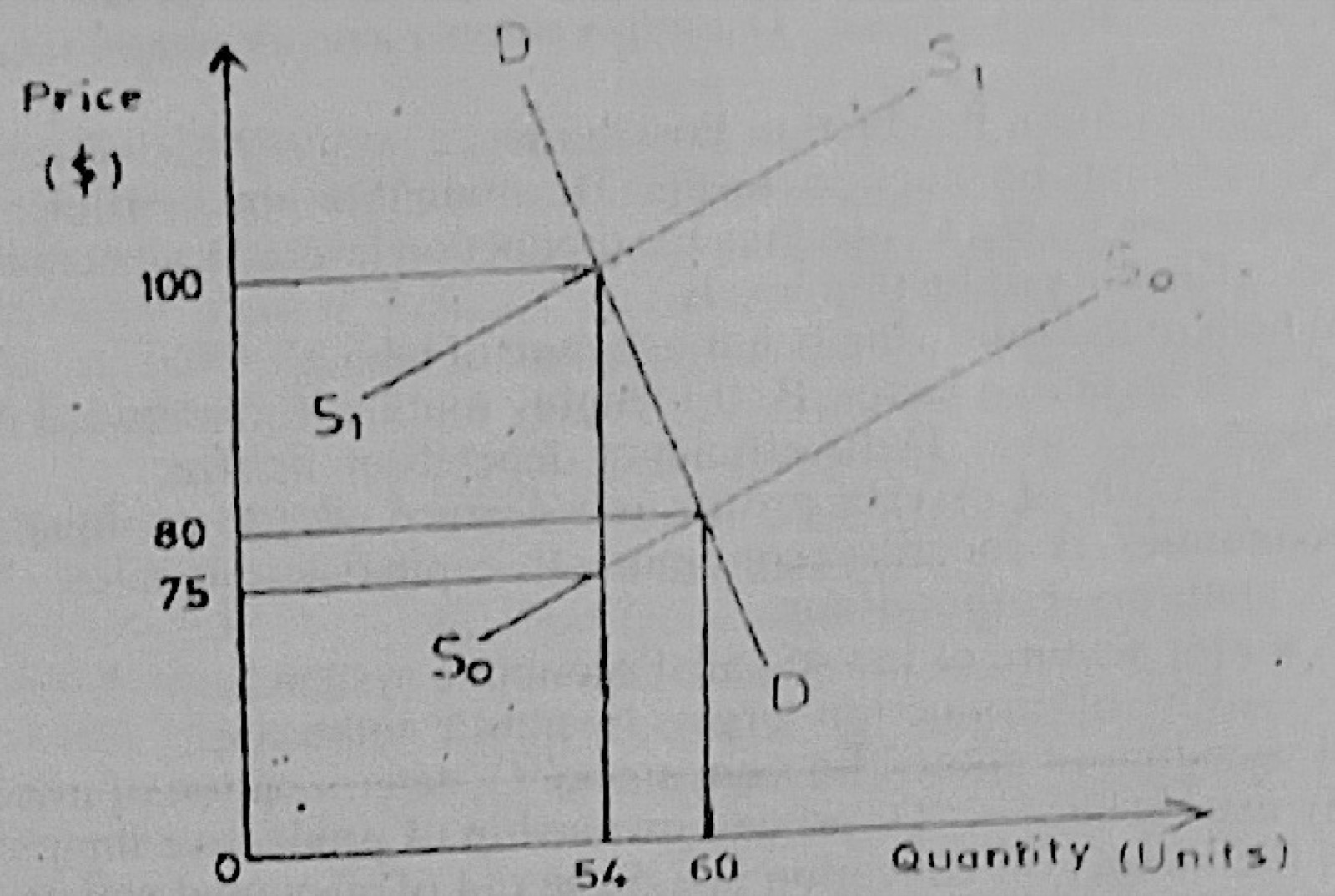
Public FinanceThe graph below shows the imposition of tax on the sellers of a product. Study the graph and answer the questions that follow.
(a) Identify the: (i) price per unit of the product before tax; (ii) quantity demanded and supplied before tax; (iii) price per unit of the product after tax; (iv) quantity demanded and supplied after tax.
(b) Determine the: (i) amount of tax imposed per unit of the product; (ii) amount retained per unit by the seller after tax.
(c) Calculate the percentage of the total tax imposed that is paid by: (i) buyers per unit; (ii) sellers per unit.
Show the model answer
(a)(i) $80; (ii) 60 units; (iii) $100; (iv) 54 units
(b)(i) Tax per unit = vertical gap between S1 and S0 at 54 units = 100 − 75 = $25; (ii) seller keeps 100 − 25 = $75
(c)(i) Buyers pay 100 − 80 = $20 of the $25: 20/25 × 100 = 80%
(ii) Sellers bear 80 − 75 = $5: 5/25 × 100 = 20%
The tax is the vertical distance between the two supply curves.