If the fixed cost of a firm is 800 Naira and its variable cost is 2,700 Naira while its total output is 100 units, what is the average cost of the firm?
A.25 Naira
B.35 Naira
C.45 Naira
D.50 Naira
Show the answer and explanation
Answer: B (35 Naira)
Explanation
Total cost = 800 + 2,700 = 3,500 Naira. Average cost = 3,500 ÷ 100 = 35 Naira.
Use the table below to answer the question. Products | Ghana | Sierra Leone Coffee | 8 tonnes | 2 tonnes Cocoa | 7 tonnes | 5 tonnes If specialization should take place, then
A.Ghana should produce coffee and cocoa
B.Ghana would benefit by producing cocoa only
C.Sierra Leone should not produce any of the products
D.Sierra Leone should produce cocoa and Ghana coffee.
Show the answer and explanation
Answer: D (Sierra Leone should produce cocoa and Ghana coffee.)
Explanation
Ghana is 4 times better at coffee but only 1.4 times better at cocoa, so Ghana has a comparative advantage in coffee and Sierra Leone in cocoa.
Given that the prices and quantities supplied per period of time in litres of gasoline is expressed as: Qs = 25 + 0.25P where Qs is quantity supplied P is price (a) Determine the quantity supplied when price per litre is (i) 0 Naira; (ii) 24 Naira; (iii) 40 Naira; (iv) 60 Naira; (v) 80 Naira. (b) From your calculations in (a) (i) present the supply schedule; (ii) draw the supply curve.
Show the model answer
Model answer
(a) (i) 25 + 0.25(0) = 25 litres (ii) 25 + 0.25(24) = 31 litres (iii) 25 + 0.25(40) = 35 litres (iv) 25 + 0.25(60) = 40 litres (v) 25 + 0.25(80) = 45 litres (b)(i) Schedule: Price (N) 0, 24, 40, 60, 80 against Quantity (litres) 25, 31, 35, 40, 45 (ii) Price on the vertical axis, quantity on the horizontal axis; plot the five points and join them: an upward-sloping straight line that starts at 25 litres when price is 0; label it S and title the graph.
Explanation
Substitute each price into the equation; a correct graph needs labelled axes, a suitable scale and the curve labelled S.
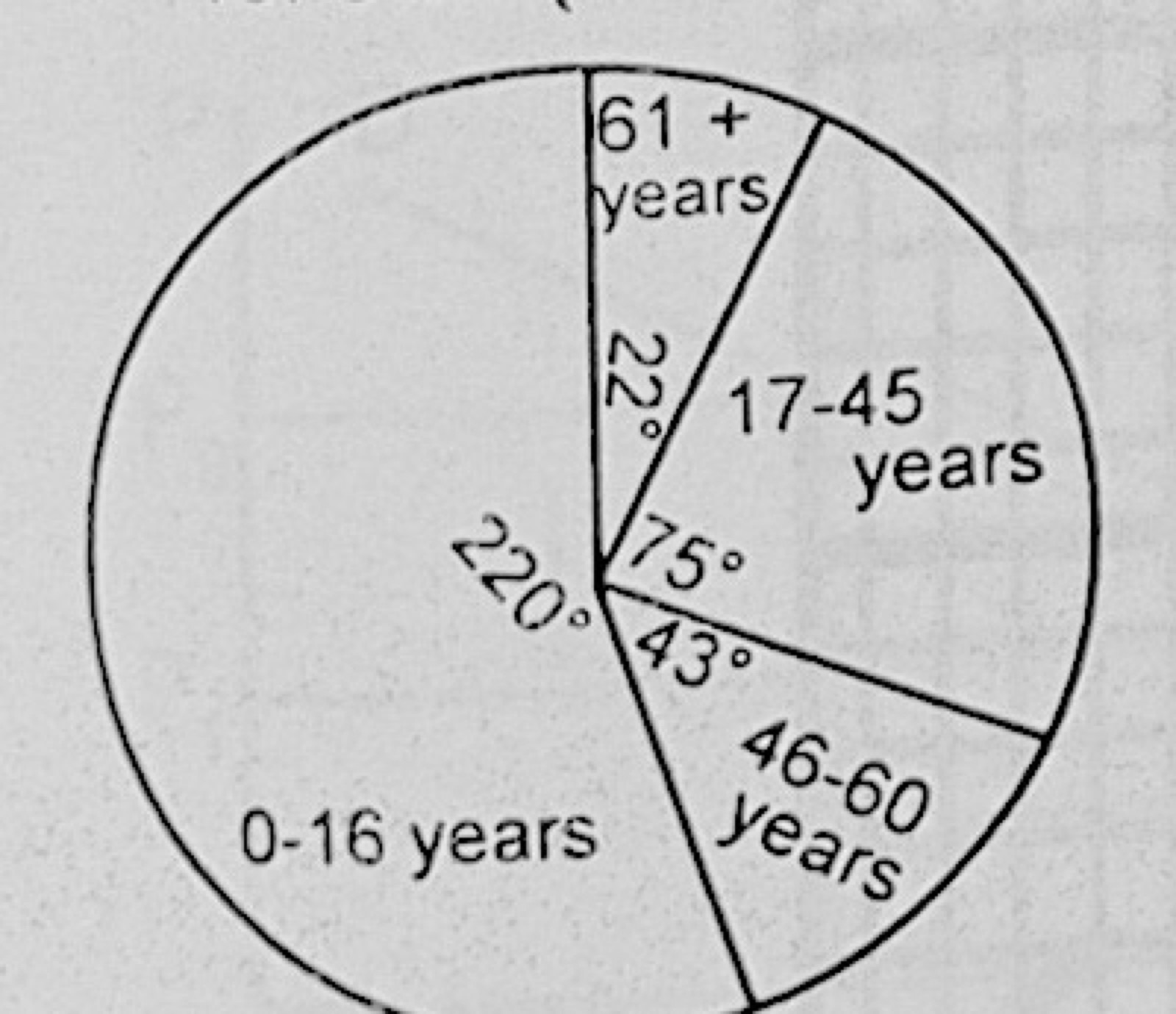
The pie chart below shows the age distribution of population in thousands of an island Y for the year 2000. The total population of the island is 245,000. Use the information supplied to answer the questions that follow. (Show all workings clearly). (a) Calculate the number of persons in the different age groups. (b) What is the dependency ratio of the population? (c) Give three implications of the above population structure.
Show the model answer
Model answer
(a) 0–16 years: 220/360 × 245,000 = 149,722 17–45 years: 75/360 × 245,000 = 51,042 46–60 years: 43/360 × 245,000 = 29,264 61+ years: 22/360 × 245,000 = 14,972 (b) Dependants (0–16 and 61+) = 164,694; working population (17–60) = 80,306 Dependency ratio = 164,694 ÷ 80,306 ≈ 2.05 (about 205 dependants per 100 workers) (c) Any three: heavy burden on the small working population; low savings and investment; high government spending on schools, health and welfare; small labour force limits output; high future population growth because most people are young; low standard of living.
Explanation
Each sector's share = its angle ÷ 360 × total population; dependants are the young and the old.
(a) Distinguish between wants and demand. (b) With the aid of diagrams, show the effect on demand when: (i) there is a reduction in the number of consumers; (ii) prices of substitutes increase; (iii) there is a decrease in the price of the commodity.
Show the model answer
Model answer
(a) Wants are human desires for goods and services, which are unlimited; demand is the quantity of a good consumers are willing and able to buy at a given price at a given time (want backed by ability to pay). (b)(i) Fewer consumers: demand curve shifts to the left (D0 to D1); less is bought at every price. (ii) Dearer substitutes: demand for this good increases; curve shifts to the right. (iii) Fall in the good's own price: no shift; movement down along the same curve to a larger quantity demanded (extension of demand). Each diagram: price on the vertical axis, quantity on the horizontal, curves and quantities labelled.
Explanation
Changes in other factors shift the curve; a change in the good's own price moves along it.
(a) What is an economic system? (b) Outline any four features of a capitalist economy.
Show the model answer
Model answer
(a) An economic system is the way a society organises the ownership and use of its resources to decide what, how and for whom to produce. (b) Any four: private ownership of the means of production; profit motive; price mechanism (market forces) allocates resources; consumer sovereignty; freedom of enterprise and choice; competition; little government interference; inequality of income and wealth.
Explanation
Define first, then give four distinct features with a short explanation each.
(a) What is population census? (b) Describe the problems faced in conducting a population census in your country.
Show the model answer
Model answer
(a) A population census is an official count of all the people living in a country at a given time, usually with details such as age, sex, occupation and location. (b) Any of: high cost/inadequate funds; illiteracy and ignorance of its purpose; religious and cultural beliefs (e.g. secluded women); political manipulation and inflation of figures; poor transport and communication to remote areas; shortage of trained enumerators; insecurity; nomadic movement of people; poor record-keeping and lack of accurate maps.
Explanation
Explain each problem in a sentence rather than listing words.
(a) What is elasticity of supply? (b) When is supply elastic? (c) Explain any four factors that influence elasticity of supply.
Show the model answer
Model answer
(a) Elasticity of supply is the degree of responsiveness of quantity supplied to a change in the price of the commodity (% change in quantity supplied ÷ % change in price). (b) Supply is elastic when the percentage change in quantity supplied is greater than the percentage change in price (coefficient greater than 1). (c) Any four: time (supply is more elastic in the long run); nature of the commodity/perishability; availability of spare capacity and stocks; cost and ease of moving factors of production; production period (farm goods take longer); ease of entry of new firms; government policy.
(a) Why would a producer (i) enter a competitive market? (ii) leave a competitive market? (b) In what two ways do consumers benefit from perfect competition? (c) Give the two conditions necessary for profit maximization for a perfectly competitive firm.
Show the model answer
Model answer
(a)(i) A producer enters when existing firms are earning supernormal (abnormal) profits, since there are no barriers to entry. (ii) A producer leaves when it makes losses, i.e. price (AR) is below average cost in the long run (or below average variable cost in the short run). (b) Any two: goods are sold at the lowest possible price (P = minimum AC in the long run); uniform price for all buyers; consumers have perfect knowledge so are not exploited; resources are used efficiently; homogeneous goods of the same quality. (c) Marginal cost equals marginal revenue (MC = MR = price); and the MC curve cuts MR from below (MC rising at that point).
(a) Explain the following strategies of industrialization: (i) Import substitution; (ii) Export promotion. (b) Highlight any four objectives of industrial development programmes in your country.
Show the model answer
Model answer
(a)(i) Import substitution: producing at home goods that were formerly imported, usually protected by tariffs and import restrictions, to save foreign exchange. (ii) Export promotion: encouraging industries to produce for foreign markets, through incentives such as subsidies, tax relief and export credit, to earn foreign exchange. (b) Any four: create employment; diversify the economy; save and earn foreign exchange; raise national income and standard of living; use local raw materials; acquire technology and skills; reduce dependence on foreign goods; improve balance of payments.
Explanation
Define each strategy and say how it is carried out.
(a) Explain the following: (i) Peasant farming; (ii) Commercial farming; (iii) State farming. (b) In what two ways will increased commercial farming contribute to the development of the economy of your country?
Show the model answer
Model answer
(a)(i) Peasant farming: small-scale farming on small plots with simple tools and family labour, mainly for the family's food with a small surplus sold. (ii) Commercial farming: large-scale farming mainly for sale and profit, using machines, hired labour and modern methods. (iii) State farming: farms owned, financed and managed by the government. (b) Any two: more food at lower prices; more raw materials for industries; more exports and foreign exchange; employment and higher incomes; more government revenue; market for industrial goods.
(a) What is (i) commodity money? (ii) token money? (iii) fiduciary issue? (iv) quasi money? (b) State any four functions of money.
Show the model answer
Model answer
(a)(i) Commodity money: goods that are generally accepted as money and also have value as goods, e.g. cowries, salt, cattle. (ii) Token money: money whose face value is greater than the value of the material it is made of, e.g. coins and notes. (iii) Fiduciary issue: the part of currency issued by the central bank that is not backed by gold or foreign reserves, only by government securities/confidence. (iv) Quasi money (near money): assets that are easily converted into money but are not themselves a medium of exchange, e.g. savings and time deposits, treasury bills, bills of exchange. (b) Medium of exchange; measure (unit) of value; store of value; standard of deferred payment.
Explanation
Four functions of money: medium of exchange, unit of account, store of value, standard of deferred payment.
(a) What are the sources of government revenue? (b) How does a government finance its budget deficit?
Show the model answer
Model answer
(a) Taxes (direct and indirect); fees, fines and licences; rents and royalties (e.g. from oil); profits of public enterprises; grants and aid; loans (internal and external); sale of government property. (b) Borrowing from the public through bonds and treasury bills; borrowing from the central bank (printing money); borrowing from commercial banks; foreign loans; grants and aid; drawing from reserves; sale of government assets (privatisation); raising taxes.
Explanation
A deficit means spending exceeds revenue, so the gap must be borrowed or covered from other sources.
(a) What are natural resources? (b) Describe any four roles natural resources play in economic development.
Show the model answer
Model answer
(a) Natural resources are gifts of nature that can be used to produce goods and services, e.g. land, minerals, forests, water and fish. (b) Any four: supply raw materials for industries; earn foreign exchange through exports; provide government revenue (royalties, rents, taxes); create employment; attract foreign investment; provide food; provide energy (oil, gas, water power); encourage development of infrastructure in their areas.
Explanation
Explain how each role leads to growth or higher living standards.