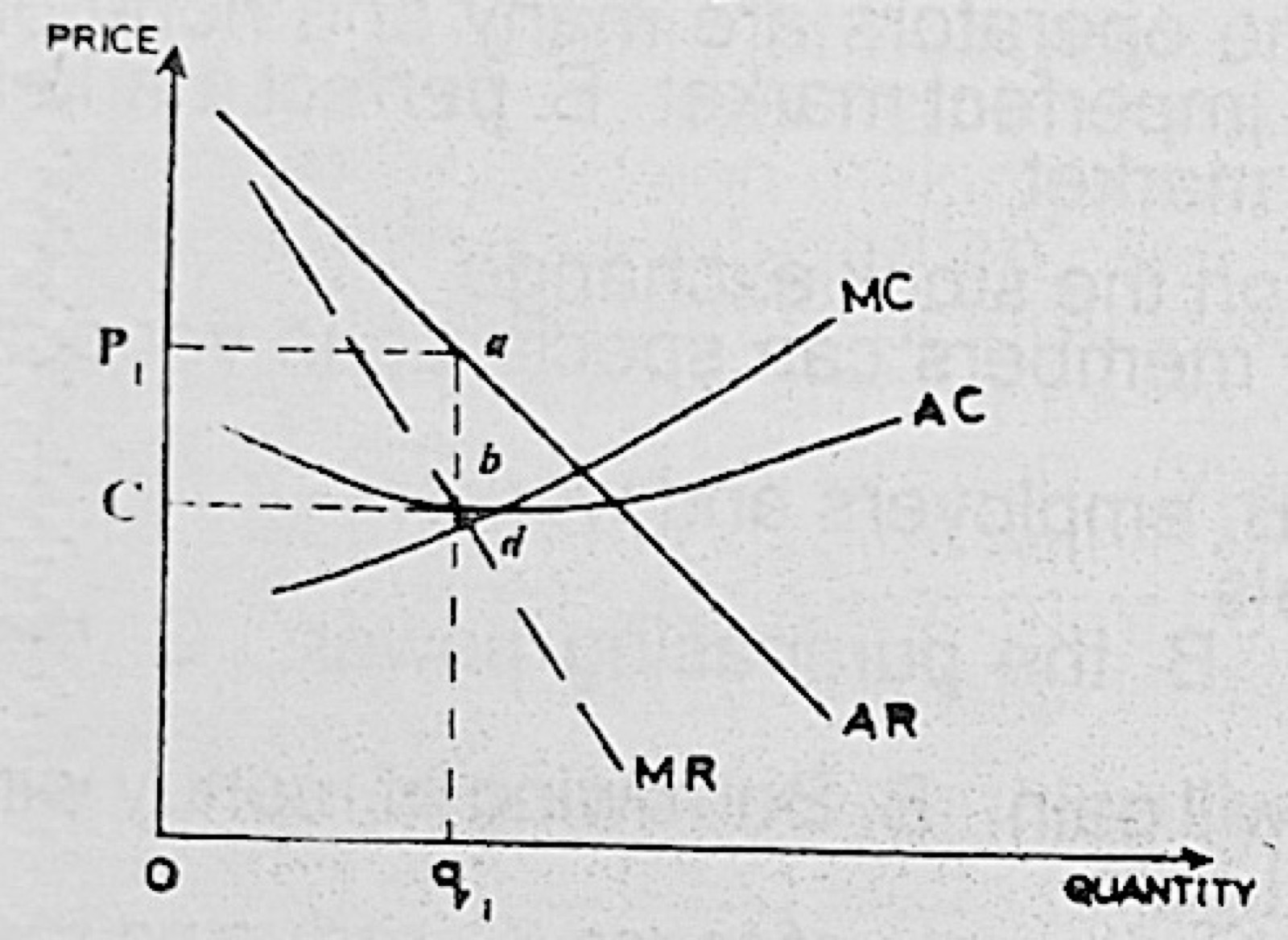
Section A (data response: answer one question only from this section) (a) When is a monopoly in equilibrium? Use the diagram below to answer the questions that follow. (b)(i) Which of the curves represents the monopoly demand curve? (ii) What is the point d on the diagram? (iii) State the equilibrium price and quantity. (iv) Which area represents the monopoly profits? (c) If P1 = 5 Naira and q1 = 50 units and C = 2 Naira, determine the monopoly profit.
Show the model answer
Model answer
(a) A monopolist is in equilibrium (maximising profit) when marginal cost equals marginal revenue (MC = MR), with MC cutting MR from below. (b)(i) The AR curve is the monopolist's demand curve. (ii) d is the point where MC = MR: the equilibrium (profit-maximising) point. (iii) Equilibrium quantity is Oq1; equilibrium price is OP1 (read up from q1 to the AR curve). (iv) The rectangle P1abC (the gap between price and average cost multiplied by output). (c) Profit = (price − average cost) × quantity = (5 − 2) × 50 = N150 (TR = 250, TC = 100).
Explanation
Output is set where MC = MR; price is read from the demand (AR) curve above that output.
Section A (data response: answer one question only from this section) The table below represents the output level of a particular firm producing soft drinks. Use the information in the table to answer the questions that follow. OUTPUT [Units]: 0, 12, 23, 36, 48, 58 Given the cost equation of the firm in Naira as C = 20 + 2q where C is total cost and q is quantity produced calculate: (a) the total cost of producing: (i) 12 units of output (ii) 36 units of output (b) the average cost when: (i) 48 units were produced (ii) 58 units were produced (c) the marginal cost when: (i) 23 units were produced (ii) 36 units were produced (d) If the firm is operating in a perfectly competitive market and the market price is N5 per unit, determine the profit when: (i) 23 units are produced (ii) 48 units are produced
Show the model answer
Model answer
(a)(i) C = 20 + 2(12) = N44. (ii) C = 20 + 2(36) = N92. (b)(i) TC = 20 + 96 = N116; AC = 116 ÷ 48 ≈ N2.42. (ii) TC = 20 + 116 = N136; AC = 136 ÷ 58 ≈ N2.34. (c) Each extra unit adds N2 to total cost, so MC = N2 at any output. (i) From 12 to 23 units: (66 − 44) ÷ 11 = N2. (ii) From 23 to 36 units: (92 − 66) ÷ 13 = N2. (d)(i) TR = 5 × 23 = N115; TC = 20 + 46 = N66; profit = N49. (ii) TR = 5 × 48 = N240; TC = N116; profit = N124.
Explanation
Total cost = fixed part (20) + 2 × output; profit = TR − TC.
Section B (answer four questions only from this section) (a) Explain any two causes of a declining population. (b) Outline any three factors which determine the size of your country's working population.
Show the model answer
Model answer
(a) Any two, explained: fall in birth rate (family planning, late marriage, education of women, high cost of raising children); rise in death rate (wars, epidemics, famine, natural disasters); net emigration (more people leaving than arriving). (b) Any three: size of total population; age structure (proportion aged about 15–65); school-leaving age and length of education; retirement age; number of women in paid work (custom, religion); health of the population; government policy, e.g. on child labour; migration.
Section B (answer four questions only from this section) (a) Describe each of the following: (i) Abnormal demand (ii) Effective demand (b) Give three reasons for the occurrence of abnormal demand.
Show the model answer
Model answer
(a)(i) Abnormal demand (exceptional demand) is demand that does not obey the law of demand: more is bought when price rises, or less when price falls, so the demand curve slopes upward. (ii) Effective demand is the desire for a commodity backed by the ability and willingness to pay for it at a given price and time. (b) Any three: Giffen goods (inferior staples bought more when their price rises); goods of ostentation/prestige (articles of conspicuous consumption); expectation of further price rises (or of further falls); ignorance – buyers judge quality by price; emergencies/necessities, e.g. during war or scarcity.
Explanation
Abnormal demand gives an upward-sloping demand curve.
Section B (answer four questions only from this section) (a) Outline any two objectives of a price control policy. (b) Highlight any three effects of a maximum price control policy.
Show the model answer
Model answer
(a) Any two: to protect consumers from exploitation; to make essential goods affordable to the poor; to control inflation; to protect producers/farmers with minimum prices; to stabilise prices; to protect workers with minimum wages. (b) Any three: shortage (excess demand) because the price is below equilibrium; black markets and hoarding; queues and rationing; fall in supply as producers lose interest; corruption and favouritism in distribution; low-income consumers get the goods more cheaply if supplies are available.
Section B (answer four questions only from this section) (a) What are public corporations? (b) State any four merits of public corporations
Show the model answer
Model answer
(a) Public corporations are business enterprises set up by an Act of parliament or decree, owned, financed and controlled by government and run by a board appointed by government, mainly to provide essential services, e.g. power, railways. (b) Any four: provide essential services at affordable prices; prevent private monopolies exploiting consumers; can undertake projects too large for private firms; create employment; profits go to government for public use; encourage balanced development (services in rural areas); protect national security in strategic industries.
Section B (answer four questions only from this section) (a) Distinguish between: (i) a firm and an industry (ii) location and localization of industry (b) Describe any four factors which influence the location of industries in your country.
Show the model answer
Model answer
(a)(i) A firm is a single business unit producing goods or services under one management; an industry is the group of all firms producing the same or similar product. (ii) Location of industry is the choice of the place where a firm or industry is sited; localisation is the concentration of many firms of the same industry in one particular area. (b) Any four: nearness to raw materials; nearness to market; availability of power and water; availability of transport; availability of labour; government policy; availability of land and finance; external economies/existing industries; climate and security.
Explanation
Explain how each factor affects cost or convenience.
Section B (answer four questions only from this section) (a) Explain any four reasons why small-scale farmers dominate agricultural production in your country. (b) Suggest any two measures that can be taken to encourage large scale farming in your country.
Show the model answer
Model answer
(a) Any four: lack of capital and credit to expand; land tenure system and fragmentation of land; use of simple tools that limit acreage; illiteracy and traditional methods; farming as a way of life (subsistence); small and scattered markets; poor infrastructure and storage; lack of modern inputs. (b) Any two: give credit/loans at low interest to farmers; land reform to make large plots available; supply of tractors and machinery at subsidised rates; extension services and training; good guaranteed prices and markets; provision of rural infrastructure; encourage co-operatives.
Section B (answer four questions only from this section) (a) Distinguish between: (i) a mortgage bank and a merchant bank. (ii) a commercial bank and a development bank. (b) Explain any four functions of commercial banks.
Show the model answer
Model answer
(a)(i) A mortgage bank gives long-term loans for building or buying houses, using the property as security; a merchant bank gives medium- and long-term finance to businesses, accepts bills of exchange, underwrites new share issues and advises firms. (ii) A commercial bank accepts deposits from the public and gives mainly short-term loans and overdrafts for profit; a development bank gives long-term loans for development projects in particular sectors (industry, agriculture) and does not usually take deposits from the public. (b) Any four: accept deposits; give loans and overdrafts; operate the cheque system; credit creation; safe keeping of valuables; foreign exchange services; act as agents (paying bills, standing orders); advise customers; discount bills of exchange.
Section B (answer four questions only from this section) (a) What is a tax? (b) Describe any four principles of a good tax system.
Show the model answer
Model answer
(a) A tax is a compulsory payment levied by government on persons, firms or goods, for which the payer receives no direct benefit in return, used to finance government spending. (b) Any four (canons of taxation): Equity – tax based on ability to pay; Certainty – the amount, time and method of payment are clear; Convenience – paid at a time and in a way convenient to the taxpayer; Economy – the cost of collection is low compared with the yield; Flexibility – easy to change as conditions change; Productivity – it yields enough revenue; Simplicity – easy to understand; Neutrality – it does not discourage work or investment.
Section B (answer four questions only from this section) Explain each of the following terms: (a) Export promotion (b) Depreciation (c) Terms of trade (d) Balance of trade
Show the model answer
Model answer
(a) Export promotion: government measures to increase the volume and value of exports, e.g. export subsidies, tax rebates, trade fairs, export credit and better quality control. (b) Depreciation: a fall in the value of a country's currency in terms of other currencies under a floating exchange rate (also: the fall in value of capital assets through wear and tear). (c) Terms of trade: the rate at which a country's exports exchange for its imports, measured as (index of export prices ÷ index of import prices) × 100. (d) Balance of trade: the difference between the value of a country's visible exports and visible imports in a period; it is favourable (surplus) if exports exceed imports.
Explanation
Give a definition and a short example or formula for each.
Section B (answer four questions only from this section) (a) Define Gross National Product (GNP). (b) Describe the three methods of measuring national income.
Show the model answer
Model answer
(a) GNP is the total money value of all final goods and services produced by a country's residents in a year, i.e. GDP plus net factor income from abroad. (b) Output (product) method: add the value added (or value of final goods and services) by all sectors of the economy, avoiding double counting. Income method: add all incomes earned by factors of production in producing the output – wages, rent, interest and profits – leaving out transfer payments. Expenditure method: add all spending on final goods and services – consumption (C), investment (I), government spending (G) and net exports (X − M). All three should give the same total.
Explanation
Mention how double counting is avoided in each method.