WAEC Economics 2002 past questions and answers

59 questions. Try each one, then open the answer to check yourself and read the explanation.

Question 1

Basic Concepts

Economics is best described as the study of

  1. A.the wealth of nations.
  2. B.how man consumes his products.
  3. C.how man provides for his everyday needs.
  4. D.the distribution of wealth
Show the answer and explanation

Answer: C (how man provides for his everyday needs.)

Explanation

Economics studies how people use scarce resources to satisfy their wants, i.e. how man provides for his everyday needs.

Open this question

Question 2

Tools of Economic Analysis

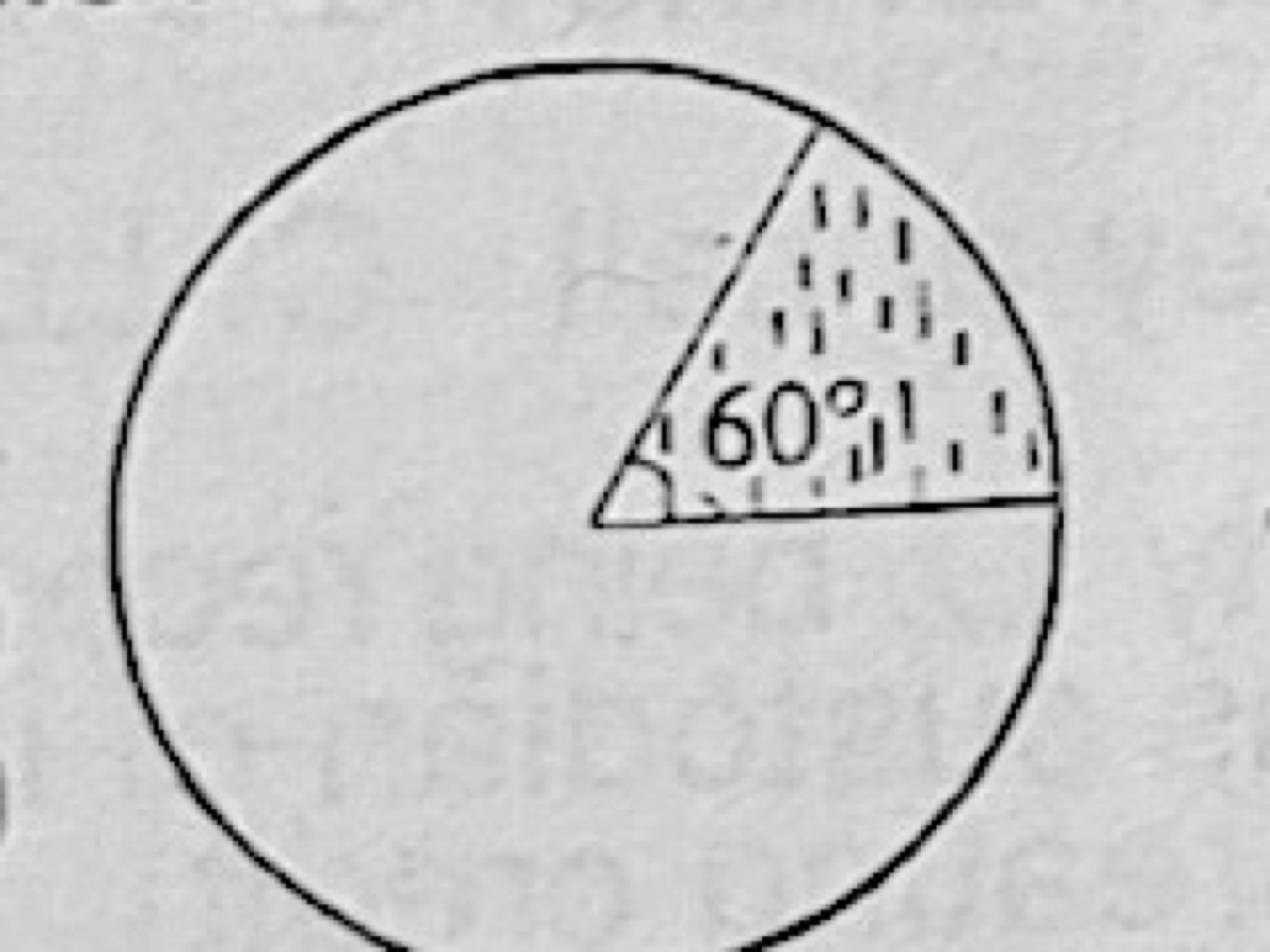
The pie-chart below represents the total population of a school of 1,200. The shaded area of 60° shows the population of the underaged pupils. What is the population of the matured students?

Diagram for this question
  1. A.600
  2. B.800
  3. C.1,000
  4. D.1,200
Show the answer and explanation

Answer: C (1,000)

Explanation

Matured students take 360° − 60° = 300°, so 300/360 × 1,200 = 1,000.

Open this question

Question 3

Tools of Economic Analysis

The most frequently occurring value in a given data is the

  1. A.mode
  2. B.median
  3. C.mean
  4. D.range
Show the answer and explanation

Answer: A (mode)

Explanation

The mode is the value that occurs most often.

Open this question

Question 4

Theory of Production

Subsistence production means that goods and services are

  1. A.produced for consumption only
  2. B.sold to others
  3. C.sold in the country
  4. D.produced for the market
Show the answer and explanation

Answer: A (produced for consumption only)

Explanation

In subsistence production, the producer makes goods mainly for his own and his family's consumption, not for sale.

Open this question

Question 5

Distributive Trade

Warehouse facilities in the distribution and marketing of products are provided by

  1. A.manufacturers
  2. B.wholesalers
  3. C.retailers
  4. D.advertisers
Show the answer and explanation

Answer: B (wholesalers)

Explanation

Wholesalers buy in bulk and store goods in warehouses until retailers need them.

Open this question

Question 6

Theory of Production

Which of the following is a reward to a factor of production?

  1. A.Interest
  2. B.Donation
  3. C.Gift
  4. D.Subsidy
Show the answer and explanation

Answer: A (Interest)

Explanation

Interest is the reward for capital; donations, gifts and subsidies are not payments for a factor's service.

Open this question

Question 7

Theory of Production

Land is a factor of production because it

  1. A.is a free gift of nature
  2. B.contains valuable mineral resources
  3. C.assists in the creation of utility
  4. D.is owned by individuals and governments.
Show the answer and explanation

Answer: C (assists in the creation of utility)

Explanation

Anything is a factor of production because it helps produce goods and services (creates utility); land does this.

Open this question

Question 8

Theory of Production

One of the advantages of large scale production is that

  1. A.there is a rise in the cost of administration.
  2. B.consumers sacrifice their individual tastes.
  3. C.the firm can use labour-saving machinery.
  4. D.the demand for a firm's products becomes localized.
Show the answer and explanation

Answer: C (the firm can use labour-saving machinery.)

Explanation

A large firm can afford expensive labour-saving machines, which lower cost per unit (technical economies).

Open this question

Question 9

Theory of Production

Which of the following is an advantage of division of labour?

  1. A.Production of specialized goods
  2. B.Employment of experts
  3. C.Monotony of work
  4. D.Greater use of machinery
Show the answer and explanation

Answer: D (Greater use of machinery)

Explanation

Breaking work into simple tasks makes it possible to use machines for them, raising output.

Open this question

Question 10

Theory of Production

Despite the benefits large firms enjoy, it could be limited by the

  1. A.desire to make maximum profits
  2. B.introduction of efficient transport system.
  3. C.growth of specialization.
  4. D.extent of the market.
Show the answer and explanation

Answer: D (extent of the market.)

Explanation

A firm cannot grow beyond what its market can buy, so the size of the market limits it.

Open this question

Question 11

Industrialisation

Localization of industry refers to the

  1. A.concentration of the firms of an industry in a particular area.
  2. B.siting of industries in rural areas.
  3. C.even spread of industries.
  4. D.government policy of influencing the location of industries.
Show the answer and explanation

Answer: A (concentration of the firms of an industry in a particular area.)

Explanation

Localisation means firms of the same industry concentrate in one area.

Open this question

Question 12

Basic Concepts

Economists speak about 'opportunity cost' when a consumer

  1. A.has the chance to minimize costs.
  2. B.has to forgo one thing in order to have another.
  3. C.can equate his fixed costs with his variable costs.
  4. D.is able to save part of his income.
Show the answer and explanation

Answer: B (has to forgo one thing in order to have another.)

Explanation

Opportunity cost is the alternative given up when a choice is made.

Open this question

Question 13

Theory of Costs and Revenue

The costs which a firm will incur whether it is in production or not, is referred to as

  1. A.average cost.
  2. B.variable cost
  3. C.opportunity cost
  4. D.fixed cost.
Show the answer and explanation

Answer: D (fixed cost.)

Explanation

Fixed costs such as rent must be paid even at zero output.

Open this question

Question 14

Theory of Costs and Revenue

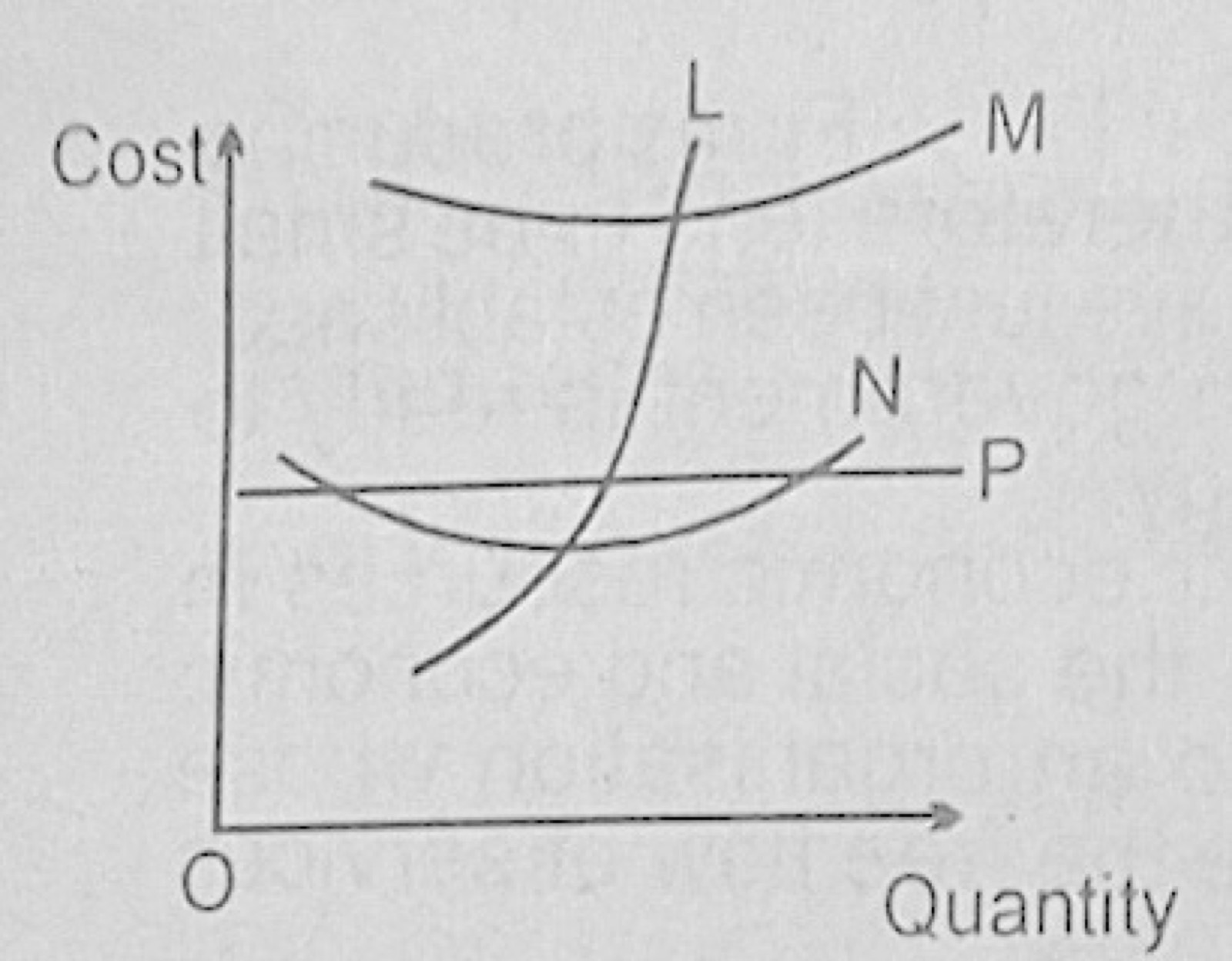
Which of the curves in the diagram below represents the firm's marginal cost (MC)?

Diagram for this question
  1. A.Curve P
  2. B.Curve N
  3. C.Curve M
  4. D.Curve L
Show the answer and explanation

Answer: D (Curve L)

Explanation

The MC curve is the steep curve that falls a little and then rises sharply, cutting the U-shaped average curves at their lowest points: curve L.

Open this question

Question 15

Industrialisation

The location of timber and plywood industries in West Africa is mainly influenced by the availability of

  1. A.transport
  2. B.water
  3. C.raw materials
  4. D.labour supply.
Show the answer and explanation

Answer: C (raw materials)

Explanation

Logs are bulky and lose weight in processing, so timber industries are sited near the forests (raw materials).

Open this question

Question 16

Business Organisations

The main objective of setting up private businesses is to

  1. A.protect the interest of government.
  2. B.maximize profits.
  3. C.provide infrastructure.
  4. D.promote exports.
Show the answer and explanation

Answer: B (maximize profits.)

Explanation

Private businesses are set up mainly to make profit.

Open this question

Question 17

Business Organisations

Small firms are important for the development of a country because

  1. A.the prices of their products are usually high.
  2. B.they render personalized services to the consumers.
  3. C.they usually produce goods for the elite.
  4. D.they do not normally provide after sales services.
Show the answer and explanation

Answer: B (they render personalized services to the consumers.)

Explanation

Small firms deal directly with customers and give personal attention to their needs.

Open this question

Question 18

Business Organisations

A limited liability company is owned by the

  1. A.president of the country
  2. B.workers
  3. C.general manager
  4. D.shareholders
Show the answer and explanation

Answer: D (shareholders)

Explanation

The shareholders own a limited liability company.

Open this question

Question 19

Business Organisations

The National Electric Power Authority (NEPA) of Nigeria is a

  1. A.public limited company.
  2. B.private limited company.
  3. C.private authority.
  4. D.public corporation.
Show the answer and explanation

Answer: D (public corporation.)

Explanation

NEPA was set up by law, owned and run by government: a public corporation.

Open this question

Question 21

Elasticity

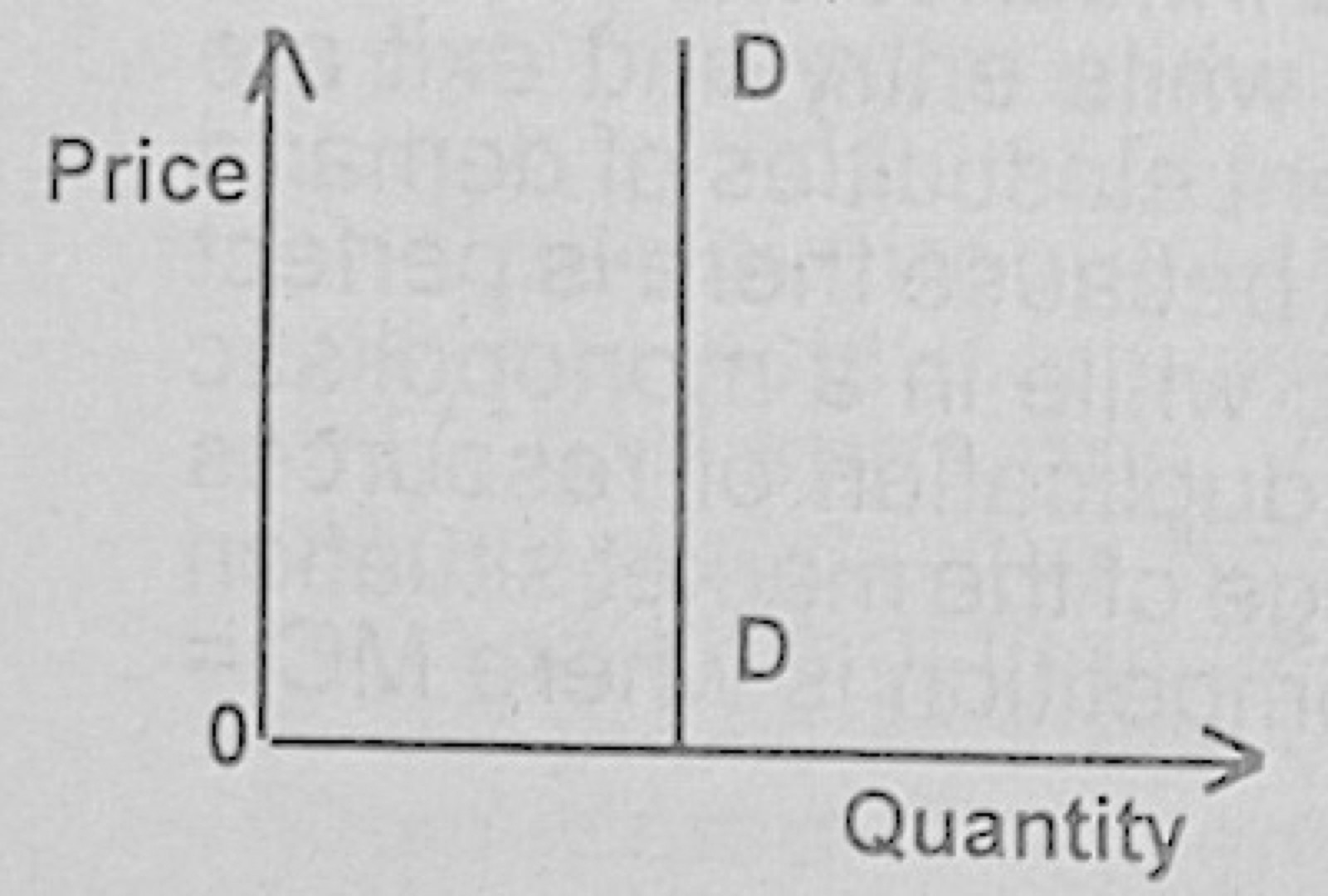
What type of price elasticity of demand is the diagram below representing?

Diagram for this question
  1. A.Perfectly inelastic demand
  2. B.Perfectly elastic demand
  3. C.Fairly inelastic demand
  4. D.Unitary elasticity
Show the answer and explanation

Answer: A (Perfectly inelastic demand)

Explanation

A vertical demand curve means the same quantity is bought at every price: perfectly inelastic demand.

Open this question

Question 22

Theory of Demand

An increase in the demand for butter reduces the demand for margarine; this type of demand is called

  1. A.competitive demand.
  2. B.elastic demand
  3. C.derived demand.
  4. D.composite demand
Show the answer and explanation

Answer: A (competitive demand.)

Explanation

Butter and margarine are substitutes that compete for the same use, so their demand is competitive.

Open this question

Question 23

Theory of Demand

A commodity is said to have derived demand when it

  1. A.has a joint demand with another commodity
  2. B.is demanded by the rich only
  3. C.is demanded for immediate consumption.
  4. D.is demanded because of what it can help to produce.
Show the answer and explanation

Answer: D (is demanded because of what it can help to produce.)

Explanation

Derived demand is demand for a thing because of the goods it helps to produce.

Open this question

Question 24

Population

Which of the following statements about population is correct?

  1. A.Optimum population whenever achieved does not change.
  2. B.Under-population implies that available resources are not used to full capacity.
  3. C.Over-population leads to a higher per capita output.
  4. D.Optimum population leads to overcrowding of cities.
Show the answer and explanation

Answer: B (Under-population implies that available resources are not used to full capacity.)

Explanation

With too few people, there is not enough labour to make full use of the resources.

Open this question

Question 25

Population

Malthus population theory stated that

  1. A.high death rate may lead to low productivity.
  2. B.population may outgrow the means of subsistence.
  3. C.people will always decide to have children.
  4. D.migration may leave some parts of the world barren.
Show the answer and explanation

Answer: B (population may outgrow the means of subsistence.)

Explanation

Malthus said population grows geometrically while food grows arithmetically, so population tends to outgrow food supply.

Open this question

Question 26

Population

One of the criticisms of population increase is that it results in

  1. A.rise in people's standard of living.
  2. B.low level of illiteracy.
  3. C.low level of taxation.
  4. D.increase in government expenditure.
Show the answer and explanation

Answer: D (increase in government expenditure.)

Explanation

More people need more schools, hospitals and amenities, which raises government spending.

Open this question

Question 27

Population

Which of the following is not likely to be an effect of a growing population?

  1. A.Rise in demand
  2. B.Unemployment
  3. C.Fall in standard of living
  4. D.High per capita income
Show the answer and explanation

Answer: D (High per capita income)

Explanation

A growing population shares income among more people, so high per capita income is unlikely.

Open this question

Question 28

Population

Census figures of most countries in West Africa are inaccurate because of

  1. A.low cost of enumeration.
  2. B.low per capita income.
  3. C.high degree of illiteracy.
  4. D.high level of civilization
Show the answer and explanation

Answer: C (high degree of illiteracy.)

Explanation

Many illiterate people cannot give their correct ages or understand the census, leading to inaccurate figures.

Open this question

Question 29

Money and Inflation

Which of the following is a problem of trade by barter?

  1. A.Exchange rate determination
  2. B.Hoarding
  3. C.How to produce
  4. D.What to produce
Show the answer and explanation

Answer: A (Exchange rate determination)

Explanation

Without a common measure of value, it is hard to decide how much of one good should exchange for another.

Open this question

Question 30

Money and Inflation

Cheques are not money because

  1. A.their use is confined to business hours.
  2. B.there are few banks in the rural areas.
  3. C.they are not generally acceptable as a medium of exchange.
  4. D.they are not issued by governments.
Show the answer and explanation

Answer: C (they are not generally acceptable as a medium of exchange.)

Explanation

A cheque is only an order to a bank to pay; people can refuse it, so it is not generally acceptable.

Open this question

Question 31

Financial Institutions

Which of the following is a liability of a commercial bank?

  1. A.Deposits
  2. B.Money at call
  3. C.Loans to customers
  4. D.Overdrafts.
Show the answer and explanation

Answer: A (Deposits)

Explanation

Deposits belong to customers and must be repaid, so they are the bank's liabilities; loans and money at call are assets.

Open this question

Question 32

Money and Inflation

The value of money is best determined by its

  1. A.size
  2. B.purchasing power
  3. C.portability
  4. D.being recognized.
Show the answer and explanation

Answer: B (purchasing power)

Explanation

The value of money is what it can buy: its purchasing power.

Open this question

Question 33

Financial Institutions

Which of the following is a function of the Central Bank of Nigeria?

  1. A.Serving as custodian of important valuables
  2. B.Giving advice to customers
  3. C.Serving as bankers' bank
  4. D.Creating credit
Show the answer and explanation

Answer: C (Serving as bankers' bank)

Explanation

The central bank keeps the reserves of commercial banks and lends to them: it is the bankers' bank.

Open this question

Question 34

Money and Inflation

Who among the following will benefit from inflation?

  1. A.Pensioners
  2. B.Savers
  3. C.Debtors
  4. D.Creditors
Show the answer and explanation

Answer: C (Debtors)

Explanation

Debtors repay loans with money that has lost value, so they gain.

Open this question

Question 35

Money and Inflation

Inflation can be controlled by increasing

  1. A.aggregate supply
  2. B.government expenditure.
  3. C.aggregate demand.
  4. D.a deficit budget.
Show the answer and explanation

Answer: A (aggregate supply)

Explanation

More goods and services reduce excess demand and so reduce the pressure on prices.

Open this question

Question 36

Financial Institutions

Which of the following is a function of merchant banks?

  1. A.Minting of coins
  2. B.Preparation of government budget
  3. C.Keeping watch on external reserves of the country
  4. D.Acting as acceptance houses
Show the answer and explanation

Answer: D (Acting as acceptance houses)

Explanation

Merchant banks accept (guarantee) bills of exchange, acting as acceptance houses.

Open this question

Question 37

Financial Institutions

Personal savings are generally low in West Africa because of

  1. A.the level of income of the people
  2. B.the refusal of banks to grant loans.
  3. C.overpopulation.
  4. D.cheaper foreign currencies.
Show the answer and explanation

Answer: A (the level of income of the people)

Explanation

Most people earn low incomes and spend almost all of it on necessities, leaving little to save.

Open this question

Question 38

Business Organisations

Which business organization enjoys tax-free profits in West Africa?

  1. A.Co-operative societies
  2. B.Private limited liability companies
  3. C.Joint stock companies
  4. D.Partnerships
Show the answer and explanation

Answer: A (Co-operative societies)

Explanation

Co-operative societies are usually exempted from company tax on their surplus.

Open this question

Question 39

Natural Resources and Petroleum

The greatest revenue earning industry in Nigeria is

  1. A.construction
  2. B.agriculture
  3. C.manufacturing
  4. D.mining.
Show the answer and explanation

Answer: D (mining.)

Explanation

Petroleum (crude oil) mining provides most of Nigeria's government revenue and exports.

Open this question

Question 40

Price Determination

A market equilibrium exists when

  1. A.no buyer goes home empty-handed.
  2. B.demand and supply are increasing.
  3. C.demand and supply are equal.
  4. D.the price is fluctuating.
Show the answer and explanation

Answer: C (demand and supply are equal.)

Explanation

Equilibrium is where quantity demanded equals quantity supplied, so there is no pressure on price to change.

Open this question

Question 41

Public Finance

The incidence of an increase in tax on a commodity with perfectly inelastic demand will be on the

  1. A.wholesaler.
  2. B.retailer
  3. C.government.
  4. D.consumer
Show the answer and explanation

Answer: D (consumer)

Explanation

Buyers keep buying the same amount at any price, so the whole tax is passed on to the consumer.

Open this question

Question 42

Public Finance

Budget surplus implies that

  1. A.expenditure equals revenue.
  2. B.expenditure is less than revenue.
  3. C.expenditure is greater than taxation.
  4. D.direct tax is more than indirect tax.
Show the answer and explanation

Answer: B (expenditure is less than revenue.)

Explanation

A surplus budget plans to collect more revenue than it spends.

Open this question

Question 43

International Trade

International trade is based on the law of

  1. A.absolute cost advantage.
  2. B.variable proportion
  3. C.comparative cost advantage.
  4. D.mutual co-operation.
Show the answer and explanation

Answer: C (comparative cost advantage.)

Explanation

Countries gain by specialising in goods in which they have the lowest opportunity cost: comparative advantage.

Open this question

Question 45

Balance of Payments and Exchange Rates

A nation's net export is negative when her

  1. A.stock of goods is declining.
  2. B.depreciation exceeds investment.
  3. C.export is adjusted upwards.
  4. D.imports exceed exports.
Show the answer and explanation

Answer: D (imports exceed exports.)

Explanation

Net exports = exports − imports, which is negative when imports are greater.

Open this question

Question 46

Balance of Payments and Exchange Rates

Deficit in the balance of payments is financed through

  1. A.capital account.
  2. B.current account.
  3. C.invisible trade
  4. D.visible trade.
Show the answer and explanation

Answer: A (capital account.)

Explanation

A current account deficit is paid for by capital inflows (borrowing, investment) or by running down reserves, recorded in the capital/financial account.

Open this question

Question 47

Balance of Payments and Exchange Rates

Devaluation of currency in a country is likely to lead to

  1. A.increasing population.
  2. B.increasing imports.
  3. C.exports becoming cheaper.
  4. D.reduced exports.
Show the answer and explanation

Answer: C (exports becoming cheaper.)

Explanation

After devaluation foreigners need less of their currency to buy the country's goods, so exports become cheaper.

Open this question

Question 48

Natural Resources and Petroleum

Which of the following is not a benefit derived by Nigeria from the petroleum industry?

  1. A.Increased foreign exchange earnings
  2. B.Establishment of refineries and petrochemical industries
  3. C.Employment of a greater proportion of the population
  4. D.Development of airports, seaports and other social infrastructures.
Show the answer and explanation

Answer: C (Employment of a greater proportion of the population)

Explanation

The oil industry is capital-intensive and employs only a small share of the population.

Open this question

Question 49

National Income

Gross Domestic Product (GDP) at market prices plus net factor income from abroad gives

  1. A.gross capital formation.
  2. B.net capital formation.
  3. C.disposable income.
  4. D.gross national product.
Show the answer and explanation

Answer: D (gross national product.)

Explanation

GNP = GDP + net factor income from abroad.

Open this question

Theory question 101

Price Determination

Section A (data response: answer one question only from this section)
The table below shows the supply and demand for kilograms of maize per month in thousands. Use the information in the table to answer the questions that follow.
Quantity Supplied (000) | Price per thousand Kilogram ($) | Quantity Demanded (000)
16 | 3.00 | 3
13 | 2.50 | 5
9 | 2.00 | 9
6 | 1.50 | 14
3 | 1.00 | 19
1 | 0.50 | 26
(a)(i) If the government fixed the price of maize at $1.50 per thousand kilogram, what will be the excess demand for maize? (ii) If the government fails to enforce the fixed price, what will happen to the price of maize?
(b) How can the government maintain a fixed price of $3.00 per thousand kilogram for maize?
(c) In relation to the equilibrium price, what will be the effects on the quantities demanded and supplied if the government enforced a fixed price of $1.00?

Show the model answer
Model answer

Equilibrium: price $2.00, where 9 (thousand) is both demanded and supplied.
(a)(i) At $1.50: quantity demanded 14 − quantity supplied 6 = excess demand of 8 (thousand), i.e. 8,000 kg.
(ii) A black market develops and the price rises towards the equilibrium price of $2.00 (or above).
(b) $3.00 is a minimum price above equilibrium, giving a surplus of 16 − 3 = 13 (thousand). Government can keep it by buying up the surplus (buffer stock / marketing board) and storing or exporting it, by limiting output with quotas, and by punishing sellers who sell below $3.00.
(c) At $1.00 (below the equilibrium of $2.00): quantity demanded rises from 9 to 19 (thousand), up by 10; quantity supplied falls from 9 to 3 (thousand), down by 6; there is a shortage of 16 (thousand), leading to queues, rationing, hoarding and black markets.

Explanation

Find the equilibrium first; a price below it gives a shortage, above it a surplus.

Open this question

Theory question 102

National Income

Section A (data response: answer one question only from this section)
The following data relate to a closed economy of a country where all production takes place in two firms. Use the information in the table to answer the questions that follow:
Items | Firm A (in 000 Dollars) | Firm B (in 000 Dollars)
Sales | 200 | 400
Raw Materials | 100 | 60
Labour Costs | 80 | 160
Depreciation | 16 | 40
Profits | 4 | 140
(a)(i) Which of the items listed above is an intermediate input? (ii) What happens to intermediate inputs in the calculation of the national income? (iii) Calculate the Gross Domestic Product (GDP) of the country.
(b)(i) Calculate the total amount of depreciation of the country. (ii) Calculate the Net Domestic Product of the country.

Show the model answer
Model answer

(a)(i) Raw materials.
(ii) They are left out (subtracted from sales) so that the same output is not counted twice (double counting); only value added is counted.
(iii) Value added: Firm A = 200 − 100 = $100,000; Firm B = 400 − 60 = $340,000; GDP = $440,000. (Check: labour + depreciation + profit = 100 + 340 = 440 thousand.)
(b)(i) Depreciation = 16 + 40 = $56,000.
(ii) NDP = GDP − depreciation = 440,000 − 56,000 = $384,000.

Explanation

GDP is the sum of value added, not the sum of sales.

Open this question

Theory question 103

Business Organisations

Section B (answer four questions only from this section)
What factors limit the size of indigenous firms in West Africa?

Show the model answer
Model answer

Shortage of capital and difficulty in getting bank loans.
Small market due to low incomes of the people.
Lack of managerial and technical skills.
Poor infrastructure: power, roads, water, communication.
Most firms are sole proprietorships or partnerships, which cannot raise large capital.
Competition from foreign firms and imported goods.
Shortage of local raw materials and high cost of imported inputs.
Inconsistent government policies, multiple taxes and political instability.
Nature of the product (perishables, personal services) and the firms' recent establishment.

Explanation

Explain each factor in one or two sentences.

Open this question

Theory question 104

Labour Market

Section B (answer four questions only from this section)
Explain the factors which influence the level of wages in your country.

Show the model answer
Model answer

Demand for and supply of labour: scarce skills earn higher wages.
Productivity (marginal productivity) of labour.
Level of education, training and skill required.
Trade union bargaining power.
Government wage policy, e.g. minimum wage legislation.
Ability of the employer/industry to pay (profitability).
Cost of living: higher prices lead to demands for higher wages.
Nature of the job: danger, unpleasantness or responsibility attract higher pay.
Mobility of labour and the location of the job.

Explanation

Explain how each factor raises or lowers wages.

Open this question

Theory question 105

Theory of Costs and Revenue

Section B (answer four questions only from this section)
(a) Distinguish between fixed and variable costs.
(b) Under which conditions will a firm continue to operate at a loss in the short run? (Use figures or a diagram to explain your answer).

Show the model answer
Model answer

(a) Fixed costs do not vary with output and are paid even when nothing is produced (rent, insurance, salaries of permanent staff, depreciation). Variable costs vary directly with output and are zero at zero output (raw materials, fuel, wages of casual workers).
(b) In the short run a firm continues to produce at a loss as long as price (average revenue) covers average variable cost (P ≥ AVC).
It then pays all variable costs and part of the fixed costs; if it shut down it would still lose all its fixed costs, so producing reduces the loss.
Example: fixed cost ₦100, variable cost ₦300, revenue ₦350: producing gives a loss of ₦50, shutting down a loss of ₦100, so it keeps producing.
Diagram: AC and AVC curves with price line between minimum AVC and minimum AC; the firm produces where MC = MR.
If price falls below AVC, the firm shuts down (shut-down point at minimum AVC).

Explanation

The key condition is price ≥ average variable cost.

Open this question

Theory question 106

Market Structures

Section B (answer four questions only from this section)
(a) What is a perfectly competitive market?
(b) Explain the conditions necessary for a perfectly competitive market.

Show the model answer
Model answer

(a) A perfectly competitive market is a market with very many buyers and sellers of an identical product, in which no one buyer or seller can influence the price; price is set by market demand and supply.
(b) Large number of buyers and sellers, each too small to affect price (price takers).
Homogeneous (identical) products.
Free entry into and exit from the industry.
Perfect knowledge of market conditions by buyers and sellers.
Perfect mobility of factors of production.
No government interference and no preferential treatment of buyers or sellers.
No transport costs (or negligible).
Firms aim to maximise profit.

Explanation

Explain each condition briefly.

Open this question

Theory question 107

Economic Systems

Section B (answer four questions only from this section)
(a) What is a market economy?
(b) Highlight the features of a market economy.

Show the model answer
Model answer

(a) A market economy (capitalism / free enterprise) is an economic system in which the means of production are privately owned and decisions on what, how and for whom to produce are made through the price mechanism, with little government intervention.
(b) Private ownership of property and means of production.
Price mechanism allocates resources.
Profit motive drives producers.
Consumer sovereignty.
Free competition among producers.
Freedom of enterprise and choice of occupation.
Minimal government intervention.
Income inequality.

Explanation

List and briefly explain at least five features.

Open this question

Theory question 108

Public Finance

Section B (answer four questions only from this section)
(a) Distinguish between direct and indirect taxes.
(b) What are the advantages of direct taxes?

Show the model answer
Model answer

(a) A direct tax is levied on the income or wealth of persons and firms and is paid directly to the tax authority by the person on whom it is imposed; its burden cannot be shifted (e.g. personal income tax, company tax). An indirect tax is levied on goods and services; it is paid to government by the seller but its burden can be shifted to consumers through higher prices (e.g. VAT, excise and import duties).
(b) Advantages of direct taxes: can be progressive, so equitable (based on ability to pay).
Reduce income inequality.
Certain: the taxpayer knows how much and when to pay.
Revenue is easy to estimate.
Economical to collect, especially PAYE.
Not inflationary: they reduce spending power rather than raise prices.
Make citizens aware of their civic responsibility.

Explanation

Explain the difference in who finally bears the tax.

Open this question

Theory question 109

Labour Market

Section B (answer four questions only from this section)
Explain the factors which influence the level of employment in your country.

Show the model answer
Model answer

Level of aggregate demand for goods and services.
Level of public and private investment.
Availability of capital and credit.
Government policies (fiscal and monetary, wage policy, retirement age).
Level of technology (labour-saving machines reduce jobs).
Size of the labour force / population growth.
Educational system and skills relevant to available jobs.
Availability of infrastructure (power, roads).
Seasonal factors, e.g. weather in agriculture.
Trade union demands for high wages.
Political stability and investment climate.

Explanation

Explain how each factor creates or reduces jobs.

Open this question

Theory question 110

International Economic Organisations

Section B (answer four questions only from this section)
In what ways will West African countries benefit from economic integration?

Show the model answer
Model answer

Larger market, allowing large-scale production and economies of scale.
Specialisation according to comparative advantage.
Increased trade among member countries as tariffs are removed.
Free movement of labour and capital.
More competition, raising efficiency and quality.
Attraction of foreign investment.
Joint development of infrastructure (roads, telecommunications, power).
Greater bargaining power in world trade and international bodies.
Job creation and faster economic development.
Political co-operation and peace in the sub-region.

Explanation

Explain at least five benefits.

Open this question

Theory question 111

Public Finance

Section B (answer four questions only from this section)
How can a huge national debt affect the economy of a country?

Show the model answer
Model answer

Debt servicing (interest and repayment) takes a large share of revenue, leaving less for development projects.
External debt servicing drains foreign exchange.
Higher taxes may be needed to pay the debt, reducing incentives.
Large domestic borrowing raises interest rates and crowds out private investment.
It can worsen income distribution (bondholders gain from taxpayers).
It may cause inflation if financed by money creation.
External creditors may impose conditions (e.g. IMF conditions), reducing economic independence.
It reduces the country's credit rating and ability to borrow again.
Burden passed on to future generations.

Explanation

Distinguish internal and external debt effects where you can.

Open this question

Theory question 112

Agriculture

Section B (answer four questions only from this section)
Why is agricultural productivity low in your country?

Show the model answer
Model answer

Use of crude implements (hoe, cutlass) instead of machinery.
Land tenure system and land fragmentation.
Lack of credit facilities for farmers.
Poor storage, processing and transport facilities.
Inadequate extension services and research.
Illiteracy of farmers and resistance to new methods.
Pests, diseases and poor seeds/inputs.
Unfavourable weather, e.g. drought or floods.
Migration of young people to towns (rural–urban drift), leaving ageing farmers.
Poor pricing policies and unstable prices of farm produce.
Low use of fertilisers and irrigation.
Explanation

Explain at least five causes.

Open this question