WAEC Economics 2000 past questions and answers

61 questions. Try each one, then open the answer to check yourself and read the explanation.

Question 1

Basic Concepts

Scarcity implies that

  1. A.goods cannot be produced efficiently
  2. B.human wants are unlimited
  3. C.goods and services are limited in supply
  4. D.commodities are evenly distributed within the economy.
Show the answer and explanation

Answer: C (goods and services are limited in supply)

Explanation

Scarcity means the goods and services (and resources) available are limited compared with what people want.

Open this question

Question 2

Basic Concepts

Economic problems arise mainly as a result of

  1. A.inaccurate statistical data in West Africa
  2. B.excessive wastage of available resources
  3. C.lack of foresight on the part of resource users
  4. D.limitations in availability of resources.
Show the answer and explanation

Answer: D (limitations in availability of resources.)

Explanation

The basic economic problem comes from limited resources set against unlimited wants, which forces choice.

Open this question

Question 3

Theory of Production

Basic extractive activities are classified as

  1. A.manufacturing production
  2. B.tertiary production
  3. C.secondary production
  4. D.primary production.
Show the answer and explanation

Answer: D (primary production.)

Explanation

Extractive activities such as farming, fishing, mining and lumbering take resources straight from nature, which is primary production.

Open this question

Question 4

Theory of Consumer Behaviour

The entire satisfaction that a consumer derives from a successive consumption of a particular commodity is known as

  1. A.marginal utility
  2. B.total utility
  3. C.average utility
  4. D.diminishing utility.
Show the answer and explanation

Answer: B (total utility)

Explanation

Total utility is the whole satisfaction from all the units consumed; marginal utility is only the extra satisfaction from the last unit.

Open this question

Question 5

Tools of Economic Analysis

A collection of data which has not been processed is referred to as

  1. A.disjointed data
  2. B.raw data
  3. C.class intervals
  4. D.frequency.
Show the answer and explanation

Answer: B (raw data)

Explanation

Data as first collected, before it is sorted or processed, is called raw data.

Open this question

Question 6

Tools of Economic Analysis

Which of the following is a measure of central tendency?

  1. A.Percentage
  2. B.Graph
  3. C.Variance
  4. D.Median.
Show the answer and explanation

Answer: D (Median.)

Explanation

Mean, median and mode are measures of central tendency; variance measures spread (dispersion).

Open this question

Question 7

Theory of Supply

The quantity supplied of books per week is represented by the function: Qs = 70 + ½P. At a price of N8.00, the quantity supplied is

  1. A.70
  2. B.74
  3. C.76
  4. D.86
Show the answer and explanation

Answer: B (74)

Explanation

Qs = 70 + ½ × 8 = 70 + 4 = 74.

Open this question

Question 8

Theory of Production

In production, the formula (total product)/(number of men employed) is used to calculate the

  1. A.total product
  2. B.average product
  3. C.marginal product
  4. D.fixed product.
Show the answer and explanation

Answer: B (average product)

Explanation

Average product is total product divided by the number of units of the variable factor (here, men employed).

Open this question

Question 9

Theory of Production

One of the internal economies of large scale production is

  1. A.administrative economies
  2. B.market economies
  3. C.regional economies
  4. D.horizontal economies.
Show the answer and explanation

Answer: B (market economies)

Explanation

Marketing economies (buying and selling in bulk) are enjoyed inside a large firm, so they are internal economies.

Open this question

Question 10

Theory of Costs and Revenue

Dividing total variable cost by quantity of output gives

  1. A.Total Cost (TC)
  2. B.Total Fixed Cost (TFC)
  3. C.Variable Cost (VC)
  4. D.Average Variable Cost (AVC).
Show the answer and explanation

Answer: D (Average Variable Cost (AVC).)

Explanation

AVC = TVC ÷ output: the variable cost per unit produced.

Open this question

Question 11

Business Organisations

Public enterprises are established mainly to

  1. A.provide basic amenities for the people
  2. B.make goods available in the markets
  3. C.make profit for the government
  4. D.compete with foreigners in the industrial sector.
Show the answer and explanation

Answer: A (provide basic amenities for the people)

Explanation

Public enterprises are set up mainly to provide essential services such as water, electricity and transport, not mainly for profit.

Open this question

Question 12

Business Organisations

One important feature of sole proprietorship is that

  1. A.it is limited liability business
  2. B.the business is owned by shareholders
  3. C.one person bears all the risks
  4. D.it is a legal entity.
Show the answer and explanation

Answer: C (one person bears all the risks)

Explanation

A sole proprietor owns the business alone, takes all the profit and bears all the risk with unlimited liability.

Open this question

Question 13

Business Organisations

The maximum amount of money a company is allowed to raise by issuing shares to the public is called

  1. A.paid-up capital
  2. B.fixed capital
  3. C.working capital
  4. D.authorized capital.
Show the answer and explanation

Answer: D (authorized capital.)

Explanation

Authorised (nominal) capital is the most share capital the company's memorandum allows it to raise.

Open this question

Question 14

Business Organisations

The Consumers' Co-operative Society is owned by

  1. A.a management committee
  2. B.members of the society
  3. C.debenture holders
  4. D.the government.
Show the answer and explanation

Answer: B (members of the society)

Explanation

A consumers' co-operative is owned by its members, who buy shares and share the surplus.

Open this question

Question 15

Distributive Trade

Which of the following is a function of the retailer?

  1. A.Provision of storage facilities
  2. B.Financing manufacturers
  3. C.Stocking variety of goods
  4. D.Advertisement of goods.
Show the answer and explanation

Answer: C (Stocking variety of goods)

Explanation

A retailer stocks a wide variety of goods from many producers so consumers can choose in one place; financing manufacturers is a wholesaler's job.

Open this question

Question 16

Labour Market

the supply of labour can be influenced by the

  1. A.size of the population
  2. B.stage of economic development
  3. C.size of the country
  4. D.extent of the market.
Show the answer and explanation

Answer: A (size of the population)

Explanation

The bigger the population (especially of working age), the more labour is available.

Open this question

Question 17

Agriculture

Majority of West African labour force is engaged in

  1. A.industrial production
  2. B.agricultural production
  3. C.mining industry
  4. D.construction industry.
Show the answer and explanation

Answer: B (agricultural production)

Explanation

Most workers in West Africa are farmers, so agriculture employs the majority of the labour force.

Open this question

Question 18

Population

Census of population is usually conducted every

  1. A.20 years
  2. B.15 years
  3. C.10 years
  4. D.7 years.
Show the answer and explanation

Answer: C (10 years)

Explanation

Population censuses are normally held every ten years.

Open this question

Question 19

Population

One economic implication of over-population is that it

  1. A.leads to low demand of goods
  2. B.reduces balance of payments difficulties
  3. C.leads to a fall in per capita income
  4. D.reduces pressure on the available social facilities.
Show the answer and explanation

Answer: C (leads to a fall in per capita income)

Explanation

With over-population, national income is shared among too many people, so income per head falls.

Open this question

Question 20

Labour Market

Hassan, an Economics teacher in Lagos, resigned his appointment and took up another job as a banker. The concept here involves

  1. A.occupational mobility of labour
  2. B.horizontal mobility of labour
  3. C.vertical mobility of labour
  4. D.geographical mobility of labour.
Show the answer and explanation

Answer: A (occupational mobility of labour)

Explanation

Hassan changed his occupation (teaching to banking) in the same place, which is occupational mobility.

Open this question

Question 21

Population

Net migration is the difference between

  1. A.population and census
  2. B.immigrants and emigrants
  3. C.per capita income and population
  4. D.internal and external migration.
Show the answer and explanation

Answer: B (immigrants and emigrants)

Explanation

Net migration = number of people coming in (immigrants) minus number leaving (emigrants).

Open this question

Question 22

Labour Market

Wages are to some extent, determined by the

  1. A.marginal utility of labour
  2. B.average utility of labour
  3. C.marginal productivity of labour
  4. D.total output of labour.
Show the answer and explanation

Answer: C (marginal productivity of labour)

Explanation

The marginal productivity theory says a worker is paid according to the value of the extra output he adds.

Open this question

Question 23

Theory of Demand

The movement along the same demand curve is a

  1. A.change in demand
  2. B.change in quatity demanded
  3. C.shift in demand
  4. D.market demand.
Show the answer and explanation

Answer: B (change in quatity demanded)

Explanation

A change in the good's own price moves us along the curve: a change in quantity demanded. A change in demand shifts the whole curve.

Open this question

Question 24

Industrialisation

An industry can best be described as

  1. A.a place where goods are processed
  2. B.a place where different firms produce different goods
  3. C.an aggregation of individual firms producing similar commodities
  4. D.the concentration of various firms in the same locality.
Show the answer and explanation

Answer: C (an aggregation of individual firms producing similar commodities)

Explanation

An industry is the group of all firms producing the same or similar products.

Open this question

Question 25

Labour Market

An association of workers in a particular industry, firm or line of job is called

  1. A.Trade Union
  2. B.Trade Association
  3. C.Chamber of Commerce
  4. D.Assembly of Workers.
Show the answer and explanation

Answer: A (Trade Union)

Explanation

A trade union is an organisation of workers formed to protect their interests, e.g. wages and working conditions.

Open this question

Question 26

Theory of Costs and Revenue

Average Variable Cost (AVC) curve

  1. A.is U-shaped
  2. B.rises from left to right
  3. C.slopes upwards
  4. D.is horizontal to the X-axis.
Show the answer and explanation

Answer: A (is U-shaped)

Explanation

AVC first falls (increasing returns) and then rises (diminishing returns), giving a U shape.

Open this question

Question 27

Elasticity

The income elasticity of a normal good is

  1. A.positive
  2. B.negative
  3. C.zero
  4. D.fixed.
Show the answer and explanation

Answer: A (positive)

Explanation

For a normal good, demand rises when income rises, so income elasticity is positive.

Open this question

Question 28

Theory of Demand

The demand for a commodity that serves two or more purposes is

  1. A.competitive demand
  2. B.complementary demand
  3. C.composite demand
  4. D.derived demand.
Show the answer and explanation

Answer: C (composite demand)

Explanation

Composite demand is demand for one good that has several uses, e.g. sugar for tea, sweets and soft drinks.

Open this question

Question 29

Market Structures

The charging of different prices to different groups of buyers for the same goods or services is called

  1. A.monopolistic competition
  2. B.price determination
  3. C.price discrimination
  4. D.monopoly.
Show the answer and explanation

Answer: C (price discrimination)

Explanation

Selling the same product at different prices to different buyers is price discrimination.

Open this question

Question 30

Public Finance

A tax on a commodity whose demand is perfectly inelastic will fall heavily on the

  1. A.consumers
  2. B.manufacturers
  3. C.wholesalers
  4. D.retailers.
Show the answer and explanation

Answer: A (consumers)

Explanation

If demand does not respond to price, the seller can pass the whole tax on in a higher price, so consumers bear it.

Open this question

Question 31

Public Finance

The main feature of regressive taxation is that its rate

  1. A.is higher when income is higher
  2. B.is equal tax for all categories of people
  3. C.remains constant when income increases
  4. D.reduces when income increases.
Show the answer and explanation

Answer: D (reduces when income increases.)

Explanation

A regressive tax takes a smaller percentage of income as income rises, so the rate falls as income increases.

Open this question

Question 32

Public Finance

Which of the following is an item of government recurrent expenditure?

  1. A.Road construction
  2. B.Port facilities
  3. C.Wages and salaries
  4. D.Telecommunication projects
Show the answer and explanation

Answer: C (Wages and salaries)

Explanation

Recurrent expenditure is spent regularly on running government, such as wages and salaries; roads and ports are capital expenditure.

Open this question

Question 33

Public Finance

Deficit budget means that government's

  1. A.expenditure is equal to revenue
  2. B.planned expenditure is more than the estimated income
  3. C.planned income and expenditure targets cannot be achieved
  4. D.expenditure is less than estimated government revenue.
Show the answer and explanation

Answer: B (planned expenditure is more than the estimated income)

Explanation

A deficit budget is one in which planned spending is greater than expected revenue.

Open this question

Question 34

Money and Inflation

The most unique quality of money is its

  1. A.relative scarcity
  2. B.divisibility
  3. C.durability
  4. D.general acceptability.
Show the answer and explanation

Answer: D (general acceptability.)

Explanation

Above all, money must be generally accepted in exchange; without acceptability it cannot serve as money.

Open this question

Question 36

Price Determination

Which of the following will occur when the market is unstable?

  1. A.Prices will fluctuate
  2. B.Demand will remain static
  3. C.Unemployment will surely fall
  4. D.Prices will remain static.
Show the answer and explanation

Answer: A (Prices will fluctuate)

Explanation

An unstable market is one where demand and supply keep changing, so prices go up and down.

Open this question

Question 37

Financial Institutions

Shares and stocks can be bought in the

  1. A.Commodity market
  2. B.Stock exchange
  3. C.Money market
  4. D.Open market.
Show the answer and explanation

Answer: B (Stock exchange)

Explanation

The stock exchange is the market for buying and selling shares and stocks.

Open this question

Question 38

Money and Inflation

Inflation can best be checked by

  1. A.allowing supply to remain constant
  2. B.decreasing supply and increasing wages
  3. C.increasing supply and holding wages constant
  4. D.decreasing supply and wages.
Show the answer and explanation

Answer: C (increasing supply and holding wages constant)

Explanation

More goods reduce excess demand, and holding wages stops costs and spending from pushing prices up further.

Open this question

Question 39

Financial Institutions

Foreign exchange control in most West African countries is enforced by the

  1. A.development banks
  2. B.merchant banks
  3. C.ministry of economic planning
  4. D.central banks.
Show the answer and explanation

Answer: D (central banks.)

Explanation

The central bank manages the country's foreign reserves and enforces exchange control.

Open this question

Question 40

Financial Institutions

Commercial banks settle their inter-bank indebtedness through

  1. A.merchant banks
  2. B.central bank
  3. C.development bank
  4. D.stock exchange.
Show the answer and explanation

Answer: B (central bank)

Explanation

The central bank is the bankers' bank and runs the clearing house where banks settle debts with one another.

Open this question

Question 41

Financial Institutions

Which of the following banks grant credit facilities to individuals wishing to build houses?

  1. A.Central Bank of Nigeria
  2. B.Nigerian Industrial Development Bank
  3. C.Agricultural Credit Bank
  4. D.Federal Mortgage Bank of Nigeria.
Show the answer and explanation

Answer: D (Federal Mortgage Bank of Nigeria.)

Explanation

Mortgage banks specialise in long-term loans for building or buying houses.

Open this question

Question 42

Labour Market

Unemployment that arises because of introduction of new machines and equipment in production is called

  1. A.cyclical
  2. B.structural
  3. C.seasonal
  4. D.disguised.
Show the answer and explanation

Answer: B (structural)

Explanation

Workers replaced by new technology lose jobs because the structure of production has changed: structural (technological) unemployment.

Open this question

Question 43

Economic Growth and Development

Mono-product economies are those that produce

  1. A.only intermediate products
  2. B.petroleum products
  3. C.agricultural products
  4. D.one main commodity.
Show the answer and explanation

Answer: D (one main commodity.)

Explanation

'Mono' means one: a mono-product economy depends on one main commodity for most of its income and exports.

Open this question

Question 44

Financial Institutions

The primary objective of the Nigerian Industrial Development Bank (NIDB) is the provision of loans to

  1. A.farmers
  2. B.manufacturers
  3. C.estate agents
  4. D.transporters.
Show the answer and explanation

Answer: B (manufacturers)

Explanation

The NIDB was set up to give medium- and long-term loans to industrial (manufacturing) firms.

Open this question

Question 45

Business Organisations

Small enterprises find it difficult to expand due to

  1. A.inadequate capital
  2. B.lack of skilled manpower
  3. C.the high level of technology required for expansion
  4. D.their inability to provide after-sales services.
Show the answer and explanation

Answer: A (inadequate capital)

Explanation

The main problem of small firms is lack of capital, since they depend on the owner's savings and find bank loans hard to get.

Open this question

Question 46

Natural Resources and Petroleum

The Organization of Petroleum Exporting Countries (OPEC) is a

  1. A.cartel
  2. B.duopoly
  3. C.monopoly
  4. D.monopsony.
Show the answer and explanation

Answer: A (cartel)

Explanation

OPEC is a group of producers who agree on output quotas to influence the price of oil, which is a cartel.

Open this question

Question 47

International Trade

One major export crop in West Africa is

  1. A.rice
  2. B.maize
  3. C.palm kernel
  4. D.cocoa.
Show the answer and explanation

Answer: D (cocoa.)

Explanation

Cocoa is the leading export crop of West Africa (Ghana, Côte d'Ivoire, Nigeria).

Open this question

Question 48

Balance of Payments and Exchange Rates

Balance of payments deficit implies that a country is

  1. A.importing more than she is exporting
  2. B.consuming less than she is producing
  3. C.living below her means
  4. D.more productive than others.
Show the answer and explanation

Answer: A (importing more than she is exporting)

Explanation

A deficit means payments to other countries (for imports) are more than receipts from them (for exports).

Open this question

Question 49

Economic Growth and Development

West African countries have low level of economic development due to

  1. A.under-population
  2. B.inadequate labour
  3. C.failure to plan
  4. D.ineffective plan implementation.
Show the answer and explanation

Answer: D (ineffective plan implementation.)

Explanation

West African countries do make development plans, but poor implementation (corruption, lack of funds, instability) keeps development low.

Open this question

Question 50

International Economic Organisations

Which of the following countries is not a member of the Economic Community of West African States (ECOWAS)?

  1. A.Ghana
  2. B.The Gambia
  3. C.Cameroun
  4. D.Guinea Bissau
Show the answer and explanation

Answer: C (Cameroun)

Explanation

Cameroun is in Central Africa and belongs to ECCAS, not ECOWAS.

Open this question

Theory question 101

Tools of Economic Analysis

Section A (answer one question only from this section)
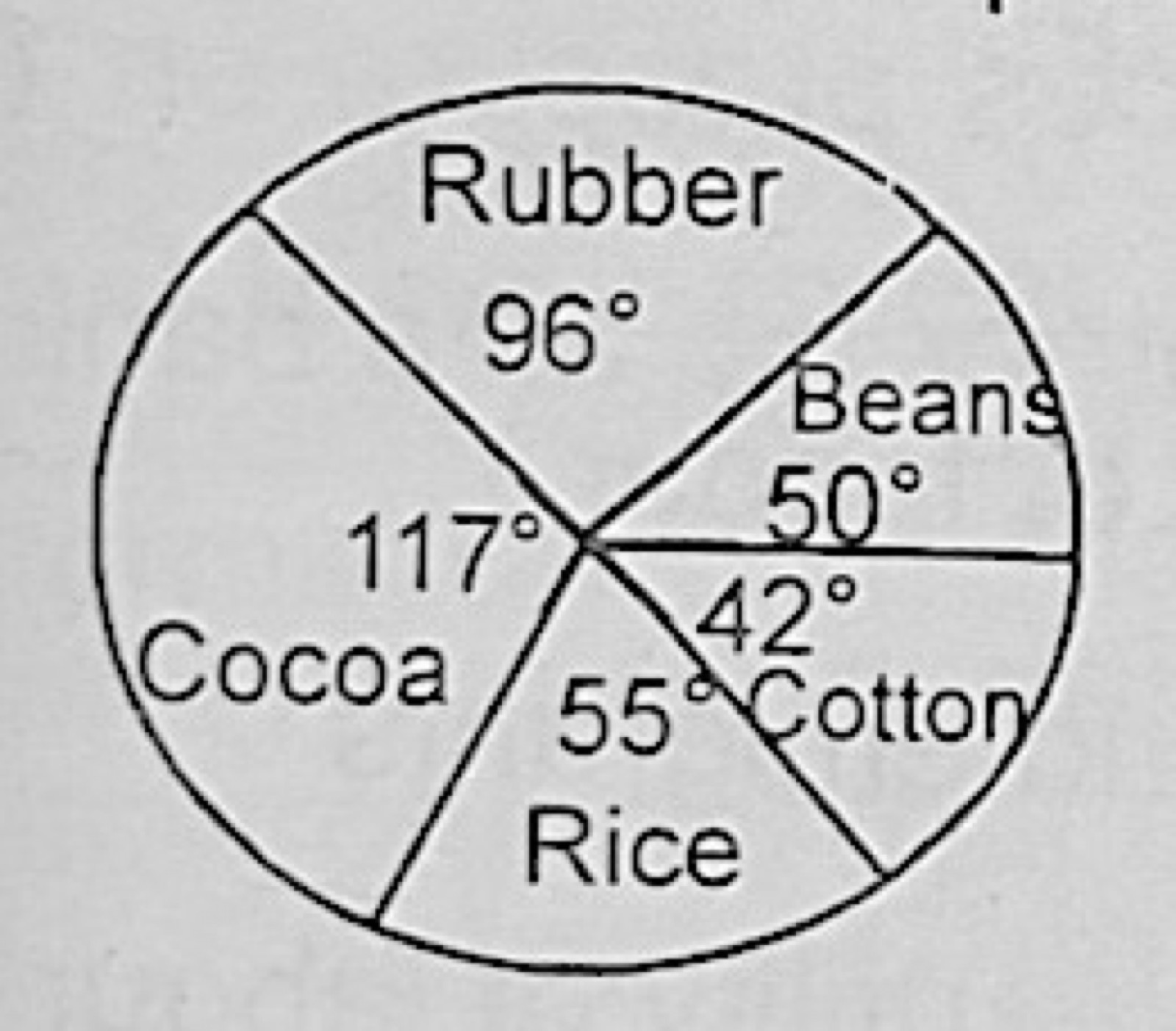
The pie chart below represents the hypothetical output of farmers in a country in a particular year. The total output of the crops was 72,000 tonnes. (Sectors: Cocoa 117°, Rubber 96°, Beans 50°, Cotton 42°, Rice 55°.)
(a) Calculate the quantity of each product.
(b)(i) By what quantity is the export crops greater than the food crops? (ii) Which crop contributed the least and by what quantity? (iii) Which crop has the highest output?

Diagram for this question
Show the model answer
Model answer

(a) Each degree = 72,000 ÷ 360 = 200 tonnes.
Cocoa = 117 × 200 = 23,400 tonnes; Rubber = 96 × 200 = 19,200 tonnes; Beans = 50 × 200 = 10,000 tonnes; Cotton = 42 × 200 = 8,400 tonnes; Rice = 55 × 200 = 11,000 tonnes.
(b)(i) Export crops (cocoa, rubber, cotton) = 23,400 + 19,200 + 8,400 = 51,000 tonnes; food crops (beans, rice) = 10,000 + 11,000 = 21,000 tonnes; difference = 30,000 tonnes.
(ii) Cotton contributed the least, 8,400 tonnes (15,000 tonnes less than cocoa, the largest).
(iii) Cocoa has the highest output (23,400 tonnes).

Explanation

Find tonnes per degree first (total ÷ 360), then multiply each angle.

Open this question

Theory question 102

Elasticity

Section A (answer one question only from this section)
(a) What is income elasticity of demand? The table below shows the various incomes and demand for different commodities.
Income (N) | Quantity Demanded (Kg)
A 20,000 | 120
B 36,000 | 96
C 40,000 | 160
D 44,000 | 200
E 45,000 | 240
F 47,000 | 252
(b) Calculate the income elasticity between (i) A and B (ii) C and D (iii) E and F
(c) What kind of good is between (i) A and B? (ii) C and D?

Show the model answer
Model answer

(a) Income elasticity of demand is the degree of responsiveness of quantity demanded to a change in consumers' income: YED = % change in quantity demanded ÷ % change in income.
(b)(i) A to B: quantity falls 120 → 96 = −24/120 × 100 = −20%; income rises 20,000 → 36,000 = 16,000/20,000 × 100 = 80%; YED = −20 ÷ 80 = −0.25.
(ii) C to D: quantity 160 → 200 = 40/160 × 100 = 25%; income 40,000 → 44,000 = 4,000/40,000 × 100 = 10%; YED = 25 ÷ 10 = 2.5.
(iii) E to F: quantity 240 → 252 = 12/240 × 100 = 5%; income 45,000 → 47,000 = 2,000/45,000 × 100 ≈ 4.44%; YED = 5 ÷ 4.44 ≈ 1.13.
(c)(i) A and B: negative YED, so an inferior good.
(ii) C and D: positive and greater than 1, so a normal good (a luxury, income-elastic).

Explanation

Use the first figure of each pair as the base; the sign of the answer tells you the kind of good.

Open this question

Theory question 103

Theory of Demand

Section B (answer four questions only from this section)
(a) State the laws of demand and supply
(b) With the aid of a diagram, explain the implications of a change in the quantity demanded of a commodity.

Show the model answer
Model answer

(a) Law of demand: other things being equal, the lower the price, the higher the quantity demanded, and the higher the price, the lower the quantity demanded.
Law of supply: other things being equal, the higher the price, the higher the quantity supplied, and the lower the price, the lower the quantity supplied.
(b) Diagram: one downward-sloping demand curve DD, price on the vertical axis, quantity on the horizontal axis, with two points marked (e.g. price falls from P1 to P2 and quantity rises from Q1 to Q2).
A change in quantity demanded is caused only by a change in the commodity's own price, other things being constant.
It is shown as a movement along the same demand curve, not a shift of the curve.
A fall in price causes an extension (rise) in quantity demanded; a rise in price causes a contraction (fall).
The demand schedule/curve itself stays the same, since income, tastes and prices of other goods are unchanged.

Explanation

Keep 'change in quantity demanded' (movement along) separate from 'change in demand' (shift).

Open this question

Theory question 104

Business Organisations

Section B (answer four questions only from this section)
What form of business enterprise would you recommend for a tailor? Give reasons for your answer.

Show the model answer
Model answer

Recommended: sole proprietorship (one-man business).
Little capital is needed to start a tailoring business.
It is easy to set up, with few legal formalities.
The owner takes quick decisions and keeps all the profit.
Personal contact with customers (measurements, styles, tastes) is important and easy to maintain.
The scale of operation is small, so one person can manage it without hired managers.
The tailor can keep business secrets and work flexibly to suit customers.

Explanation

Name the business form first, then give at least five reasons.

Open this question

Theory question 105

Labour Market

Section B (answer four questions only from this section)
(a) What is mobility of labour?
(b) What factors serve as obstacles to occupational mobility of labour?

Show the model answer
Model answer

(a) Mobility of labour is the ease with which labour moves from one occupation to another (occupational mobility) or from one place to another (geographical mobility).
(b) Obstacles to occupational mobility:
Long and costly training or retraining needed for the new job.
Lack of the natural ability, skill or talent required.
Age: older workers find it hard to learn new skills and employers may not hire them.
Restrictions by professional bodies and trade unions (entry requirements, licences).
Lack of information about vacancies elsewhere.
Personal preference, attachment to one's job, and fear of losing seniority or pension.
Discrimination by sex, religion or ethnic origin.

Explanation

Define both kinds of mobility, then list obstacles for occupational mobility only.

Open this question

Theory question 106

Price Determination

Section B (answer four questions only from this section)
Highlight any five objectives of price controls.

Show the model answer
Model answer

To protect consumers from exploitation by producers or sellers (maximum prices).
To keep essential goods affordable to low-income earners.
To control inflation.
To protect producers, e.g. farmers, by guaranteeing minimum prices.
To prevent wide fluctuations in prices of goods such as farm produce.
To protect workers through minimum wages.
To limit the excess profits of monopolies.

Explanation

Mention both maximum and minimum price objectives.

Open this question

Theory question 107

National Income

Section B (answer four questions only from this section)
Why should a country measure her national income?

Show the model answer
Model answer

To measure the standard of living (income per head).
To compare living standards and growth between countries.
To measure the rate of economic growth over time.
To help government in economic planning and policy making.
To show the contribution of each sector (agriculture, industry, services) to the economy.
To guide the distribution of income and help fiscal policy, e.g. taxation.
To help international bodies decide contributions and aid (e.g. IMF quotas, World Bank loans).
To give information to investors and researchers.

Explanation

Give each use as a separate point with a brief explanation.

Open this question

Theory question 108

Industrialisation

Section B (answer four questions only from this section)
Explain each of the following: (a) Indigenisation policy (b) Localization of industry (c) Economies of scale (d) National budget.

Show the model answer
Model answer

(a) Indigenisation policy: a deliberate government policy of transferring ownership and control of businesses from foreigners to citizens, e.g. by reserving some businesses or a share of equity for indigenes.
(b) Localization of industry: the concentration of firms in the same industry in a particular area, e.g. because of raw materials, markets or power supply.
(c) Economies of scale: the cost advantages (fall in average cost) a firm enjoys as it grows. Internal economies come from the firm's own size (technical, managerial, marketing, financial, risk-bearing); external economies come from the growth of the industry or area.
(d) National budget: a statement of the government's estimated revenue and planned expenditure for a coming period, usually one year; it may be balanced, surplus or deficit.

Explanation

Each part needs a clear definition plus an example or brief detail.

Open this question

Theory question 109

Labour Market

Section B (answer four questions only from this section)
(a) What is unemployment?
(b) Explain any three types of unemployment.

Show the model answer
Model answer

(a) Unemployment is a situation in which people who are able and willing to work at the current wage cannot find jobs.
(b) Any three, explained:
Frictional: short-term unemployment while workers move between jobs or lack information about vacancies.
Structural: caused by long-term changes in the structure of the economy or technology, e.g. machines replacing workers or a declining industry.
Cyclical: caused by a general fall in demand during a depression or recession in the trade cycle.
Seasonal: caused by seasonal changes in demand or weather, e.g. farm workers in the dry season.
Disguised: more workers are employed than needed, so the marginal product of some is zero.
Residual: people who are unemployable through physical or mental disability.

Explanation

Define each type and give its cause or an example.

Open this question

Theory question 110

Public Finance

Section B (answer four questions only from this section)
Why do governments impose taxes?

Show the model answer
Model answer

To raise revenue to finance government expenditure.
To redistribute income and reduce inequality (e.g. progressive taxes).
To discourage consumption of harmful goods such as alcohol and tobacco.
To protect infant industries (import duties).
To control inflation by reducing spending power.
To correct balance of payments deficits by reducing imports.
To influence the location of industries and the use of resources.
To control monopolies and excess profits.

Explanation

Give at least five reasons, each with a short explanation.

Open this question

Theory question 111

Industrialisation

Section B (answer four questions only from this section)
Give five reasons for the low rate of industrial growth in your country.

Show the model answer
Model answer

Shortage of capital for investment.
Shortage of skilled labour, managers and technical know-how.
Poor infrastructure: unreliable electricity, bad roads, poor communications.
Small domestic market due to low incomes.
Inadequate supply of local raw materials and dependence on imported inputs.
Political instability and inconsistent government policies.
Competition from cheaper or preferred foreign goods.
Corruption and poor management.

Explanation

Five well-explained reasons are needed.

Open this question

Theory question 112

International Economic Organisations

Section B (answer four questions only from this section)
How can the International Bank for Reconstruction and Development (World Bank) contribute to the economic development of your country?

Show the model answer
Model answer

By granting long-term loans at low interest for development projects (roads, power, water).
By financing infrastructure and agricultural or industrial projects.
By giving technical assistance and expert advice on development planning.
By training local personnel and experts.
By carrying out or funding feasibility studies for projects.
By guaranteeing loans from private lenders to the country.
By encouraging private foreign investment.
By supporting education, health and poverty-reduction programmes.

Explanation

Link each World Bank function to development in the country.
Open this question