WAEC Economics 1992 past questions and answers

40 questions. Try each one, then open the answer to check yourself and read the explanation.

Question 1

Basic Concepts

Economics is a social science because it

  1. A.deals with an aspect of human behaviour
  2. B.provides people with the commodities they want
  3. C.deals with limited resources which have alternative uses
  4. D.deals with the production of goods for present and future consumption
  5. E.is related to how choice is made.
Show the answer and explanation

Answer: A (deals with an aspect of human behaviour)

Explanation

A social science studies human behaviour in society; economics studies how people behave in using scarce resources.

Open this question

Question 2

Basic Concepts

Scarcity in Economics generally refers to

  1. A.a period of production
  2. B.hoarding of goods
  3. C.monopolization of existing supply of resources
  4. D.period of famine
  5. E.resources being limited.
Show the answer and explanation

Answer: E (resources being limited.)

Explanation

Scarcity means resources are limited compared with the wants they must satisfy.

Open this question

Question 3

Basic Concepts

Opportunity cost is defined as the

  1. A.money cost
  2. B.cost of production
  3. C.real cost
  4. D.variable cost
  5. E.fixed cost.
Show the answer and explanation

Answer: C (real cost)

Explanation

Opportunity cost is the real cost of a choice – the next best alternative given up.

Open this question

Question 5

Price Determination

The equilibrium price of oranges is 50k. If for some reasons, the price rises to 60k, there will be

  1. A.excess demand
  2. B.excess supply
  3. C.shortage in the market
  4. D.many buyers in the market
  5. E.no buyer in the market.
Show the answer and explanation

Answer: B (excess supply)

Explanation

Above equilibrium, sellers offer more but buyers want less, so there is excess supply (a surplus).

Open this question

Question 7

Money and Inflation

Which of the following is not a characteristic of money?

  1. A.Scarcity
  2. B.Durability
  3. C.Divisibility
  4. D.Homogeneity
  5. E.Mobility.
Show the answer and explanation

Answer: E (Mobility.)

Explanation

The usual qualities of good money are relative scarcity, durability, divisibility, homogeneity, portability and acceptability; the key treats 'mobility' as not one of them.

Open this question

Question 9

Basic Concepts

A society that is on its production possibility curve

  1. A.has attained full employment but not full production
  2. B.has attained full production but not full employment
  3. C.is using its resources inefficiently
  4. D.has attained both full employment and full production
  5. E.has a lower output level than it should have.
Show the answer and explanation

Answer: D (has attained both full employment and full production)

Explanation

Points on the PPC show the maximum output when all resources are fully and efficiently employed.

Open this question

Question 11

Price Determination

The market price of a commodity is determined by the

  1. A.total number of people in the market
  2. B.total demand for the commodity
  3. C.quantity of the commodity supplied
  4. D.interaction of demand and supply
  5. E.law of demand.
Show the answer and explanation

Answer: D (interaction of demand and supply)

Explanation

Market price is set where demand and supply meet.

Open this question

Question 13

Economic Growth and Development

Economic growth is the

  1. A.rate of increase in a country's full employment and real output
  2. B.rate of increase in a nation's total population
  3. C.rate of increase in inflation
  4. D.growth in birth rate.
Show the answer and explanation

Answer: A (rate of increase in a country's full employment and real output)

Explanation

Economic growth is the rise over time in a country's real output (real GDP).

Open this question

Question 14

Price Determination

If the price of margarine rises substantially, the equilibrium price and quantity of butter demanded will

  1. A.decrease
  2. B.increase
  3. C.remain constant
  4. D.fluctuate
  5. E.be inelastic.
Show the answer and explanation

Answer: B (increase)

Explanation

Butter and margarine are substitutes; dearer margarine raises demand for butter, so its price and quantity both rise.

Open this question

Question 15

Money and Inflation

Money as a unit of account implies that it can be

  1. A.counted in units
  2. B.used to facilitate exchange
  3. C.used to measure the value of goods and services
  4. D.used to store goods and services
  5. E.used for future payment.
Show the answer and explanation

Answer: C (used to measure the value of goods and services)

Explanation

As a unit of account (measure of value), money lets us state the worth of every good as a price.

Open this question

Question 16

Population

Which of the following does not increase the population of a country?

  1. A.An increase in birth rate
  2. B.A decrease in death rate
  3. C.Emigration
  4. D.Immigration
  5. E.Early marriage.
Show the answer and explanation

Answer: C (Emigration)

Explanation

Emigration means people leave the country, which reduces population.

Open this question

Question 17

Business Organisations

A stockholder partakes of the profits of a limited liability business by receiving

  1. A.shares
  2. B.profits
  3. C.wages and salaries
  4. D.dividends
  5. E.gifts.
Show the answer and explanation

Answer: D (dividends)

Explanation

Shareholders' share of company profit is paid as dividends.

Open this question

Question 18

Money and Inflation

Near money is made up of

  1. A.very liquid assets which can be easily converted into money
  2. B.currency in circulation and demand deposits
  3. C.notes and coins
  4. D.fixed assets which cannot be converted into money
  5. E.the total money supply in the economy.
Show the answer and explanation

Answer: A (very liquid assets which can be easily converted into money)

Explanation

Near money (e.g. treasury bills, savings deposits, bills of exchange) is not money itself but can quickly be turned into money.

Open this question

Question 20

Elasticity

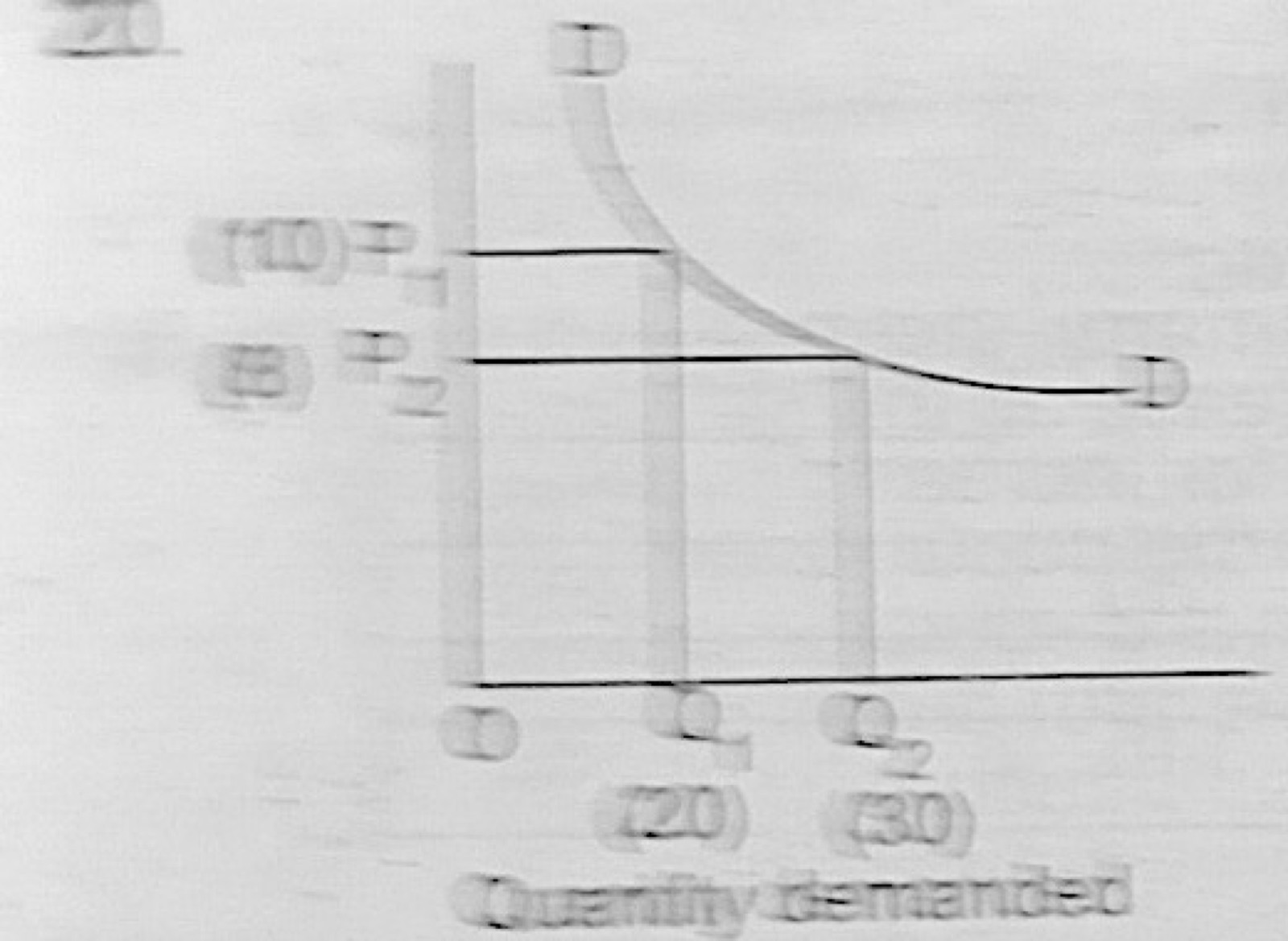
The diagram above illustrates

Diagram for this question
  1. A.perfectly elastic demand
  2. B.inelastic demand
  3. C.perfectly inelastic demand
  4. D.elastic demand
  5. E.unitary elasticity of demand.
Show the answer and explanation

Answer: D (elastic demand)

Explanation

Price falls from 10 to 8 (20%) while quantity rises from 20 to 30 (50%); quantity changes more than price, so demand is elastic. Total revenue also rises from 200 to 240.

Open this question

Question 21

Money and Inflation

Which of the following is not a negative effect of inflation?

  1. A.Lenders earn less
  2. B.Pensioners and salary earners on fixed incomes suffer
  3. C.Exports tend to decline
  4. D.Savings are discouraged
  5. E.Borrowers tend to gain.
Show the answer and explanation

Answer: E (Borrowers tend to gain.)

Explanation

Borrowers gain because they repay with money worth less; this is not a harm to them.

Open this question

Question 22

Theory of Demand

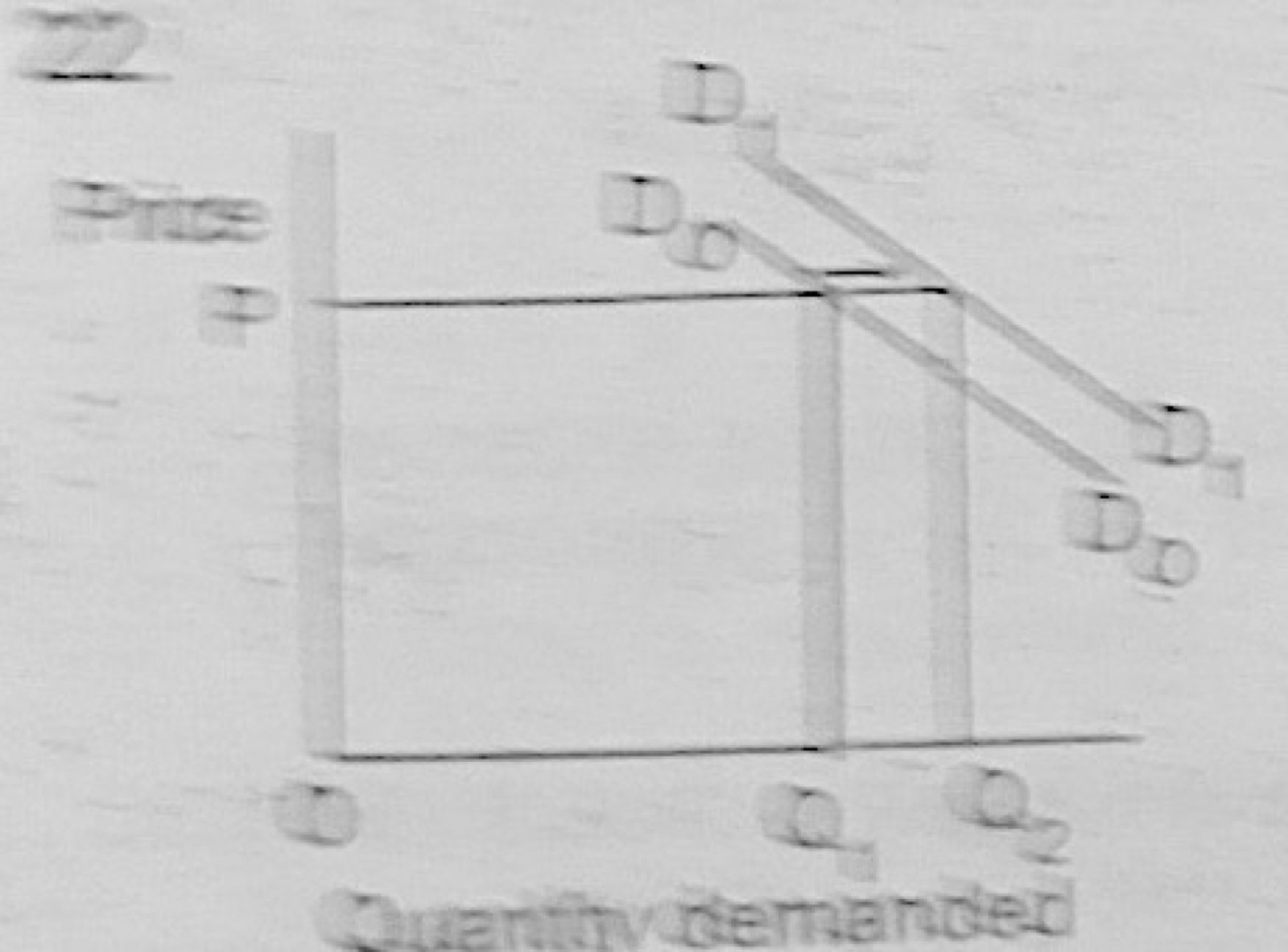
The above diagram represents

Diagram for this question
  1. A.an increase in demand
  2. B.an increase in quantity supplied
  3. C.a decrease in quantity demanded
  4. D.a decrease in demand
  5. E.a change in price.
Show the answer and explanation

Answer: A (an increase in demand)

Explanation

The demand curve shifts from Do to D1 (to the right): at the same price P more is demanded (Q2 instead of Q1), an increase in demand.

Open this question

Question 24

Public Finance

Proportional tax is a tax whose

  1. A.percentage rate remains constant as the tax base increases
  2. B.percentage rate increases as the tax base increases
  3. C.percentage rate decreases as the tax base increases
  4. D.percentage rate fluctuates as the tax base increases
  5. E.burden falls heavily on consumers.
Show the answer and explanation

Answer: A (percentage rate remains constant as the tax base increases)

Explanation

Under a proportional tax everyone pays the same percentage whatever their income.

Open this question

Question 25

Public Finance

The largest part of the revenue of a country is derived from

  1. A.direct taxation
  2. B.indirect taxation
  3. C.excise duties
  4. D.company taxes
  5. E.non-tax revenue.
Show the answer and explanation

Answer: B (indirect taxation)

Explanation

In most West African countries taxes on goods (import, export and excise duties, sales taxes) bring in more than direct taxes.

Open this question

Question 26

Agriculture

Which of the following is not a good reason for the importance of agriculture in West African countries? It

  1. A.employs about 60% of the people
  2. B.provides the highest tax revenue
  3. C.is a major foreign exchange earner in most of the countries
  4. D.provides the raw materials for all import-substitution industries
  5. E.provides raw materials only for foreign industries.
Show the answer and explanation

Answer: E (provides raw materials only for foreign industries.)

Explanation

Agriculture supplies local industries too, so 'only for foreign industries' is false.

Open this question

Question 28

Public Finance

The greater burden of the taxes on essential goods is borne by

  1. A.the middle income group
  2. B.high income group
  3. C.low income group
  4. D.people between the middle and high income groups
  5. E.few top rich people.
Show the answer and explanation

Answer: C (low income group)

Explanation

The poor spend a larger share of their income on essentials, so such taxes take more of their income.

Open this question

Question 29

Theory of Supply

A change in supply implies a

  1. A.shift in the supply curve to the right and not to the left
  2. B.shift in supply curve to the left and not to the right
  3. C.shift in the supply curve to the left or to the right
  4. D.movement along the supply curve
  5. E.decrease in price and quantity supplied.
Show the answer and explanation

Answer: C (shift in the supply curve to the left or to the right)

Explanation

A change in supply is a shift of the whole curve – right for an increase, left for a decrease.

Open this question

Question 30

National Income

Which of the following would increase the GNP of an economy?

  1. A.increased government expenditure on the salary of civil servants
  2. B.An increase in the proportion of the productively employed population
  3. C.A decrease in the rate of unemployment
  4. D.A decrease in output per worker
  5. E.An increase in the population dependency ratio.
Show the answer and explanation

Answer: B (An increase in the proportion of the productively employed population)

Explanation

When a bigger share of the population is in productive work, total output (GNP) rises.

Open this question

Question 31

Market Structures

A market condition where profit is maximized when MR = AR = MC = P is known as

  1. A.monopoly
  2. B.oligopoly
  3. C.monopsony
  4. D.perfect competition
  5. E.duopoly.
Show the answer and explanation

Answer: D (perfect competition)

Explanation

Only a perfect competitor has P = AR = MR, so its profit-maximising point MC = MR also equals price.

Open this question

Question 32

Price Determination

When the price of a commodity is fixed by law either below or above the equilibrium, the mechanism is known as

  1. A.price discrimination
  2. B.price control
  3. C.perfect market
  4. D.equilibrium price
  5. E.market structure.
Show the answer and explanation

Answer: B (price control)

Explanation

Government fixing of maximum or minimum prices by law is price control.

Open this question

Question 33

Money and Inflation

Money supply is the

  1. A.currency available in the banks
  2. B.currency in circulation and time deposits
  3. C.currency in circulation and saving deposits
  4. D.currency in circulation and demand deposits
Show the answer and explanation

Answer: D (currency in circulation and demand deposits)

Explanation

Narrow money supply = currency held by the public + demand deposits.

Open this question

Question 34

Financial Institutions

Which of the following is not the function of a commercial bank?

  1. A.Accepting deposits from the public
  2. B.Serving as banker to the government
  3. C.Lending to the public
  4. D.Safekeeping of valuables
  5. E.Undertaking foreign exchange transactions of customers.
Show the answer and explanation

Answer: B (Serving as banker to the government)

Explanation

Banker to the government is a central bank function.

Open this question

Question 35

International Trade

Country | Amount of Labour days | Quantity of Cocoa produced | Quantity of Textile produced
I | 200 | 600 | 900
II | 200 | 300 | 800
From the above table, we can correctly say that country

  1. A.I has absolute disadvantage in the production of both cocoa and textile
  2. B.I has absolute advantage in the production of both cocoa and textile
  3. C.II has absolute advantage in the production of both cocoa and textile
  4. D.II has comparative advantage in the production of cocoa only
  5. E.II has absolute disadvantage in the production of textile only.
Show the answer and explanation

Answer: B (I has absolute advantage in the production of both cocoa and textile)

Explanation

With the same 200 labour days, country I makes more cocoa (600 > 300) and more textiles (900 > 800), so it has an absolute advantage in both.

Open this question

Question 36

Money and Inflation

Inflation caused by an increase in demand is known as

  1. A.cost-push inflation
  2. B.hyper-inflation
  3. C.demand-pull inflation
  4. D.creeping inflation
  5. E.runaway inflation.
Show the answer and explanation

Answer: C (demand-pull inflation)

Explanation

When rising demand pulls prices up, it is demand-pull inflation.

Open this question

Question 37

Public Finance

Indirect taxes are taxes which

  1. A.are levied on the incomes and profits of individuals and firms
  2. B.always affect the producer only
  3. C.are based on progressive principles
  4. D.are based on regressive principles
  5. E.are levied on goods and services purchased by individuals and firms.
Show the answer and explanation

Answer: E (are levied on goods and services purchased by individuals and firms.)

Explanation

Indirect taxes are placed on goods and services and paid through their prices.

Open this question

Question 40

Theory of Production

Land is often different from other factors of production because it

  1. A.is a free gift of nature
  2. B.constitutes one-third of the entire world
  3. C.has different grades
  4. D.is owned by individuals
  5. E.is owned by government.
Show the answer and explanation

Answer: A (is a free gift of nature)

Explanation

Land is not made by man; it is a free gift of nature, unlike labour effort, capital and enterprise.

Open this question

Theory question 101

Tools of Economic Analysis

Section A (answer one question only from this section)
The values of different types of accounts held in Nigerian banks for the period 1984 to 1988 are as follows (in ₦m):
Year | 1984 | 1985 | 1986 | 1987 | 1988
Savings | 100 | 120 | 120 | 180 | 200
Current | 65 | 75 | 70 | 100 | 130
Fixed deposit | 40 | 45 | 60 | 145 | 50
Present the data above in the form of a component bar chart.

Show the model answer
Model answer

Totals: 1984 = 205; 1985 = 240; 1986 = 250; 1987 = 425; 1988 = 380 (₦m)
Draw one bar per year on the horizontal axis; vertical axis in ₦m with a suitable scale (e.g. 2 cm to ₦50m) up to at least 425.
Each bar's height = the year's total, divided into three components stacked in the same order every year: savings at the bottom, current next, fixed deposit on top (e.g. 1984: 0–100 savings, 100–165 current, 165–205 fixed deposit).
Shade/colour each component differently and give a key, title, axis labels and scale.

Explanation

Same component order and shading in every bar.

Open this question

Theory question 102

Elasticity

Section A (answer one question only from this section)
(a) Define price elasticity
(b) If at N8.00 per tuber, twenty tubers were demanded and when the price fell to N6.00 per tuber, thirty tubers were demanded, what is the elasticity of demand?

Show the model answer
Model answer

(a) Price elasticity of demand is the degree of responsiveness of quantity demanded to a change in price; measured as % change in quantity demanded ÷ % change in price.
(b) % change in quantity = (30 − 20)/20 × 100 = 50%
% change in price = (8 − 6)/8 × 100 = 25%
Elasticity = 50 ÷ 25 = 2
Since 2 > 1, demand is elastic.

Explanation

Use the original price and quantity as the base.

Open this question

Theory question 103

Theory of Demand

Section B (answer three questions only from this section)
A demand curve slopes downwards from left to right, but this may not always be so. Explain the statement.

Show the model answer
Model answer

Normally (law of demand) more is bought at lower prices: substitution and income effects, diminishing marginal utility, new buyers enter at lower prices – so the curve slopes down from left to right.
Exceptions (abnormal/upward-sloping demand curves):
1. Giffen goods – inferior staples of the very poor; a rise in price makes them buy more.
2. Goods of ostentation/prestige (Veblen goods) – bought more when dearer.
3. Expectation of further price rises – people buy more now as price rises.
4. Speculative buying (e.g. shares).
5. Ignorance – consumers judge quality by price.
6. Necessities in times of scarcity/emergency.
A diagram of an upward-sloping (regressive) demand curve earns credit.

Explanation

State the normal case first, then the exceptions.

Open this question

Theory question 104

Theory of Production

Section B
(a) Highlight the factors which encourage entrepreneurs to adopt division of labour in production
(b) What factors are capable of limiting the practice of division of labour?

Show the model answer
Model answer

(a) Factors encouraging division of labour: increased output and productivity; saving of time (no moving between tasks); skill improves through repetition; use of machines; workers placed where their talents suit; lower cost per unit; makes large-scale production possible; easier training of workers.
(b) Limiting factors: size of the market (main limit); nature of the product (custom-made goods, art); scarce capital; small scale of production; shortage of skilled labour; nature of the job (agriculture is seasonal); poor transport and communication; low level of technology.

Explanation

Market size is the key limit.

Open this question

Theory question 105

Agriculture

Section B
Discuss the different types of agricultural systems that exist in West Africa.

Show the model answer
Model answer

Types (each with features, merits/demerits):
1. Shifting cultivation – farmer moves to new land when soil fertility falls; low output.
2. Bush fallowing / land rotation – land left to rest and farmer returns later.
3. Subsistence (peasant) farming – small farms, crude tools, family labour, output for family use.
4. Commercial farming – large scale, mechanised, for sale/export.
5. Plantation agriculture – large estates of one cash crop (rubber, oil palm, cocoa).
6. Mixed farming – crops and livestock on the same farm.
7. Nomadic herding / pastoralism – cattle moved in search of pasture (northern savanna).
8. Mono-cropping and mixed cropping; continuous cultivation near towns; cooperative and government farms.

Explanation

Describe each system with an example.

Open this question

Theory question 106

Industrialisation

Section B
Outline the ways in which the federal government has encouraged industrialization in Nigeria in recent years.

Show the model answer
Model answer

Ways:
1. Provision of infrastructure: roads, power, water, telecommunication.
2. Industrial estates and export processing zones.
3. Tax incentives: pioneer status, tax holidays, capital allowances.
4. Tariff protection and import bans for infant industries.
5. Development banks and credit schemes (NIDB, NBCI, SME schemes).
6. Indigenisation and local raw material sourcing policies.
7. Direct investment in heavy industries (iron and steel, petrochemicals).
8. Manpower training and research institutes.
9. Encouraging foreign investment, joint ventures and Structural Adjustment reforms.
10. Export promotion schemes.

Explanation

Outline – brief points, each explained in a line.

Open this question

Theory question 107

Distributive Trade

Section B
Middlemen do encounter problems in the process of carrying out their businesses. Explain.

Show the model answer
Model answer

Problems of middlemen:
1. Poor transport and communication networks.
2. Inadequate storage facilities; perishable goods spoil.
3. Lack of capital and credit facilities.
4. High taxes, levies and multiple charges.
5. Government price controls and policies.
6. Bad debts from customers given credit.
7. Competition from producers selling directly and from other middlemen.
8. Insecurity – theft and armed robbery.
9. Fluctuations in prices and supply; risks of loss.
10. Poor power supply and high operating costs.

Explanation

Explain each problem.

Open this question

Theory question 108

Population

Section B
What are the possible solutions to the problems of rural-urban migration in West African countries?

Show the model answer
Model answer

Solutions:
1. Provide social amenities in rural areas: electricity, water, schools, hospitals, roads.
2. Create jobs in rural areas; locate industries there.
3. Improve agriculture: credit, inputs, mechanisation, good prices, so farming pays.
4. Rural development programmes and cooperatives.
5. Even development and decentralisation of government projects.
6. Reduce the gap between urban and rural incomes.
7. Promote cottage and small-scale industries.
8. Public enlightenment about life in the cities.

Explanation

Make rural life more attractive.

Open this question

Theory question 109

Distributive Trade

Section B
Outline the economic activities that are likely to improve the effective distribution and marketing of commodities in Nigeria.

Show the model answer
Model answer

Activities:
1. Good transport network: roads, railways, waterways.
2. Adequate storage and warehousing facilities.
3. Efficient communication systems.
4. Banking and credit facilities for traders.
5. Insurance to cover risks.
6. Advertising and market information.
7. Standardisation, grading and packaging.
8. Cooperative marketing societies.
9. Peace, security and stable government policies.
10. Reduction of levies and checkpoints.

Explanation

Aids to trade are the key idea.

Open this question

Theory question 110

Balance of Payments and Exchange Rates

Section B
Discuss the measures that can be taken by a country seeking to correct its balance of payment deficit.

Show the model answer
Model answer

Measures:
1. Devaluation – makes exports cheaper and imports dearer.
2. Import restrictions: tariffs, quotas, import bans.
3. Exchange control – rationing of foreign exchange.
4. Export promotion: subsidies, incentives, diversification of exports.
5. Deflationary monetary and fiscal policies to reduce demand for imports.
6. Import substitution industrialisation.
7. Borrowing from the IMF or other sources / using reserves (short-term).
8. Attracting foreign investment and tourism; reducing invisible payments.
9. Debt rescheduling.
Explanation

Explain how each measure reduces the deficit.

Open this question