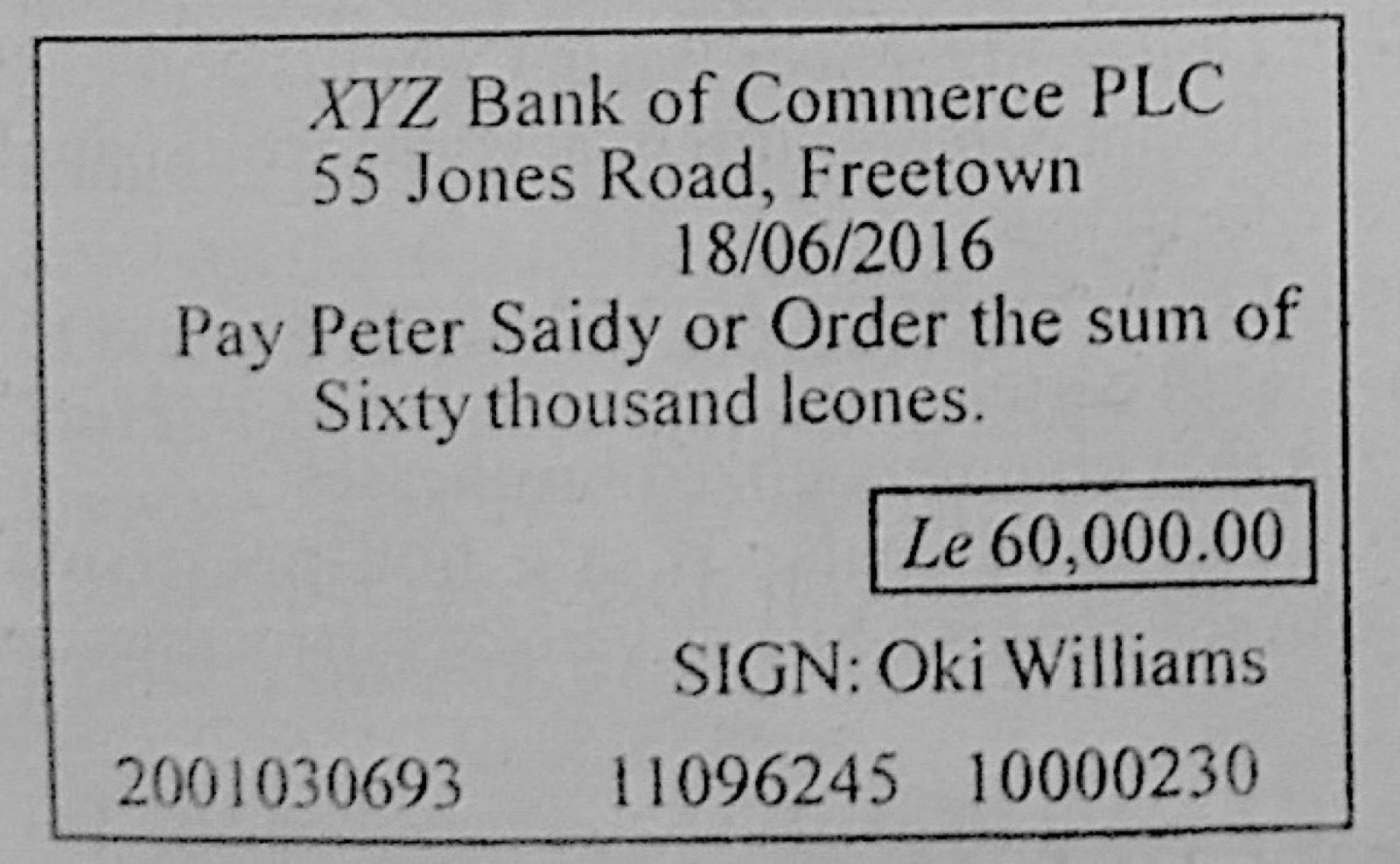
Use the diagram (a cheque: XYZ Bank of Commerce PLC, 55 Jones Road, Freetown, 18/06/2016, 'Pay Peter Saidy or Order the sum of Sixty thousand leones', Le 60,000.00, SIGN: Oki Williams) to answer the question. The diagram above shows a
A.standing order.
B.receipt.
C.cheque.
D.bill of exchange.
Show the answer and explanation
Answer: C (cheque.)
Explanation
It is a written order to a bank to pay a named person a sum of money, signed by the account holder: a cheque.
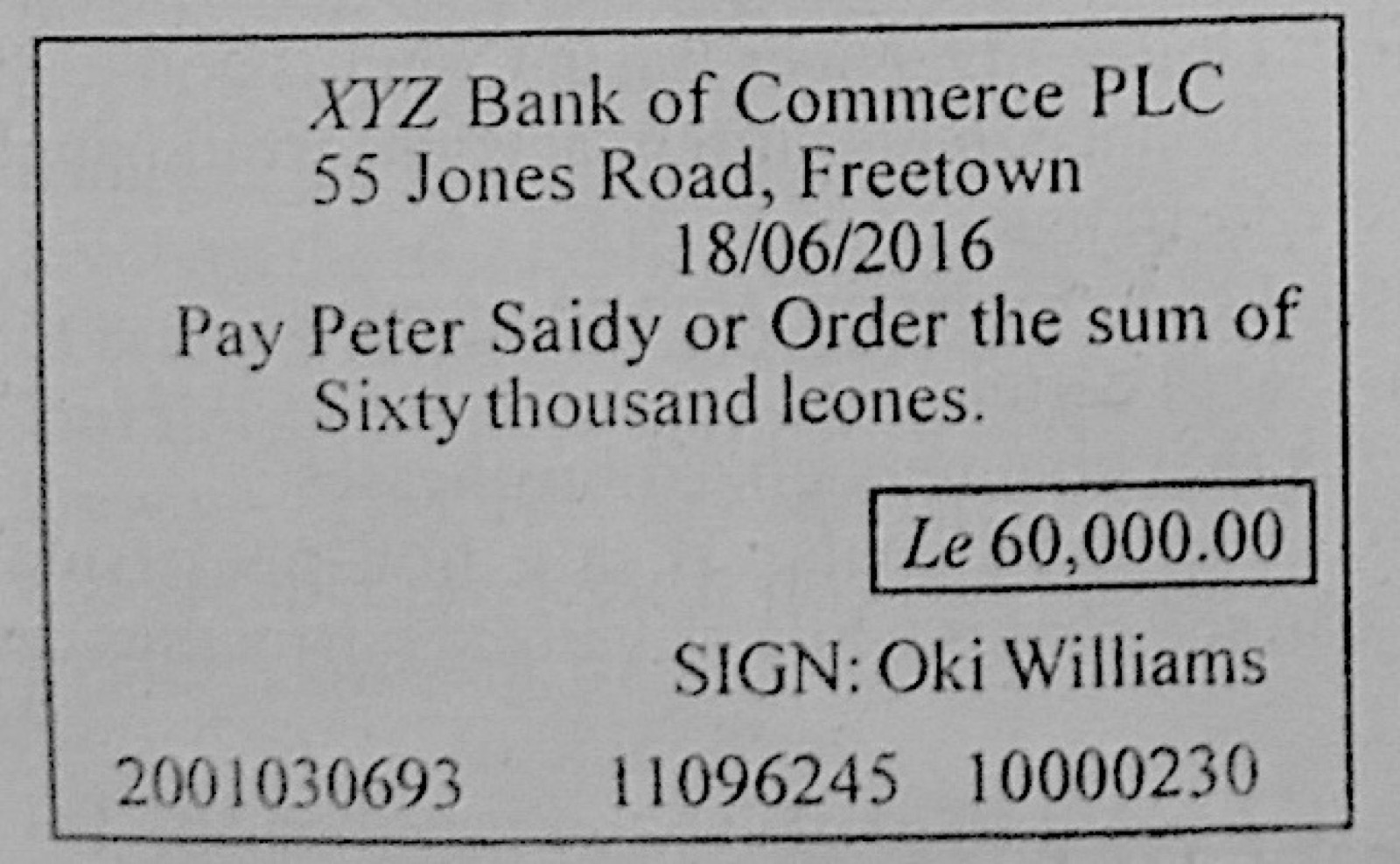
Use the diagram (a cheque: XYZ Bank of Commerce PLC, 55 Jones Road, Freetown, 18/06/2016, 'Pay Peter Saidy or Order the sum of Sixty thousand leones', Le 60,000.00, SIGN: Oki Williams) to answer the question. XYZ Bank of Commerce PLC is the
A.payee.
B.endorser.
C.drawer.
D.drawee.
Show the answer and explanation
Answer: D (drawee.)
Explanation
The bank on which a cheque is drawn, and which pays it, is the drawee.
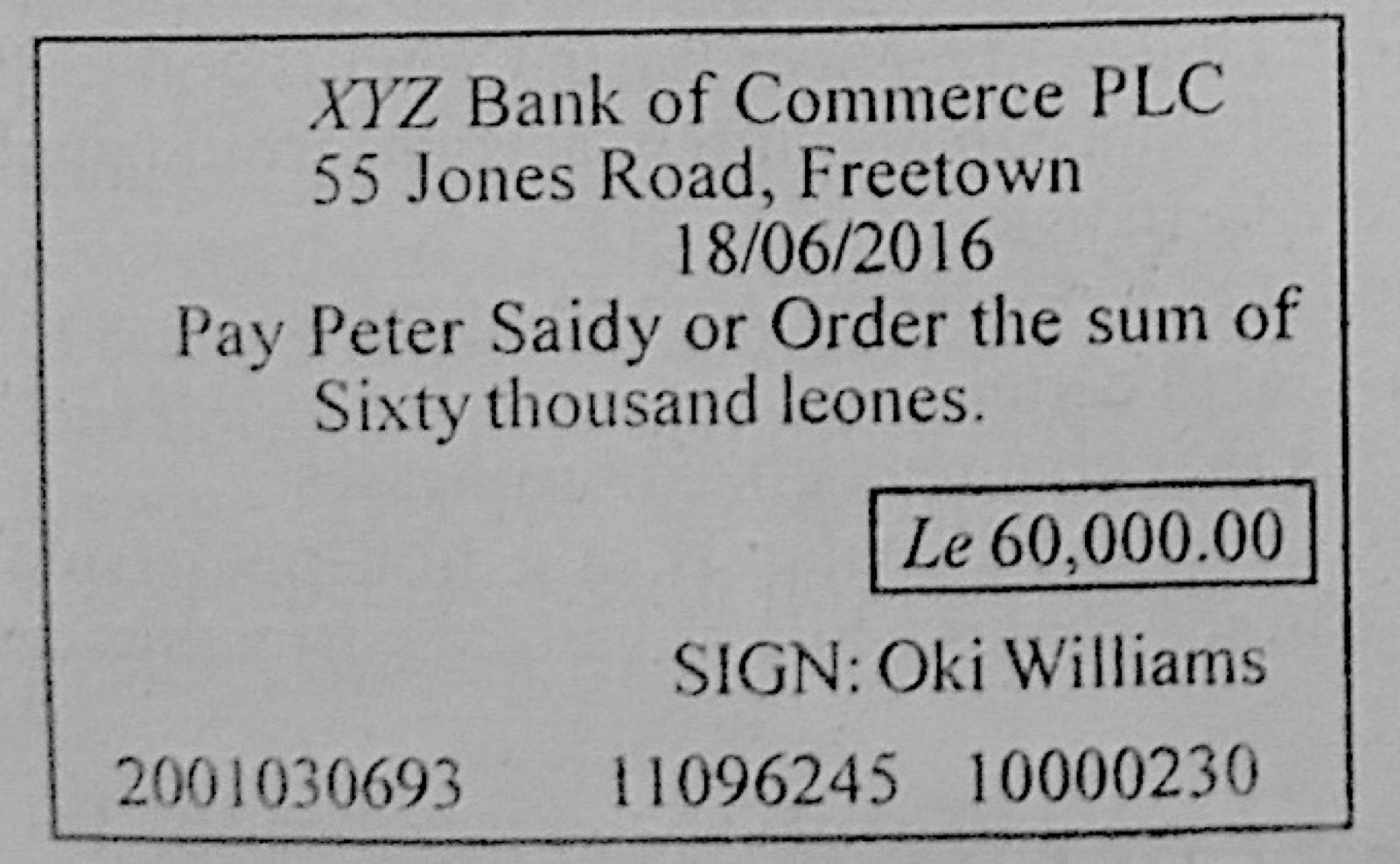
Use the diagram (a cheque: XYZ Bank of Commerce PLC, 55 Jones Road, Freetown, 18/06/2016, 'Pay Peter Saidy or Order the sum of Sixty thousand leones', Le 60,000.00, SIGN: Oki Williams) to answer the question. Oki Williams is the
A.payee.
B.endorser.
C.drawer.
D.drawee.
Show the answer and explanation
Answer: C (drawer.)
Explanation
Oki Williams signed the cheque, so he is the drawer.
Commerce 2 (theory) (a) List fourcareer opportunities available to a student of commerce. (b) State two functions of an entrepreneur. (c) Explain the following activities giving two examples of each: (i) extractive industry; (ii) construction industry; (iii) manufacturing industry; (iv) tertiary industry.
Show the model answer
Model answer
(a) Any four: trading (wholesaling/retailing); banking; insurance; accountancy; marketing/sales; advertising; transport/shipping and clearing; warehousing/storekeeping; stockbroking; secretarial/office work; tourism. (b) Any two: combines and organises the other factors of production; provides capital; bears the risks of the business; takes major decisions/plans; innovates. (c)(i) Extractive industry – taking raw materials from land, water or air, e.g. mining, fishing, farming, lumbering, quarrying. (ii) Construction industry – assembling processed materials into usable structures, e.g. building houses, roads, bridges, furniture making. (iii) Manufacturing industry – changing raw materials into finished or semi-finished goods, e.g. textiles, car assembly, brewing, oil refining. (iv) Tertiary industry – provision of services, both commercial and direct, e.g. banking, transport, trading, teaching, medical and legal services.
Explanation
In (c) define each industry first, then give two examples.
Commerce 2 (theory) The staff of Kander Manufacturing Company Limited formed a cooperative society to enable them have access to funds. (a) Name the type of cooperative society they formed. (b) State four features of the cooperative society. (c) State three advantages and two disadvantages of the cooperative society.
Show the model answer
Model answer
(a) Thrift and credit (credit and savings) co-operative society. (b) Any four: formed by people with a common bond (e.g. same workplace); voluntary membership; capital from members' regular savings/shares; aim is to give members loans at low interest; one member, one vote; managed by an elected committee; registered, so it has continuity and limited liability; surplus shared according to patronage/savings. (c) Advantages (any three): encourages saving; gives members cheap loans with little collateral; easy deductions from salary; loans for emergencies and projects; members learn management; dividends on savings. Disadvantages (any two): limited capital; poor management by part-time officers; possible misuse or embezzlement of funds; loan defaults by members; small loans relative to needs; delays in giving loans.
Explanation
The common workplace and the aim of access to funds point to a thrift and credit society.
Commerce 2 (theory) (a) State five reasons that would make a bank to dishonour a customer's cheque. (b) State five reasons countries introduce restrictions in foreign trade.
Show the model answer
Model answer
(a) Any five: insufficient funds in the account; signature differs from specimen; words and figures differ; cheque is stale (over six months old); post-dated cheque; drawer has stopped payment (countermand); death, insanity or bankruptcy of the drawer; account closed or frozen by court order; alterations not signed; cheque mutilated or wrongly filled/irregular endorsement. (b) Any five: to protect infant industries; to correct a balance of payments deficit; to raise government revenue; to prevent dumping; to protect jobs/reduce unemployment; to prevent importation of harmful goods; to conserve foreign exchange; for political/strategic reasons (e.g. sanctions); to encourage local production and self-reliance.
Explanation
Keep cheque reasons specific (e.g. 'stale', 'post-dated', 'signature differs').
Commerce 2 (theory) (a) State three benefits of a commodity exchange. (b) Explain two methods of trading in a commodity exchange. (c) State four requirements for trading in a commodity exchange
Show the model answer
Model answer
(a) Any three: provides an organised market for commodities; helps fix fair prices through demand and supply; reduces risk through hedging/forward contracts; gives price information to producers and buyers; encourages production of the commodities; earns foreign exchange; enables trading without seeing the goods (by sample/grade). (b) Any two, explained: spot (cash) trading – goods are bought and paid for for immediate delivery; futures/forward trading – contracts to buy or sell at an agreed price for delivery at a future date; trading by sample – a sample represents the whole lot; trading by description/grade – goods are sold by recognised grades without inspection; auction sales. (c) Any four: commodities must be durable (non-perishable); capable of being graded/standardised; available in large quantities; sold through registered brokers/members; must have a large number of buyers and sellers; prices must fluctuate freely; goods must be easily transported/stored.
Explanation
Requirements in (c) are mainly about the nature of the commodity (durable, gradable, plentiful).
Commerce 2 (theory) (a) List six advertising media used in business. (b) What is personal selling? (c) State four advantages and two disadvantages of personal selling.
Show the model answer
Model answer
(a) Any six: newspapers; magazines/journals; radio; television; cinema; billboards/posters; handbills; internet/social media; window display; neon signs; direct mail; sky writing. (b) Personal selling is face-to-face contact between a salesperson and prospective buyers to present a product, answer questions and persuade them to buy. (c) Advantages (any four): immediate feedback from customers; salesperson can demonstrate the product; objections are answered on the spot; message is tailored to each customer; builds good customer relations/loyalty; can close the sale at once; useful for technical goods. Disadvantages (any two): expensive (salaries, commission, travel); reaches few people; time-consuming; depends on skill of the salesperson; aggressive salespeople may annoy customers.
Explanation
Personal selling must mention face-to-face contact with the aim of making a sale.
Commerce 2 (theory) Country X is facing a situation where its total payments to other countries is greater than its total earnings from abroad. (a) State the term that relates to the above situation. (b) Explain six measures the country could take to correct the situation.
Show the model answer
Model answer
(a) Unfavourable balance of payments (balance of payments deficit). (b) Any six, explained: restrict imports through tariffs, quotas or bans; promote exports (export incentives, export promotion council); devalue the currency to make exports cheaper and imports dearer; exchange control to ration foreign exchange; import substitution (produce locally what is imported); borrow from abroad/IMF to finance the deficit; attract foreign investment; diversify the economy and exports; reduce government spending abroad; encourage tourism; deflationary policies to cut demand for imports.
Explanation
Each measure should say how it cuts payments or raises earnings.
Commerce 2 (theory) (a) State four services rendered by courier companies. (b) State three advantages and three disadvantages of rail transport.
Show the model answer
Model answer
(a) Any four: fast delivery of letters, documents and parcels; door-to-door collection and delivery; tracking of items; delivery of urgent/valuable items within the country and abroad; proof of delivery; insurance of items; cash-on-delivery/ e-commerce deliveries. (b) Advantages (any three): carries bulky and heavy goods; cheap over long distances; carries large numbers of passengers; fairly safe and regular (timetable); less road congestion; not affected by traffic. Disadvantages (any three): fixed routes – no door-to-door service; expensive to build and maintain; unsuitable for short distances; goods need double handling; inflexible timetable; slow compared with air; breakdowns delay all traffic on the line.
Explanation
Rail suits bulky goods over long distances; its weakness is lack of door-to-door service.
Commerce 2 (theory) The following information was extracted from the books of Jinka Enterprises as at 31st August 2015. 15 cartons of sweets at ₦2,000 per carton. 25 cartons of milk at ₦4,000 per carton. 15 cartons of sugar at ₦3,000 per carton. 17 cartons of soap at ₦5,000 per carton. The following payments were made: Rent and rates – ₦3,500 Salaries and wages – ₦8,000 Fuel – ₦2,000 Electricity – ₦1,500 A cash discount of 6% and a 10% trade discount was allowed if payment was made within 7 days. (i) Calculate how much cash was paid for the goods bought if payment was made within 7 days. (ii) If all the goods were sold at a mark up of 20%, determine the selling price. (iii) Calculate the value of the net profit made.
Show the model answer
Model answer
List price: sweets 30,000 + milk 100,000 + sugar 45,000 + soap 85,000 = ₦260,000. (i) Less 10% trade discount (26,000) = ₦234,000; less 6% cash discount (14,040) = ₦219,960 paid. (ii) Cost after trade discount ₦234,000 + 20% mark-up (46,800) = selling price ₦280,800. (iii) Gross profit 46,800 + discount received 14,040 = 60,840; less expenses (3,500 + 8,000 + 2,000 + 1,500 = 15,000); net profit = ₦45,840.
Explanation
Take trade discount first, then cash discount; the cash discount received is added to gross profit.