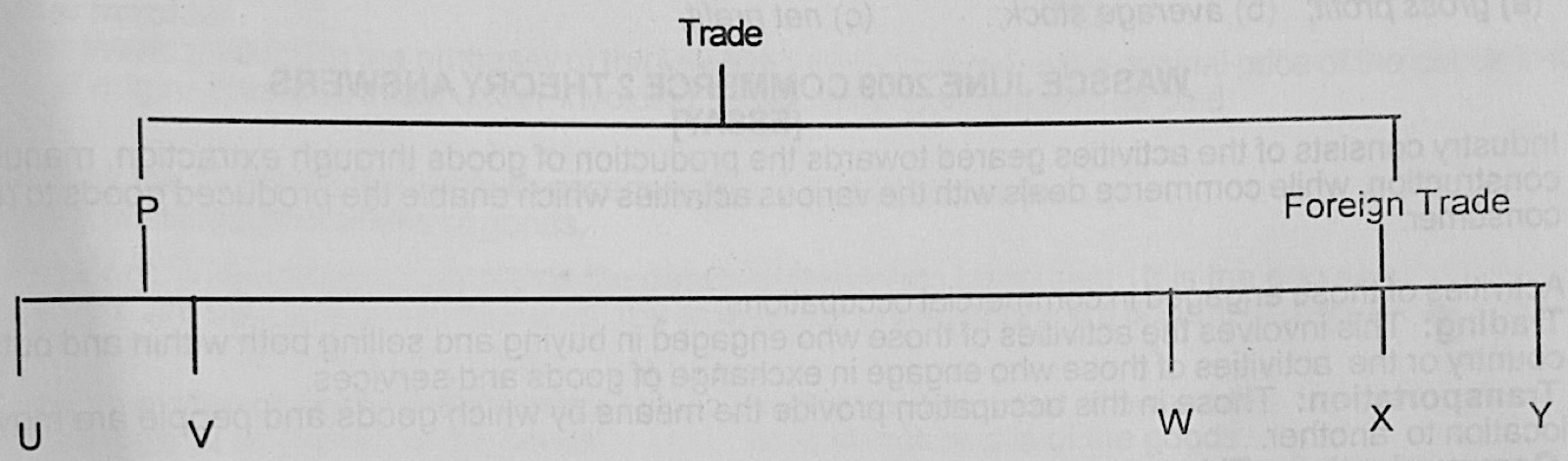
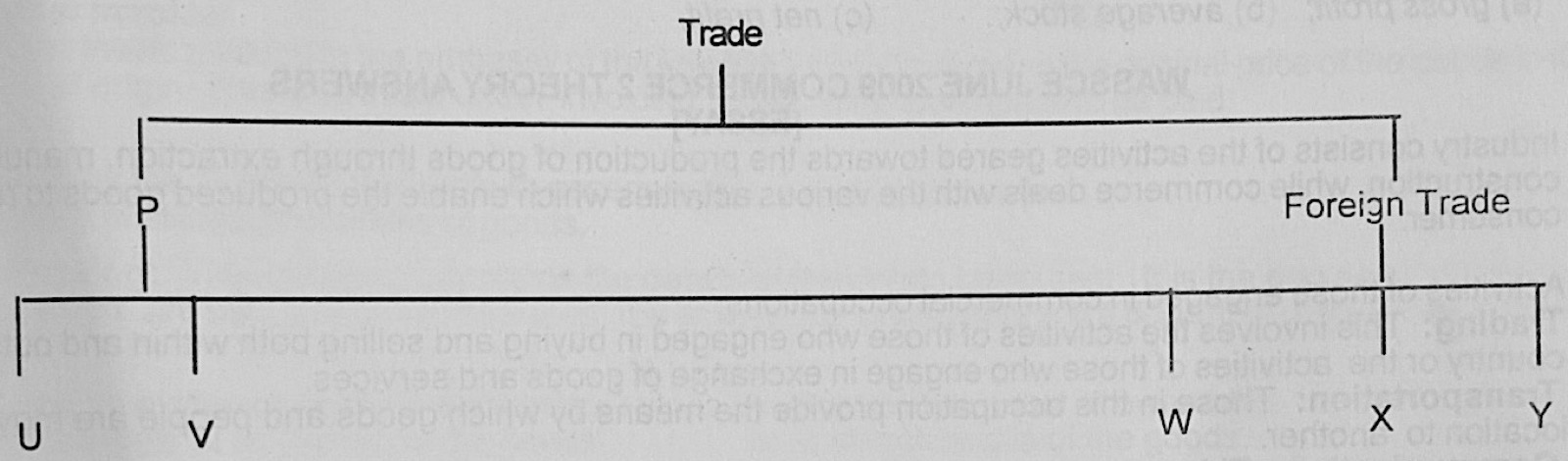
Use the diagram (Trade divided into P and Foreign Trade; P divided into U and V; Foreign Trade divided into W, X and Y) to answer the question. "P" in the diagram above represents
A.commerce
B.home trade
C.wholesale trade
D.entrepot trade
Show the answer and explanation
Answer: B (home trade)
Explanation
Trade is divided into home trade and foreign trade; P stands beside foreign trade, so it is home trade.
Use the diagram (Trade divided into P and Foreign Trade; P divided into U and V; Foreign Trade divided into W, X and Y) to answer the question. What does 'V' represent in the diagram?
A.Trade
B.Home trade
C.Retail trade
D.Commerce
Show the answer and explanation
Answer: C (Retail trade)
Explanation
Home trade divides into wholesale and retail trade, so V is retail trade.
Commerce 2 (essay) (a) Differentiate between industry and commerce. (b) List and explain four activities of those engaged in commercial occupations.
Show the model answer
Model answer
(a) Industry is the production of goods through extraction, manufacturing and construction; commerce is all activities that move the goods produced to the final consumer (trade and aids to trade). (b) Any four, explained: trading (buying and selling at home and abroad); transport (moving goods and people); communication (passing information between buyers and sellers); banking (saving, lending, payments); insurance (cover against risks); advertising (informing buyers); warehousing (storage until needed).
Explanation
Each commercial activity should say what the workers do.
Commerce 2 (essay) Explain five benefits that would be derived and five losses that would be suffered when a sole trader admits other partners.
Show the model answer
Model answer
Benefits (any five, explained): more capital from the new partners; shared risks and losses; wider skills and experience; division of work/specialisation; easier to get loans; continuity when one partner is absent; more ideas and better decisions; business can expand. Losses (any five, explained): loss of sole control; profits must be shared; slower decisions; possible disagreements; still unlimited liability, now also for partners' acts; loss of secrecy; partnership may end on death/withdrawal of a partner; difficulty withdrawing his capital.
Commerce 2 (essay) (a) What is personal selling? (b) List and explain six media available to an advertiser of goods and services
Show the model answer
Model answer
(a) Personal selling is face-to-face contact between a seller and a prospective buyer to present a product and persuade him to buy. (b) Any six, explained: television (sight and sound, wide reach); radio (sound only, reaches rural and non-literate people); newspapers and magazines (printed, can be kept); billboards/hoardings (outdoor, seen by passers-by); posters and handbills; cinema; trade fairs and exhibitions; neon signs; catalogues; internet/social media; banners; loudspeakers/town criers.
Commerce 2 (essay) Explain the following terms: (a) fixed assets; (b) certificate of trading; (c) dividend; (d) authorized capital; (e) promoters
Show the model answer
Model answer
(a) Fixed assets – long-lasting assets bought for use in the business, not for resale, e.g. buildings, machinery, vehicles. (b) Certificate of trading – document from the Registrar allowing a public company to start business after meeting legal requirements. (c) Dividend – the part of a company's profit paid to shareholders on their shares. (d) Authorised capital – the maximum share capital a company may issue, as stated in its memorandum of association. (e) Promoters – persons who take the steps to form a company, e.g. preparing documents and registering it.
Commerce 2 (essay) Describe each of the following documents and state one use of each: (a) consular invoice; (b) bill of lading; (c) certificate of origin; (d) bill of sight
Show the model answer
Model answer
(a) Consular invoice – an invoice certified by the importing country's consul in the exporting country; used to confirm the value of goods for customs duty. (b) Bill of lading – document issued by the shipowner listing goods shipped; used as a receipt, evidence of the contract of carriage and a document of title to claim the goods. (c) Certificate of origin – document stating the country where the goods were made; used to fix duty or claim preferential tariffs. (d) Bill of sight – a provisional declaration made by an importer who cannot fully describe the goods; used to allow customs to inspect them before full entry is made.
Explanation
Give both a description and one use for each document.
Commerce 2 (essay) (a) Explain five functions of the Customs Authority. (b) State five advantages of international trade.
Show the model answer
Model answer
(a) Any five, explained: collects import, export and excise duties; prevents smuggling; stops importation of prohibited goods; supervises bonded warehouses; compiles trade statistics; enforces trade policies/quotas; examines and clears goods and documents. (b) Any five: countries get goods they cannot produce; specialisation and lower costs; wider markets for local goods; earns foreign exchange; raises standard of living; promotes international co-operation; transfer of technology; creates jobs.
Explanation
Customs functions centre on duties and control of goods.
Commerce 2 (essay) Explain the following terms as used on the stock exchange market: (a) Backwardation; (b) Bear; (c) Jobber; (d) Jobber's turn; (e) Brokerage
Show the model answer
Model answer
(a) Backwardation – the charge a bear pays to postpone delivery of shares he has sold to the next settlement period. (b) Bear – a speculator who sells shares expecting prices to fall, hoping to buy them back cheaper. (c) Jobber – a dealer on the stock exchange who buys and sells securities on his own account, dealing only with brokers. (d) Jobber's turn – the jobber's profit: the difference between his buying and selling prices. (e) Brokerage – the commission a stockbroker charges clients for buying or selling securities for them.
Commerce 2 (essay) (a) Explain the following terms: (i) goodwill; (ii) patents; (iii) trade mark; (iv) copyright (b) State four factors that could lead to the dissolution of a limited liability company
Show the model answer
Model answer
(a)(i) Goodwill – the value of a firm's good name, reputation and customer connections, above the value of its physical assets. (ii) Patents – exclusive rights given to an inventor to make and sell his invention for a period. (iii) Trade mark – a registered name, symbol or design that identifies a firm's products. (iv) Copyright – legal right of an author, artist or musician to stop others copying his work. (b) Any four: members pass a special resolution to wind up (voluntary); inability to pay debts (insolvency); court order (compulsory liquidation); object of the company achieved or becomes illegal; fraud or illegal activities; number of members falls below the legal minimum; expiry of a fixed period; failure to start business within a year.
Commerce 2 (essay) (a) Distinguish between nationalization and indigenization (b) State five advantages of nationalization and three disadvantages of indigenization
Show the model answer
Model answer
(a) Nationalisation – government takes over ownership and control of private businesses; indigenisation – ownership and control of businesses pass from foreigners to citizens. (b) Advantages of nationalisation (any five): government controls strategic industries; essential services at low prices; prevents private monopoly exploitation; profits go to the state; creates jobs; ensures even development; protects national security. Disadvantages of indigenisation (any three): shortage of local capital and skills; may scare away foreign investors; fronting – foreigners use local names; few rich citizens gain control; possible fall in efficiency and technology.
Explanation
Nationalisation transfers to government; indigenisation transfers to citizens.
Commerce 2 (essay) The following information is from the books of Auntie Justie, who sells books, for the year ended 31/12/05 (Le): Sales – 220,000 Stock 1/1/05 – 60,000 Purchases – 180,000 Stock 31/12/05 – 70,000 Salaries and wages – 8,000 Debtors – 16,000 Transport – 6,000 Rent – 5,000 Calculate (showing all workings) the: (a) gross profit; (b) average stock; (c) net profit,
Show the model answer
Model answer
(a) Cost of goods sold = 60,000 + 180,000 − 70,000 = Le 170,000; gross profit = 220,000 − 170,000 = Le 50,000. (b) Average stock = (60,000 + 70,000) ÷ 2 = Le 65,000. (c) Expenses = salaries and wages 8,000 + transport 6,000 + rent 5,000 = Le 19,000; net profit = 50,000 − 19,000 = Le 31,000. (Debtors are an asset, not an expense.)