WAEC Civic Education 2021 past questions and answers

58 questions. Try each one, then open the answer to check yourself and read the explanation.

Question 1

National Values

The deliberate effort to avoid behaving abnormally when faced with pressure can be termed

  1. A.self-esteem.
  2. B.self-control.
  3. C.integrity.
  4. D.determination.
Show the answer and explanation

Answer: B (self-control.)

Explanation

Self-control is restraining oneself from acting wrongly under pressure.

Open this question

Question 2

Citizenship and Citizenship Education

The categories of Nigerian citizens that cannot be declared as non-citizens under any circumstances are citizens by

  1. A.parentage and naturalization.
  2. B.registration and birth.
  3. C.birth and parentage.
  4. D.registration and naturalization.
Show the answer and explanation

Answer: C (birth and parentage.)

Explanation

Under the 1999 Constitution only citizenship by registration or naturalization can be withdrawn; citizens by birth (parentage) cannot be deprived.

Open this question

Question 3

Responsible Parenthood

An importance of effective parenting is that it ensures

  1. A.adequate formal education of the children.
  2. B.provision of secondary needs for the family.
  3. C.family members know how to socialize.
  4. D.morally upright wards are bred for the society.
Show the answer and explanation

Answer: D (morally upright wards are bred for the society.)

Explanation

Good parenting raises morally upright children.

Open this question

Question 4

Human Rights

A ban on public lectures and symposiums is against the right to freedom of

  1. A.movement and right to speech.
  2. B.worship and fair hearing.
  3. C.electronic and print media.
  4. D.peaceful assembly and association.
Show the answer and explanation

Answer: D (peaceful assembly and association.)

Explanation

Public lectures are gatherings, so banning them denies freedom of peaceful assembly.

Open this question

Question 5

Traffic Regulations

All these can be a cause of accident on the road except

  1. A.praying while driving.
  2. B.eating while driving.
  3. C.being conscious of road signs.
  4. D.taking alcohol before driving.
Show the answer and explanation

Answer: C (being conscious of road signs.)

Explanation

Paying attention to road signs prevents accidents.

Open this question

Question 6

National Values

Read the quotation: "Being truthful to oneself; being truthful to others; being someone others can trust; doing what is right regardless of the circumstances".
The above quotation is apt for describing

  1. A.selflessness.
  2. B.diligence.
  3. C.discipline.
  4. D.integrity.
Show the answer and explanation

Answer: D (integrity.)

Explanation

Truthfulness, trustworthiness and doing right always describe integrity.

Open this question

Question 7

Nationalism and National Symbols

National consciousness, unity and integrity are promoted through all the following ways except

  1. A.obedience to rules and regulations.
  2. B.National Youth Service Corps.
  3. C.compromise of the rule of law.
  4. D.teaching of Civic Education in schools.
Show the answer and explanation

Answer: C (compromise of the rule of law.)

Explanation

Compromising the rule of law breeds injustice and division.

Open this question

Question 8

Cultism

Membership of an organization associated with secrecy of operations in the society is an indication of

  1. A.activism.
  2. B.cultism.
  3. C.radicalism.
  4. D.spiritism.
Show the answer and explanation

Answer: B (cultism.)

Explanation

Secret organisations of this kind are cults.

Open this question

Question 9

Interpersonal and Inter-communal Relationships

Associations, connections and affiliations between two or more people is what type of relationship?

  1. A.Intra-group
  2. B.Inter-communal
  3. C.Interpersonal
  4. D.Intra-communal
Show the answer and explanation

Answer: C (Interpersonal)

Explanation

Relationships between people are interpersonal.

Open this question

Question 10

National Values

Orderliness in society is best guaranteed when all citizens

  1. A.obey rules and regulations.
  2. B.respect and humble themselves.
  3. C.are proud to be associated with the society.
  4. D.know the sanctions for violation of laws.
Show the answer and explanation

Answer: A (obey rules and regulations.)

Explanation

Obeying rules is the basis of an orderly society.

Open this question

Question 11

Traffic Regulations

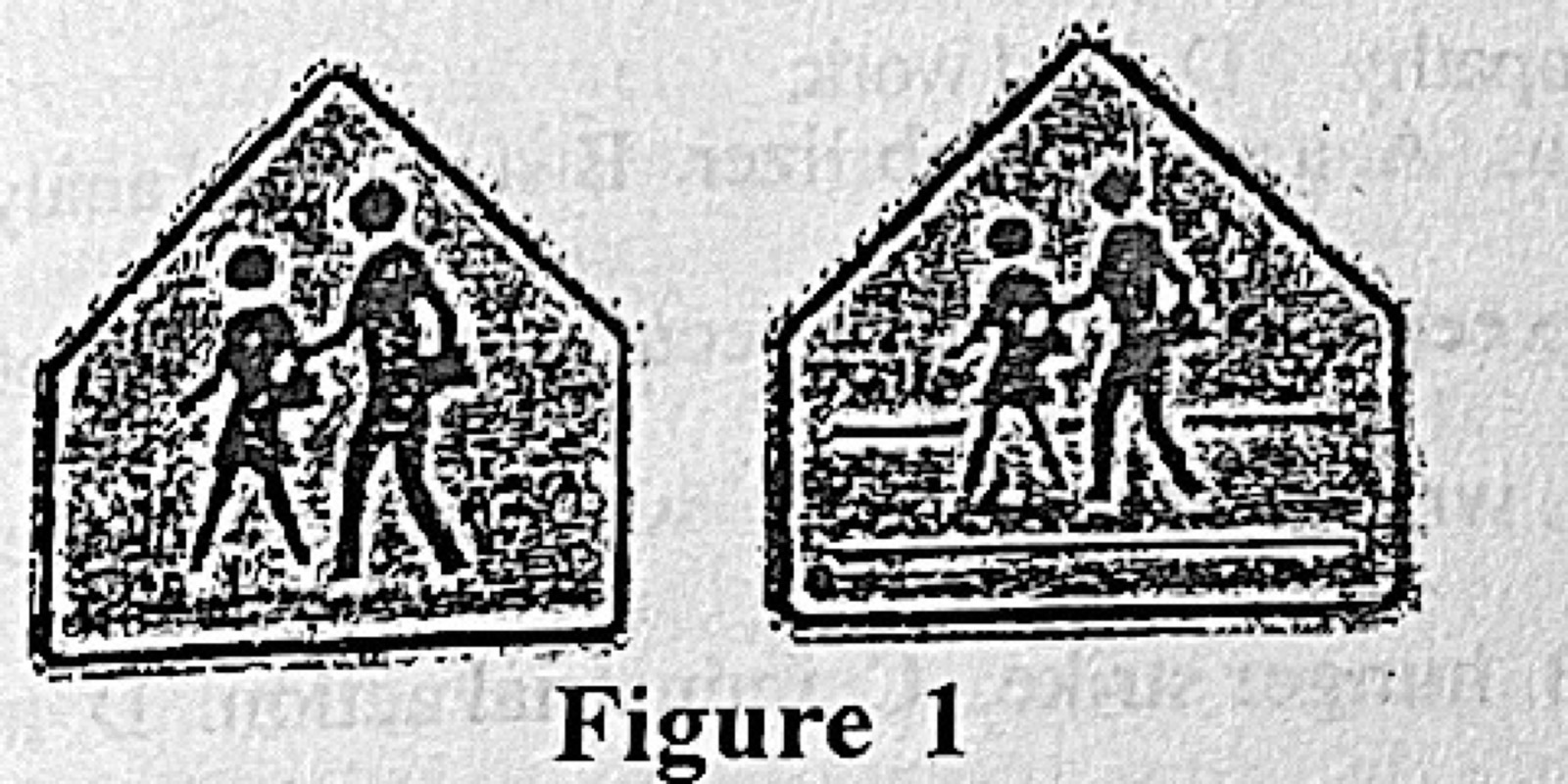
The traffic sign in the images in Figure 1 is to caution road drivers that

Diagram for this question
  1. A.pedestrians crossing is in progress therefore, all cars should wait patiently for them.
  2. B.a designated bus-stop is ahead where school children can be picked and dropped.
  3. C.pedestrians are to hold hands together so as to support one another when crossing.
  4. D.they need to move fast because of the presence of a school zone.
Show the answer and explanation

Answer: A (pedestrians crossing is in progress therefore, all cars should wait patiently for them.)

Explanation

The signs show people crossing, warning drivers to slow down and give way to pedestrians (often school children).

Open this question

Question 12

Citizenship and Citizenship Education

Paying our taxes and assisting the government in the fight against crime are examples of

  1. A.civil obligations.
  2. B.social obligations.
  3. C.economic obligations.
  4. D.cultural obligations.
Show the answer and explanation

Answer: A (civil obligations.)

Explanation

These are duties citizens owe the state: civic (civil) obligations.

Open this question

Question 13

Youth Empowerment

Creating an enabling environment for someone to have control over his financial situation is known as

  1. A.reinforcement.
  2. B.endowment.
  3. C.empowerment.
  4. D.enhancement.
Show the answer and explanation

Answer: C (empowerment.)

Explanation

Empowerment helps people take control of their own lives and finances.

Open this question

Question 14

Nationalism and National Symbols

The following are steps towards sustaining national unity except

  1. A.emphasis on factors that unite a nation.
  2. B.respecting the national symbols.
  3. C.discouraging inter-religious marriages.
  4. D.working towards achieving national objectives.
Show the answer and explanation

Answer: C (discouraging inter-religious marriages.)

Explanation

Inter-religious marriages bring groups together; discouraging them divides people.

Open this question

Question 15

Interpersonal and Inter-communal Relationships

A major reason that fosters healthy interpersonal relationship is

  1. A.pursuit of money.
  2. B.party politics.
  3. C.common goals.
  4. D.culture.
Show the answer and explanation

Answer: C (common goals.)

Explanation

People who share goals work together and relate well.

Open this question

Question 16

HIV/AIDS

People Living with HIV/AIDS (PLWHA) are stigmatized by

  1. A.refusal of privileges.
  2. B.exploitation by care givers.
  3. C.refusal to be voted for in election.
  4. D.refusing to respect their authority.
Show the answer and explanation

Answer: A (refusal of privileges.)

Explanation

Denying PLWHAs the privileges others enjoy is stigmatisation.

Open this question

Question 17

Human Rights

A child who is forced to engage in hawking all day must have been denied the right to

  1. A.fair hearing.
  2. B.expression.
  3. C.education.
  4. D.life.
Show the answer and explanation

Answer: C (education.)

Explanation

Hawking all day keeps the child out of school.

Open this question

Question 18

Youth Empowerment

The sole aim of youth empowerment is to

  1. A.encourage students to take on a vacation job.
  2. B.learn to earn money and also how to manage it.
  3. C.learn how to behave in a work-related environment.
  4. D.give youths financial independence and self-reliance.
Show the answer and explanation

Answer: D (give youths financial independence and self-reliance.)

Explanation

Youth empowerment aims at self-reliance and financial independence.

Open this question

Question 19

Human Trafficking
WASSCE 2021: Chalyn
Chalyn was a sixteen year old girl. She was the sixth child in a family of nine. Chalyn's father and mother were both private workers who barely had time for the home. The new management of Chalyn's parents' workplace was incompetent and could not pay workers' salaries for several months. Chalyn became frustrated with the situation at home.

One day she met some friends who capitalized on her situation and advised her to leave home if she wanted to live a good life and she obliged. She was introduced to a trafficking agent who took her abroad where she was compelled to engage in prostitution. Five years later, Chalyn was deported after she had contracted the deadly HIV/AIDS.

From the above passage, it could be inferred that Chalyn is majorly a victim of

  1. A.human trafficking.
  2. B.inconsiderate government.
  3. C.lack of family planning.
  4. D.non-payment of salaries.
Show the answer and explanation

Answer: A (human trafficking.)

Explanation

She was taken abroad by a trafficking agent and forced into prostitution.

Open this question

Question 20

Human Trafficking

Which of the following would have likely saved Chalyn from falling into the hands of traffickers?

  1. A.Adequate remunerations for civil servants
  2. B.An established family business
  3. C.Moral upbringing and solid parental care
  4. D.Adequate family planning.
Show the answer and explanation

Answer: C (Moral upbringing and solid parental care)

Explanation

Chalyn's parents were private workers who barely had time for the home, and she was easily led away by friends. Moral upbringing and solid parental care would most likely have protected her from the traffickers.

Open this question

Question 21

Human Trafficking

Chalyn's ordeal would have been likely prevented through all the following means except

  1. A.poverty alleviation programme.
  2. B.effective family planning.
  3. C.qualitative higher education.
  4. D.skill acquisition courses.
Show the answer and explanation

Answer: C (qualitative higher education.)

Explanation

Poverty, a large family and lack of skills drove her ordeal; she was only sixteen, so higher education is the least relevant.

Open this question

Question 22

Traffic Regulations

Which of the following agents is not saddled with the responsibility of maintaining traffic regulation in Nigeria?

  1. A.Vehicle Inspection Officer
  2. B.Nigerian Customs Officer
  3. C.Police Traffic Warden
  4. D.Corps Marshal
Show the answer and explanation

Answer: B (Nigerian Customs Officer)

Explanation

Customs officers control imports and exports; FRSC marshals, VIOs and traffic wardens enforce traffic rules.

Open this question

Question 23

HIV/AIDS

A society that is free from HIV/AIDS infected persons will likely experience

  1. A.increase in level of poverty.
  2. B.increase in productivity.
  3. C.loss of man power.
  4. D.high death rate.
Show the answer and explanation

Answer: B (increase in productivity.)

Explanation

A healthy population works more, so productivity rises.

Open this question

Question 24

Drug Abuse

Major behavioural manifestations of drug addicts include the following except

  1. A.mental disorder.
  2. B.isolation and withdrawal.
  3. C.depression and regrets.
  4. D.humility and boldness.
Show the answer and explanation

Answer: D (humility and boldness.)

Explanation

Humility is not a typical sign of drug addiction.

Open this question

Question 25

Structure and Organs of Government

The lowest court in Nigeria is the

  1. A.Magistrate/District Court.
  2. B.Court of Appeal.
  3. C.Sharia Court of Appeal.
  4. D.State High Court.
Show the answer and explanation

Answer: A (Magistrate/District Court.)

Explanation

Of the options, Magistrate/District Courts are the lowest.

Open this question

Question 26

Structure and Organs of Government

Which of the following has the power to impeach the president in Nigeria?

  1. A.Executive
  2. B.Judiciary
  3. C.Legislature
  4. D.Supreme Court
Show the answer and explanation

Answer: C (Legislature)

Explanation

The National Assembly (legislature) can remove the President by impeachment.

Open this question

Question 27

Interpersonal and Inter-communal Relationships

The phrase no man is an island... means that

  1. A.mankind needs other plants and animals to survive.
  2. B.citizens cannot operate without help of a government.
  3. C.individuals need the cooperation of others to progress.
  4. D.humans need to marry and have life partners.
Show the answer and explanation

Answer: C (individuals need the cooperation of others to progress.)

Explanation

No one can live and succeed entirely alone.

Open this question

Question 28

Youth Empowerment

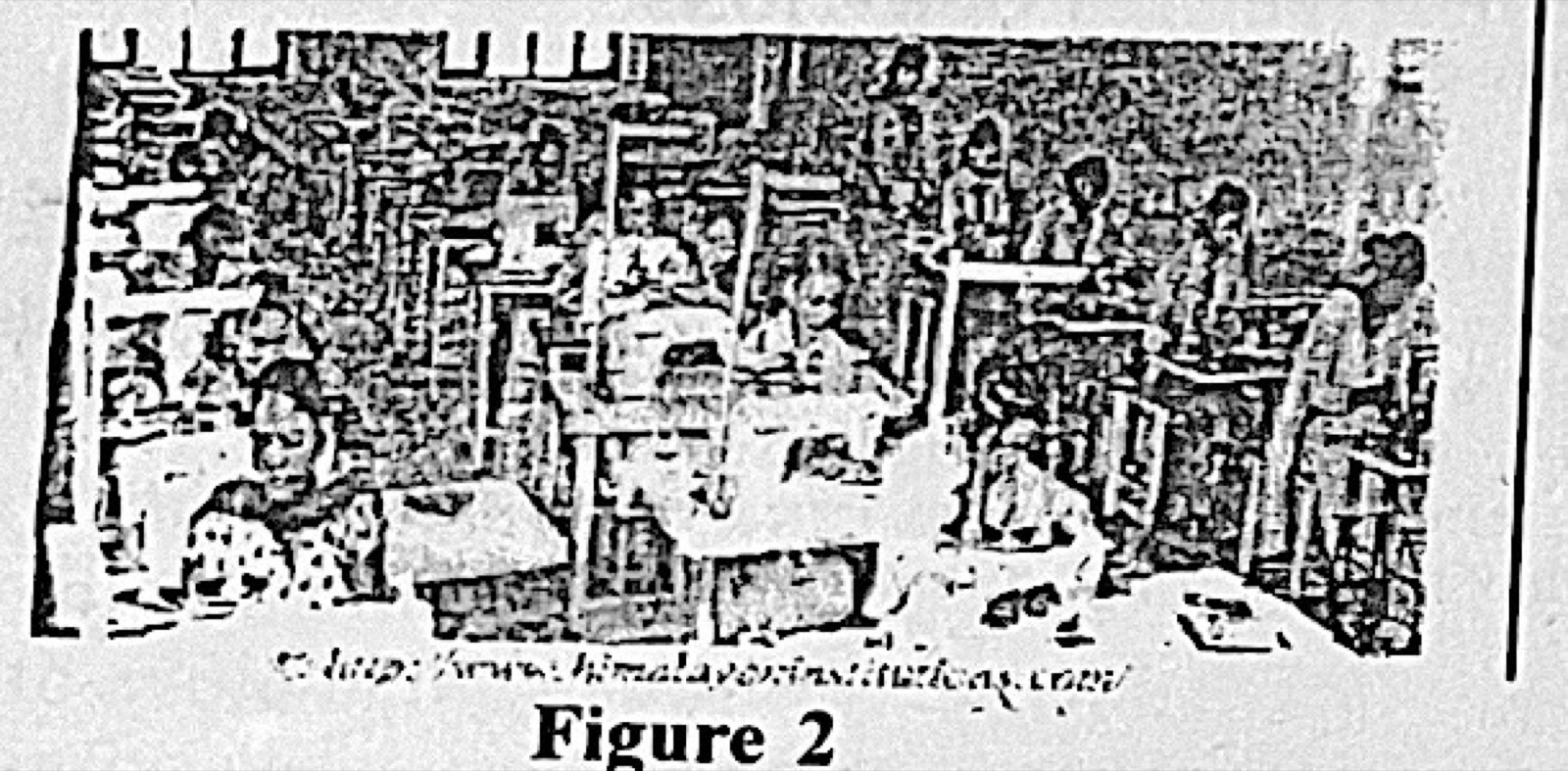
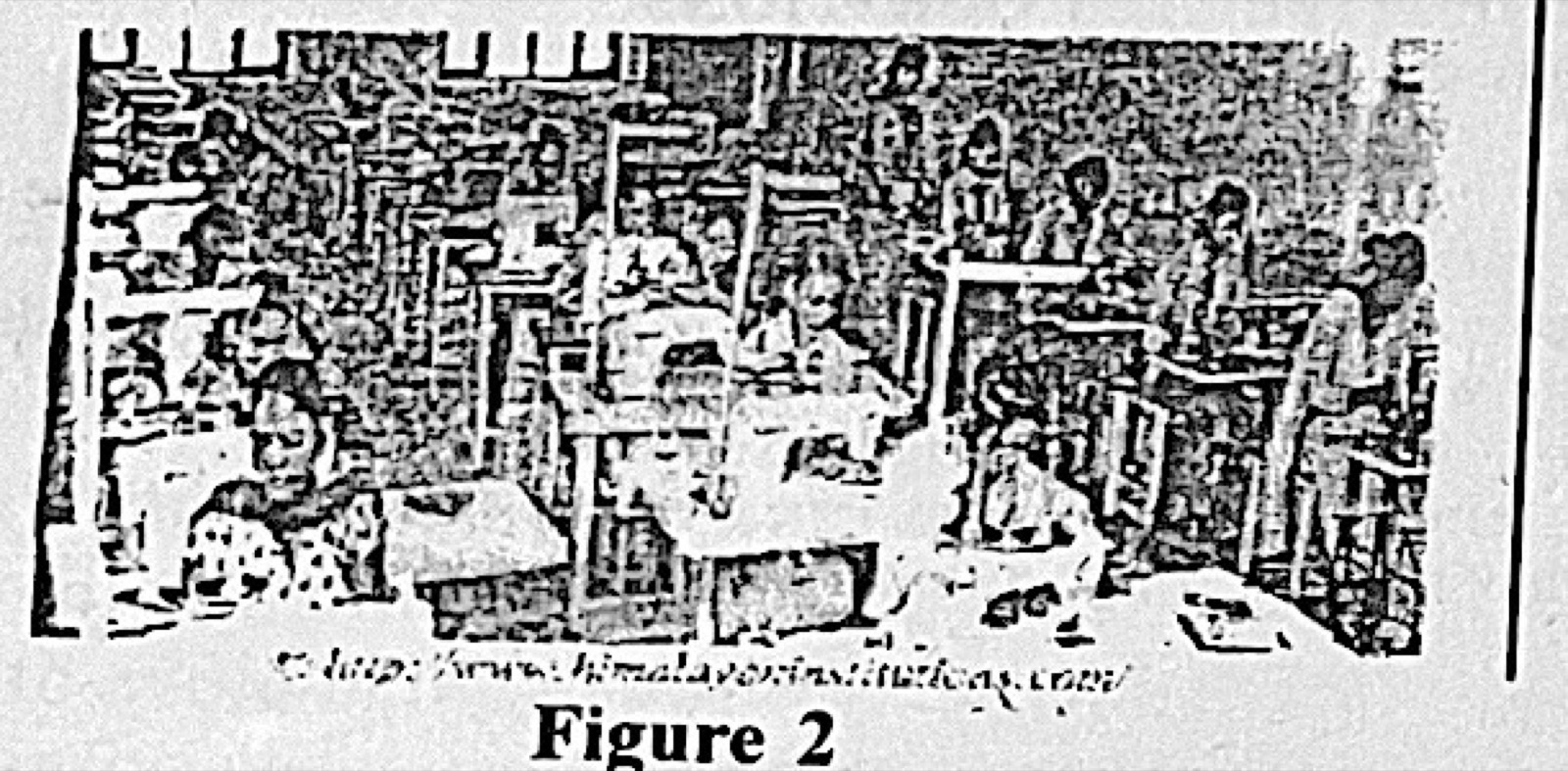
The people depicted in the image in Figure 2 are engaged in

Diagram for this question
  1. A.community service.
  2. B.personal development.
  3. C.empowerment scheme.
  4. D.fashion design competition.
Show the answer and explanation

Answer: C (empowerment scheme.)

Explanation

The picture shows trainees learning a trade (sewing) in a skills empowerment centre.

Open this question

Question 29

Youth Empowerment

The aim of those engaged in the activity captured in the image in Figure 2 is to

Diagram for this question
  1. A.obtain relevant skills.
  2. B.acquire formal knowledge.
  3. C.source for extra income.
  4. D.develop interpersonal skills.
Show the answer and explanation

Answer: A (obtain relevant skills.)

Explanation

Trainees in an empowerment scheme aim to acquire skills.

Open this question

Question 30

Youth Empowerment

Which type of skill is dominant in the image in Figure 2?

Diagram for this question
  1. A.Manipulative skill
  2. B.Intellectual skill
  3. C.Negotiation skill
  4. D.Communicative skill.
Show the answer and explanation

Answer: A (Manipulative skill)

Explanation

Sewing and similar crafts use the hands: manipulative skills.

Open this question

Question 31

Citizenship and Citizenship Education

Citizenship education ensures that citizens become aware of

  1. A.tenets of the laws of the society.
  2. B.attributes required to become a leader.
  3. C.how to restore peace during conflict.
  4. D.justice and injustice during litigation.
Show the answer and explanation

Answer: A (tenets of the laws of the society.)

Explanation

Citizenship education teaches citizens the laws, rights and duties of their society.

Open this question

Question 32

Cultism

Cultism is usually not associated with

  1. A.rustication.
  2. B.academic excellence.
  3. C.stigmatization.
  4. D.spiritual problems.
Show the answer and explanation

Answer: B (academic excellence.)

Explanation

Cult members usually perform poorly in school.

Open this question

Question 33

Democracy and Elections

The programmes political parties intend to implement if they are voted into power are known as political

  1. A.campaigns.
  2. B.manifestoes.
  3. C.agenda.
  4. D.propaganda.
Show the answer and explanation

Answer: B (manifestoes.)

Explanation

A party's manifesto states its programmes.

Open this question

Question 34

Political Apathy and Popular Participation
WASSCE 2021: Mr. Ganaba and Mr. Katoun
Mr. Ganaba: Mr Katoun, where are you going with hoe and cutlass on a day that has been set aside for the rescheduled gubernatorial election in our state?
Mr. Katoun: I am going to the farm to harvest some tubers of yam for the next market day. I don't need to remind you that we have been made our own government. Therefore, the sale of this product is much more beneficial to me and my family than whoever becomes the next governor.

From the dialogue above, Mr. Katoun has demonstrated

  1. A.survival mode.
  2. B.intolerance.
  3. C.apathy.
  4. D.hard work.
Show the answer and explanation

Answer: C (apathy.)

Explanation

He goes to his farm instead of voting: political apathy.

Open this question

Question 35

Political Apathy and Popular Participation

As seen in the dialogue above, Mr. Ganaba is involved in an essential community service as

  1. A.a social mobilizer.
  2. B.a political analyst.
  3. C.an election observer.
  4. D.a party official.
Show the answer and explanation

Answer: A (a social mobilizer.)

Explanation

He is encouraging Katoun to go and vote: social mobilisation.

Open this question

Question 36

Political Apathy and Popular Participation

The behaviour of Mr. Katoun in the dialogue above can be traced to the following factors except

  1. A.inadequate security at polling booths.
  2. B.poor technology.
  3. C.unfulfilled manifestoes.
  4. D.existence of endemic corruption.
Show the answer and explanation

Answer: B (poor technology.)

Explanation

Insecurity, broken promises and corruption cause apathy; poor technology is not a usual reason.

Open this question

Question 37

The Constitution and Constitutional Democracy

The constitutions of the Federal Republic of Nigeria from 1979 to 1999 have all been

  1. A.written and rigid.
  2. B.written and flexible.
  3. C.unwritten and rigid.
  4. D.unwritten and flexible.
Show the answer and explanation

Answer: A (written and rigid.)

Explanation

Nigeria's constitutions are written documents that need special majorities to amend, so they are rigid.

Open this question

Question 38

Public Service

An established way Labour Unions protect the interest of workers is

  1. A.police action.
  2. B.hunger strike.
  3. C.industrial action.
  4. D.mass resignation.
Show the answer and explanation

Answer: C (industrial action.)

Explanation

Unions use strikes and other industrial action.

Open this question

Question 39

Human Rights

The right to vie for public office falls under

  1. A.economic rights.
  2. B.political rights.
  3. C.social rights.
  4. D.religious rights.
Show the answer and explanation

Answer: B (political rights.)

Explanation

Contesting elections is a political right.

Open this question

Question 40

Democracy and Elections

A system of government where the ultimate power resides in the people is

  1. A.plutocracy.
  2. B.aristocracy.
  3. C.theocracy.
  4. D.democracy.
Show the answer and explanation

Answer: D (democracy.)

Explanation

In democracy power belongs to the people.

Open this question

Question 41

Political Apathy and Popular Participation

Politically enlightened people may still feel discouraged in the political affairs of their society because of political

  1. A.selflessness.
  2. B.contentment.
  3. C.participation.
  4. D.marginalization.
Show the answer and explanation

Answer: D (marginalization.)

Explanation

Being shut out (marginalised) discourages even informed citizens.

Open this question

Question 42

Structure and Organs of Government

Supervisory Councillors at the local government level are part of the

  1. A.civil servants.
  2. B.executive organ.
  3. C.legislative organ.
  4. D.judicial organ.
Show the answer and explanation

Answer: B (executive organ.)

Explanation

Supervisory councillors are appointed by the chairman to head departments, so they are part of the executive.

Open this question

Question 43

The Constitution and Constitutional Democracy

Constitutional provisions cannot be derived from

  1. A.statutory sources.
  2. B.customary sources.
  3. C.judicial precedents.
  4. D.colonial policies.
Show the answer and explanation

Answer: D (colonial policies.)

Explanation

Sources of a constitution include statutes, customs and judicial decisions, not colonial policies.

Open this question

Question 44

Political Apathy and Popular Participation

Political participation is facilitated by the following reasons except

  1. A.engaging in moral upliftment.
  2. B.fostering of political stability.
  3. C.enhancement of dividends of democracy.
  4. D.influencing the direction of government policies.
Show the answer and explanation

Answer: A (engaging in moral upliftment.)

Explanation

Moral upliftment is not a political reason for participation.

Open this question

Question 45

Public Service

Which of these societal values is most expected of every public office holder?

  1. A.Excellence
  2. B.Accountability
  3. C.Hospitality
  4. D.Diplomacy
Show the answer and explanation

Answer: B (Accountability)

Explanation

Public office holders must answer for their use of public power and funds.

Open this question

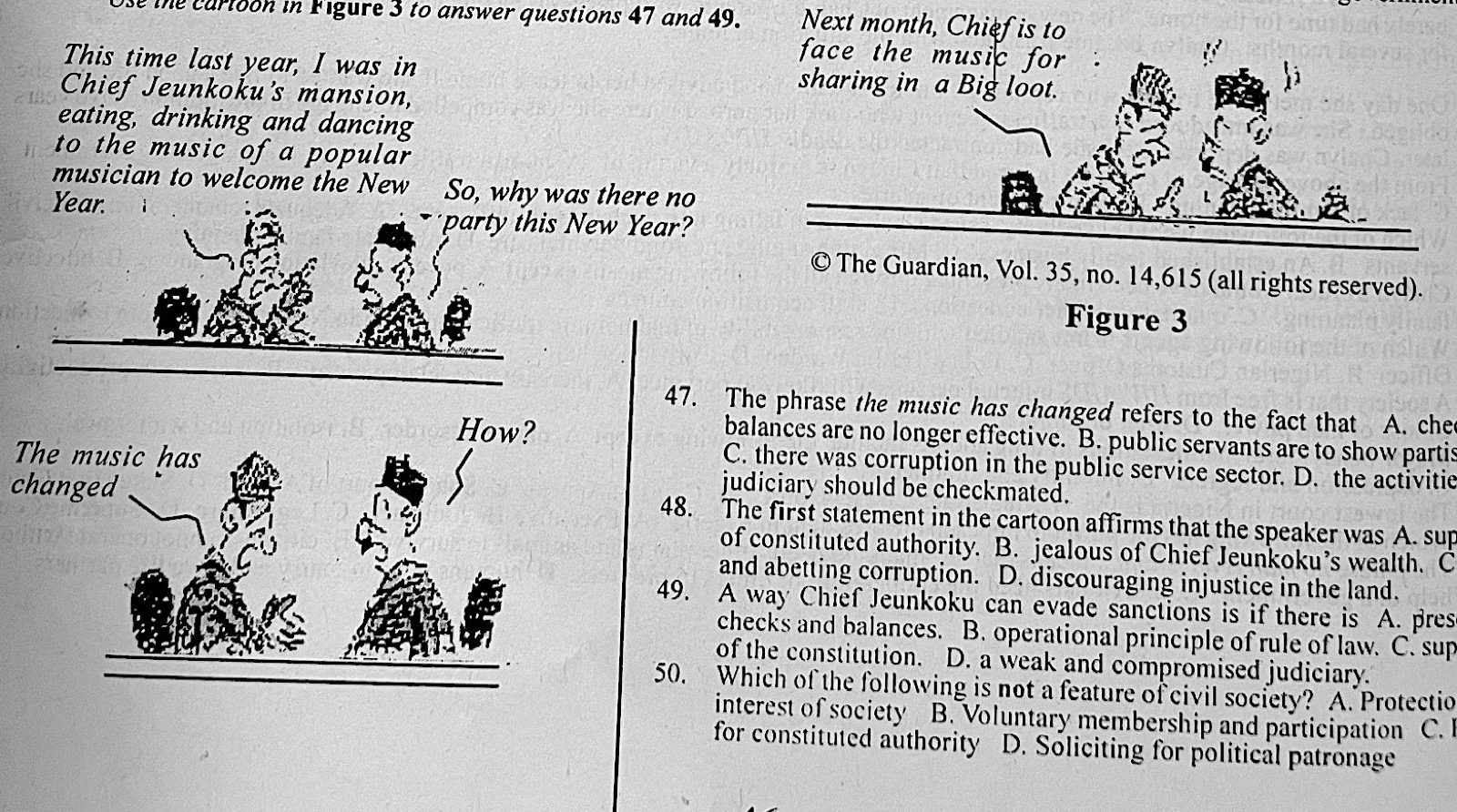
Question 47

Rule of Law and Constituted Authority

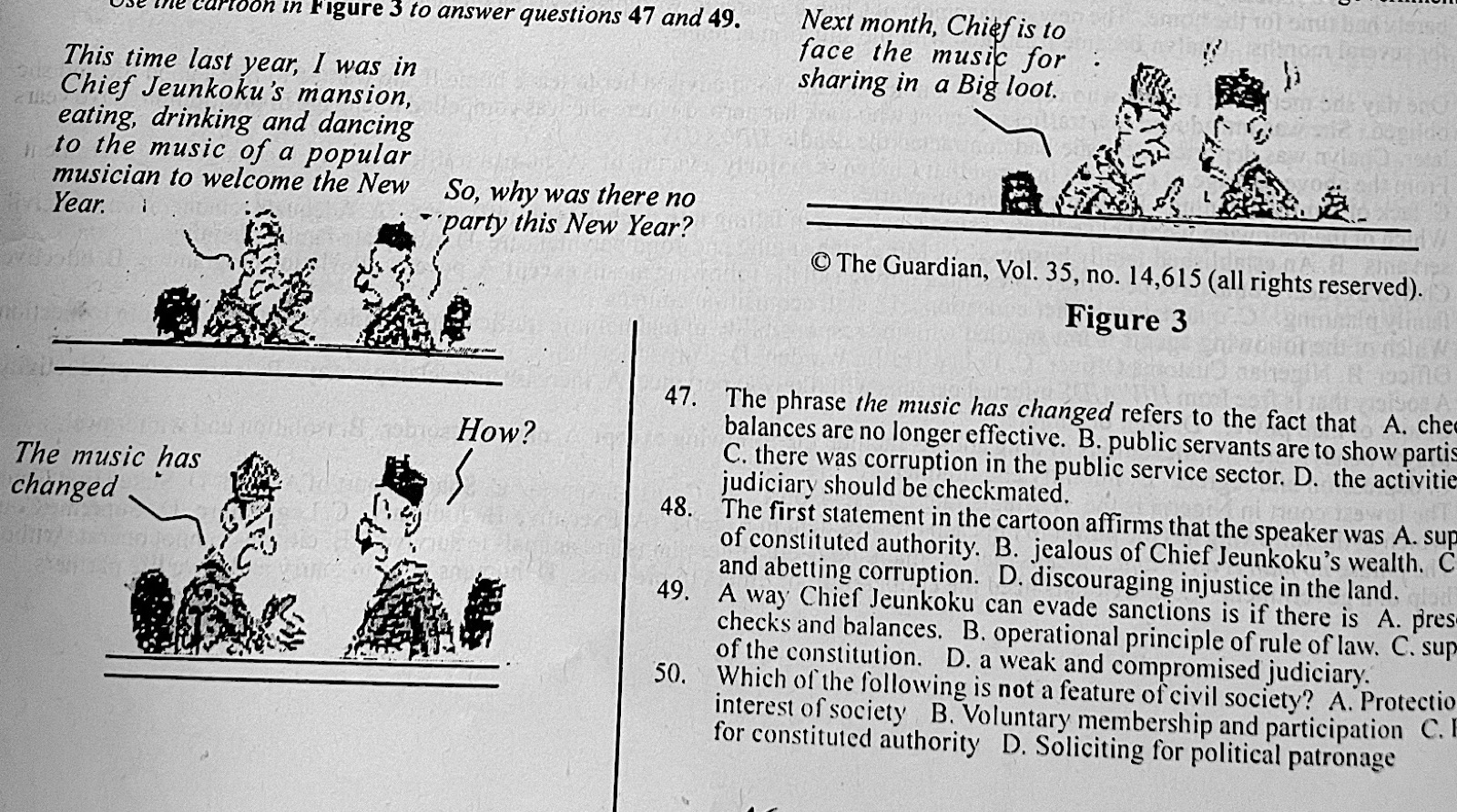
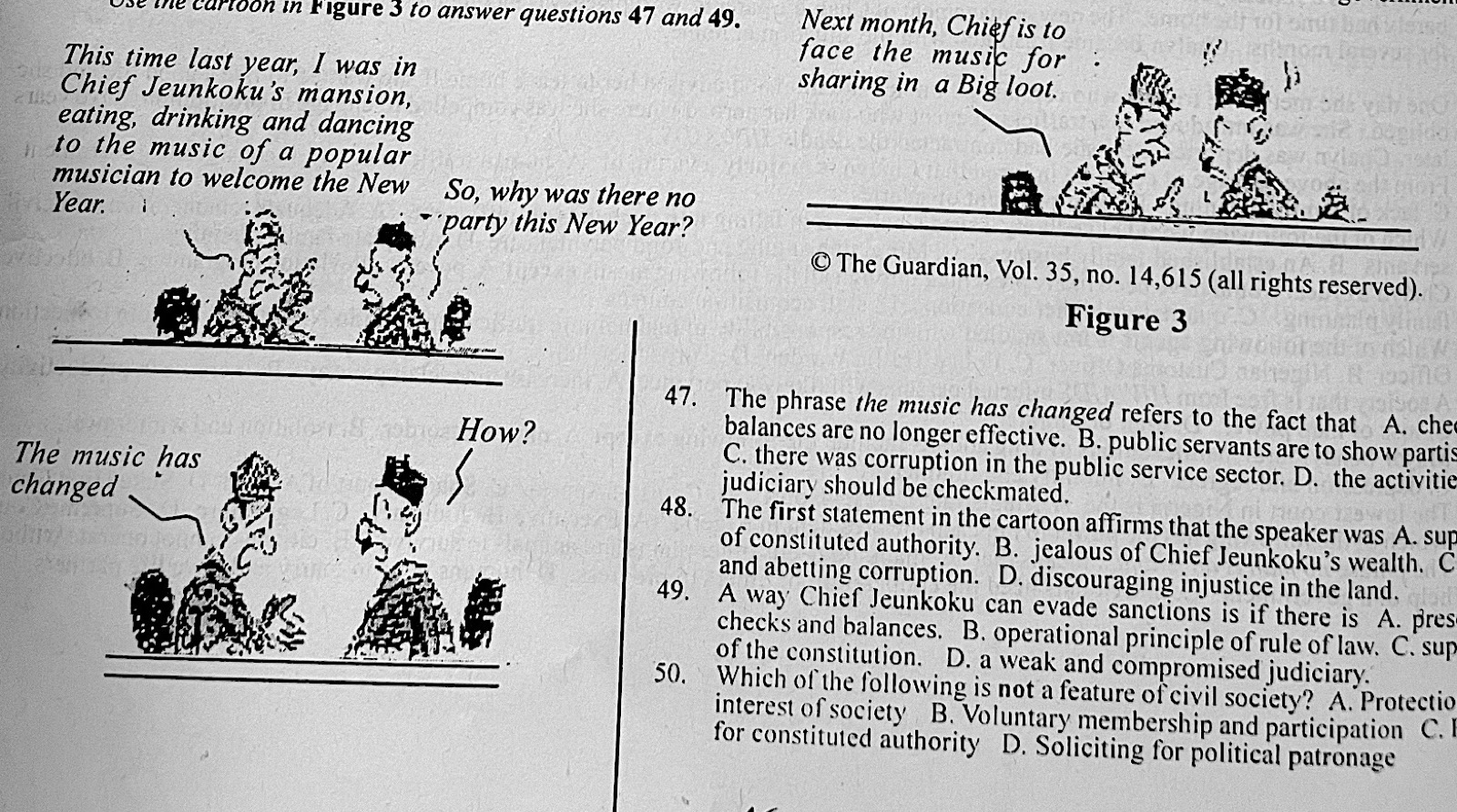
The phrase the music has changed refers to the fact that

Diagram for this question
  1. A.checks and balances are no longer effective.
  2. B.public servants are to show partisanship.
  3. C.there was corruption in the public service sector.
  4. D.the activities of the judiciary should be checkmated.
Show the answer and explanation

Answer: C (there was corruption in the public service sector.)

Explanation

Chief Jeunkoku is to face trial for sharing in a big loot, showing there was corruption in public service.

Open this question

Question 48

Rule of Law and Constituted Authority

The first statement in the cartoon affirms that the speaker was

Diagram for this question
  1. A.supportive of constituted authority.
  2. B.jealous of Chief Jeunkoku's wealth.
  3. C.aiding and abetting corruption.
  4. D.discouraging injustice in the land.
Show the answer and explanation

Answer: C (aiding and abetting corruption.)

Explanation

He enjoyed the parties funded by the Chief's loot, so he shared in the corruption.

Open this question

Question 49

Rule of Law and Constituted Authority

A way Chief Jeunkoku can evade sanctions is if there is

Diagram for this question
  1. A.presence of checks and balances.
  2. B.operational principle of rule of law.
  3. C.supremacy of the constitution.
  4. D.a weak and compromised judiciary.
Show the answer and explanation

Answer: D (a weak and compromised judiciary.)

Explanation

A weak, corrupt judiciary lets offenders escape justice.

Open this question

Question 50

Civil Society

Which of the following is not a feature of civil society?

  1. A.Protection of the interest of society
  2. B.Voluntary membership and participation
  3. C.Respect for constituted authority
  4. D.Soliciting for political patronage
Show the answer and explanation

Answer: D (Soliciting for political patronage)

Explanation

Civil society is independent; it does not seek political patronage.

Open this question

Theory question 101

National Values

Section A: National Ethics, Discipline, Rights and Obligations
(a) What are values?
(b) Elucidate six reasons why integrity is the foundation of any functional society in the world.

Show the model answer
Model answer

(a) Values are the beliefs, principles and standards of behaviour a society considers good and worth upholding, passed from generation to generation.
(b) Any six, explained:
Builds trust among people and in institutions.
Reduces corruption and fraud.
Produces responsible, credible leaders.
Promotes accountability and transparency.
Improves the image of individuals and the nation, attracting investment.
Promotes peace and unity.
Encourages hard work and quality service.
Ensures fair play and respect for others' rights.

Explanation

Define, then explain six reasons.

Open this question

Theory question 102

Human Rights

Section A: National Ethics, Discipline, Rights and Obligations
(a) Summarize the seven core freedoms as established in the Charter of the Universal Declaration of Human Rights (UDHR).
(b) In what four ways can individuals and groups contribute to the upholding of the vision and mission of the Universal Declaration of Human Rights (UDHR)?

Show the model answer
Model answer

(a) Any seven:
Right to life, liberty and security of person.
Freedom from slavery and servitude.
Freedom from torture and degrading treatment.
Equality before the law / freedom from discrimination.
Freedom of movement and residence.
Freedom of thought, conscience and religion.
Freedom of opinion and expression.
Freedom of peaceful assembly and association.
Right to fair trial.
(b) Any four:
Knowing and respecting the rights of others.
Reporting human rights abuses.
Forming or joining human rights groups.
Educating others about the UDHR.
Giving legal or financial help to victims.
Taking part in politics to elect leaders who respect rights.

Explanation

Seven freedoms, four contributions.

Open this question

Theory question 103

Traffic Regulations

Section A: National Ethics, Discipline, Rights and Obligations
(a) Identify five reasons road accidents in Nigeria could be seen as consequences of humans' negligence.
(b) Highlight five explicit roles of government in mandating Nigerians to maintain traffic regulation.

Show the model answer
Model answer

(a) Any five: over-speeding; overloading; driving unroadworthy vehicles; drunk driving/drug use; using phones or eating while driving; disobeying traffic signs and lights; driving while tired; not using seat belts or helmets; unlicensed/underage drivers; reckless overtaking.
(b) Any five: enacting and enforcing traffic laws; establishing and equipping FRSC, VIO and traffic police; providing good roads, signs and traffic lights; licensing only qualified drivers; inspecting vehicles; punishing offenders; public road safety campaigns; including road safety in school curricula; installing speed-check cameras.

Explanation

Human-caused reasons in (a); government actions in (b).

Open this question

Theory question 104

Cultism

Section B: Emerging Issues in the Society
(a) Define a secret cult group.
(b) Explain four ways Civic Education can help eradicate involvement in cult activities in the society.

Show the model answer
Model answer

(a) A secret cult group is an organisation whose membership, rituals and activities are kept secret from the public, often bound by oaths and marked by violence, and contrary to the norms of society.
(b) Any four, explained:
Creates awareness of the dangers of cultism.
Instils right values and attitudes.
Teaches students to resist peer pressure.
Teaches the laws and penalties against cultism.
Encourages good citizenship and healthy activities.
Promotes respect for constituted authority.

Explanation

Define, then four explained ways.

Open this question

Theory question 105

HIV/AIDS

Section B: Emerging Issues in the Society
(a) Outline five physical manifestations a person with Human Immunodeficiency Virus/Acquired Immune Deficiency Syndrome (HIV/AIDS) is bound to exhibit.
(b) Highlight five socio-economic effects of Human Immunodeficiency Virus/Acquired Immune Deficiency Syndrome (HIV/AIDS) on the carrier.

Show the model answer
Model answer

(a) Any five: rapid weight loss; persistent fever; chronic diarrhoea; persistent cough; skin rashes and sores; night sweats; oral thrush; swollen glands; extreme tiredness.
(b) Any five: loss of job/income; high cost of treatment and poverty; stigmatisation and discrimination; isolation from family and friends; reduced productivity; inability to continue education; early death leaving dependants.

Explanation

Physical signs in (a); social and economic effects in (b).

Open this question

Theory question 106

Youth Empowerment

Section B: Emerging Issues in the Society
(a) Define youth empowerment.
(b) Outline six youth empowerment skills.

Show the model answer
Model answer

(a) Youth empowerment is the process of giving young people skills, knowledge, resources and opportunities to become self-reliant and useful to society.
(b) Any six: tailoring/fashion design; ICT/computer skills; hairdressing and barbing; carpentry; welding and fabrication; agriculture/poultry; catering and baking; photography; electrical installation; auto mechanics; shoe and bag making; soap making.

Explanation

Define, then six skills.

Open this question

Theory question 107

Democracy and Elections

Section C: Governmental System and Processes
(a) Explain any three pillars of democracy from the list below: (i) independent judiciary; (ii) the military; (iii) political parties; (iv) Civil Society Organizations; (v) free and independent press.
(b) Highlight three reasons why competition for political power among politicians is fierce in Nigeria.

Show the model answer
Model answer

(a) Any three explained:
Independent judiciary: interprets laws without interference, protects rights and checks other arms.
The military: defends the country and constitution under civilian control and stays out of politics.
Political parties: offer candidates and programmes, give voters choice, form government and opposition.
Civil society organisations: educate citizens, defend rights and monitor government.
Free press: informs the public and exposes abuse of power.
(b) Any three: political office brings wealth and control of resources (politics seen as business); weak institutions and immunity; ethnic and religious rivalry; poverty and unemployment make office attractive; 'winner takes all' politics; godfatherism.

Explanation

Explain three pillars; three reasons.

Open this question

Theory question 108

Political Apathy and Popular Participation

Section C: Governmental System and Processes
(a) Define modern mode of popular participation.
(b) Explain six ways popular participation can facilitate the advancement of a developing society.

Show the model answer
Model answer

(a) Modern popular participation is the involvement of citizens in politics and governance through current means such as voting, party membership, contesting elections, social media, petitions, civil society groups and peaceful protests.
(b) Any six, explained:
Election of competent leaders.
Accountability of leaders.
Policies reflect people's needs.
Legitimacy and political stability.
Protection of rights.
Political awareness of citizens.
Sense of belonging and national unity.
Community support for development projects.

Explanation

Define, then six ways.

Open this question

Theory question 109

Public Service

Section C: Governmental System and Processes
(a) Itemize five components of the public service in Nigeria.
(b) Advance five reasons for the ineffectiveness and inefficiency of public servants in Nigeria.

Show the model answer
Model answer

(a) Any five: the civil service (ministries and departments); parastatals and agencies; public corporations; local government service; armed forces; police and paramilitary services; judicial service; teaching service in public schools; federal and state service commissions.
(b) Any five: corruption; poor pay and late salaries; political interference; nepotism and tribalism in recruitment; lack of training; poor working tools and environment; red tape; lack of motivation and promotion; overstaffing.
Explanation

Components in (a); reasons in (b).

Open this question