A potted plant was placed in an experimental setup to measure the rate of water loss in plants. The instrument in the experimental setup that would be used to measure the rate of water loss is
A.potometer
B.klinostat
C.photometer
D.hygrometer
Show the answer and explanation
Answer: A (potometer)
Explanation
A potometer measures the rate at which a shoot takes up water, which is used to estimate the rate of transpiration.
A potted plant was placed in an experimental setup to measure the rate of water loss in plants. A structure in the plant that is primarily responsible for water loss is
A.spongy mesophyll
B.root
C.stomata
D.palisade mesophyll
Show the answer and explanation
Answer: C (stomata)
Explanation
Most water vapour leaves the plant through the stomata in the leaves.
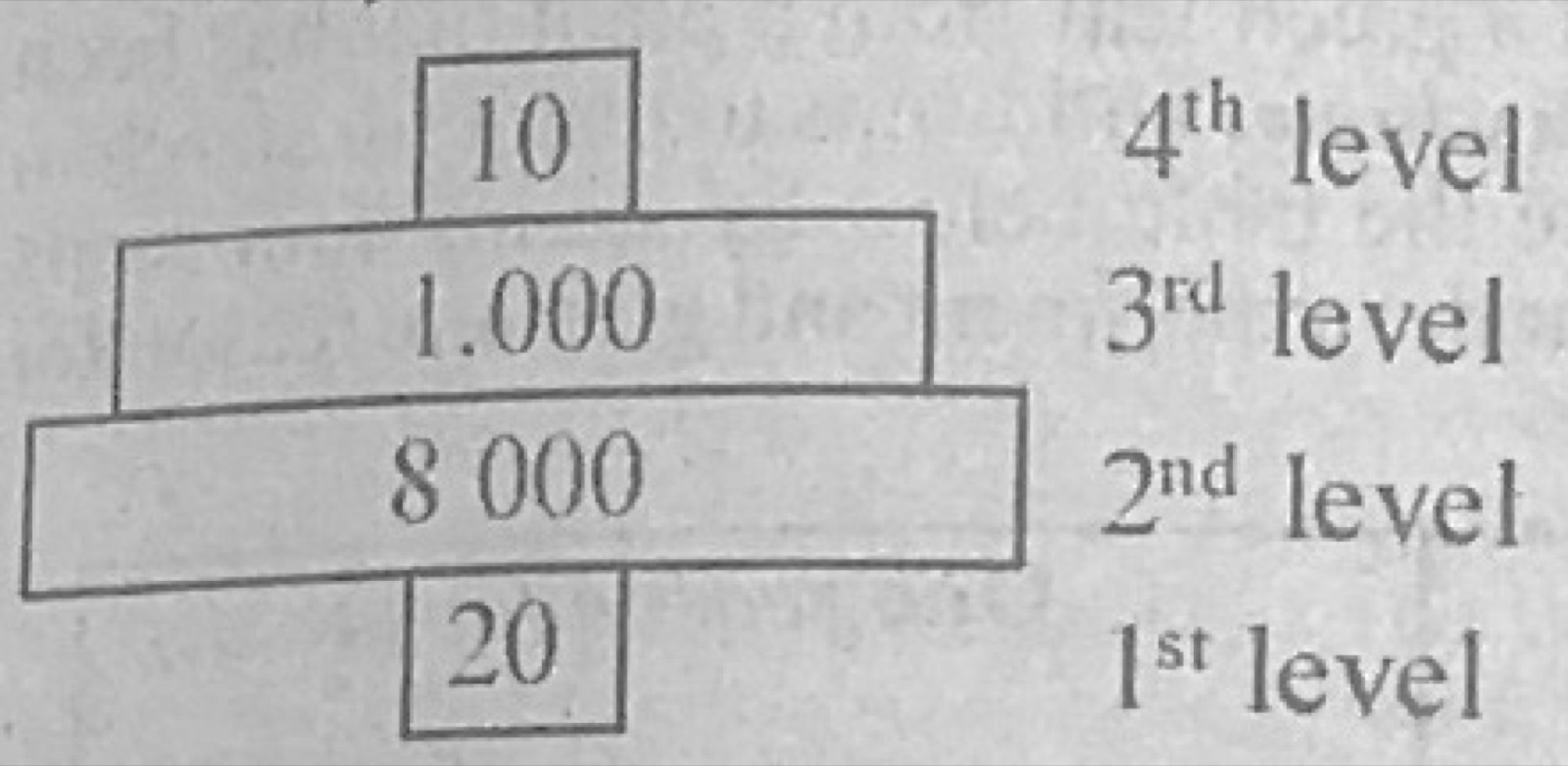
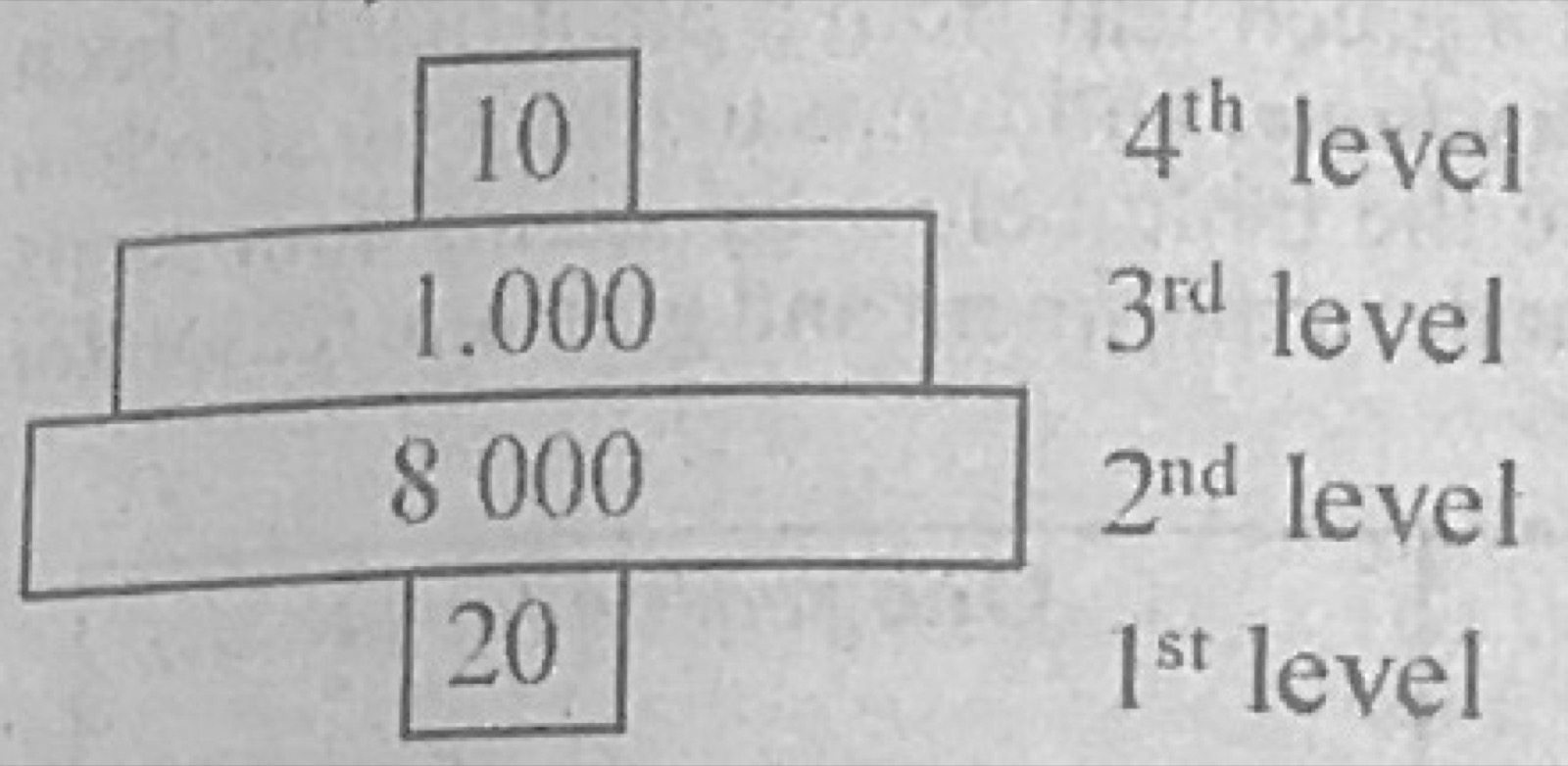
The diagram below is an illustration of an ecological pyramid. 4th level: 10 3rd level: 1,000 2nd level: 8 000 1st level: 20 The illustrated diagram is a pyramid of
A.energy
B.numbers
C.organisms
D.population
Show the answer and explanation
Answer: B (numbers)
Explanation
The values are counts of individuals at each feeding level, and a pyramid of numbers can have a narrow base when the producers are few large trees.
The diagram below is an illustration of an ecological pyramid. 4th level: 10 3rd level: 1,000 2nd level: 8 000 1st level: 20 Organisms that would occupy the first level are
A.grasses
B.trees
C.herbs
D.weeds
Show the answer and explanation
Answer: B (trees)
Explanation
Only 20 producers support 8,000 primary consumers, so each producer must be very large, like a tree.
During an ecological survey, it was observed that the following factors were prevalent in a community with limited resources. I. High birth rate; II. Low mortality; III. High immigration. The likely implication of the factors on the community would be
A.increased food production and reduced disease outbreak
B.reduced competition and reduced population size
C.increased competition and food shortage
D.increased population size and reduced competition
Show the answer and explanation
Answer: C (increased competition and food shortage)
Explanation
All three factors increase the population; with limited resources this leads to more competition and food shortage.
During an ecological survey, it was observed that the following factors were prevalent in a community with limited resources. I. High birth rate; II. Low mortality; III. High immigration. A measure that could be introduced by the government to control the implication of the factors on the community is
A.encourage birth control measures
B.encourage more immigration
C.discourage emigration
D.discourage the use of birth control pills
Show the answer and explanation
Answer: A (encourage birth control measures)
Explanation
Birth control lowers the birth rate and slows population growth; the other options would make the population larger.
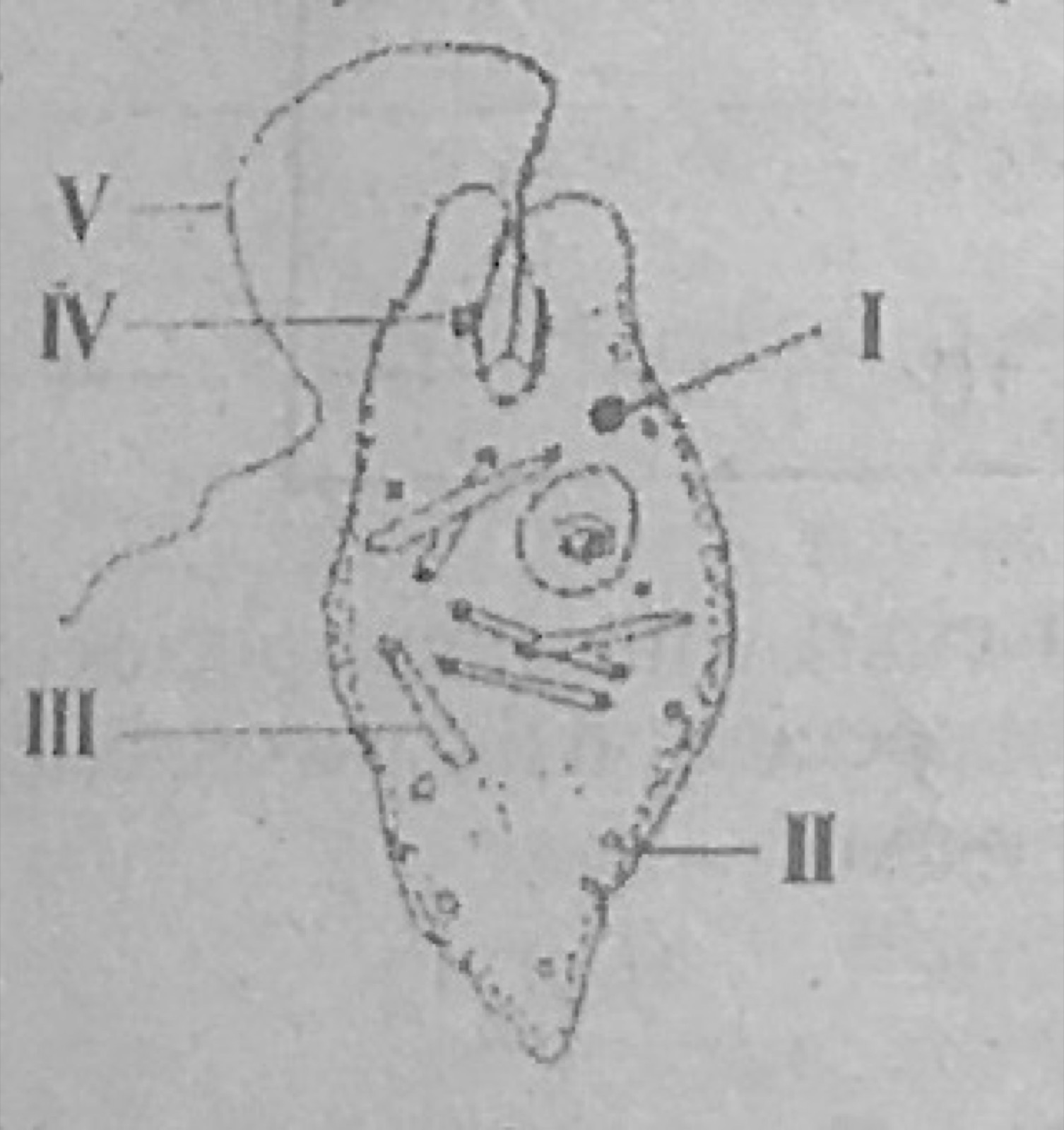
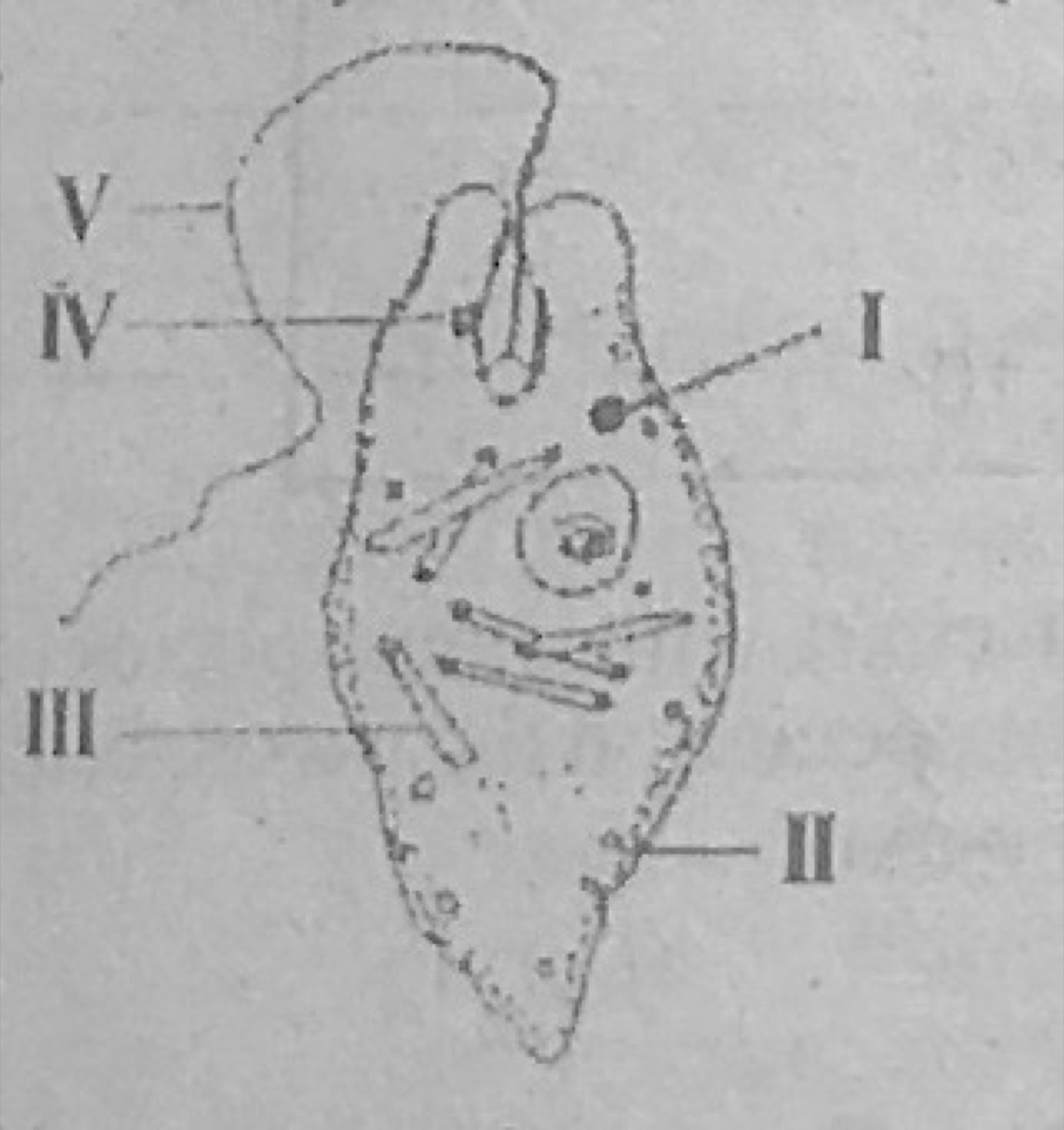
The diagram below is an illustration of a unicellular organism. Which of the labelled parts qualify the organism as an animal?
A.I, II and III
B.II, IV and V
C.III, IV and V
D.I, III and V
Show the answer and explanation
Answer: B (II, IV and V)
Explanation
The organism is Euglena. Its flagellum (V), gullet (IV) and flexible pellicle (II), with no cellulose wall, are animal-like features; the chloroplasts (III) are plant-like.
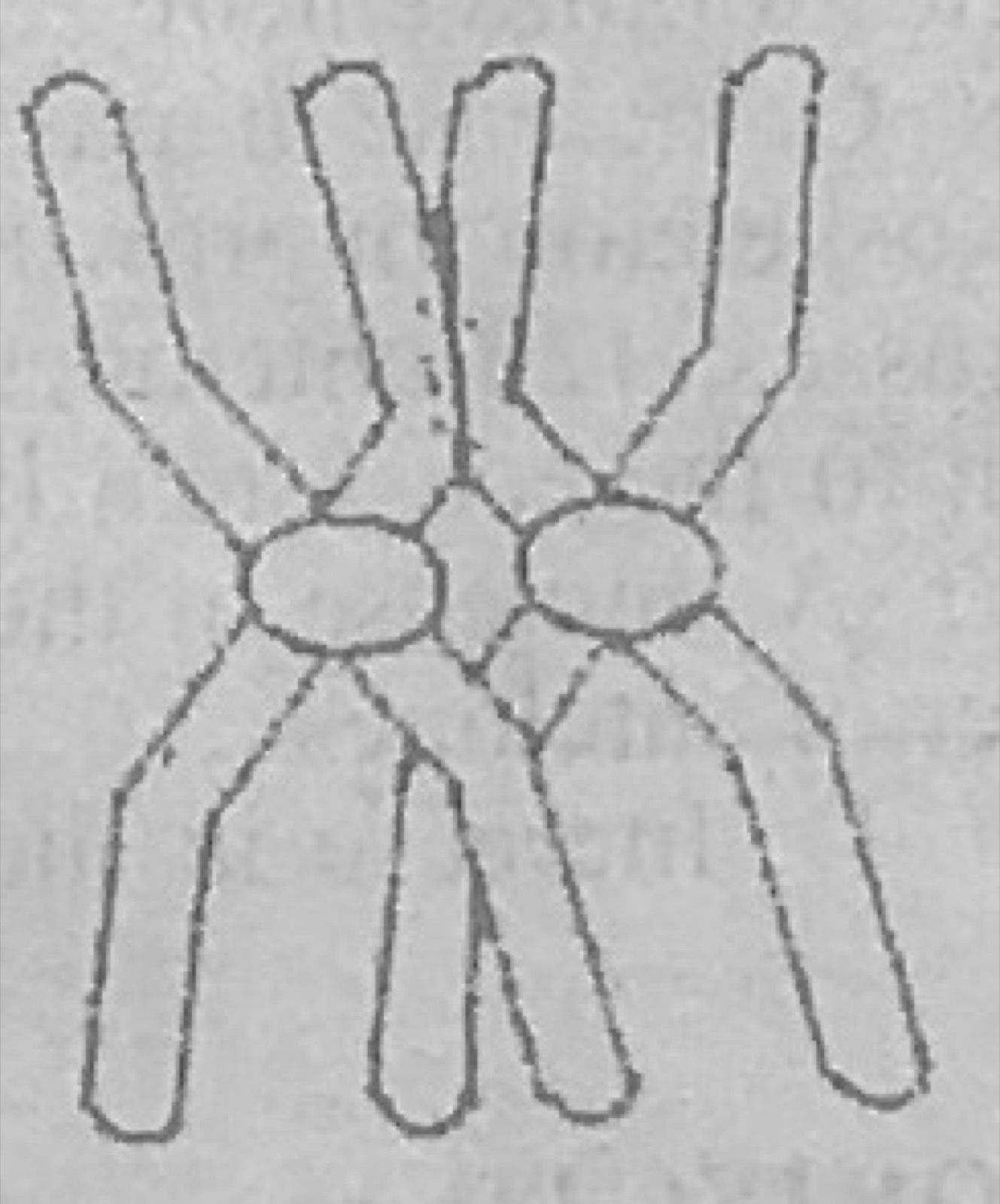
Blood group depends on chemicals in the blood, not on visible structure, so it is a physiological variation; height, leaf shape and hair colour are morphological.
The correct pair of organism with its type of skeleton is
A.grasshopper and endoskeleton
B.earthworm and hydrostatic skeleton
C.rat and exoskeleton
D.spider and endoskeleton
Show the answer and explanation
Answer: B (earthworm and hydrostatic skeleton)
Explanation
An earthworm is supported by fluid under pressure in its body cavity (hydrostatic skeleton). Grasshoppers and spiders have exoskeletons, rats endoskeletons.
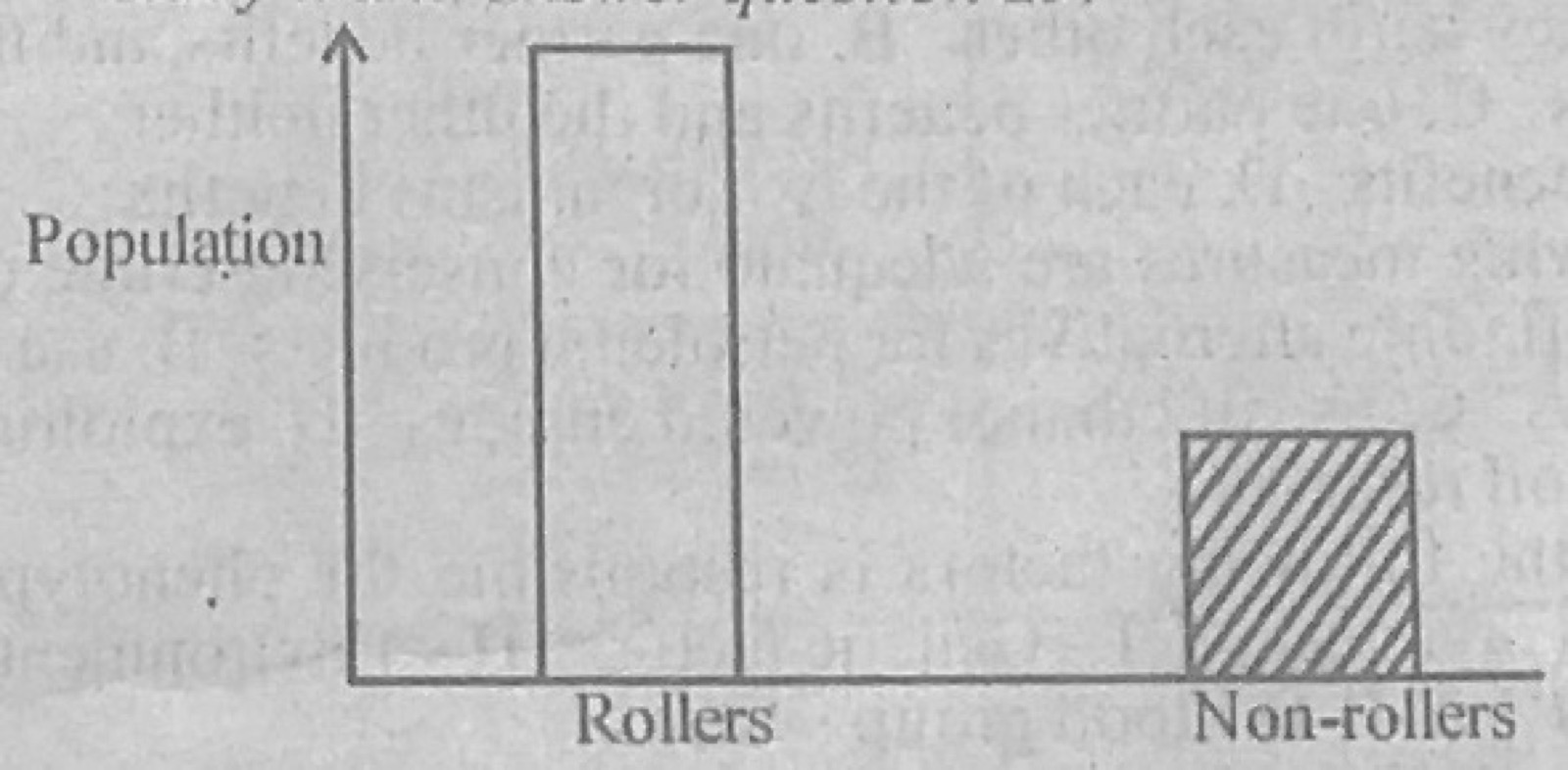
The diagram below is an illustration of the percentage of tongue rollers and non-tongue rollers in a human population. The type of variation in the illustrated diagram is
A.adaptive
B.continuous
C.discontinuous
D.environmental
Show the answer and explanation
Answer: C (discontinuous)
Explanation
People are either rollers or non-rollers, with no in-between groups, so the variation is discontinuous.
A teacher made a drawing of the brain and asked students to label the part responsible for regulation of heartbeat and respiration. The part that should be labelled is
A.cerebrum
B.cerebellum
C.olfactory lobe
D.medulla oblongata
Show the answer and explanation
Answer: D (medulla oblongata)
Explanation
The medulla oblongata controls involuntary actions such as heartbeat and breathing.
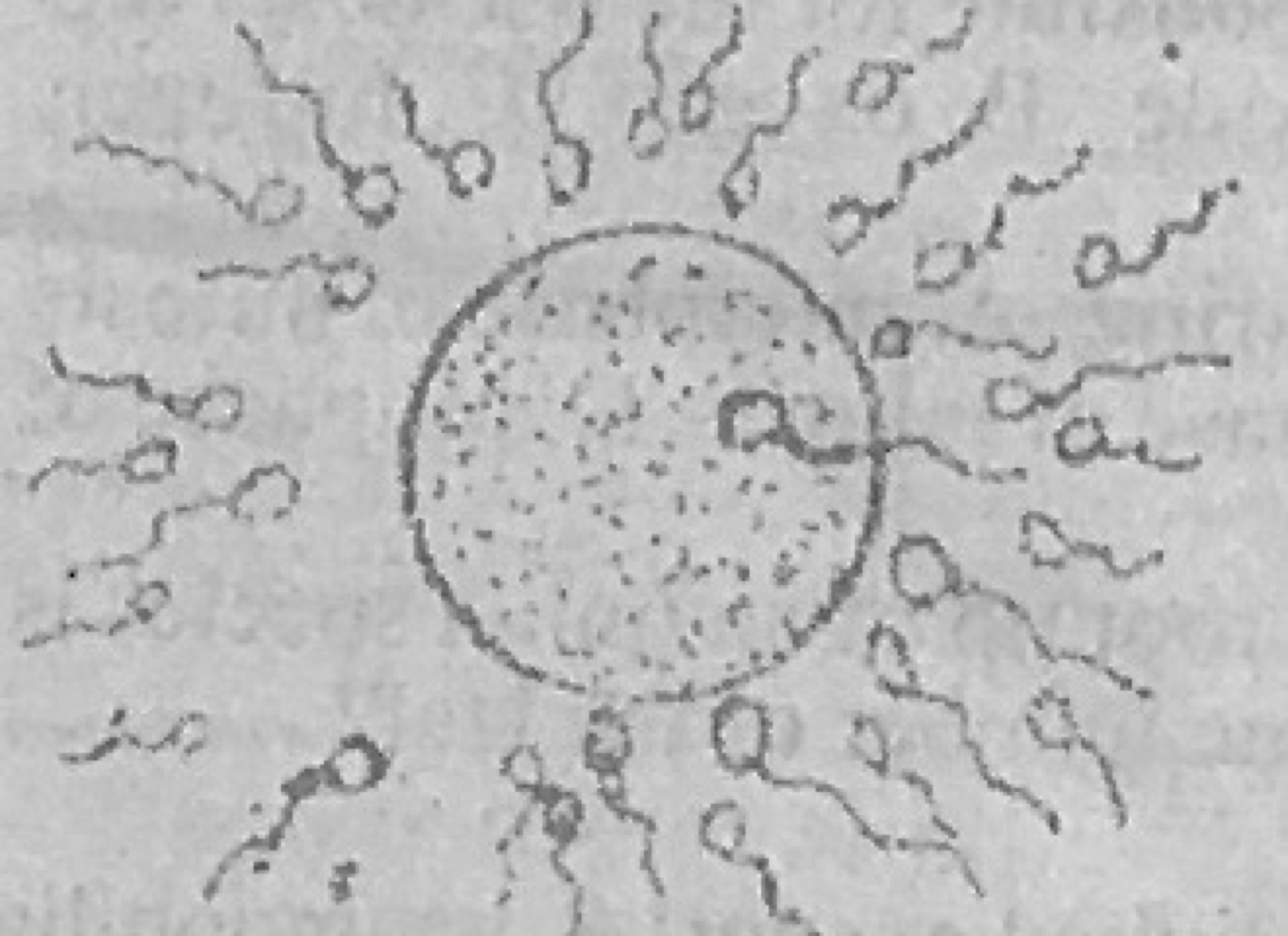
The diagram below is an illustration of a biological process that occurs in the body of a mature female mammal. The process illustrated in the diagram is
A.conjugation
B.fertilization
C.ovulation
D.implantation
Show the answer and explanation
Answer: B (fertilization)
Explanation
Many sperms surround an ovum, one of which is entering it: this is fertilisation.
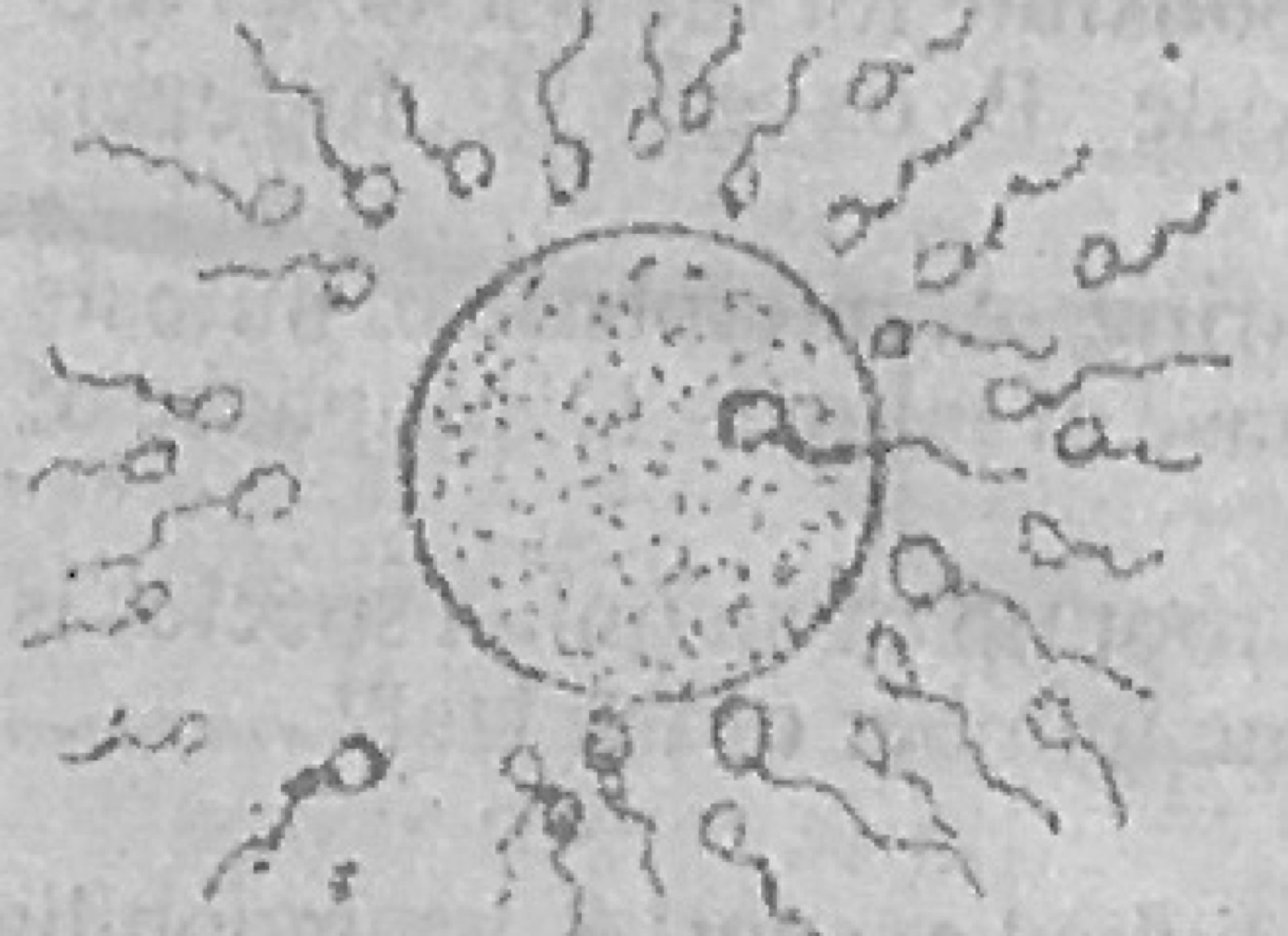
The diagram below is an illustration of a biological process that occurs in the body of a mature female mammal. The product resulting from the illustrated process will
A.undergo mitotic division
B.undergo meiotic division
C.undergo a continuous reduction in size
D.be expelled from tne body immediately
Show the answer and explanation
Answer: A (undergo mitotic division)
Explanation
Fertilisation forms a zygote, which divides repeatedly by mitosis to form the embryo.
Which of the following factors is responsible for phenotypic variation in organisms? I - Genetic factors; II - Environmental factors; III - A-B-O blood group system
A.I only
B.II only
C.I and II only
D.I, II and III
Show the answer and explanation
Answer: C (I and II only)
Explanation
Phenotype results from genes acting together with the environment. The ABO blood group system is itself a trait, not a cause of variation.
An ecosystem comprises abundance of grasses, 120 antelopes and 20 hyenas. What would likely happen to the ecosystem if 15 of the hyenas were killed by a disease?
A.Increase in the population of grasses
B.Increase in number of antelopes
C.Decrease in the number of antelopes
D.Increase in the number of hyenas
Show the answer and explanation
Answer: B (Increase in number of antelopes)
Explanation
With fewer predators, fewer antelopes are eaten, so the antelope population rises.
Section A A gardener that cultivates ornamental plants observed a delay in the flowering of the plants on the garden and then introduced bees to encourage a biological interaction between the bees and the plants, and also stimulate flowering. Use the information to answer questions 1(a) to 1(c). (a)(i) Name the biological process resulting from the interaction that led to the flowering of the plants. (ii) Explain briefly the process named in 1(a)(i). (b) Mention two features each in the bees and the plants that encouraged the interaction. (i) Bees (ii) Plants (c) Give one advantage of the plants to the bees. (d) Mention two. (i) essential parts of a hibiscus flower; (ii) non-essential parts of a hibiscus flower. (e) Explain briefly double fertilization in flowering plants. (f) Give two features of the fruit of pride of Barbados that promotes its dispersal. (g) Complete the table below. Table columns: Fruit | Type of placentation Rows: Cowpea; Okra; Pawpaw
Show the model answer
Model answer
(a)(i) Pollination (insect pollination). (ii) Pollination is the transfer of pollen grains from the anther to the stigma of a flower of the same species; bees visiting flowers for nectar carry pollen on their hairy bodies from flower to flower. (b)(i) Bees, any two: hairy body to which pollen sticks; pollen baskets on the hind legs; long proboscis for sucking nectar; good colour vision/sense of smell. (ii) Plants, any two: large, brightly coloured petals; scent; nectar and nectar guides; sticky or rough pollen; sticky stigma inside the flower. (c) Any one: nectar as food (energy); pollen as protein food for larvae; resins/wax materials for the hive. (d)(i) Stamens (androecium) and pistil/carpels (gynoecium). (ii) Sepals (calyx), petals (corolla), epicalyx. (e) The pollen tube carries two male nuclei into the embryo sac. One fuses with the egg cell to form the zygote (which becomes the embryo); the other fuses with the two polar nuclei (or definitive nucleus) to form the triploid endosperm nucleus. Two fusions occur, hence double fertilisation. (f) Any two: the pod is dry and dehiscent; the pod walls dry unevenly and split along two lines (sutures), twisting and throwing the seeds out (explosive mechanism); seeds are small and smooth. (g) Cowpea - marginal; Okra - axile; Pawpaw - parietal.
Explanation
Name the essential parts in (d) as the reproductive organs.
(a) Explain briefly the process of translocation of food in plants. (b) A student obtained a green leaf from a plant that has been exposed to sunlight for sixhours and wants to test it for starch in the laboratory. Complete the table below by stating four steps that would be involved in the experiment and give one reason for each of the steps. Table columns: Foursteps involved in the experiment | Onereason for the step (c) Complete the table below on enzymes Table columns: Enzyme | Organ/gland where enzyme is produced | Site of action | Substrate that enzyme acts on Rows: Ptyalin; Trypsin; Sucrase
Show the model answer
Model answer
(a) Translocation is the movement of manufactured food (mainly sucrose and amino acids) from the leaves where it is made to other parts (growing points, storage organs, fruits) through the phloem sieve tubes, in both directions. (b) 1. Boil the leaf in water for a few minutes - to kill the cells and stop enzyme action, and make the cells permeable. 2. Put the leaf in alcohol (methylated spirit) in a test tube heated in a water bath - to remove the chlorophyll (decolourise the leaf). 3. Dip the leaf in warm water - to soften it, as alcohol makes it brittle. 4. Spread the leaf on a white tile and add iodine solution - a blue-black colour shows starch is present. (c) Ptyalin - salivary glands - mouth - starch (cooked starch) to maltose. Trypsin - pancreas - duodenum (small intestine) - proteins/peptones to polypeptides. Sucrase - wall of small intestine (intestinal glands) - small intestine (ileum) - sucrose to glucose and fructose.
Explanation
Never heat alcohol over a direct flame; use a water bath.
The population of some plant species found in a rainforest is presented on the table below. Plant species | Population of plant species Mahogany | 10 Iroko | 25 Obeche | 15 Hevea sp. | 5 Delonix sp. | 10 Use the information to answer questions 3(a) to 3(c). (a) On the graph below, draw a bar chart with plant species on the x-axis and the population of plant species on the y-axis, using a scale of 2cm to five plants on the y-axis. (b)(i) Identify the most dominant plant species in the habitat. (ii) Name one method of population studies that could be used to collect the data on the table. (c) If the area of the rainforest is 1000m2, calculate the population density of Hevea sp. (d) State four: (i) Ways of conserving endangered species (ii) benefits of conserving forests to humans
Show the model answer
Model answer
(a) A bar chart with a title, labelled axes (plant species on x, population on y), the stated scale (2 cm = 5 plants, so Iroko's bar is 10 cm tall), five separate bars of equal width: Mahogany 10, Iroko 25, Obeche 15, Hevea 5, Delonix 10. (b)(i) Iroko (largest population, 25). (ii) Quadrat method (or line/belt transect, direct counting). (c) Population density = number ÷ area = 5 ÷ 1000 m2 = 0.005 per m2. (d)(i) Any four: protect their habitats in game reserves and national parks; enforce laws against poaching and illegal trade; breed them in captivity (zoos, botanical gardens) and release them; control deforestation and bush burning; public education; seed and gene banks. (ii) Any four: supply timber, fuel wood and other products; give food and medicinal plants; protect the soil from erosion; take in carbon (IV) oxide and give out oxygen (control climate); habitat for wildlife; protect water catchments; tourism and recreation.
Explanation
In the bar chart, keep gaps between the bars and label every axis.
A group of insects living together have each member performing different tasks in the community. (a) Give a term to describe the group of insects with the kind of behaviour. (b) Complete the table below Table columns: Four likely members of the insect community | One role of the member | One structure for performing the role (c) Give two likely examples of the group of insects. (d) State: (i) three advantages of the type of behaviour named in 4(a) to the community. (ii) two methods of communication among the group of insects with the behaviour named in 4(a).
Show the model answer
Model answer
(a) Social insects (social behaviour / division of labour in a caste system). (b) For termites, four of: Queen - lays eggs - very large abdomen/ovaries; King - fertilises the queen - testes/reproductive organs; Workers - build the nest, find food, feed others - strong biting mandibles; Soldiers - defend the colony - large head with powerful mandibles (or nozzle). (For bees: queen - lays eggs - ovaries; drone - mates with queen - reproductive organs; worker - collects nectar and pollen - proboscis and pollen basket; worker as guard - stings - sting.) (c) Any two: termites; honeybees; ants; wasps. (d)(i) Any three: division of labour makes work efficient; better defence against enemies; better food gathering and storage; care of the young; building of protective nests; continuity of the colony. (ii) Any two: chemicals (pheromones); touch/antennae contact; dancing (in bees); sounds/vibrations (head banging in termites).
Explanation
Each member in (b) needs its role and the body part used for it.
Section B (a) Explain briefly the reason why energy flow in an ecosystem is non-cyclic. (b) Make a drawing of a pyramid of energy using the information below. Primary consumer - 1000kJ Tertiary consumer - 200kJ Secondary consumer - 500kJ Producer - 3000 kJ (c) State three differences between pyramid of energy and pyramid of numbers. Table columns: Pyramid of energy | Pyramid of numbers (d) State the: (i) first law of thermodynamics (ii) second law of thermodynamics (e) State three adaptations of a tapeworm to its mode of feeding. (f) Two organisms A and B live in different habitats within a rural area. Organism A possesses gills while organism B possesses lungs for gaseous exchange. (i) Name the habitats of each of organisms A and B (ii) Give two abiotic factors that are unique to the habitats of each of organisms A and B.
Show the model answer
Model answer
(a) Energy enters as sunlight, passes one way from producers to consumers, and at each level some is lost as heat (respiration, movement) and cannot be reused by producers, so it does not cycle back. (b) A pyramid of four stacked bars, widest at the base: Producer 3000 kJ (bottom), Primary consumer 1000 kJ, Secondary consumer 500 kJ, Tertiary consumer 200 kJ (top); bar widths in proportion, each level labelled, with a title. (c) Any three: pyramid of energy is always upright, pyramid of numbers may be inverted; energy pyramid shows energy (kJ) at each level, numbers pyramid shows the count of organisms; energy pyramid takes account of the size of organisms and time, numbers pyramid does not; energy pyramid allows comparison between ecosystems, numbers pyramid does not. (d)(i) Energy can neither be created nor destroyed, but can be changed from one form to another. (ii) In every energy change some energy is lost as heat (unusable energy), so no transfer is 100% efficient. (e) Any three: hooks and suckers on the scolex for attachment to the host's gut; thick cuticle resistant to digestive enzymes; secretes anti-enzymes; no mouth or gut - absorbs digested food over its whole body surface; flat body with large surface area; can respire anaerobically; produces very many eggs. (f)(i) A - aquatic habitat (e.g. pond, stream, river); B - terrestrial habitat (land). (ii) A, any two: turbidity; salinity; dissolved oxygen; water current/waves; depth/pressure of water. B, any two: relative humidity; wind; soil/edaphic factors; topography/altitude; rainfall.
Explanation
In (b) the bars must decrease in width from the producer to the tertiary consumer.