51 questions. Try each one, then open the answer to check yourself and read the explanation.
Question 1
Characteristics and Classification of Living Things
Which of the following statements about living things is correct?
A.Animals respire using carbon (IV) oxide as a raw material
B.Growth in plants is limited after some time
C.Most plants respond to stimulus slowly
D.Higher animals can reproduce asexually
Show the answer and explanation
Answer: C (Most plants respond to stimulus slowly)
Explanation
Plants usually respond to stimuli slowly, by growing towards or away from them. Animals use oxygen (not CO2) in respiration, plant growth is unlimited, and higher animals reproduce sexually.
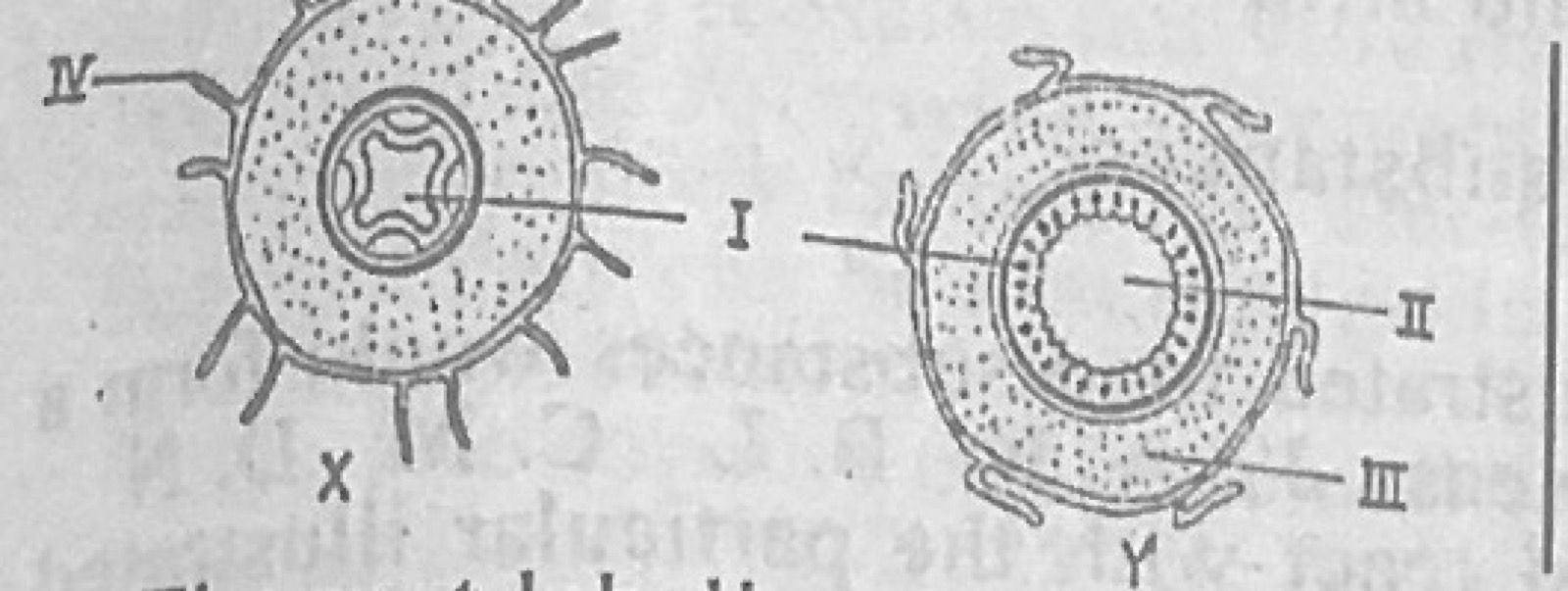
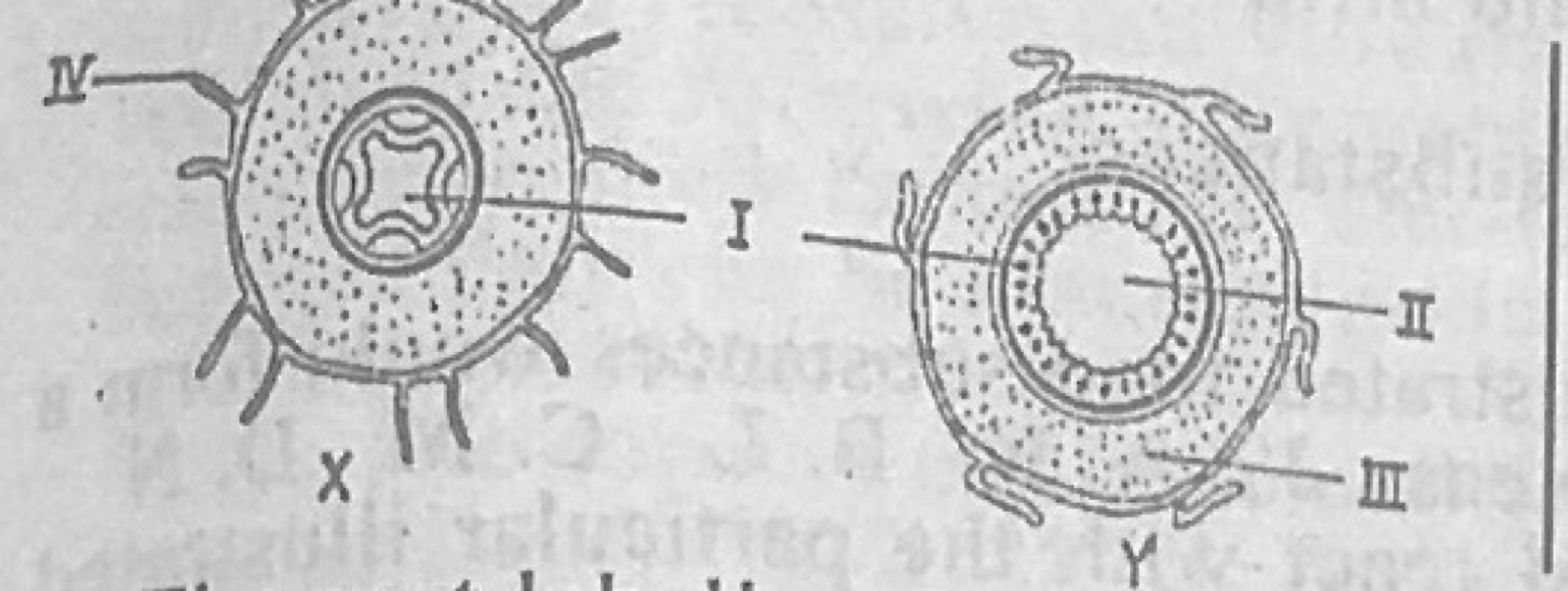
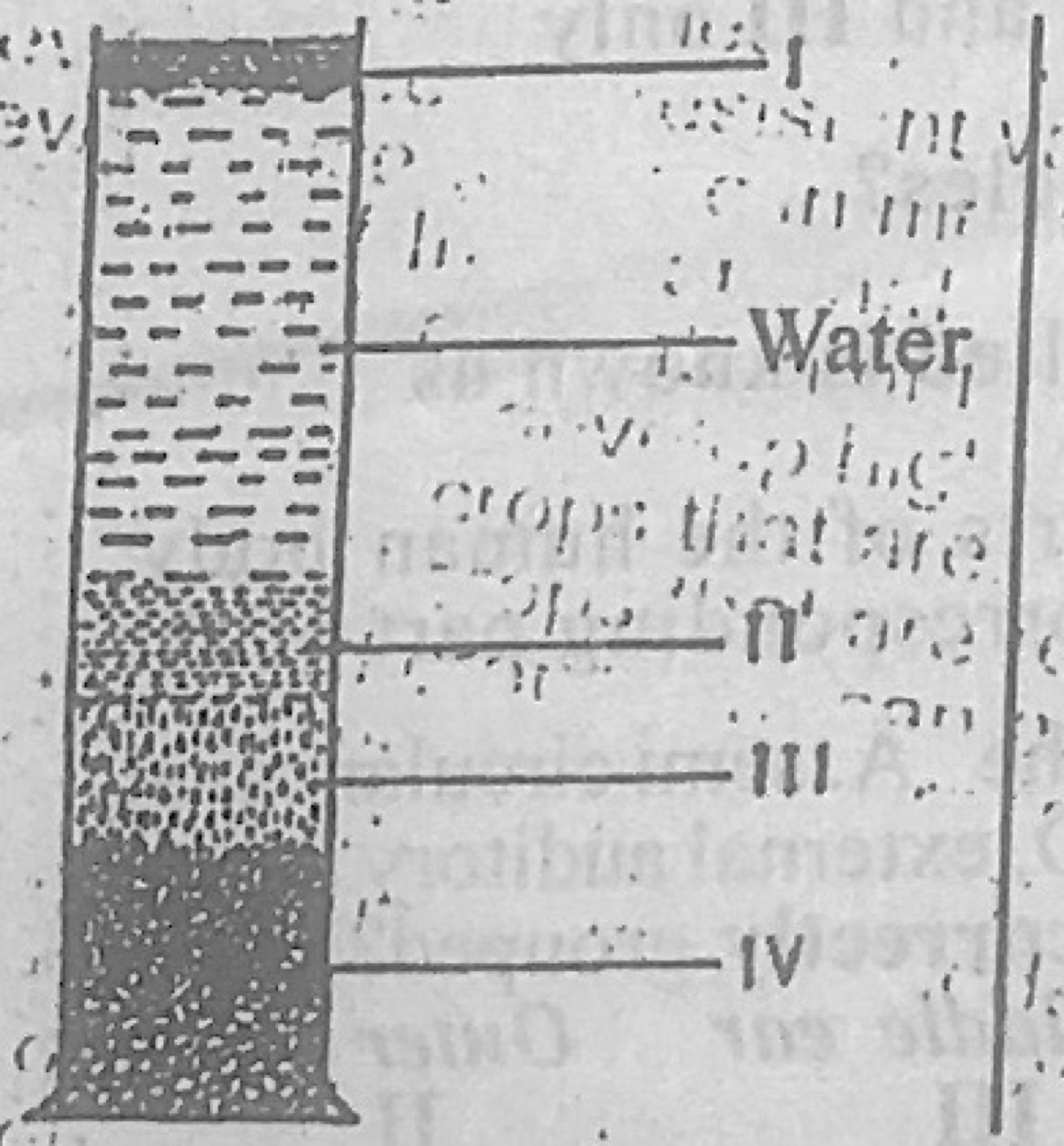
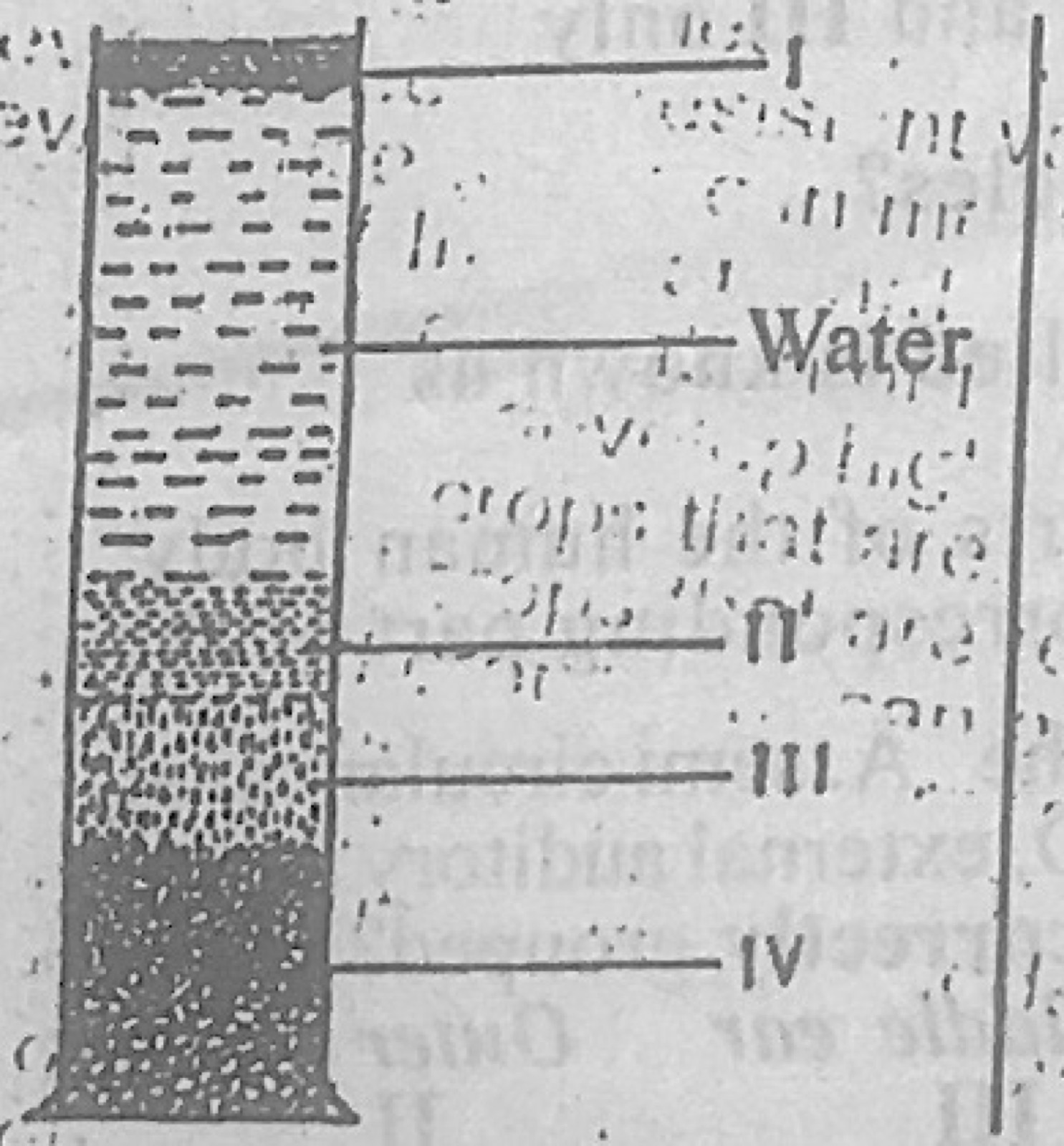
Diagrams X and Y are illustrations of transverse sections of a part of plants. The part responsible for conducting water and dissolved mineral salts from the soil to the leaves is labelled
A.I
B.II
C.III
D.IV
Show the answer and explanation
Answer: A (I)
Explanation
Water is carried from the roots to the leaves in the xylem, the star-shaped central tissue labelled I. Root hairs (IV) only absorb it from the soil.
Use the following processes to answer this question. I. Ribs move upward and outward II. Diaphragm relaxes III. Volume of thorax increases IV. Air is forced out of the lungs Which of the processes take place during inspiration?
A.I and III only
B.II and III only
C.II and IV only
D.III and IV only
Show the answer and explanation
Answer: A (I and III only)
Explanation
Breathing in: ribs move up and out and the diaphragm contracts, so the thorax gets bigger. Diaphragm relaxing and air forced out happen in expiration.
Use the following processes to answer this question. I. Ribs move upward and outward II. Diaphragm relaxes III. Volume of thorax increases IV. Air is forced out of the lungs Which of the processes is a direct result of contraction of the intercostal muscles?
A.I
B.II
C.III
D.IV
Show the answer and explanation
Answer: A (I)
Explanation
The intercostal muscles lie between the ribs; when they contract they lift the ribs up and out, which then enlarges the chest.
The table shows the effect of hormones I, II, III and IV on some parts of the human body (✓ = effect, X = no effect): Hormone I: heart ✓, digestive system ✓, kidney ✓, uterus ✓ Hormone II: heart X, digestive system X, kidney ✓, uterus X Hormone III: heart X, digestive system X, kidney X, uterus ✓ Hormone IV: heart X, digestive system ✓, kidney X, uterus X Which of the following hormones are I, II, III and IV respectively?
A.ADH, Glucagon, Oestrogen, Adrenaline
B.Adrenaline, Glucagon, Oestrogen, ADH
C.Glucagon, ADH, Oestrogen, Adrenaline
D.Adrenaline, ADH, Oestrogen, Glucagon
Show the answer and explanation
Answer: D (Adrenaline, ADH, Oestrogen, Glucagon)
Explanation
Adrenaline affects many organs (I); ADH acts only on the kidney (II); oestrogen acts on the uterus (III); glucagon acts on the liver, part of the digestive system (IV).
The table shows the effect of hormones I, II, III and IV on some parts of the human body (✓ = effect, X = no effect): Hormone I: heart ✓, digestive system ✓, kidney ✓, uterus ✓ Hormone II: heart X, digestive system X, kidney ✓, uterus X Hormone III: heart X, digestive system X, kidney X, uterus ✓ Hormone IV: heart X, digestive system ✓, kidney X, uterus X The hormone responsible for anxiety is
A.I
B.II
C.III
D.IV
Show the answer and explanation
Answer: A (I)
Explanation
Hormone I acts on many organs at once, like adrenaline, the hormone released in fear and anxiety.
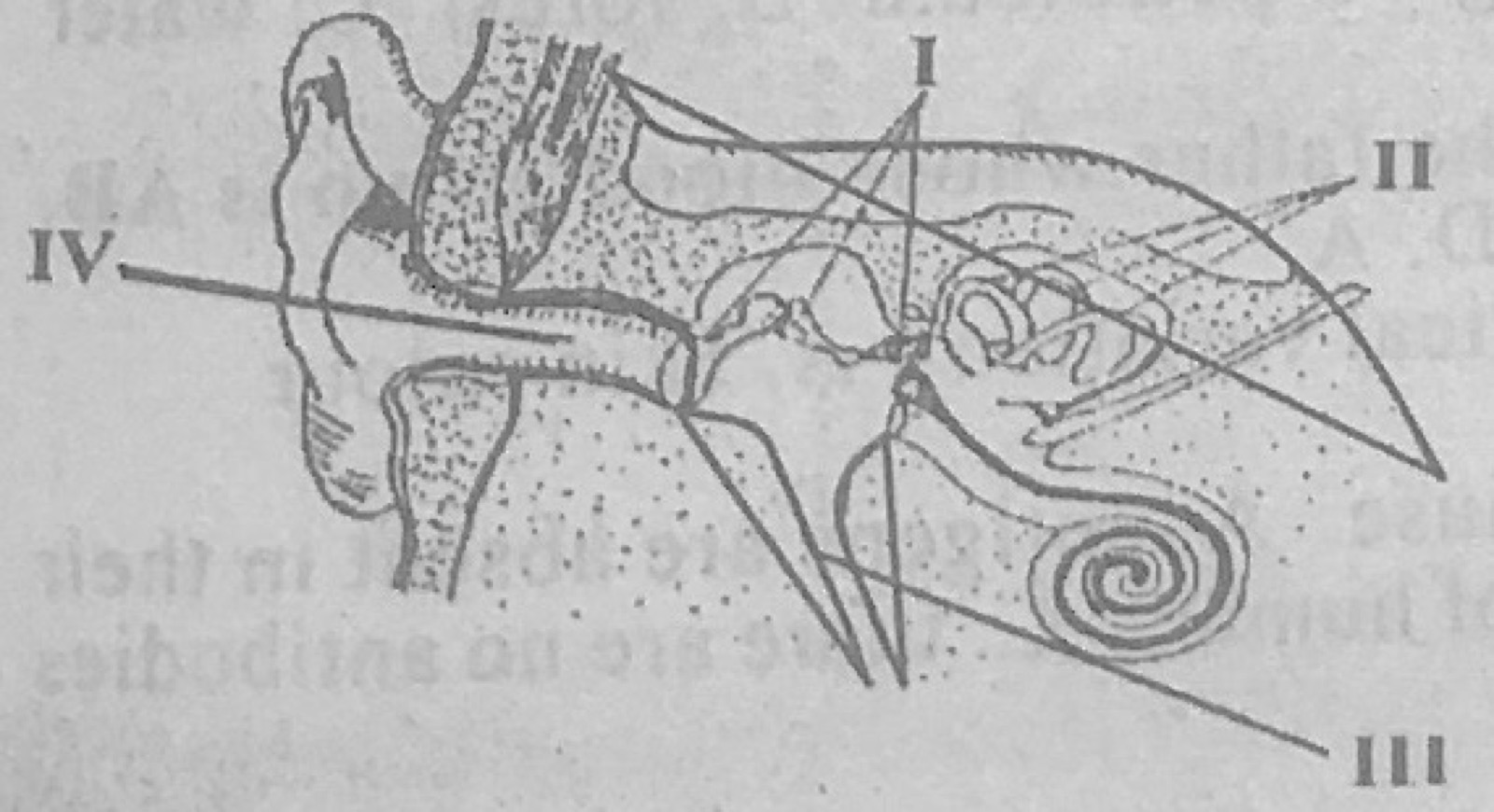
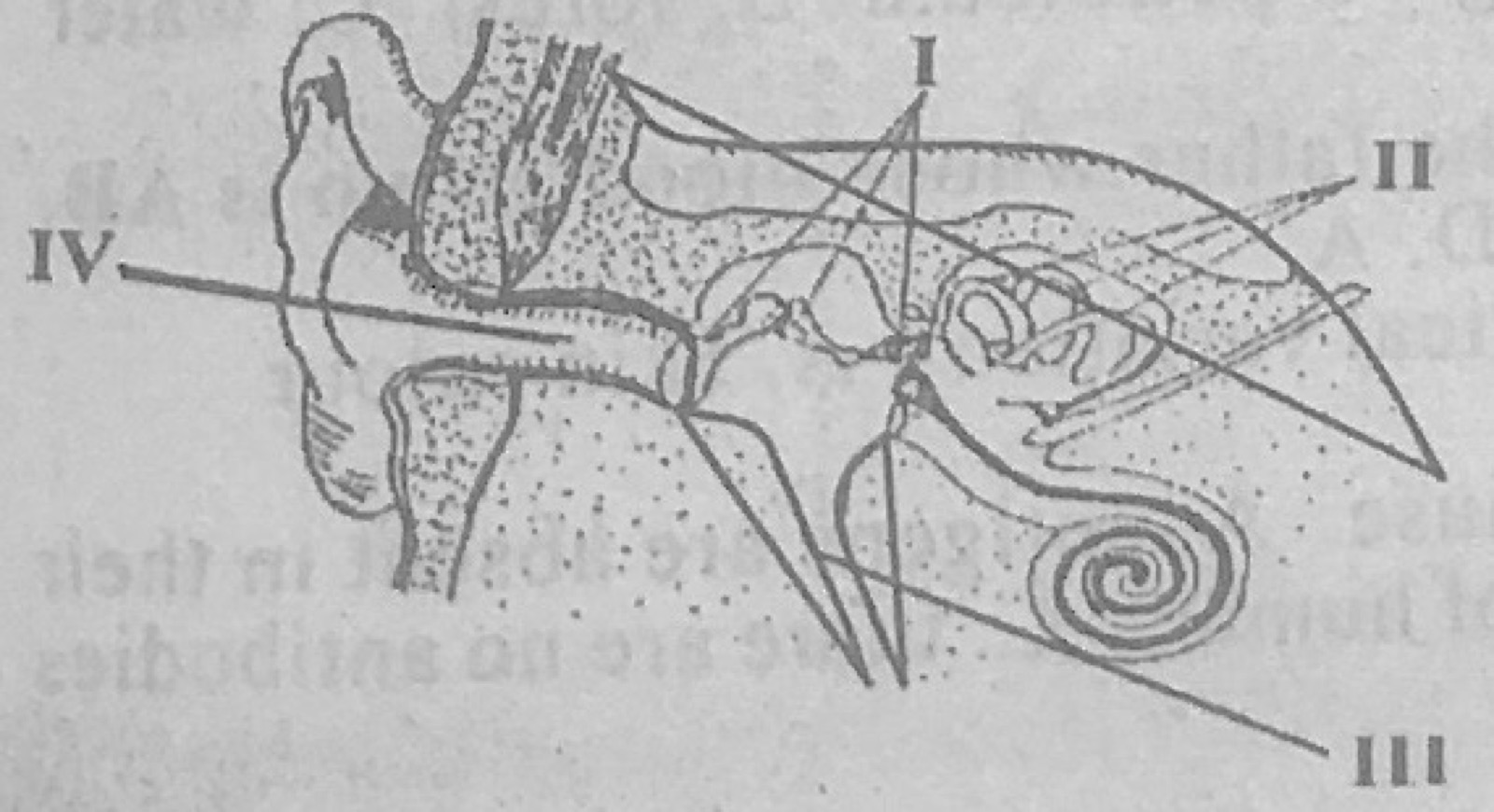
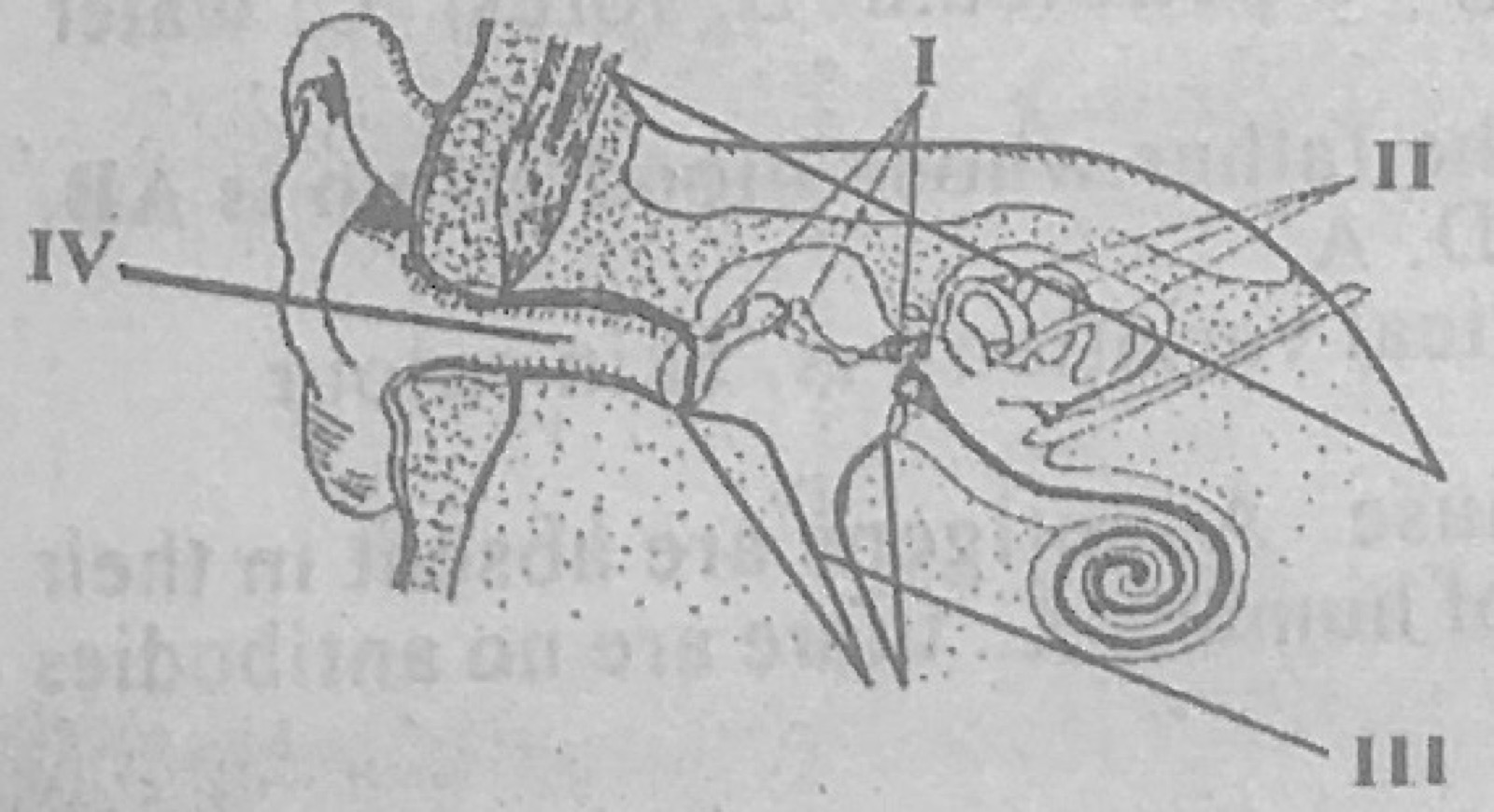
The diagram is an illustration of some parts of a mammalian ear. Which of the parts are correctly grouped? A. Inner ear: I, IV; Middle ear: III; Outer ear: II B. Inner ear: III; Middle ear: II, IV; Outer ear: I C. Inner ear: I; Middle ear: II; Outer ear: III, IV D. Inner ear: II; Middle ear: I, III; Outer ear: IV
A.A
B.B
C.C
D.D
Show the answer and explanation
Answer: D (D)
Explanation
II (semicircular canals) is inner ear; I (ossicles) and III (Eustachian tube) belong to the middle ear; IV (ear canal) is outer ear.
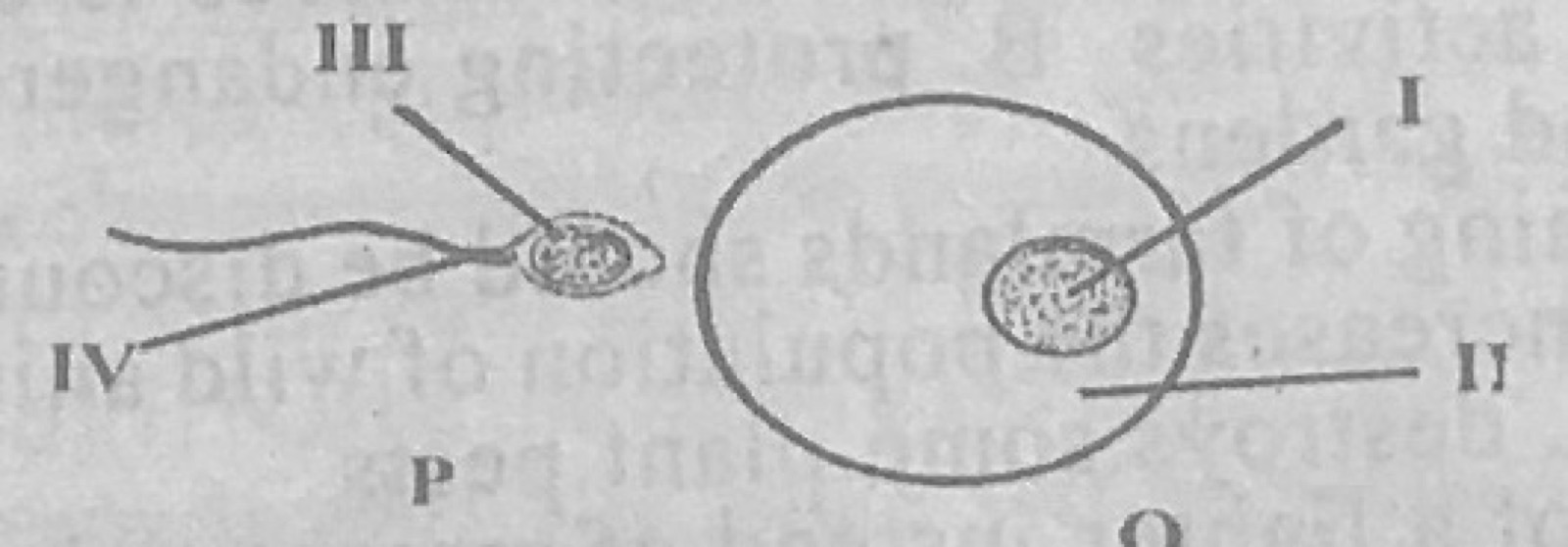
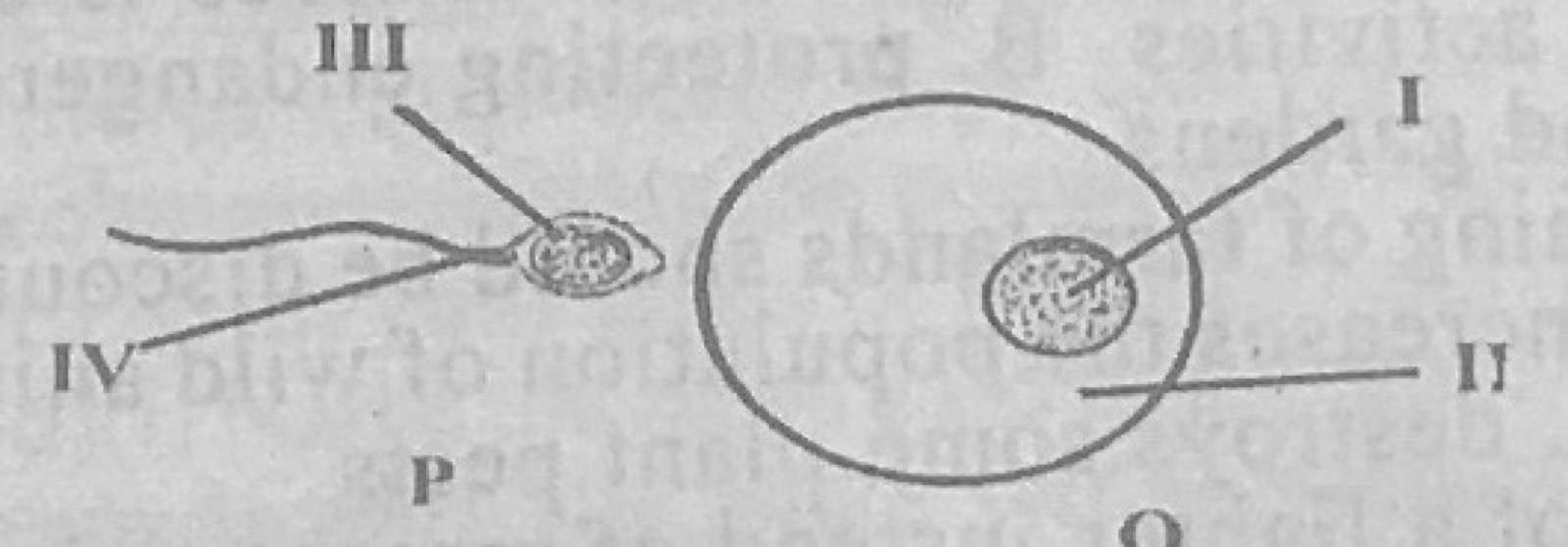
The diagrams are illustrations of two different cells (P and Q) involved in a biological process in mammals. Which parts of P and Q fuse to complete the biological process?
A.III and I
B.IV and I
C.III and II
D.IV and II
Show the answer and explanation
Answer: A (III and I)
Explanation
At fertilisation the nucleus in the sperm head (III) fuses with the egg nucleus (I).
The diagrams are illustrations of two different cells (P and Q) involved in a biological process in mammals. Which of the following statements about P and Q is correct?
A.Both cells are structures for asexual reproduction
B.Both cells normally belong to the same individual
C.Both cells are found in plants
D.The union of both cells gives rise to a new mammal
Show the answer and explanation
Answer: D (The union of both cells gives rise to a new mammal)
Explanation
A sperm and an egg fuse at fertilisation to form a zygote, which develops into a new individual.
The diagrams are illustrations of two different cells (P and Q) involved in a biological process in mammals. If the number of chromosomes in the skin cells of mammals is 46, how many chromosomes would be found in P and Q respectively?
A.23 and 23
B.23 and 46
C.46 and 23
D.46 and 46
Show the answer and explanation
Answer: A (23 and 23)
Explanation
Gametes are haploid, so both sperm and ovum carry half the body-cell number: 23 each.
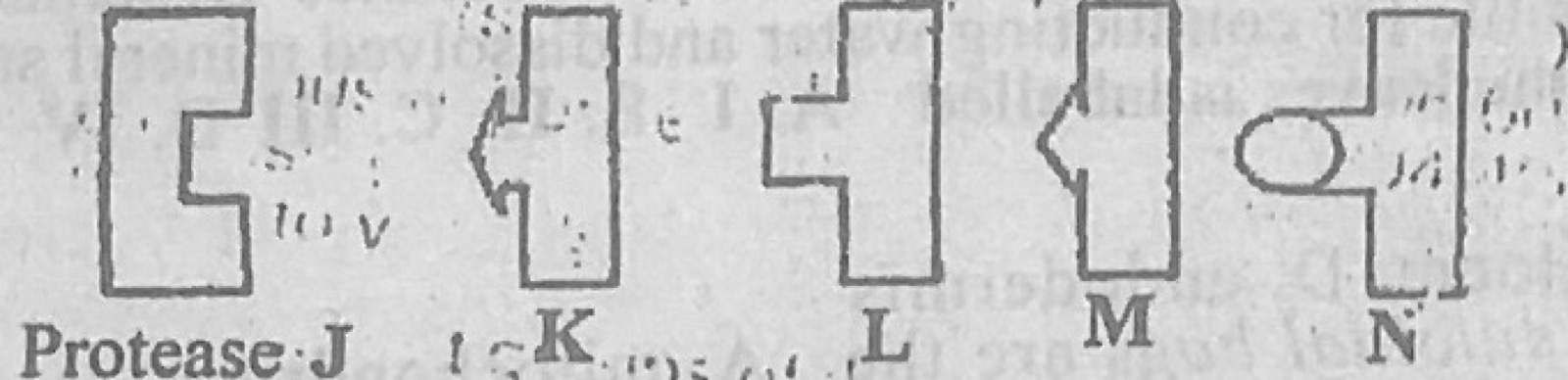
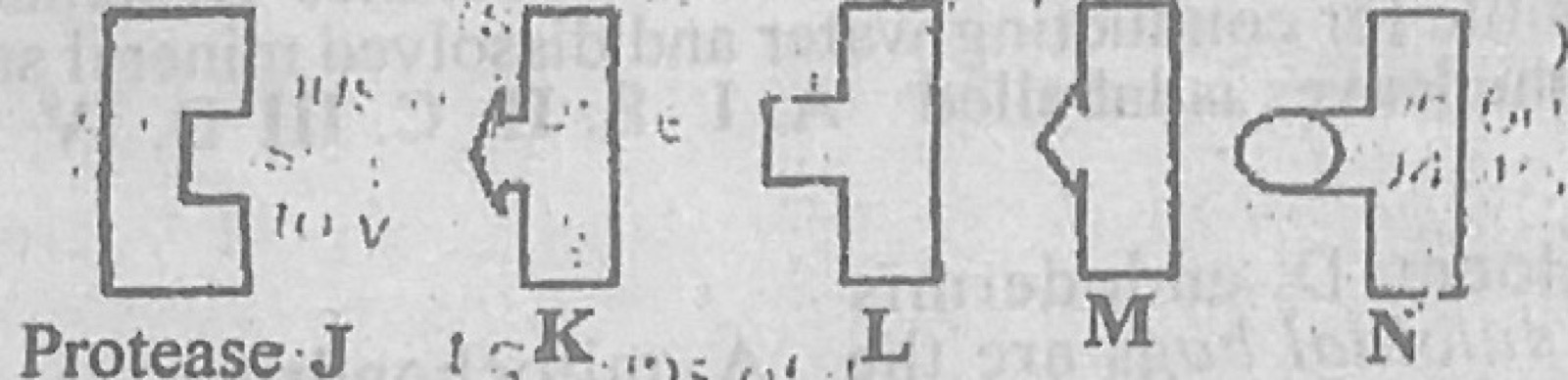
Diagram J is a protease while diagrams K, L, M and N are food substances. Which of the illustrated food substances would form a reaction with protease J?
A.K
B.L
C.M
D.N
Show the answer and explanation
Answer: B (L)
Explanation
L has a square projection that fits exactly into the square notch (active site) of J, like a key in a lock.
Diagram J is a protease while diagrams K, L, M and N are food substances. Protease J would react with the particular illustrated substance because enzymes
A.are denatured at a high frequency
B.are specific in their action
C.remain unchanged after a reaction
D.speed up the rate of chemical reaction
Show the answer and explanation
Answer: B (are specific in their action)
Explanation
Each enzyme's active site fits only one substrate shape, so it acts only on that substance (lock-and-key).
Diagram J is a protease while diagrams K, L, M and N are food substances. After a reaction between protease J and the food substance, the end-product would be
A.fatty acids
B.glucose
C.amino acids
D.water
Show the answer and explanation
Answer: C (amino acids)
Explanation
Proteases digest proteins, and the final products of protein digestion are amino acids.
Two tall plants were crossed and all the F1 plants were tall. When the F1 plants were selfed, some of the F2 plants were tall while others were short. What are the possible genotypes of the original plants?
A.Tt and tt
B.TT and TT
C.tt and tt
D.TT and Tt
Show the answer and explanation
Answer: D (TT and Tt)
Explanation
Both parents are tall and all F1 are tall, so at least one parent is TT; short F2 plants mean some F1 were Tt, so the other parent carried t: TT × Tt.
(a)(i) What is a cell? (ii) Name three scientists that are associated with the discovery of the cell. (b)(i) Make a diagram, 6 cm to 8 cm long of a plant cell and label only the organelle responsible for cell reproduction. (ii) Name one blood cell in humans that does not have the organelle labelled in 1(b)(i). (iii) What is the biological implication of the cell named in 1(b)(ii) not possessing the organelle responsible for cell reproduction? (c) List six organelles found in a plant cell.
Show the model answer
Model answer
(a)(i) A cell is the basic structural and functional unit of life; the smallest unit that can carry out all life processes. (ii) Any three: Robert Hooke; Anton van Leeuwenhoek; Matthias Schleiden; Theodor Schwann; Rudolf Virchow; Felix Dujardin. (b)(i) Diagram of correct size, roughly rectangular plant cell with cell wall, cell membrane, cytoplasm, large vacuole and chloroplasts drawn; only the nucleus labelled; title. (ii) Red blood cell (erythrocyte). (iii) It cannot divide/reproduce or repair itself, so it has a short life (about 120 days) and must be constantly replaced by the bone marrow; (lack of nucleus gives more room for haemoglobin to carry oxygen). (c) Any six: nucleus; chloroplast; mitochondrion; vacuole; endoplasmic reticulum; ribosome; Golgi body; cell membrane; (lysosome).
Explanation
Label only the nucleus in (b)(i), as the question asks.
(a) Complete the table below by ticking (✓) the appropriate group to which each of the listed elements required by plants belongs. Elements: Hydrogen, Copper, Magnesium, Zinc, Phosphorus, Manganese, Boron, Nitrogen, Carbon, Oxygen Groups: Microelement | Macroelement (b) State: (i) three differences between the dentition of a herbivore and a carnivore; (ii) four differences between the dentition of a human and a goat. (c) What are milk teeth?
Show the model answer
Model answer
(a) Macroelements: hydrogen, magnesium, phosphorus, nitrogen, carbon, oxygen. Microelements: copper, zinc, manganese, boron. (b)(i) Any three — Herbivore: has a diastema / carnivore: no diastema; canines absent or reduced / long, pointed canines; no carnassial teeth / carnassial teeth present; molars with flat, ridged grinding surfaces / molars with sharp cusps; incisors absent in upper jaw (horny pad) / incisors in both jaws. (ii) Any four — Human: incisors in both jaws / goat: no upper incisors (horny pad); canines present / no canines; no diastema / diastema present; molars and premolars with cusps / with ridges for grinding; dental formula i2/2 c1/1 pm2/2 m3/3 / i0/3 c0/1 pm3/3 m3/3; jaws move up and down / jaws move side to side. (c) Milk teeth are the first (deciduous) set of teeth in young mammals, which fall out and are replaced by permanent teeth.
(a)(i) What is an ecological niche? (ii) State five roles played by a mango tree in its ecological niche. (b)(i) State two reasons why ecologists use sampling techniques in population studies. (ii) State four examples of sampling techniques used in the population studies. (c) Name four types of fingerprints in humans. (d)(i) Name the plant used by Gregor Mendel in his experiment. (ii) State two reasons why the plant named in 3(d)(i) was used.
Show the model answer
Model answer
(a)(i) An ecological niche is the role or functional position of an organism in its habitat: where it lives, what it feeds on, what feeds on it and how it affects the environment. (ii) Any five: producer — makes food by photosynthesis; provides fruits as food for animals and humans; provides shelter/nesting sites for birds, insects; gives shade; releases oxygen and absorbs CO2; adds leaf litter/humus to the soil; roots hold the soil and prevent erosion; host to epiphytes and parasites; transpiration adds water vapour to the air. (b)(i) It is impossible or too time-consuming to count every organism in a large area; sampling saves time, labour and cost; it gives a good estimate of the whole population; avoids destroying the habitat. (ii) Any four: quadrat; line transect; belt transect; capture–mark–recapture; pitfall trap; sweep net; pooter. (c) Arch; loop; whorl; compound (composite). (d)(i) Garden pea (Pisum sativum). (ii) Any two: it has many clear contrasting characters; it is normally self-pollinating, so pure lines are easy to keep; it can be cross-pollinated by hand; short life cycle; produces many seeds; easy to grow.
Explanation
For (a)(ii) think of what the tree does for other organisms and the environment.
(a)(i) What are conservation laws? (ii) State three conservation laws. (b)(i) State two reasons why animals are poached. (ii) Name five animals that are commonly poached. (c) State four effects of excessive use of the forest. (d) Explain briefly the following terms: (i) blood transfusion; (ii) antigen.
Show the model answer
Model answer
(a)(i) Conservation laws are rules made by government to protect and regulate the use of natural resources so that they are not wasted or destroyed. (ii) Any three: laws against hunting endangered species; ban on bush burning; laws against illegal felling of trees/requiring permits; closed seasons for hunting/fishing; laws against trade in wildlife products; laws against pollution; laws setting up game reserves and national parks. (b)(i) For meat (bushmeat); for skins, tusks, horns, scales to sell for money; for traditional medicine; for pets/trade. (ii) Any five: elephant; leopard; pangolin; crocodile; gorilla/chimpanzee; antelope; python; grasscutter; rhinoceros; parrot. (c) Any four: deforestation and loss of habitats; extinction of plant and animal species; soil erosion and desertification; reduced rainfall/climate change; flooding; loss of timber and medicinal plants; increased CO2 in the air. (d)(i) Blood transfusion is the transfer of blood from a healthy donor into the blood vessels of a recipient who needs it, after matching blood groups. (ii) An antigen is a foreign substance (usually a protein, e.g. on red cells or germs) that stimulates the body to produce antibodies.
Explanation
Give named animals, not general groups, in (b)(ii).
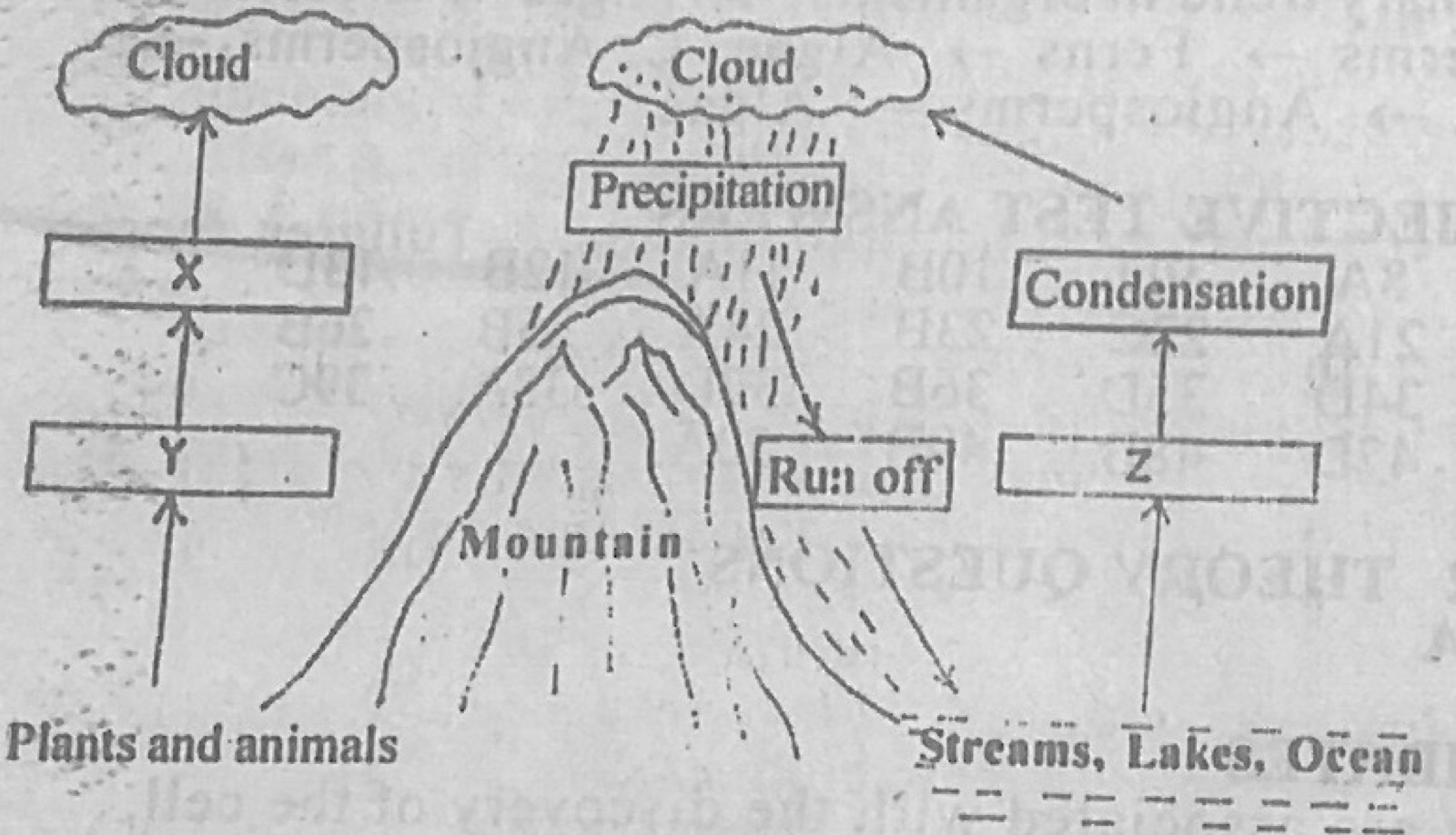
(a)(i) State three differences between the alimentary canals of earthworm and cockroach. (ii) State three similarities between the alimentary canals of earthworm and cockroach. (b) The diagram is an illustration of a biological cycle. Study it and answer questions 5(b)(i) to 5(b)(iii). (i) Name the biological cycle. (ii) Explain briefly three roles played by plants and animals in the cycle. (iii) Name the processes that occur in X, Y and Z. (c) Complete the table below: Organ associated with excretion in humans | Three diseases each that affect the organ (i) ________ | ________ (ii) ________ | ________ (d)(i) What is decay of organic matter? (ii) Name two groups of organisms that cause decay of organic matter. (iii) State one other factor that causes decay. (iv) Name the biological cycle that involves decay. (e) Explain briefly the mode of nutrition in carnivorous plants.
Show the model answer
Model answer
(a)(i) Any three — Earthworm: gizzard grinds soil and food / cockroach: gizzard with chitinous teeth; earthworm has a typhlosole in the intestine / cockroach has none; earthworm has calciferous glands / cockroach has salivary glands with reservoirs; earthworm has no hepatic caeca / cockroach has hepatic (gastric) caeca; earthworm gut is a straight tube / cockroach gut is coiled; earthworm feeds on soil and organic matter / cockroach on many kinds of food with mouthparts. (ii) Any three: both have a mouth and anus; both have a crop for storage; both have a gizzard for grinding; both have an intestine for digestion and absorption; both have a pharynx/oesophagus. (b)(i) The water cycle (hydrological cycle). (ii) Plants take in water through roots and lose it as vapour by transpiration; plants and animals release water vapour in respiration; animals lose water by sweating and excretion (urine); animals drink water; decay of dead plants and animals releases water. (iii) X: evaporation (of water vapour into the air); Y: transpiration/respiration (and sweating) by plants and animals; Z: evaporation from streams, lakes and oceans. (c) Any two organs with three diseases each, e.g. kidney — kidney stones, nephritis, kidney failure; liver — hepatitis, cirrhosis, liver cancer; lungs — tuberculosis, pneumonia, lung cancer, asthma; skin — ringworm, scabies, eczema, skin cancer. (d)(i) Decay is the breakdown of dead plants, animals and their wastes into simpler substances. (ii) Bacteria and fungi (saprophytes). (iii) Any one: warmth; moisture; oxygen; detritivores such as earthworms. (iv) Carbon cycle (or nitrogen cycle). (e) Carnivorous plants (e.g. pitcher plant, sundew, Venus flytrap) grow in nitrogen-poor soil; they make carbohydrates by photosynthesis; they attract insects by colour, scent or nectar and trap them with special leaves; glands secrete enzymes that digest the insect's proteins; the plant absorbs the amino acids/nitrogen compounds.
Explanation
In the water cycle X and Y lie on the path from plants and animals to the clouds, and Z on the path from open water.