Theory question 105
Animal Nutrition(a)(i) State three differences between the alimentary canals of earthworm and cockroach. (ii) State three similarities between the alimentary canals of earthworm and cockroach.
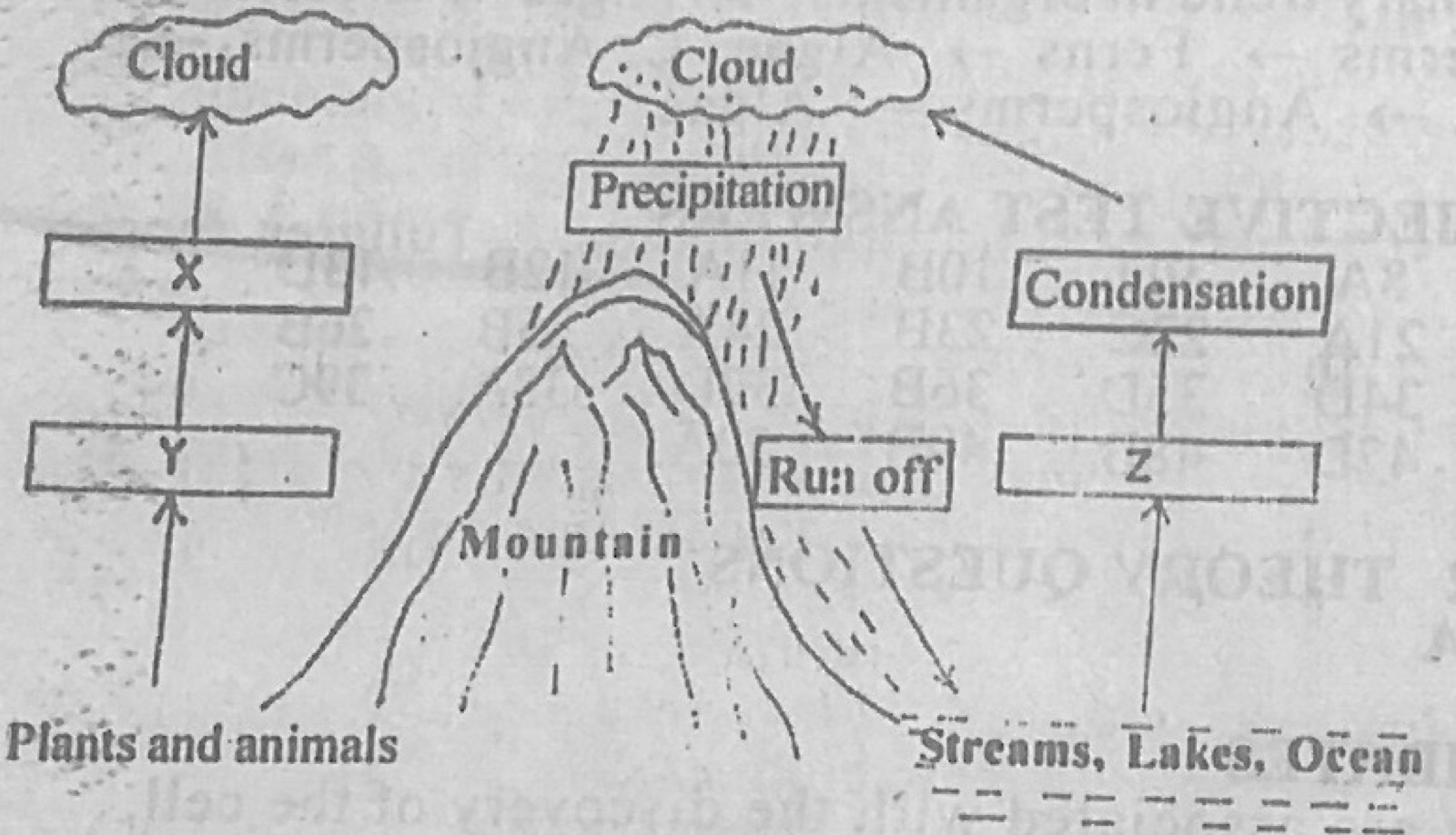
(b) The diagram is an illustration of a biological cycle. Study it and answer questions 5(b)(i) to 5(b)(iii).
(i) Name the biological cycle. (ii) Explain briefly three roles played by plants and animals in the cycle. (iii) Name the processes that occur in X, Y and Z.
(c) Complete the table below:
Organ associated with excretion in humans | Three diseases each that affect the organ
(i) ________ | ________
(ii) ________ | ________
(d)(i) What is decay of organic matter? (ii) Name two groups of organisms that cause decay of organic matter. (iii) State one other factor that causes decay. (iv) Name the biological cycle that involves decay.
(e) Explain briefly the mode of nutrition in carnivorous plants.
Show the model answer
(a)(i) Any three — Earthworm: gizzard grinds soil and food / cockroach: gizzard with chitinous teeth; earthworm has a typhlosole in the intestine / cockroach has none; earthworm has calciferous glands / cockroach has salivary glands with reservoirs; earthworm has no hepatic caeca / cockroach has hepatic (gastric) caeca; earthworm gut is a straight tube / cockroach gut is coiled; earthworm feeds on soil and organic matter / cockroach on many kinds of food with mouthparts.
(ii) Any three: both have a mouth and anus; both have a crop for storage; both have a gizzard for grinding; both have an intestine for digestion and absorption; both have a pharynx/oesophagus.
(b)(i) The water cycle (hydrological cycle).
(ii) Plants take in water through roots and lose it as vapour by transpiration; plants and animals release water vapour in respiration; animals lose water by sweating and excretion (urine); animals drink water; decay of dead plants and animals releases water.
(iii) X: evaporation (of water vapour into the air); Y: transpiration/respiration (and sweating) by plants and animals; Z: evaporation from streams, lakes and oceans.
(c) Any two organs with three diseases each, e.g. kidney — kidney stones, nephritis, kidney failure; liver — hepatitis, cirrhosis, liver cancer; lungs — tuberculosis, pneumonia, lung cancer, asthma; skin — ringworm, scabies, eczema, skin cancer.
(d)(i) Decay is the breakdown of dead plants, animals and their wastes into simpler substances.
(ii) Bacteria and fungi (saprophytes).
(iii) Any one: warmth; moisture; oxygen; detritivores such as earthworms.
(iv) Carbon cycle (or nitrogen cycle).
(e) Carnivorous plants (e.g. pitcher plant, sundew, Venus flytrap) grow in nitrogen-poor soil; they make carbohydrates by photosynthesis; they attract insects by colour, scent or nectar and trap them with special leaves; glands secrete enzymes that digest the insect's proteins; the plant absorbs the amino acids/nitrogen compounds.
In the water cycle X and Y lie on the path from plants and animals to the clouds, and Z on the path from open water.