Theory question 104
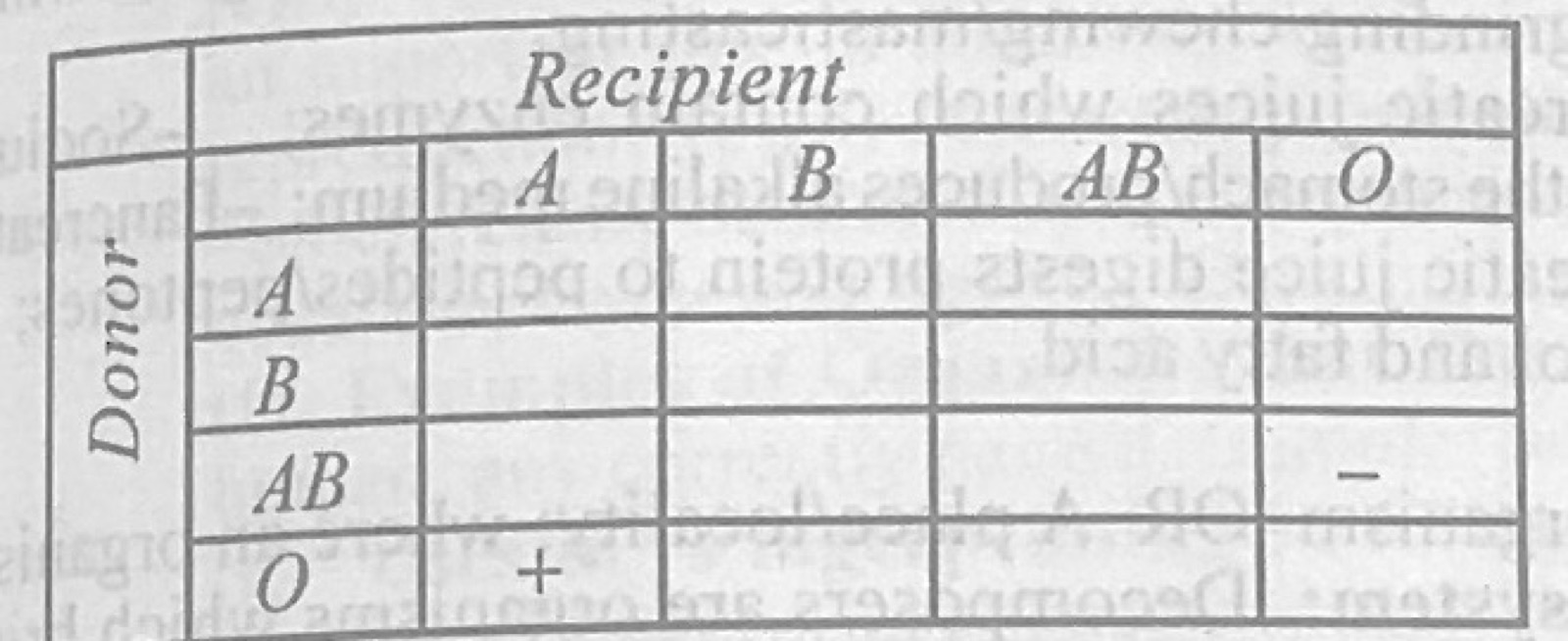
Transport in Animals(a)(i) Explain the term agglutination as used in blood transfusion. (ii) The table below represents blood transfusion between blood donors and recipients. Copy and complete the table using the keys (+) to represent compatibility and (−) to represent incompatibility.
(b) Explain how each of the following organisms are adapted for obtaining food: (i) Mosquito larva; (ii) Dodder plant; (iii) Grasshopper.
Show the model answer
(a)(i) Agglutination is the clumping together of red blood cells when the antigens on the donor's cells meet the matching antibodies in the recipient's plasma (incompatible blood).
(ii) Completed table (donor down, recipient across: A, B, AB, O):
Donor A: +, −, +, −
Donor B: −, +, +, −
Donor AB: −, −, +, −
Donor O: +, +, +, +
(b)(i) Mosquito larva: mouth brushes create water currents that sweep tiny food particles (algae, bacteria) into the mouth; it hangs at the surface breathing through a siphon while it feeds.
(ii) Dodder: a parasitic plant with no (or little) chlorophyll and no true leaves; its stem twines round the host and sends haustoria into the host's xylem and phloem to absorb water and food.
(iii) Grasshopper: biting and chewing mouthparts – strong toothed mandibles cut and grind leaves, maxillae hold and pass food, labrum and labium hold food in place, palps taste and feel food.
Remember O is the universal donor and AB the universal recipient.