WAEC Biology 2009 past questions and answers

65 questions. Try each one, then open the answer to check yourself and read the explanation.

Question 1

Characteristics and Classification of Living Things

A group of closely related organisms capable of interbreeding to produce fertile offspring are known as members of a

  1. A.kingdom.
  2. B.class.
  3. C.family.
  4. D.species.
Show the answer and explanation

Answer: D (species.)

Explanation

A species is defined as a group of organisms that can interbreed and produce fertile offspring.

Open this question

Question 2

Microorganisms and Health

Viruses are economically important because they

  1. A.do not have cell structures.
  2. B.can only reproduce inside living cells.
  3. C.cause diseases in plants and animals.
  4. D.exist as crystals outside living cells.
Show the answer and explanation

Answer: C (cause diseases in plants and animals.)

Explanation

Economic importance is about effect on people: viruses cause diseases of crops, livestock and humans. The other options are just features of viruses.

Open this question

Question 3

Photosynthesis and Plant Nutrition

A beaker of pond water containing few specimens of Euglena was placed in a dark room for two weeks. At the end of this period, the specimens of Euglena were still alive because they were

  1. A.able to carry out holozoic nutrition.
  2. B.able to carry out photosynthesis using carbon dioxide in the pond water.
  3. C.better adapted to life in darkness than to life in light.
  4. D.not overcrowded.
Show the answer and explanation

Answer: A (able to carry out holozoic nutrition.)

Explanation

Without light Euglena cannot photosynthesise, but it can switch to feeding on organic matter (heterotrophic nutrition), so it survives in the dark.

Open this question

Question 4

Cell Structure and Organisation

The cytoplasm of the cell is considered a very important component because it

  1. A.regulates the amount of energy in the cell.
  2. B.suspends all cell organelles.
  3. C.is the outermost part of the cell.
  4. D.is solely responsible for cell division
Show the answer and explanation

Answer: B (suspends all cell organelles.)

Explanation

The cytoplasm is the jelly-like medium in which all the organelles are suspended and where many reactions take place.

Open this question

Question 5

Cell and Its Environment

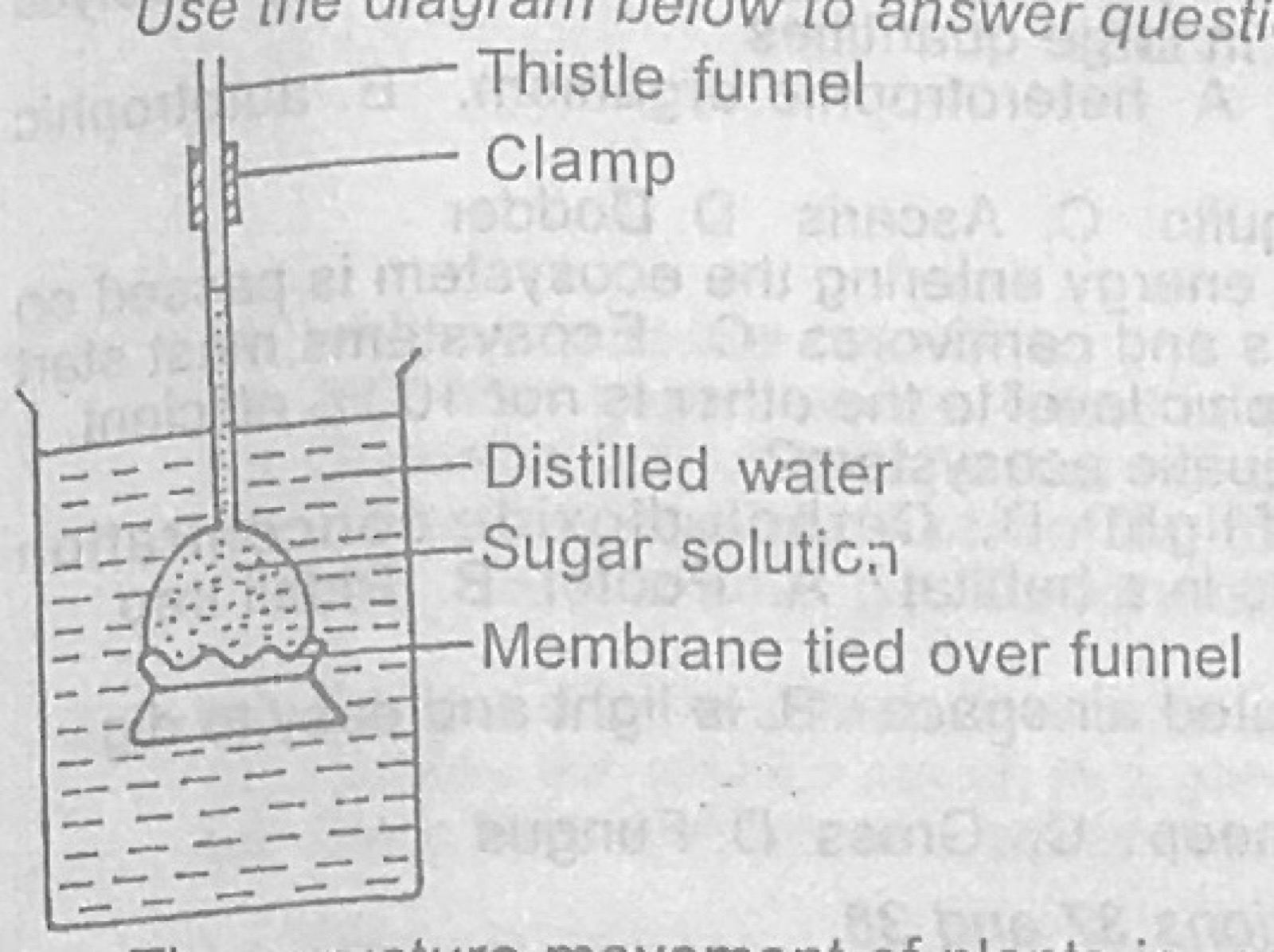
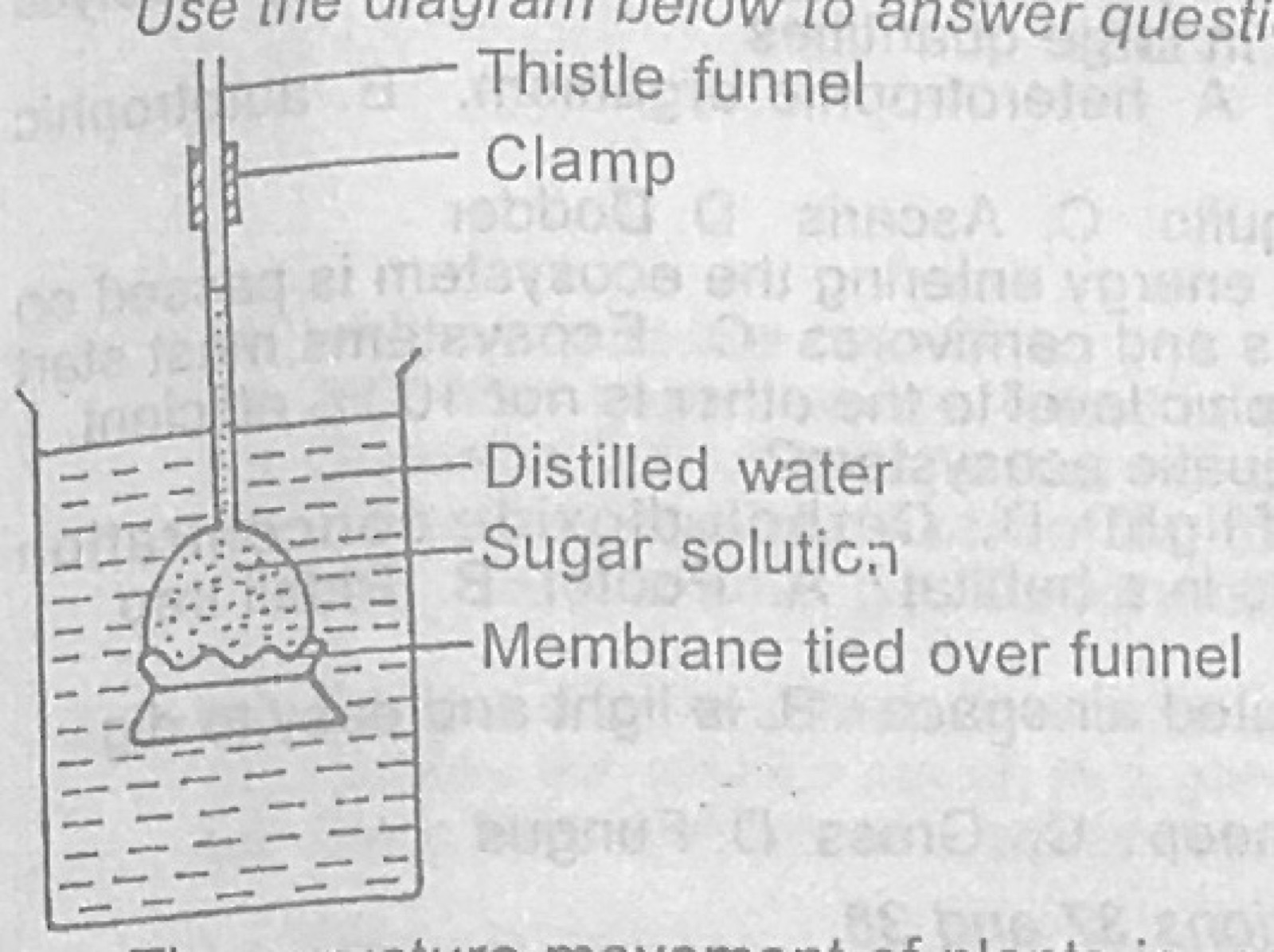
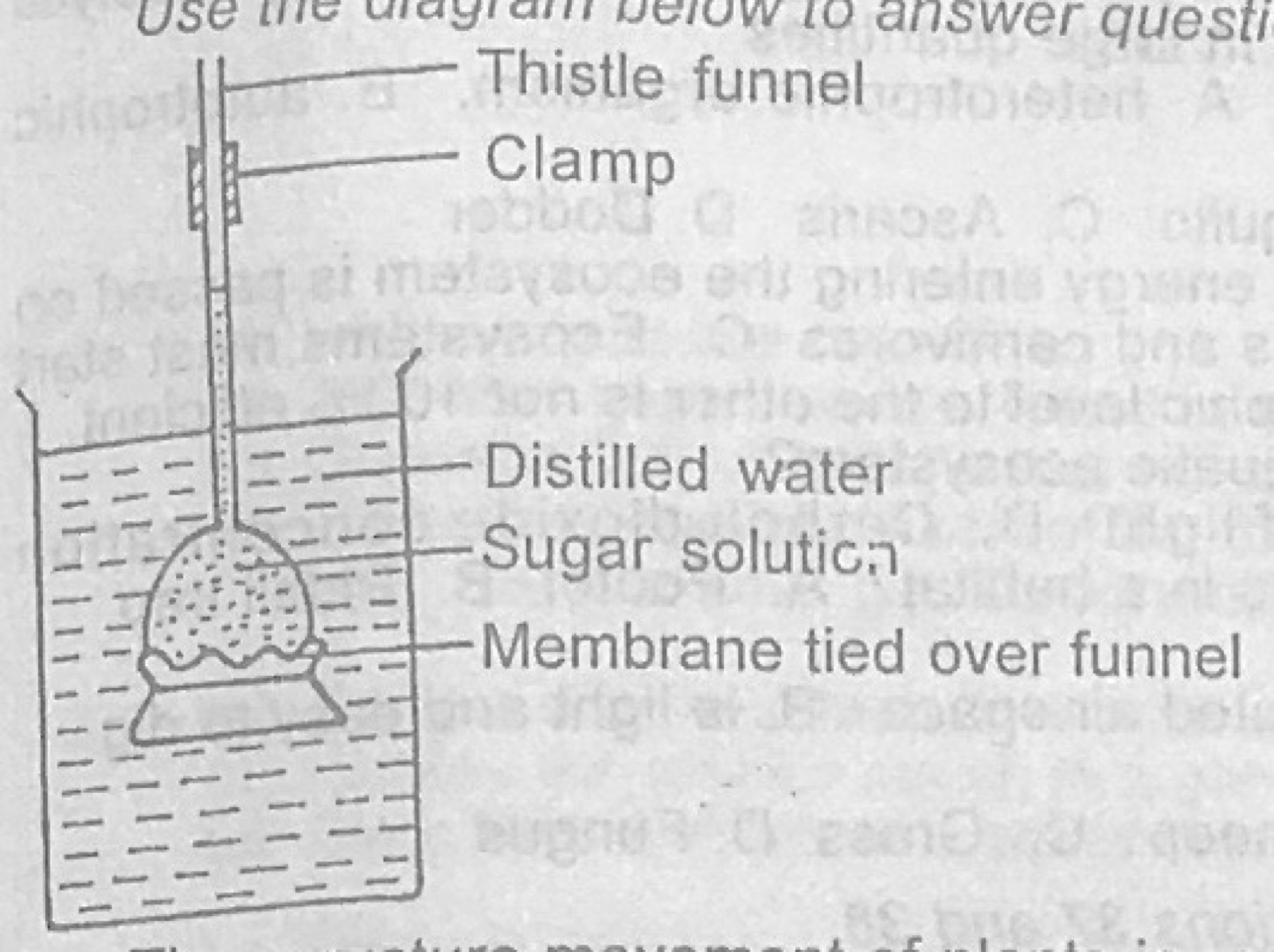
Use the diagram (a thistle funnel containing sugar solution, with a membrane tied over the funnel, standing in distilled water) to answer this question.
After an hour, the level of water in the thistle funnel will

Diagram for this question
  1. A.rise.
  2. B.fall.
  3. C.remain the same.
  4. D.double.
Show the answer and explanation

Answer: A (rise.)

Explanation

Water moves by osmosis from the distilled water into the more concentrated sugar solution, so the level in the funnel rises.

Open this question

Question 6

Cell and Its Environment

Use the diagram (a thistle funnel containing sugar solution, with a membrane tied over the funnel, standing in distilled water) to answer this question.
The experiment above is used to demonstrate the process of

Diagram for this question
  1. A.transpiration.
  2. B.water culture.
  3. C.diffusion.
  4. D.osmosis.
Show the answer and explanation

Answer: D (osmosis.)

Explanation

Water passing through a selectively permeable membrane from a dilute to a concentrated solution is osmosis.

Open this question

Question 7

Cell and Its Environment

Use the diagram (a thistle funnel containing sugar solution, with a membrane tied over the funnel, standing in distilled water) to answer this question.
In plant cells the role of the membrane is played by the

Diagram for this question
  1. A.nucleolus.
  2. B.cell wall.
  3. C.cytoplasm.
  4. D.mitochondrion.
Show the answer and explanation

Answer: C (cytoplasm.)

Explanation

The membrane in the funnel is selectively permeable. In a plant cell the cell wall lets everything through; it is the lining of cytoplasm (with the cell membrane and tonoplast) that acts as the selectively permeable membrane.

Open this question

Question 8

Cell and Its Environment

Red blood cells were found to have burst open after being placed in distilled water for an hour. This phenomenon is known as

  1. A.plasmolysis.
  2. B.diffusion.
  3. C.haemolysis.
  4. D.wilting.
Show the answer and explanation

Answer: C (haemolysis.)

Explanation

Water enters red cells by osmosis until they burst; the bursting of red blood cells is called haemolysis.

Open this question

Question 9

Respiration

The overall reaction in glycolysis can be summarised as

  1. A.C6H12O6 → C3H4O3 + 4H + ATP
  2. B.C6H12O6 → 2C3H4O3 + 4H + 2ATP
  3. C.C6H12O6 → 2C3H4O3 + 4H + ADP
  4. D.C6H12O6 → 2C3H4O3 + 4H + 2ADP
Show the answer and explanation

Answer: B (C6H12O6 → 2C3H4O3 + 4H + 2ATP)

Explanation

Glycolysis splits one glucose into two molecules of pyruvic acid (C3H4O3), releasing hydrogen and a net gain of 2 ATP.

Open this question

Question 10

Plant Responses and Hormones

The curvature movement of plants in response to the stimulus of water is called

  1. A.hydrotropism.
  2. B.geotropism.
  3. C.phototropism.
  4. D.thigmotropism.
Show the answer and explanation

Answer: A (hydrotropism.)

Explanation

'Hydro' means water; a growth curvature in response to water is hydrotropism.

Open this question

Question 11

Cell Division

Two organelles directly involved in mitotic cell division are

  1. A.nucleus and mitochondrion.
  2. B.ribosome and nucleus.
  3. C.centriole and golgi apparatus.
  4. D.nucleus and centriole.
Show the answer and explanation

Answer: D (nucleus and centriole.)

Explanation

The nucleus holds the chromosomes that divide, and the centrioles form the spindle that pulls them apart.

Open this question

Question 12

Cell Division

The following statements about mitotic cell division are correct except that

  1. A.it occurs only in young cells.
  2. B.it occurs in somatic cells.
  3. C.the chromosome number of the daughter cell is the same as that of the parent.
  4. D.the genetic composition of the mother cell is the same as that of the daughter cell.
Show the answer and explanation

Answer: A (it occurs only in young cells.)

Explanation

Mitosis happens in body (somatic) cells of all ages, e.g. for repair and replacement, so it is not limited to young cells.

Open this question

Question 13

Support and Movement

The longest bone in the body is the

  1. A.humerus.
  2. B.femur.
  3. C.scapula.
  4. D.tibia.
Show the answer and explanation

Answer: B (femur.)

Explanation

The femur (thigh bone) is the longest bone in the human body.

Open this question

Question 14

Support and Movement

Which of the following structures is not a skeletal material?

  1. A.Chitin
  2. B.Cartilage
  3. C.Bone
  4. D.Muscle
Show the answer and explanation

Answer: D (Muscle)

Explanation

Chitin, cartilage and bone all form skeletons; muscle moves the skeleton but is not a skeletal material.

Open this question

Question 15

Transport in Animals

The reason why the flow of blood through the capillaries is very slow is

  1. A.because the walls of capillaries are very thin.
  2. B.to avoid high blood pressure.
  3. C.to ensure that the individual does not get dizzy.
  4. D.to allow adequate time for exchange of materials.
Show the answer and explanation

Answer: D (to allow adequate time for exchange of materials.)

Explanation

Slow flow in capillaries gives time for oxygen, food and wastes to diffuse between the blood and the tissues.

Open this question

Question 16

Transport in Animals

Which of the following features is not characteristic of arteries? Arteries

  1. A.possess valves at intervals throughout their length
  2. B.have thick, muscular and elastic walls
  3. C.carry blood away from the heart
  4. D.transport oxygenated blood with the exception of the pulmonary artery
Show the answer and explanation

Answer: A (possess valves at intervals throughout their length)

Explanation

Valves along the length are a feature of veins; blood in arteries is under high pressure and needs no valves except at the heart.

Open this question

Question 17

Respiration

A group of rats placed in an air-tight box for some hours died because they

  1. A.breathed in air containing nitrogen
  2. B.produced carbon dioxide.
  3. C.ran short of energy.
  4. D.used up the available oxygen.
Show the answer and explanation

Answer: D (used up the available oxygen.)

Explanation

In a sealed box no fresh air enters, so the rats used up the oxygen needed for respiration and died.

Open this question

Question 18

Excretion

Which of the following organisms have kidney as their excretory organ?

  1. A.Fishes, amphibians, birds, man
  2. B.Fishes, amphibians, annelids, insects.
  3. C.Fishes, reptiles, birds, tapeworms.
  4. D.Fishes, protozoans, amphibians, man.
Show the answer and explanation

Answer: A (Fishes, amphibians, birds, man)

Explanation

Kidneys are found in vertebrates. Annelids use nephridia, insects Malpighian tubules, tapeworms flame cells and protozoans contractile vacuoles.

Open this question

Question 19

Homeostasis

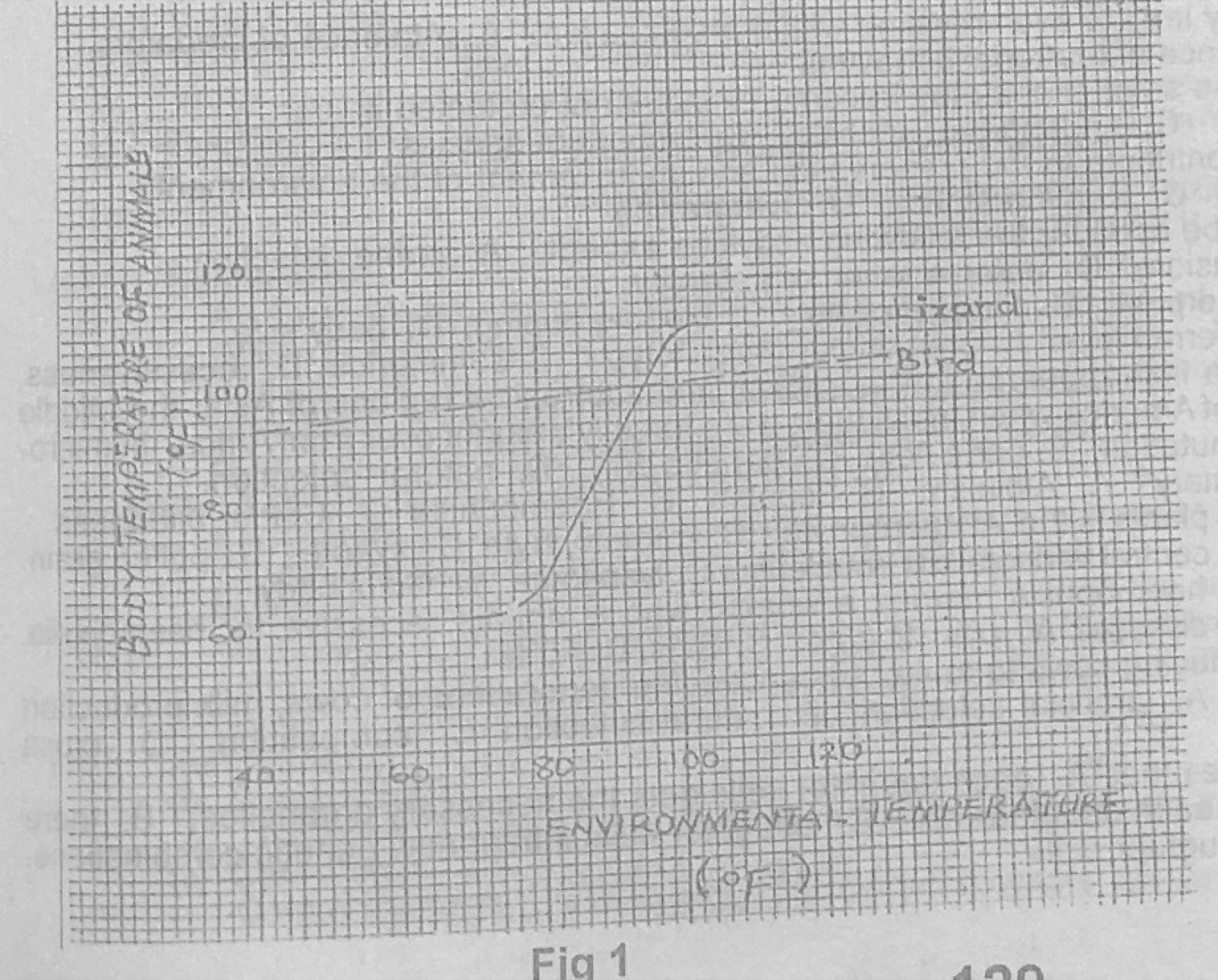
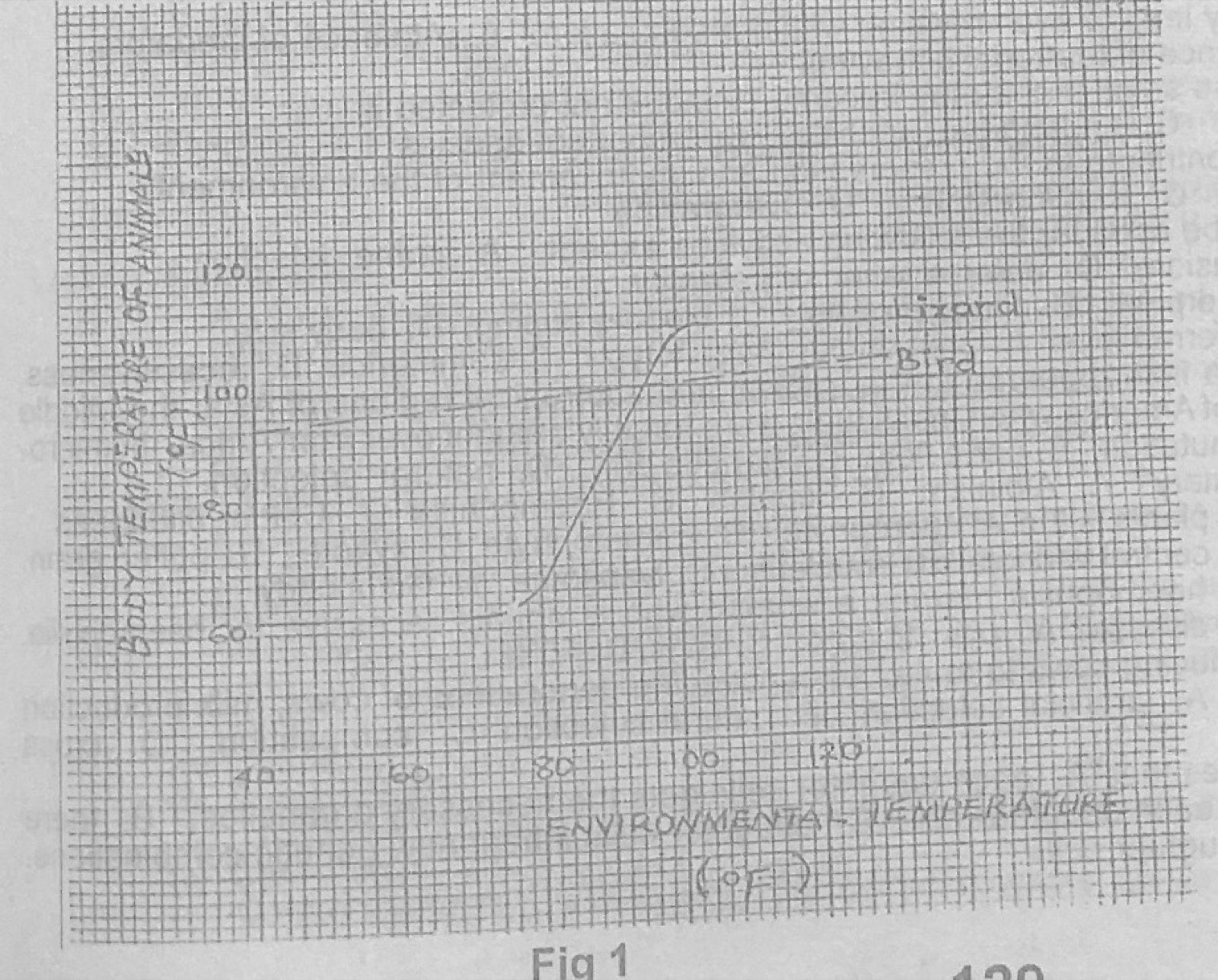
The graph in Fig. 1 shows the results of a laboratory investigation which measured the body temperatures of a lizard and a bird under changing artificial conditions.
Which of the statements below is valid?

Diagram for this question
  1. A.The bird's blood was always warmer than that of the lizard
  2. B.The body temperature of the bird varied less than that of the lizard during changes in environmental temperature
  3. C.The body temperature of the bird remained constant despite changes in environmental temperature
  4. D.The body temperature of the lizard was always close to that of the environmental temperature
Show the answer and explanation

Answer: B (The body temperature of the bird varied less than that of the lizard during changes in environmental temperature)

Explanation

On the graph the lizard's temperature climbs steeply from about 60°F to above 110°F, while the bird's line rises only a few degrees. So the bird's temperature varied less, but it did not stay exactly constant, and the lizard was warmer than the bird at high temperatures.

Open this question

Question 20

Homeostasis

The graph in Fig. 1 shows the results of a laboratory investigation which measured the body temperatures of a lizard and a bird under changing artificial conditions.
What physiological term can be used to describe the regulation of the body temperature of the lizard?

Diagram for this question
  1. A.Homeostasis
  2. B.Homoithermy
  3. C.Poikilothermy
  4. D.Osmoregulation
Show the answer and explanation

Answer: C (Poikilothermy)

Explanation

The lizard's body temperature changes with its surroundings; animals like this are poikilothermic (cold-blooded).

Open this question

Question 21

Homeostasis

The reason why hospitals use saline solutions as drip instead of water is

  1. A.because salt is a preservative.
  2. B.to prevent contamination of the body.
  3. C.to maintain the composition of body fluids.
  4. D.to increase the number of blood cells.
Show the answer and explanation

Answer: C (to maintain the composition of body fluids.)

Explanation

Saline has the same salt concentration as blood plasma, so it keeps body fluids balanced; plain water would make blood cells swell and burst.

Open this question

Question 22

Sense Organs

The part of the ear which contains nerve cells sensitive to sound vibrations is the

  1. A.cochlea.
  2. B.ampulla
  3. C.tympanum.
  4. D.malleus.
Show the answer and explanation

Answer: A (cochlea.)

Explanation

The cochlea in the inner ear holds the sensory hair cells that respond to sound; the ampulla senses movement for balance.

Open this question

Question 23

Sense Organs

Spectacles with convex lenses correct long-sightedness by

  1. A.converging the light rays before they enter the eye.
  2. B.diverging the light rays before they enter the eye.
  3. C.reducing light intensity before it enters the eye.
  4. D.increasing light intensity before it enters the eye.
Show the answer and explanation

Answer: A (converging the light rays before they enter the eye.)

Explanation

A convex lens bends light rays inwards (converges them) so that near objects focus on the retina instead of behind it.

Open this question

Question 24

Reproduction in Plants

A seed of a flowering plant can best be described as

  1. A.radicle and plumule.
  2. B.the developed ovule.
  3. C.the embryo and endosperm.
  4. D.developed ovary.
Show the answer and explanation

Answer: B (the developed ovule.)

Explanation

After fertilisation the ovule becomes the seed and the ovary becomes the fruit.

Open this question

Question 25

Nutrient Cycling

Which of the following processes removes carbon from the atmosphere?

  1. A.Putrefaction
  2. B.Photosynthesis
  3. C.Volcanic eruption
  4. D.Burning of fuels
Show the answer and explanation

Answer: B (Photosynthesis)

Explanation

Green plants take in carbon dioxide from the air during photosynthesis; the other processes release carbon dioxide.

Open this question

Question 26

Nutrient Cycling

Which of the following cycles involves the process of precipitation and transpiration?

  1. A.Water cycle
  2. B.Carbon cycle
  3. C.Nitrogen cycle
  4. D.Oxygen cycle
Show the answer and explanation

Answer: A (Water cycle)

Explanation

Precipitation (rain) and transpiration (water loss from leaves) are stages of the water cycle.

Open this question

Question 27

Structure of Flowering Plants

The mesophyll layer of a leaf consists of

  1. A.wax and cutin.
  2. B.cells with lignified walls.
  3. C.irregularly shaped collenchyma cells.
  4. D.photosynthetic parenchyma cells.
Show the answer and explanation

Answer: D (photosynthetic parenchyma cells.)

Explanation

The mesophyll (palisade and spongy layers) is made of parenchyma cells packed with chloroplasts for photosynthesis.

Open this question

Question 28

Transport in Plants

Which of the following treatments would increase the rate of transpiration in a potted plant?

  1. A.Placing it in a cold room
  2. B.Placing it under a fan in a room
  3. C.Putting it in a cupboard
  4. D.Smearing grease on the lower surface of the leaves
Show the answer and explanation

Answer: B (Placing it under a fan in a room)

Explanation

A fan blows away the humid air around the leaves, keeping the diffusion gradient steep, so water vapour is lost faster.

Open this question

Question 29

Animal Nutrition

Pepsin is secreted as an inactive precursor called pepsinogen because

  1. A.pepsin as an enzyme is quickly destroyed by the alkaline food from the mouth
  2. B.all digestive enzymes pass through a precursor stage
  3. C.pepsin is a proteolytic enzyme and might attack the stomach tissues
  4. D.pepsin is not required in large quantities
Show the answer and explanation

Answer: C (pepsin is a proteolytic enzyme and might attack the stomach tissues)

Explanation

Pepsin digests protein, and the stomach wall is made of protein; releasing it in an inactive form protects the cells that make it.

Open this question

Question 30

Photosynthesis and Plant Nutrition

An organism whose source of carbon is inorganic is likely to be a/an

  1. A.heterotrophic organism.
  2. B.autotrophic organism.
  3. C.symbiotic organism.
  4. D.parasitic organism.
Show the answer and explanation

Answer: B (autotrophic organism.)

Explanation

Autotrophs make their own food from inorganic carbon (carbon dioxide); heterotrophs need organic carbon from other organisms.

Open this question

Question 31

Ecological Associations

Which of the following organisms is an endoparasite?

  1. A.Mice
  2. B.Mosquito
  3. C.Ascaris
  4. D.Dodder
Show the answer and explanation

Answer: C (Ascaris)

Explanation

Ascaris (roundworm) lives inside the host's intestine, so it is an endoparasite; mosquitoes and dodder feed from the outside.

Open this question

Question 32

Feeding Relationships and Energy Flow

Which of the following statements about ecosystems is false?

  1. A.All the energy entering the ecosystem is passed on to decomposers
  2. B.The primary producers provide energy for herbivores and carnivores
  3. C.Ecosystems must start with the capture of energy by autotrophs
  4. D.Energy transfer from one trophic level to the other is not 100% efficient.
Show the answer and explanation

Answer: A (All the energy entering the ecosystem is passed on to decomposers)

Explanation

Much of the energy entering an ecosystem is lost as heat at each level, so not all of it reaches the decomposers.

Open this question

Question 33

Habitats and Biomes

What is the critical limiting factor for plants below the photic zone in an aquatic ecosystem?

  1. A.Availability of nutrients
  2. B.Availability of water
  3. C.Intensity of light
  4. D.Carbon dioxide concentration
Show the answer and explanation

Answer: C (Intensity of light)

Explanation

The photic zone is the layer light can reach; below it there is too little light for photosynthesis.

Open this question

Question 34

Population Ecology

Which of the following instruments is used to estimate the number of plants in a habitat?

  1. A.Pooter
  2. B.Pitfall trap
  3. C.Quadrat
  4. D.Sweep net
Show the answer and explanation

Answer: C (Quadrat)

Explanation

A quadrat is a square frame placed in a habitat to count plants; the others are for catching small animals.

Open this question

Question 35

Soil

Which of the following statements is true about sandy soil? It

  1. A.has limited air space
  2. B.is light and easy to dig
  3. C.drains slowly
  4. D.is heavy and poorly aerated
Show the answer and explanation

Answer: B (is light and easy to dig)

Explanation

Sandy soil has large particles with big air spaces, so it is light, well aerated, drains fast and is easy to dig.

Open this question

Question 36

Feeding Relationships and Energy Flow

Which of the following organisms is a primary consumer?

  1. A.Dog
  2. B.Sheep
  3. C.Grass
  4. D.Fungus
Show the answer and explanation

Answer: B (Sheep)

Explanation

A primary consumer eats plants; the sheep is a herbivore.

Open this question

Question 37

Feeding Relationships and Energy Flow

Study the food chain P → Q → R → S → T.
The organism designated P in the food chain above is normally sustained by energy from

  1. A.sunlight.
  2. B.carbohydrates.
  3. C.green plants.
  4. D.mineral salts.
Show the answer and explanation

Answer: A (sunlight.)

Explanation

P is the first link, the producer (a green plant), which gets its energy from sunlight.

Open this question

Question 38

Feeding Relationships and Energy Flow

Study the food chain P → Q → R → S → T.
Which of the following statements best describes the organism designated R? It

  1. A.feeds on S
  2. B.is a primary consumer
  3. C.is a producer as well as a consumer
  4. D.is a secondary consumer
Show the answer and explanation

Answer: D (is a secondary consumer)

Explanation

P is the producer, Q the primary consumer, so R, which eats Q, is the secondary consumer.

Open this question

Question 39

Feeding Relationships and Energy Flow

Food chains are relatively short because

  1. A.of energy recycling in the ecosystem.
  2. B.energy gain at each trophic level is high.
  3. C.of energy loss at each trophic level.
  4. D.energy flow in an ecosystem is uni-directional.
Show the answer and explanation

Answer: C (of energy loss at each trophic level.)

Explanation

About 90% of energy is lost at each level (respiration, heat, waste), so after a few links too little is left to support another level.

Open this question

Question 40

Adaptation

Which of the following organisms does not show colour adaptation to its environment?

  1. A.Chameleon
  2. B.Earthworm
  3. C.Fish
  4. D.Toad
Show the answer and explanation

Answer: B (Earthworm)

Explanation

The chameleon, fish and toad use colour for camouflage; the earthworm lives underground and does not depend on colour.

Open this question

Question 41

Adaptation

Most tropical plants shed their leaves during dry weather conditions in order to

  1. A.reduce their growth rate.
  2. B.conserve water.
  3. C.reduce competition.
  4. D.minimise the rate of photosynthesis.
Show the answer and explanation

Answer: B (conserve water.)

Explanation

Most water is lost through leaves by transpiration, so shedding leaves in the dry season saves water.

Open this question

Question 42

Adaptation

Which of the following features is not an adaptation of plants to aquatic habitat?

  1. A.Breathing roots for entry of air
  2. B.Flowers raised above water for the purpose of pollination
  3. C.Spongy tissues containing gases for buoyancy
  4. D.Hairy structures on the leaves to reduce water loss
Show the answer and explanation

Answer: D (Hairy structures on the leaves to reduce water loss)

Explanation

Water plants have plenty of water, so they don't need hairs to cut water loss; that is a desert-plant adaptation.

Open this question

Question 44

Population Ecology

Population growth rate may be defined as the

  1. A.mortality rate per unit area over a period.
  2. B.number of times an organism occurs within a given period.
  3. C.number of a particular species per unit area.
  4. D.net rate of natality and mortality in the habitat over a period.
Show the answer and explanation

Answer: D (net rate of natality and mortality in the habitat over a period.)

Explanation

Growth rate is the balance of births (natality) against deaths (mortality) over a period of time.

Open this question

Question 45

Population Ecology

In ecological succession, since lichens grow on bare rock, they are considered to be

  1. A.primary consumers.
  2. B.pioneer organisms.
  3. C.climax organisms.
  4. D.producers.
Show the answer and explanation

Answer: B (pioneer organisms.)

Explanation

The first organisms to colonise a bare area are called pioneers; lichens break down rock and start soil formation.

Open this question

Question 46

Population Ecology

Which of the following factors will most likely lead to overcrowding within a population?

  1. A.Absence of predators
  2. B.Emigration
  3. C.Food shortage
  4. D.Absence of territorial behaviour
Show the answer and explanation

Answer: A (Absence of predators)

Explanation

Predators keep numbers down; without them the population keeps growing and becomes overcrowded. Emigration and food shortage reduce numbers.

Open this question

Question 47

Conservation of Natural Resources

A species whose populations has become so small that it may become extinct if not protected is a/an

  1. A.special species.
  2. B.dangerous species.
  3. C.endangered species.
  4. D.important species.
Show the answer and explanation

Answer: C (endangered species.)

Explanation

An endangered species is one so reduced in number that it risks extinction without protection.

Open this question

Question 48

Conservation of Natural Resources

Which of the following practices does not contribute to the preservation and improvement of the environment?

  1. A.Pollution reduction
  2. B.Material recycling
  3. C.Reafforestation
  4. D.Overgrazing
Show the answer and explanation

Answer: D (Overgrazing)

Explanation

Overgrazing strips the vegetation, exposing soil to erosion and desert formation; the others protect the environment.

Open this question

Question 49

Variation

Variation is important in human life and can be used for the following activities except

  1. A.crime detection.
  2. B.population distribution.
  3. C.blood transfusion.
  4. D.determination of paternity.
Show the answer and explanation

Answer: B (population distribution.)

Explanation

Fingerprints help crime detection, and blood groups guide transfusion and paternity tests; variation is not used for population distribution.

Open this question

Question 50

Variation

An example of continuous variation is

  1. A.fingerprint.
  2. B.tongue rolling.
  3. C.blood grouping.
  4. D.body size.
Show the answer and explanation

Answer: D (body size.)

Explanation

Body size shows a smooth range of values with many in-between forms, which is continuous variation; the others fall into clear-cut groups.

Open this question

Question 51

Mendelian Inheritance

The outward appearance of an organism is referred to as

  1. A.phenotype.
  2. B.genotype.
  3. C.dominance.
  4. D.recessiveness.
Show the answer and explanation

Answer: A (phenotype.)

Explanation

The phenotype is the observable appearance; the genotype is the genetic make-up behind it.

Open this question

Question 52

Evolution

The allele responsible for sickle-cell anaemia first appeared in the tropical and subtropical regions of Asia, the Middle East and Africa. It entered the United States of America when individuals were forcibly brought over from Africa. In micro-evolutionary terms this is an example of

  1. A.mutation.
  2. B.gene flow.
  3. C.genetic drift.
  4. D.natural selection.
Show the answer and explanation

Answer: B (gene flow.)

Explanation

Gene flow is the movement of alleles from one population to another when individuals migrate, as happened here.

Open this question

Question 53

Mendelian Inheritance

Which of the following diseases is not hereditary?

  1. A.Albinism
  2. B.Scabies
  3. C.Haemophilia
  4. D.Colour blindness
Show the answer and explanation

Answer: B (Scabies)

Explanation

Scabies is caused by a mite passed by contact, not by genes; the other three are inherited.

Open this question

Question 54

Reproduction in Plants

The immediate product of meiosis in flowering plants is the

  1. A.sporophyte.
  2. B.gametophyte.
  3. C.zygote.
  4. D.pollen grain.
Show the answer and explanation

Answer: D (pollen grain.)

Explanation

In the anther, meiosis of pollen mother cells directly produces haploid pollen grains (microspores).

Open this question

Question 55

Cell Structure and Organisation

DNA in eukaryotic cells is contained in the

  1. A.central vacuole.
  2. B.nucleus.
  3. C.lysosome.
  4. D.Golgi body.
Show the answer and explanation

Answer: B (nucleus.)

Explanation

In eukaryotic cells the DNA is held in the chromosomes inside the nucleus.

Open this question

Question 56

Chromosomes, DNA and Sex Linkage

A man who is heterozygous for the disease haemophilia marries a woman who is double recessive for haemophilia. What percentage of their offspring would have the disease?

  1. A.0%
  2. B.25%
  3. C.50%
  4. D.75%
Show the answer and explanation

Answer: C (50%)

Explanation

Crossing Hh × hh gives Hh and hh in equal numbers, so half (50%) of the offspring are hh and show the disease.

Open this question

Question 57

Evolution

A dairy farmer allowed only his best milk producing cows to mate. In succeeding generations of cows, milk production increased. This outcome is an example of

  1. A.artificial selection.
  2. B.natural selection.
  3. C.competition.
  4. D.cross fertilization.
Show the answer and explanation

Answer: A (artificial selection.)

Explanation

When humans choose which animals breed to get a desired trait, it is artificial selection.

Open this question

Question 58

Cell Division

Cytokinesis of mitosis is a process that ensures that

  1. A.each daughter cells gets the necessary organelles.
  2. B.there is distribution of a complete set of genes into each daughter cell.
  3. C.daughter cells inherit new genetic combinations.
  4. D.worn out organelles are excluded from daughter cells.
Show the answer and explanation

Answer: A (each daughter cells gets the necessary organelles.)

Explanation

Mitosis has two parts: the nucleus divides first, giving each cell a full set of chromosomes, then cytokinesis divides the cytoplasm so each daughter cell gets its share of organelles.

Open this question

Question 59

Habitats and Biomes

An animal which is active during the day is known as a

  1. A.nocturnal animal.
  2. B.diurnal animal.
  3. C.terrestrial animal.
  4. D.homoiothermic animal.
Show the answer and explanation

Answer: B (diurnal animal.)

Explanation

Diurnal animals are active by day; nocturnal animals are active at night.

Open this question

Question 60

Evolution

Evidence for evolution include the following except

  1. A.fossil records.
  2. B.comparative anatomy.
  3. C.mutation of genes.
  4. D.geographical distribution of organisms.
Show the answer and explanation

Answer: C (mutation of genes.)

Explanation

Fossils, comparative anatomy and geographical distribution are lines of evidence; mutation is a cause of variation, not evidence that evolution happened.

Open this question

Theory question 101

Sense Organs

(a) What is a sense organ?
(b) List four sense organs found in mammals.
(c) Describe the processes that will cause a person who has been spinning to feel dizzy.
(d) State two functions each of the following structures:
(i) Cerebellum; (ii) Cerebrum; (iii) Medulla Oblongata.

Show the model answer
Model answer

(a) An organ made of specialised receptor cells that detect a particular stimulus and send impulses to the nervous system.
(b) Any four: eye, ear, nose, tongue, skin.
(c) Spinning sets the fluid (endolymph) in the semicircular canals moving; when the person stops, the fluid keeps moving; it bends the sensory hairs in the ampullae; impulses go along the auditory nerve to the cerebellum/brain; the brain reads this as the body still turning while the eyes say it is still; the conflicting messages cause dizziness.
(d)(i) Cerebellum: keeps balance and posture; coordinates voluntary muscle movement.
(ii) Cerebrum: controls voluntary actions; seat of memory, intelligence, reasoning and interpretation of senses.
(iii) Medulla oblongata: controls involuntary actions such as heartbeat and breathing; controls reflexes such as coughing, sneezing and swallowing; regulates blood pressure by constricting/dilating vessels.

Explanation

For (c) link the moving inner-ear fluid to the brain's wrong reading of body position.

Open this question

Theory question 102

Food Substances and Enzymes

(a) Explain why an athlete in a race would be given a glucose drink rather than a piece of bread.
(b) Outline the test for starch in a given food substance.
(c) State five reasons why water is important in human diet.

Show the model answer
Model answer

(a) Glucose is a simple sugar that needs no digestion; it is absorbed quickly into the blood and oxidised in respiration, giving energy almost at once. Bread contains starch, a complex carbohydrate that must first be digested (mouth to small intestine) before it can be absorbed, so its energy is released slowly.
(b) Crush the food and add a little water to make a suspension (or use a piece of the food); place some on a white tile or in a test tube; add a few drops of iodine solution; a blue-black colour shows starch is present (it stays brown if absent).
(c) Any five: main part of protoplasm, blood and tissue fluid; solvent for chemical reactions; transports digested food, hormones and gases; carries away excretory wastes (urine, sweat); helps regulate body temperature (sweating); lubricates joints (synovial fluid) and moistens food for swallowing; aids movement of food through the gut and prevents constipation; protects organs (e.g. cerebrospinal and amniotic fluid).

Explanation

In (a) contrast 'no digestion needed' with 'must be digested first'.

Open this question

Theory question 103

Feeding Relationships and Energy Flow

(a) What is meant by the term Food chain?
(b) Draw a food chain involving four trophic levels which can be found in a terrestrial habitat.
(c) Explain (i) the flow of energy through the food chain drawn in 3(b) above;
(ii) how energy in the chain is lost to the environment.

Show the model answer
Model answer

(a) A linear feeding relationship in which energy passes from a producer through a series of organisms, each feeding on the one before it.
(b) e.g. Grass (producer) → Grasshopper (primary consumer) → Lizard (secondary consumer) → Hawk (tertiary consumer), with arrows pointing towards the eater.
(c)(i) Sun's light energy is trapped by chlorophyll in grass and stored as chemical energy in food (photosynthesis); the grasshopper gets it by eating grass; the lizard by eating the grasshopper; the hawk by eating the lizard; flow is one-way (non-cyclic), and decomposers finally obtain energy from dead remains.
(ii) At each level energy is lost as heat in respiration; in movement and other activities; in undigested food (faeces) and excretory products; parts of the organism are not eaten (bones, roots); so only about 10% passes on to the next level.

Explanation

Remember: energy flows one way and decreases at each trophic level.

Open this question

Theory question 104

Variation

(a) What is variation?
(b) State five advantages of variation within a species.
(c) In a tabular form, outline four differences between continuous and discontinuous variations.
(d) Explain the following terms: (i) Sex-linked characters; (ii) Co-dominance; (iii) Hybrid vigour.

Show the model answer
Model answer

(a) The differences in features (structure, function, behaviour) between members of the same species, which may be inherited or caused by the environment.
(b) Any five: produces new varieties; allows natural selection (survival of the best-adapted); some individuals resist diseases; population can adapt to environmental change; reduces competition by using different resources; allows breeders to select desired traits; helps identification (fingerprints, blood groups).
(c) Table — Continuous: shows a range of intermediate forms / Discontinuous: clear-cut groups with no intermediates; Continuous: controlled by many genes (polygenic) / Discontinuous: one or few genes; Continuous: strongly affected by environment / Discontinuous: little or not affected; Continuous: gives a normal distribution curve / Discontinuous: bar chart of distinct classes; Continuous: e.g. height, weight / Discontinuous: e.g. blood group, tongue rolling. (Answer must be in a table.)
(d)(i) Characters whose genes are carried on the sex chromosomes (usually the X), e.g. haemophilia, colour blindness, so they show different patterns in males and females.
(ii) Both alleles in a heterozygote are fully expressed, neither dominant, e.g. AB blood group or roan coat in cattle.
(iii) The increased vigour, yield or disease resistance of offspring from crossing two genetically different (unrelated) parents.

Explanation

Part (c) earns no marks unless it is in a table.

Open this question

Theory question 107

Nutrient Cycling

(For candidates in Nigeria only)
(a) With the aid of annotated diagrams only, outline the water cycle.
(b) Describe an experiment to show that water is conducted in the xylem tissue of flowering plants.

Show the model answer
Model answer

(a) Labelled/annotated diagram showing: evaporation from seas, rivers and lakes; transpiration from plants; evaporation from soil; respiration, sweating and excretion by animals; water vapour rising and condensing into clouds; precipitation (rain) falling; run-off into streams and water bodies; infiltration into underground water; absorption by plant roots; drinking by animals; decay returning water.
(b) Cut a young herbaceous shoot (e.g. balsam) under water; wash the roots/stem; stand it in a beaker of dilute dye (eosin or red ink) in sunlight for a few hours; remove, wash, and cut thin transverse sections of the stem; view under a microscope: only the xylem is stained red, showing water travels up in the xylem.

Explanation

For (a) the marks are in the arrows and labels on the diagram, not in written paragraphs.

Open this question

Theory question 108

Growth and Development

(For candidates in Nigeria only)
(a) What is growth?
(b) State two differences each between:
(i) growth in plants and animals; (ii) metamorphosis in housefly and toad.
(c) Name two hormones each involved in:
(i) plant growth; (ii) animal growth.
(d) State the effects of the hormones named in 8(c) above.
(e) Name the type of germination which takes place in:
(i) monocotyledonous plants; (ii) dicotyledonous plants.
(f) In a tabular form state four differences between the forms of germination named in 8(e) above.

Show the model answer
Model answer

(a) A permanent (irreversible) increase in size or dry mass of an organism due to the addition of new protoplasm.
(b)(i) Plants: growth restricted to meristems (tips) / animals: growth occurs all over the body; plants grow throughout life / animals stop growing at maturity; plants have an indefinite number of parts / animals a definite number.
(ii) Housefly: complete metamorphosis with a pupa (egg-larva-pupa-adult) / toad: no pupa (egg-tadpole-adult); housefly develops on land / toad's young develop in water; housefly is quicker.
(c)(i) Any two: auxin (IAA), gibberellin, cytokinin. (ii) Any two: growth hormone (somatotrophin), thyroxine, testosterone/oestrogen.
(d) Auxin: cell elongation, tropisms, root formation; gibberellin: stem elongation, breaks seed dormancy, larger fruits; cytokinin: cell division, growth of lateral buds. Growth hormone: growth of bones and muscles (too little causes dwarfism, too much gigantism); thyroxine: controls metabolic rate, growth and development (lack causes cretinism); sex hormones: development of secondary sexual features.
(e)(i) Hypogeal germination. (ii) Epigeal germination (most dicots, e.g. bean).
(f) Table — Hypogeal: cotyledons stay below ground / Epigeal: cotyledons are carried above ground; Hypogeal: epicotyl elongates / Epigeal: hypocotyl elongates; Hypogeal: cotyledons do not become green or photosynthesise / Epigeal: cotyledons turn green and photosynthesise; Hypogeal: plumule emerges first, protected by coleoptile (maize) / Epigeal: hypocotyl hooks out of the soil first; e.g. maize / e.g. bean.

Explanation

Note some dicots (e.g. pea) germinate hypogeally; give the common case for each group.
Open this question