WAEC Biology 2000 past questions and answers

64 questions. Try each one, then open the answer to check yourself and read the explanation.

Question 1

Viruses, Monera, Protista and Fungi

Amoeba obtains its oxygen requirements

  1. A.from oxidising food substances
  2. B.from air trapped in vacuoles
  3. C.through diffusion of air into its body
  4. D.through an air cavity in the ectoplasm
Show the answer and explanation

Answer: C (through diffusion of air into its body)

Explanation

Amoeba has no breathing organs; oxygen dissolved in the water diffuses straight in through its cell membrane.

Open this question

Question 2

Cell Structure and Organisation

Which of the following best describes a colony of volvox?

  1. A.Asexually reproduced cells held together in a mass, but independent of each other
  2. B.Sexually reproduced cells held together in a mass, and dependent on each other
  3. C.Single free-living acellular units irrespective of their parental orgin
  4. D.Several units of cells, held together by cytoplasmic strands and dependent on each other
Show the answer and explanation

Answer: D (Several units of cells, held together by cytoplasmic strands and dependent on each other)

Explanation

The cells of a Volvox colony are joined by strands of cytoplasm and work together, so they depend on one another.

Open this question

Question 3

Animal Kingdom

The hydra has two body layers of cells called

  1. A.ectodermis and enteron
  2. B.ectoderm and endoderm
  3. C.endodermis and dermis
  4. D.epidermis and dermis
Show the answer and explanation

Answer: B (ectoderm and endoderm)

Explanation

Hydra's body wall has an outer ectoderm and an inner endoderm, with jelly (mesogloea) between them.

Open this question

Question 4

Cell Structure and Organisation

All the following organelles have membranes except

  1. A.nucleus
  2. B.vacuole
  3. C.cell membrane
  4. D.cell wall
Show the answer and explanation

Answer: D (cell wall)

Explanation

The cell wall is a non-living layer of cellulose, not a membrane; the nucleus and vacuole are bounded by membranes, and the cell membrane is itself a membrane.

Open this question

Question 5

Cell Structure and Organisation

Which of these has the most complex level of organization?

  1. A.Euglena
  2. B.Hydra
  3. C.Heart
  4. D.Virus
Show the answer and explanation

Answer: C (Heart)

Explanation

The heart is an organ made of several tissues working together; Hydra is organised only at tissue level, Euglena is a single cell and a virus is not even a cell.

Open this question

Question 6

Chromosomes, DNA and Sex Linkage

The unit contained in a cell structure responsible for changes in form and shape of organisms is called

  1. A.mitochondria
  2. B.gene
  3. C.ribosome
  4. D.lysosome
Show the answer and explanation

Answer: B (gene)

Explanation

Genes on the chromosomes carry the instructions that decide an organism's features such as form and shape.

Open this question

Question 7

Food Substances and Enzymes

The plant cell mostly stores food as

  1. A.glycogen
  2. B.auxins
  3. C.hormones
  4. D.starch
Show the answer and explanation

Answer: D (starch)

Explanation

Plants store carbohydrate as starch; animals store it as glycogen.

Open this question

Question 8

Cell Structure and Organisation

The presence of a large member of mitochondria in a cell indicates that

  1. A.it has little cytoplasmic content
  2. B.the cell is very active
  3. C.the cell is dormant
  4. D.the respiration is poor
Show the answer and explanation

Answer: B (the cell is very active)

Explanation

Mitochondria release energy by respiration, so cells that need much energy, like muscle cells, have many of them.

Open this question

Question 9

Cell and Its Environment

Which of the following statements is incorrect about diffusion?

  1. A.It involves degradation of soluble particles in solvents
  2. B.it occurs mainly in gaseous and liquid media
  3. C.No membrane is needed to effect the movement of molecules
  4. D.Molecules move from region of lower concentration to that of higher concentration
Show the answer and explanation

Answer: D (Molecules move from region of lower concentration to that of higher concentration)

Explanation

In diffusion molecules move from where they are more concentrated to where they are less concentrated, not the other way round.

Open this question

Question 10

Excretion

In which of the following organisms is ammonia excreted as a waste product?

  1. A.Man
  2. B.Bird
  3. C.Amoeba
  4. D.Spirogyra
Show the answer and explanation

Answer: C (Amoeba)

Explanation

Amoeba lives in water, so it can get rid of very soluble, toxic ammonia by diffusion; man excretes urea and birds uric acid.

Open this question

Question 11

Support and Movement

The following are the functions of supporting tissues in plant except

  1. A.rigidity
  2. B.flexibility
  3. C.strengthening
  4. D.secretory
Show the answer and explanation

Answer: D (secretory)

Explanation

Supporting tissues (collenchyma, sclerenchyma, xylem) give strength, rigidity and flexibility; they do not secrete.

Open this question

Question 12

Cell and Its Environment

Which of the following organisms has the largest surface area-to-volume ratio?

  1. A.Man
  2. B.Earthworm
  3. C.Amoeba
  4. D.Grasshopper
Show the answer and explanation

Answer: C (Amoeba)

Explanation

The smaller the organism, the larger its surface compared with its volume; the tiny single-celled Amoeba has the largest ratio.

Open this question

Question 13

Support and Movement

Which of the following plant parts does not perform supportive function?

  1. A.Parenchyma, xylem and collenchyma
  2. B.Epidermis, sclerenchyma and xylem
  3. C.Parenchyma, collenchyma and sclerenchyma
  4. D.Sclerenchyma, xylem and collenchyma
Show the answer and explanation

Answer: B (Epidermis, sclerenchyma and xylem)

Explanation

The epidermis is a protective covering, not a supporting tissue, so B is the group that includes a non-supporting part.

Open this question

Question 14

Microorganisms and Health

The following are useful effect of micro-organisms except

  1. A.production of vaccines
  2. B.curing of tobacco
  3. C.tanning of leather
  4. D.decay of meat
Show the answer and explanation

Answer: D (decay of meat)

Explanation

Decay of meat spoils food, which is harmful; the other activities are useful to man.

Open this question

Question 15

Structure of Flowering Plants

Which of the following structures is not present in the vascular bundles of a dicot stem?

  1. A.Xylem
  2. B.Phloem
  3. C.Intra-fascicular cambium
  4. D.Inter-fascicular cambium
Show the answer and explanation

Answer: D (Inter-fascicular cambium)

Explanation

Each vascular bundle contains xylem, phloem and the intra-fascicular cambium between them; inter-fascicular cambium lies between the bundles, outside them.

Open this question

Question 16

Respiration

When a mammal respires anaerobically for a long time

  1. A.pyruvic acid is converted into acetyl COA
  2. B.more energy is released from fats in the body
  3. C.lactic acid accumulates in the muscles
  4. D.the Kreb's cycle is fully completed
Show the answer and explanation

Answer: C (lactic acid accumulates in the muscles)

Explanation

Without enough oxygen, pyruvic acid is turned into lactic acid, which builds up in the muscles and causes fatigue and cramp.

Open this question

Question 17

Photosynthesis and Plant Nutrition

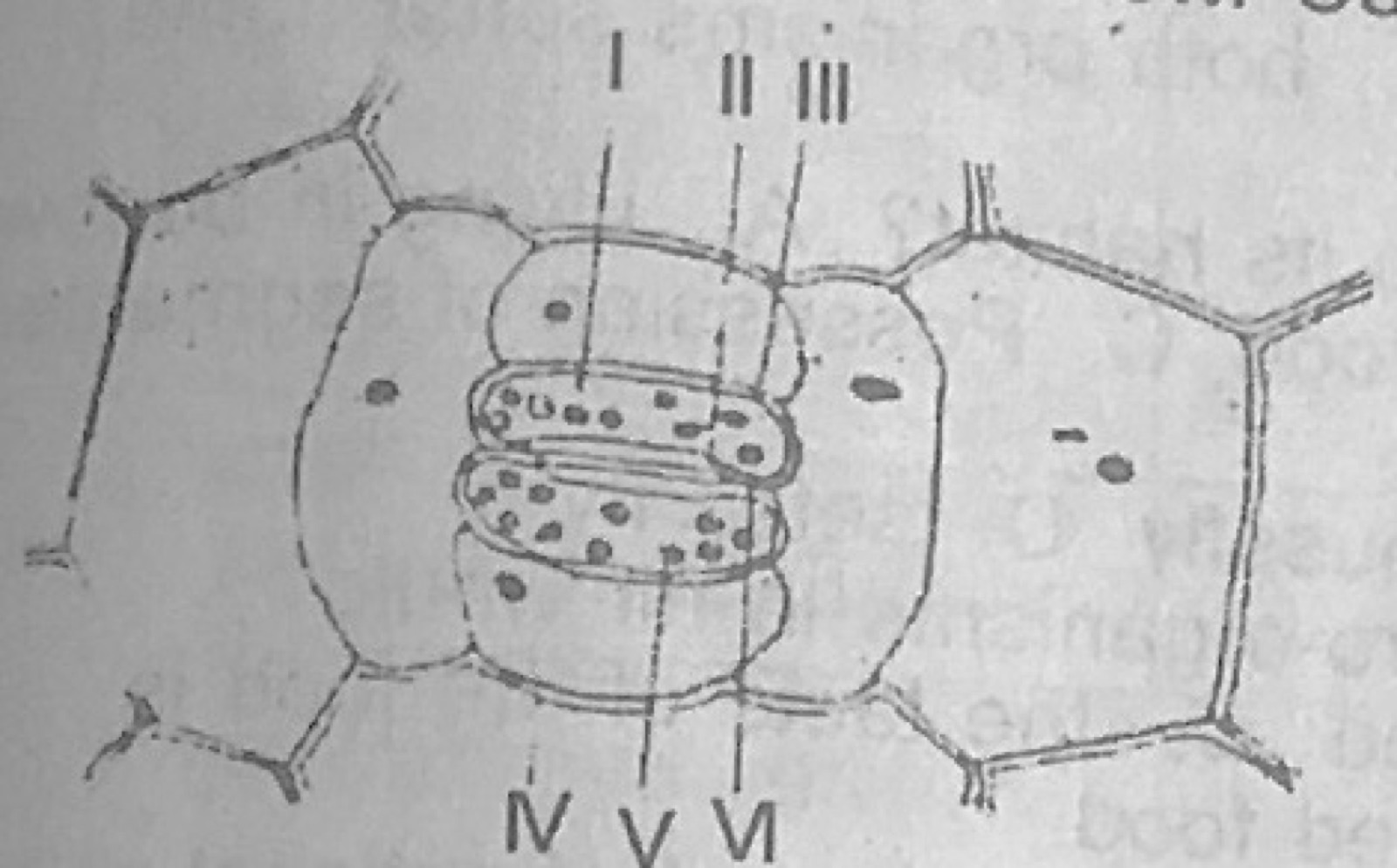
Which of the labelled structures in the diagram are involved with the entry of carbondioxide for photosynthesis?

Diagram for this question
  1. A.I, II and III only
  2. B.I, II, III and VI
  3. C.I, II, V and VI
  4. D.I, II, III, and IV
Show the answer and explanation

Answer: C (I, II, V and VI)

Explanation

Carbon dioxide enters through the stoma, which is controlled by the two guard cells; the labels on the guard cells and pore are I, II, V and VI.

Open this question

Question 18

Cell and Its Environment

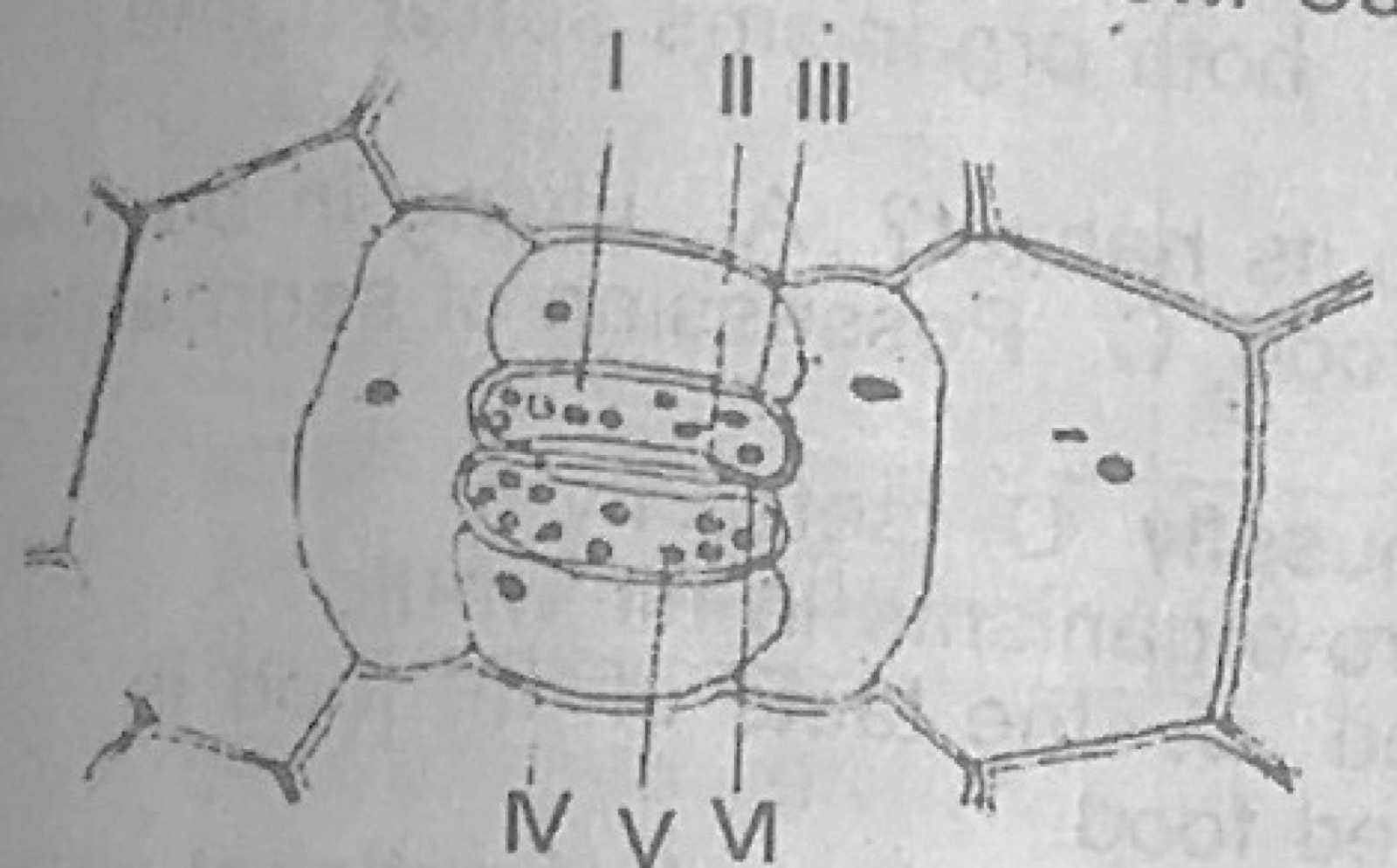
Which of the labelled structures in the diagram will shrink when plasmolysis occurs?

Diagram for this question
  1. A.I
  2. B.II
  3. C.III
  4. D.IV
Show the answer and explanation

Answer: A (I)

Explanation

I is a guard cell; in a strong solution it loses water, and its contents shrink away from the wall.

Open this question

Question 19

Transport in Plants

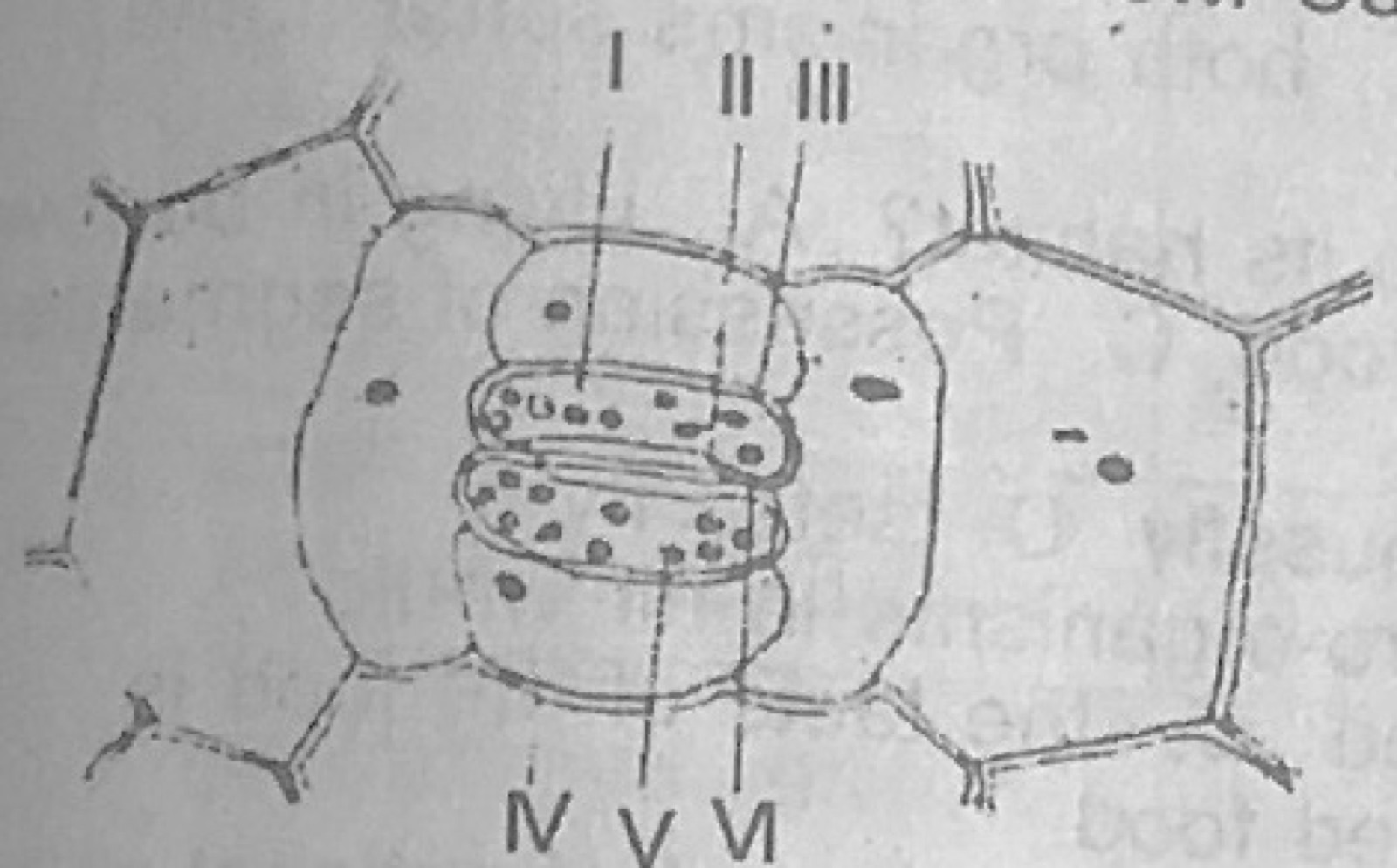
The condition shown in the above diagram is due to

Diagram for this question
  1. A.conversion of starch to sugar
  2. B.conversion of sugar to starch
  3. C.excess water in structure labelled I
  4. D.presence of carbondioxide in the structure labelled I
Show the answer and explanation

Answer: C (excess water in structure labelled I)

Explanation

The guard cells are swollen with water (turgid), which bends them apart and opens the stoma.

Open this question

Question 20

Cell and Its Environment

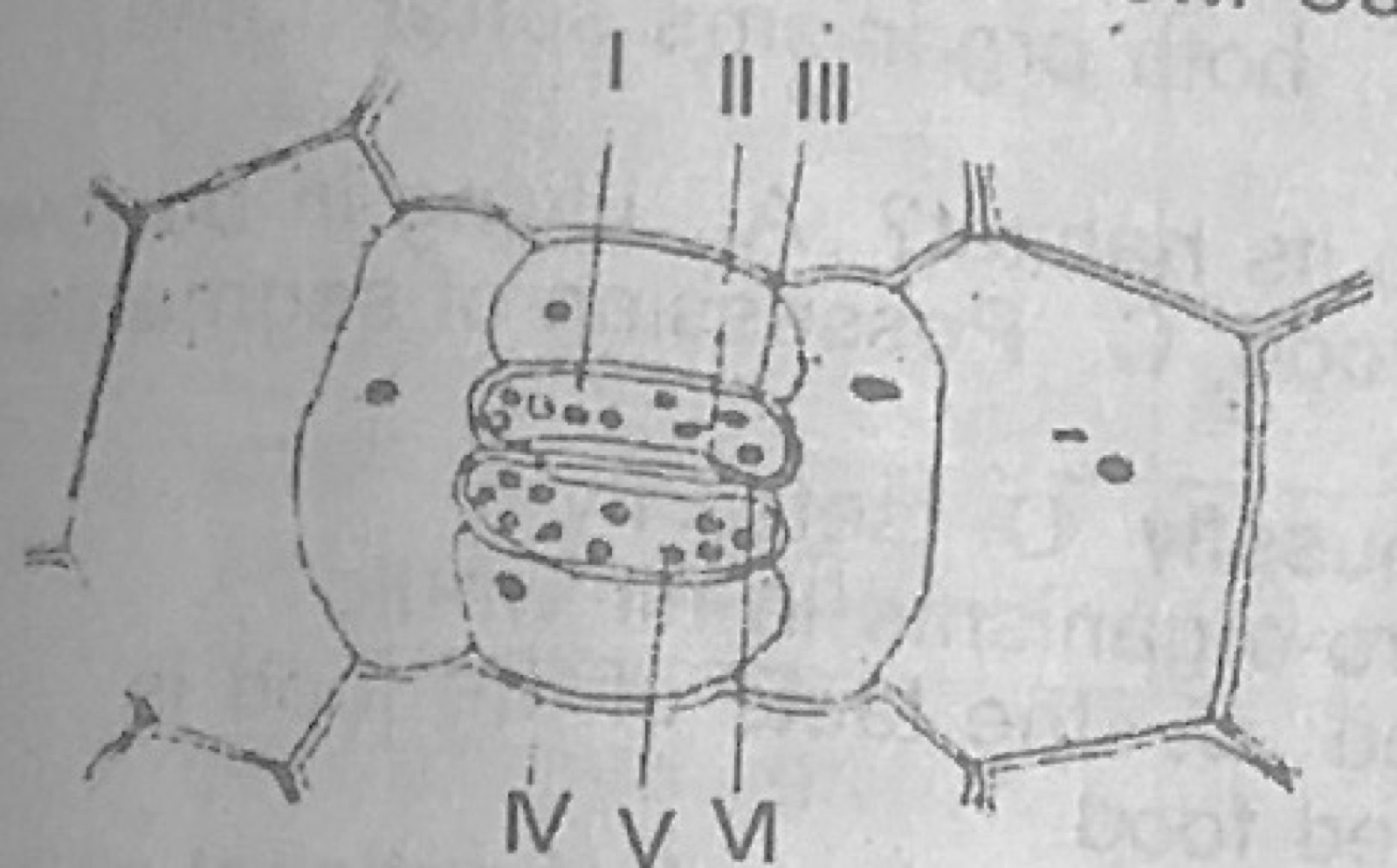
Which of the following solutions will induce the condition shown in the diagram?

Diagram for this question
  1. A.Hypertonic solution
  2. B.Hypotonic solution
  3. C.Isotonic solution
  4. D.Distilled water
Show the answer and explanation

Answer: B (Hypotonic solution)

Explanation

In a hypotonic (weaker) solution the guard cells take in water by osmosis, become turgid and open the stoma.

Open this question

Question 21

Homeostasis

Which of the following conditions will cause a decrease in body temperature?

  1. A.Increased metabolism
  2. B.Shivering
  3. C.Vasoconstriction of capillaries of the skin
  4. D.Relaxation of the erector muscles
Show the answer and explanation

Answer: D (Relaxation of the erector muscles)

Explanation

When the erector muscles relax, hairs lie flat and trap less air, so more heat is lost; the other options keep heat in or make heat.

Open this question

Question 23

Hormonal Coordination

Which of the following is responsible for the increased heart beat of a boy who saw a python? Increased production of

  1. A.adrenalin
  2. B.insulin
  3. C.pituitrin
  4. D.thyroxin
Show the answer and explanation

Answer: A (adrenalin)

Explanation

Fear makes the adrenal glands release adrenaline, the 'fight or flight' hormone that speeds up the heart.

Open this question

Question 24

Nervous Coordination

The nerves that arise from the brain are known as

  1. A.spinal nerves
  2. B.sacral nerves
  3. C.cranial nerves
  4. D.optic nerves
Show the answer and explanation

Answer: C (cranial nerves)

Explanation

Nerves that come straight from the brain are cranial nerves; spinal nerves come from the spinal cord.

Open this question

Question 25

Nervous Coordination

The neurone that relay the message of effector organs are called

  1. A.efferent neurones
  2. B.intermediate neurones
  3. C.afferent neurones
  4. D.spinal nerves
Show the answer and explanation

Answer: A (efferent neurones)

Explanation

Efferent (motor) neurones carry impulses from the central nervous system to effectors such as muscles and glands.

Open this question

Question 26

Nervous Coordination

Each neurone consists of the following structures except

  1. A.cell body
  2. B.dendrites
  3. C.axon
  4. D.white matter
Show the answer and explanation

Answer: D (white matter)

Explanation

White matter is a region of the brain and spinal cord made of many axons; it is not part of a single neurone.

Open this question

Question 27

Nervous Coordination

The simplest form of nervous pathway which links receptors with effectors is known as the

  1. A.relay neuron
  2. B.reflex arc
  3. C.motor nerves
  4. D.sensory nerves
Show the answer and explanation

Answer: B (reflex arc)

Explanation

A reflex arc is the shortest pathway: receptor, sensory neurone, relay neurone, motor neurone, effector.

Open this question

Question 28

Sense Organs

Which of the following parts of the eye is sensitive to light?

  1. A.Retina
  2. B.Cornea
  3. C.Choroid layer
  4. D.Optic nerves
Show the answer and explanation

Answer: A (Retina)

Explanation

The retina contains the light-sensitive rods and cones.

Open this question

Question 29

Reproduction in Plants

What happens to an ovule of a flower, after fertilization? It

  1. A.becomes a fruit
  2. B.withers away
  3. C.becomes a seed
  4. D.forms the cotyledons
Show the answer and explanation

Answer: C (becomes a seed)

Explanation

After fertilisation the ovule develops into a seed, while the ovary becomes the fruit.

Open this question

Question 30

Reproduction in Plants

Which of the following is not a dry indehiscent fruit?

  1. A.Legume
  2. B.Cypsela
  3. C.Samara
  4. D.Caryopsis
Show the answer and explanation

Answer: A (Legume)

Explanation

A legume (pod) splits open along two sides to release its seeds, so it is dehiscent.

Open this question

Question 31

Photosynthesis and Plant Nutrition

Which of the following groups consists of only micro-nutrients?

  1. A.Molybdenum, sulphur and copper
  2. B.Boron, Zinc and Calcium
  3. C.Manganese, molybdenum and zinc
  4. D.Magnesium, phosphorus and manganese
Show the answer and explanation

Answer: C (Manganese, molybdenum and zinc)

Explanation

Manganese, molybdenum and zinc are needed only in tiny amounts; sulphur, calcium, magnesium and phosphorus are macro-nutrients.

Open this question

Question 32

Photosynthesis and Plant Nutrition

The first stable product of photosynthesis is

  1. A.starch
  2. B.glucose
  3. C.oxygen
  4. D.water
Show the answer and explanation

Answer: B (glucose)

Explanation

Glucose (a simple sugar) is the first carbohydrate formed in photosynthesis; it is later changed to starch for storage.

Open this question

Question 33

Photosynthesis and Plant Nutrition

Which of the following statements about nitrogen is not correct? Nitrogen is needed for

  1. A.protein synthesis
  2. B.activating certain enzymes
  3. C.the synthesis of chlorophyll
  4. D.healthy vegetative growth of plants
Show the answer and explanation

Answer: B (activating certain enzymes)

Explanation

Nitrogen is built into proteins and chlorophyll and so promotes leafy growth; activating enzymes is a role of elements such as magnesium and potassium.

Open this question

Question 34

Photosynthesis and Plant Nutrition

A very poor growth in plants and discolouration of leaves signifies the deficiency of

  1. A.calcium
  2. B.magnesium
  3. C.potassium
  4. D.manganese
Show the answer and explanation

Answer: B (magnesium)

Explanation

Magnesium is part of chlorophyll; without it leaves turn yellow (chlorosis) and growth is poor.

Open this question

Question 35

Food Substances and Enzymes

Vitamin C which is water soluble is

  1. A.cabalamine
  2. B.pyridoxine
  3. C.ascorbic acid
  4. D.riboflavine
Show the answer and explanation

Answer: C (ascorbic acid)

Explanation

The chemical name of vitamin C is ascorbic acid.

Open this question

Question 36

Food Substances and Enzymes

Vitamin C deficiency results in

  1. A.ricket
  2. B.beri-beri
  3. C.scurvy
  4. D.pellagra
Show the answer and explanation

Answer: C (scurvy)

Explanation

Lack of vitamin C causes scurvy, with bleeding gums and slow healing of wounds.

Open this question

Question 37

Food Substances and Enzymes

Members of the vitamin B complex are

  1. A.water-soluble
  2. B.fat-soluble
  3. C.water insoluble
  4. D.generally insoluble
Show the answer and explanation

Answer: A (water-soluble)

Explanation

The B vitamins, like vitamin C, dissolve in water; vitamins A, D, E and K are fat-soluble.

Open this question

Question 39

Food Substances and Enzymes

Vitamin E is concerned with

  1. A.bone formation
  2. B.reproduction
  3. C.normal growth
  4. D.formation of red blood cells
Show the answer and explanation

Answer: B (reproduction)

Explanation

Vitamin E is known as the anti-sterility vitamin; lack of it affects fertility in experimental animals.

Open this question

Question 40

Food Substances and Enzymes

A balanced meal for an adult person may consist of

  1. A.two pieces of chicken, four balls of bean cake, two eggs and two cups of tea with milk
  2. B.four slices of bread, one bowl of pap, two oranges and two bananas
  3. C.four slices of yam and stew, two pieces of beef, one cup of tea with milk and two oranges
  4. D.a plate of beans, two pieces of meat, two eggs, one cup of tea with milk and two oranges
Show the answer and explanation

Answer: C (four slices of yam and stew, two pieces of beef, one cup of tea with milk and two oranges)

Explanation

Option C has carbohydrate (yam), protein (beef, milk), fat and oil (stew) and vitamins (oranges) in sensible amounts; A and D are mostly protein and B lacks protein.

Open this question

Question 41

Food Substances and Enzymes

Which of the following food substances turns bright red when warmed with suddan III solution?

  1. A.Starch
  2. B.Reducing sugar
  3. C.Protein
  4. D.Fat
Show the answer and explanation

Answer: D (Fat)

Explanation

Sudan III is a red dye that dissolves in fats and oils, staining them red.

Open this question

Question 42

Food Substances and Enzymes

Mammals require a relatively high amount of carbohydrates because

  1. A.they maintain the weight of the body
  2. B.they are required for growth
  3. C.they initiate enzyme production
  4. D.they yield energy for activities
Show the answer and explanation

Answer: D (they yield energy for activities)

Explanation

Carbohydrates are the body's main source of energy for daily activities.

Open this question

Question 43

Ecosystem and Ecological Factors

All the available places on earth which support life constitute the

  1. A.lithosphere
  2. B.atmosphere
  3. C.biosphere
  4. D.hydrosphere
Show the answer and explanation

Answer: C (biosphere)

Explanation

The biosphere is the whole part of the earth (land, water and air) where living things are found.

Open this question

Question 44

Habitats and Biomes

The abiotic factor which determines the depth to which light penetrates in a pond is

  1. A.current
  2. B.turbidity
  3. C.wind
  4. D.salinity
Show the answer and explanation

Answer: B (turbidity)

Explanation

Turbidity is the cloudiness of water; the more suspended particles, the less deep light reaches.

Open this question

Question 45

Feeding Relationships and Energy Flow

Which of the following organisms is a producer?

  1. A.Spirogyra
  2. B.Mucor
  3. C.Rhizopus
  4. D.Yeast
Show the answer and explanation

Answer: A (Spirogyra)

Explanation

Spirogyra is a green alga that makes food by photosynthesis; the others are fungi.

Open this question

Question 46

Feeding Relationships and Energy Flow

Which of the following groups consists of heterotrophs?

  1. A.Mucor, chlamydomonas and Euglena
  2. B.Spirogyra, Mucor and Mushroom
  3. C.Man, Mucor and Mushroom
  4. D.Man, Maize and Cowpea
Show the answer and explanation

Answer: C (Man, Mucor and Mushroom)

Explanation

Man and fungi such as Mucor and mushrooms cannot make their own food; the other groups include green organisms.

Open this question

Question 47

Nutrient Cycling

Which of the following organisms will not bring about decomposition?

  1. A.Earthworm
  2. B.Bacterium
  3. C.Mould
  4. D.Spirogyra
Show the answer and explanation

Answer: D (Spirogyra)

Explanation

Spirogyra is a green alga that makes its own food; bacteria, moulds and earthworms break down dead matter.

Open this question

Question 48

Nutrient Cycling

Which of the following is not released during decay of living matter?

  1. A.Ammonia
  2. B.Oxygen
  3. C.Carbon dioxide
  4. D.Heat energy
Show the answer and explanation

Answer: B (Oxygen)

Explanation

Decomposers use up oxygen as they respire and release carbon dioxide, ammonia and heat.

Open this question

Question 49

Ecological Associations

In commensalism

  1. A.one of the organisms gains and the other loses
  2. B.both organisms benefit from the association
  3. C.one of the organisms gains while the other neither gains nor loses
  4. D.one of the organisms produces extra cellular digestive juices
Show the answer and explanation

Answer: C (one of the organisms gains while the other neither gains nor loses)

Explanation

In commensalism one partner benefits and the other is neither helped nor harmed.

Open this question

Question 50

Ecological Associations

Parasitism can best be defined as an association between two organisms in which

  1. A.both organisms benefit
  2. B.one organism gains and the other neither gains nor loses
  3. C.both organisms suffer some disadvantages
  4. D.one organism gains and the other loses
Show the answer and explanation

Answer: D (one organism gains and the other loses)

Explanation

A parasite benefits by feeding on its host, which is harmed.

Open this question

Question 51

Adaptation

Which of the following best describes the adaptation of the earthworm to its habitat?

  1. A.Living in burrow during the day to prevent desiccation
  2. B.Burrowing into soft soil to store food
  3. C.Possession of segmented body to reduce movement
  4. D.Possession of a few bristles for defence
Show the answer and explanation

Answer: A (Living in burrow during the day to prevent desiccation)

Explanation

The earthworm breathes through a moist skin, so it stays in its burrow by day to avoid drying out.

Open this question

Question 52

Microorganisms and Health

Trypanosomiasis is associated with

  1. A.cockcroach
  2. B.mosquito
  3. C.housefly
  4. D.tsetse fly
Show the answer and explanation

Answer: D (tsetse fly)

Explanation

Trypanosomiasis (sleeping sickness) is spread by the bite of the tsetse fly.

Open this question

Question 53

Microorganisms and Health

The major reason why foods should be properly covered is that

  1. A.micro-organisms in air would contaminate the food
  2. B.hot foods cool off easily when properly covered
  3. C.the taste of the food is maintained when covered
  4. D.all water easily evaporates from uncovered food
Show the answer and explanation

Answer: A (micro-organisms in air would contaminate the food)

Explanation

Covering food keeps out germs, dust and flies that carry disease.

Open this question

Question 54

Conservation of Natural Resources

Which of the following is not a means of conserving natural resources?

  1. A.Establishment of national parks
  2. B.Selective logging
  3. C.Building of dams
  4. D.Bush burning
Show the answer and explanation

Answer: D (Bush burning)

Explanation

Bush burning destroys plants, animals and soil organic matter; the others protect or manage resources.

Open this question

Question 55

Conservation of Natural Resources

Which of the following resources is non-renewable?

  1. A.Forest
  2. B.Wildlife
  3. C.Mineral deposits
  4. D.Water
Show the answer and explanation

Answer: C (Mineral deposits)

Explanation

Mineral deposits took millions of years to form and cannot be replaced once used up.

Open this question

Question 56

Mendelian Inheritance

Character which falls to express itself in the first filial generation but emerges in the second is

  1. A.heterozygote
  2. B.homozygote
  3. C.dominant
  4. D.recessive
Show the answer and explanation

Answer: D (recessive)

Explanation

A recessive character is hidden by the dominant one in the F1 and reappears in a quarter of the F2.

Open this question

Question 57

Evolution

The concept of use and disuse of parts was postulated by

  1. A.Darwin
  2. B.Larmarck
  3. C.Miller
  4. D.Wallace
Show the answer and explanation

Answer: B (Larmarck)

Explanation

Lamarck's theory said organs that are used develop and unused ones waste away.

Open this question

Question 58

Mendelian Inheritance

Which of the following represents Mendel's second law of inheritance? The factors for two pairs of contrasting characters are

  1. A.dependent on each other
  2. B.on homologous chromosomes
  3. C.allelomorphic
  4. D.inherited independently of each other
Show the answer and explanation

Answer: D (inherited independently of each other)

Explanation

Mendel's second law (independent assortment) says each pair of factors is passed on independently of the other pair.

Open this question

Question 59

Variation

Which of the following terms is not associated with fingerprint and classification?

  1. A.Whorl
  2. B.Contour
  3. C.Arch
  4. D.Loop
Show the answer and explanation

Answer: B (Contour)

Explanation

Fingerprints are classed as arches, loops and whorls (and compound); 'contour' is not a fingerprint type.

Open this question

Question 60

Transport in Animals

During blood transfusion, agglutination could be prevented if a patient having blood group O is given blood from group

  1. A.AB
  2. B.A
  3. C.O
  4. D.B
Show the answer and explanation

Answer: C (O)

Explanation

Group O plasma has both anti-A and anti-B antibodies, so a group O person can safely receive only group O blood.

Open this question

Theory question 101

Sense Organs

(a) What is a sense organ?
(b) (i) State two main functions of the ear (ii) Explain the mechanism involved in one of the functions stated in (b) (i) above
(c) With the aid of a large labelled diagram illustrate the eye defect of short-sight and its correction

Show the model answer
Model answer

(a) A sense organ is an organ with receptor cells that detect a particular stimulus (e.g. light, sound) and send impulses to the brain.
(b)(i) Hearing; balance (maintaining posture).
(ii) Hearing: sound waves enter the outer ear and make the eardrum vibrate; the ossicles (malleus, incus, stapes) pass and amplify the vibrations to the oval window; this sets the fluid in the cochlea vibrating, which stimulates sensory hair cells; impulses travel along the auditory nerve to the brain, which interprets the sound.
OR Balance: movement of the head moves the fluid (endolymph) in the semicircular canals, utriculus and sacculus; this bends sensory hairs in the ampullae, which send impulses through the auditory nerve to the cerebellum, which keeps the body balanced.
(c) Diagram 1: light rays from a distant object focused in front of the retina because the eyeball is too long (or the lens too thick/curved). Diagram 2: a concave (diverging) lens placed in front of the eye spreads the rays so they focus on the retina. Labels: eye lens, retina, point of focus, concave lens, light rays; title and neat labelling.

Explanation

Short sight: image in front of the retina, corrected with a concave lens.

Open this question

Theory question 102

Reproduction in Plants

(a) State five different methods used in vegetative propagation in plants giving an example in each case
(b) State five (i) advantages and (ii) disadvantages of vegetative propagation

Show the model answer
Model answer

(a) Any five with example: stem cuttings – cassava, sugarcane; grafting – citrus, mango; budding – citrus, rubber; layering (marcotting) – hibiscus, cocoa; suckers – banana, plantain; tubers – yam (stem tuber), sweet potato (root tuber); rhizomes – ginger; corms – cocoyam; bulbs – onion; runners/stolons – grass; leaves – Bryophyllum.
(b)(i) Advantages (any five): offspring are exactly like the parent, so good qualities are kept; plants mature and yield faster; no need for pollination or seeds; useful for plants that produce few or no viable seeds; the food store in the organ helps young plants survive; a quick way to get many plants.
(ii) Disadvantages (any five): no variation, so no new better varieties; diseases of the parent are passed on; overcrowding near the parent and competition; propagating materials are bulky to store and carry; they may not keep long (rot); poor adaptation to changing environments.

Explanation

Pair each method with a crop example.

Open this question

Theory question 103

Food Substances and Enzymes

(a) List five classes of food other than carbohydrates
(b) Explain why glucose is taken by an athlete ready for a race rather than corn meal
(c) Describe the test for starch

Show the model answer
Model answer

(a) Proteins; fats and oils (lipids); vitamins; mineral salts; water; (roughage).
(b) Glucose is a simple sugar that needs no digestion; it is absorbed directly into the blood and quickly respired to release energy. Corn meal contains starch, which must first be digested to glucose, so its energy is released slowly.
(c) Put a little of the food (or a few cm3 of its solution) in a test tube or on a tile; add a few drops of iodine solution; a blue-black colour shows that starch is present (the iodine stays brown if starch is absent).

Explanation

Glucose = quick energy because no digestion is needed.

Open this question

Theory question 104

Cell Structure and Organisation

(a) (i) Name the four levels of organisation in living organisms (ii) Explain two of the levels of organisations named in (a) (i) above. (iii) State the level of organisation of Euglena, onion bulb and blood
(b) Give four advantages of complexity of organisation in higher organisms.
(c) (i) State one advantage Amoeba has over a cell of a lizard, in relation to their levels of organisation (ii) Give two reasons for the advantage.

Show the model answer
Model answer

(a)(i) Cell; tissue; organ; system (organ system). (Organism may also be named.)
(ii) Any two: cell – the basic unit of life that can carry out all life processes, e.g. Amoeba; tissue – a group of similar cells doing the same job, e.g. xylem, epithelium; organ – several tissues working together for a function, e.g. heart, leaf; system – several organs working together, e.g. digestive system.
(iii) Euglena – cell level; onion bulb – organ level; blood – tissue level.
(b) Any four: division of labour – each part specialises and works more efficiently; organisms can grow larger; better adaptation to many environments; cells can specialise (e.g. nerve, muscle); body is less affected by small changes outside (internal environment controlled); injury to some cells is not fatal; longer life span.
(c)(i) Amoeba can live on its own and carry out all life processes, while a lizard's cell cannot survive alone (it is specialised).
(ii) Any two: Amoeba is a complete organism; it has a large surface area to volume ratio for diffusion of food, gases and wastes; it is not specialised, so it feeds, respires, excretes and reproduces by itself; a lizard cell depends on other cells/tissues for food and removal of waste.

Explanation

Cell → tissue → organ → system → organism.

Open this question

Theory question 105

Nutrient Cycling

(a) Describe the water cycle using an annotated diagram(s) only
(b) What is the importance of water to living organisms?

Show the model answer
Model answer

(a) Annotated diagram showing: water evaporates from seas, rivers and soil (sun's heat); transpiration from plants and respiration/sweating of animals add water vapour; vapour rises, cools and condenses into clouds; precipitation as rain, snow or hail; water runs off into rivers and seas, or soaks into the soil (infiltration) to form ground water, which is absorbed by roots; arrows linking each step in a cycle.
(b) Any: main part of protoplasm; solvent in which reactions take place; raw material for photosynthesis; medium of transport (blood, sap); keeps body temperature steady (sweating, transpiration); keeps plant cells turgid for support; habitat for aquatic organisms; needed for germination; medium for fertilisation in some organisms; removes wastes (urine); lubrication (synovial fluid, mucus).

Explanation

In (a) use labelled arrows only, as the question asks for a diagram.

Open this question

Theory question 106

Cell and Its Environment

(a) Explain the term osmosis
(b) Describe an experiment to show that the xylem tissue conducts water from the root to the shoot
(c) (i) Explain what happens to a red blood cell when placed in a hypotonic solution (ii) Mention three conditions that may cause haemolysis.

Show the model answer
Model answer

(a) Osmosis is the movement of water molecules from a dilute solution (high water concentration) to a more concentrated solution (low water concentration) through a semi-permeable membrane.
(b) Place a leafy shoot (e.g. Balsam) or uprooted seedling with its roots in water coloured with eosin (red dye) for a few hours. Cut transverse sections of the stem/root and look at them under a microscope (or hand lens). Only the xylem vessels are stained red, showing that water moves up through the xylem. (A control in plain water shows no stain.)
(c)(i) Water enters the red blood cell by osmosis because the solution outside is more dilute than its cytoplasm; the cell swells and, having no cell wall, bursts (haemolysis), releasing haemoglobin.
(ii) Any three: placing red cells in a hypotonic solution or distilled water; some snake venoms; malaria parasites; incompatible blood transfusion; some bacterial toxins/chemicals; sickle-cell crisis.

Explanation

Red cells have no wall, so in a weak solution they burst.
Open this question