WAEC Agricultural Science 2021 past questions and answers

55 questions. Try each one, then open the answer to check yourself and read the explanation.

Question 1

Introduction to Agriculture

The branch of crop science which deals with the study of insect pests is

  1. A.zoology.
  2. B.agronomy
  3. C.entomology.
  4. D.pathology.
Show the answer and explanation

Answer: C (entomology.)

Explanation

Entomology is the study of insects.

Open this question

Question 2

Classification of Farm Animals

Horse racing and polo are events where horses are used for

  1. A.wildlife conservation.
  2. B.recreation.
  3. C.dowry payment.
  4. D.transportation.
Show the answer and explanation

Answer: B (recreation.)

Explanation

Racing and polo are sports, a form of recreation.

Open this question

Question 3

Agricultural Development

The construction of rural feeder roads solves the following access problems in agriculture except

  1. A.marketing.
  2. B.transportation.
  3. C.extension services.
  4. D.land tenure system.
Show the answer and explanation

Answer: D (land tenure system.)

Explanation

Roads help move produce and extension staff, but they do not change how land is owned.

Open this question

Question 4

Farm Machinery and Mechanisation

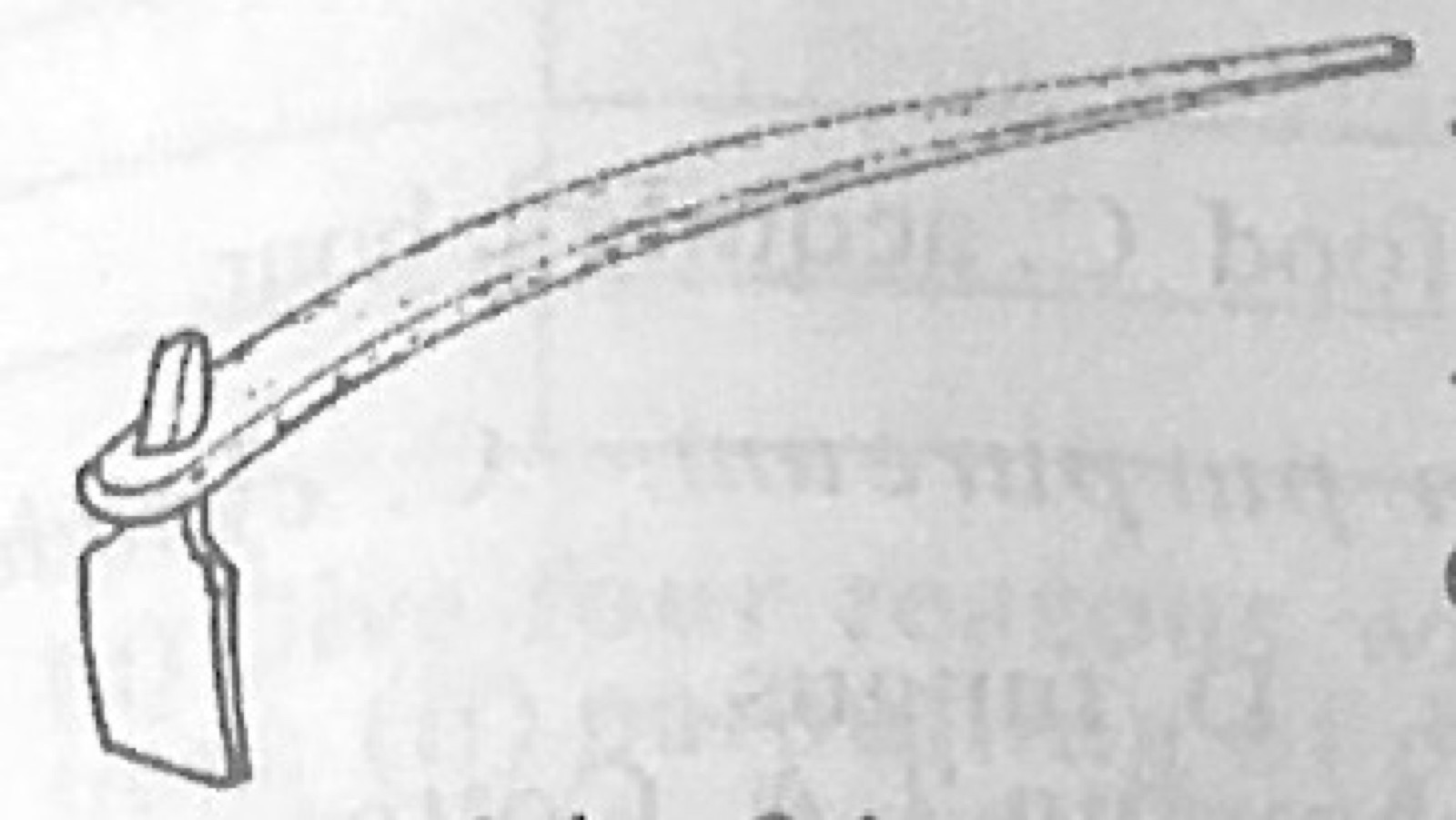
The diagram below illustrates a farm tool.
The illustrated farm tool is used for

Diagram for this question
  1. A.making mounds.
  2. B.transplanting seedlings.
  3. C.cutting trees
  4. D.pruning hedges.
Show the answer and explanation

Answer: A (making mounds.)

Explanation

The drawing is a hoe, used to make mounds and ridges.

Open this question

Question 5

Farm Machinery and Mechanisation

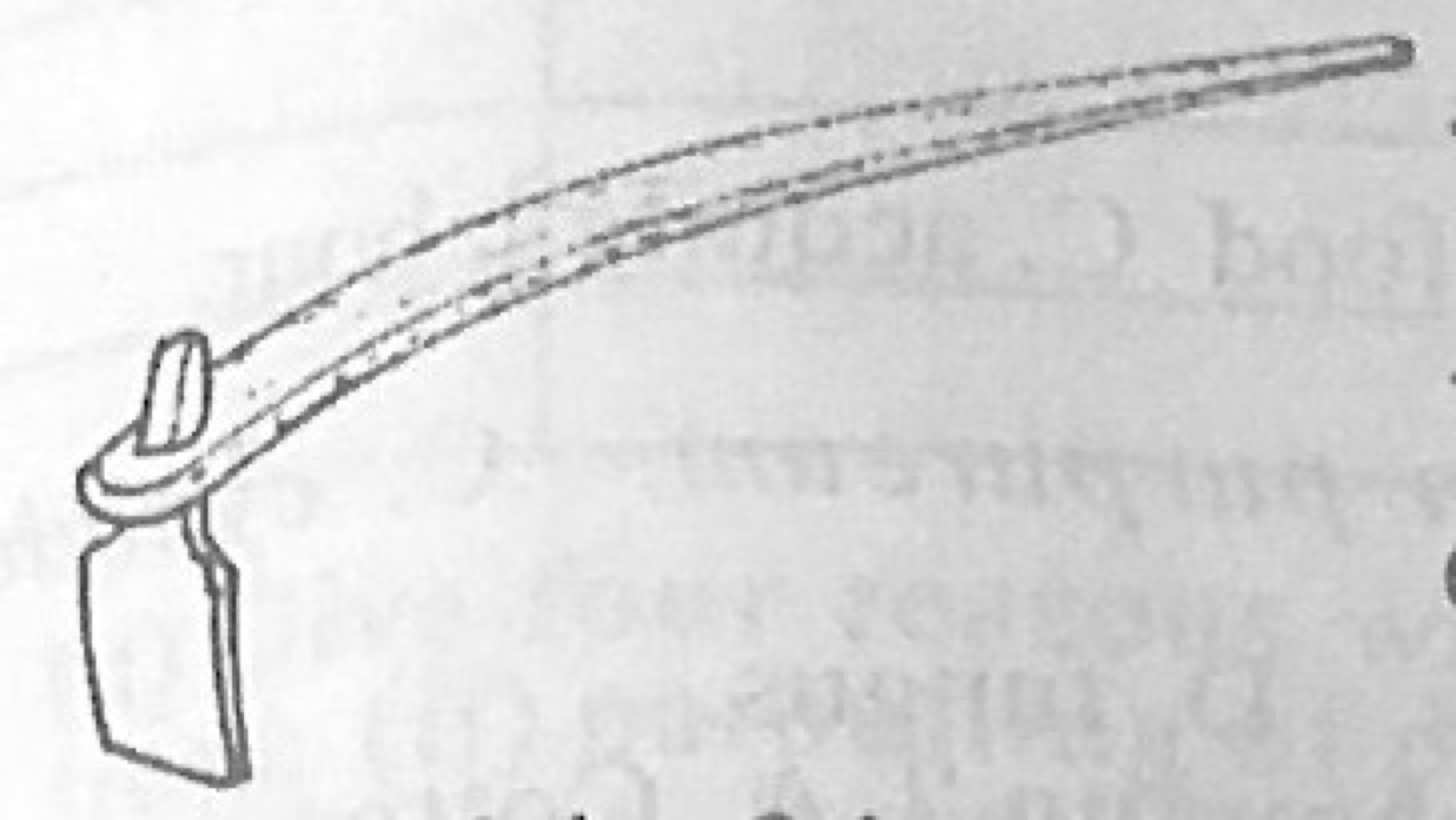
The diagram below illustrates a farm tool.
The farm implement that could perform a similar function as the illustrated tool is

Diagram for this question
  1. A.plough.
  2. B.harrow.
  3. C.ridger.
  4. D.cultivator.
Show the answer and explanation

Answer: C (ridger.)

Explanation

A ridger makes ridges/heaps of soil, the same job as the hoe.

Open this question

Question 6

Farm Machinery and Mechanisation

A tractor-mounted sprayer used on large-scale farms is the

  1. A.electrodyne sprayer.
  2. B.motorized sprayer.
  3. C.knapsack sprayer.
  4. D.boom sprayer.
Show the answer and explanation

Answer: D (boom sprayer.)

Explanation

A boom sprayer has a long boom of nozzles mounted on a tractor.

Open this question

Question 7

Farm Power

Which of the following types of farm power does not cause pollution?

  1. A.Hydro
  2. B.Electrical
  3. C.Mechanical
  4. D.Chemical
Show the answer and explanation

Answer: A (Hydro)

Explanation

Water (hydro) power burns no fuel and gives no fumes.

Open this question

Question 8

Farm Surveying and Planning

In planning a farmstead, the structure which should be located on high elevation is the

  1. A.fish pond.
  2. B.pigsty.
  3. C.farmhouse.
  4. D.processing shed.
Show the answer and explanation

Answer: C (farmhouse.)

Explanation

The farmhouse goes on high ground for a view of the farm, good drainage and fresh air.

Open this question

Question 9

Agricultural Ecology

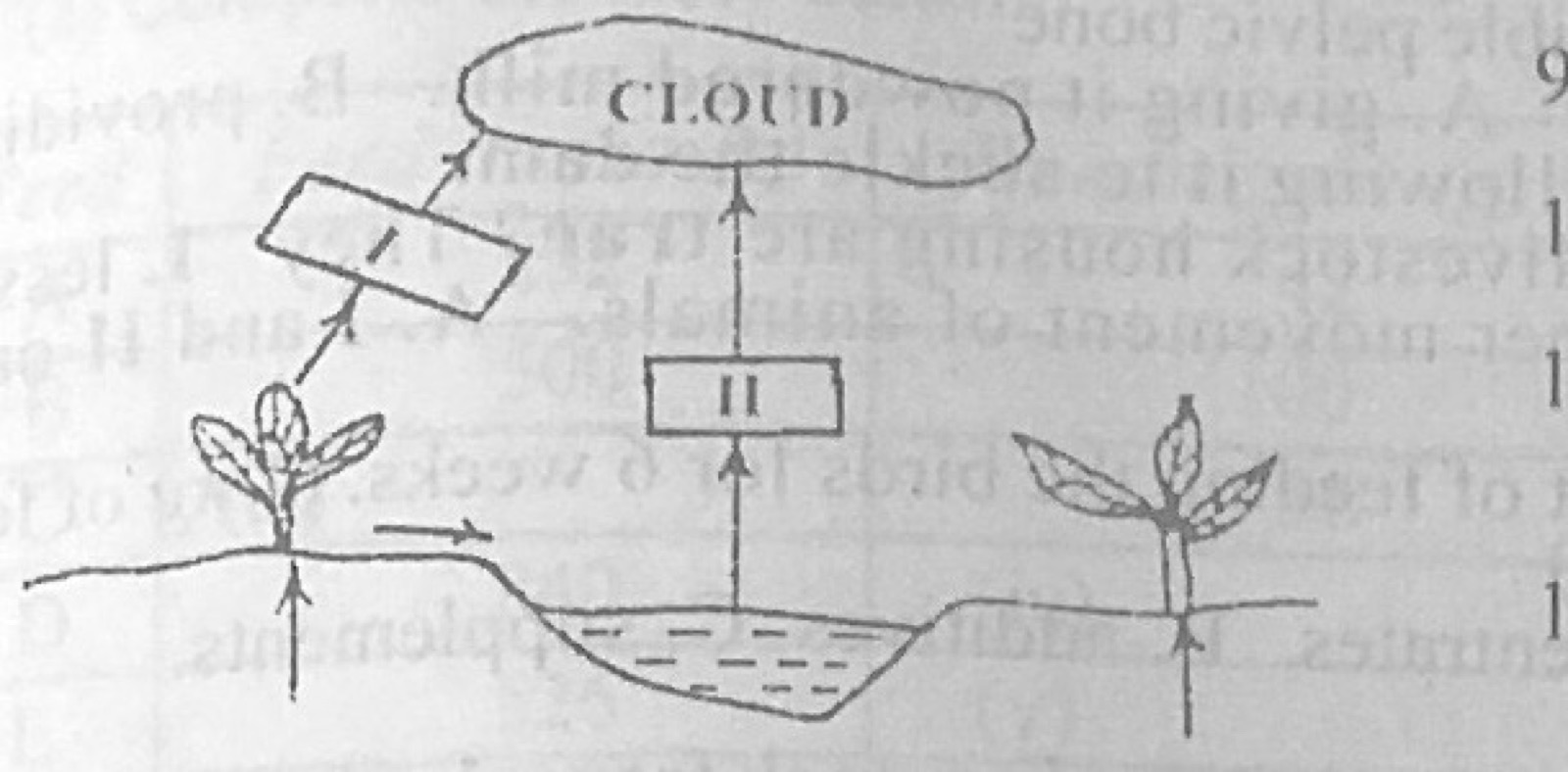
The diagram below illustrates processes in the water cycle.
The process labelled I is

Diagram for this question
  1. A.evaporation.
  2. B.absorption.
  3. C.respiration
  4. D.transpiration.
Show the answer and explanation

Answer: D (transpiration.)

Explanation

I is water vapour leaving the plant: transpiration.

Open this question

Question 10

Agricultural Ecology

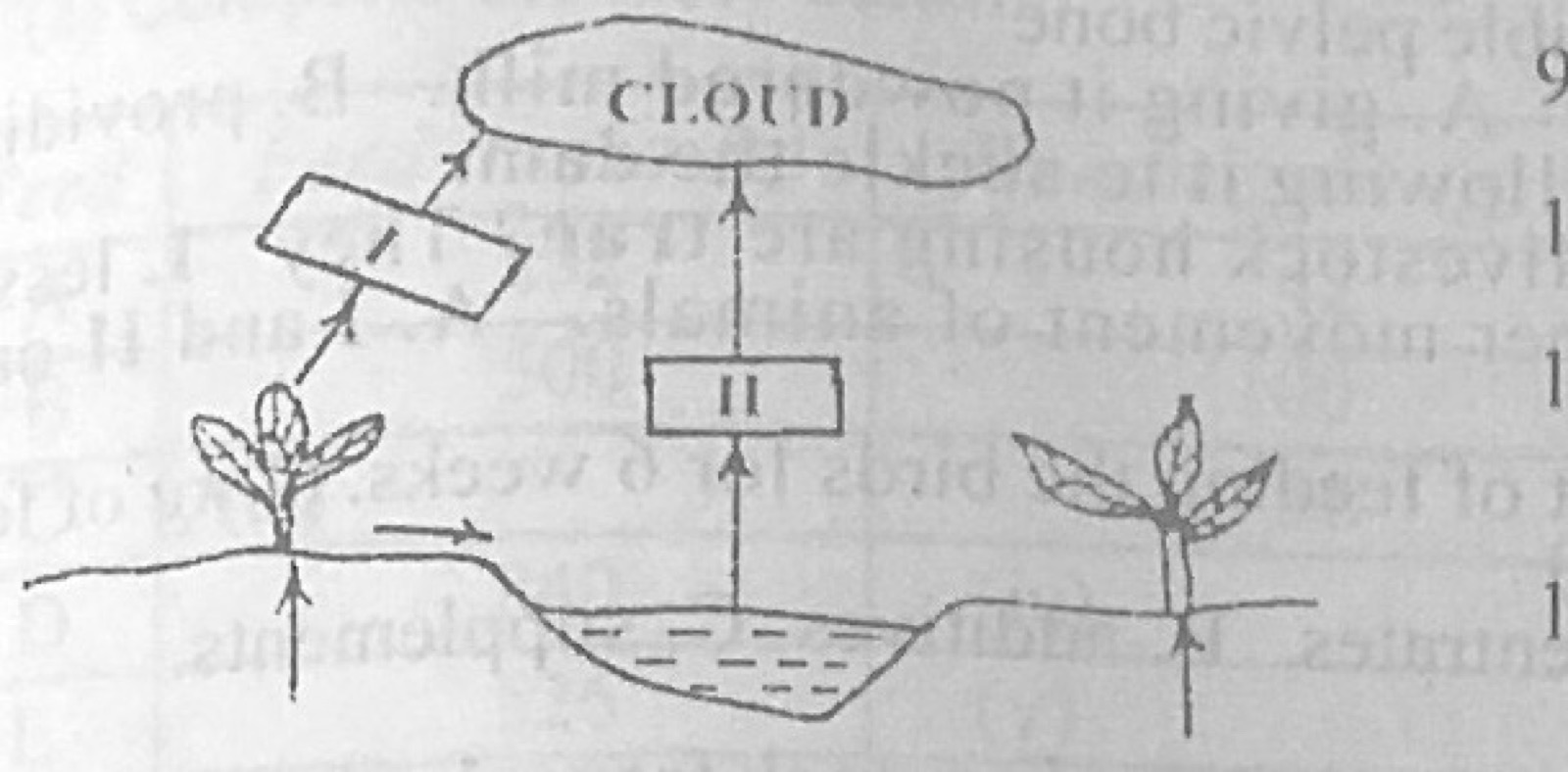
The diagram below illustrates processes in the water cycle.
The process labelled II is

Diagram for this question
  1. A.transpiration.
  2. B.condensation
  3. C.evaporation.
  4. D.respiration.
Show the answer and explanation

Answer: C (evaporation.)

Explanation

II is water vapour rising from the pond: evaporation.

Open this question

Question 11

Agricultural Ecology

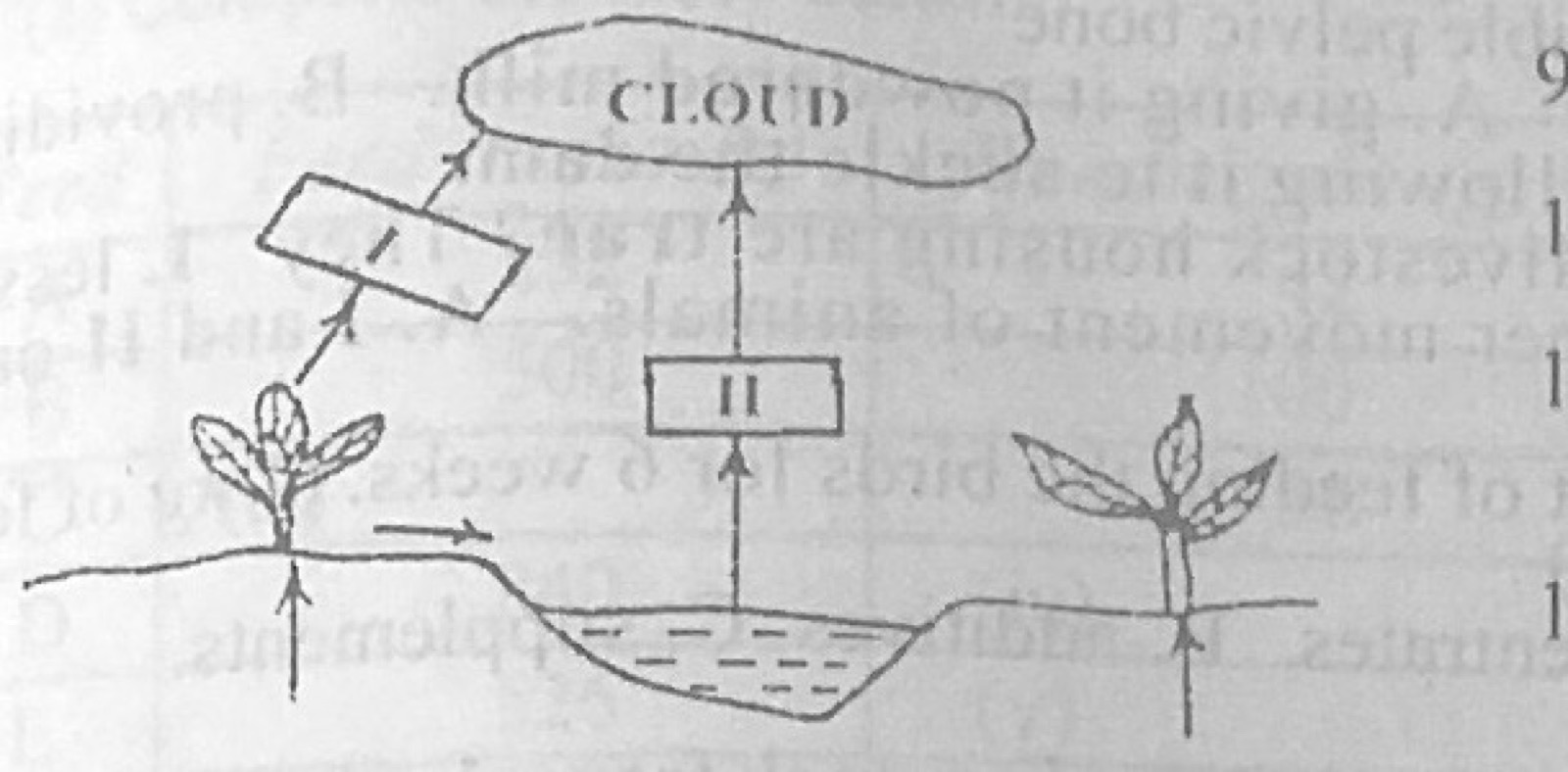
The diagram below illustrates processes in the water cycle.
The major source of water to the plants in the diagram is

Diagram for this question
  1. A.gravitational water.
  2. B.hygroscopic water
  3. C.capillary water.
  4. D.surface water.
Show the answer and explanation

Answer: C (capillary water.)

Explanation

Plants absorb mainly capillary water held in the soil pores.

Open this question

Question 12

Rocks and Soil Formation

The new rock formed when limestone is subjected to great heat and pressure is

  1. A.slate
  2. B.graphite
  3. C.marble
  4. D.gneiss.
Show the answer and explanation

Answer: C (marble)

Explanation

Limestone changes into marble, a metamorphic rock.

Open this question

Question 13

Agricultural Development

Which of the following pairs of raw materials is used in the canning industry?

  1. A.Meat and fish
  2. B.Cotton and tea
  3. C.Hide and skin
  4. D.pulpwood and cocoa
Show the answer and explanation

Answer: A (Meat and fish)

Explanation

Meat and fish are commonly preserved in cans.

Open this question

Question 14

Soil Properties

Microorganisms that decompose organic matter will function best under

  1. A.waterlogged soil condition.
  2. B.anaerobic soil condition
  3. C.low soil temperature
  4. D.optimum soil pH.
Show the answer and explanation

Answer: D (optimum soil pH.)

Explanation

Decomposers work best in warm, aerated soil of suitable pH.

Open this question

Question 15

Soil Properties

In an experiment to determine the percentage of organic matter in a soil sample, the following data was collected: weight of oven-dried soil before burning = 50g. Weight of oven-dried soil after burning = 28g
Calculate the weight of organic matter in the soil.

  1. A.11g
  2. B.22g
  3. C.44g
  4. D.78g
Show the answer and explanation

Answer: B (22g)

Explanation

Organic matter burnt off = 50 − 28 = 22 g.

Open this question

Question 16

Soil Properties

In an experiment to determine the percentage of organic matter in a soil sample, the following data was collected: weight of oven-dried soil before burning = 50g. Weight of oven-dried soil after burning = 28g
Determine the percentage of organic matter in the soil.

  1. A.22%
  2. B.44%
  3. C.56%
  4. D.60%
Show the answer and explanation

Answer: B (44%)

Explanation

22 ÷ 50 × 100 = 44%.

Open this question

Question 17

Soil Properties

Which of the following practices will improve clay soil?

  1. A.Use of acid-forming fertilizers
  2. B.Bush burning
  3. C.Addition of sodium chloride
  4. D.Addition of organic material
Show the answer and explanation

Answer: D (Addition of organic material)

Explanation

Organic matter opens up clay, improving drainage and aeration.

Open this question

Question 18

Farming Systems

A farmer practices crop rotation in order to

  1. A.reduce yield.
  2. B.improve soil texture
  3. C.increase pest incidence
  4. D.improve soil fertility.
Show the answer and explanation

Answer: D (improve soil fertility.)

Explanation

Rotation, especially with legumes, keeps the soil fertile.

Open this question

Question 19

Soil Fertility and Plant Nutrition

The phosphorus cycle is described as being sedimentary because phosphorus

  1. A.is a macroelement.
  2. B.is an earthbound element.
  3. C.is solid at room temperature.
  4. D.occurs in the atmosphere.
Show the answer and explanation

Answer: B (is an earthbound element.)

Explanation

Phosphorus cycles through rocks, soil and water, not the air.

Open this question

Question 20

Crop Husbandry

The following factors are essential for maize production except

  1. A.high temperature
  2. B.low temperature
  3. C.relative humidity
  4. D.adequate rainfall.
Show the answer and explanation

Answer: B (low temperature)

Explanation

Maize grows best in warm conditions, so low temperature is the odd one out.

Open this question

Question 21

Processing and Storage of Farm Produce

Drying of newly harvested grains before storage helps to increase the

  1. A.moisture content.
  2. B.pest incidence.
  3. C.seed viability.
  4. D.nutrient content.
Show the answer and explanation

Answer: C (seed viability.)

Explanation

Dry seeds stay alive longer in store.

Open this question

Question 22

Processing and Storage of Farm Produce

Yams stored in a barn should be inspected at least once a week in order to

  1. A.remove irregular shaped tubers.
  2. B.control termite attack.
  3. C.prevent mouldiness in yam.
  4. D.remove sprouts and rotten tubers.
Show the answer and explanation

Answer: D (remove sprouts and rotten tubers.)

Explanation

Regular checks remove sprouts and rotten yams before rot spreads.

Open this question

Question 23

Plant Forms and Crop Classification

The botanical name of onion is

  1. A.Zea mays.
  2. B.Oryza sativa.
  3. C.Carica papaya
  4. D.Allium cepa.
Show the answer and explanation

Answer: D (Allium cepa.)

Explanation

Onion is Allium cepa.

Open this question

Question 24

Land Preparation and Cultural Practices

Okro seeds are sown on 0.72 hectares of farmland at a spacing of 60 cm by 60 cm. Calculate the expected plant population.

  1. A.3,600 plants
  2. B.7,200 plants
  3. C.10,000 plants
  4. D.20,000 plants
Show the answer and explanation

Answer: D (20,000 plants)

Explanation

0.72 ha = 7,200 m²; each plant has 0.6 × 0.6 = 0.36 m²; 7,200 ÷ 0.36 = 20,000.

Open this question

Question 25

Crop Husbandry

A plot of land devoted to the cultivation of fruit trees is called

  1. A.orchard.
  2. B.farmstead.
  3. C.forest.
  4. D.ranch.
Show the answer and explanation

Answer: A (orchard.)

Explanation

An orchard is a plantation of fruit trees.

Open this question

Question 26

Crop Husbandry

Two species of kola grown for commercial purposes in West Africa are

  1. A.cola acuminata and cola gigantea
  2. B.cola nitida and cola verticillata
  3. C.cola nitida and cola acuminata
  4. D.cola verticillata and cola gigantea
Show the answer and explanation

Answer: C (cola nitida and cola acuminata)

Explanation

Cola nitida and Cola acuminata are the commercial kola species.

Open this question

Question 27

Crop Propagation

Propagation of ginger is generally done using its

  1. A.corm.
  2. B.rhizome.
  3. C.sucker.
  4. D.seed.
Show the answer and explanation

Answer: B (rhizome.)

Explanation

Ginger is planted from pieces of its rhizome.

Open this question

Question 28

Plant Forms and Crop Classification

Elaeis guineensis and Arachis hypogaea are examples of

  1. A.latex crops.
  2. B.oil crops.
  3. C.fibre crops
  4. D.fruit crops
Show the answer and explanation

Answer: B (oil crops.)

Explanation

Oil palm and groundnut are oil crops.

Open this question

Question 29

Land Preparation and Cultural Practices

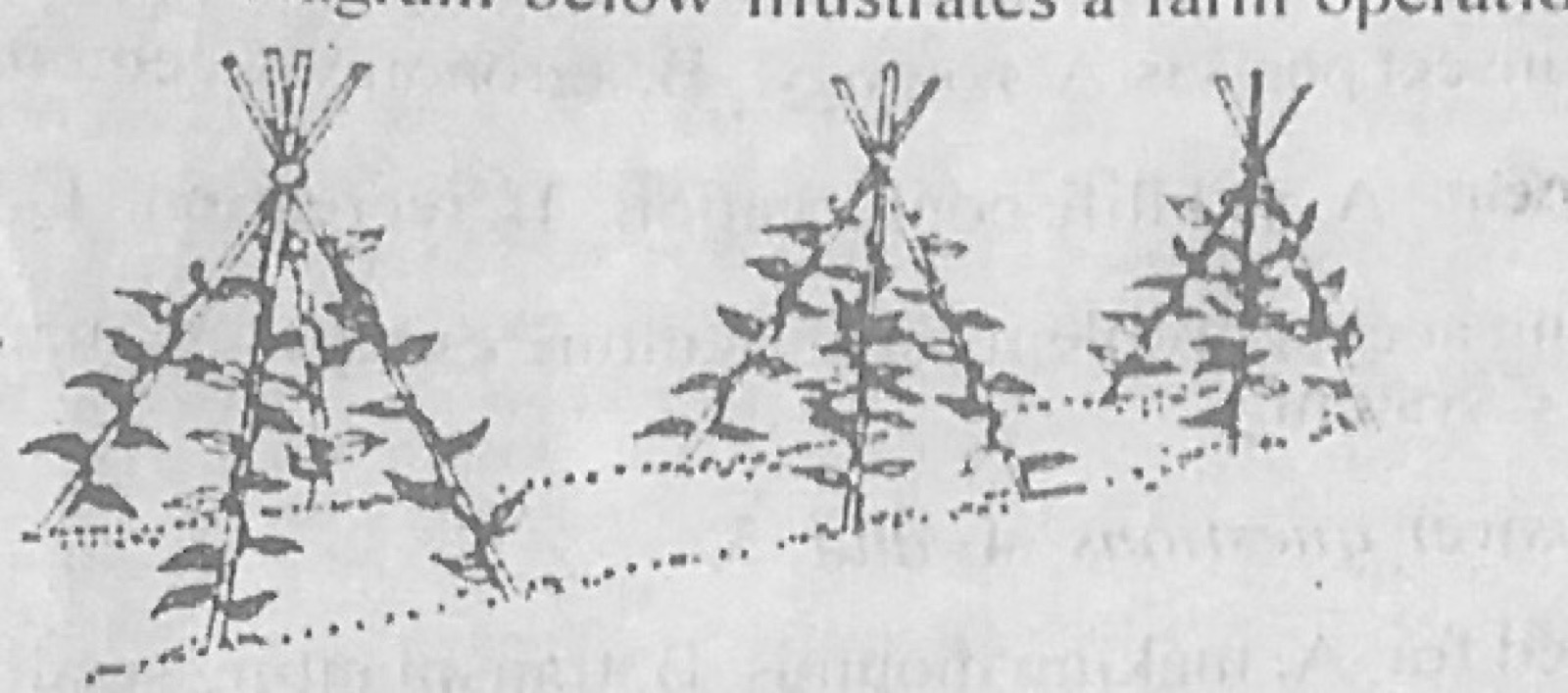
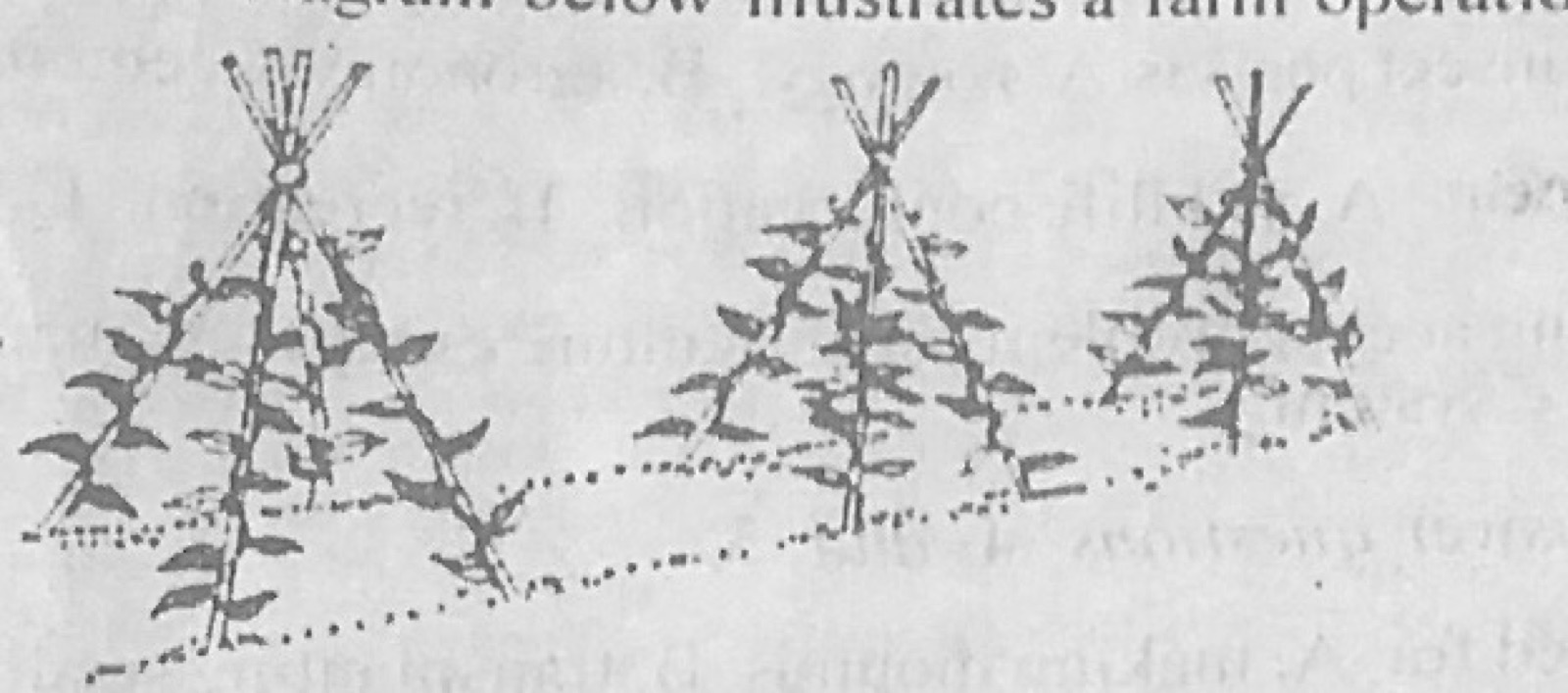
The diagram below illustrates a farm operation.
Which of the following statements is not a reason for carrying out the illustrated farm operation? To

Diagram for this question
  1. A.expose the leaves to sunlight.
  2. B.prevent damage by rodents.
  3. C.improve the yield of the crop
  4. D.prevent lodging of the plants.
Show the answer and explanation

Answer: B (prevent damage by rodents.)

Explanation

The drawing shows staking, which lifts plants to the light and stops them falling, but does not keep rodents away.

Open this question

Question 30

Land Preparation and Cultural Practices

The diagram below illustrates a farm operation.
Crops which require the illustrated farm operation are

Diagram for this question
  1. A.yam and cowpea.
  2. B.tomato and okro.
  3. C.okro and pepper.
  4. D.tomato and yam.
Show the answer and explanation

Answer: D (tomato and yam.)

Explanation

Yam and tomato are commonly staked.

Open this question

Question 31

Forestry and Wildlife

The basic importance of agriculture to a forester is to

  1. A.obtain honey.
  2. B.obtain food
  3. C.acquire labour.
  4. D.procure timber.
Show the answer and explanation

Answer: D (procure timber.)

Explanation

Forestry is mainly about producing timber.

Open this question

Question 32

Ornamental Plants

A suitable grass for lawns is

  1. A.Andropogon gayanus.
  2. B.pennisetum purpureum.
  3. C.cynodon dactylon
  4. D.panicum maximum.
Show the answer and explanation

Answer: C (cynodon dactylon)

Explanation

Cynodon dactylon (Bermuda grass) is a low creeping lawn grass.

Open this question

Question 33

Crop Diseases

The causative organism of maize rust is a

  1. A.bacterium
  2. B.protozoon.
  3. C.virus.
  4. D.fungus.
Show the answer and explanation

Answer: D (fungus.)

Explanation

Rust diseases are caused by fungi (Puccinia).

Open this question

Question 34

Crop Pests

Which of the following groups of insect pests damage crops by biting and chewing?

  1. A.Cotton stainer, armyworm and cricket.
  2. B.Cricket, mealybug and whitefly
  3. C.Armyworm, termite and grasshopper
  4. D.Cotton stainer, mealybug and termite
Show the answer and explanation

Answer: C (Armyworm, termite and grasshopper)

Explanation

Armyworms, termites and grasshoppers have biting mouthparts.

Open this question

Question 35

Classification of Farm Animals

The breeds of cattle resistant to trypanosomiasis are

  1. A.N'dama and Muturu.
  2. B.White Fulani and Biu.
  3. C.Red Bororo and Adamawa.
  4. D.Wadara and Sokoto Gudali.
Show the answer and explanation

Answer: A (N'dama and Muturu.)

Explanation

N'dama and Muturu are trypanotolerant.

Open this question

Question 36

Poultry Production

Which of the following features is not a characteristics of a good layer?

  1. A.Bright red comb and wattle
  2. B.Long and curved beak
  3. C.Bright and bulging eyes
  4. D.Broad and flexible pelvic bone
Show the answer and explanation

Answer: B (Long and curved beak)

Explanation

Beak shape does not show laying ability.

Open this question

Question 37

Animal Health

The best way for a young animal to obtain colostrum is by

  1. A.giving it powdered milk.
  2. B.providing it with warm milk.
  3. C.injecting it with progesterone.
  4. D.allowing it to suckle the dam.
Show the answer and explanation

Answer: D (allowing it to suckle the dam.)

Explanation

Colostrum comes from the mother's udder, so the young should suckle.

Open this question

Question 39

Animal Nutrition

If 0.7 kg of feed was fed to chicks per week, determine the cost of feeding the birds for 6 weeks. (1 kg of feed cost N5)

  1. A.N4.20
  2. B.N11.70
  3. C.N21.00
  4. D.N30.00
Show the answer and explanation

Answer: C (N21.00)

Explanation

0.7 × 6 = 4.2 kg; 4.2 × N5 = N21.00.

Open this question

Question 40

Animal Nutrition

Feeds that have more than 18% fibre are classified as

  1. A.concentrates.
  2. B.additives.
  3. C.supplements.
  4. D.roughages.
Show the answer and explanation

Answer: D (roughages.)

Explanation

Feeds with high fibre are roughages.

Open this question

Question 41

Animal Nutrition

An advantage of zero-grazing is that it

  1. A.requires a lot of labour.
  2. B.prevents livestock from physical exercises.
  3. C.prevents depletion of pasture.
  4. D.increases the cost of pasture management.
Show the answer and explanation

Answer: C (prevents depletion of pasture.)

Explanation

Grass is cut and carried, so animals do not trample or overgraze the pasture.

Open this question

Question 42

Animal Reproduction

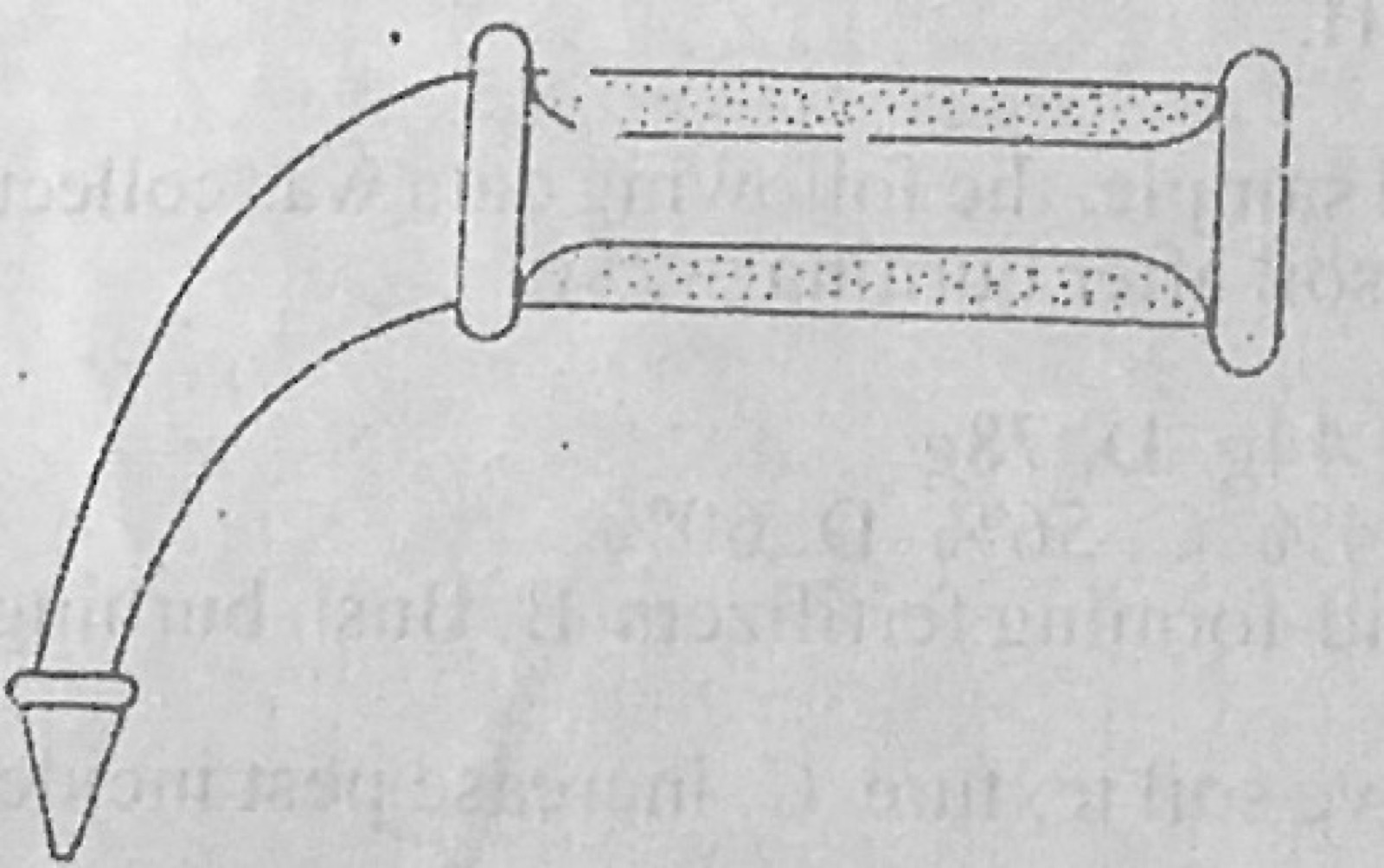
The diagram below illustrates a tool used in animal production.
The illustrated tool is

Diagram for this question
  1. A.an elastrator
  2. B.a burdizzo
  3. C.an electric dehorner.
  4. D.an artificial vagina.
Show the answer and explanation

Answer: D (an artificial vagina.)

Explanation

The drawing is a lined tube with a collecting cone: an artificial vagina.

Open this question

Question 43

Animal Reproduction

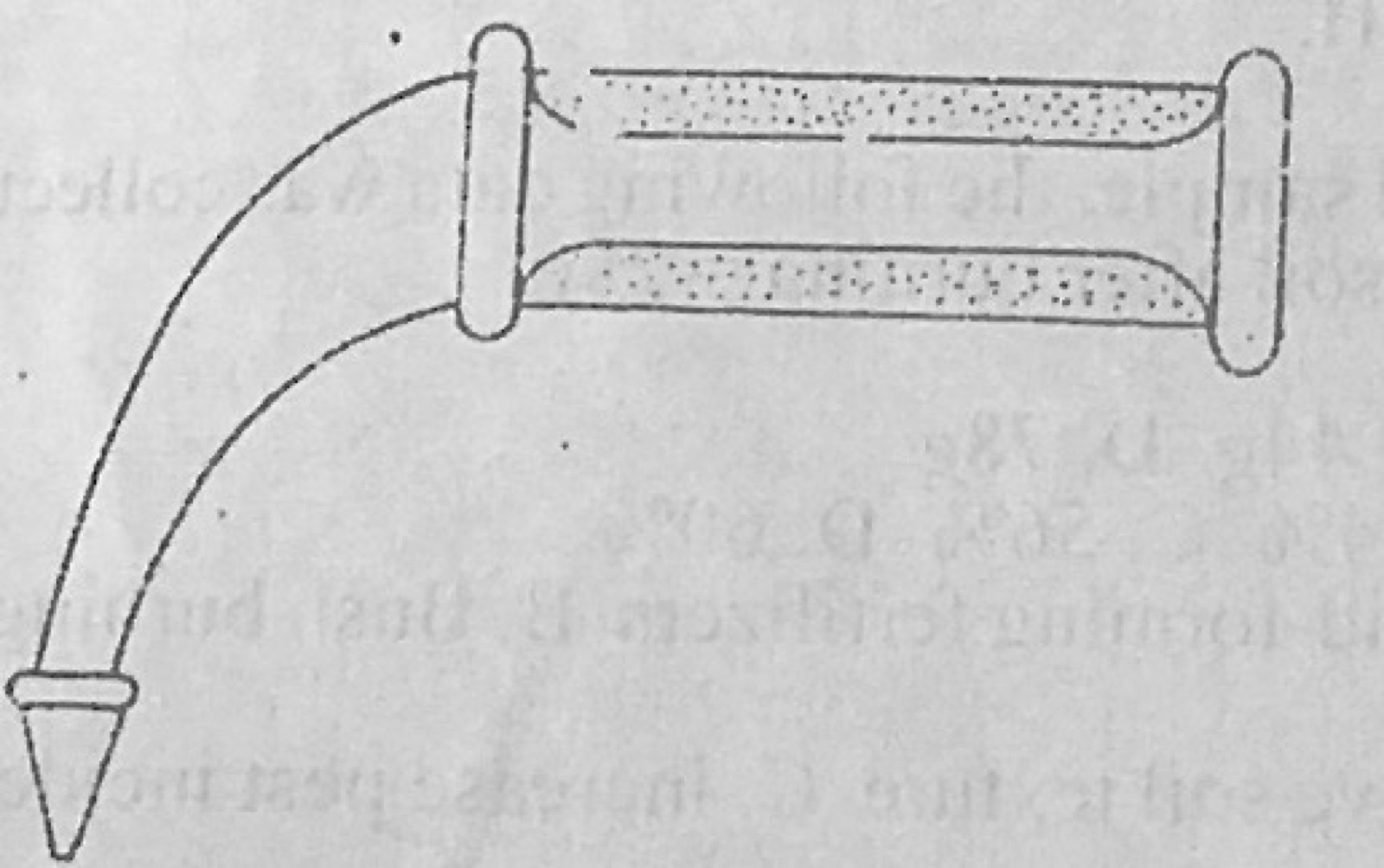
The diagram below illustrates a tool used in animal production.
The illustrated tool is used for

Diagram for this question
  1. A.castrating the bull calf
  2. B.cutting the horns of the animal
  3. C.collecting semen from the bull
  4. D.identifying the animal.
Show the answer and explanation

Answer: C (collecting semen from the bull)

Explanation

An artificial vagina collects semen for artificial insemination.

Open this question

Question 44

Animal Health

Formation of blisters on the mouth and the skin around the hoof of farm animals is a symptom of

  1. A.rinderpest.
  2. B.anthrax.
  3. C.Newcastle disease.
  4. D.foot and mouth disease.
Show the answer and explanation

Answer: D (foot and mouth disease.)

Explanation

Foot and mouth disease causes blisters in the mouth and on the feet.

Open this question

Question 45

Animal Health

In sheep production, tapeworm could be controlled by

  1. A.dusting.
  2. B.spraying.
  3. C.dipping.
  4. D.drenching.
Show the answer and explanation

Answer: D (drenching.)

Explanation

Internal worms are treated by drenching with a dewormer.

Open this question

Question 46

Basic Agricultural Economics

The table below illustrates the supply schedule for maize.
Price (N) 24 — Quantity supplied 480 kg
Price (N) 16 — Quantity supplied 400 kg
The percentage change in quantity supplied for maize is

  1. A.16.7%.
  2. B.20%.
  3. C.80%.
  4. D.83.3%.
Show the answer and explanation

Answer: A (16.7%.)

Explanation

(480 − 400) ÷ 480 × 100 = 16.7%.

Open this question

Question 47

Basic Agricultural Economics

The table below illustrates the supply schedule for maize.
Price (N) 24 — Quantity supplied 480 kg
Price (N) 16 — Quantity supplied 400 kg
Calculate the percentage change in price for maize.

  1. A.8.0%
  2. B.33.3%
  3. C.50.0%
  4. D.66.7%
Show the answer and explanation

Answer: B (33.3%)

Explanation

(24 − 16) ÷ 24 × 100 = 33.3%.

Open this question

Question 48

Basic Agricultural Economics

The table below illustrates the supply schedule for maize.
Price (N) 24 — Quantity supplied 480 kg
Price (N) 16 — Quantity supplied 400 kg
Determine the elasticity of supply for maize.

  1. A.0.3
  2. B.0.4
  3. C.0.5
  4. D.0.6
Show the answer and explanation

Answer: C (0.5)

Explanation

Elasticity of supply = % change in quantity ÷ % change in price = 16.7 ÷ 33.3 = 0.5.

Open this question

Question 49

Agricultural Finance

A long term loan for an agricultural enterprise could be obtained from

  1. A.microfinance banks.
  2. B.commercial banks.
  3. C.money lenders
  4. D.cooperative societies.
Show the answer and explanation

Answer: B (commercial banks.)

Explanation

Commercial banks have the funds to give large, long-term loans.

Open this question

Question 50

Agricultural Development

Which of the following problems of agriculture could be solved through farmers' adoption of research findings?

  1. A.Unpredictable climate
  2. B.Environmental degradation
  3. C.Poor extension services
  4. D.Insufficient basic amenities
Show the answer and explanation

Answer: A (Unpredictable climate)

Explanation

Research gives drought-tolerant and early-maturing varieties that help farmers cope with an unpredictable climate.

Open this question

Theory question 101

Agricultural Development

(a) Mention two roles of the governments of West African countries in agricultural development in each of the following areas: (i) agricultural finance; (ii) agricultural education; (iii) agricultural extension services; (iv) agricultural policies and programmes.
(b) State three structural differences between disc plough and disc harrow. (Use a table with the columns: Disc plough, Disc harrow.)
(c) Highlight four effects of the frequent use of disc plough on the soil.

Show the model answer
Model answer

(a)(i) Finance: give subsidies; provide loans/credit through agricultural banks; credit guarantee schemes; agricultural insurance.
(ii) Education: set up colleges and universities of agriculture; fund research institutes; train youths and farmers in agriculture.
(iii) Extension: employ and train extension workers; provide extension tools and transport; spread research findings to farmers.
(iv) Policies and programmes: formulate agricultural policies and laws; set up programmes (e.g. OFN, farm settlements, ADPs) and implement them.
(b) Disc plough: larger discs; fewer discs; discs spaced far apart and mounted individually, each at an angle. Disc harrow: smaller discs; many discs; discs close together on a common shaft in gangs.
(c) Any four: breaks down soil structure; causes compaction/hard pan below the plough layer; exposes soil to erosion; increases loss of organic matter and moisture; destroys soil organisms.

Explanation

Give each difference as a matched pair.

Open this question

Theory question 102

Rocks and Soil Formation

(a) Explain three roles played by each of the following factors in soil formation: (i) time; (ii) rainfall; (iii) parent material.
(b) Mention four principles which should be followed in a good crop rotation plan.
(c) Give five uses of forage crops.

Show the model answer
Model answer

(a)(i) Time: the longer weathering goes on, the deeper the soil; older soils have well-developed horizons; time allows organic matter to build up and leaching to occur.
(ii) Rainfall: water breaks rocks (hydrolysis, solution); causes leaching of nutrients; moves particles (erosion, deposition); supports plants and organisms that form humus.
(iii) Parent material: decides the minerals and nutrients in the soil; decides texture (sandy or clayey); affects soil colour, pH and depth.
(b) Any four: deep-rooted crops should follow shallow-rooted ones; legumes should be included to add nitrogen; crops of the same family or with the same pests should not follow each other; heavy feeders should come first after fallow/manuring; include a cover/fallow crop to control erosion; crops should suit the soil and farmer's needs.
(c) Any five: livestock feed (grazing, hay, silage); cover crops against erosion; green manure; improve soil fertility (legumes fix nitrogen); mulch; roofing/thatching material; weed suppression.

Explanation

Three roles for each factor in (a).

Open this question

Theory question 103

Forestry and Wildlife

(a)(i) Explain the term selective exploitation as used in forest management. (ii) State four advantages of selective exploitation of forest trees.
(b) Distinguish between field pests and storage pest of crops.
(c) Name three examples each of: (i) storage insect pests of crops; (ii) field insect pests of crops.
(d) Mention four ways of conserving water in the soil.

Show the model answer
Model answer

(a)(i) Selective exploitation is felling only mature trees of chosen species and sizes, leaving the young and other trees to grow.
(ii) Any four: forest cover is kept, so soil is protected from erosion; young trees grow to replace those felled; preserves wildlife and biodiversity; ensures a continuous supply of timber; prevents extinction of valuable species.
(b) Field pests attack crops while they are still growing in the field; storage pests attack harvested produce in the store.
(c)(i) Any three: maize weevil; rice weevil; grain moth; bean beetle (Callosobruchus); flour beetle; yam beetle in barns; larger grain borer.
(ii) Any three: stem borer; armyworm; grasshopper; cotton stainer; aphids; pod borer; capsids; variegated grasshopper.
(d) Any four: mulching; cover cropping; adding organic matter; shading; reducing tillage; contour ploughing/ridging across slopes; windbreaks; controlling weeds.

Explanation

Examples should be named insects.

Open this question

Theory question 104

Crop Husbandry

(a) Give four reasons why each of the following farm operations is important: (i) pruning of cocoa trees; (ii) parboiling of paddy rice.
(b) A farmer abandoned a plot of land due to low soil fertility. After three years, it was discovered that guinea grass has invaded the land. Suggest five ways by which the farmer can eradicate the grass.
(c) State five uses of ornamental plants.

Show the model answer
Model answer

(a)(i) Pruning cocoa (any four): removes diseased and dead branches; lets in light and air, reducing black pod; shapes the tree for easy harvesting; removes chupons that waste food; improves pod yield.
(ii) Parboiling rice (any four): loosens the husk for milling; reduces breakage during milling; moves vitamins from bran into the grain; hardens grains against storage pests; improves keeping and cooking quality.
(b) Any five: slash and dig out the clumps/rhizomes; deep ploughing and harrowing to expose and dry roots; apply a systemic herbicide (e.g. glyphosate); repeated hoeing; plant a smothering cover crop; mulch heavily; burn the gathered debris; crop rotation with close planting.
(c) Any five: beautify homes and surroundings; hedges and fences; shade and windbreaks; erosion control; source of income; decorations and gifts; some are medicinal; reduce noise and dust.

Explanation

Four points for each operation in (a).

Open this question

Theory question 105

Animal Nutrition

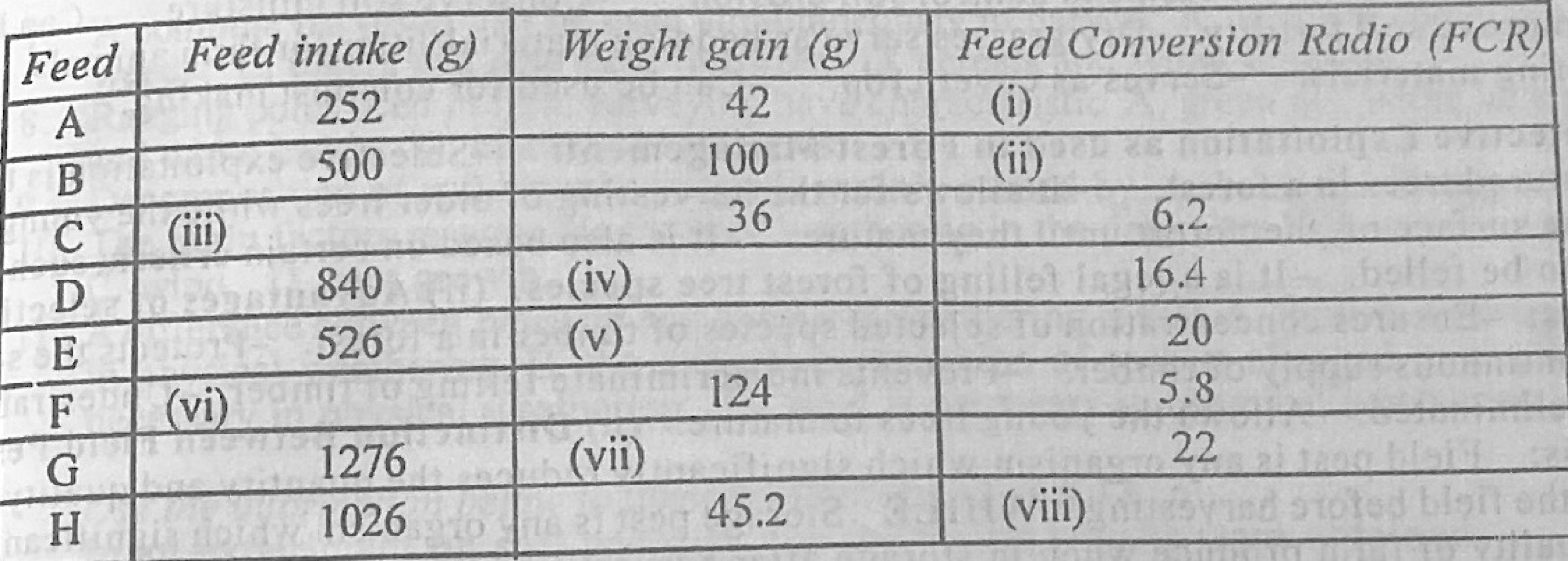
A farmer fed some lambs with eight different feed compositions. Assuming the Feed Conversion Ratio (FCR) = Feed intake (g) ÷ Weight gain (g)
(a) Complete the table below.
(b) Deduce from the table the feed with the; (i) highest feed conversion ratio; (ii) lowest feed conversion ratio;
(c) Name five products that could be obtained from farm animals.
(d) List three chemical processes involved in rock weathering.

Diagram for this question
Show the model answer
Model answer

(a)(i) A: 252 ÷ 42 = 6.0. (ii) B: 500 ÷ 100 = 5.0. (iii) C: intake = 36 × 6.2 = 223.2 g. (iv) D: gain = 840 ÷ 16.4 = 51.2 g. (v) E: gain = 526 ÷ 20 = 26.3 g. (vi) F: intake = 124 × 5.8 = 719.2 g. (vii) G: gain = 1276 ÷ 22 = 58 g. (viii) H: 1026 ÷ 45.2 = 22.7.
(b)(i) Highest FCR: feed H (22.7). (ii) Lowest FCR: feed B (5.0).
(c) Any five: meat; milk; eggs; wool; hides and skins; manure; bones/bone meal; horns and hooves; feathers; blood meal; honey.
(d) Any three: hydrolysis; hydration; oxidation; carbonation; solution; reduction.

Explanation

Rearrange FCR = intake ÷ gain to find the missing intake or gain.

Open this question

Theory question 106

Agricultural Extension

(a) An outbreak of Avian influenza was reported in a locality with the possibility of the disease spreading to other parts of the country. (i) Mention three main agricultural extension methods that could be used to create awareness of the disease among poultry farmers. (ii) Which of the main agricultural extension methods mentioned in 6(a)(i) is most appropriate to create awareness among poultry farmers? (iii) Give two reasons for the choice of the extension methods mentioned in 6(a)(ii). (iv) Mention three problems that could be encountered in the use of the extension method mentioned in 6(a)(ii).
(b) Highlight five problems faced by farm managers.
(c) Name four breeds of goat found in West Africa.

Show the model answer
Model answer

(a)(i) Individual (farm and home visits); group (meetings, demonstrations); mass (radio, TV, newspapers, posters).
(ii) The mass method.
(iii) It reaches very many farmers in many places at the same time; it is fast for urgent information; it is cheap per farmer reached.
(iv) Any three: no feedback/questions cannot be answered; some farmers have no radio/TV or cannot read; language barriers; epileptic electricity; message may be misunderstood; costly airtime.
(b) Any five: inadequate capital/credit; shortage of skilled labour; pests and diseases; unpredictable weather; price fluctuations and poor markets; high cost of inputs; poor storage and transport; theft; inadequate records.
(c) Any four: West African Dwarf; Red Sokoto (Maradi); Sahel (Desert) goat; Kano Brown; Borno White.
Explanation

Choose one method in (a)(ii) and justify it.

Open this question