WAEC Agricultural Science 2019 past questions and answers

47 questions. Try each one, then open the answer to check yourself and read the explanation.

Question 1

Introduction to Agriculture

Which of the following statements best describes commercial farming?

  1. A.Production of plants and animals for family consumption
  2. B.Large scale agricultural production for sale
  3. C.Large scale agricultural production for family consumption
  4. D.Use of family labour for large scale agricultural production.
Show the answer and explanation

Answer: B (Large scale agricultural production for sale)

Explanation

Commercial farming produces on a large scale for sale and profit.

Open this question

Question 3

Land Use and Land Tenure

An advantage of communal land tenure system is that it

  1. A.encourages use of land for permanent projects by individuals.
  2. B.makes land cheap to acquire.
  3. C.leads to fragmentation.
  4. D.does not promote farm mechanization.
Show the answer and explanation

Answer: B (makes land cheap to acquire.)

Explanation

Members get community land free or cheaply.

Open this question

Question 4

Land Preparation and Cultural Practices

Which of the following implements is used for primary tillage?

  1. A.Ridger
  2. B.Cultivator
  3. C.Plough
  4. D.Harrow
Show the answer and explanation

Answer: C (Plough)

Explanation

Ploughing is the first (primary) tillage; the others are secondary.

Open this question

Question 5

Farm Machinery and Mechanisation

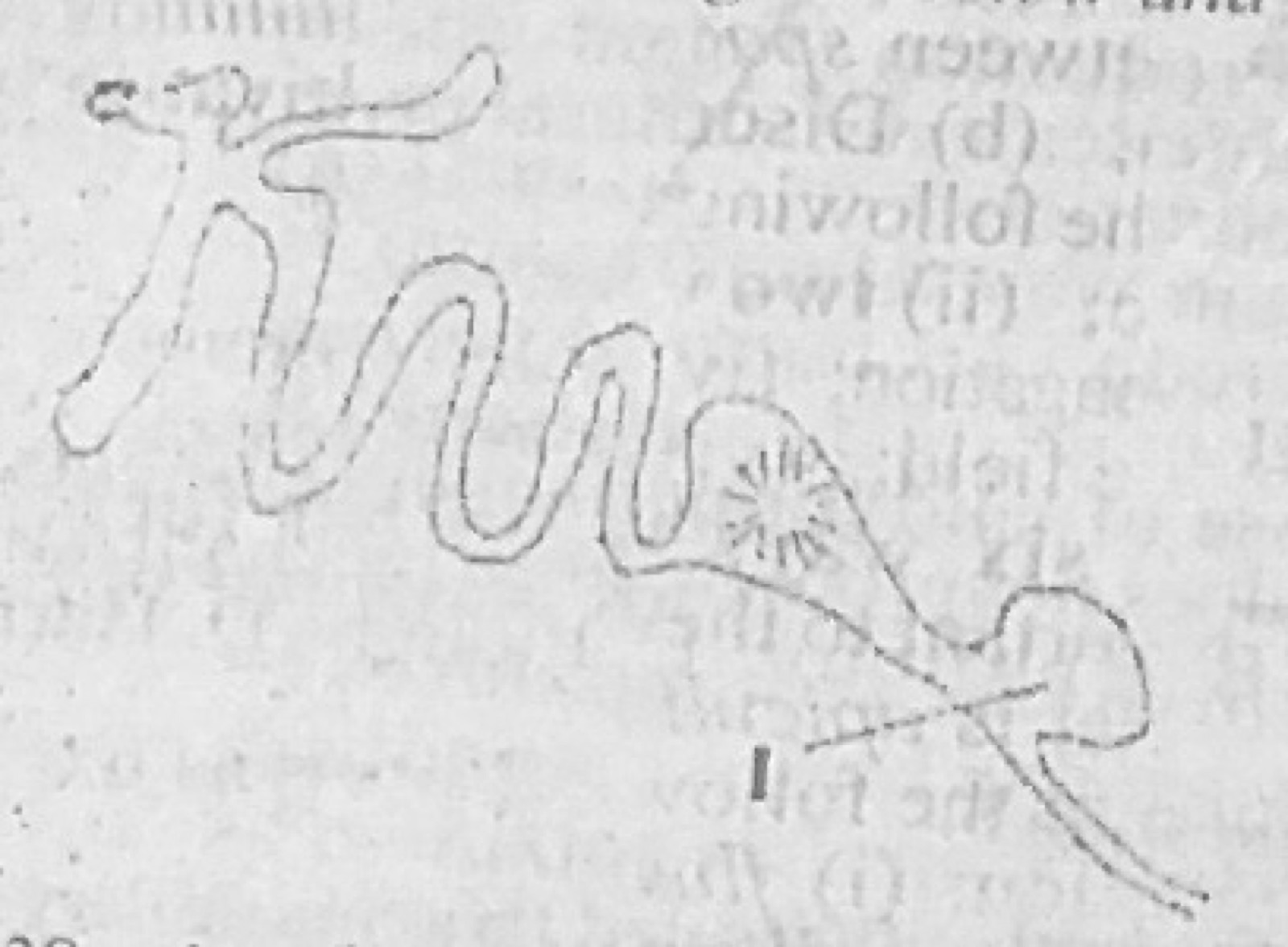
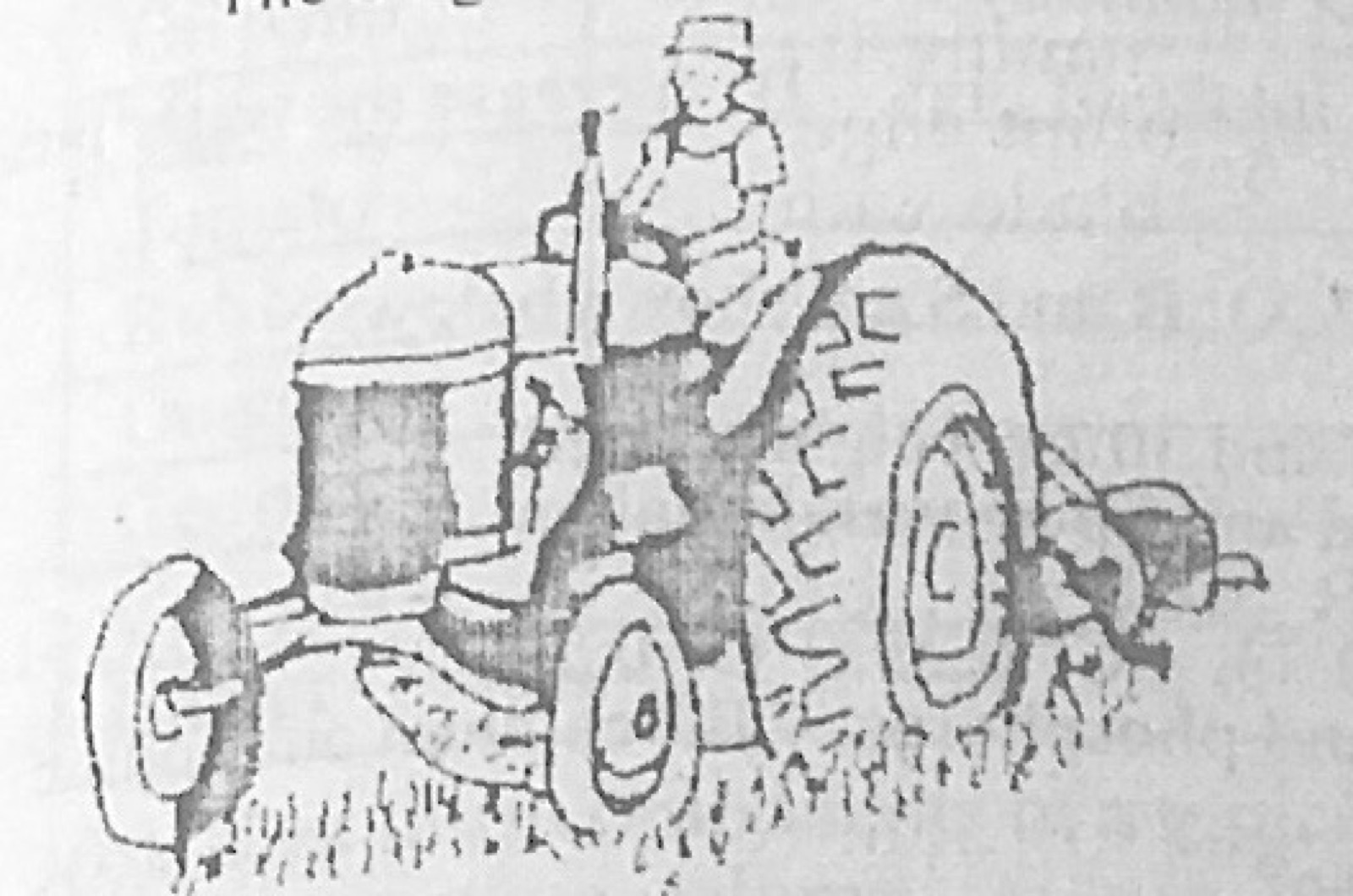
The diagram below illustrates the use of a farm machinery.
A periodic maintenance activity carried out on the illustrated farm machinery is

Diagram for this question
  1. A.checking the radiator water.
  2. B.checking of tyre pressure.
  3. C.changing of engine oil.
  4. D.cleaning after use.
Show the answer and explanation

Answer: C (changing of engine oil.)

Explanation

Oil is changed after set working hours; the others are daily checks.

Open this question

Question 6

Farm Machinery and Mechanisation

A disadvantage of farm mechanization is

  1. A.efficiency in farming.
  2. B.displacement of farm workers.
  3. C.reduction in health hazards.
  4. D.timeliness of farm operations.
Show the answer and explanation

Answer: B (displacement of farm workers.)

Explanation

Machines replace workers, causing unemployment.

Open this question

Question 7

Farm Surveying and Planning

Calculate in hectares the area of a rectangular farmland with dimensions 50 m by 25 m.

  1. A.125 ha
  2. B.12.5 ha
  3. C.1.25 ha
  4. D.0.125ha
Show the answer and explanation

Answer: D (0.125ha)

Explanation

50 × 25 = 1,250 m²; ÷ 10,000 = 0.125 ha.

Open this question

Question 8

Farm Surveying and Planning

The practice of measuring and mapping out the size, position and boundary of a farmland is called farm

  1. A.layout.
  2. B.business.
  3. C.surveying.
  4. D.tillage.
Show the answer and explanation

Answer: C (surveying.)

Explanation

Measuring and mapping land is surveying.

Open this question

Question 9

Land Use and Land Tenure

Which of the following statements about land is not correct?

  1. A.Its supply is limited
  2. B.It is used for agricultural production
  3. C.It is subject to depreciation
  4. D.It can be relocated
Show the answer and explanation

Answer: D (It can be relocated)

Explanation

Land is immobile; it cannot be moved.

Open this question

Question 10

Land Use and Land Tenure

A socio-cultural factor affecting land availability is

  1. A.soil type.
  2. B.religion.
  3. C.topography.
  4. D.mining.
Show the answer and explanation

Answer: B (religion.)

Explanation

Religion (sacred groves, shrines) is a socio-cultural factor.

Open this question

Question 11

Agricultural Ecology

A biotic factor affecting agricultural production is

  1. A.rainfall.
  2. B.predator.
  3. C.humidity.
  4. D.temperature.
Show the answer and explanation

Answer: B (predator.)

Explanation

Biotic factors are living things, such as predators.

Open this question

Question 12

Weeds and Weed Control

Which of the following groups of organisms are parasitic plants?

  1. A.Nematode, fungus and bacterium
  2. B.Striga, nematode and dodder
  3. C.Dodder, fungus and striga
  4. D.Mistletoe, fungus and bacterium
Show the answer and explanation

Answer: C (Dodder, fungus and striga)

Explanation

Dodder and striga are parasitic flowering plants; older syllabuses group fungi with plants, so C is the intended answer.

Open this question

Question 13

Rocks and Soil Formation

The type of rock formed from accumulation of materials transported by water is called

  1. A.sedimentary rock.
  2. B.igneous rock.
  3. C.metamorphic rock.
  4. D.plutonic rock.
Show the answer and explanation

Answer: A (sedimentary rock.)

Explanation

Sediments laid down by water harden into sedimentary rock.

Open this question

Question 14

Soil Properties

A fresh garden soil sample weighed 25 kg. When oven-dried, its weight reduced to 20 kg. Calculate the percentage moisture content of the soil sample.

  1. A.5.0%
  2. B.12.5%
  3. C.20.0%
  4. D.25.0%
Show the answer and explanation

Answer: C (20.0%)

Explanation

Water = 25 − 20 = 5 kg; 5 ÷ 25 × 100 = 20%.

Open this question

Question 16

Rocks and Soil Formation

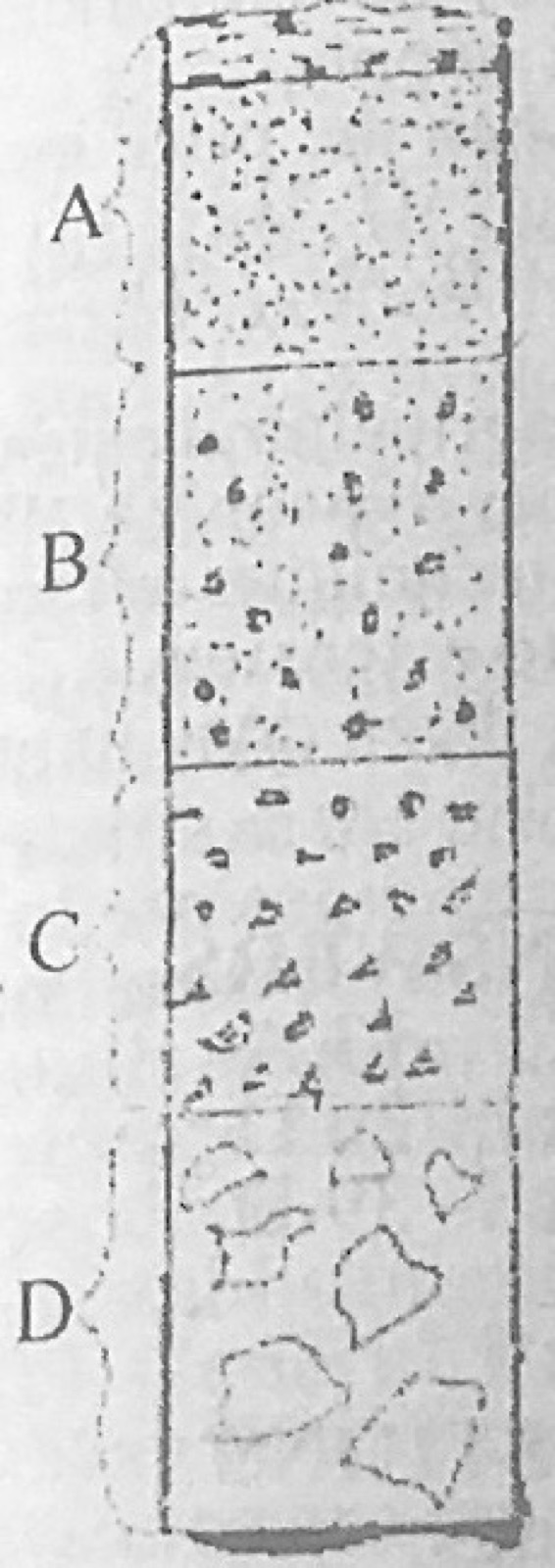
The diagram below illustrates a soil profile.
The soil horizon that is not supportive of the growth of tree crops is

Diagram for this question
  1. A.horizon A.
  2. B.horizon B.
  3. C.horizon C.
  4. D.horizon D.
Show the answer and explanation

Answer: D (horizon D.)

Explanation

Horizon D is solid bedrock, which roots cannot use.

Open this question

Question 17

Irrigation and Drainage

Liquid fertilizers and pesticides could be applied through

  1. A.furrow irrigation.
  2. B.channel irrigation.
  3. C.sprinkler irrigation.
  4. D.flood irrigation.
Show the answer and explanation

Answer: C (sprinkler irrigation.)

Explanation

Chemicals can be mixed into sprinkler water and sprayed evenly.

Open this question

Question 18

Farming Systems

In a crop rotation system it is usually preferred that cassava comes last in the rotation because it

  1. A.adds nitrogen to the soil.
  2. B.is a shallow feeder.
  3. C.is a deep rooted crop.
  4. D.is a perennial crop.
Show the answer and explanation

Answer: C (is a deep rooted crop.)

Explanation

Cassava's deep roots reach nutrients left deep in the soil after other crops.

Open this question

Question 19

Farming Systems

The growing of only one crop on a piece of land from year to year is known as

  1. A.mixed cropping.
  2. B.crop rotation.
  3. C.monoculture.
  4. D.shifting cultivation.
Show the answer and explanation

Answer: C (monoculture.)

Explanation

One crop grown year after year is monoculture.

Open this question

Question 20

Soil Fertility and Plant Nutrition

In green manuring, crops are ploughed into the soil just before flowering in order to

  1. A.control soil pathogens.
  2. B.enrich the soil with nutrients.
  3. C.control soil erosion.
  4. D.increase the soil temperature.
Show the answer and explanation

Answer: B (enrich the soil with nutrients.)

Explanation

The green plants rot and add nutrients and organic matter.

Open this question

Question 24

Crop Propagation

A planting material used in propagating plantain is the

  1. A.crown.
  2. B.peeper.
  3. C.slip.
  4. D.leaf.
Show the answer and explanation

Answer: B (peeper.)

Explanation

Plantain is propagated with suckers such as peepers.

Open this question

Question 25

Land Preparation and Cultural Practices

If maize seed is sown at a spacing of 100 cm × 50 cm, determine the expected maize plant population per hectare.

  1. A.40,000
  2. B.20,000
  3. C.5,000
  4. D.2,000
Show the answer and explanation

Answer: B (20,000)

Explanation

Area per stand = 1 m × 0.5 m = 0.5 m²; 10,000 ÷ 0.5 = 20,000.

Open this question

Question 26

Forestry and Wildlife

Protective functions of forests include the following except

  1. A.soil conservation.
  2. B.serving as windbreak.
  3. C.purification of air.
  4. D.source of firewood.
Show the answer and explanation

Answer: D (source of firewood.)

Explanation

Firewood is a productive use, not a protective function.

Open this question

Question 27

Forestry and Wildlife

The growing of both trees and arable crops on the same piece of land is

  1. A.ley farming.
  2. B.mixed farming.
  3. C.forestry.
  4. D.taungya system.
Show the answer and explanation

Answer: D (taungya system.)

Explanation

In taungya, farmers grow food crops between young forest trees.

Open this question

Question 28

Ornamental Plants

Sexual propagation of ornamental plants involves the use of

  1. A.stems.
  2. B.seeds.
  3. C.suckers.
  4. D.rhizomes.
Show the answer and explanation

Answer: B (seeds.)

Explanation

Seeds come from sexual reproduction.

Open this question

Question 29

Crop Diseases

The vector of leaf curl disease of cotton is

  1. A.grasshopper.
  2. B.termites.
  3. C.thrips.
  4. D.white fly.
Show the answer and explanation

Answer: D (white fly.)

Explanation

Whiteflies spread cotton leaf curl virus.

Open this question

Question 30

Crop Pests

A major storage pest of cereals in West Africa is

  1. A.stem borer.
  2. B.weevil.
  3. C.bird.
  4. D.army worm.
Show the answer and explanation

Answer: B (weevil.)

Explanation

Weevils attack stored grains; the others are field pests.

Open this question

Question 31

Crop Pests

Biological control of insect-pests of crops is carried out through

  1. A.crop rotation.
  2. B.use of predators.
  3. C.use of pesticides.
  4. D.farm sanitation.
Show the answer and explanation

Answer: B (use of predators.)

Explanation

Biological control uses living natural enemies.

Open this question

Question 33

Classification of Farm Animals

Which of the following breeds of cattle is exotic?

  1. A.Sokoto Gudali
  2. B.Ndama
  3. C.Friesian
  4. D.Muturu
Show the answer and explanation

Answer: C (Friesian)

Explanation

Friesian comes from Europe; the others are West African breeds.

Open this question

Question 34

Animal Anatomy and Physiology

Study the diagram below.
The diagram represents the digestive system of a

Diagram for this question
  1. A.buck.
  2. B.cock.
  3. C.bull.
  4. D.sow.
Show the answer and explanation

Answer: B (cock.)

Explanation

The tract has a crop and gizzard, so it belongs to a bird (cock).

Open this question

Question 36

Animal Reproduction

Which of the following hormones is responsible for oestrus in farm animals?

  1. A.Oxytocin
  2. B.Oestrogen
  3. C.Prolactin
  4. D.Progesterone
Show the answer and explanation

Answer: B (Oestrogen)

Explanation

Oestrogen brings the female on heat.

Open this question

Question 37

Animal Reproduction

In animal production, immature spermatozoa are stored in the

  1. A.urethra.
  2. B.scrotum.
  3. C.epididymis.
  4. D.prostate gland.
Show the answer and explanation

Answer: C (epididymis.)

Explanation

Sperm mature and are stored in the epididymis.

Open this question

Question 38

Poultry Production

The least important factor for successful incubation of eggs is

  1. A.light.
  2. B.temperature.
  3. C.ventilation.
  4. D.humidity.
Show the answer and explanation

Answer: A (light.)

Explanation

Eggs hatch in the dark; heat, air and moisture are what matter.

Open this question

Question 39

Livestock Management

A wallow should be provided in the pen of pigs in order to

  1. A.reduce the feed intake of pigs.
  2. B.increase the water intake of pigs.
  3. C.enable the pigs to swim.
  4. D.cool the temperature of pigs.
Show the answer and explanation

Answer: D (cool the temperature of pigs.)

Explanation

Pigs have few sweat glands and cool themselves in wallows.

Open this question

Question 42

Animal Nutrition

Bone meal is usually included in the diet of livestock to supply

  1. A.calcium and phosphorus.
  2. B.calcium and iodine.
  3. C.phosphorus and iron.
  4. D.magnesium and sodium.
Show the answer and explanation

Answer: A (calcium and phosphorus.)

Explanation

Bones are rich in calcium and phosphorus.

Open this question

Question 43

Animal Improvement

Which of the following statements about inbreeding in farm animals is/are false?
I. Inbred animals reach market weight early
II. Inbred animals have reduced vigour
III. Inbreeding increases the occurrence of undesirable traits

  1. A.I only
  2. B.II only
  3. C.I and II only
  4. D.I and III only
Show the answer and explanation

Answer: A (I only)

Explanation

Inbreeding lowers vigour and brings out bad traits, so statement I is the false one.

Open this question

Question 44

Animal Health

Which of the following parasites may be found in the gut of livestock?

  1. A.Tick
  2. B.Flea
  3. C.Roundworm
  4. D.Louse
Show the answer and explanation

Answer: C (Roundworm)

Explanation

Roundworms live in the intestine; the others live on the skin.

Open this question

Question 45

Fisheries and Aquaculture

Vegetative growth in fish ponds

  1. A.makes fish movement easy.
  2. B.regulates water acidity.
  3. C.increases pond water turbidity.
  4. D.moderates pond temperature.
Show the answer and explanation

Answer: D (moderates pond temperature.)

Explanation

Plants in and around a pond give shade, keeping the water from overheating.

Open this question

Question 46

Basic Agricultural Economics

Which of the following factors of agricultural production is abundant in rural areas?

  1. A.Enterprise
  2. B.Land
  3. C.Labour
  4. D.Capital
Show the answer and explanation

Answer: B (Land)

Explanation

Rural areas have plenty of land but little capital.

Open this question

Question 47

Basic Agricultural Economics

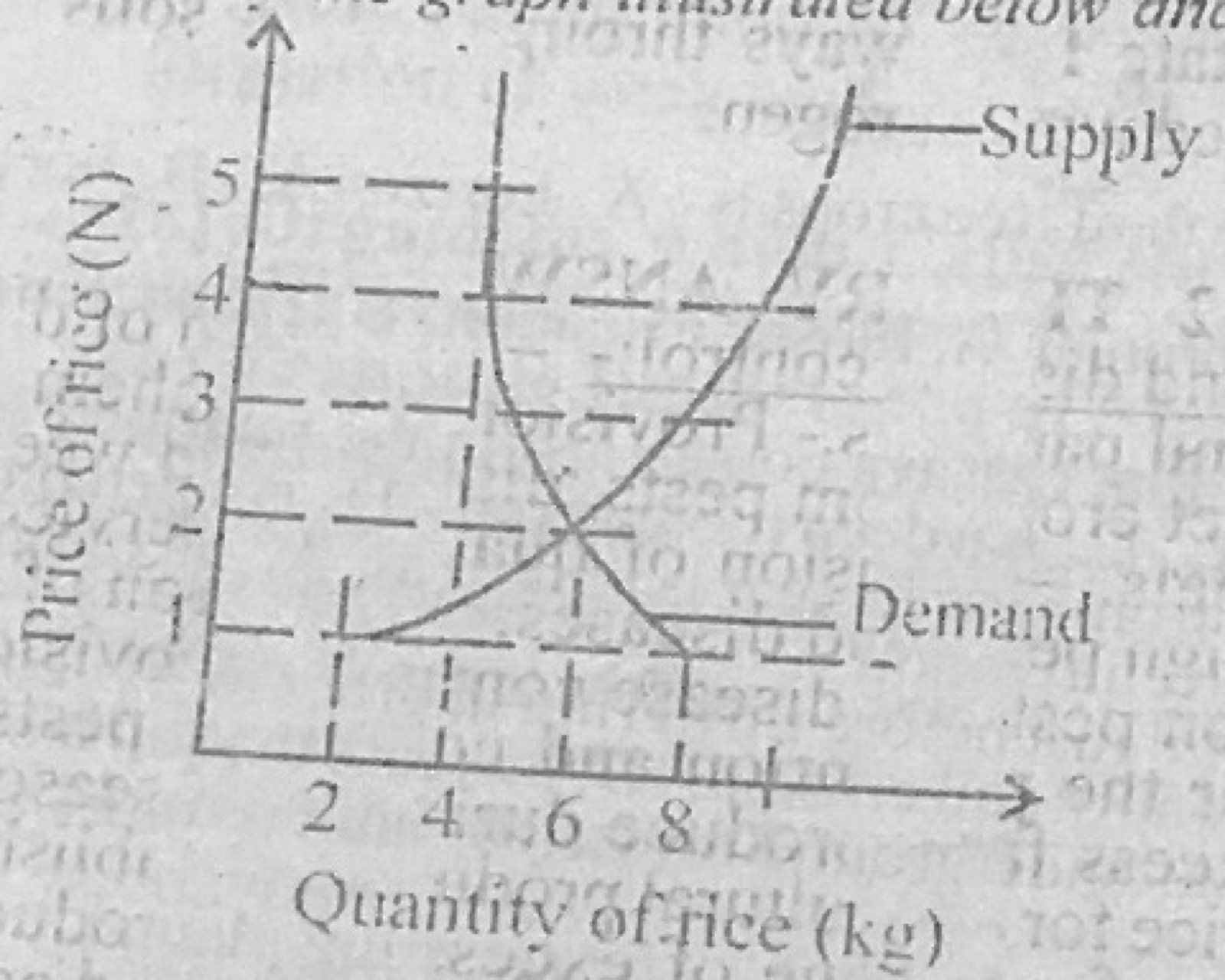
Study the graph illustrated below.
The graph best

Diagram for this question
  1. A.shows an increase in the supply of rice.
  2. B.describes a shift in the demand for rice.
  3. C.describes the equilibrium price for rice.
  4. D.shows that the demand for rice exceeds supply.
Show the answer and explanation

Answer: C (describes the equilibrium price for rice.)

Explanation

Where the demand and supply curves cross is the equilibrium point.

Open this question

Question 48

Basic Agricultural Economics

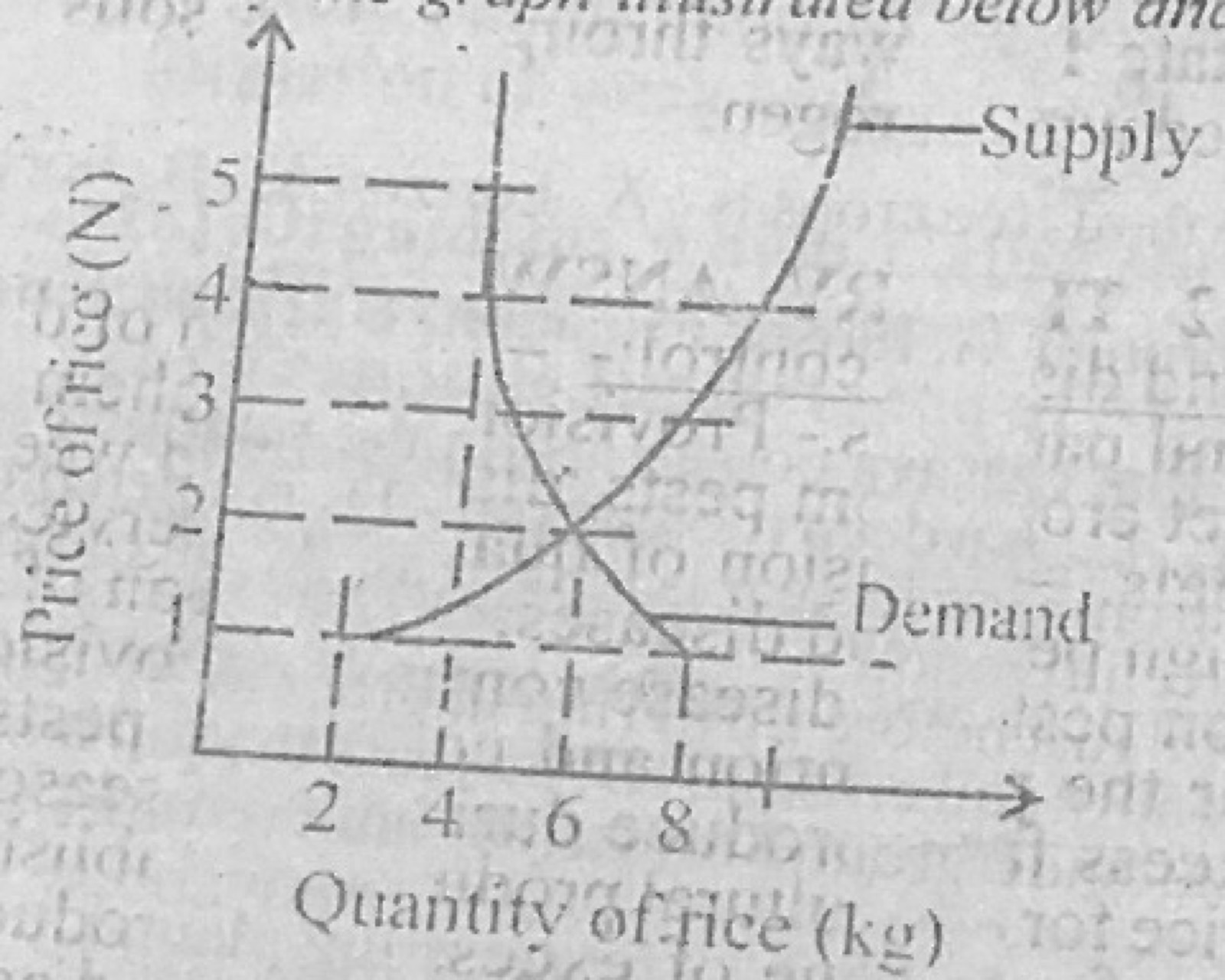
Study the graph illustrated below.
What is the change in quantity of rice demanded when the price increases from N1.00 to N5.00?

Diagram for this question
  1. A.8kg
  2. B.6kg
  3. C.4kg
  4. D.2kg
Show the answer and explanation

Answer: C (4kg)

Explanation

On the demand curve, quantity falls from 8 kg at N1 to 4 kg at N5: a change of 4 kg.

Open this question

Question 49

Basic Agricultural Economics

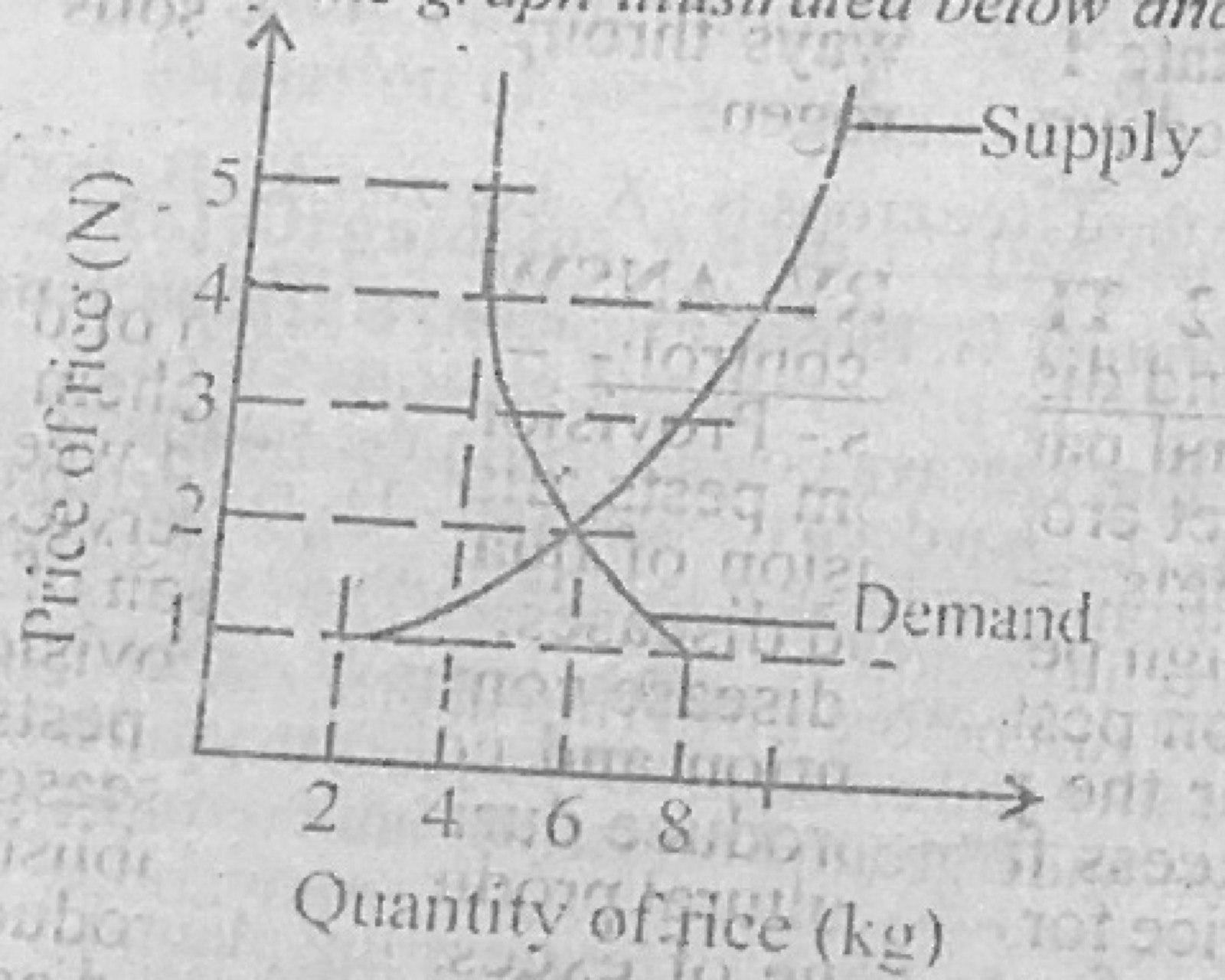
Study the graph illustrated below.
Determine the equilibrium price of rice.

Diagram for this question
  1. A.N1.00
  2. B.N2.00
  3. C.N3.00
  4. D.N4.00
Show the answer and explanation

Answer: B (N2.00)

Explanation

The curves cross at a price of N2.00.

Open this question

Question 50

Agricultural Extension

A major characteristic of mass teaching method of agricultural extension is that

  1. A.information can be directed to a large number of people at different locations.
  2. B.it demonstrates how to carry out new techniques to farmers in the same locality.
  3. C.feedback is readily available to extension officers.
  4. D.it summarizes and analyses what had been done in previous learning situations.
Show the answer and explanation

Answer: A (information can be directed to a large number of people at different locations.)

Explanation

Mass methods (radio, TV, print) reach many people in many places at once.

Open this question

Theory question 101

Agricultural Development

(a) Explain four roles of government in agricultural development under the following headings: (i) pest and disease control; (ii) marketing of agricultural produce.
(b) Give four general problems of land tenure system in agricultural development in West Africa.
(c) List three farm machinery and three farm implements. Farm machinery: (i) ____ (ii) ____ (iii) ____ Farm implements: (i) ____ (ii) ____ (iii) ____

Show the model answer
Model answer

(a)(i) Pest and disease control (any four): supply/subsidise drugs, vaccines and agrochemicals; provide veterinary and crop protection services; quarantine at ports and borders; fund research institutes; train farmers on control.
(ii) Marketing (any four): fix guaranteed minimum prices; set up commodity/marketing boards; buy surplus produce and build silos/strategic reserves; build markets, storage and processing facilities; encourage exports; good rural roads.
(b) Any four: land fragmentation prevents large-scale and mechanised farming; land cannot easily be used as collateral; insecure ownership discourages permanent crops; land disputes and litigation; outsiders cannot easily get land; high cost of land; time lost moving between scattered plots.
(c) Machinery (three): tractor; bulldozer; combine harvester; power tiller; milking machine; incubator; dryer. Implements (three): plough; harrow; ridger; cultivator; planter/seed drill; boom sprayer; fertilizer spreader; mower.

Explanation

Machinery are self-powered; implements are pulled or driven by a tractor.

Open this question

Theory question 102

Weeds and Weed Control

(a) Complete the table below: for each of the weeds goat weed, siam weed and water leaf, give its botanical name and method of dispersal.
(b) List three examples of each of the following factors affecting land availability for agriculture: (i) physical factors; (ii) economic factors.
(c) Enumerate four effects of pollution on agricultural lands and ponds.
(d) State two ways of minimizing land and pond pollution.

Show the model answer
Model answer

(a) Goat weed: Ageratum conyzoides – wind (also animals). Siam weed: Chromolaena odorata – wind. Water leaf: Talinum triangulare – explosive/self dispersal (also water).
(b)(i) Physical (any three): topography; soil type/fertility; climate (rainfall); erosion; flooding. (ii) Economic (any three): industrial development; mining; road and building construction; cost of land; urbanisation; tourism.
(c) Any four: kills soil organisms and fish; makes soil and water toxic to crops/animals; lowers soil fertility and crop yield; changes soil pH; reduces oxygen in pond water; contaminates food; makes land unfit for farming.
(d) Any two: proper disposal/treatment of wastes; control use of agrochemicals; laws against dumping and oil spills; recycling; public education.

Explanation

Give the scientific names in full.

Open this question

Theory question 103

Plant Forms and Crop Classification

(a) Using the table below, classify the following crops based on their life cycle: Mango, Rice, Groundnut, Cotton, Pepper, Soya bean, Oil palm, Yam, Tomato, Rubber, Ginger, Cocoa, Cowpea, Carrot.
(b) List four components of a typical soil with their percentage volume. (Soil component — Percentage volume: (i) to (iv))
(c) State three methods of applying inorganic fertilizers to the soil.

Show the model answer
Model answer

(a) Annuals: rice, groundnut, soya bean, tomato, cowpea, (yam and ginger are grown as annuals). Biennials: carrot (also pepper grown as biennial; cotton sometimes). Perennials: mango, oil palm, rubber, cocoa. Accept pepper and cotton as annual/biennial, yam and ginger as annuals.
(b) Mineral matter about 45%; organic matter about 5%; soil water about 25%; soil air about 25%.
(c) Any three: broadcasting; side/band placement; ring application; foliar spraying; fertigation; drilling/placement in holes.

Explanation

Put each crop under annual, biennial or perennial.

Open this question

Theory question 104

Crop Husbandry

(a) Distinguish between spacing and thinning in crop production.
(b) Discuss the cultivation of oil palm under the following headings: (i) botanical name; (ii) two varieties; (iii) method of propagation; (iv) soil requirement; (v) spacing on the field; (vi) two diseases.
(c) Enumerate six ways in which forest resources are important to the economy of West Africa.
(d) What is apiculture?

Show the model answer
Model answer

(a) Spacing is the distance left between plants/rows at planting; thinning is removing excess seedlings after germination to leave the right number per stand.
(b)(i) Elaeis guineensis.
(ii) Any two: Dura; Pisifera; Tenera.
(iii) By seed, raised in a pre-nursery and nursery (after heat treatment to break dormancy) and transplanted at about 12 months.
(iv) Deep, well-drained, fertile loamy soil in a humid area with high rainfall.
(v) About 9 m × 9 m (triangular).
(vi) Any two: Fusarium wilt (vascular wilt); freckle; blast; anthracnose; bud rot.
(c) Any six: timber for building and furniture; foreign exchange from exports; employment; raw materials for paper, plywood and other industries; firewood and charcoal; bushmeat; medicinal plants; tourism/recreation; revenue from licences and taxes.
(d) Apiculture is the keeping of bees for honey, wax and other products.

Explanation

Two named varieties and two named diseases.

Open this question

Theory question 105

Livestock Management

(a) Explain each of the following terms as used in animal production: (i) flushing; (ii) castration; (iii) culling.
(b) Mention two advantages of each of the terms in 5(a). (i) Flushing; (ii) Castration; (iii) Culling.
(c) Give two uses of each of the following survey equipment: (i) prismatic compass; (ii) measuring tape.
(d) Differentiate between the terms floriculture and aquaculture.

Show the model answer
Model answer

(a)(i) Flushing: giving extra, high-quality feed to female animals a few weeks before mating.
(ii) Castration: removing or destroying the testes of male animals not wanted for breeding.
(iii) Culling: removing unproductive, sick, old or poor animals from the herd/flock.
(b)(i) Flushing: increases ovulation (twins/more offspring); improves conception rate; healthier offspring.
(ii) Castration: animals become docile and easy to handle; fatten faster with better meat; prevents unwanted mating.
(iii) Culling: improves overall productivity; reduces feed waste; removes diseased animals and limits spread.
(c)(i) Prismatic compass: measures bearings/angles; finds direction and positions of stations.
(ii) Measuring tape: measures distances/lengths; measures offsets and boundaries.
(d) Floriculture is the growing of flowers and ornamental plants; aquaculture is the rearing of fish and other aquatic organisms in water.

Explanation

Two advantages for each term.

Open this question

Theory question 106

Farm Management and Records

(a) A farmer purchased a tractor in the year 2000 for D12,000.00. In 2009, the tractor was sold for D3,000.00 as it was no longer economical to keep. Calculate the: (i) useful life of the tractor; (ii) salvage value of the tractor; (iii) total depreciation of the tractor; (iv) annual depreciation of the tractor.
(b) Describe the following terms as used in agricultural economics: (i) demand schedule; (ii) supply curve.
(c) List four agricultural extension agencies in West Africa.
(d) State four ways through which soils are enriched with nitrogen.

Show the model answer
Model answer

(a)(i) 2009 − 2000 = 9 years.
(ii) D3,000.00.
(iii) 12,000 − 3,000 = D9,000.00.
(iv) 9,000 ÷ 9 = D1,000.00 per year.
(b)(i) Demand schedule: a table showing the quantities of a commodity consumers will buy at different prices at a given time.
(ii) Supply curve: a graph showing the quantities producers will offer for sale at different prices; it slopes upward from left to right.
(c) Any four: ministries of agriculture (extension departments); agricultural development programmes (ADPs); universities and research institutes; NGOs; farmers' co-operatives; commercial firms (agro-chemical/seed companies); international agencies (FAO, IITA).
(d) Any four: nitrogen fixation by Rhizobium in legumes; free-living bacteria (Azotobacter, Clostridium); lightning; nitrogen fertilizers; organic manure and compost; decay of organic matter; rain.
Explanation

Show each depreciation step.

Open this question