The following are factors that affect agricultural development in West Africa except
A.transportation.
B.rainfall.
C.land tenure.
D.pests and diseases.
Show the answer and explanation
Answer: B (rainfall.)
Explanation
The key treats rainfall as a natural condition of farming rather than a development factor; transport, land tenure and pests are the usual development problems listed.
Three soil samples labelled X, Y and Z were put separately in three funnels plugged with cotton wool and placed in graduated cylinders. An equal volume of water was poured on each soil sample. It was later observed that the amount of water that passed through soil sample X was more than that of Y and that of Y was more than that of Z. Which of the following statements is a correct deduction from the information?
A.X is clay, Y is sand and Z is loam
B.X is sand, Y is clay and Z is loam
C.X is loam, Y is sand and Z is clay
D.X is sand, Y is loam and Z is clay
Show the answer and explanation
Answer: D (X is sand, Y is loam and Z is clay)
Explanation
Sand drains fastest, loam is in between and clay holds water best, so X is sand, Y loam and Z clay.
Which of the following factors should be considered in selecting cover crops? The cover crops must I. be easy to propagate. II. compete with the main crops. III. have roots capable of binding soils. IV. be slow growing.
A.I and II only
B.II and III only
C.I and III only
D.III and IV only
Show the answer and explanation
Answer: C (I and III only)
Explanation
A good cover crop establishes easily, grows fast and binds the soil without competing with the main crop.
Which of the following statements are advantages of mulching? It I. controls weeds. II. conserves soil moisture. III. increases soil temperature. IV. reduces soil pH.
A.I and II only
B.I and III only
C.II and IV only
D.III and IV only
Show the answer and explanation
Answer: A (I and II only)
Explanation
Mulch smothers weeds and cuts evaporation; it keeps soil cooler, not hotter.
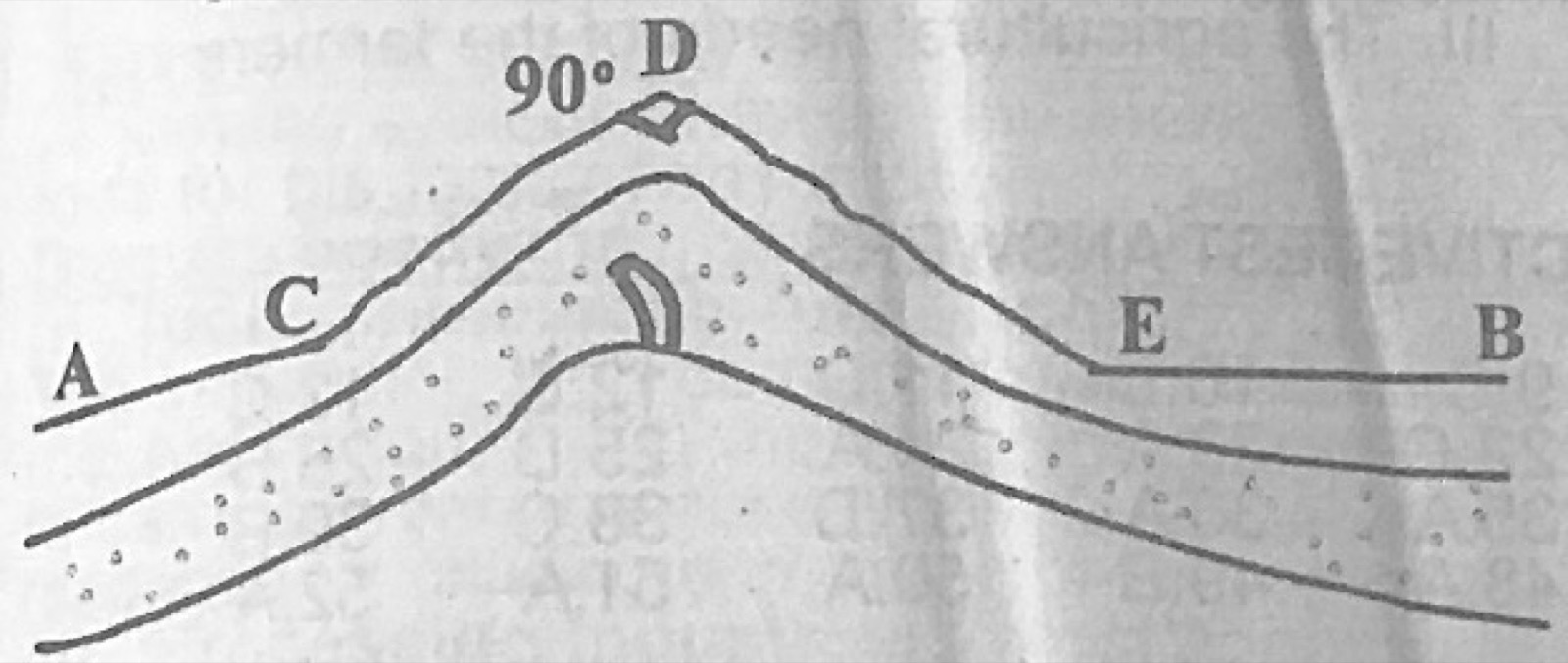
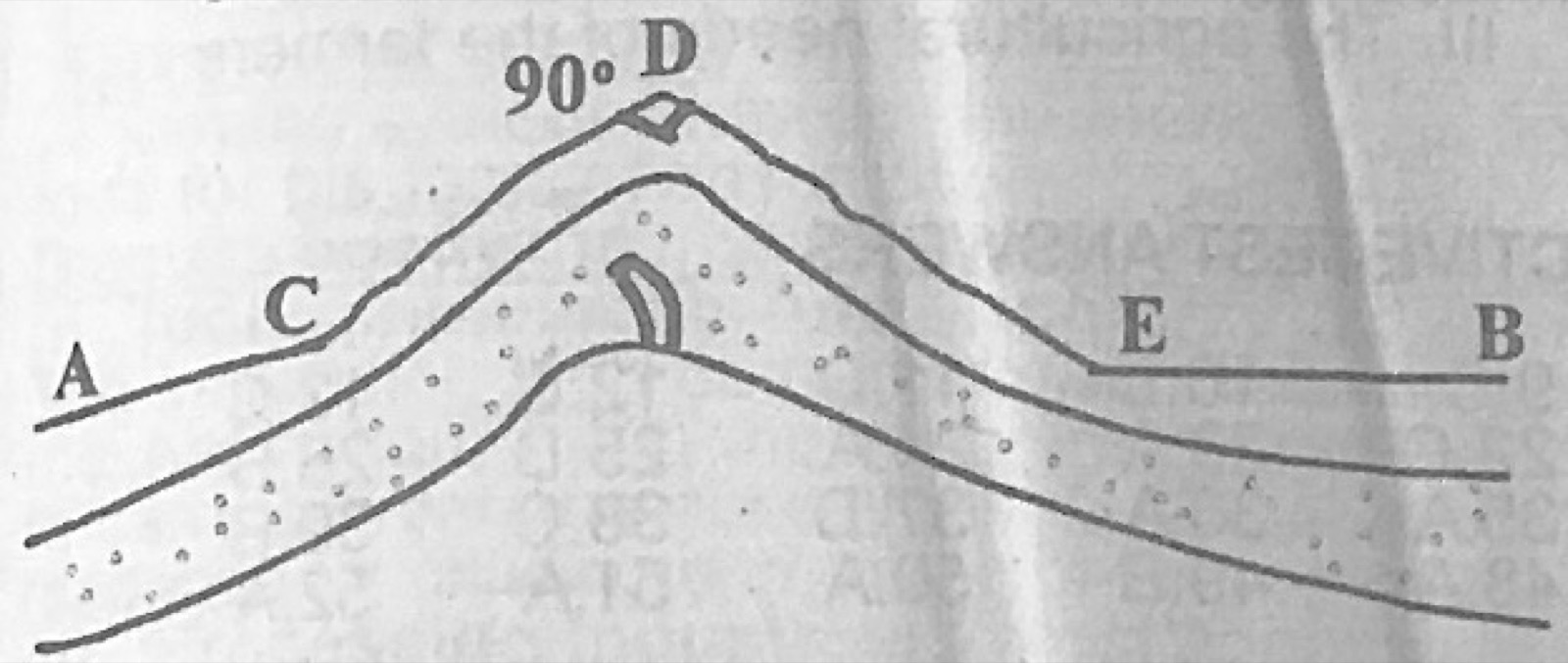
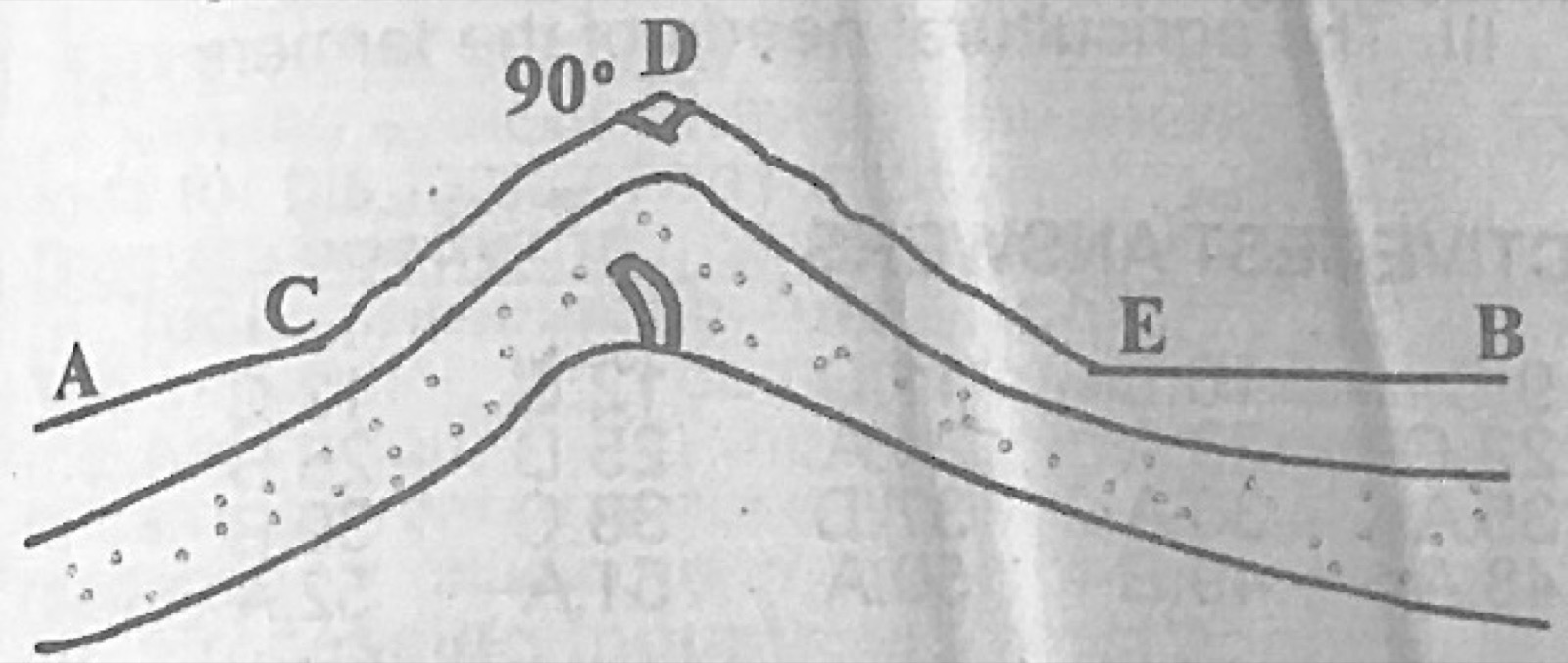
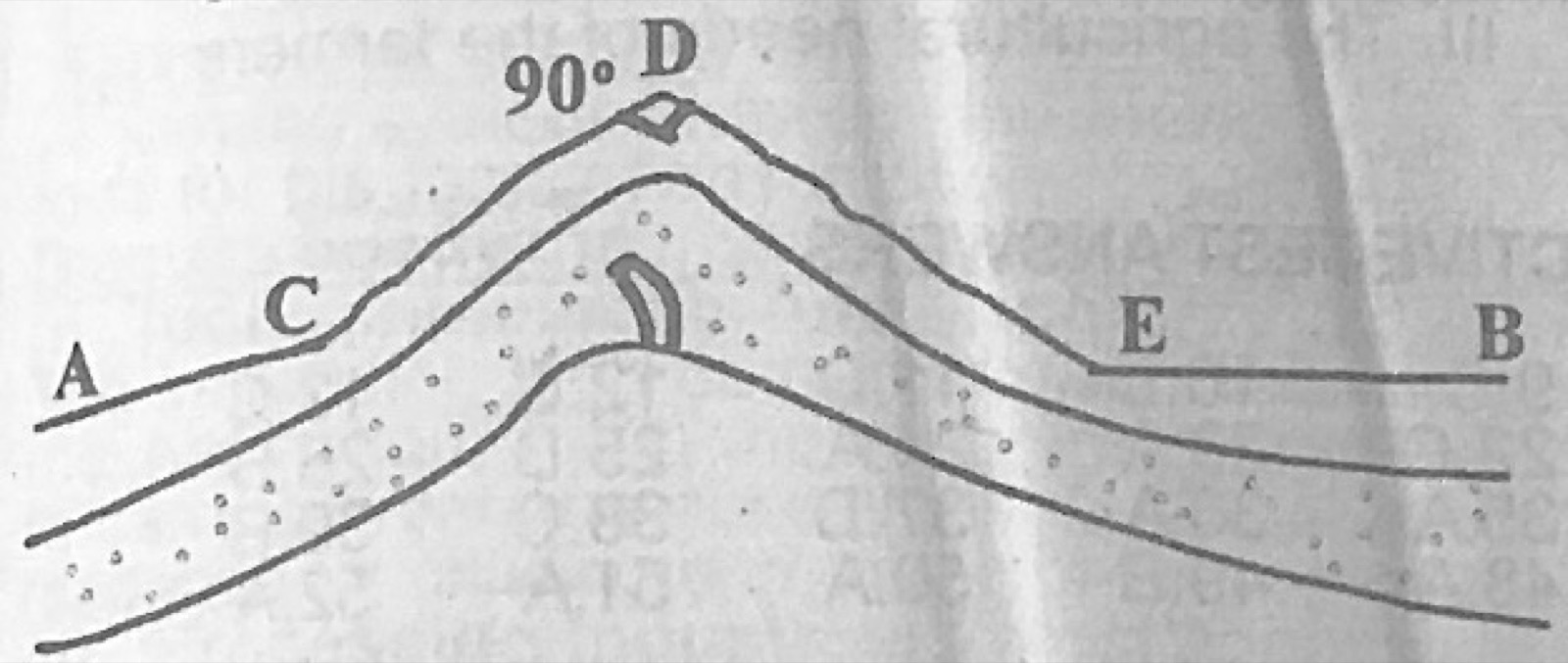
The diagram below represents a chain measurement drawing of a school farmland surveyed by students who encountered an obstruction at point C. Use the diagram and the information provided to answer questions 19, 20, 21 and 22. The distance between points A and B will be given by
A.AC + CD + EB.
B.CD + DE + EB.
C.AC + CE + EB.
D.AC + CD + DE + EB.
Show the answer and explanation
Answer: C (AC + CE + EB.)
Explanation
The chain line runs A–C–E–B, so AB is AC + CE + EB.
The diagram below represents a chain measurement drawing of a school farmland surveyed by students who encountered an obstruction at point C. Use the diagram to answer questions 19–22. How would the distance CE be calculated over the obstruction?
A.CE = CD² + EB²
B.CE = CD² + DE²
C.CE = √(CD² + DE²)
D.CE = √(DE²)
Show the answer and explanation
Answer: C (CE = √(CD² + DE²))
Explanation
The angle at D is 90°, so by Pythagoras CE² = CD² + DE².
The diagram below represents a chain measurement drawing of a school farmland surveyed by students who encountered an obstruction at point C. Use the diagram to answer questions 19–22. The method used to calculate the distance CE is called
A.chain method.
B.right-angled method.
C.similar triangle method.
D.double perpendicular method.
Show the answer and explanation
Answer: B (right-angled method.)
Explanation
A right angle is set out at D and CE found as the hypotenuse.
The diagram below represents a chain measurement drawing of a school farmland surveyed by students who encountered an obstruction at point C. Use the diagram to answer questions 19–22. What form of obstruction was encountered by the students?
A.Tree
B.River
C.Hill
D.Pond
Show the answer and explanation
Answer: C (Hill)
Explanation
The chain line has to rise over a raised mound between C and E, which is a hill.
Which of the following combinations of activities gives the correct sequence of nursing seeds? I. Watering of sown seeds II. Making drills with a dibber III. Covering seeds with palm fronds IV. Sowing seeds in drills
Which of the following statements is/are correct? Yams stored in barns should be inspected at least once a week to I. remove rotten tubers. II. remove sprouts from the tubers. III. prevent mouldiness in the tubers.
A.I only
B.II only
C.III only
D.I, II and III
Show the answer and explanation
Answer: D (I, II and III)
Explanation
Regular checks remove rotting tubers and sprouts and stop mould spreading.
Which of the following statements about the effects of diseases on crops are true? Reduction in I. quality of produce. II. photosynthetic ability. III. cost of production. IV. yield of the produce.
A.I and II only
B.I and III only
C.I, II and III only
D.I, II and IV only
Show the answer and explanation
Answer: D (I, II and IV only)
Explanation
Diseases lower quality, photosynthesis and yield; they raise, not reduce, the cost of production.
Use the animal body parts listed below to answer questions 49, 50 and 51. I. Cowper's gland II. Jejunum III. Urethra Which of the animal body parts listed above are related to the reproductive system?
A.I and II only
B.I and III only
C.II and III only
D.I, II and III
Show the answer and explanation
Answer: B (I and III only)
Explanation
Cowper's gland and the urethra belong to the male reproductive tract; the jejunum is part of the gut.
Use the animal body parts listed below to answer questions 49, 50 and 51. I. Cowper's gland II. Jejunum III. Urethra Which of the animal body parts listed above are found in female animals?
A.I and II only
B.I and III only
C.II and III only
D.I, II and III
Show the answer and explanation
Answer: C (II and III only)
Explanation
Females have a jejunum and a urethra, but Cowper's glands are male accessory glands.
Use the animal body parts listed below to answer questions 49, 50 and 51. I. Cowper's gland II. Jejunum III. Urethra Which of the animal body parts listed above secretes substances?
A.I and II only
B.I and III only
C.II and III only
D.I, II and III
Show the answer and explanation
Answer: A (I and II only)
Explanation
Cowper's gland secretes a fluid into semen and the jejunum secretes intestinal juice; the urethra is just a tube.
Which of the following statements about herbivores are true? I. Non-ruminant herbivores have long ceaca II. Non-ruminant herbivores have complex stomach III. Ruminant herbivores chew the cud
A.I and II only
B.I and III only
C.II and III only
D.I, II and III
Show the answer and explanation
Answer: B (I and III only)
Explanation
Non-ruminant herbivores (rabbit, horse) have a large caecum and a simple stomach; ruminants chew the cud.
Determine the cost price of a farm equipment that has a salvage value of ₦500,000.00, a useful life of 10 years and an annual depreciation of ₦400,000.00.
Which of the following criteria are used in selecting agricultural extension teaching methods? I. Time available for the programme II. The number of farmers involved III. The agricultural needs of the farmers
A.I and II only
B.I and III only
C.II and III only
D.I, II and III
Show the answer and explanation
Answer: D (I, II and III)
Explanation
The method chosen depends on the time, the number of farmers and what they need to learn.
(a) Explain what is meant by subsistence agriculture. (b) Discuss briefly the interdependence of agriculture and industry under the following headings: (i) tools, implements and machinery industries; (ii) processing industries; (iii) agro-chemical industries. (c)(i) What is farm surveying? (ii) With the aid of a diagram, explain the use of the 3, 4, 5 method in farm survey.
Show the model answer
Model answer
(a) Farming in which the farmer, using simple tools and family labour on a small area, produces mainly enough to feed his family, with little or nothing for sale. (b)(i) Industries make tools, implements and machines for farming, and farmers are their market; farming gives these industries demand and income. (ii) Agriculture supplies raw materials (cocoa, cotton, oil palm, cassava, milk) to processing industries; the industries buy farm produce, add value, reduce waste and provide a market for farmers. (iii) Agro-chemical industries supply fertilizers, pesticides, herbicides, drugs and feed additives; farmers' demand keeps these industries going. (c)(i) Farm surveying is the measuring and mapping of a farm to find its size, shape, boundaries and the position of features on it. (ii) Diagram: right-angled triangle with sides 3 m, 4 m and 5 m (right angle at A). Explanation: from point A on the base line measure 3 m along the line to C and peg it; tie a 4 m cord to A and a 5 m cord to C; stretch both until they meet at B and peg it; angle BAC is then 90°, giving a perpendicular for setting out the farm.
Explanation
The diagram in (c)(ii) must show the 3, 4 and 5 m sides and the right angle.
(a) What is communal land tenure system? (b) State two objectives of each of the following agricultural development programmes: (i) farm settlement schemes; (ii) river basin authorities; (iii) agricultural development projects. (c)(i) Distinguish between farm machinery and farm implements. (ii) Give six examples each of farm machinery and farm implements.
Show the model answer
Model answer
(a) A system in which land belongs to the whole community (family, clan or village) and is held in trust by its head, who allocates it to members to use but not to sell. (b)(i) Farm settlements: reduce unemployment among school leavers; make farming attractive to youths; teach modern farming; reduce rural–urban migration. (ii) River basin authorities: provide irrigation and water for dry-season farming; develop water resources for fisheries and livestock; control floods and erosion; increase food production. (iii) ADPs: increase food production and farmers' income; provide extension services and inputs; build rural infrastructure (roads, water); improve rural living standards. (c)(i) Farm machinery are power-driven machines with moving parts that do farm work (e.g. tractor); farm implements are tools/equipment pulled or operated by a power source (tractor-drawn), with no engine of their own. (ii) Machinery (any six): tractor; combine harvester; bulldozer; planter (powered); milking machine; grinding mill; sheller; water pump; incubator. Implements (any six): plough; harrow; ridger; cultivator; trailer; mower; seed drill; sprayer; fertilizer distributor; rotavator.
Explanation
Machinery has its own power unit; implements are drawn or driven by one.
(a) State four characteristics of a fertile soil. (b) Discuss briefly three factors that affect land availability for agricultural production in West Africa. (c) State four benefits of draining farm lands. (d) List two sources of soil nitrogen.
Show the model answer
Model answer
(a) Any four: contains enough of all nutrients in available form; good water-holding capacity and drainage; good aeration and crumb structure; suitable pH; deep enough for roots; rich in organic matter and organisms; free from toxic substances and pests. (b) Any three discussed: population pressure – more land for houses and less for farms; land tenure system – fragmentation and insecurity; topography – steep or swampy land is hard to farm; soil type/fertility; climate; industrialisation and urbanisation; government policy/land use act; erosion and pollution. (c) Any four: removes excess water and improves aeration; allows roots to grow deeper; raises soil temperature; increases activity of useful organisms; reduces leaching losses and toxic substances; makes land workable earlier; reduces diseases. (d) Any two: fixation by legumes/rhizobium; free-living nitrogen-fixing bacteria; lightning; organic matter decomposition; fertilizers; animal manure.
Explanation
In (b) explain how each factor limits the land available.
(a) List four factors that affect the type of soil formed at a place. (b) State: (i) two agricultural uses of land; (ii) two non-agricultural uses of land. (c) State two functions and two deficiency symptoms of each of the following nutrients in crops: (i) nitrogen; (ii) potassium. (d) Mention two ways in which soil structure is important in agriculture.
Show the model answer
Model answer
(a) Parent material; climate; living organisms/vegetation; topography; time. (b)(i) Crop production; livestock grazing/ranching; fish farming; forestry; wildlife conservation. (ii) Housing; roads and railways; industries; schools/hospitals; mining; recreation. (c)(i) Nitrogen – functions: formation of proteins and chlorophyll; promotes leafy vegetative growth. Deficiency: yellowing (chlorosis) of older leaves; stunted growth. (ii) Potassium – functions: strengthens stems and disease resistance; helps starch and sugar formation and movement; regulates water in cells. Deficiency: scorched/brown leaf edges; weak stems and lodging; poor fruit/tuber quality. (d) Any two: affects aeration; affects water infiltration and holding; affects root penetration; affects ease of tillage; affects resistance to erosion.
(a)(i) What's natural pasture? (ii) State four characteristics of natural pastures in West Africa. (b) Discuss the root knot disease of tomato under the following headings: (i) causal organism; (ii) mode of transmission; (iii) two symptoms; (iv) two prevention and control measures. (c) Distinguish between grafting and budding in plant propagation. (d) Give two uses of sugarcane.
Show the model answer
Model answer
(a)(i) Grassland that grows on its own without being planted or managed by man, on which animals graze. (ii) Any four: low yield and low quality; mostly grasses with few legumes; seasonal (lush in rainy season, dry and fibrous in dry season); contains weeds and poisonous plants; grows on its own; may harbour pests and parasites. (b)(i) Nematode, Meloidogyne spp. (root knot eelworm). (ii) Spread through infested soil, water, farm tools, and infected seedlings/roots. (iii) Galls or knots on the roots; wilting, yellowing and stunted growth; low yield. (iv) Crop rotation with non-host crops; nematicides/soil fumigation; resistant varieties; clean seedlings and sterilised nursery soil; fallowing/flooding. (c) Grafting joins a shoot (scion) with several buds onto a rootstock; budding joins only a single bud (with a little bark) onto the stock. (d) Any two: sugar production; chewing; molasses/animal feed; ethanol/alcohol; bagasse for fuel, paper or fibre board.
Explanation
Give the scientific name of the nematode in (b)(i).
(a) What is forest reserve? (b) State two advantages of taungya system of farming to each of the following: (i) farmers; (ii) foresters. (c) With the aid of a diagram, describe the life cycle of yam beetle (Heteroligus meles). (d) State two advantages of organic fertilizers over inorganic fertilizers. (e) Name two varieties of oil palm.
Show the model answer
Model answer
(a) An area of forest set aside and protected by law, where cutting trees, farming and hunting are controlled. (b)(i) Farmers: get land to grow food crops; land is fertile; land preparation partly done/reduces cost. (ii) Foresters: young trees are weeded and tended free by farmers; cost of establishing the forest is reduced; fire and illegal felling are watched. (c) Diagram of complete metamorphosis: egg → larva → pupa → adult. Description: adults lay eggs in moist soil near swamps; eggs hatch into larvae which feed on organic matter; larvae pupate in the soil; adults emerge and migrate to yam farms at the start of the rains, bore into and eat the tubers, then return to the swamps to breed. (d) Any two: improve soil structure and water holding; add humus; release nutrients slowly; increase soil organisms; do not acidify the soil; cheap/locally available. (e) Any two: Dura; Pisifera; Tenera.
Explanation
Yam beetle has complete metamorphosis: draw and label egg, larva, pupa, adult in a cycle.
(a)(i) What is incubation in poultry production? (ii) State two advantages and two disadvantages of natural incubation. (b) List four factors that affect pasture establishment in West Africa. (c) In a tabular form, state the causal organism and two symptoms of each of the following diseases of farm animals: (i) Brucellosis; (ii) Newcastle.
Show the model answer
Model answer
(a)(i) Incubation is keeping fertile eggs at the right temperature, humidity and turning until they hatch, either under a broody hen or in an incubator. (ii) Advantages: cheap, no equipment; hen turns eggs and gives correct heat and humidity; hen broods chicks after hatching. Disadvantages: few eggs at a time; hen stops laying while sitting; hen may desert eggs; diseases can pass from hen to chicks; hatching depends on hen's broodiness. (b) Any four: rainfall; soil fertility; land preparation/seedbed; choice of species/seed quality; time of planting; weeds; pests and diseases; grazing management/fire. (c) Table: Brucellosis – causal organism: bacterium Brucella abortus (cattle)/B. melitensis; symptoms: abortion in late pregnancy, retained placenta, infertility, swollen joints/testes. Newcastle – causal organism: virus (Newcastle disease virus/paramyxovirus); symptoms: gasping and coughing, greenish diarrhoea, twisting of neck/paralysis, drop in egg production, sudden death.
Explanation
Set (c) out in a table with columns for disease, cause and symptoms.
(a)(i) Explain the term malnutrition as used in animal production. (ii) State four effects of malnutrition on farm animals. (b) Write short notes on the following methods of rangeland improvement: (i) rotational grazing; (ii) reseeding; (iii) controlled stocking. (c) State four objectives of animal improvement programmes in West Africa.
Show the model answer
Model answer
(a)(i) Malnutrition is a condition caused by feeding animals a diet lacking in, or with too much of, one or more nutrients (an unbalanced diet). (ii) Any four: slow growth and low weight; deficiency diseases (rickets, anaemia); low production of eggs, milk, meat; poor reproduction/infertility; low resistance to disease; death. (b)(i) Rotational grazing: the range is divided into paddocks grazed in turn, so each rests and regrows, preventing overgrazing. (ii) Reseeding: sowing seeds of better grasses and legumes on bare or poor parts of the range to improve yield and quality. (iii) Controlled stocking: keeping the right number of animals per area (carrying capacity) so the pasture is not overgrazed. (c) Any four: increase meat, milk and egg yield; faster growth/early maturity; disease and pest resistance; adaptation to local climate/heat tolerance; better feed conversion; higher fertility and prolificacy; better quality products.
Explanation
Each note in (b) should say what is done and how it helps the range.
(a) Distinguish between the terms loan and subsidy as used in agricultural financing. (b)(i) Define the term supply. (ii) Use the information in the supply schedule below to draw a supply curve. Price of Cocoa (Le): 10,000; 15,000; 20,000; 25,000; 30,000 Supply of Cocoa (tonne): 450; 550; 700; 1,000; 1,700 (iii) Use the supply curve drawn to explain the relationship between supply and price. (c) State two advantages and two disadvantages of using farm and home visits as a teaching method in agricultural extension work. (d) Mention three characteristics of agricultural produce in relation to marketing.
Show the model answer
Model answer
(a) A loan is money lent to a farmer that must be repaid, usually with interest; a subsidy is part of the cost of inputs or services paid by government, which the farmer does not repay. (b)(i) Supply is the quantity of a commodity that producers are willing and able to offer for sale at a given price and time. (ii) Plot price (Le) on the vertical axis and quantity supplied (tonnes) on the horizontal axis with a suitable scale and title; plot the five points (450, 10,000), (550, 15,000), (700, 20,000), (1,000, 25,000), (1,700, 30,000) and join them with a smooth curve sloping upward from left to right. (iii) Supply rises as price rises (direct/positive relationship): the higher the price of cocoa, the more is supplied, and vice versa. (c) Advantages: personal contact builds trust; problems specific to the farmer are solved; farmer learns on his own farm; good for adoption of new ideas. Disadvantages: reaches few farmers; time-consuming and costly; needs many extension workers and transport. (d) Any three: perishable; bulky; seasonal; variable in quality/not uniform; produced in small quantities by many scattered farmers; demand is fairly inelastic.
Explanation
The supply curve must slope upward; label both axes with units.
(a) State the law of diminishing returns in agricultural production. (b) The table below shows the relationship between quantities of fertilizers used and the corresponding yields of sorghum. Quantity of fertilzer (bags): 0, 6, 12, 18, 24, 28, 32, 36, 40, 46 Sorghum yield (kg): 8, 30, 50, 90, 140, 170, 190, 200, 200, 190 (i) Use the table to draw an input - output graph. (ii) Explain the relationships between fertilizer input and sorghum yield. (c) Enumerate four functions of an agricultural extension agent. (d) State five benefits of commodity boards in the marketing of agricultural produce in West Africa.
Show the model answer
Model answer
(a) When more and more units of a variable input are added to a fixed input, total output first rises at an increasing rate, then at a decreasing rate, and finally falls. (b)(i) Plot fertilizer (bags) on the horizontal axis and sorghum yield (kg) on the vertical axis, plot the ten points and join them with a smooth curve with a title and labelled axes. (ii) From 0 to about 24 bags, yield rises at an increasing rate (increasing returns); from about 24 to 36–40 bags it rises at a decreasing rate (diminishing returns); maximum yield of 200 kg is reached at 36–40 bags; beyond 40 bags yield falls (negative returns), so extra fertilizer is wasteful. (c) Any four: teach farmers improved practices; demonstrate new technologies; carry farmers' problems to researchers; help farmers get inputs and credit; organise farmers into groups/co-operatives; advise on marketing and record keeping. (d) Any five: guaranteed/stable prices for farmers; provide market for produce; maintain quality through grading; fund research and development; provide storage and processing; earn foreign exchange; give credit/subsidies to farmers.
Explanation
In (b)(ii) mark the three stages of returns on the curve.