WAEC Agricultural Science 2002 past questions and answers

63 questions. Try each one, then open the answer to check yourself and read the explanation.

Question 1

Introduction to Agriculture

Subsistence agriculture mainly involves

  1. A.high capital input on the farm enterprise
  2. B.food production on large scale farms
  3. C.food production using family labour
  4. D.mechanisation of all farm operations
Show the answer and explanation

Answer: C (food production using family labour)

Explanation

Subsistence farmers grow food for their families using family labour.

Open this question

Question 2

Introduction to Agriculture

The major export crops produced in the West African subregion include

  1. A.coffee, pepper, tomato and groundnut
  2. B.cotton, cassava, coffee and ginger
  3. C.cocoa, rubber, groundnut and cotton
  4. D.cocoa, coffee, cashew and tomato
Show the answer and explanation

Answer: C (cocoa, rubber, groundnut and cotton)

Explanation

Cocoa, rubber, groundnut and cotton are traditional export crops; tomato, pepper and cassava are mainly eaten locally.

Open this question

Question 3

Processing and Storage of Farm Produce

A major problem of grains storage in the rain forest zone of West Africa is high

  1. A.temperatures
  2. B.solar radiation
  3. C.wind speed
  4. D.humidity
Show the answer and explanation

Answer: D (humidity)

Explanation

Humid air makes stored grain damp, so moulds and insects thrive.

Open this question

Question 4

Agricultural Finance

When the government provides subsidies in agriculture,

  1. A.farm inputs are made available to farmers at reduced prices
  2. B.farmers obtain loans from agricultural banks
  3. C.farmers are given extended time to repay loans
  4. D.farming becomes less attractive
Show the answer and explanation

Answer: A (farm inputs are made available to farmers at reduced prices)

Explanation

A subsidy means government pays part of the cost, so inputs are cheaper.

Open this question

Question 6

Crop Diseases

Plant quarantine regulations are enforced to

  1. A.prevent the introduction of foreign pests and diseases
  2. B.increase the resistance of crops to diseases
  3. C.encourage the importation of foreign crops
  4. D.discourage dependence on temperate crops
Show the answer and explanation

Answer: A (prevent the introduction of foreign pests and diseases)

Explanation

Quarantine checks imported plants so new pests and diseases are kept out.

Open this question

Question 7

Forestry and Wildlife

The primary purpose of establishing wildlife reserve is to

  1. A.conserve animals for hunting
  2. B.prevent extinction of wild animals
  3. C.provide constant supply of meat for export
  4. D.prevent wild animals from predating on other animals
Show the answer and explanation

Answer: B (prevent extinction of wild animals)

Explanation

Reserves protect wild animals so that species do not die out.

Open this question

Question 8

Agricultural Ecology

The most important factor that limits agricultural production in West Africa is

  1. A.temperature
  2. B.wind
  3. C.rainfall
  4. D.light
Show the answer and explanation

Answer: C (rainfall)

Explanation

Temperature and light are favourable all year; rainfall amount and timing decide what can be grown and when.

Open this question

Question 9

Soil Fertility and Plant Nutrition

An acidic soil can be neutralised by the addition of

  1. A.urea
  2. B.ammonium sulphate
  3. C.wood ash
  4. D.laterite
Show the answer and explanation

Answer: C (wood ash)

Explanation

Wood ash is alkaline (rich in potassium and calcium carbonates) so it neutralises acidity; ammonium sulphate makes soil more acidic.

Open this question

Question 10

Soil Properties

Capillarity is highest in

  1. A.silt
  2. B.loam
  3. C.sand
  4. D.clay
Show the answer and explanation

Answer: D (clay)

Explanation

Clay has the finest pores, and water rises highest in the narrowest pores.

Open this question

Question 11

Soil Fertility and Plant Nutrition

Which of the following describes the effects of excessive nitrogen application on the growth of maize plants?

  1. A.High vegetative growth with low yield
  2. B.High vegetative growth with high yield
  3. C.Low vegetative growth with high yield
  4. D.Low vegetative growth with low yield
Show the answer and explanation

Answer: A (High vegetative growth with low yield)

Explanation

Too much nitrogen gives lush leaves and stems but delays and reduces grain yield (and causes lodging).

Open this question

Question 12

Soil Fertility and Plant Nutrition

Which reaction takes place in nitrogen fixation during lightening?

  1. A.2NO2 + HNO2 → HNO3
  2. B.N2 + O2 → 2NO
  3. C.2HNO2 + O2 → 2HNO3
  4. D.NO2 → 2NO + O2
Show the answer and explanation

Answer: B (N2 + O2 → 2NO)

Explanation

The heat of lightning makes nitrogen and oxygen in the air combine to form nitrogen oxide.

Open this question

Question 13

Soil Fertility and Plant Nutrition

Nitrogen is taken up by plant roots in the form of

  1. A.nitrate ion
  2. B.nitrite ion
  3. C.nitric acid
  4. D.nitrogen gas
Show the answer and explanation

Answer: A (nitrate ion)

Explanation

Plants absorb nitrogen mainly as nitrate (NO3−) ions.

Open this question

Question 16

Soil Properties

When soils are poorly drained

  1. A.they dry up easily
  2. B.they form hardpans
  3. C.the air content of the soil is reduced
  4. D.the rate of decomposition is accelerated
Show the answer and explanation

Answer: C (the air content of the soil is reduced)

Explanation

Water fills the pore spaces and drives the air out.

Open this question

Question 17

Irrigation and Drainage

Which of the following sources of water is least useful for irrigation purposes?

  1. A.Sea
  2. B.River
  3. C.Lake
  4. D.Borehole
Show the answer and explanation

Answer: A (Sea)

Explanation

Sea water is salty and would kill crops and spoil the soil.

Open this question

Question 18

Farm Power

Which of the following sources of farm power is most flexible and adaptable to farm operations?

  1. A.animal power
  2. B.wind power
  3. C.human power
  4. D.solar power
Show the answer and explanation

Answer: C (human power)

Explanation

People can think and do almost any farm job, from planting to harvesting.

Open this question

Question 19

Farm Power

Which of the following sources of power supply to the farm is most unreliable?

  1. A.wind
  2. B.electricity
  3. C.animal
  4. D.machine
Show the answer and explanation

Answer: A (wind)

Explanation

Wind speed and direction change all the time and it may not blow at all.

Open this question

Question 20

Farm Power

Animal power is usually used on the farm for

  1. A.harvesting
  2. B.spraying
  3. C.ploughing
  4. D.planting
Show the answer and explanation

Answer: C (ploughing)

Explanation

Work animals (bulls, donkeys) are mostly used to pull ploughs.

Open this question

Question 21

Farm Machinery and Mechanisation

The most appropriate farm implement for breaking up soil clod is the

  1. A.harrow
  2. B.plough
  3. C.ridger
  4. D.mower
Show the answer and explanation

Answer: A (harrow)

Explanation

The harrow breaks the clods left by ploughing into a fine tilth.

Open this question

Question 22

Farm Machinery and Mechanisation

The daily maintenance practice carried out on a disc harrow is

  1. A.changing the disc
  2. B.cleaning the soil off the disc
  3. C.smearing the disc with oil
  4. D.sharpening the edges of its scraper
Show the answer and explanation

Answer: B (cleaning the soil off the disc)

Explanation

After each day's use the soil is cleaned off the discs to prevent rust.

Open this question

Question 23

Farm Machinery and Mechanisation

Which of the following is an advantage of mechanization?

  1. A.Carrying out many farm operations with ease
  2. B.Displacing many farm workers
  3. C.Exposing soil to direct effect of sunlight and erosion
  4. D.Polluting the environment with industrial gases and wastes
Show the answer and explanation

Answer: A (Carrying out many farm operations with ease)

Explanation

Machines make farm work easier and faster; the other options are drawbacks.

Open this question

Question 24

Crop Propagation

Sexual propagation involves the use of

  1. A.buds
  2. B.seeds
  3. C.cuttings
  4. D.vines
Show the answer and explanation

Answer: B (seeds)

Explanation

Seeds come from fertilisation, so propagating by seed is sexual.

Open this question

Question 25

Crop Propagation

The process of inducing root development on portions of stems still attached to the parent plant is known as

  1. A.budding
  2. B.grafting
  3. C.layering
  4. D.tillering
Show the answer and explanation

Answer: C (layering)

Explanation

In layering a stem is made to root while still attached to the parent plant.

Open this question

Question 26

Crop Husbandry

Which of the following crops requires shade in the early stages of its growth in the field?

  1. A.Coconut
  2. B.Banana
  3. C.Cotton
  4. D.Cocoa
Show the answer and explanation

Answer: D (Cocoa)

Explanation

Young cocoa needs shade, often from plantain or cocoyam.

Open this question

Question 27

Agricultural Ecology

Which of the following groups of crops is widely grown in areas with high rainfall?

  1. A.Cocoa, oil palm, rubber and kola
  2. B.Millet, onion, cotton and sorghum
  3. C.Coffee, cocoa, cotton and millet
  4. D.Rubber, onion, oil palm and cotton
Show the answer and explanation

Answer: A (Cocoa, oil palm, rubber and kola)

Explanation

Cocoa, oil palm, rubber and kola are rain-forest tree crops.

Open this question

Question 28

Pasture and Forage Crops

An important forage crop in West Africa is

  1. A.maize
  2. B.rice
  3. C.giant star grass
  4. D.guinea corn
Show the answer and explanation

Answer: C (giant star grass)

Explanation

Giant star grass is grown mainly to feed livestock; the others are grown mainly as food grains.

Open this question

Question 29

Forestry and Wildlife

The most important reason for encouraging afforestation in the arid regions of West Africa is to

  1. A.provide timber for building purposes
  2. B.provide shelter for wildlife
  3. C.produce medicinal plants
  4. D.serve as wind break
Show the answer and explanation

Answer: D (serve as wind break)

Explanation

Tree belts in dry areas break the wind and check desert encroachment.

Open this question

Question 30

Forestry and Wildlife

The growing of both forest trees and arable crops simultaneously on the same piece of land is termed

  1. A.mixed cropping
  2. B.mixed farming
  3. C.pastoral farming
  4. D.taungya system
Show the answer and explanation

Answer: D (taungya system)

Explanation

Taungya grows food crops among young forest trees.

Open this question

Question 32

Crop Diseases

Mosaic disease affects

  1. A.cotton and cocoa
  2. B.groundnut and tomato
  3. C.cassava and tobacco
  4. D.mango and orange
Show the answer and explanation

Answer: C (cassava and tobacco)

Explanation

Cassava mosaic and tobacco mosaic are well-known viral mosaic diseases.

Open this question

Question 33

Crop Pests

The following are biting and chewing insects except

  1. A.caterpillars
  2. B.beetles
  3. C.crickets
  4. D.moths
Show the answer and explanation

Answer: D (moths)

Explanation

Adult moths suck nectar through a coiled proboscis; caterpillars, beetles and crickets chew.

Open this question

Question 34

Crop Pests

Mealy bug is a major pest of

  1. A.citrus
  2. B.cassava
  3. C.maize
  4. D.oil palm
Show the answer and explanation

Answer: B (cassava)

Explanation

The cassava mealybug sucks sap and causes bunchy tops and leaf loss.

Open this question

Question 35

Weeds and Weed Control

Weeds which produce light and numerous seeds are normally dispersed by

  1. A.wind
  2. B.water
  3. C.animals
  4. D.insects
Show the answer and explanation

Answer: A (wind)

Explanation

Small, light seeds are easily carried by wind.

Open this question

Question 36

Crop Improvement

Which of the following effects is not a consequence of 'Introduction' in crop improvement? Introduced crops

  1. A.may mature faster than the local varieties
  2. B.may have high yield
  3. C.improve the quality of existing crops
  4. D.hamper the growth of local varieties
Show the answer and explanation

Answer: D (hamper the growth of local varieties)

Explanation

Introduced varieties bring benefits such as early maturity and high yield; they do not stop local varieties growing.

Open this question

Question 37

Animal Anatomy and Physiology

In which part of the alimentary canal of poultry is grit mostly found?

  1. A.Proventriculus
  2. B.Cloaca
  3. C.Gizzard
  4. D.Rectum
Show the answer and explanation

Answer: C (Gizzard)

Explanation

Birds keep grit in the gizzard to help grind food.

Open this question

Question 38

Animal Reproduction

Parturition in farm animals marks the end of

  1. A.breeding
  2. B.lactation
  3. C.ovulation
  4. D.gestation
Show the answer and explanation

Answer: D (gestation)

Explanation

Giving birth ends pregnancy (gestation).

Open this question

Question 39

Livestock Management

A sow is normally expected to farrow

  1. A.once a year
  2. B.once in two years
  3. C.twice a year
  4. D.four times a year
Show the answer and explanation

Answer: C (twice a year)

Explanation

With a 114-day pregnancy plus nursing, a sow can farrow about twice a year.

Open this question

Question 40

Poultry Production

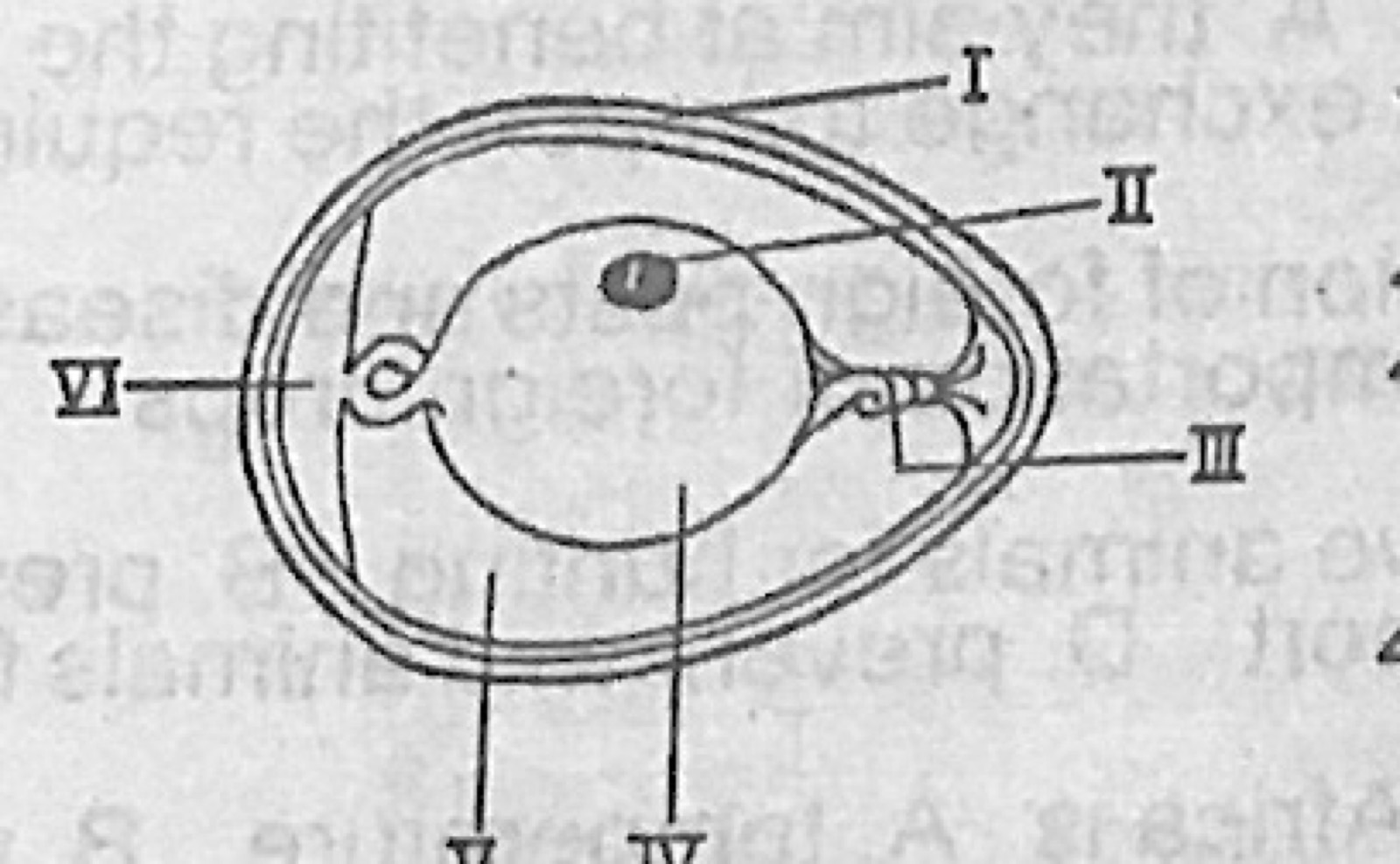
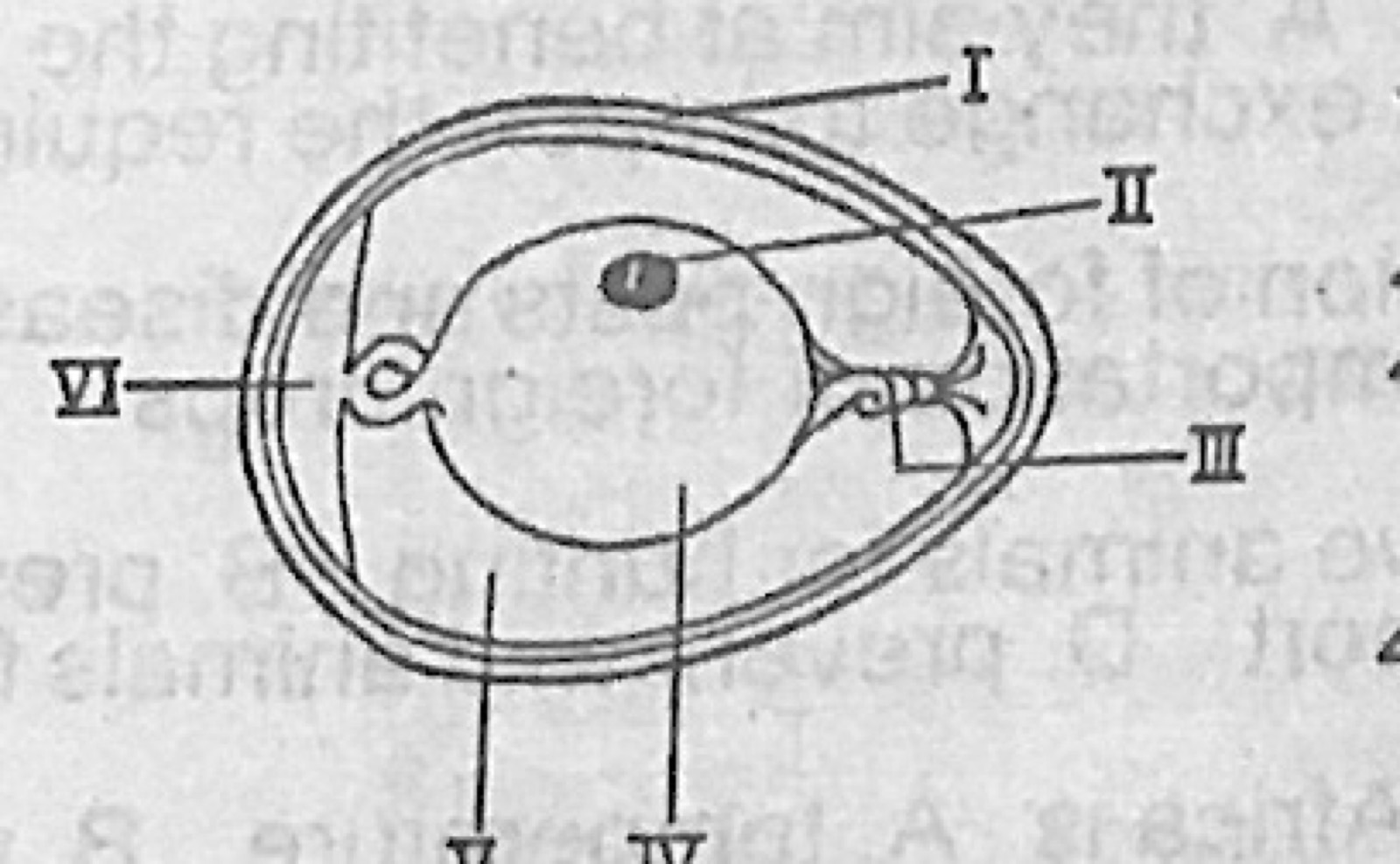
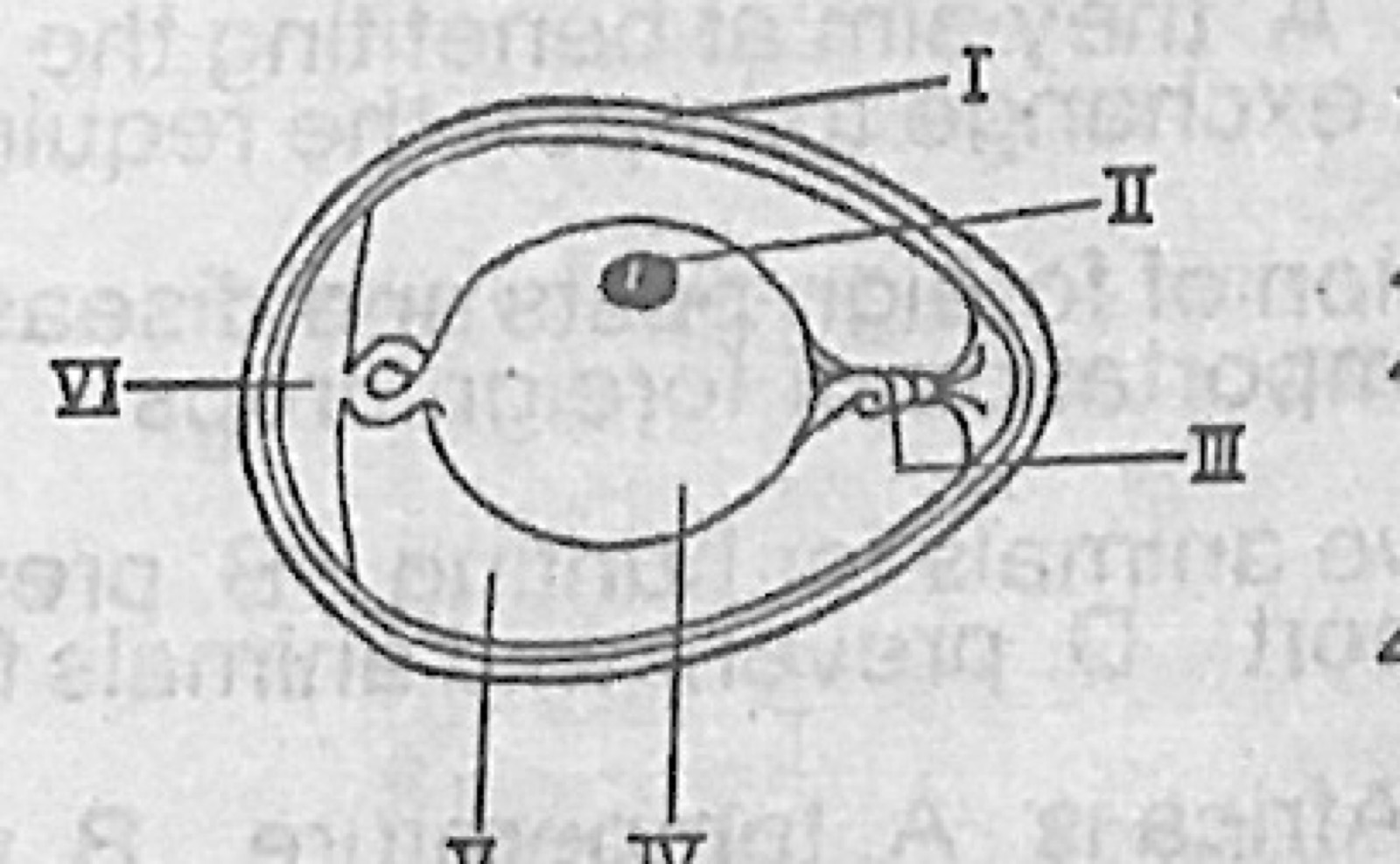
Study the diagram (a section of an egg, parts labelled I to VI). The part contributing about 60 percent of the weight of the animal product illustrated in the diagram above is labelled

Diagram for this question
  1. A.I
  2. B.III
  3. C.V
  4. D.VI
Show the answer and explanation

Answer: C (V)

Explanation

The albumen (egg white, V) is about 60% of the egg's weight.

Open this question

Question 41

Poultry Production

Study the diagram (a section of an egg, parts labelled I to VI). The part labelled IV is kept in position by

Diagram for this question
  1. A.II
  2. B.III
  3. C.V
  4. D.VI
Show the answer and explanation

Answer: B (III)

Explanation

The chalazae (III) are twisted cords that hold the yolk (IV) in the centre.

Open this question

Question 42

Poultry Production

Study the diagram (a section of an egg, parts labelled I to VI). Which of the following is not a function of the part labelled I?

Diagram for this question
  1. A.Gives the product mechanical strength
  2. B.Prevents entrance of contaminants
  3. C.Allows for gaseous exchange
  4. D.Controls the size of the product
Show the answer and explanation

Answer: D (Controls the size of the product)

Explanation

The shell (I) protects the egg and has pores for gas exchange; it does not decide the egg's size.

Open this question

Question 43

Livestock Management

High temperatures on livestock induces the following effects except

  1. A.high feed intake
  2. B.low productivity
  3. C.high water intake
  4. D.general body weakness
Show the answer and explanation

Answer: A (high feed intake)

Explanation

Hot animals eat less, not more.

Open this question

Question 44

Livestock Management

Rabbits are kept in cages called

  1. A.pens
  2. B.hutches
  3. C.paddocks
  4. D.crushes
Show the answer and explanation

Answer: B (hutches)

Explanation

Rabbit cages are hutches.

Open this question

Question 45

Livestock Management

Farm animals are identified by the following methods except

  1. A.tattooing
  2. B.tagging
  3. C.shearing
  4. D.notching
Show the answer and explanation

Answer: C (shearing)

Explanation

Shearing removes wool; it does not mark an animal.

Open this question

Question 46

Livestock Management

Which of the following is not a characteristic of pigs?

  1. A.High feed conversion rate
  2. B.Fast growth rate
  3. C.Highly prolific
  4. D.Unlimited ability to digest fibre
Show the answer and explanation

Answer: D (Unlimited ability to digest fibre)

Explanation

Pigs have a simple stomach and digest fibre poorly.

Open this question

Question 48

Animal Nutrition

The sugar most commonly found in the blood of animals is

  1. A.glucose
  2. B.galactose
  3. C.lactose
  4. D.sucrose
Show the answer and explanation

Answer: A (glucose)

Explanation

Blood sugar is glucose.

Open this question

Question 49

Animal Health

Foot and mouth disease is caused by a

  1. A.nematode
  2. B.virus
  3. C.bacterium
  4. D.fungus
Show the answer and explanation

Answer: B (virus)

Explanation

Foot and mouth disease is viral.

Open this question

Question 50

Animal Health

Which of the following symptoms indicate anthrax disease?

  1. A.Persistent coughing
  2. B.Sudden death without any visible sign of sickness
  3. C.Abortion in the seventh month of gestation
  4. D.Prolonged diarrhoea
Show the answer and explanation

Answer: B (Sudden death without any visible sign of sickness)

Explanation

Anthrax often kills animals suddenly, before signs are seen.

Open this question

Question 52

Animal Improvement

Selection and hybridization are all methods of animal

  1. A.insemination
  2. B.grading
  3. C.quarantine
  4. D.improvement
Show the answer and explanation

Answer: D (improvement)

Explanation

Selection and crossing are used to improve animals.

Open this question

Question 53

Animal Improvement

The system of breeding that is practised when N'dama cows are mated by Muturu bulls is

  1. A.inbreeding
  2. B.out crossing
  3. C.cross breeding
  4. D.line breeding
Show the answer and explanation

Answer: C (cross breeding)

Explanation

N'dama and Muturu are different breeds, so this is cross-breeding.

Open this question

Question 54

Basic Agricultural Economics

In a crop production enterprise, a fixed factor of production could be the

  1. A.size of the land
  2. B.amount of labour required
  3. C.amount of capital employed
  4. D.entrepreneurial skill of the farmer
Show the answer and explanation

Answer: A (size of the land)

Explanation

Land area stays the same in the short run; labour and capital can be varied.

Open this question

Question 55

Basic Agricultural Economics

On a curve for the law of diminishing returns, maximum output is obtained at the

  1. A.beginning of the curve
  2. B.end of the curve
  3. C.apex of the curve
  4. D.middle of the curve
Show the answer and explanation

Answer: C (apex of the curve)

Explanation

Total output is highest at the peak (apex); after it output falls.

Open this question

Question 57

Farm Management and Records

Farm accounts help the farmer to

  1. A.manage the farm as a business
  2. B.acquire skills for tools' maintenance
  3. C.keep records
  4. D.adopt modern farming techniques
Show the answer and explanation

Answer: A (manage the farm as a business)

Explanation

Accounts show costs, income and profit so the farm can be run as a business.

Open this question

Question 58

Agricultural Finance

A maize farmer obtains a loan of N120,000.00 at an interest rate of 9% to be repaid in one year. Calculate the interest to be paid on the loan

  1. A.N10,800.00
  2. B.N13,333.00
  3. C.N109,200.00
  4. D.N1,080,000.00
Show the answer and explanation

Answer: A (N10,800.00)

Explanation

Interest = 9% of 120,000 = N10,800.

Open this question

Question 59

Agricultural Extension

Agricultural extension programme

  1. A.promotes practical application of useful agricultural information
  2. B.teaches farmers about all government political programmes
  3. C.encourages adherence to the traditional farming systems
  4. D.is aimed at teaching new innovations to commercial farmers only
Show the answer and explanation

Answer: A (promotes practical application of useful agricultural information)

Explanation

Extension helps farmers put useful research findings into practice.

Open this question

Question 60

Agricultural Extension

In the mass method of agricultural extension, information is passed to farmers through the following channels except

  1. A.radio
  2. B.television
  3. C.newspapers
  4. D.farm visits
Show the answer and explanation

Answer: D (farm visits)

Explanation

Farm visits are an individual method; the others are mass media.

Open this question

Theory question 101

Agricultural Development

(a) State five objectives each of (i) Farm Settlement Scheme and (ii) Agricultural Development Programme.
(b) State six roles of cooperative organisations in agricultural production.

Show the model answer
Model answer

(a)(i) Farm Settlement Scheme (any five): attract young school leavers into farming; reduce unemployment; teach modern farming methods; check rural–urban drift by developing rural areas; raise food production and farmers' income; provide model farms for nearby farmers; overcome land tenure problems
(ii) ADP (any five): raise food production and farm incomes; supply inputs (seeds, fertilizers, chemicals) through farm service centres; intensify extension contact with farmers; build rural roads, earth dams, boreholes; support mechanisation (tractor hiring); improve rural living standards
(b) Any six: supply inputs in bulk at lower cost; give credit to members; provide storage and processing facilities; market members' produce at better prices; provide machinery and transport; educate and train members; spread risks; encourage large-scale production; employment

Explanation

Five objectives for each programme, then six cooperative roles.

Open this question

Theory question 102

Land Use and Land Tenure

(a) List six types of land tenure systems.
(b) Discuss five reasons why the government should enforce the land use legislation.

Show the model answer
Model answer

(a) Any six: communal; inheritance; freehold/outright purchase; leasehold; gift; pledge; rent/tenancy (share cropping); state/government ownership
(b) Any five, discussed: gives security of tenure so farmers are not evicted unfairly; ensures good land is kept for farming, not wasted on other uses; makes large areas available for government farms and projects; prevents fragmentation and allows consolidation of holdings; reduces land disputes and court cases; allows land improvement such as irrigation and conservation; makes land easier to get for those who want to farm

Explanation

Six types as a list; five reasons each with a short explanation.

Open this question

Theory question 103

Irrigation and Drainage

(a) State five effects of each of the following practices on crop production: (i) Irrigation (ii) Drainage
(b) List four methods of surface irrigation.
(c) Give two main reasons why surface drainage is often necessary in crop production.

Show the model answer
Model answer

(a)(i) Irrigation (any five): allows dry-season and all-year cropping; raises yields; softens soil for tillage; dissolves nutrients for roots; cools the crop; may cause salinity, waterlogging, leaching or spread of weeds and water-borne diseases
(ii) Drainage (any five): removes excess water; improves aeration for roots; warms the soil earlier; increases microbial activity and decomposition; lets roots grow deeper; prevents toxic substances building up; makes tillage and harvesting easier; reclaims swampy land
(b) Any four: flood (wild flooding); furrow; basin; border strip; check flooding
(c) Any two: to remove excess surface (rain or flood) water quickly and prevent waterlogging; to prevent erosion from run-off; to improve aeration and workability of the soil

Explanation

Give both good and bad effects of irrigation.

Open this question

Theory question 104

Soil Fertility and Plant Nutrition

(a) State three functions of nitrogen in crop plants.
(b) Mention four effects of excess soil nitrogen and three effects of nitrogen deficiency on plants.
(c) Apart from lightning, state three other ways by which nitrogen is added to the soil?
(d) List six soil micro nutrients

Show the model answer
Model answer

(a) Any three: part of proteins and protoplasm; part of chlorophyll, giving dark green leaves; promotes vegetative (leaf and stem) growth; increases protein content of grain; helps uptake of other nutrients
(b) Excess (any four): too much leafy growth; delays flowering and maturity; weak stems and lodging; lower quality/low grain yield; more disease attack; soft, watery tissues
Deficiency (any three): yellowing (chlorosis) of older leaves; stunted growth; small leaves; early maturity with low yield; thin stems
(c) Any three: fertilizer application (inorganic); organic manure (farmyard manure, compost); symbiotic fixation by Rhizobium in legume nodules; free-living bacteria (Azotobacter, Clostridium) and blue-green algae; decomposition of plant and animal remains
(d) Any six: iron; manganese; zinc; copper; boron; molybdenum; chlorine

Explanation

Separate excess from deficiency effects.

Open this question

Theory question 105

Weeds and Weed Control

(a) Describe briefly four methods of weed dispersal.
(b) Describe three mechanical and three cultural methods of weed control.

Show the model answer
Model answer

(a) Any four: wind – light seeds with hairs or wings (e.g. Tridax); water – floating seeds carried by run-off and irrigation; animals – hooked/sticky seeds on fur and clothes, or seeds eaten and passed in dung; man – in impure crop seed, on tools, machines and vehicles; explosive pods that burst and throw seeds (self-dispersal); vegetative spread by rhizomes and stolons
(b) Mechanical (any three): hand pulling; hoeing; slashing/mowing with cutlass or mower; tillage (ploughing, harrowing); burning; flooding
Cultural (any three): crop rotation; mulching; cover cropping; close spacing/high plant population; timely planting; use of clean seed; fallowing

Explanation

Explain how each method works.

Open this question

Theory question 106

Crop Diseases

(a) In a tabular form, name one fungal disease, one viral disease and one pest of any four of the following crops: (i) citrus (ii) banana (iii) tomato (iv) yam (v) groundnut
(b) State six general control measures of diseases of crops

Show the model answer
Model answer

(a) Any four rows:
Citrus – fungal: gummosis/foot rot, scab; viral: tristeza; pest: citrus fruit moth, aphids, fruit flies
Banana – fungal: Sigatoka leaf spot, Panama disease; viral: bunchy top; pest: banana weevil, nematodes
Tomato – fungal: damping off, early blight, Fusarium wilt; viral: tomato leaf curl, mosaic; pest: whitefly, root-knot nematode, fruit worm
Yam – fungal: anthracnose, tuber rot; viral: yam mosaic; pest: yam beetle, nematodes, mealybugs
Groundnut – fungal: Cercospora leaf spot, rust; viral: rosette; pest: aphids, termites, millipedes
(b) Any six: plant resistant varieties; use disease-free seeds and planting materials; crop rotation; seed dressing; spraying fungicides/chemicals; uprooting and burning infected plants (sanitation); control of insect vectors; proper spacing and drainage; quarantine; early planting; fallowing

Explanation

Set (a) out as a table with crops in rows.

Open this question

Theory question 107

Livestock Management

(a)(i) What is culling? (ii) Give three reasons why culling is practised in livestock management.
(b) State three advantages and three disadvantages of each of the following management systems in poultry production: (i) deep litter system (ii) battery cage system

Show the model answer
Model answer

(a)(i) Culling is removing unproductive, sick, old or otherwise undesirable animals from a flock or herd
(ii) Any three: remove poor producers to raise efficiency; remove sick animals to stop spread of disease; remove animals with bad traits from breeding; reduce feed cost; reduce overcrowding
(b)(i) Deep litter – advantages: cheaper than cages; birds can move and exercise; litter makes good manure; fewer leg and breast problems; disadvantages: diseases such as coccidiosis spread easily; floor/dirty eggs; cannibalism and egg eating; litter may become wet and smelly; harder to identify poor layers
(ii) Battery cage – advantages: more birds per space; clean eggs, easy collection; easy to cull poor layers and keep records; less disease from droppings; less feed wastage and fighting; disadvantages: high cost of cages; birds cannot exercise (cage layer fatigue, leg problems); eggs infertile; needs electricity/skill; fly problems from droppings

Explanation

Define culling, then three of each for both systems.

Open this question

Theory question 108

Animal Health

(a) Define the term "disease"
(b) State the difference between resistance and susceptibility to diseases.
(c) Enumerate four economic importance of animal diseases.
(d) List three factors which determine the degree of resistance of an animal to a disease.
(e) Outline three conditions that may inactivate a pathogenic organism.

Show the model answer
Model answer

(a) Disease is any condition in which the normal functioning of the animal's body is disturbed, shown by signs such as fever, poor appetite or poor production
(b) Resistance is the ability of an animal to withstand attack by disease organisms; susceptibility is being easily attacked by them (lack of resistance)
(c) Any four: deaths of animals; lower production (meat, milk, eggs); cost of treatment and vaccines; poor quality products/lower market value; some diseases spread to man (zoonoses); infertility and abortion; loss of income
(d) Any three: age; breed/heredity; nutrition; previous infection or vaccination (immunity); health status/stress; sex; environment and management
(e) Any three: high temperature (heat, boiling, sterilising); disinfectants and chemicals; sunlight/ultraviolet light; drying; antibiotics and drugs; extreme pH

Explanation

Short definitions, then lists.

Open this question

Theory question 109

Basic Agricultural Economics

Explain the following terms used in agricultural production:
(a) hired labour
(b) fixed capital
(c) working capital
(d) management

Show the model answer
Model answer

(a) Hired labour: workers employed and paid wages (daily, weekly or monthly) to do farm work, as opposed to family labour
(b) Fixed capital: durable assets used over many production seasons, e.g. land improvements, buildings, machinery, tree crops, breeding stock
(c) Working (circulating) capital: inputs used up within one production cycle, e.g. seeds, fertilizer, feed, chemicals, cash for wages
(d) Management: the organising and controlling of land, labour and capital, taking decisions and bearing risks to make profit (the entrepreneur)

Explanation

One clear definition with an example for each.

Open this question

Theory question 110

Marketing of Agricultural Produce

(a) Explain the term "marketing"
(b) State five importance of marketing in agriculture.
(c) Mention five marketing functions.
(d) In what four ways can the marketing of agricultural produce be encouraged?

Show the model answer
Model answer

(a) Marketing is all the activities involved in moving farm produce from the producer to the final consumer, including buying, selling, assembling, storage, processing, transport and pricing
(b) Any five: gives farmers income; encourages more production; makes produce available where and when needed; reduces waste; creates jobs; supplies raw materials to industries; earns foreign exchange; stabilises prices
(c) Any five: assembling; grading and standardisation; processing; packaging; storage; transportation; financing; risk bearing; pricing; advertising; selling/distribution
(d) Any four: good rural roads and transport; storage and processing facilities; market information; formation of cooperatives; guaranteed minimum prices; credit to farmers and traders; grading and standards; reduce levies and taxes
Explanation

Define, then lists for (b) to (d).

Open this question