Home › Past questions › JAMB › Physics › 2014 46 questions. Try each one, then open the answer to check yourself and read the explanation.
Sign up free to answer these questions on a CBT screen with a timer, then see your score and every answer explained.
Start practising free
Question 3 Scalars and Vectors A quantity which requires magnitude and direction to be specified is
A. distance. B. displacement. C. mass. D. temperature. Show the answer and explanation Answer: B (displacement. )
Explanation Displacement is distance in a stated direction, so it is a vector. Distance, mass and temperature are scalars.
Open this question
Question 4 Scalars and Vectors I. Electrical potential II. Torque III. Kinetic energy IV. Momentum
A. I and II. B. I and III. C. II and III. D. II and IV. Show the answer and explanation Answer: D (II and IV. )
Explanation Torque and momentum have direction, so they are vectors. Electrical potential and kinetic energy have size only.
Open this question
Question 5 Motion Which type of motion do the wheels of a moving car undergo?
A. Random and translational motion. B. Rotational and oscillatory motion. C. Translational and rotational motion. D. Vibratory and translational motion. Show the answer and explanation Answer: C (Translational and rotational motion. )
Explanation Each wheel spins about its axle (rotation) while it also moves forward with the car (translation).
Open this question
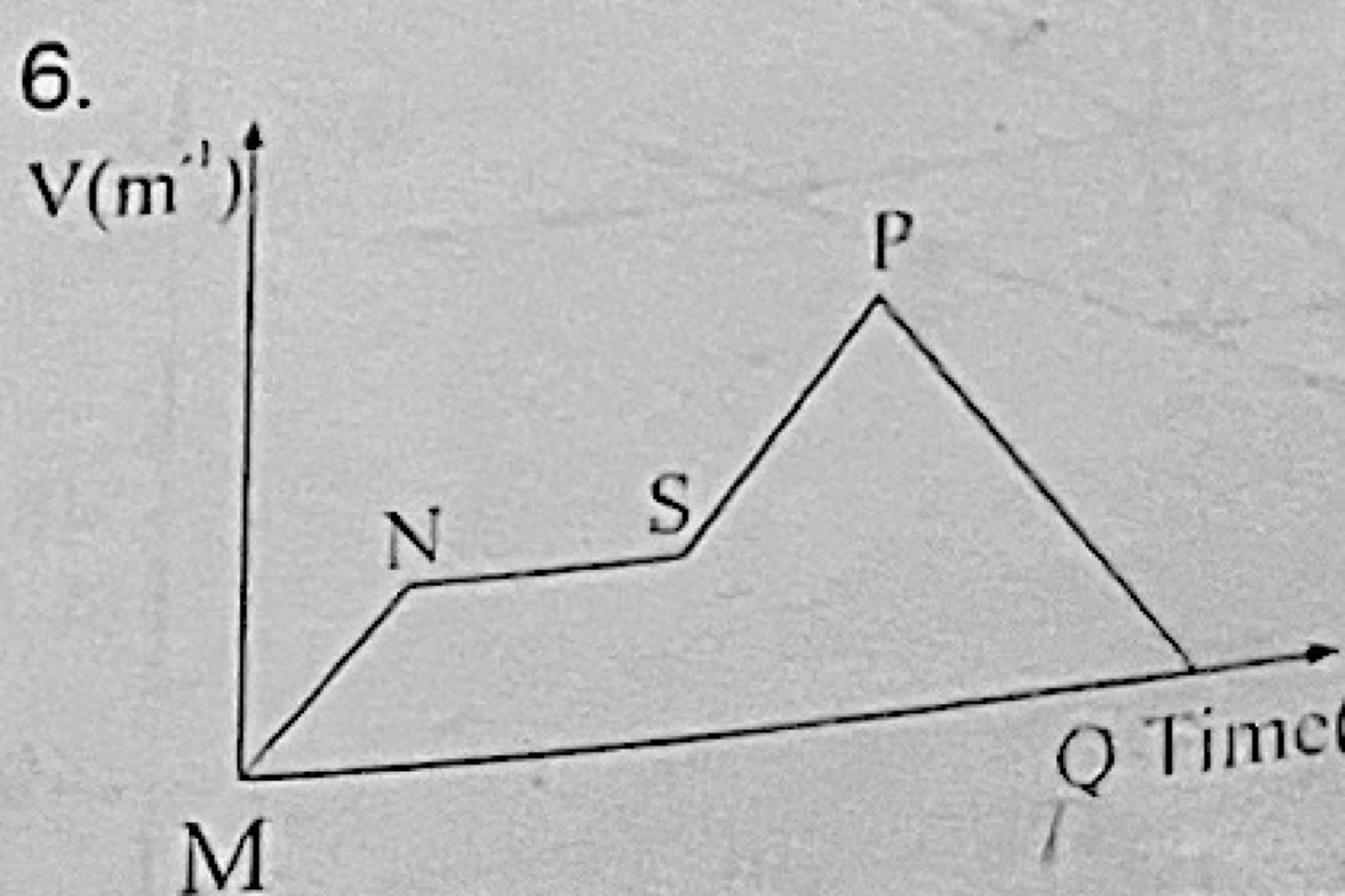
Question 6 Motion From the diagram above, the region of zero acceleration is
A. MN. B. NS. C. SP. D. PQ. Show the answer and explanation Answer: B (NS. )
Explanation On a velocity–time graph, acceleration is the slope. NS is the flattest (horizontal) part, where the velocity is constant and the acceleration is zero.
Open this question
Question 7 Motion A car accelerates uniformly from rest at 3ms−2 , its velocity after travelling a distance of 24m is
A. 144 ms−1 . B. 72 ms−1 . C. 36 ms−1 . D. 12 ms−1 . Show the answer and explanation Answer: D (12 ms−1 . )
Explanation v2 = u2 + 2as = 0 + 2 × 3 × 24 = 144, so v = 12 m s−1 .
Open this question
Question 8 Gravitational Field Calculate the escape velocity of a satellite launched from the earth's surface if the radius of the earth is 6.4 × 10⁶ m. [g=10 ms−2 ]
A. 4.2 kms−1 . B. 4.0 kms−1 . C. 11.3 kms−1 . D. 25.3 kms−1 . Show the answer and explanation Answer: C (11.3 kms−1 . )
Explanation v = √(2gR) = √(2 × 10 × 6.4 × 106 ) ≈ 1.13 × 10⁴ m s−1 = 11.3 km s−1 .
Open this question
Question 9 Gravitational Field An object of weight 80kg on earth is taken to a planet where the acceleration due to gravity is one-third of its value on earth. The weight of the object on the planet is [g=10 ms−2 ]
A. 12 N. B. 27 N. C. 36 N. D. 48 N. Show the answer and explanation Answer: B (27 N. )
Explanation Weight is proportional to g, so on the planet the weight is one-third of its earth value: 80 ÷ 3 ≈ 27 N.
Open this question
Question 10 Equilibrium of Forces One of the conditions necessary for an object to be in equilibrium when acted upon by a number of parallel forces is that the vector sum of the forces is
A. zero. B. negative. C. positive. D. average. Show the answer and explanation Answer: A (zero. )
Explanation For equilibrium the resultant force must be zero (forces up = forces down), and the total moment about any point must also be zero.
Open this question
Question 11 Equilibrium of Forces What happens when three coplanar non-parallel forces are in equilibrium?
A. They are represented in magnitude only. B. They are represented in direction only. C. Their lines of action meet at a point. D. Their lines of action are parallel. Show the answer and explanation Answer: C (Their lines of action meet at a point. )
Explanation Three non-parallel forces in equilibrium must be concurrent: their lines of action pass through one point (otherwise they would make the body turn).
Open this question
Question 12 Work, Energy and Power An object of mass 20kg is released from a height of 10m above the ground level. The kinetic energy of the object just before it hits the ground is [g=10ms−2 ]
A. 4 000 J. B. 2 000 J. C. 500 J. D. 200 J. Show the answer and explanation Answer: B (2 000 J. )
Explanation All its potential energy becomes kinetic energy: KE = mgh = 20 × 10 × 10 = 2000 J.
Open this question
Question 13 Radioactivity and Nuclear Physics The energy in the nucleus of atoms produce heat which can be used to generate
A. mechanical energy. B. electrical energy. C. potential energy. D. kinetic energy. Show the answer and explanation Answer: B (electrical energy. )
Explanation In a nuclear power station the heat from fission boils water; the steam turns turbines connected to generators, producing electrical energy.
Open this question
Question 14 Simple Machines A machine whose efficiency is 75% is used to lift a load of 1000N. Calculate the effort put in to the machine if it has a velocity ratio of 4.
A. 233.33 N. B. 333.33 N. C. 334.33 N. D. 343.32 N. Show the answer and explanation Answer: B (333.33 N. )
Explanation MA = efficiency × VR = 0.75 × 4 = 3. Effort = load ÷ MA = 1000 ÷ 3 ≈ 333.33 N.
Open this question
Question 15 Simple Machines A wheel and axle is used to raise a load whose weight is 800 N when an effort of 250 N is applied. If the radii of the wheel and axle are 800 mm and 200 mm respectively, the efficiency of the machine is
A. 80%. B. 85%. C. 87%. D. 90%. Show the answer and explanation Answer: A (80%. )
Explanation VR = 800 ÷ 200 = 4 and MA = 800 ÷ 250 = 3.2. Efficiency = 3.2/4 × 100% = 80%.
Open this question
Question 16 Elasticity A force of 500N is applied to a steel wire of cross-sectional area 0.2m2 . the tensile stress is
A. 1.0 × 10² Nm−2 B. 1.0 × 10³ Nm−2 C. 2.5 × 10³ Nm−2 D. 2.5 × 10⁴ Nm−2 Show the answer and explanation Answer: C (2.5 × 10³ Nm−2 )
Explanation Tensile stress = force ÷ area = 500 ÷ 0.2 = 2500 N m−2 = 2.5 × 10³ N m−2 .
Open this question
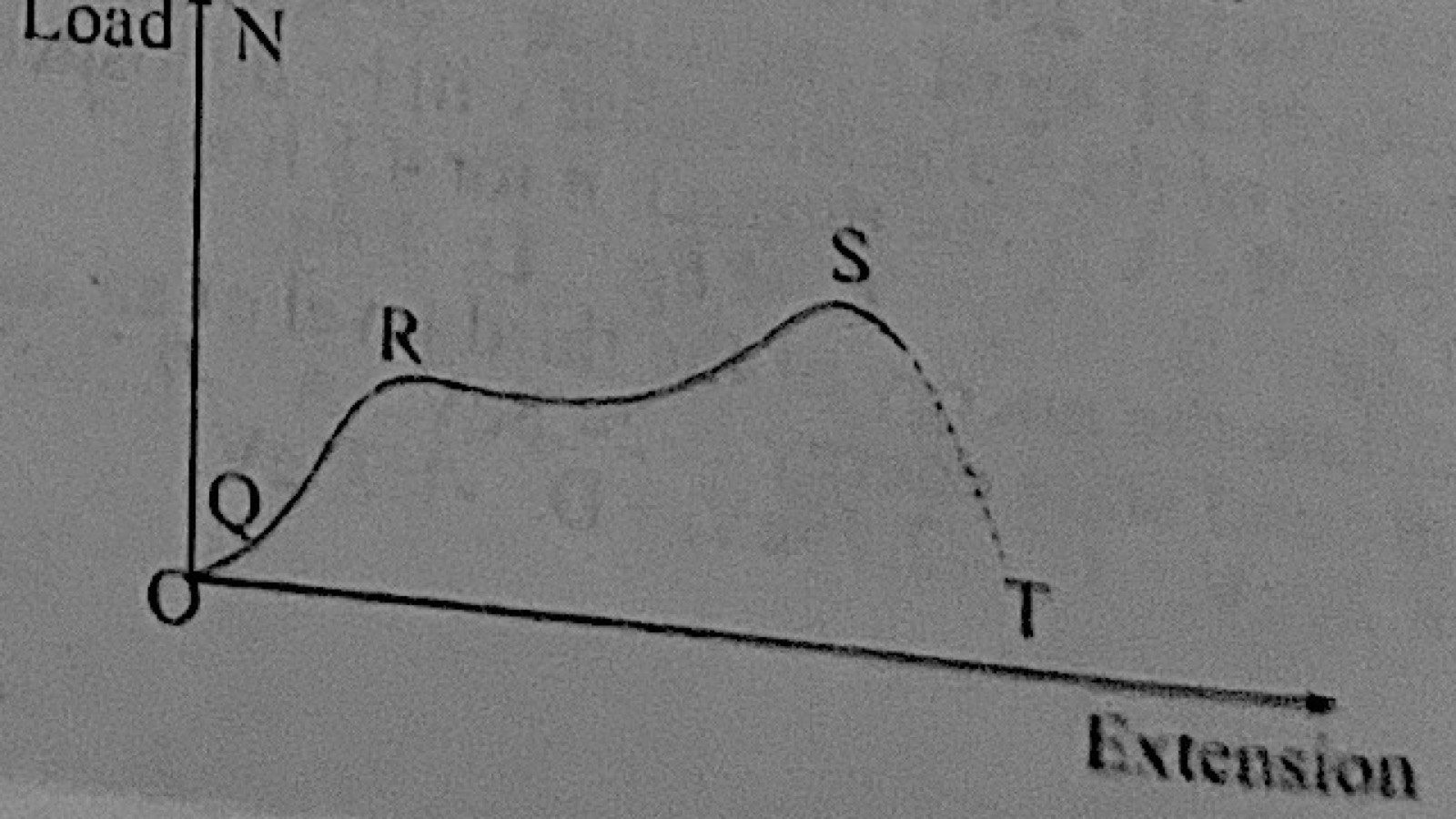
Question 17 Elasticity From the diagram above, the point that represents the elastic limit is
A. Q. B. R. C. S. D. T. Show the answer and explanation Answer: B (R. )
Explanation Hooke's law holds on the straight part up to Q (limit of proportionality). The elastic limit is just after it, where the curve reaches R and the wire starts to yield. S is the maximum load and T the breaking point.
Open this question
Question 20 Thermal Expansion A glass bottle of initial volume 2 × 104 cm3 is heated from 20°C to 50°C. If the linear expansivity of glass is 9 × 10⁻⁶ K−1 , the volume of the bottle at 50°C is
A. 20 005.4 cm3 . B. 20 008.1 cm3 . C. 20 013.5 cm3 . D. 20 016.2 cm3 . Show the answer and explanation Answer: D (20 016.2 cm3 . )
Explanation Cubic expansivity = 3 × 9 × 10−6 = 2.7 × 10⁻⁵ K−1 . ΔV = 2.7 × 10−5 × 2 × 104 × 30 = 16.2 cm3 , so V = 20 016.2 cm3 .
Open this question
Question 21 Gas Laws The equation Pa Vb Tc = constant reduces to Charles Law if
A. a=1, b=0 and c= −1. B. a=0, b=1 and c=1. C. a=0, b=1 and c= −1. D. a=1, b=1 and c=0. Show the answer and explanation Answer: C (a=0, b=1 and c= −1. )
Explanation Charles' law is V/T = constant at fixed pressure, i.e. P0 V1 T−1 = constant: a = 0, b = 1, c = −1.
Open this question
Question 22 Quantity of Heat The quantity of heat needed to raise the temperature of a body by 1K is the body's
A. internal energy. B. specific heat capacity. C. latent heat of fusion. D. heat capacity. Show the answer and explanation Answer: D (heat capacity. )
Explanation Heat capacity is the heat needed to raise the temperature of the whole body by 1 K. Specific heat capacity is for 1 kg of the substance.
Open this question
Question 23 Change of State and Vapours The melting point of a substance is equivalent to its
A. solidification temperature. B. liquidification temperature. C. solidification pressures. D. vapour pressure. Show the answer and explanation Answer: A (solidification temperature. )
Explanation A pure substance melts and freezes (solidifies) at the same temperature, so its melting point equals its solidification (freezing) temperature.
Open this question
Question 24 Change of State and Vapours The temperature at which the water vapour present in the air just sufficient to saturate the air is
A. ice point. B. saturation point. C. dew point. D. boiling point. Show the answer and explanation Answer: C (dew point. )
Explanation The dew point is the temperature at which the water vapour already in the air is just enough to saturate it, so dew starts to form.
Open this question
Question 25 Heat Transfer Heat transfer by convection in a liquid is due to the
A. increased vibration of the molecules of the liquid about their mean position. B. variation of density of the liquid. C. expansion of the liquid as it is heated. D. latent heat of vaporization of the liquid. Show the answer and explanation Answer: B (variation of density of the liquid. )
Explanation Heated liquid becomes less dense and rises, while cooler, denser liquid sinks to take its place. These density differences drive convection currents.
Open this question
Question 26 Waves The distance between two successive crests of a wave is 15 cm and the velocity 300 ms−1 . Calculate the frequency.
A. 4.5 × 10⁵ Hz. B. 2.0 × 10³ Hz. C. 4.5 × 10² Hz. D. 2.0 × 10² Hz. Show the answer and explanation Answer: B (2.0 × 10³ Hz. )
Explanation The wavelength is 0.15 m. f = v/λ = 300 ÷ 0.15 = 2000 Hz = 2.0 × 10³ Hz.
Open this question
Question 27 Sound A boy receives the echo of his clap reflected by a nearby hill 0.8s later. How far is he from the hill? [speed of sound in air = 340ms−1 ]
A. 66 m. B. 136 m. C. 264 m. D. 528 m. Show the answer and explanation Answer: B (136 m. )
Explanation The sound goes to the hill and back: 2d = vt = 340 × 0.8 = 272 m, so d = 136 m.
Open this question
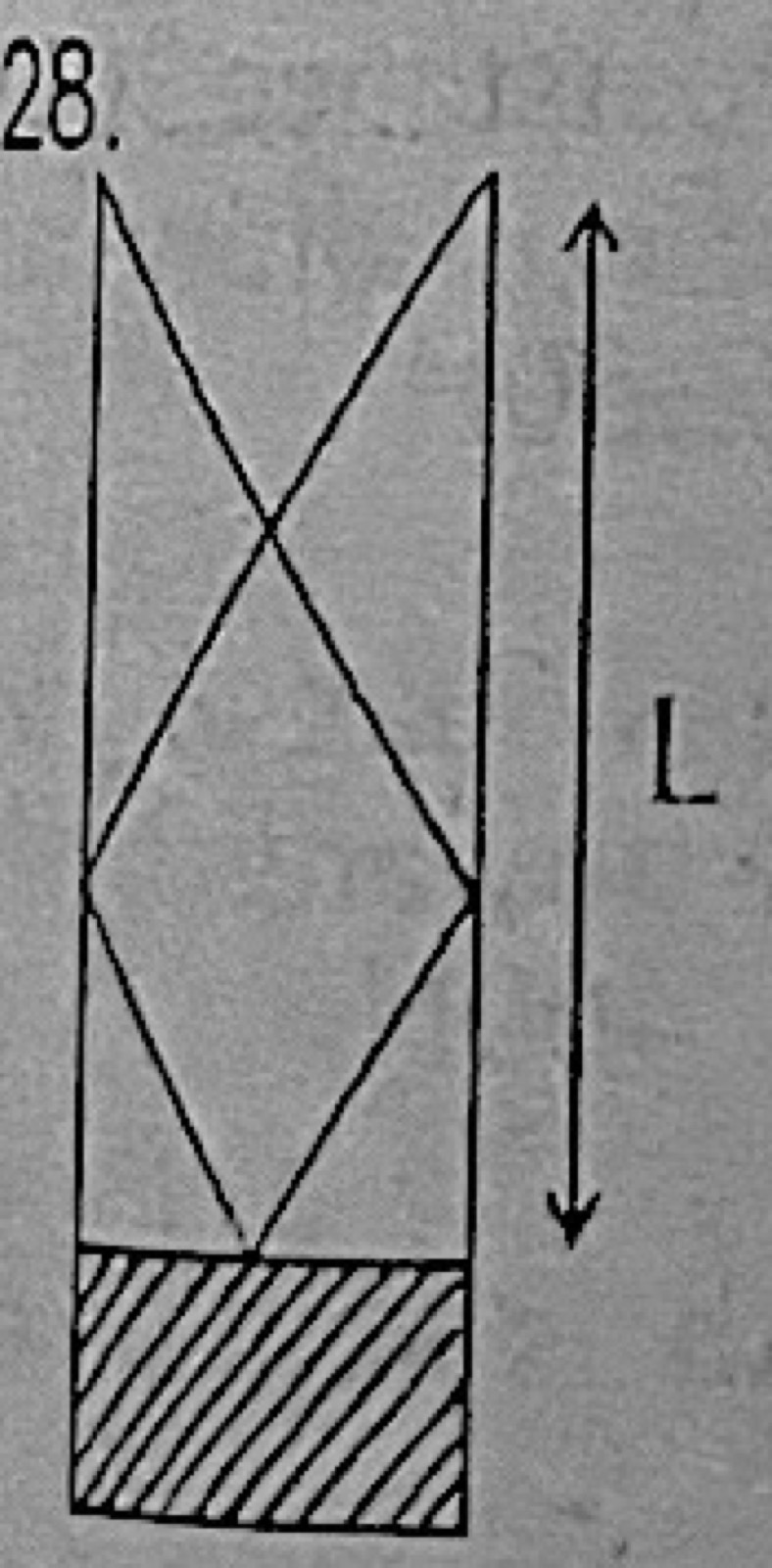
Question 28 Sound The diagram above shows a stationary wave of wavelength 40 cm in a closed tube. The length L of the resonating air column is
A. 10 cm. B. 20 cm. C. 30 cm. D. 40 cm. Show the answer and explanation Answer: C (30 cm. )
Explanation The diagram shows one and a half loops, i.e. three quarter-wavelengths: L = 3λ/4 = 3 × 40 ÷ 4 = 30 cm.
Open this question
Question 29 Light and Reflection An object is placed 10 m from a pinhole camera of length 25 cm. Calculate the linear magnification
A. 2.5 × 10⁻² . B. 2.5 × 10⁻¹ . C. 2.5 × 101 . D. 2.5 × 10² . Show the answer and explanation Answer: A (2.5 × 10⁻² . )
Explanation Magnification = image distance ÷ object distance = 0.25 m ÷ 10 m = 2.5 × 10⁻² .
Open this question
Question 30 Light and Reflection The focal length of a concave mirror is 2.0 cm. If an object is placed 8.0 cm from it, the image is at
A. 2.0 m. B. 2.3 m. C. 2.5 m. D. 2.7 m. Show the answer and explanation Answer: D (2.7 m. )
Explanation 1/v = 1/f − 1/u = 1/2 − 1/8 = 3/8, so v = 8/3 ≈ 2.7 cm in front of the mirror.
Open this question
Question 31 Lenses and Optical Instruments In a compound microscope, the objective and the eyepiece focal lengths are
A. long. B. short. C. the same. D. at infinity. Show the answer and explanation Answer: B (short. )
Explanation A compound microscope uses two converging lenses of short focal length to give a large magnification of a near object.
Open this question
Question 32 Lenses and Optical Instruments When a telescope is in normal use, the final image is at
A. the focus. B. the radius of curvature. C. the near point. D. infinity. Show the answer and explanation Answer: D (infinity. )
Explanation In normal adjustment the focal points of the objective and eyepiece coincide, so the final image is formed at infinity and the eye is relaxed.
Open this question
Question 33 Electrostatics When a negatively-charged rod is brought near the cap of a charged gold leaf electroscope which has positive charges, the leaf
A. collapses. B. collapses and diverges again. C. diverges. D. remains the same. Show the answer and explanation Answer: A (collapses. )
Explanation The negative rod attracts positive charge up to the cap (electrons move down and neutralise the leaf), so the leaf loses its charge and collapses.
Open this question
Question 34 Capacitors What charge is stored in a 0.1F capacitor when a 10V supply is connected across it?
A. 5 C B. 4 C C. 2 C D. 1 C Show the answer and explanation Answer: D (1 C )
Explanation Q = CV = 0.1 × 10 = 1 C.
Open this question
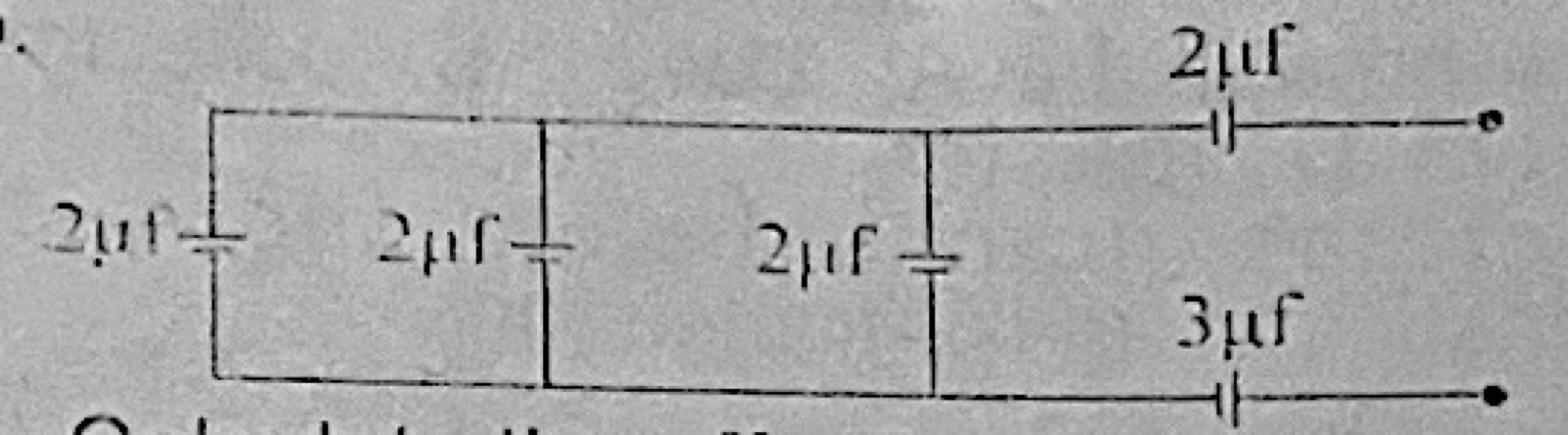
Question 35 Capacitors Calculate the effective capacitance of the circuit above.
A. 1μf. B. 2μf. C. 3μf. D. 4μf. Show the answer and explanation Answer: A (1μf. )
Explanation The three 2 μF capacitors are in parallel: 6 μF. This is in series with 2 μF and 3 μF: 1/C = 1/6 + 1/2 + 1/3 = 1, so C = 1 μF.
Open this question
Question 36 Current Electricity The maximum power transfer occurs in a cell when the external resistance is
A. the same as the internal resistance of the cell. B. greater than the internal resistance of the cell. C. less than the internal resistance of the cell. D. twice the internal resistance of the cell. Show the answer and explanation Answer: A (the same as the internal resistance of the cell. )
Explanation The power delivered to the external resistor is greatest when the external resistance equals the cell's internal resistance.
Open this question
Question 37 Current Electricity If a metal wire 4 m long and cross-sectional area 0.8 mm2 has a resistance of 6Ω, find the resistivity of the wire.
A. 3.0 × 10⁻⁵ Ωm. B. 1.2 × 10⁻⁶ Ωm. C. 3.2 × 10⁻⁶ Ωm. D. 5.3 × 10⁻⁷ Ωm. Show the answer and explanation Answer: B (1.2 × 10⁻⁶ Ωm. )
Explanation A = 0.8 mm2 = 0.8 × 10⁻⁶ m2 . ρ = RA/L = 6 × 0.8 × 10−6 ÷ 4 = 1.2 × 10⁻⁶ Ω m.
Open this question
Question 38 Current Electricity A circuit has a resistance of 200Ω. The resistance of the circuit can be reduced to 120Ω when
A. an 80Ω resistor is connected to it in series. B. a 150Ω resistor is connected to it in parallel. C. a 240Ω resistor is connected to it in series. D. a 300Ω resistor is connected to it in parallel. Show the answer and explanation Answer: D (a 300Ω resistor is connected to it in parallel. )
Explanation Adding in series always increases resistance, so a parallel resistor is needed: 1/120 = 1/200 + 1/R gives 1/R = 1/300, R = 300 Ω.
Open this question
Question 39 Electrical Energy and Power PHCN measures its electrical energy in
A. kWh. B. Wh. C. J. D. W. Show the answer and explanation Answer: A (kWh. )
Explanation Electricity companies bill energy in kilowatt-hours (units): 1 kWh is 1 kW used for 1 hour.
Open this question
Question 40 Magnetism What is the best method of demagnetizing a steel bar magnet?
A. Heating it. B. Rough handling it. C. Solenoid method. D. Hammering. Show the answer and explanation Answer: C (Solenoid method. )
Explanation Placing the magnet in a solenoid carrying a.c. and slowly pulling it out (east–west) jumbles its domains without damaging it. This is the best method.
Open this question
Question 41 Magnetism The magnitude of the angle of dip at the equator is
A. 0°. B. 90°. C. 180°. D. 360°. Show the answer and explanation Answer: A (0°. )
Explanation At the magnetic equator the earth's field is horizontal, so a freely pivoted needle does not dip: the angle of dip is 0°.
Open this question
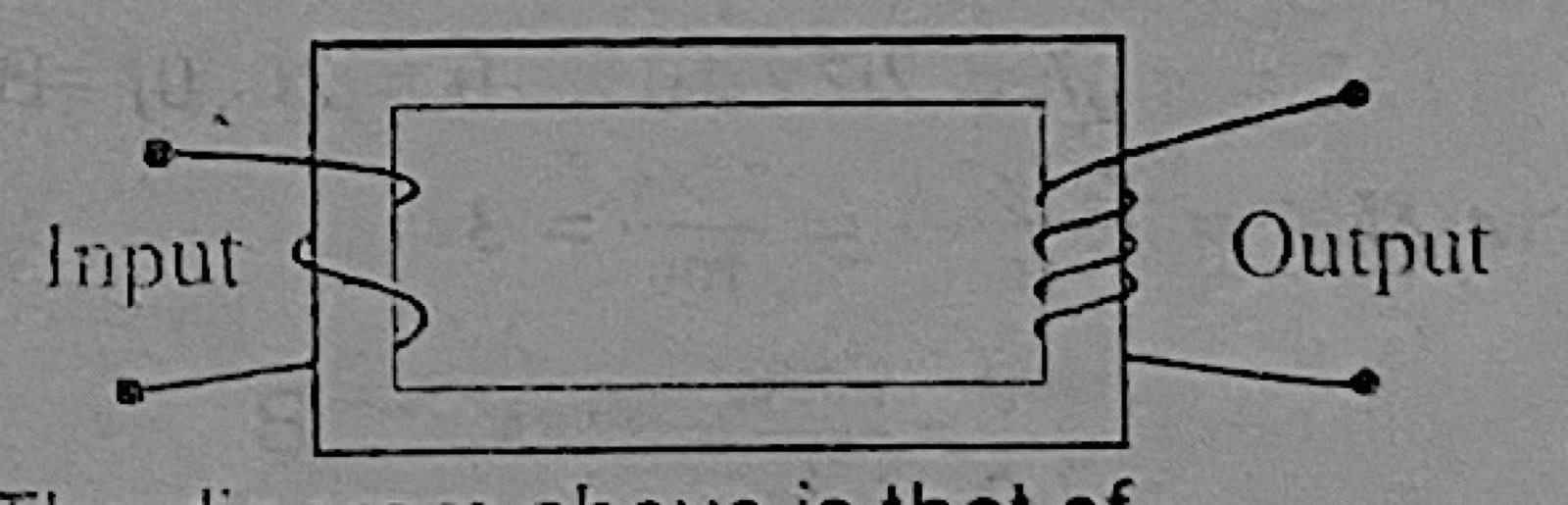
Question 42 Electromagnetic Induction Use the diagram above to answer this question. The diagram above is that of
A. a step-up transformer. B. a step-down transformer. C. an auto transformer. D. an oil transformer. Show the answer and explanation Answer: A (a step-up transformer. )
Explanation The output (secondary) coil has more turns than the input (primary) coil, so the transformer steps the voltage up.
Open this question
Question 43 Electromagnetic Induction Use the diagram above (the transformer) to answer this question. The electromotive force in the secondary winding is
A. increasing. B. reducing. C. stabilizing. D. varying. Show the answer and explanation Answer: A (increasing. )
Explanation With more turns on the secondary than on the primary, the e.m.f. induced in the secondary is larger than the input voltage (Vs /Vp = Ns /Np ).
Open this question
Question 44 Radioactivity and Nuclear Physics What type of reaction is represented by the equation 2 1 X + 2 1 X → 3 2 Y + 1 0 n + energy ?
A. Fusion. B. Fission. C. Chain. D. Ionization. Show the answer and explanation Answer: A (Fusion. )
Explanation Two light nuclei join to make a heavier nucleus and release energy. Joining of light nuclei is nuclear fusion.
Open this question
Question 45 Radioactivity and Nuclear Physics When an atom undergoes a beta decay, the atomic number of the nucleus
A. decreases by one. B. increases by one. C. becomes zero. D. remains unchanged. Show the answer and explanation Answer: B (increases by one. )
Explanation In beta decay a neutron changes into a proton and an electron is emitted, so the atomic number goes up by one.
Open this question
Question 46 Conduction through Liquids and Gases Calculate the mass of the copper deposited during electrolysis when a current of 4A passes through a copper salt for 2 hours. [ece of copper z=3.3 × 10⁻⁷ kgC−1 ]
A. 9.5 × 10⁻⁷ kg B. 9.5 × 10⁻³ kg C. 2.9 × 10⁻⁴ kg D. 2.9 × 10⁵ kg Show the answer and explanation Answer: B (9.5 × 10⁻³ kg )
Explanation m = zIt = 3.3 × 10−7 × 4 × 7200 ≈ 9.5 × 10⁻³ kg.
Open this question
Question 47 Conduction through Liquids and Gases Which gas produces a pink coloured light in a discharge tube?
A. Argon. B. Air. C. Neon. D. Mercury. Show the answer and explanation Answer: B (Air. )
Explanation Air (mainly nitrogen) in a discharge tube glows pinkish. Neon gives an orange-red glow and mercury a bluish one.
Open this question
Question 48 Radioactivity and Nuclear Physics When 210 82 Pb decays to 206 80 Pb, it emits
A. an apha particle. B. one beta particle. C. one alpha and one beta particle. D. two alpha and two beta particles. Show the answer and explanation Answer: A (an apha particle. )
Explanation The mass number falls by 4 and the atomic number by 2, which is exactly one alpha particle.
Open this question
Question 49 Electronics In a common emitter configuration, the output voltage is through the
A. base. B. collector. C. emitter. D. resistor. Show the answer and explanation Answer: B (collector. )
Explanation In the common-emitter arrangement the emitter is shared, the signal goes in at the base, and the amplified output is taken from the collector.
Open this question
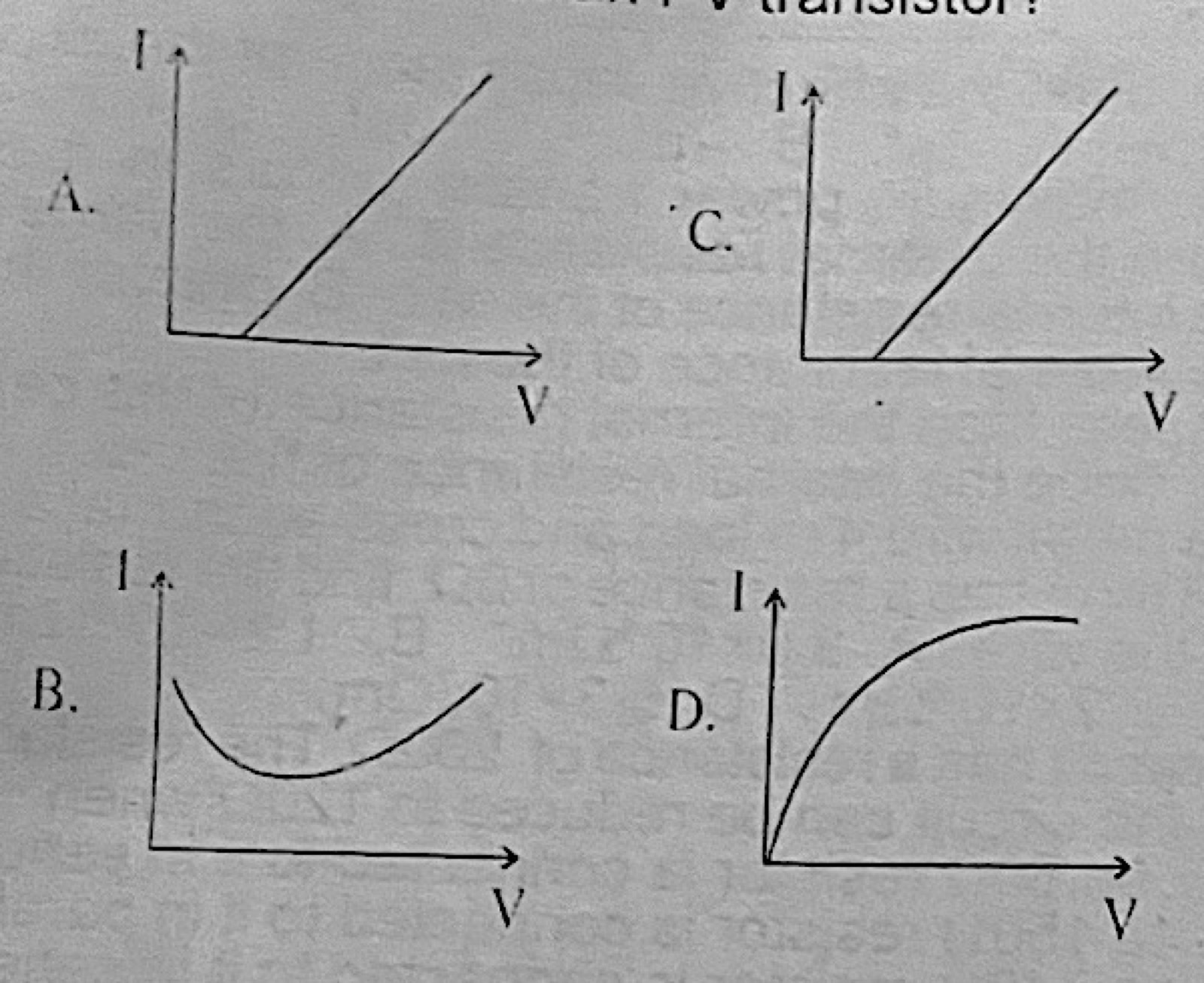
Question 50 Electronics Which of the graphs below shows the characteristics of an I-V transistor?
A. A B. B C. C D. D Show the answer and explanation Answer: D (D )
Explanation The output characteristic of a transistor (collector current against collector voltage) rises quickly at first and then becomes nearly flat, as in graph D.
Open this question Sign up free for every JAMB Physics year, practice by topic and timed mocks.
Start practising free