A load is pulled at a uniform speed along a horizontal floor by a rope at 45° to floor. If the force in the rope is 1500N, what is the frictional force on the load?
A.1524N
B.1350N
C.1260N
D.1061N.
Show the answer and explanation
Answer: D (1061N.)
Explanation
At uniform speed the horizontal pull equals the friction: F = 1500 cos 45° ≈ 1500 × 0.707 ≈ 1061 N.
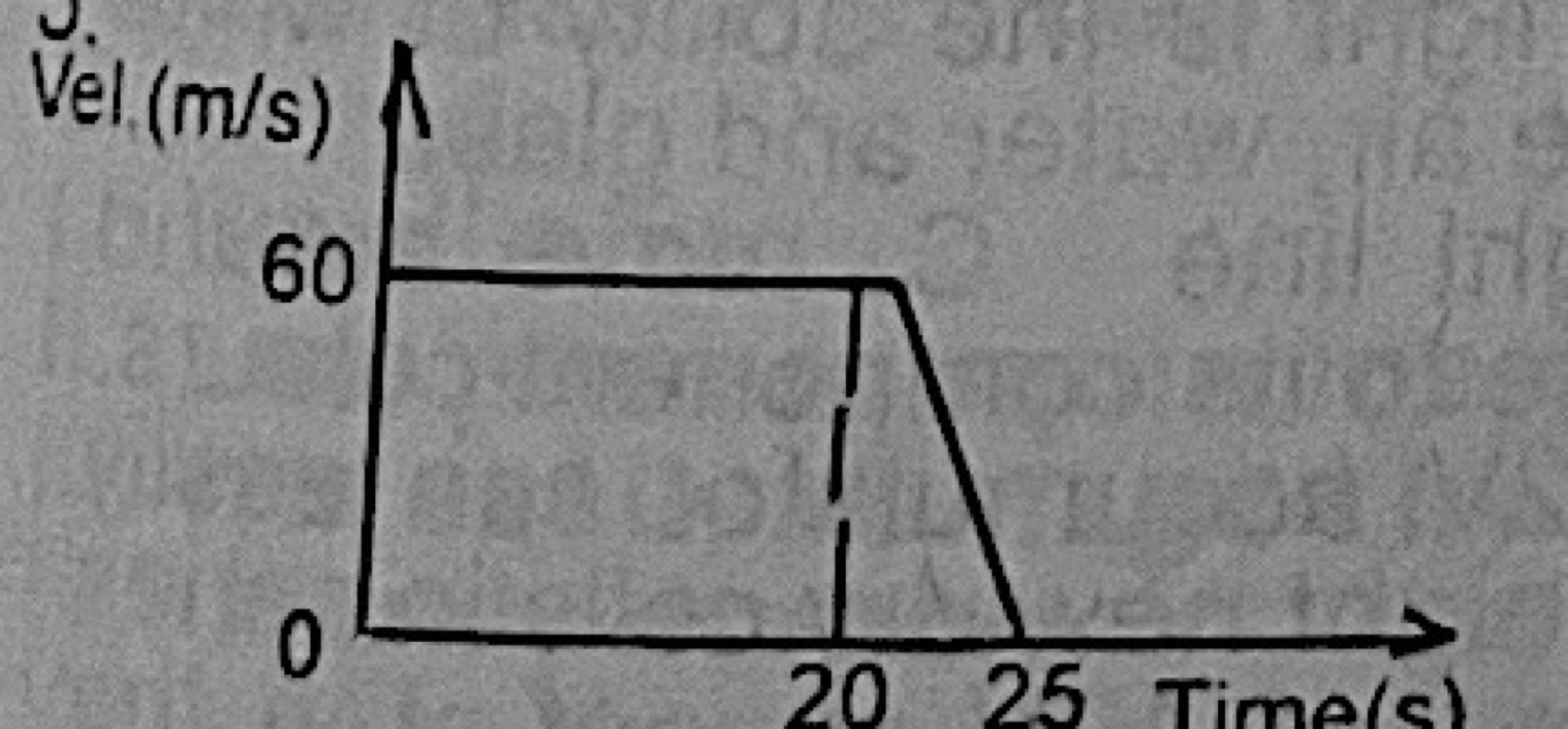
From the velocity-time graph shown above, which of the following quantities CANNOT be determined?
A.Deceleration
B.Initial velocity
C.Total distance travelled
D.Initial acceleration.
Show the answer and explanation
Answer: D (Initial acceleration.)
Explanation
The graph starts at 60 m s−1, so the initial velocity, the deceleration (slope from 20 s to 25 s) and the distance (area) can all be read. How the body reached 60 m s−1 is not shown, so its initial acceleration cannot be found.
If a freely suspended object is pulled to one side and released, it oscillates about the point of suspension because the
A.acceleration is directly proportional to the displacement
B.motion is directed away from the equilibrium point
C.acceleration is directly proportional to the square of the displacement
D.velocity is minimum at the equilibrium point.
Show the answer and explanation
Answer: A (acceleration is directly proportional to the displacement)
Explanation
The restoring force, and so the acceleration, is proportional to the displacement and directed back towards the equilibrium point. This is simple harmonic motion.
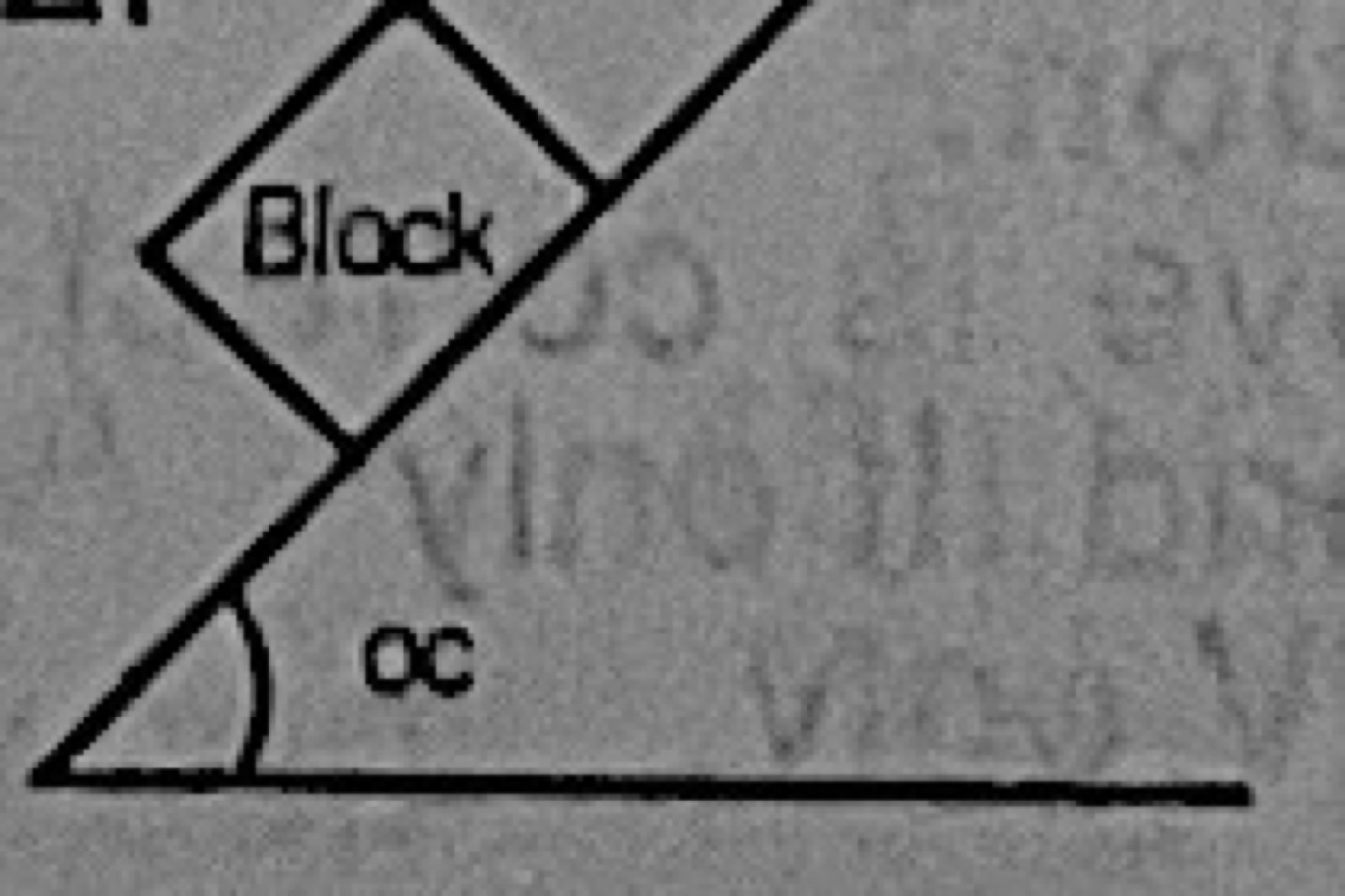
The diagram above shows a wooden block just about to slide down an inclined plane whose inclination to the horizontal is α. The coefficient of frictional force between the block and the plane is
A.sin α
B.tan α
C.cot α
D.cos α.
Show the answer and explanation
Answer: B (tan α)
Explanation
On the point of sliding, friction μmg cos α balances mg sin α, so μ = sin α/cos α = tan α.
A block and tackle is used to raise a load of 250N through a vertical distance of 30m. What is the efficiency of the system if the work done against friction is 1500J?
A.62.5%
B.73.3%
C.83.3%
D.94.3%.
Show the answer and explanation
Answer: C (83.3%)
Explanation
Useful work = 250 × 30 = 7500 J. Total work put in = 7500 + 1500 = 9000 J. Efficiency = 7500/9000 × 100% ≈ 83.3%.
The quantity of heat energy required to melt completely 1 kg of ice at −30°C is [latent heat of fusion = 3.5 × 10⁵ Jkg−1, specific heat capacity of ice = 2.1 × 10³ Jkg−1K−1]
A.4.13 × 106J
B.4.13 × 105J
C.3.56 × 104J
D.3.56 × 102J
Show the answer and explanation
Answer: B (4.13 × 10⁵J)
Explanation
Warm the ice to 0°C: 1 × 2100 × 30 = 63 000 J. Melt it: 1 × 3.5 × 105 = 350 000 J. Total = 413 000 J = 4.13 × 10⁵ J.
I. It is a rapid, constant and irregular motion of tiny particles. II. It gives evidence that tiny particles of matter called molecules exist. III. It takes place only in gases. IV. It gives evidence that molecules are in a constant state of random motion. Which of the combinations above is correct about Brownian motion?
A.I, II and III only
B.II, III and IV only
C.I, III and IV only
D.I, II and IV only.
Show the answer and explanation
Answer: D (I, II and IV only.)
Explanation
Brownian motion is the constant, irregular jiggling of tiny particles, which shows that molecules exist and are always moving. It happens in liquids as well as gases, so III is false.
Which of the following factors will affect the velocity of sound?
A.An increase in the pitch of the sound.
B.An increase in the loudness of the sound.
C.Wind travelling in the same direction of the sound
D.A change in the atmospheric pressure constant temperature.
Show the answer and explanation
Answer: C (Wind travelling in the same direction of the sound)
Explanation
Wind carries the air along, so sound moving with the wind travels faster relative to the ground. Pitch, loudness and pressure (at constant temperature) do not change the speed.
A pinhole camera is placed 300m in front of a building so that the image is formed on a screen 5cm from the pinhole. If the image is 2.5cm high, the height of the building will be
A.25m
B.50m
C.100m
D.150m.
Show the answer and explanation
Answer: D (150m.)
Explanation
Object height ÷ image height = object distance ÷ image distance = 300 m ÷ 0.05 m = 6000. Building height = 0.025 m × 6000 = 150 m.
I. Rays of light travel from a less dense medium to a denser medium. II. The Angle of incidence is greater than critical angle. III. Rays of light travel from a denser medium to a less dense medium. Which of the statements above are conditions for total internal reflection to occur?
A.I & II only
B.I & III only
C.II & III only
D.II only.
Show the answer and explanation
Answer: C (II & III only)
Explanation
Total internal reflection needs light going from a denser to a less dense medium, at an angle of incidence greater than the critical angle.
A newly charged 12V accumulator can easily start a car whereas eight new dry cells in series with an effective e.m.f. of 12V cannot start the same car because
A.the current capacity is high
B.the current capacity is low
C.it cannot be re-charged
D.it cannot easily be connected to a car.
Show the answer and explanation
Answer: B (the current capacity is low)
Explanation
Dry cells have a high internal resistance and a low current capacity, so they cannot supply the very large current a starter motor needs.
A particle carrying a charge of 1.0 × 10⁻⁸C enters a magnetic field at 3.0 × 10² ms−1 at right angles to the field. If the force on this particle is 1.8 × 10⁻⁸ N, what is the magnitude of the field?
A.6.0 × 10−1T
B.6.0 × 10−2T
C.6.0 × 10−3T
D.6.0 × 10−4T.
Show the answer and explanation
Answer: C (6.0 × 10⁻³T)
Explanation
F = Bqv, so B = F/(qv) = 1.8 × 10⁻⁸ ÷ (1.0 × 10−8 × 3.0 × 102) = 6.0 × 10⁻³ T.
A conductor of length 1m moves with a velocity of 50ms−1 at an angle of 30° to the direction of a uniform magnetic field of flux density 1.5Wbm−2. What is the e.m.f. induced in the conductor?
The process of detecting a pin mistakenly swallowed by a child is x - ray
A.diagnosis
B.therapy
C.crystallography
D.mammography.
Show the answer and explanation
Answer: A (diagnosis)
Explanation
Taking an X-ray picture to find something inside the body is X-ray diagnosis. Therapy treats disease, crystallography studies crystals and mammography examines breasts.
I. Small size. II. Low power requirement III. Not easily damaged by high temperature IV. Highly durable. Which of the above are the advantages of semiconductors?
A.I, II and III only
B.II, III and IV only
C.I, II and IV only
D.I, II, III and IV.
Show the answer and explanation
Answer: C (I, II and IV only)
Explanation
Semiconductor devices are small, use little power and last a long time. However, they are easily damaged by heat, so III is not an advantage.