Question 2
Number BasesConvert 2710 to another number in base three.
- A.11003
- B.10003
- C.10013
- D.10103
Show the answer and explanation
Answer: B (10003)
Explanation
27 = 33, so in base three it is 10003.
36 questions. Try each one, then open the answer to check yourself and read the explanation.
Convert 2710 to another number in base three.
Answer: B (10003)
27 = 33, so in base three it is 10003.
3 girls share a number of apples in the ratio 5:3:2. If the highest share is 40 apples, find the smallest share.
Answer: A (16)
The highest share is 5 parts = 40, so 1 part = 8. The smallest share is 2 parts = 16.
Evaluate (1.25 × 0.025)/0.05, correct to 1 decimal place.
Answer: C (0.6)
1.25 × 0.025 = 0.03125, and 0.03125 ÷ 0.05 = 0.625, which is 0.6 to 1 decimal place.
Calculate the time taken for N3000 to earn N600 if invested at 8% simple interest.
Answer: C (2½ years)
T = 100I/(PR) = 100 × 600/(3000 × 8) = 2.5 years.
Simplify 3−5n/91−n × 27n+1
Answer: B (3)
In powers of 3: 3−5n ÷ 32 − 2n × 33n + 3 = 3−5n − 2 + 2n + 3n + 3 = 31 = 3.
If log104 = 0.6021, evaluate log104⅓
Answer: B (0.2007)
log 4⅓ = ⅓ log 4 = 0.6021 ÷ 3 = 0.2007.
Simplify: √5(√147 − √12)/√15
Answer: C (5)
√147 = 7√3 and √12 = 2√3, so the top is √5 × 5√3 = 5√15. Dividing by √15 gives 5.
P, Q and R are subsets of the universal set U. The venn diagram showing the relationship (P∩Q)∪R is
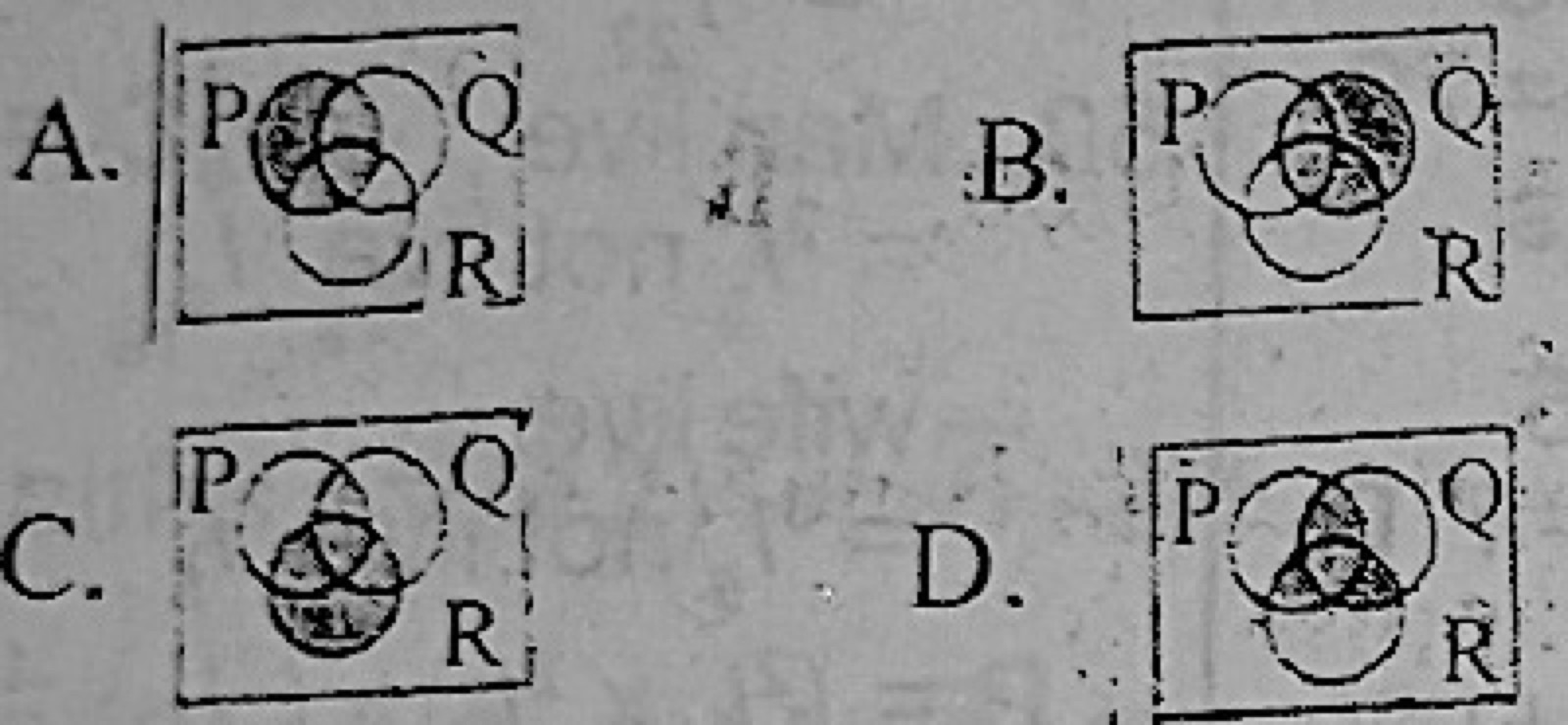
Answer: C (Diagram C)
(P ∩ Q) ∪ R is all of circle R together with the overlap of P and Q. Diagram C shades this region.
If P = {x: x is odd, −1 < x ≤ 20} and Q = {y: y is prime; −2 < y ≤ 25}, find P∩Q.
Answer: A ({3,5,7,11,13,17,19})
P = {1, 3, 5, ..., 19} and Q = {2, 3, 5, 7, 11, 13, 17, 19, 23}. The odd primes up to 19 are in both: {3, 5, 7, 11, 13, 17, 19}.
If S = √(t2 − 4t + 4), find t in terms of S.
Answer: D (S + 2)
t2 − 4t + 4 = (t − 2)2, so S = t − 2 (taking t ≥ 2) and t = S + 2.
If x − 4 is a factor of x2 − x − k, then k is
Answer: D (12)
By the factor theorem, x = 4 gives 16 − 4 − k = 0, so k = 12.
The remainder when 6p3 − p2 − 47p + 30 is divided by p − 3 is
Answer: D (42)
Put p = 3: 162 − 9 − 141 + 30 = 42.
P varies jointly as m and u, and varies inversely as q. Given that p = 4, m = 3 and u = 2 when q = 1, find the value of p when m = 6, u = 4 and q = 8/5.
Answer: A (10)
p = kmu/q: 4 = 6k, so k = 2/3. Then p = (2/3 × 6 × 4) ÷ 8/5 = 16 × 5/8 = 10.
If r varies inversely as the square root of s and t, how does s vary with r and t?
Answer: D (s varies inversely as r2 and t.)
r = k/√(st), so r2 = k2/(st) and s = k2/(r2t): s varies inversely as r2 and t.
Evaluate 3(x + 2) > 6(x + 3)
Answer: A (x < −4)
3x + 6 > 6x + 18 gives −3x > 12, so x < −4 (the sign flips when dividing by −3).
If the sum of the first two terms of a G.P. is 3 and the sum of the second and the third terms is −6, find the sum of the first term and the common ratio.
Answer: A (−5)
a(1 + r) = 3 and ar(1 + r) = −6, so r = −2. Then a(−1) = 3 and a = −3. a + r = −5.
The nth term of the progression 4/2, 7/3, 10/4, 13/5, ... is
Answer: D ((3n + 1)/(n + 1))
The numerators 4, 7, 10, 13 are 3n + 1 and the denominators 2, 3, 4, 5 are n + 1, so the nth term is (3n + 1)/(n + 1).
If a binary operation * is defined by x * y = x + 2y, find 2*(3*4)
Answer: C (24)
3 * 4 = 3 + 8 = 11, then 2 * 11 = 2 + 22 = 24.
If P = (5 3; 2 1) and Q = (4 2; 3 5), find 2P + Q. (Matrices written row by row.)
Answer: D ((14 8; 7 7))
2P = (10 6; 4 2). Adding Q: (14 8; 7 7).
Find the inverse of (5 3; 6 4). (Matrices written row by row.)
Answer: D ((2 −3/2; −3 5/2))
The determinant is 20 − 18 = 2. Swap the diagonal and change the other signs, then halve: ½(4 −3; −6 5) = (2 −3/2; −3 5/2).
In the diagram above, find the value of x.
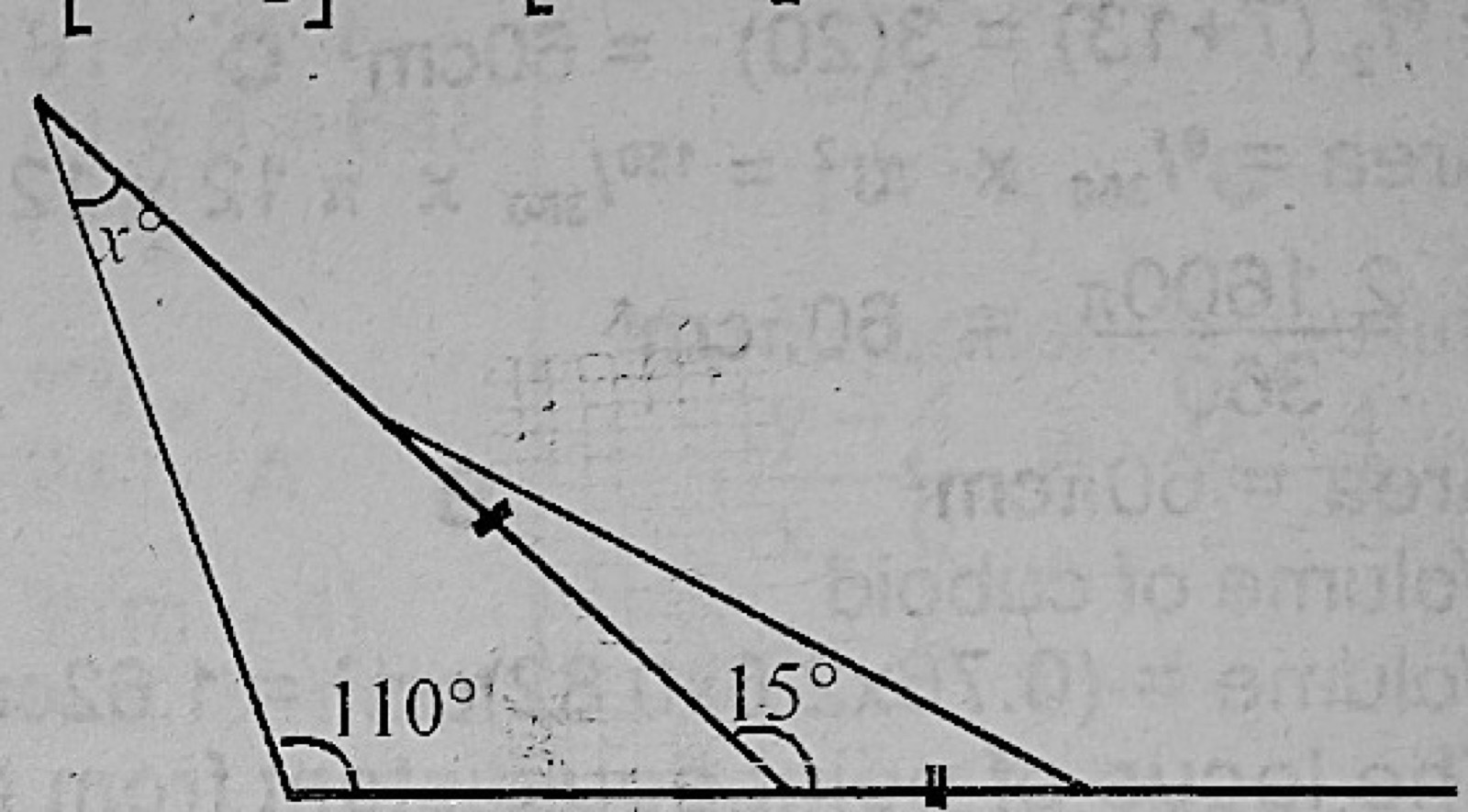
Answer: D (40°)
The marked equal sides make the small triangle isosceles, so both its base angles are 15° and its exterior angle is 30°. In the big triangle, x = 180° − 110° − 30° = 40°.
Find the length of a chord which subtends an angle of 90° at the centre of a circle whose radius is 8cm.
Answer: D (8√2 cm)
The two radii and the chord form a right-angled triangle, so chord = √(82 + 82) = 8√2 cm.
The locus of the points which is equidistant from the line PQ forms a
Answer: D (pair of parallel lines to PQ.)
All points a fixed distance from a straight line lie on two lines parallel to it, one on each side. So the locus is a pair of parallel lines to PQ.
If the mid point of the line PQ is (2,3) and the point P is (−2,1), find the coordinate of the point Q.
Answer: D ((6,5))
Q = (2 × 2 − (−2), 2 × 3 − 1) = (6, 5).
Find the equation of the perpendicular bisector of the line joining P(2, −3) to Q(−5, 1)
Answer: C (8y − 14x − 13 = 0)
The midpoint is (−3/2, −1) and PQ has gradient −4/7, so the bisector has gradient 7/4: y + 1 = 7/4 (x + 3/2). Multiplying by 8 gives 8y − 14x − 13 = 0.
In triangle PQR, q = 8 cm, r = 6cm and Cos P = 1/12. Calculate the value of p.
Answer: C (√92 cm)
Cosine rule: p2 = 64 + 36 − 2 × 8 × 6 × 1/12 = 100 − 8 = 92, so p = √92 cm.
If tan θ = 3/4, find the value of sin θ + cos θ.
Answer: D (1⅖)
A 3-4-5 triangle gives sin θ = 3/5 and cos θ = 4/5, so the sum is 7/5 = 1⅖.
The radius of a circle is increasing at the rate of 0.02 cms−1. Find the rate at which the area is increasing when the radius of the circle is 7 cm.
Answer: B (0.88cm2s−1)
dA/dt = 2πr × dr/dt = 2 × 22/7 × 7 × 0.02 = 0.88 cm2/s.
Integrate ((1 + x)/x3) dx.
Answer: B (−1/(2x2) − 1/x + k)
Split as x−3 + x−2. Integrating gives −x−2/2 − x−1 + k = −1/(2x2) − 1/x + k.
Find the mean of t + 2, 2t − 4, 3t + 2 and 2t.
Answer: D (2t)
The sum is 8t and there are 4 terms, so the mean is 2t.
The mean of seven numbers is 10. If six of the numbers are 2, 4, 8, 14, 16 and 18, find the mode.
Answer: D (8)
The seven numbers total 70 and the six given add to 62, so the seventh is 8. Then 8 appears twice, making it the mode.
If the variance of 3 + x, 6, 4, x, and 7 − x is 4 and the mean is 5, find the standard deviation.
Answer: D (2)
The standard deviation is the square root of the variance: √4 = 2.
Score: 3, 4, 5, 6, 7, 8, 9, 10
Frequency: 1, 0, 7, 5, 2, 3, 1, 1
The table above shows the scores of 20 students in Further Mathematics test. What is the range of the distribution?
Answer: C (7)
Range = highest score − lowest score = 10 − 3 = 7.
In how many ways can a student select 2 subjects from 5 subjects?
Answer: A (5!/(2!3!))
Choosing 2 from 5 when order does not matter is 5C2 = 5!/(2! 3!).
In how many ways can three seats be occupied if 5 people are willing to sit?
Answer: C (60)
Order matters on the seats: 5P3 = 5 × 4 × 3 = 60.
A basket contains 9 apples, 8 bananas and 7 oranges. A fruit is picked from the basket, find the probability that it is neither an apple nor orange.
Answer: D (1/3)
"Neither an apple nor an orange" means a banana: 8 out of 24 fruits, so 8/24 = 1/3.