Question 2
Number BasesConvert 726 to a number in base three.
- A.2211
- B.2121
- C.1212
- D.1122
Show the answer and explanation
Answer: D (1122)
Explanation
726 = 7 × 6 + 2 = 44. Dividing 44 repeatedly by 3 gives remainders 2, 2, 1, 1, so 44 = 11223.
44 questions. Try each one, then open the answer to check yourself and read the explanation.
Convert 726 to a number in base three.
Answer: D (1122)
726 = 7 × 6 + 2 = 44. Dividing 44 repeatedly by 3 gives remainders 2, 2, 1, 1, so 44 = 11223.
Simplify (2⅔ × 1½)/4⅘
Answer: C (5/6)
2⅔ × 1½ = 8/3 × 3/2 = 4, and 4 ÷ 24/5 = 4 × 5/24 = 5/6.
Evaluate 21/9 to 3 significant figures.
Answer: D (2.33)
21 ÷ 9 = 2.333..., which is 2.33 to 3 significant figures.
A man earns N3 500 per month out of which he spends 15% on his children's education. If he spends additional N1 950 on food, how much does he have left?
Answer: B (N1 025)
Education costs 15% of 3500 = N525. With N1,950 on food he spends N2,475, leaving 3500 − 2475 = N1,025.
If log3x2 = −8, what is x?
Answer: D (1/81)
x2 = 3−8, so x = 3−4 = 1/81.
Simplify (√6 + 2)2 − (√6 − 2)2
Answer: C (8√6)
Difference of two squares: [(√6 + 2) + (√6 − 2)][(√6 + 2) − (√6 − 2)] = 2√6 × 4 = 8√6.
If P is a set of all prime factors of 30 and Q is a set of all factors of 18 less than 10, find P∩Q.
Answer: B ({2,3})
P = {2, 3, 5} and Q = {1, 2, 3, 6, 9}. The common elements are 2 and 3.
In a class of 46 students, 22 play football and 26 play volleyball. If 3 students play both games how many play neither?
Answer: A (1)
At least one game: 22 + 26 − 3 = 45. Neither: 46 − 45 = 1.
Make n the subject of the formula if w = v(2 + cn)/(1 − cn)
Answer: A ((1/c)((w − 2v)/(v + w)))
w − cnw = 2v + cnv, so w − 2v = cn(v + w) and n = (w − 2v)/(c(v + w)).
Find the remainder when 2x3 − 11x2 + 8x − 1 is divided by x + 3.
Answer: D (−178)
Put x = −3: 2(−27) − 11(9) + 8(−3) − 1 = −54 − 99 − 24 − 1 = −178.
Solve for x and y in the equations below.
x2 − y2 = 4
x + y = 2
Answer: C (x = 2, y = 0)
x2 − y2 = (x + y)(x − y), so 2(x − y) = 4 and x − y = 2. With x + y = 2, x = 2 and y = 0.
If y varies directly as √n and y = 4 when n = 4, find y when n = 1 7/9.
Answer: C (8/3)
y = k√n: 4 = 2k, so k = 2. n = 16/9 gives √n = 4/3, so y = 8/3.
U is inversely proportional to the cube of V and U = 81 when V = 2. Find U when V = 3.
Answer: A (24)
U = k/V3: k = 81 × 8 = 648. When V = 3, U = 648/27 = 24.
The value of y for which (1/5)y + 1/5 < (1/2)y + 2/5 is
Answer: C (y > −2/3)
Multiply by 10: 2y + 2 < 5y + 4, so −3y < 2 and y > −2/3.
Find the range of values of m which satisfy (m − 3)(m − 4) < 0.
Answer: C (3 < m < 4)
The product of (m − 3) and (m − 4) is negative only when m lies between the roots 3 and 4.
The shaded region above is represented by the equation
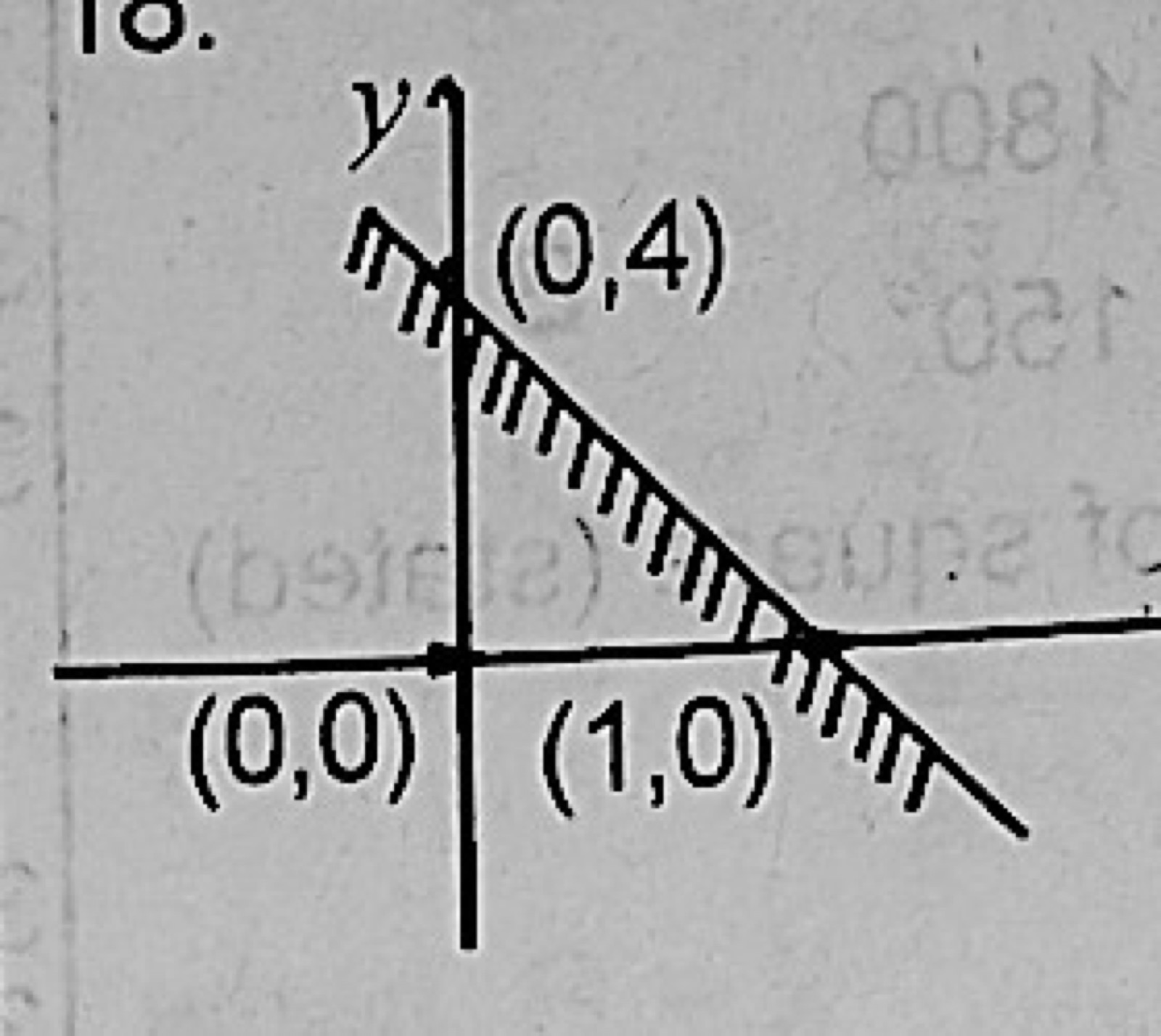
Answer: C (y ≤ −4x + 4)
The line through (0, 4) and (1, 0) is y = −4x + 4. The region on the origin side is below it, so y ≤ −4x + 4.
The nth term of a sequence is n2 − 6n − 4. Find the sum of the 3rd and 4th terms.
Answer: D (−25)
T3 = 9 − 18 − 4 = −13 and T4 = 16 − 24 − 4 = −12, so the sum is −25.
The sum to infinity of a geometric progression is −1/10 and the first term is −1/8. Find the common ratio of the progression.
Answer: B (−1/4)
−1/10 = (−1/8)/(1 − r), so 1 − r = 10/8 and r = −1/4.
The binary operation * is defined on the set of integers such that p * q = pq + p − q. Find 2*(3*4).
Answer: B (13)
3 * 4 = 12 + 3 − 4 = 11. Then 2 * 11 = 22 + 2 − 11 = 13.
A binary operation on the set of real numbers is defined by m * n = mn/2 for all m, n ∈ R. If the identity element is 2, find the inverse of −5.
Answer: A (−4/5)
The inverse a satisfies −5a/2 = 2, so a = −4/5.
Given that I3 is a unit matrix of order 3, find |I3|.
Answer: C (1)
The unit matrix has 1s on the diagonal and 0s elsewhere, so its determinant is 1 × 1 × 1 = 1.
In the diagram above, QR//TU, ∠PQR = 80° and ∠PSU = 95°. Calculate ∠SUT.
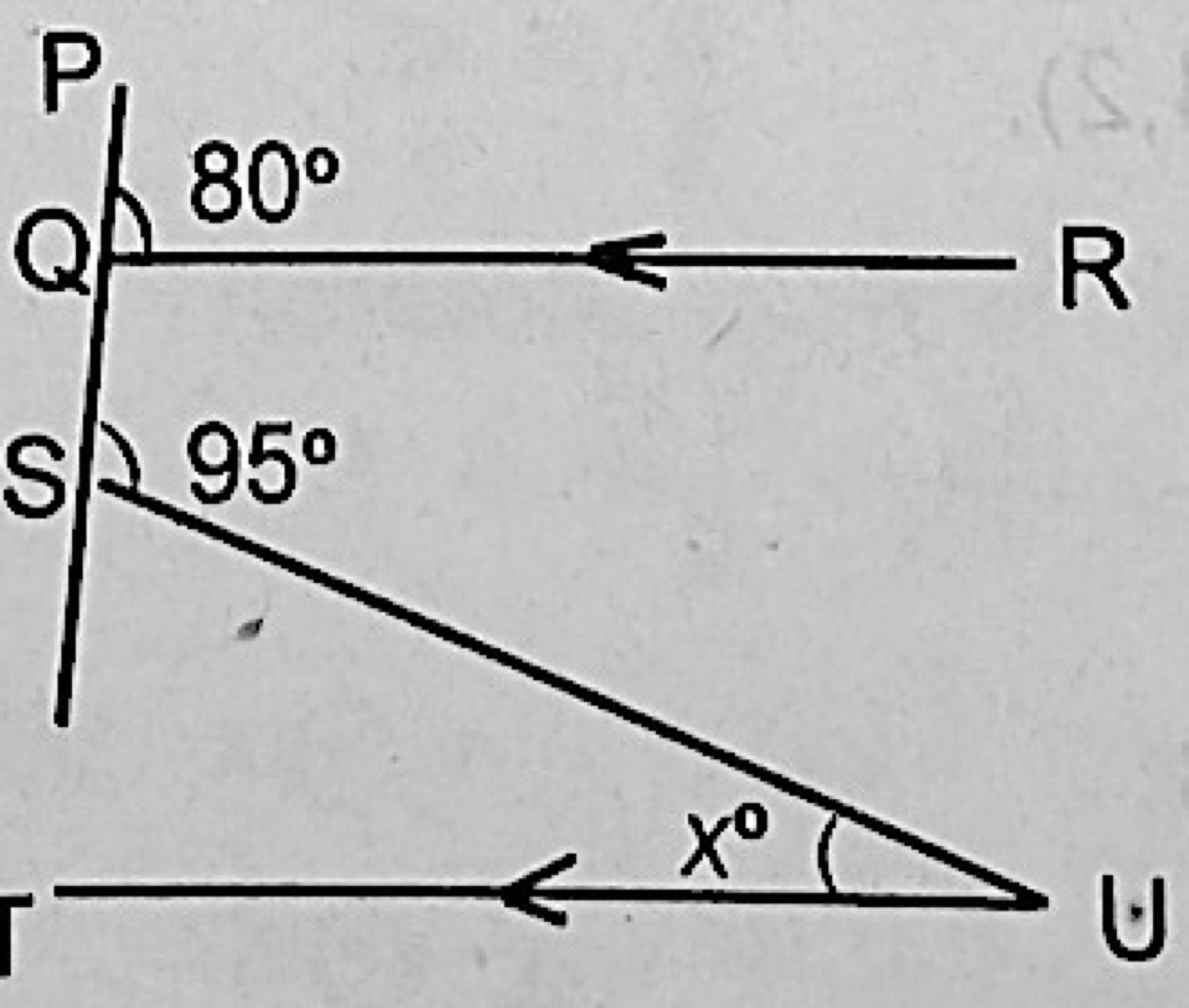
Answer: A (15°)
∠STU = ∠PQR = 80° (corresponding angles) and ∠TSU = 180° − 95° = 85°. In triangle STU, x = 180° − 80° − 85° = 15°.
The angles of a polygon are given by x, 2x, 3x, 4x and 5x respectively. Find the value of x.
Answer: D (36°)
Five angles make a pentagon, whose angles add to 540°: 15x = 540, so x = 36°.
In the diagram above, PQR is a circle centre O. If ∠QPR is x°, find ∠QRP.
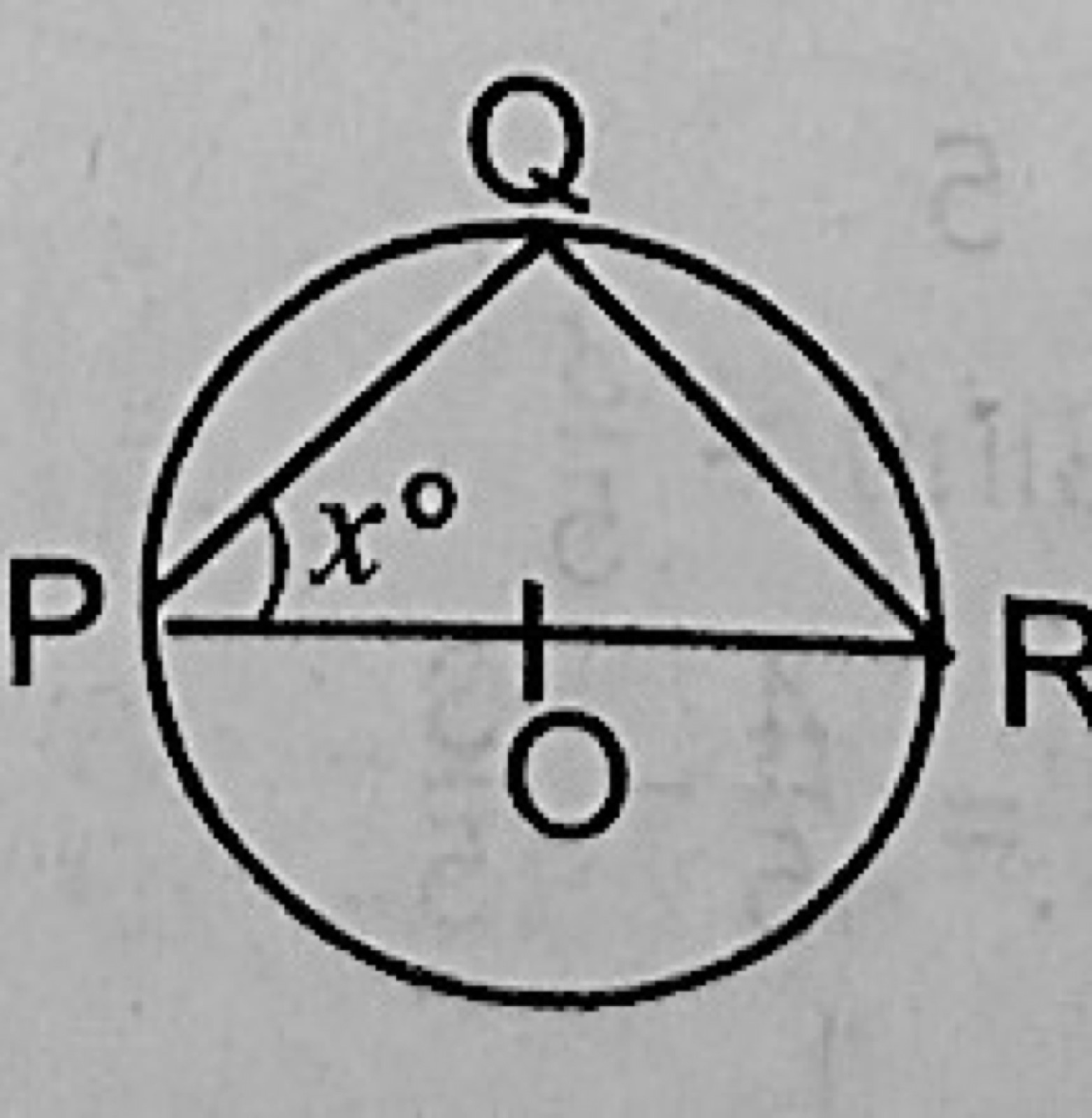
Answer: B ((90 − x)°)
PR passes through O, so it is a diameter and ∠PQR = 90°. The angles of triangle PQR add to 180°, so ∠QRP = 90° − x.
Find the area of the trapezium above.
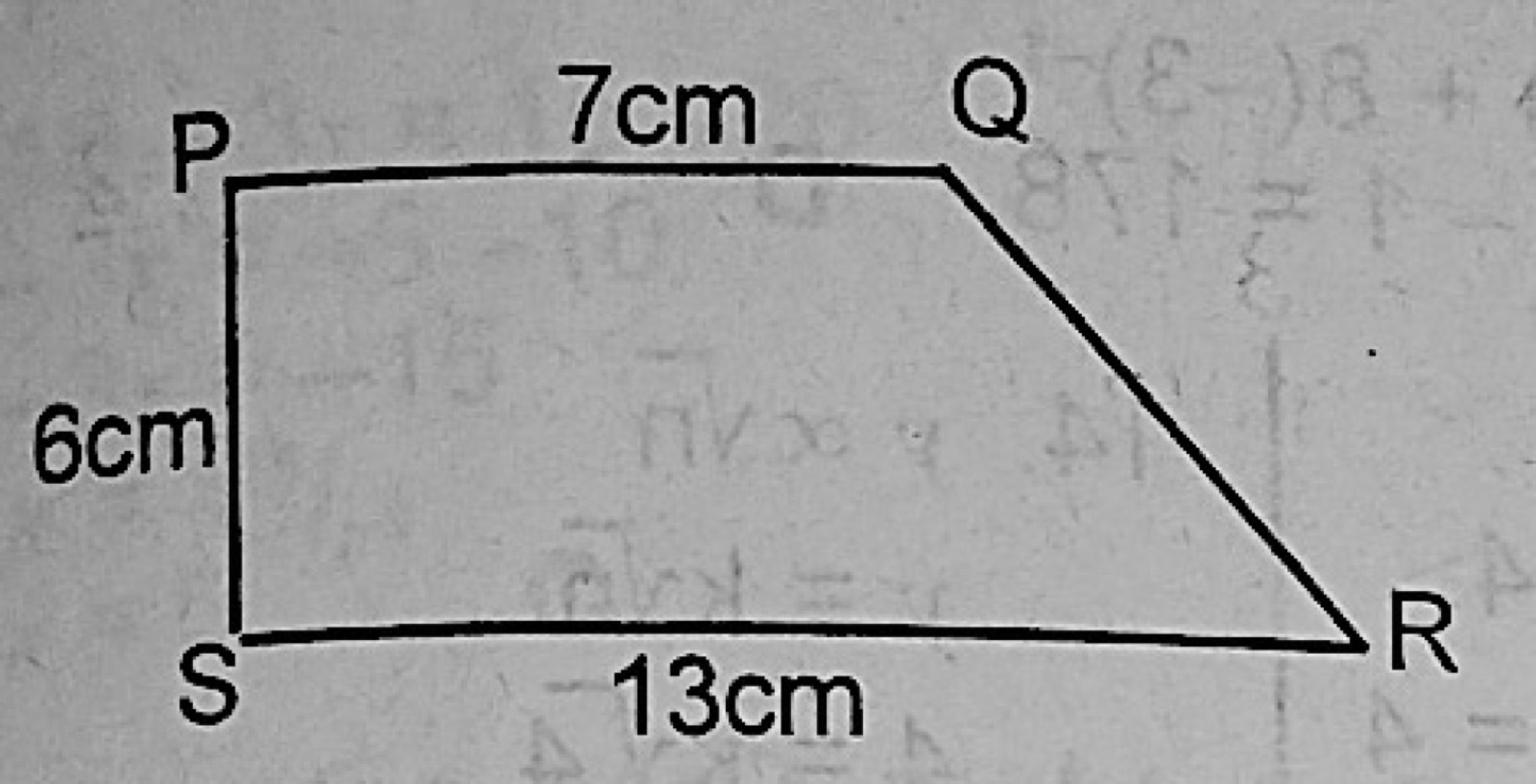
Answer: C (60 cm2)
Area = ½ × (7 + 13) × 6 = 60 cm2.
A circular arc subtends angle 150° at the centre of a circle of radius 12 cm. Calculate the area of the sector of the arc.
Answer: B (60π cm2)
Area = 150/360 × π × 144 = 60π cm2.
Calculate the volume of a cuboid of length 0.76 cm, breadth 2.6 cm and height 0.82cm.
Answer: D (1.62 cm3)
Volume = 0.76 × 2.6 × 0.82 ≈ 1.62 cm3.
The locus of a point equidistant from the intersection of lines 3x − 7y + 7 = 0 and 4x − 6y + 1 = 0 is a
Answer: B (circle)
Points at a fixed distance from one point (here the intersection of the two lines) form a circle centred at that point.
The gradient of the straight line joining the points P(5,−7) and Q(−2,−3) is
Answer: C (−4/7)
Gradient = (−3 + 7)/(−2 − 5) = 4/(−7) = −4/7.
The distance between the point (4,3) and the intersection of y = 2x + 4 and y = 7 − x is
Answer: B (3√2)
2x + 4 = 7 − x gives x = 1, y = 6. Distance from (4, 3) = √(32 + 32) = √18 = 3√2.
Find the equation of the line through the points (−2,1) and (−½,4).
Answer: B (y = 2x + 5)
Gradient = (4 − 1)/(−½ + 2) = 3/1.5 = 2. Then y − 1 = 2(x + 2), so y = 2x + 5.
If angle θ is 135°, evaluate cos θ.
Answer: C (−√2/2)
cos 135° = −cos 45° = −√2/2.
A man stands on a tree 150 cm high and sees a boat at an angle of depression of 74°. Find the distance of the boat from the base of the tree.
Answer: B (43cm)
The angle of elevation from the boat is 74°, so distance = 150/tan 74° ≈ 150/3.487 ≈ 43cm.
Find dy/dx if y = cos x.
Answer: B (−sin x)
The derivative of cos x is −sin x.
Evaluate ∫12 (x2 − 4x) dx
Answer: D (−11/3)
[x3/3 − 2x2] from 1 to 2 = (8/3 − 8) − (1/3 − 2) = 7/3 − 6 = −11/3.
Evaluate ∫0π/4 sec2θ dθ
Answer: A (1)
∫sec2θ dθ = tan θ. From 0 to π/4: tan 45° − tan 0 = 1.
The bar chart above shows the distribution of marks in a class test. If the pass mark is 5, what percentage of the students failed the test?
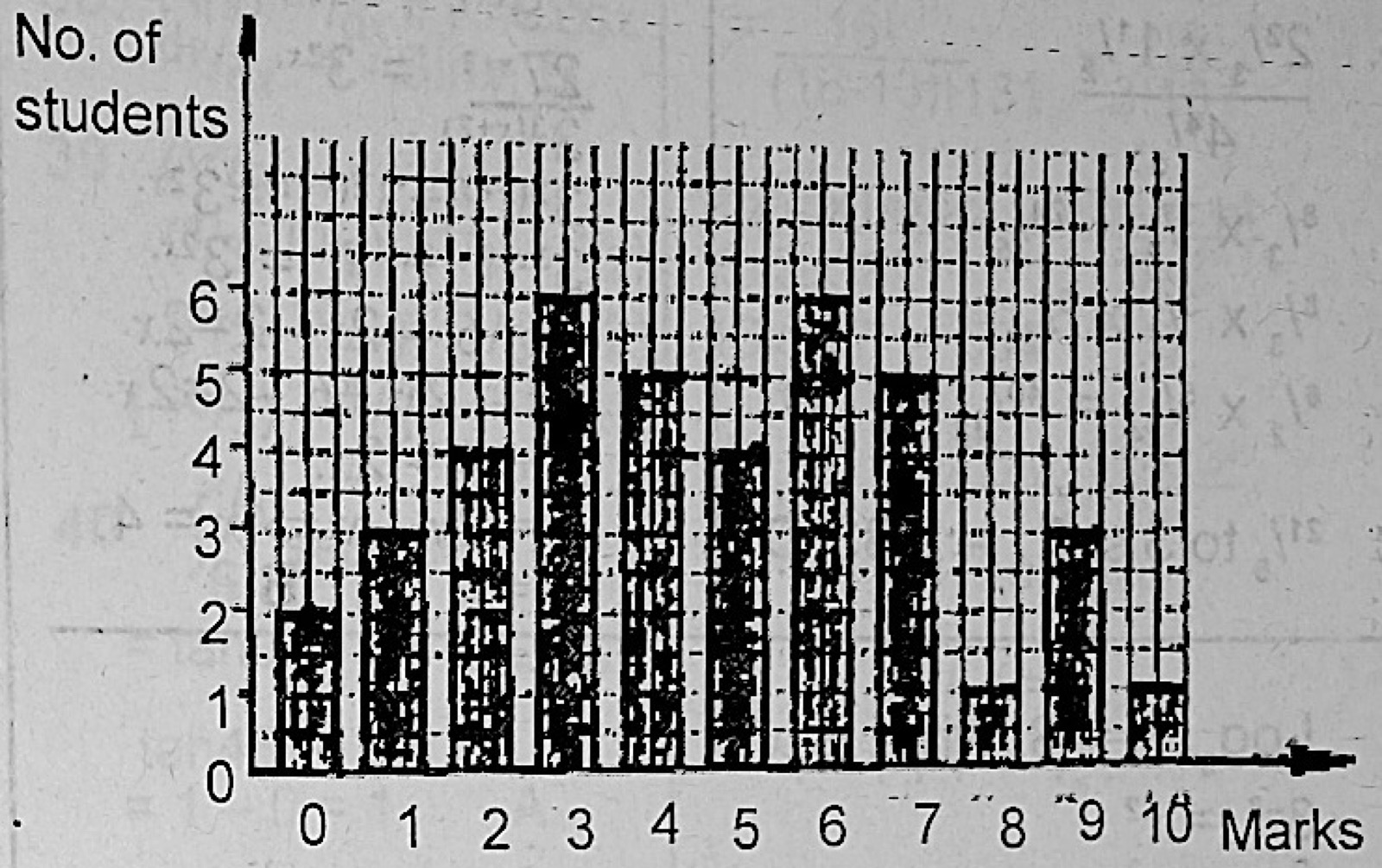
Answer: C (50%)
The bars total 40 students. Those scoring below 5 (marks 0 to 4) number 2 + 3 + 4 + 6 + 5 = 20, which is 50%.
The mean of seven numbers is 96. If an eighth number is added, the mean becomes 112. Find the eighth number.
Answer: D (224)
The seven numbers total 672 and the eight total 896, so the eighth number is 224.
Find the median of 2,3,7,3,4,5,8,9,9,4,5,3,4,2,4 and 5.
Answer: D (4)
In order: 2, 2, 3, 3, 3, 4, 4, 4, 4, 5, 5, 5, 7, 8, 9, 9. The 8th and 9th values are both 4, so the median is 4.
Find the range of 4,9,6,3,2,8,10 and 11.
Answer: B (9)
Range = 11 − 2 = 9.
Evaluate n+1Cn−2 if n = 15.
Answer: D (560)
16C13 = 16C3 = (16 × 15 × 14)/6 = 560.
In how many ways can the letters of the word TOTALITY be arranged?
Answer: A (6720)
TOTALITY has 8 letters with T three times, so 8!/3! = 40320/6 = 6720.
The probability that a student passes a Physics test is 2/3. If he takes three Physics tests, what is the probability that he passes two of the tests?
Answer: A (4/9)
Exactly two passes can happen in 3 orders, each with probability (2/3)(2/3)(1/3) = 4/27. Total = 3 × 4/27 = 4/9.
The probabilities that a man and his wife live for 80 years are 2/3 and 3/5 respectively. Find the probability that at least one of them will live up to 80 years.
Answer: D (13/15)
P(neither) = 1/3 × 2/5 = 2/15, so P(at least one) = 1 − 2/15 = 13/15.